I never expected to find my boss, the woman who had made my life miserable for three years, sobbing on my doorstep at two in the morning with mascara streaking down her face.
But that was exactly where Victoria Winters stood.
She was leaning against the hallway wall outside my apartment, one hand pressed to her stomach, the other gripping her phone like it was the only thing keeping her attached to the world. 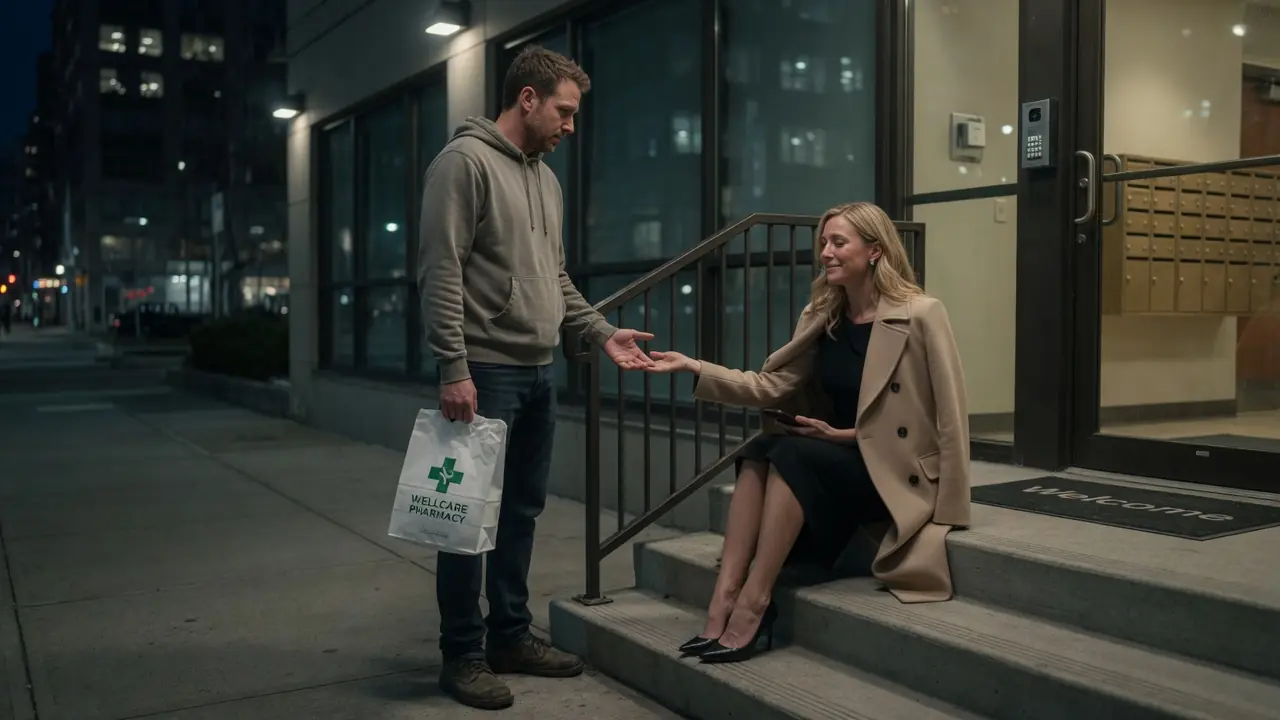
Her designer coat was soaked from the rain. Her usually perfect blonde hair had come loose from its bun. Her white blouse was stained with red wine, and one of her heels was missing.
For a few seconds, I could only stare at her.
This was not the Victoria Winters I knew.
The Victoria Winters I knew did not cry. She did not stumble. She did not ask. She ordered. She corrected. She cut people down with a tone so sharp it could make an entire conference room sit straighter.
At Reynolds Marketing Agency, she was not just my boss.
She was the storm everyone checked the forecast for.
And for three years, most of that storm had landed on me.
“Mark,” she whispered.
Her voice sounded broken.
Not dramatic.
Not drunk and loud.
Broken.
Then she said something I had never heard her say before.
“Please help me.”
Behind me, from the living room, my eight-year-old daughter Lily called out sleepily, “Daddy? Who is it?”
I turned my head slightly.
“Stay on the couch, sweetheart.”
Victoria looked past me, and shame crossed her face so quickly that it almost made her look younger.
“I’m sorry,” she said. “I didn’t know where else to go.”
Those words should not have mattered.
Not after everything she had done.
Not after the late nights she had forced on me, the weekends she had taken, the school events she had made me miss, the way she once told me, in front of three junior employees, that my “single-dad chaos” was not a business strategy.
Not after Lily’s recital.
Especially not after Lily’s recital.
One month earlier, Lily had stood on a school auditorium stage wearing a yellow dress and white tights, searching the crowd for me while I sat in a conference room across town because Victoria had decided the Dalton account needed a revised strategy deck by morning.
When I asked to leave early, she looked at me over the rim of her glasses and said, “Your daughter will survive one recital without you. This client may not survive one bad presentation.”
Lily had survived.
I was not sure I had.
And now that same woman stood outside my door at two in the morning, soaked, humiliated, and shaking.
My phone buzzed again on the table behind me.
It had been buzzing for almost an hour.
Five missed calls.
Three texts.
The last one had said:
Please help. I’m in trouble.
I had almost ignored it.
I should have ignored it.
But there she was.
I opened the door wider.
“Come in.”
Victoria blinked.
As if she had expected me to shut the door.
As if some part of her believed she deserved that.
“Mark, I…”
“Come inside before you wake the whole floor.”
She stepped in carefully, like my modest apartment was more intimidating than any boardroom she had ever entered.
My apartment was small. Two bedrooms. A narrow kitchen. A living room with a couch that had one sagging cushion and a coffee table covered in Lily’s coloring books, crayons, library books, and the half-finished manuscript of a storybook I had been writing for her birthday.
It was not impressive.
It was home.
Lily was sitting upright on the couch under her blanket, eyes wide, dark curls messy from sleep.
When she saw Victoria, her mouth opened.
“Daddy,” she whispered, not quietly at all, “is that the Dragon Lady?”
I closed my eyes.
For one terrible second, I wanted the floor to open.
“Lily.”
Victoria looked at her.
Then, to my complete surprise, she gave a small, wet, exhausted laugh.
“Yes,” she said softly. “That would be me.”
Lily stared at her like she had never expected villains to look sad.
I took Victoria’s coat and hung it over the back of a kitchen chair. Water dripped onto the floor. She swayed slightly, and I reached out automatically to steady her elbow.
She flinched.
That told me more than the tears.
“You’re cold,” I said. “Sit down.”
“I’m fine.”
“No. You’re not. Sit.”
For once, Victoria Winters obeyed.
She lowered herself into the armchair near the window, one hand pressed to her forehead. Lily watched her with the careful suspicion children reserve for adults who have caused damage in stories they do not fully understand.
I went to the hall closet and found an old towel. Then I filled a glass of water and set it on the side table beside Victoria.
“Drink.”
She looked at the glass.
“Why are you doing this?”
I did not answer right away.
Because there was no simple answer.
Because my daughter was watching.
Because my father had taught me that decency mattered most when it was inconvenient.
Because I knew what it felt like to need help from someone who owed you nothing.
Because even after three years of her cruelty, I could not look at another human being falling apart on my doorstep and close the door.
“Because you asked for help,” I said finally.
Victoria’s face folded.
She covered her mouth with one hand, trying to stop the sound that came out of her. It was not a sob exactly. It was smaller and worse. A sound made by someone who had spent years refusing to break and had finally run out of strength.
Lily slid off the couch.
“Daddy, is she sick?”
“She’s upset.”
“Is she going to throw up?”
“Probably not.”
Victoria lifted one hand weakly.
“Unclear.”
Lily looked at me.
“Should I get the bucket?”
I almost laughed.
Victoria did.
A real laugh this time, cracked but there.
“I like her,” Victoria said.
“She’s eight,” I replied. “She has strong opinions and emergency protocols.”
Lily nodded seriously.
“The bucket is under the sink.”
I sent Lily to brush her teeth again and lie down in my room for a while, because I could not exactly tuck Victoria Winters into my daughter’s space and call that normal. Lily protested, but only a little. She was curious, not scared, and that was a relief.
When Lily disappeared down the hall, I turned back to Victoria.
“What happened?”
She stared at the water glass as if it might answer for her.
“I was at the Velvet Lounge.”
I knew the place. Upscale bar in the business district. Dark wood, private booths, overpriced cocktails, and clients who liked to pretend deals made after 9:00 p.m. were more sophisticated than the ones made over email.
“You called me from there?”
She nodded.
“I don’t remember all of it.”
“Did someone hurt you?”
Her eyes snapped up.
“No. No, not like that.”
“Then what happened?”
She swallowed.
“I had too much to drink. The bartender took my keys. I got angry. Richard Townsend saw me.”
My stomach tightened.
Richard Townsend was the CEO of Townsend Group, Reynolds Marketing’s largest client. Their account paid more than half the salaries on our floor.
Victoria rubbed her eyes.
“He saw everything. Me arguing. Me insulting the bartender. Me falling off the stool like some pathetic college freshman. Then I left before the cab arrived.”
“You walked here?”
“Part of the way. Then a driver took pity on me. I gave him your address.”
“My address?”
“It was in the employee emergency file.”
I stared at her.
She closed her eyes.
“I know. That was inappropriate.”
“Inappropriate is an interesting word for using HR files to arrive drunk at my apartment at two in the morning.”
“I didn’t know who else would answer.”
The sentence landed quietly.
I did not want it to.
I wanted to stay angry. Anger was cleaner. Anger kept her as the villain and me as the exhausted single father who deserved better.
But no one else would answer.
That was a lonely sentence.
“Why tonight?” I asked.
Victoria’s lips pressed together.
For a moment, I thought she would refuse to answer.
Then she looked toward the small bookshelf near the television, where Lily’s school picture sat beside a framed photo of my father. Her eyes stayed on the picture.
“My mother died five years ago tonight.”
The apartment went still around us.
The refrigerator hummed.
Rain tapped against the window.
From the bedroom, I could hear Lily’s faucet running.
Victoria’s voice turned flat, the way people sound when they are trying not to fall through their own words.
“She died at 11:38 p.m. I remember because the clock in the hospital room was directly above the foot of the bed. I remember the second hand moving while she stopped breathing.”
I sat across from her on the edge of the couch.
“I’m sorry.”
She laughed once, bitterly.
“I hate when people say that.”
“I know.”
“But thank you.”
She took the water and drank half of it.
“My mother was the only person who ever knew how to talk to me like I wasn’t a project. After she died, I just… decided work would be enough.”
“It wasn’t?”
She looked at me.
“Does it look like it was?”
I did not answer.
A few minutes later, her phone began ringing again.
She looked at the screen and went pale.
“Richard Townsend.”
“Don’t answer.”
“I have to.”
“No, you really don’t.”
“If I don’t, he’ll pull the account by morning.”
“And if you answer like this, he’ll pull it faster.”
She stared at the phone, panicked in a way I had never seen from her.
The call ended.
Then started again.
I held out my hand.
“Give it to me.”
She looked confused.
“What?”
“Give me the phone.”
“Mark, you cannot talk to Richard Townsend.”
“Apparently tonight is full of bad ideas.”
For one moment, she almost looked like herself.
Then she handed me the phone.
I answered before I could overthink it.
“Mr. Townsend, this is Mark Reynolds.”
There was silence.
Then Richard Townsend’s voice came through, cold and controlled.
“Why are you answering Miss Winters’s phone?”
“Because Miss Winters is not in a condition to have a productive conversation, and I would rather protect both her and your time.”
Another pause.
“Interesting.”
I kept my voice steady.
“Mr. Townsend, I understand you witnessed something concerning tonight. I won’t insult you by pretending it did not happen. Miss Winters is dealing with a private grief anniversary and made a poor decision in public. I got her to a safe place. No one drove intoxicated. No one was harmed. I would respectfully ask that we discuss the Townsend account Monday morning when everyone involved is clear, rested, and able to speak professionally.”
“I saw your boss threaten to buy a bar because a bartender would not hand over her keys.”
“Yes, sir.”
“And you expect me to ignore that?”
“No, sir. I expect you to include it in your assessment of her judgment tonight, not our agency’s ability to deliver the campaign your team approved last week.”
There was a faint shift on the line.
Richard did not hang up.
I continued.
“The campaign strategy is strong. The revised rollout can still be ready by Tuesday. I know because I built most of the segmentation model and the regional messaging framework myself. If your concern is whether the work can continue with stability, I can send you a full status report by 10:00 a.m. tomorrow.”
Victoria looked up at me sharply.
Richard was quiet.
“You built the segmentation model?”
“Yes, sir.”
“I was told Victoria’s senior team handled that.”
“I am part of the senior work, even if not the senior title.”
Victoria flinched.
I did not look at her.
Richard exhaled.
“Send me the status report. Tomorrow by ten. Then I want a meeting Monday at nine with you and Victoria.”
“Yes, sir.”
“And Mark?”
“Yes?”
“You handled this better than several executives I pay far more than you.”
The call ended.
I handed Victoria her phone.
She stared at it, then at me.
“You saved my career.”
“No. I bought you a weekend.”
“After everything I’ve done to you.”
I stood because I did not want the conversation to become too soft.
“You can sleep on the couch. Bathroom is down the hall. I’ll get another blanket.”
“Mark.”
I stopped.
She looked at me with mascara under her eyes, wet hair falling around her face, and shame sitting plainly on every feature.
“I am so sorry about Lily’s recital.”
The words hit harder than I expected.
I had imagined hearing them so many times that the real version felt strange.
I did not turn around.
“You should sleep.”
“I mean it.”
“I hope you do.”
That was all I could give her.
I got a blanket from the hall closet and left it on the armchair. She moved to the couch after I woke Lily and tucked her into my bed beside a stack of stuffed animals. My daughter whispered, “Is the Dragon Lady sleeping here?”
“Just tonight.”
“Is she still a dragon?”
“I don’t know.”
Lily considered that.
“Maybe she lost her fire.”
Maybe.
By the time I lay down in Lily’s twin bed, my body felt like stone. I stared at the ceiling, listening to the rain and the distant sound of Victoria Winters crying quietly in my living room.
I expected the morning to be awkward.
I did not expect it to change my life.
At 6:40, I woke to the smell of toast burning.
That was never good.
I rushed into the kitchen and found Lily standing on a chair, waving a dish towel in front of the toaster while Victoria stood beside her in one of my old sweatshirts, looking horrified.
“I was trying to help,” Victoria said.
Lily pointed at her.
“She put the bread in twice.”
“I didn’t know your toaster was aggressive.”
“It’s not aggressive. It’s old.”
Victoria looked at the smoking toast.
“I may have offended it.”
I stood in the doorway, barefoot and exhausted, and for the first time in three years, I saw Victoria Winters completely out of her element.
No tailored suit.
No office.
No conference room.
No power.
Just a woman with a hangover, wearing my sweatshirt, failing at toast while my daughter judged her.
Lily looked at me.
“Daddy, she doesn’t know breakfast.”
Victoria covered her face.
“I know breakfast conceptually.”
Despite everything, I laughed.
The sound surprised all three of us.
Victoria lowered her hands slowly.
Something in her expression shifted when she heard it. Maybe she realized I was not laughing at her. Maybe she realized the world had not ended because she had been seen messy and human.
I took over breakfast.
Eggs, toast that survived, and sliced apples.
Victoria tried to leave before eating, but Lily insisted.
“You can’t go if your stomach is empty. Daddy says empty stomachs make people mean.”
Victoria looked at me.
I cleared my throat.
“That was not specifically about you.”
“It’s accurate,” she said.
She sat at our small kitchen table and ate slowly. Lily asked her questions the way children do when they have decided someone is interesting.
“Do you have kids?”
“No.”
“Do you want kids?”
Victoria nearly choked.
“Lily.”
Victoria dabbed her mouth with a napkin.
“I don’t know.”
“Do you have a mom?”
Victoria’s fork stopped.
“I did.”
Lily’s face softened.
“Mine left.”
The room went still.
My ex-wife, Nora, had left two years earlier. She had not died. She had not been taken from us. She simply decided motherhood was not the life she wanted, and eventually, being near Lily made her feel guilty enough that she preferred distance.
Try explaining that to a child.
Victoria looked at Lily with a gentleness I had never seen from her.
“I’m sorry.”
Lily shrugged, but her small fingers tightened around her fork.
“Daddy stayed.”
Victoria looked at me.
“Yes,” she said quietly. “He did.”
After breakfast, she asked if she could use my phone charger before calling a car. While she sat near the window, I packed Lily’s backpack for Saturday art class. Victoria watched us with an expression I could not read.
Lily complained about socks.
I negotiated with her like I was diffusing a hostage situation.
Victoria folded the blanket she had used.
Lily forgot her crayons.
I found them under the couch.
Victoria noticed the manuscript on the coffee table.
“What is this?”
I turned quickly.
“Nothing.”
She picked up the top page before I could stop her.
“The Moon Rabbit and the Girl Who Fixed the Sky,” she read.
Lily brightened.
“Daddy’s writing it for my birthday.”
Victoria looked down at the pages.
Something softened in her face.
“You wrote this?”
“It’s just a story for Lily.”
“It’s good.”
“You read half a page.”
“I know good work fast.”
There was the boss again, but without the blade.
She set the pages down carefully.
“I didn’t know you wrote.”
“You never asked.”
That landed between us.
She nodded once.
“I didn’t.”
At 8:15, her car arrived.
She stood by the door wearing her ruined blouse under my sweatshirt and holding her wet coat over one arm. She looked at the apartment, at Lily, then at me.
“I remember everything,” she said.
I did not know what to say.
She continued.
“I remember the bar. I remember coming here. I remember what you said to Richard. I remember what I said about the recital. I am not going to pretend this didn’t happen.”
“I assumed you would.”
“I know.”
Lily appeared beside me and held out a granola bar.
“For the road. Daddy says adults forget snacks.”
Victoria took it like Lily had handed her something fragile.
“Thank you.”
Lily nodded.
“Don’t be a dragon at work.”
Victoria gave her a small smile.
“I’ll try not to.”
When the door closed, Lily looked up at me.
“Daddy?”
“Yeah?”
“I think she’s sadder than mean.”
I looked at the door for a long moment.
“Maybe both.”
Monday morning arrived with the usual chaos of single-parent life.
Spilled cereal.
Missing homework.
One shoe under the couch.
A school bus that seemed determined to arrive earlier than the laws of time allowed.
By the time I reached the office, I was already tired, and the day had not even properly begun.
I braced myself as the elevator climbed.
I expected Victoria to pretend nothing had happened. I expected a curt nod, a closed door, maybe an email about the Townsend report with no acknowledgment that she had slept on my couch two nights earlier.
What I did not expect was to find her standing by my desk with two cups of coffee.
The entire floor was pretending not to stare.
“Good morning, Mark,” she said.
Her voice lacked its usual sharp edge.
“I got you coffee. Black with one sugar, right?”
I stared at her.
In three years, Victoria Winters had never once remembered how I took my coffee, let alone brought me one.
“Thank you,” I said cautiously.
She handed me the cup.
“I’d like to speak with you in my office when you have a moment.”
Her tone was still professional, but for the first time, it sounded like a request instead of a summons.
I followed her.
Behind us, the office erupted into whispers before her door even closed.
Once inside, Victoria turned to face me.
She looked like herself again on the surface: tailored black suit, neat hair, precise makeup, expensive watch. But her eyes were different. Tired, yes. Embarrassed, yes. But also clear.
“I sent Richard the note you drafted Saturday.”
“You used the whole thing?”
“I used your whole structure and credited you.”
That alone nearly made me sit down.
She moved to her desk and picked up a folder.
“I spent the weekend reviewing your personnel file.”
My stomach tightened.
“That sounds ominous.”
“It should have been done fairly years ago.”
She opened the folder.
“You are one of our top performers. Your retention metrics are excellent. Your strategy work on Dalton, Townsend, and Northstar outperformed teams with higher billing rates. You have trained three junior employees without formal compensation. You requested schedule flexibility four times in two years and were denied by me each time.”
She looked up.
“I also passed you over for promotion twice.”
I said nothing.
She continued.
“I told myself it was because you were not available enough. Because you had parenting constraints. Because I needed someone more aggressive. The truth is that I punished you for having a life outside this office.”
The words were direct.
No decoration.
No corporate fog.
I stood still.
“My behavior was inexcusable,” she said. “Professionally and personally. I cannot undo the harm, but I can stop continuing it.”
She handed me the folder.
Inside was paperwork for a promotion to senior creative director, two levels above my current role, with a forty percent salary increase, flexible working hours, and authority over key accounts.
I stared at it.
“Victoria.”
“You earned it.”
“This looks like guilt.”
“It began as guilt,” she said. “Then I looked at the numbers. You earned it before I ever showed up at your door.”
I looked down at the papers.
My hands felt unsteady.
“This changes a lot.”
“It should have changed a long time ago.”
She folded her hands in front of her.
“I also spoke to HR. You will not report directly to me for performance evaluation. You’ll collaborate with me on accounts, but your formal review line will move to Martin Hale. I did not want this to feel like repayment for Friday.”
That mattered.
It mattered that she had thought about it.
It mattered that she understood the power imbalance before I had to name it.
“I don’t expect forgiveness,” Victoria said. “But I meant what I told Lily. I am trying not to breathe fire anymore.”
Despite myself, I smiled.
Just barely.
“She’ll ask.”
“I assumed.”
Before I could respond, my phone buzzed.
Lily’s school.
My heart sank as I read the message.
“Lily’s sick. Fever. I need to pick her up.”
Old fear rose in me automatically.
The fear of asking.
The fear of being judged.
The fear of choosing my daughter and paying for it later.
Victoria saw it.
“Go.”
I looked up.
“I have the Townsend prep.”
“I’ll cover it until you’re back. Take the rest of the day if you need it.”
I stood there, still holding the folder.
She softened.
“Mark, go get your daughter.”
I went.
As I drove to Lily’s school, I kept waiting for regret to hit. For a call. For an email. For some sign that Victoria’s change had lasted exactly one morning.
It did not come.
That afternoon, while Lily slept on the couch with a fever, my laptop pinged.
Victoria had sent the Townsend meeting notes, fully organized, with one line at the top.
Lily comes first. Review when you can.
I stared at that sentence longer than necessary.
People made promises in moments of shame.
Following through was different.
Three days later, while Lily was still recovering from the flu, my doorbell rang.
I opened it to find Victoria standing awkwardly in the hallway, holding a large gift bag and a container of soup.
She wore a gray coat and looked far less certain than she did in office lighting.
“I hope I’m not intruding,” she said. “I wanted to check on Lily. And you.”
I looked at the container.
“What’s that?”
“Chicken soup. My mother’s recipe.”
“You cook?”
“Not professionally. Or confidently.”
I stepped aside.
“Come in.”
She entered like she had the first night, carefully, but without the collapse. Lily appeared from the hallway wrapped in her favorite blanket, cheeks flushed, hair wild.
“Dragon Lady?”
Victoria knelt, holding up the soup.
“Former Dragon Lady. Currently Soup Lady.”
Lily narrowed her eyes.
“Depends if it tastes good.”
“Fair.”
Victoria handed her the gift bag.
“I brought books. Your father said you like stories about animals and space.”
Lily looked at me.
“You told her that?”
“She saw your shelf.”
Victoria added, “And the manuscript.”
Lily gasped.
“You read Moon Rabbit?”
“Only part of it. I would like to read the rest when your father allows it.”
Lily turned to me with the betrayal of a child whose unfinished story was being withheld from the public.
“Daddy.”
I pointed toward the couch.
“Fever patients do not negotiate publishing rights.”
Victoria laughed.
It became easier after that.
Not simple.
Not immediate.
But easier.
She stayed for dinner. Lily judged the soup and declared it “pretty good for a boss.” Victoria helped wash dishes afterward, which was so strange I nearly checked whether she had a fever too.
Later, when Lily fell asleep on the couch, Victoria and I sat at the kitchen table with tea.
She looked around the apartment again.
Not with judgment.
With attention.
“You’ve built a warm home,” she said.
“I’ve built a crowded home.”
“Warm and crowded are not opposites.”
I looked at her.
She traced the rim of her cup with one finger.
“I’ve been thinking about what you said Friday night.”
“What did I say?”
“That everyone deserves a second chance.”
I remembered saying it.
I had not meant it to become a philosophy.
“Do you believe that?” she asked.
“I believe people deserve the chance to become better. That doesn’t mean they are owed access to the people they hurt.”
She absorbed that.
“That is fair.”
A silence settled between us.
Then she said, “Do you think people can really change, Mark? Or do we just become better at hiding who we really are?”
The question did not feel abstract.
“I think who we are is partly what happened to us, partly what we chose because of it, and partly what we choose next.”
Victoria’s eyes lifted.
“My mother used to say grief hardens anything you don’t keep turning over.”
“That sounds true.”
“I stopped turning it over.”
I thought about my own grief, though mine was not death. Nora leaving had not buried a person, but it had buried a future. I had turned myself into a father first, employee second, human being somewhere far below both. I had stopped asking what I wanted because wanting things felt irresponsible when Lily needed everything.
“Maybe we both have walls,” I said.
Victoria nodded.
“Mine have better lighting.”
“That sounds expensive.”
“It was.”
She smiled faintly, then looked at Lily sleeping on the couch.
“I don’t want to be the person she first heard about.”
“The Dragon Lady?”
“Yes.”
“You’ll need a better nickname.”
“What does she call people she likes?”
“Usually by their names.”
Victoria looked down at her tea.
“Then I’ll work toward that.”
In the months that followed, the office watched Victoria Winters become almost unrecognizable.
Not soft.
Never soft.
She was still brilliant, demanding, and impossible to bluff. She still returned sloppy work with notes so precise they could sting. She still expected people to know their accounts, meet deadlines, and defend their ideas.
But she stopped being cruel.
She stopped calling late meetings without cause. She stopped treating personal obligations like moral failures. She created a new project coverage system so no single employee became trapped by one emergency. She approved flexible schedules across departments, not just mine.
The first time someone asked to leave early for a child’s school event, everyone went quiet.
Victoria looked up from her laptop and said, “Send the recap tomorrow. Family events are not emergencies to be justified.”
The employee nearly cried.
So did I, though I pretended to cough.
The Townsend account did not leave.
In fact, it expanded.
Richard Townsend later told me privately that the reason was not only the campaign. It was the night at the Velvet Lounge. He had seen Victoria at her worst, yes, but he had also seen what kind of people surrounded her when things went wrong.
“Companies show themselves under pressure,” he said. “So do people. You showed steadiness. She showed accountability afterward. That combination is rare.”
Victoria heard that from him too.
I know because she sat in her office afterward for ten minutes without speaking.
One afternoon, three months after the night on my doorstep, a junior strategist named Dana made an error in a client presentation. Not a small one. A budget slide had the wrong market allocation, and the mistake made it all the way to the client call.
The old Victoria would have destroyed her.
Everyone in the room braced for it.
Victoria looked at the slide, paused, then said, “We need to correct this now. Dana, pull the raw budget file. Mark, keep the client on strategic context. We will own the correction before they find it.”
After the call, Dana stood shaking near the conference table.
“I’m so sorry,” she said. “I should have caught it.”
“Yes,” Victoria said. “You should have. Now tell me what system failed that allowed one person’s miss to reach final presentation.”
Dana blinked.
“What?”
“If the only protection against error is one exhausted employee never making a mistake, the process is bad. We fix the process.”
Dana cried in the bathroom afterward.
Not because she had been humiliated.
Because she had not been.
That was when I started believing Victoria’s change was real.
Not complete.
Real.
Outside work, she became part of our life slowly.
At first, she stopped by only when Lily was sick or when she had brought soup. Then she came to Lily’s art show because Lily invited her with a handmade card that said, To Victoria, No Dragons Allowed Unless Nice.
Victoria framed it.
She joined us at the museum one Saturday, claiming she had “professional interest” in the children’s illustration exhibit. Lily held her hand for half the dinosaur wing. Victoria looked terrified and happy.
She came to the park.
Then ice cream.
Then dinner.
She learned that Lily hated peas but would eat broccoli if it was called tiny trees. She learned that bedtime negotiations could last longer than board meetings. She learned that my apartment toaster was, in fact, aggressive.
Lily stopped calling her Dragon Lady.
One evening, while Victoria helped her glue stars onto a school project, Lily said, “Victoria, can you pass the silver one?”
Victoria froze.
Just for half a second.
Then she passed the star.
Later that night, after Lily went to bed, Victoria sat very still at my kitchen table.
“She used my name.”
“She does that with people she trusts.”
Victoria looked away.
“I don’t know what to do with that.”
“Be careful with it.”
“I will.”
Our friendship deepened before either of us admitted it was becoming something else.
We were careful.
Painfully careful.
She had removed herself from my direct reporting line, but we still worked at the same agency. I still knew how people would talk. She knew it too. For months, neither of us crossed a line. No secret dinners that could be explained as dates. No office closeness that made others uncomfortable. No confusion between gratitude and affection.
When feelings finally became impossible to ignore, Victoria requested a formal review with HR and the agency partners. My role shifted again. I moved into a new division under Martin Hale, with my compensation and evaluation fully independent from Victoria’s authority.
She told me before she did it.
“I don’t want there to be any question,” she said. “Not for you. Not for me. Not for Lily. Not for anyone watching.”
I appreciated that more than any romantic speech.
Still, even after everything was clean on paper, I hesitated.
Not because I did not care about her.
Because I did.
That was the problem.
Caring meant risk.
Caring meant Lily could lose someone.
Caring meant I could lose someone.
One evening in late spring, six months after the night she came to my door, Victoria and I sat on a park bench while Lily chased butterflies in the grass. The sun was low, turning the trees soft around the edges.
Victoria watched Lily with an expression I had come to recognize.
Longing mixed with fear.
“Do you ever think about how different things would be if you hadn’t answered the door?” she asked.
“Sometimes.”
“And?”
“And then I think about something my father used to say.”
“What?”
“The most important moments in our lives usually don’t announce themselves. They just show up, inconvenient and badly timed, and we only recognize them later.”
Victoria smiled.
“Your father sounds wise.”
“He was. He also would have disliked you for the first three years.”
“That is fair.”
“Then he would have liked you after you stopped terrorizing everyone.”
She laughed, and the sound had become familiar enough that I could no longer remember how rare it once was.
“I’m still working on the scales,” she said.
“They’re more glitter than armor now.”
She looked at me.
The joke faded.
“I’m ready to stop being afraid,” she said.
My heart shifted.
“Victoria.”
“Let me say it.”
I nodded.
She looked toward Lily, then back at me.
“I spent my adult life believing vulnerability was a weakness. After my mother died, I decided needing people was dangerous. So I built a life where no one could get close enough to matter.”
Her voice trembled, but she continued.
“Then I showed up at your door at the worst moment of my life, and you had every reason to turn me away. You didn’t. Lily saw me at my lowest and still handed me a granola bar. Your home was the first place in years where I felt ashamed, but not unwanted.”
I swallowed.
“That was mostly Lily.”
“No,” Victoria said. “It was both of you.”
Lily ran past us, laughing, chasing a yellow butterfly that had no respect for sidewalks.
Victoria watched her.
“I love her,” she said quietly. “Not as an idea. Not because she belongs to you. I love the way she thinks, the way she asks questions, the way she tells the truth like it’s a civic duty.”
I looked at my daughter.
Then at Victoria.
“And you?” she asked softly.
“What about me?”
“What do you ask when you think about this?”
The question felt like a door.
I looked at the woman beside me, the one who had once made my life harder, then worked steadily to repair what she could. The woman who had learned my daughter’s favorite books, remembered my coffee, rebuilt workplace policies because apology without change meant nothing. The woman who still made mistakes, still sometimes went too sharp in meetings, then caught herself and apologized without excuses.
“I ask,” I said, “whether you might want to be part of our story for more than this chapter.”
Victoria’s eyes filled.
“That is a very writer thing to say.”
“I’m practicing.”
She laughed through tears.
Then she reached for my hand.
This time, neither of us pulled away.
We did not tell Lily immediately.
We let things grow carefully.
Children do not need adults rushing into promises just because their hearts finally caught up. Victoria understood that. She never tried to buy Lily’s affection or force herself into a role. She showed up. She listened. She kept promises. She accepted when Lily wanted space.
One night, months later, Lily asked during dinner, “Are you and Victoria boyfriend and girlfriend?”
I choked on water.
Victoria remained calmer, though her ears turned red.
I said, “We care about each other.”
Lily rolled her eyes.
“That means yes.”
Victoria coughed into her napkin.
Lily pointed her fork at us.
“Fine. But if you get married, I want to pick the cake.”
“Slow down,” I said.
“I’m just saying. No raisins.”
Victoria looked at me.
“No raisins seems reasonable.”
A year after the night Victoria appeared on my doorstep, my apartment no longer looked quite the same.
There were still Lily’s books everywhere. Still crayons in strange places. Still the aggressive toaster. But there were new things too. A framed photograph of the three of us at the museum. A small plant Victoria had brought and somehow kept alive. A stack of publishing contracts on the kitchen table because The Moon Rabbit and the Girl Who Fixed the Sky had been accepted by a children’s publisher.
Victoria had helped me polish the submission packet.
Not by taking over.
By asking questions.
By believing the story deserved to leave the coffee table.
The book would come out the following spring, dedicated to Lily and to my father, who taught me that kindness is only real when it costs something.
One Friday night, exactly one year after Victoria’s breakdown, she invited Lily and me to her apartment for dinner.
The place had changed.
The first time I had visited her penthouse months earlier, it had looked like a luxury hotel suite where no one had ever sat comfortably. White walls. Black furniture. Chrome fixtures. No warmth. No personal life.
Now there were photographs.
Her mother smiling in a garden.
Lily’s artwork on the refrigerator.
A picture of Victoria and me from the park, both of us pretending not to know Lily had taken it crooked.
There were books on the coffee table and a blanket over the couch. A blue ceramic bowl full of candy sat near the door because Lily had once said houses needed “guest candy.”
Victoria was in the kitchen attempting to recreate her mother’s lasagna recipe while Lily added far too much cheese.
“Are you going to stand there,” Victoria called without turning, “or help us rescue this?”
I walked in and kissed Lily on the head.
Then Victoria.
It still amazed me, sometimes, how ordinary love could feel after arriving in such an unlikely way.
Dinner was slightly burned around the edges.
Lily declared it “good in the middle.”
Victoria accepted that as a culinary victory.
Later, after Lily fell asleep in the guest room with three stuffed animals and one book open across her chest, Victoria and I sat on the balcony overlooking the city lights.
She handed me a wrapped package.
“What’s this?”
“Open it.”
Inside was a first edition copy of the children’s book my father used to read to me. I had mentioned it once months earlier, almost casually, while telling her how my father made different voices for every character.
I ran my fingers over the cover.
“How did you find this?”
“I have my ways.”
“Corporate espionage?”
“Rare book dealer.”
“Less dramatic.”
“More legal.”
She smiled, but there was nervousness in it.
“Read the inscription.”
I opened the book.
Her handwriting filled the first page.
To Mark and Lily,
Some people save others without realizing they are also opening the door to their own healing.
Thank you for giving me a second chance I did not know how to ask for.
Thank you for teaching me that love is not weakness, family is not distraction, and home is not something to fear.
I promise to keep choosing what matters.
All my love,
Victoria.
Below the inscription was a small velvet box.
My breath stopped.
Victoria took the box before I could speak, her hands trembling slightly.
“I know tradition says you ask,” she said. “And I know I am still learning how to do this without turning it into a presentation.”
I laughed, because if I did not, I might cry.
She opened the box.
Inside was a simple ring.
Elegant.
Not flashy.
Warm gold.
“I am not asking to replace anyone,” Victoria said. “I am not asking to rewrite what you and Lily survived before me. I am asking whether there is room for me in the family you built. Officially. Permanently. Completely.”
I looked at her.
This woman who once seemed made of ice and ambition.
This woman who had cried on my doorstep.
This woman who had done the hard, unglamorous work of changing after apology.
This woman my daughter now trusted enough to ask for help with school projects, bedtime fears, and cake opinions.
“There has always been room,” I said. “We were just waiting for you to find your way home.”
She cried then.
I did too.
The next morning, Lily found us in the kitchen and noticed the ring immediately.
She gasped so dramatically that I nearly dropped my coffee.
“Does this mean cake?”
Victoria laughed.
“It means we are going to talk about it as a family.”
Lily climbed into a chair.
“Okay. First family decision. Chocolate.”
I looked at Victoria.
Victoria looked at me.
“Chocolate,” she agreed.
Sometimes the most important crossroads in our lives do not arrive with signs.
Sometimes they arrive as inconvenient calls we nearly ignore.
As a knock at two in the morning.
As a person we resent standing broken at our door.
As a child handing a granola bar to someone who forgot how to be loved gently.
I once thought Victoria Winters was the person making my life smaller. In some ways, for a while, she was. But people are not only the worst thing they have done, unless they refuse to become anything else.
Victoria chose to become someone else.
And I chose to answer the door.
That did not erase the years she hurt me. It did not make kindness simple. It did not turn pain into a fairy tale overnight.
But it began something.
A second chance.
A new story.
A family none of us saw coming.
And whenever Lily asks how Victoria really became part of our lives, I tell her the truth.
Sometimes, sweetheart, people lose their way so completely that all they can do is knock on the wrong door in the middle of the night.
And sometimes, by grace or courage or simple human decency, that door opens anyway.