In the heart of a Montana blizzard, tearing across Highway 2, cars buried beneath ice, everyone fled toward distant gas stations.
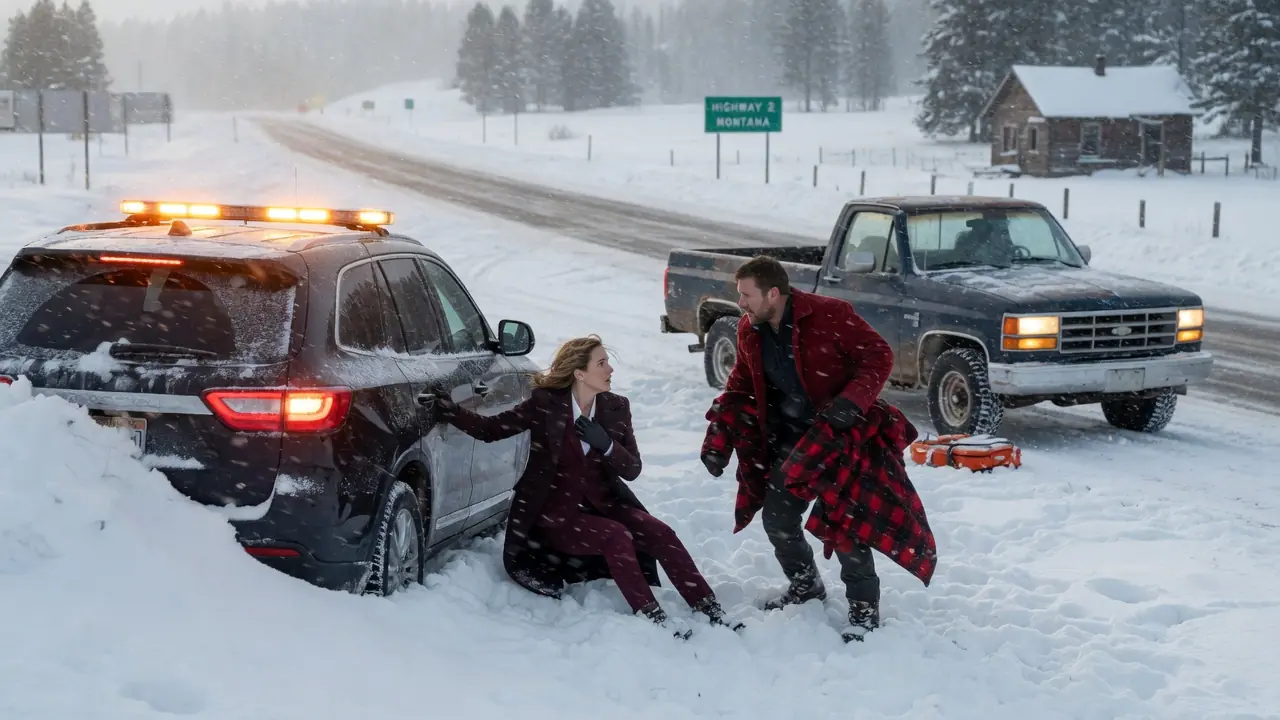
Liam Carter, a single father in a battered pickup, slammed the brakes before a spinning SUV. Glass shattered. Cold air flooded the cabin.
He smashed the door, pulled an unconscious woman out, wrapped her in his coat, and dragged her to an abandoned cabin.
He did not know she was Audrey Sterling, the CEO who would sign his termination papers tomorrow morning.
Montana winter stretched across the valley like a white shroud, the kind of cold that bit through bone and turned breath to smoke.
Highway 2 cut through the desolate landscape, connecting the sleepy town of Ridgemont to the Sterling Dynamics Montana plant, a sprawling facility that hummed day and night, feeding components to aerospace manufacturers across three continents.
In this world of contrasts, warmth fought against cold, people against systems, simplicity against power.
Liam Carter was thirty-six, a night-shift mechanic at the Montana plant. Though he had once been something more, a former aviation maintenance engineer, he had walked away from that life after family tragedy reshaped everything he knew. Now he lived by a simple code: do the right thing even when nobody was watching.
His days revolved around keeping machines alive and his daughter safe, two missions that demanded everything he had.
His hands bore the calluses of honest work, grease permanently etched into the creases of his palms. He drove a twelve-year-old Ford pickup with two hundred thousand miles on it, delivered packages on contract during daylight hours, then clocked in at the plant when darkness fell.
The double shifts kept food on the table and paid for Bridget’s school supplies.
Bridget Carter, seven years old, sat at their kitchen table most evenings, building wind turbine models from scrap metal and cardboard. Her small fingers were surprisingly deft. She worshiped her father with the uncomplicated devotion only children possess.
She drew pictures of fireplaces with careful crayon strokes and wrote beneath them in wobbly letters.
Warm beats storm.
Her second-grade teacher had called her gifted. Liam just called her his reason.
But the plant had secrets Liam could not see, currents moving beneath the surface like ice forming on a winter lake. In a glass tower three states away, executives reviewed spreadsheets with clinical detachment. And someone had decided that eleven percent of the night shift needed to disappear.
Audrey Sterling was thirty-four, beautiful in the sharp way of expensive things, cold in the manner of those who had learned that warmth invites weakness. As CEO of Sterling Dynamics, she carried the weight of quarterly expectations, board demands for seven percent profit margin increases, and media outlets eager to paint her as the ruthless woman who inherited Daddy’s empire.
She had not inherited anything.
She had earned it degree by degree, project by project, soul-hardening decision by soul-hardening decision.
The board wanted results. The shareholders wanted growth. The efficiency consultants wanted blood.
So Audrey came to Montana in secret, flying in under cover of a routine inspection. Her real mission was known only to the inner circle: identify where to cut deep enough to satisfy the wolves without killing the patient.
She believed in performance metrics the way some people believed in scripture. Numbers did not lie. Systems did not play favorites. If you could not prove your value on a spreadsheet, maybe you did not have value.
It was a philosophy that had carried her to the executive suite by thirty-two. But it was also a philosophy that kept her awake at three in the morning, wondering what her father would say if he could see her now.
Clinton Morris, the chief operating officer, had already done the preliminary work, manipulating data points to paint certain workers as expendable. He needed sacrificial lambs to justify his own cost-saving measures. Needed bodies to prove he was serious about efficiency.
His emails to Amanda Pierce in human resources were clinical, stripped of anything resembling humanity.
Henry Blake, the chief financial officer, spoke in the language of formulas and fiscal quarters. To him, people were line items, benefits were overhead, and safety protocols were expensive inconveniences that ate into margins.
He knew that old equipment needed experienced hands, that safety systems required vigilant eyes, that some knowledge could not be downloaded from a training manual.
On Audrey’s laptop, buried in an encrypted folder she had not yet opened, sat a document titled Phase 1 Reductions.
Liam Carter’s name appeared on line seventeen.
The radio in Liam’s truck crackled with news of a female CEO conducting surprise inspections at Montana facilities. He turned the volume down, focused on the road, focused on getting home to Bridget.
The sky had gone from gray to charcoal, and the weather service was upgrading warnings to emergencies.
The blizzard hit Highway 2 like divine wrath, visibility dropping to arm’s length in seconds. Audrey’s rented SUV, a luxury model with all-wheel drive and every electronic safety feature Detroit could engineer, meant nothing against black ice and wind that pushed forty-ton trucks sideways.
Her phone showed no signal. Her GPS flickered and died. The last thing she remembered was headlights, the sickening sensation of rotation, the dashboard rushing toward her face.
Liam saw the hazard lights first, a weak pulse of amber in the whiteout. Every instinct screamed to keep driving, get home, get safe, but his foot found the brake pedal instead.
Muscle memory from another life, when he had been the guy who ran toward problems while others ran away.
He left the engine running, pulled his collar up, and stepped into wind that tried to shove him back. The SUV sat at a forty-five-degree angle, front end buried in a snowbank, driver’s side door crumpled like aluminum foil.
Through the spiderwebbed glass, he could see a woman slumped against the deployed airbag, blood trickling from a cut above her eye.
Liam’s toolbox yielded a pry bar. He wedged it into the door frame, put his back into it, felt the metal groan and give. The woman’s seat belt had locked, trapping her against the seat.
He pulled his knife, sawed through the nylon strap, and caught her as she fell forward. Two fingers pressed to her neck and found a pulse, steady but weak.
She was breathing.
That was enough.
He stripped off his red flannel coat, the one Bridget had picked out at the thrift store because it looked like fire, Daddy, and wrapped it around the unconscious woman. The fabric was warm from his body heat, and he tucked it tight around her shoulders before lifting her in both arms.
The abandoned hunting cabin sat two hundred yards off the highway, down a trail only locals knew. Liam had passed it a thousand times, never needed it until now.
He kicked the door open with his boot, laid the woman on the floor near the stone fireplace, and went to work.
Dry alcohol tablets from his emergency kit got a fire started. Old newspapers someone had left behind fed the flames. Within ten minutes, orange light flickered across rough-hewn walls, and heat began pushing back the cold.
The woman stirred, eyelids fluttering.
Her first instinct was control. You could see it in how her hand moved to check for her phone, her bag, her files. But none of that was here.
Just firelight and a stranger and the sound of wind trying to tear the world apart outside.
“Your name?” Her voice came out as a rasp, damaged by cold and shock.
“Liam.”
She studied him through the haze of pain and confusion, making calculations he could not read.
“I’m Audrey.”
She did not offer a last name. That simple omission changed everything and nothing.
Liam noticed her wrist swelling already, the joint at an angle that made him wince. He found a straight piece of wood from the kindling pile, tore strips from an old blanket, and fashioned a splint with the kind of improvisation that came from years of making broken things work.
His hands were gentle despite their roughness, and Audrey found herself watching those hands more than his face.
“You have someone waiting for you?” Liam asked, feeding another log to the fire.
Audrey almost laughed.
Waiting, as if anyone in her life operated on something as quaint as waiting.
“No. You?”
“My daughter. She’s seven. Obsessed with wind turbines.”
The pride in his voice was unmistakable.
“Builds them out of scrap parts. Says she’s going to power the whole valley someday.”
Audrey felt something crack inside her chest. Just a hairline fracture, easy to ignore.
When was the last time someone had spoken to her about dreams instead of deliverables?
She turned her face toward the fire, hiding whatever expression had escaped her control.
The wrist splint held. The fire burned steady. Outside, the storm raged like it had personal grievances against Montana. The cabin became its own small world, firelight the only thing standing between them and the consuming dark.
Audrey hated this. Hated the loss of control. Hated depending on a stranger. Every instinct screamed to take charge, establish dominance, create structure.
But here in this primitive space, those instincts had no purchase.
“We should wait for dawn before trying the highway,” Liam said.
It was not a suggestion, just a statement of fact delivered without authority, which somehow made it more convincing.
Audrey wanted to argue, but the wind howling through cracks in the walls made her point moot.
“In my world, efficiency determines who stays.”
Liam poked at the fire, sent sparks spiraling upward.
“In my world, everyone deserves to get home.”
The words hung between them. Simple and devastating.
Audrey thought of her father, Chairman George Sterling, who told her leadership meant being willing to be cold, meant making decisions others were too weak to make. She had built her career on that principle, worn it like armor.
But here, watching this stranger tend a fire to keep her alive, the armor felt thin.
When the flames began to die, Liam pulled something from his pocket, a hand warmer made from a Ziploc bag filled with salt solution and a heat pack, improvised, imperfect, and exactly what she needed.
He placed it against her good hand, and Audrey stared at his calloused palms. These hands that fixed things, that saved things, that knew how to be useful without seeking credit.
In the firelight, she saw safety, the kind money could not purchase.
And for just a moment, she let herself feel it.
Liam had a notebook in his truck, had grabbed it when he retrieved the emergency kit. Old habits from his engineering days meant he still sketched systems, still thought in diagrams.
While Audrey dozed fitfully, he flipped through pages of generator schematics for the plant, notes about aging safety valves, observations about equipment that should have been replaced three budgets ago.
One notation stood out, written in his precise hand.
Safety valve C7. Installed 1983. Past service life. Recommend replacement before winter load increase.
He had submitted that recommendation four months ago. It had vanished into the bureaucratic void. Probably died on someone’s desk. Probably got filed under not urgent enough to fund.
Dawn came slowly, gray light filtering through gaps in the cabin walls. The storm had exhausted itself sometime in the dark hours, leaving behind a world buried under two feet of fresh snow. Search and rescue vehicles appeared on the highway, their lights cutting through the morning gloom.
Audrey sat up, winced at the pain in her wrist, and felt the red flannel coat slide from her shoulders. She had slept in a stranger’s jacket, in a stranger’s protection, and that vulnerability felt more dangerous than the storm had been.
“I owe you,” she said, standing with effort.
Liam shook his head, already gathering their meager supplies.
“Just stay warm another night.”
The rescue team loaded Audrey into their vehicle. Someone draped an emergency blanket over her shoulders, but she kept the red flannel coat close, could not quite bring herself to return it yet.
Through the rear window, she watched Liam climb back into his ancient pickup, watched him drive toward town, toward his daughter, toward a life she could not imagine living.
She did not know his last name. Did not know what he did or where he worked. For a few hours, she had just been Audrey, and he had just been Liam.
And that simplicity felt like something precious she had lost long ago.
Liam made it to the plant just before his shift started. The night crew was already assembling, men and women with lunch pails and tired eyes. People who worked while the world slept.
He poured himself cheap coffee from the breakroom. Taped Bridget’s latest drawing to his locker, the one with the fireplace and those words she loved.
Warm beats storm.
His phone buzzed.
Email from management.
9:30 a.m. CEO inspection. All senior staff and department leads required in conference room B.
He had never met the CEO, had only seen her in company newsletters, professional headshots that made her look untouchable.
He drained his coffee, pulled on his work coveralls, and headed to the floor. Whatever corporate theater was about to unfold, he had equipment to maintain.
Conference room B smelled like fear and furniture polish. The night-shift supervisors stood in awkward clusters, uncertain whether to sit or stand.
Then the door opened, and Audrey Sterling walked in wearing a burgundy business suit, hair pulled into a severe bun, eyes like winter ice.
The room stood.
Liam felt the floor tilt beneath him.
Audrey’s gaze swept the assembled faces, professional and detached, until it landed on Liam. For half a heartbeat, something flickered in her expression. Shock and recognition and something else.
But then it was gone, replaced by the mask she wore like a second skin.
Clinton Morris launched into his presentation, spreadsheets projected on the wall, charts showing labor costs in angry red. Henry Blake emphasized overtime expenditures, talked about burning money on redundant coverage.
The night shift, he explained with clinical precision, was where inefficiency lived.
A document flashed on screen, too quick for most to read, but Liam caught his own name scrolling past.
Test reduction targets, the header read.
His stomach went cold.
Otis Palmer, gray-haired and solid as old timber, pushed back.
“You cut maintenance, you’re gambling with safety. This equipment is forty years old. Needs experienced eyes on it.”
“Equipment has diagnostic systems,” Clinton countered smoothly. “We can’t justify legacy staffing based on outdated protocols.”
Audrey sat at the head of the table, her bandaged wrist hidden beneath the sleek cuff of her jacket. She looked at that wrist and felt the phantom pressure of Liam’s hands creating a splint from scraps.
On her notepad, she had written cut night maintenance.
But now her pen hovered over it.
Hesitant, she crossed it out.
Nobody noticed.
The inspection tour began with Audrey moving through the plant like a general reviewing troops. Clipboard. Checklist. Questions delivered in rapid-fire succession.
Liam was assigned to assist, technical queries, demonstrate systems. He kept his responses short, professional, accurate.
When she asked about hydraulic pressure tolerances, he gave her exact numbers. When she questioned maintenance intervals, he cited the manual from memory.
Then they reached Sector 7, where a coolant line was weeping fluid. The vendor quote for repair sat on someone’s desk, still pending approval. Three weeks old.
Liam grabbed a spare compression clamp from the parts cage, adjusted the fitting with practiced efficiency, and sealed the leak in under twenty minutes.
“Why didn’t you call the vendor?” Audrey asked.
“Because we could fix it ourselves in twenty minutes,” Liam said, wiping his hands on a rag. “Saved about twenty-four hundred dollars and three days of downtime.”
Clinton appeared from nowhere, a shark smelling blood.
“He improvised. Bypassed proper procurement channels.”
Audrey turned to Liam.
“Write up your method. Include safety verification. On my desk by end of shift.”
Liam nodded, walked away to find paper.
He wrote by hand, clear block letters, each step documented with the kind of precision that came from understanding that details mattered, that someone’s life might depend on following the process correctly.
The report was thorough, professional, and undeniably competent.
His phone rang during the write-up. Bridget’s teacher. His daughter had won the school science fair, first place for her recycled-materials turbine.
Pride flooded through him, pure and bright.
Audrey was nearby, close enough to see his face transform. For just a second, the ice in her expression melted. Then she rebuilt it brick by brick because CEOs did not get distracted by employees’ personal victories.
But she had seen it.
And she could not unsee it.
The gas line in the casting sector had been problematic for weeks. Pressure sensors throwing intermittent warnings that maintenance logged but could not replicate. The vendor had provided budget sensors approved by Clinton Morris himself as a cost-saving measure.
They worked ninety-eight percent of the time.
The other two percent, they lied.
At 2:15 in the afternoon, while the day shift hummed with normal production noise, the sensor reported all clear. The pressure gauge told a different story, but the gauge was old, analog, the kind of thing people had learned to mistrust in favor of digital readouts.
Clinton stood in the observation booth watching production numbers climb.
“Don’t stop the line,” he told the floor supervisor. “We’re losing one hundred twenty thousand per hour when we’re down.”
Below, safety valve C7, installed in 1983, began to whistle. Just a small sound, easily missed under the industrial din, but Liam heard it. That particular pitch that meant pressure building where it should not.
He hit the emergency stop, pulled the alarm that shut down the casting line.
Clinton’s voice exploded through the radio.
“Who authorized that shutdown?”
“Valve’s critical,” Liam shouted back. “We need to—”
The explosion was not large. Not by industrial standards. Just a pressure release, a burst of flame, white smoke billowing across the sector.
But it was enough.
Equipment worth six hundred thousand dollars sat in the blast radius. More importantly, twelve people worked in that space.
Liam grabbed a soaked blanket from the safety station, held it over his head, and ran toward the smoke. Through the haze, he saw Audrey frozen in the observation corridor, too close to the rupture. She was staring at the flames with the blank expression of someone watching their theories incinerate in real time.
He reached her, wrapped the blanket around them both, and pulled her toward the exit. His arms seared where a spark had caught him, but he did not let go.
They stumbled into clear air, Audrey coughing. Liam’s jacket was smoking.
On the chair in her temporary office, the red flannel coat still hung where she had left it.
In the medical bay, Audrey’s hands shook as she poured water for Liam. He sat on the examination table, shirt off, burn gel on his forearm. He tried to make a joke.
“Coffee would be better.”
She did not laugh.
“Why do you keep saving me?”
Liam looked at her directly. No deference. No calculation.
“Because you’re a person.”
Something in Audrey’s carefully constructed worldview cracked wide open. All her theories about efficiency, about metrics, about who deserved what, scattered like ash in wind.
This man, this night-shift mechanic who should have been a line on a termination list, had just risked his life for hers. And he had done it without hesitation, without expecting reward, without even thinking about it.
The emergency board meeting convened within the hour. Executives dialing in from three time zones. Voices tense and accusatory through the speakerphone.
Henry Blake led the prosecution.
Unauthorized shutdown. False alarm. Estimated losses exceed ninety thousand dollars in delayed production.
Clinton had his narrative ready, polished and poisonous.
“This is exactly the kind of reactive, non-protocol behavior that makes night maintenance a liability. Carter acted on instinct, not data.”
Amanda Pierce from human resources laid out the paperwork. Performance issue. Forms prepopulated with legal language, ready for signatures, the machinery of termination grinding forward with bureaucratic efficiency.
Audrey sat at the conference table, staring at her bandaged wrist. She thought about the cabin, about hands making splints from scraps. She thought about the fire that had kept her alive and the fire that could have harmed a dozen workers.
She thought about the difference between data and truth.
“I need forty-eight hours,” she said.
Henry’s face went rigid.
“Safety investigation,” she continued. “Full review before any personnel action.”
Clinton opened his mouth to object, but Audrey cut him off with a look that could freeze nitrogen.
“Forty-eight hours. If we fire someone for preventing a disaster, and it turns out he was right, we’ll face lawsuits that make today’s losses look like pocket change.”
It was language they understood. Risk management. Liability mitigation.
She was learning to speak their dialect while meaning something entirely different.
That night, she called her father, Chairman George Sterling.
He answered on the second ring, his voice carrying that particular tone of disappointment he had perfected over decades.
“Don’t go soft,” he said. “Leadership means making hard choices.”
Audrey looked at the burn patterns on her jacket sleeve, at the medical report documenting Liam’s injury.
“What if the hard choice is admitting we’re wrong?”
Her father had no answer for that.
The next morning, Liam submitted his resignation letter, two sentences on plant stationery.
Effective immediately, I resign my position. I won’t let anyone sacrifice their principles for my sake.
He left it on Audrey’s desk and walked out.
Audrey and Otis Palmer spent sixteen hours in the maintenance records room pulling files that had not been opened in months. The safety valve logs told a story, if you knew how to read them. Pressure anomalies dating back four months, all documented, all ignored.
The sensor purchase orders revealed more. Clinton had approved the budget vendor over engineering recommendations, saved forty-two thousand dollars on equipment, and buried the objections under procedural language.
His emails were the final piece. Messages to Amanda about accelerating headcount reduction to offset equipment costs. Casual brutality dressed in corporate speak.
But the smoking gun was the valve itself.
When they brought in an independent inspector, he dated it to 1983, confirmed it was three years past safe operational life. Liam’s maintenance notes had flagged it. His recommendation had been clear. It had died on Clinton’s desk, marked non-critical, defer to next budget.
Audrey drove to Liam’s address, a trailer park on the edge of town where rent was cheap and dignity was hard-won. The trailer was small but immaculate, flower boxes in the windows, a satellite dish pointing toward stars.
Bridget answered the door, this tiny person with serious eyes and a gap-toothed smile. She was holding a drawing still wet with marker ink, the familiar fireplace and those three words.
Warm beats storm.
“Are you my dad’s boss?” Bridget asked with the directness of children who have not learned to lie yet.
“I am,” Audrey said.
Bridget studied her for a long moment, then held out the drawing.
“He says warm always wins, even when the storm is really, really big.”
Audrey took the drawing with hands that were not quite steady. She knelt down to Bridget’s level.
“Your dad is right. He’s very right.”
Liam appeared behind his daughter, saw Audrey, and started to close the door.
But Audrey spoke first.
“I need you to come back. Not to your old job. To lead the emergency systems restoration, full protocol review. You write the new standards.”
Liam shook his head.
“I’m not interested in being anyone’s token redemption.”
“This isn’t redemption,” Audrey said. “It’s recognition. The plant needs someone who sees problems before sensors do. Someone who will hit the alarm even when it costs six figures. Someone who understands that numbers don’t bleed.”
Over the next thirty-six hours, Liam worked with a handpicked team to methodically restore and upgrade the safety systems. He replaced valve C7, recalibrated the entire sensor array, wrote new standard operating procedures in language that assumed competence rather than compliance.
His recommendation was simple: stagger shifts to ensure overlap. Experienced eyes on every piece of critical equipment.
The production line restarted on hour forty-seven.
Every system ran clean. Every gauge read true.
And the cost of Liam’s solution was sixty-three percent less than Clinton’s budget projections. The math was undeniable. The truth was unavoidable.
The board meeting was scheduled for nine in the morning. All members present. No remote attendance allowed.
Audrey stood at the head of the table with a laptop, a stack of maintenance logs, and absolutely nothing left to lose.
She walked them through it. The video footage of the near miss. The sensor data proving the alarm was justified. The email trail showing how cost-cutting had created the crisis. The opportunity cost analysis showing that Liam’s shutdown had prevented an estimated 4.2 million dollars in equipment damage and unknowable costs in human injury.
Clinton Morris sat silent, watching his carefully constructed narrative collapse. Henry Blake’s expression went from stern to carefully neutral as the liability implications became clear. Amanda Pierce quietly withdrew the performance issue documentation.
“The failure,” Audrey said, her voice steady and clear, “was in leadership. In choosing metrics over safety, in valuing efficiency over wisdom. Clinton Morris approved substandard equipment and suppressed engineering recommendations. That ends today.”
The vote was unanimous. Clinton was suspended pending full audit. The vendor contracts were under review, and Audrey stood before the board with a new proposal.
“I’m creating a new position: night-shift engineering supervisor. Not based on credentials, but on demonstrated expertise and judgment under pressure. I’m appointing Liam Carter.”
One board member objected.
“He doesn’t have the degree.”
“He has something better,” Audrey replied. “He has the courage to stop the machine when the machine is wrong.”
The announcement was made on the plant floor. All shifts assembled. Audrey stood on the loading dock, looking at faces weathered by years of work, eyes skeptical from years of broken promises.
“The person who saved this plant,” she said, “was someone we almost threw away. Someone we almost fired for having the audacity to be right when the data was wrong. That changes now. We build systems around wisdom, not the other way around.”
The applause started slow, then built, rolling across the floor like thunder.
Liam stood in the back, overwhelmed. And when Otis Palmer clapped him on the shoulder, he finally let himself believe it was real.
In the shadows near the executive entrance, George Sterling watched. His daughter had defied everything he had taught her about cold calculations and hard choices. And standing there, seeing her transform corporate loyalty into genuine respect, he felt something he had not expected.
Pride.
Three months later, the Montana plant celebrated ninety consecutive days without safety incidents, a record that made industry publications and sent Sterling Dynamics stock up four percent. Local media praised the company’s revolutionary safety culture, and corporate sent photographers to document the success.
But the real story was smaller, quieter.
Bridget Carter won the regional science competition with a wind turbine built from plant scrap metal. Each piece donated and documented. Audrey established a STEM scholarship fund for local kids. No press release, no logo, just money that let dreams become engineering degrees.
On a Friday evening, as spring began pushing back winter, Liam grilled burgers in the trailer park’s common area. Bridget ran between tables, explaining turbine blade angles to anyone who would listen. Otis Palmer brought potato salad and stories from forty years inside those plant walls.
And Audrey Sterling sat on a picnic bench wearing jeans and the red flannel coat, looking more at peace than a CEO had any right to be.
“First time I felt warm for the right reasons,” she said quietly, watching fire dance in the portable grill.
Liam handed her a burger, their fingers touching briefly.
“Storms still come, but we’ve got fire now.”
In the distance, the Montana plant hummed its steady rhythm, lights glowing against the darkening sky. Somewhere inside, Liam’s handwritten safety protocols were taped to equipment, reminders that wisdom and efficiency could coexist, that the right person in the right moment could save more than numbers could measure.
Bridget brought her drawing over, the one Audrey had kept, now laminated and worn from being carried everywhere. The fireplace still glowed in crayon orange, the words still clear.
Warm beats storm.
Audrey looked at those words, at this makeshift family that had formed around second chances and split-second decisions. She thought about the person she had been in that cabin, stripped of title and authority, just someone who needed saving.
She thought about the person she was becoming, someone who understood that the strongest structures were built on trust, not spreadsheets.
Snow still crowned the mountains in the distance. But here in the valley, fire kept the darkness back. Not the consuming kind, not the destructive kind. The kind that gathered people close, that turned strangers into something like home.
The kind that wins.