A widowed father sat alone every Friday with two plates, one for him, one for the ghost of his dead son. He thought grief was all he had left. Then a desperate mother walked through the door with a starving child and whispered five words that would shatter everything.
“Can we stay a while?”
What happened next wasn’t just about saving strangers. It was about whether a broken man could learn to live again. This is a story about loss, redemption, and the families we choose when blood fails us.
The fluorescent lights of Rosy’s Diner hummed their tired song, the same mechanical lullaby they’d been singing for 30 years. Jack Turner didn’t notice anymore. He sat in booth 7, always booth 7, with his calloused hands wrapped around a coffee cup that had gone cold an hour ago.
The vinyl seat across from him held a plate of untouched meatloaf, mashed potatoes, and green beans arranged exactly how his son used to like them. Potatoes on the left, vegetables separated, gravy only on the meat.
Danny had been particular about his food. Particular about everything, really. His socks had to match. His sandwich had to be cut diagonal, never straight across. His bedtime story had to be read twice. No more, no less.
Jack remembered every detail with the kind of clarity that felt like punishment.
Three years. Three years since the accident. Three years of Friday nights in this booth, ordering two meals, eating one, leaving the other to grow cold while the waitresses pretended not to notice. They’d stopped asking if someone was joining him. They’d stopped offering to box up the second plate. They just brought the food, refilled his coffee, and gave him the space his grief demanded.
“You know, Jack,” Rosie herself had told him once, about six months after Danny died, “there’s no rule book for this. You grieve however you need to grieve.”
So, he did.
Every Friday at 6:47 p.m., the exact time Danny used to burst through the diner doors after Little League practice, dirt on his knees and joy in his eyes, Jack sat down and ordered the meals they used to share.
It wasn’t healthy. His sister told him that at least once a week. His therapist, the one he’d seen exactly three times before deciding therapy was useless, had called it maladaptive coping.
But what the hell did they know about the weight of an empty house? What did they know about waking up every morning and forgetting for exactly two seconds that your entire world was gone, only to have reality crash down like a sledgehammer to the chest?
The diner had become his church, the booth his confessional, and the untouched plate his only prayer.
Jack was 52 years old. His hands were permanently stained with engine grease no amount of scrubbing could remove. His back ached from 30 years of bending over motorcycles in his shop three blocks away. His hair had gone completely gray in the months after the funeral. Not gradually, but almost overnight, like his body had decided to physically manifest his grief.
He looked 10 years older than he was. Felt a hundred years older than that.
The crash had been quick. A drunk driver running a red light at 50 miles an hour. Danny was walking home from his friend’s house, probably thinking about the math test he’d aced or the new video game he wanted for his birthday.
He was 11 years old. He never saw it coming.
The doctor said he didn’t suffer. Jack didn’t believe them, but he pretended to because the alternative, imagining his boy’s final moments, was a darkness he couldn’t afford to enter.
His wife, Carol, had died six years earlier from cancer. Breast cancer that spread to her bones, her liver, her lungs. She’d fought for two years, and Jack had held her hand through every chemo session, every radiation treatment, every moment of agony.
When she finally let go, Danny had been the only thing keeping Jack tethered to the world. And then Danny was gone, too.
So here he sat, every Friday, keeping vigil at a table for two, where only one soul remained.
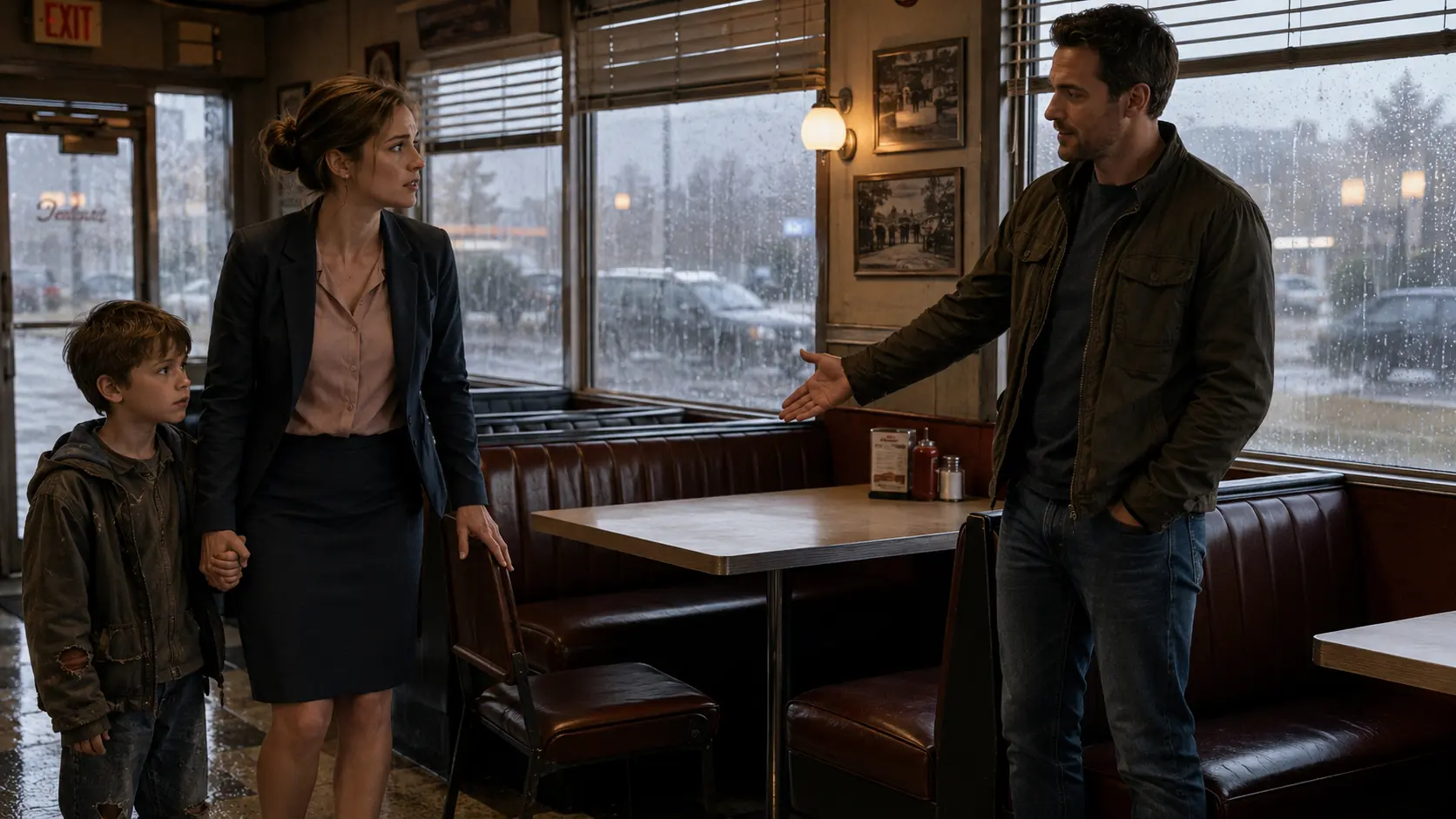
Outside, the November rain beat against the windows. Portland weather, perpetual and gray, matching the color of everything inside Jack. The diner was mostly empty tonight, just old Frank at the counter nursing his third cup of decaf and a young couple in the corner booth stealing kisses between bites of pie.
Jack envied them without really meaning to. He envied anyone who still had someone to kiss.
He was about to signal Rosie for the check when the door opened.
The woman who stepped inside was maybe 35, though hardship had etched lines around her eyes that suggested she’d lived several lifetimes already. She was thin, too thin, wearing a jacket that was more patches than original fabric. Her dark hair was pulled back in a messy ponytail, and her eyes darted around the diner with the weariness of a cornered animal.
Behind her, clinging to her hand with white-knuckled desperation, was a boy. He couldn’t have been more than seven or eight. His clothes were too small. His sneakers were held together with duct tape. And his face had the hollow, haunted look that comes from missing too many meals.
But his eyes, his eyes were Danny’s eyes. Not literally, not the same color or shape, but they held that same spark of intelligence, that same desperate hope that the world might still have kindness left in it.
Jack felt something crack inside his chest.
The woman didn’t approach the counter. She didn’t sit down. She just stood there inside the doorway, water dripping from her jacket onto Rosy’s worn linoleum, looking like she was gathering courage for a battle she’d already lost a hundred times before.
Rosie, standing behind the counter with a coffee pot in hand, froze. Jack saw her face cycle through confusion, concern, and something that looked like recognition. Not recognition of the woman specifically, but recognition of the situation.
Anyone who’d worked in a diner for 30 years knew desperation when they saw it.
“Honey,” Rosie said gently, setting down the coffee pot. “Can I help you?”
The woman’s lips moved, but no sound came out. The boy pressed closer to her side, and Jack could see him trembling. From cold, probably from hunger, definitely from fear.
“We were just,” the woman started, then stopped. Her voice was barely above a whisper. “I thought maybe…”
She couldn’t finish. Her jaw clenched, and Jack watched her swallow hard, fighting back tears that probably felt like defeat.
The boy tugged on her hand.
“Mama,” he whispered, so quiet Jack almost didn’t hear it. “Mama, I’m really hungry.”
The woman’s face crumpled for just a second before she forced it back into a mask of fragile dignity. She looked at Rosie, then at Frank, then at the young couple, then finally, God help him, at Jack.
Their eyes met across the diner. And in that moment, Jack saw everything.
He saw the shame and the fear and the desperation. He saw a woman who’d probably walked blocks in the rain, looking for someplace warm, someplace that might show mercy. He saw a mother trying to hold it together for a child who was depending on her to perform miracles.
He saw Carol in those final weeks when she’d been too proud to ask for help, even as the medical bills buried them. He saw himself in the months after Danny died, too broken to accept the casseroles and condolences that kept arriving on his doorstep.
He saw people who’d been invisible for so long they’d almost stopped existing.
The woman took a breath, straightened her spine, and walked directly toward Jack’s booth. Each step looked like it cost her something precious.
When she reached his table, she stood there for a moment, visibly shaking, before the words finally came out in a rush.
“I’m sorry,” she said, her voice cracking on the words. “I’m so sorry to bother you, but my son, he’s hungry. He hasn’t eaten since yesterday morning, and I thought…”
She gestured vaguely at the diner, at the warm lights and the smell of food.
“I thought maybe we could just sit for a while, just to get warm. We won’t cause any trouble. I promise we’ll leave as soon as…”
Her words dried up as she noticed the second plate sitting across from Jack. The untouched meatloaf and potatoes still steaming slightly.
Her eyes widened, and Jack saw the exact moment she understood what she was looking at. A meal for someone who wasn’t there. A ritual she had just interrupted.
“Oh, God,” she breathed. “I’m so sorry. I didn’t mean to. We’ll go.”
“Sit down,” Jack heard himself say.
The woman froze.
“What?”
“Sit down.” He gestured to the empty seat across from him, the one Danny’s ghost had occupied for three years. “Both of you.”
She stared at him like he’d just spoken in a foreign language. Behind her, Rosie had gone completely still, the coffee pot forgotten in her hand. Frank had turned on his stool to watch. Even the young couple had stopped kissing.
“I can’t,” the woman started.
“You asked if you could stay a while,” Jack said. His voice was rough from disuse, from too many nights spent not talking to anyone. “I’m saying yes. Sit down.”
The boy looked up at his mother with eyes that begged her to say yes, to accept this impossible mercy. The woman’s throat worked as she swallowed again, and Jack could see her pride warring with her desperation.
Desperation won.
“Thank you,” she whispered. “Thank you so much.”
She slid into the booth, and her son scrambled in beside her. The boy’s eyes locked onto the plate of food with an intensity that made Jack’s stomach hurt. This wasn’t just hunger. This was starvation dressed up in a small body that was trying so hard to be brave.
“Go ahead,” Jack said, pushing the plate across the table.
The boy looked at his mother. She nodded, tears streaming down her face now, past pretending she was fine.
And then the kid fell on that food like it was the last meal on Earth.
Jack had seen hungry people before. He’d been hungry himself in the lean years when he was first starting his business, and Danny was a baby, and Carol was working two jobs to keep them afloat. But he’d never seen anything like this.
The boy ate with his hands, shoveling mashed potatoes into his mouth, barely chewing, his whole body trembling with the effort of not completely losing control.
His mother put a hand on his shoulder, trying to slow him down, murmuring, “Easy, baby. Easy. You’ll make yourself sick.”
But the boy couldn’t stop.
And watching him, Jack felt something he hadn’t felt in three years. Not happiness, not exactly, but a crack in the numbness, a fissure in the ice.
Rosie appeared at the table with three cups of coffee and a glass of milk.
“On the house,” she said quietly, setting them down. Then, looking at Jack with an expression he couldn’t quite read, she added, “I’ll bring more food.”
“Thanks, Rosie.”
The woman was crying openly now, her hands wrapped around the coffee cup like it was a lifeline.
“I don’t know how to thank you,” she said. “I don’t… We’ve been…”
She couldn’t finish. The sentences kept breaking apart before she could complete them.
“What’s your name?” Jack asked.
“Mara.” She wiped at her face with the back of her hand. “Mara Chen. And this is Eli.”
Eli looked up at the sound of his name, his mouth still full of meatloaf.
“Hi,” he managed to say around the food.
“I’m Jack Turner.” He paused, then added something he hadn’t said to anyone in months. “It’s nice to meet you.”
They sat in silence for a while. Eli ate. Mara cried quietly into her coffee. Jack watched them and felt like he was witnessing something sacred, though he couldn’t have explained what or why.
Rosie brought more food, a burger for Eli, soup for Mara, and refused to take any money when Jack tried to pay.
“Just this once,” she said firmly. “Consider it my good deed for the year.”
When Eli finally slowed down, his stomach visibly distended from eating too much too fast, he leaned against his mother and closed his eyes. Mara stroked his hair with a tenderness that made Jack look away. It was too intimate a moment, too raw. It reminded him of Carol with Danny, the way she used to run her fingers through his hair when he fell asleep during family movie nights.
“How long?” Jack asked quietly.
Mara knew what he was asking.
“Three weeks since we had a place to sleep. Two months since we left.”
She didn’t need to say left what. The bruise on her wrist, fading to yellow but still visible, told that story.
“I’ve been trying to find work, but everywhere wants references, an address, an ID that’s not expired. I’m doing what I can, but it’s never enough.”
“Where were you planning to go tonight?”
She laughed, a bitter sound without humor. “There’s a church two blocks over that leaves their basement unlocked sometimes, if we’re lucky. If not…” She shrugged. “We find a doorway, an overpass, somewhere the rain won’t hit us too hard.”
Jack thought about his shop. The storeroom in the back where he kept parts and tools, but also where he’d set up a cot during the early days after Danny died, when going home to an empty house felt impossible.
It was warm. It was dry. It was private.
“I have a place,” he said before he could talk himself out of it. “It’s not much, just a storeroom behind my motorcycle shop. But there’s a cot, a space heater, and a bathroom. You can stay there tonight.”
“What?”
“Just for tonight,” Jack added quickly, as much to reassure himself as her. “It’s not safe for a kid to sleep on the street when it’s this cold. One night won’t hurt anything.”
“Why would you?” She stared at him, searching his face for the catch, the hidden cost. “You don’t even know us.”
“No,” Jack agreed. “I don’t.”
He couldn’t explain it to her. Couldn’t explain that the moment he’d seen Eli’s face, something in him had shifted. Couldn’t explain that the untouched plate he’d been maintaining like a shrine suddenly felt less like remembrance and more like waste. Couldn’t explain that he’d spent three years convinced his life was over.
And then in walked two strangers who reminded him that other people’s lives were still happening, still urgent, still in desperate need of the kindness he’d forgotten how to give.
“My son,” he finally said, gesturing to where the plate had been. “He died three years ago. Car accident. He was 11.”
Mara’s face softened with understanding.
“I’m so sorry.”
“Every Friday, I come here and I order his favorite meal. I let it sit there and get cold, and then I go home. It’s stupid. I know it’s stupid, but it’s the only thing that makes me feel like he’s not completely gone.”
“It’s not stupid,” Mara said quietly.
“But tonight, watching your boy eat that food…” Jack trailed off, searching for words that could hold the size of what he was feeling. “It felt right. It felt like maybe that plate was supposed to feed someone after all. Does that make sense?”
Mara nodded, fresh tears streaming down her face.
“It makes sense.”
Eli stirred, mumbling something in his sleep. Mara kissed the top of his head, and Jack felt that crack in his chest widen a little more.
“Come on,” he said, standing up. “Let’s get you somewhere warm.”
The rain had stopped by the time they left the diner, but the streets were still slick and gleaming under the streetlights. Jack led them three blocks south to Turner’s Motorcycle Repair, a squat brick building with a rolling metal door and a hand-painted sign that had been there since his father opened the place in 1978.
Jack had inherited it when his old man died, back when Carol was pregnant with Danny and the world still made sense.
Inside, the shop smelled like oil and metal and old leather, a smell Jack found more comforting than any cologne. Motorcycles in various states of repair lined the walls. His workbench was covered in tools arranged with the kind of precision that came from 30 years of muscle memory.
This place was his sanctuary, the only spot where his hands knew what to do, even when his brain shut down.
“Back here,” he said, leading them through the main shop to a door in the rear.
The storeroom was small, maybe 10 by 12 feet, but it was warm and dry. The cot was still there, covered in a faded quilt Carol had made before she got sick. There was a space heater in the corner, a mini fridge that mostly worked, and a small bathroom with a shower that ran hot if you were patient with it.
“It’s not much,” Jack said again.
“It’s everything,” Mara replied, her voice thick with emotion. “It’s everything.”
Eli was fully asleep now, a dead weight in his mother’s arms. Jack helped her lay him on the cot and covered him with the quilt. The boy didn’t even stir. He was so small, so fragile, so heartbreakingly young.
“There’s a coffee maker on the bench,” Jack said, backing toward the door. “Help yourself to whatever’s in the fridge. The bathroom’s through there, and the front door locks from the inside, so you’re safe.”
“Jack.”
Mara caught his arm as he turned to leave.
“Why are you doing this?”
He thought about lying. Thought about giving her some easy answer about Christian charity or paying it forward, or whatever people said when they did decent things. But he was too tired for lies, and she’d been too honest for him to be anything less.
“I don’t know,” he admitted. “Maybe because I’ve been dead for three years, and tonight I felt something like alive. Maybe because my boy would have wanted me to. Maybe because if I don’t do this, I’ll go home to my empty house and sit in my empty rooms and wonder why the hell I’m still here when everyone I loved is gone.”
He paused.
“One night. That’s all this is. Tomorrow, you’ll figure out your next step, and I’ll go back to my regularly scheduled grief. But tonight, at least we’ll both sleep somewhere warm.”
Mara’s eyes shone in the dim light.
“One night,” she agreed.
Jack locked the front door behind him and walked the six blocks to his house, a small craftsman bungalow that had once been filled with laughter and music and Danny’s endless questions about how everything worked. Now it was just rooms full of furniture and photographs of people who weren’t coming back.
He poured himself three fingers of whiskey and sat in his recliner, the same one where he used to read bedtime stories. The house was silent except for the ticking of the kitchen clock and the distant sound of traffic.
One night, he told them. One night, he told himself.
But sitting there in the dark, Jack Turner had the strangest feeling that he’d just done something irreversible, that he’d opened a door he’d spent three years keeping locked, that tomorrow morning when he walked into his shop, his life would already be different in ways he couldn’t yet see.
He finished his whiskey, poured another, stared at the photographs on the mantle. Carol in her wedding dress. Danny at six years old, missing his front teeth. The three of them together at the beach two months before she died.
“I don’t know what I’m doing,” he said to their frozen, smiling faces. “I don’t know if this is a mistake or a miracle, or just me losing my damn mind.”
The photographs didn’t answer. They never did.
Jack went to bed and dreamed of a diner with two plates of food. Except this time, both plates were being eaten by people who were alive and grateful and present.
When he woke up at dawn, his face was wet with tears. He didn’t remember crying.
He lay there for a long time, watching the gray light filter through the curtains, listening to his heartbeat in his chest, feeling something he’d almost forgotten the shape of. Hope, maybe, or terror, or possibly both at once.
At 7:15, he got dressed and walked back to the shop, expecting to find the storeroom empty, expecting them to have vanished in the night, back to whatever uncertain wandering had brought them to his door, expecting his one impulsive moment of humanity to be over so he could return to the comfortable numbness he’d been cultivating.
But when he unlocked the front door and walked through the shop, he heard water running. The shower. Someone was using the shower.
Jack stood there in his own building, suddenly unsure what to do with himself.
Make coffee, he decided. Coffee was normal. Coffee was what people did in the morning.
He was halfway through his second cup when the bathroom door opened and Eli emerged, his hair wet, wearing the same clothes, but looking somehow more human than he had the night before.
The kid froze when he saw Jack, his eyes going wide with that same weariness Jack had seen in his mother.
“Morning,” Jack said.
“Hi.” Eli’s voice was small.
“You hungry?”
The boy nodded, careful and uncertain.
“I don’t have much here, but there’s a bakery two blocks over. They open at seven. We could walk over, get some donuts and milk.”
Eli’s eyes lit up, but he didn’t move.
“I should ask my mom.”
“Good man. Always ask your mom.”
Mara appeared in the bathroom doorway, her hair damp, her face scrubbed clean in the morning light without the layers of fear and exhaustion. She looked younger, still worn, still carrying the weight of whatever she’d run from, but younger.
“We can go to the bakery,” she said to Eli. “But we’re not taking advantage of Mr. Turner’s kindness anymore than we already have.”
“Jack,” he corrected. “And I’m offering. That’s not taking advantage. That’s accepting help.”
“We’ve already accepted enough help.”
“Have you had coffee yet?”
She paused.
“No.”
“Then have coffee, and we’ll argue about this after you’ve had caffeine.”
The corner of her mouth twitched, almost a smile.
“Deal.”
They walked to the bakery through streets that were waking up. Shopkeepers rolling up grates. Early commuters hurrying to bus stops with travel mugs in their hands. Eli stayed close to his mother, but Jack noticed the kid looking at everything. The store windows, the cars, the seagulls fighting over a discarded sandwich with an intensity that reminded Jack painfully of Danny.
At the bakery, Eli pressed his face against the glass case, overwhelmed by choices. Jack ordered a dozen donuts, two cartons of milk, and three large coffees. They sat at one of the small tables by the window, and Jack watched Eli methodically eat three donuts while Mara sipped her coffee and tried not to cry again.
“So,” Jack said eventually. “What’s your plan?”
Mara set down her cup.
“Find work, save money, find a place to rent, get Eli enrolled in school.” She said it like a mantra she’d repeated so many times it had lost all meaning. “I’ve got applications in at six restaurants, three grocery stores, and every store in the mall. Someone has to call back eventually.”
“You need an address for most of those jobs.”
“I know.”
“An ID.”
“I know.”
“And childcare while you’re working.”
“I know.” Her voice rose sharp with frustration, and Eli flinched. She immediately softened. “Sorry, baby. I’m not mad at you.”
Then to Jack, she said, “I know all of this. I know it’s impossible, but I don’t have a choice. I can’t…”
She stopped, her jaw clenched.
“We can’t go back. So somehow, I have to make this work.”
Jack thought about the storeroom. Thought about how empty his days were, how little he had to lose. Thought about the way Eli had devoured that meal last night like it was the first kindness he’d received in months.
“Stay,” he heard himself say.
Mara blinked.
“What?”
“In the storeroom. Stay. Not just one night. Stay until you get on your feet.”
“Jack, we can’t.”
“Why not? It’s just sitting there empty. Has been for years. You’d actually be doing me a favor. Someone should be using it.”
“We can’t impose on you like that.”
“It’s not imposing if I’m offering.” He leaned forward. “Look, I get it. You’ve got pride. You don’t want to be a charity case, but pride doesn’t keep a kid warm at night, and it doesn’t put food in his stomach. You need time to find work, to save up for deposits and first month’s rent and all the other stuff landlords require. The storeroom gives you that time.”
“Why?” Mara asked the same question from last night. “Why would you do this for strangers?”
Jack looked at Eli, at his donut-crumbed face and his eyes that held too much worry for someone so young.
“Because three years ago, my son died, and I’ve spent every day since then figuring out how to keep breathing. And last night, for the first time, I felt like maybe breathing wasn’t the only thing I was capable of.”
He stood up, suddenly embarrassed by his own honesty.
“Think about it. I’ll be at the shop until six. If you decide to stay, great. If you decide to move on, I’ll understand.”
He pulled out his wallet and left two twenties on the table.
“For whatever you need today.”
“Jack.”
But he was already walking toward the door, his heart pounding like he’d just run a marathon.
What the hell was he doing? Inviting homeless strangers to live in his shop. He didn’t know these people. They could rob him blind. They could be running from something worse than an abusive ex. They could be anything.
But even as his brain threw up every reasonable objection, Jack knew he wasn’t going to change his mind. Something had shifted last night. Some fundamental recalibration of what his life could be.
For three years, he’d been sitting in that diner booth waiting to die. And then two people had walked in and reminded him that other people were fighting to live.
He spent the day working on a 1975 Honda CB750, losing himself in the familiar rhythms of diagnosis and repair, checking compression, cleaning carburetors, adjusting valves. His hands knew this work so well he barely had to think, which meant his mind was free to spiral through every possible outcome of his impulsive invitation.
At noon, the storeroom door opened and Mara emerged with a garbage bag full of trash. She’d cleaned. The room that Jack had been using as a dumping ground for parts and old paperwork was now spotless. She’d even swept the floor.
“You didn’t have to do that,” he said.
“If we’re staying, we’re not freeloading.” She met his eyes. “We’ll stay, but only if you let me help out around here, cleaning, organizing, whatever needs doing, and only until I find real work. A month, maybe two at most.”
Jack wanted to tell her she didn’t have to earn her keep, that just having people in that empty room was payment enough, but he understood pride. He understood needing to feel useful.
“Deal,” he said.
And just like that, one night became something else entirely.
The first week passed in a strange, careful dance of boundaries and routines. Mara cleaned the shop every morning before Jack arrived, organizing tools he’d left scattered, sweeping metal shavings from beneath workbenches, sorting bolts and screws into labeled containers he hadn’t used in years. She moved through the space like she was trying to make herself invisible, while simultaneously proving her worth with every polished surface and straightened shelf.
Eli did his homework in the corner Jack cleared for him. A small desk salvaged from the dumpster behind the elementary school and a folding chair that had seen better days. The kid was quiet, almost unnaturally so, as if he’d learned early that silence was safer than noise. He’d sit there for hours with his workbooks and borrowed library books, occasionally glancing up at Jack with those watchful eyes that seemed to catalog everything.
Jack found himself acutely aware of their presence in ways both uncomfortable and oddly comforting. The shop had been his fortress of solitude for three years, a place where he could lose himself in the mechanical perfections of engines and exhaust systems without having to navigate the messy complications of human interaction.
Now there were voices in his sanctuary, questions about where things went, the sound of a child’s pencil scratching across paper, the smell of instant ramen coming from the storeroom at lunch.
On the third day, he walked in to find Eli standing next to the Honda he was working on, staring at the disassembled engine with an intensity that made Jack’s chest ache.
“You can look,” Jack said. “Just don’t touch anything yet.”
Eli nodded solemnly, his hands clasped behind his back like a museum visitor, afraid of setting off alarms.
“What’s wrong with it?”
“Carburetors are gummed up. Happens when a bike sits too long without being run. Fuel turns to varnish, clogs everything up.”
“Can you fix it?”
“That’s the plan.”
“How?”
And just like that, Jack found himself explaining compression ratios and fuel-air mixtures to an 8-year-old who listened like every word was gospel. It reminded him so much of Danny, the endless curiosity, the way the kid’s face lit up with understanding, that Jack had to stop twice to clear his throat of the emotion threatening to choke him.
“My dad had a motorcycle,” Eli said quietly when Jack finished. “Before he got mean.”
Jack’s hands stilled on the carburetor he was cleaning.
“Yeah?”
“It was loud. Really loud. He used to take me for rides sometimes, back when he still smiled.” The kid’s voice went soft. “I liked it when he smiled.”
Mara appeared in the doorway of the storeroom, her face tight with something between fear and anger.
“Eli, don’t bother Mr. Turner while he’s working.”
“He’s not bothering me,” Jack said quickly. “Kid’s got a good head for mechanics.”
“Still. Come do your reading, baby.”
Eli trudged back to his corner desk, and Jack caught Mara’s eye. She looked exhausted, dark circles shadowing her eyes, her shoulders hunched with the weight of carrying more than any one person should have to bear.
He wanted to tell her it was okay, that talking about the past didn’t mean the past would find them. But he didn’t know if that was true. So he stayed quiet and went back to work.
That night, after they’d all eaten the Chinese takeout Jack had picked up, another thing that was becoming routine, these shared meals, Mara lingered in the main shop while Eli brushed his teeth.
“I got called back for an interview,” she said. “The diner. Rosy’s.”
“That’s great.”
“It’s dishwashing. Minimum wage, no benefits, but it’s something.” She twisted her hands together. “The interview’s Friday at three. Would you… Could Eli stay here? I don’t want to bring him. I need them to see me as reliable, not as someone with complications.”
“He’s not a complication.”
“I know that, but employers don’t. Single mom with a kid means missed shifts when he’s sick. Means leaving early for school pickups. Means all the things that make them choose someone else.” Her voice was brittle with the reality of it. “I have to play the game.”
“He can stay here,” Jack said. “I’ll keep an eye on him.”
Relief flooded her face.
“Thank you. I’ll make it up to you. I swear.”
“Mara.”
He waited until she looked at him.
“You don’t owe me anything. Stop trying to repay kindness like it’s a debt.”
She laughed, but there was no humor in it.
“Everything’s a debt when you’ve got nothing.”
Friday came, and Mara left for her interview wearing clothes Jack recognized from the donation box at the church down the street. Slightly too big, but clean and professional. She’d pulled her hair back and even found lipstick somewhere, probably borrowed from Rosie. She looked terrified and determined in equal measure.
“Wish me luck,” she said at the door.
“You don’t need luck,” Jack told her. “You need them to be smart enough to hire you.”
After she left, Jack found Eli standing by the Honda, now fully reassembled and gleaming. The kid hadn’t moved closer, still maintaining that careful distance, but his longing was palpable.
“Want to help me test it?” Jack asked.
Eli’s head snapped up.
“Really?”
“Really. Come here.”
He showed Eli how to check the oil level, how to inspect the chain tension, how to look for leaks or loose bolts. The kid absorbed everything like a sponge, asking questions that showed he was actually thinking about the answers.
When Jack finally started the engine, the Honda roared to life with a deep, throaty rumble that made Eli’s face split into the first real smile Jack had seen from him.
“It works!” Eli shouted over the engine noise. “You fixed it!”
“We fixed it,” Jack corrected, and watched the kid’s smile somehow get even bigger.
They spent the next hour going over basic maintenance, how to clean a chain, how to check tire pressure, how to spot the signs that something was wrong before it became a real problem. Eli hung on every word, and Jack found himself enjoying the teaching in a way he hadn’t enjoyed anything in years.
There was something pure about passing knowledge to someone who actually wanted to learn, who saw the value in understanding how things worked.
When Mara returned three hours later, she found them both covered in grease, laughing as Eli tried to explain torque specs in his own 8-year-old terminology that was technically wrong, but conceptually sound.
“I got the job,” she announced, and promptly burst into tears.
Eli ran to her, and Jack looked away to give them privacy while she sobbed into her son’s hair, relief and exhaustion pouring out in great heaving gasps. When she finally pulled herself together, her eyes were red, but her smile was genuine.
“I start Monday, four to midnight, five days a week. It’s not much, but it’s a start.”
“It’s more than a start,” Jack said. “It’s a foundation.”
That weekend, Jack did something he hadn’t done in three years. He cleaned out Danny’s room. Not everything. He couldn’t throw away the baseball trophies or the drawings stuck to the walls or the stuffed dinosaur that had been his boy’s favorite since he was three. But he packed away the clothes that didn’t fit anymore, the shoes that would never be worn, the schoolwork saved in folders that served no purpose except to remind him of potential that would never be realized.
He brought three boxes of clothes to the shop Monday morning. Eli’s size, more or less, jeans and T-shirts and a winter jacket that still had the tags on because Carol had bought it for Danny’s birthday two weeks before she died, and he’d grown too fast to ever wear it.
“These were my son’s,” Jack said, setting the boxes in the storeroom. “Thought maybe Eli could use them.”
Mara stared at the boxes like they might explode.
“Jack, we can’t take your son’s clothes.”
“They’re just sitting in a room gathering dust. Danny would have wanted them to be used. He was always like that. If he had something someone else needed, he’d hand it over without thinking twice.” Jack swallowed hard. “He would have liked Eli. They’re similar. That curiosity, that good heart.”
“You don’t have to do this.”
“I know. I want to.”
That night, Eli came out of the storeroom wearing Danny’s old Seahawks jersey, and Jack had to turn away and pretend to be very interested in organizing his wrench set while he blinked back tears.
The kid was swimming in the shirt, but he wore it with such pride that Jack felt something crack open in his chest all over again.
Mara started her job at the diner, and a new routine emerged. Jack would watch Eli after school. Not babysitting, he insisted, just letting the kid hang around the shop while he worked. Eli would do homework, ask questions about whatever bike Jack was fixing, occasionally hand him tools when asked.
They developed an easy rhythm, a comfortable silence punctuated by the kid’s observations about teachers and classmates and the injustice of homework on weekends.
“Mom says we can’t stay here forever,” Eli said one afternoon about three weeks in. He was sitting on a rolling stool organizing sockets by size, a task he’d assigned himself. “She says we’re imposing.”
“Your mom worries too much.”
“That’s what I told her. But she says you have your own life and we can’t keep taking advantage.”
Jack set down the torque wrench he’d been using.
“Eli, look at me.”
The kid met his eyes.
“You and your mom aren’t taking advantage. If anything, you’re doing me a favor.”
“How?”
“Because this shop was real quiet before you got here. And quiet isn’t always good. Sometimes quiet just means lonely.” He paused, trying to find words an 8-year-old would understand. “My son died three years ago, and after he was gone, I kind of forgot how to be around people. But having you here, teaching you stuff, answering your questions, it reminds me that I still know how to do that. Does that make sense?”
Eli nodded slowly.
“I think so. Like how Mom says sometimes helping other people is how we help ourselves.”
“Yeah, exactly like that.”
“Okay.” Eli went back to organizing sockets. “I’ll tell her you said that.”
But the conversation lingered in Jack’s mind. Mara was right. They couldn’t stay in his storeroom indefinitely. She needed a real place, stability, an address that wasn’t a motorcycle shop.
He started asking around, putting out feelers among the other business owners on the block. Mrs. Chen at the corner grocery had a cousin with a rental unit. Frank from the diner knew a guy with a basement apartment.
Every lead Jack followed went nowhere. Too expensive, no kids allowed, first and last month plus security deposit that might as well have been asking for the moon.
Two months in, and Mara had saved exactly $437. Jack knew because he’d seen her counting it in the storeroom one night. The bills spread out on the cot, her face a mask of frustration. $400 against a city that wanted $2,000 just to sign a lease.
“It’s going to take years,” she’d said to the empty room, not knowing Jack was on the other side of the door getting a late start on a repair. “How am I supposed to save for an apartment when I’m barely covering food?”
Jack had walked away without announcing his presence, but the conversation haunted him. He started paying Mara for the cleaning and organizing she did, over her strenuous objections.
“It’s not charity,” he insisted. “You’re making my shop more efficient. That’s worth something.”
She knew it was charity, but she took the money anyway because she had to. Pride was a luxury she couldn’t afford.
Things were settling into something almost comfortable when the first sign of trouble appeared.
It was a Tuesday night, and Mara had just gotten off work. Jack was closing up the shop when he noticed her standing at the front door, frozen, staring at something on the ground.
“What’s wrong?” he asked.
She didn’t answer, just pointed.
There on the doorstep was a single red rose with a note tied to the stem. Jack picked it up, and Mara made a sound like a wounded animal.
“Don’t,” she whispered. “Don’t open it.”
But he already had.
The note was short.
Found you.
Mara’s face went white. Her breathing turned shallow and rapid, panic rising in her eyes like floodwater.
“He knows where we are. Oh, God. He knows. We have to leave. We have to.”
“Mara.” Jack gripped her shoulders, forcing her to focus. “Breathe. Just breathe.”
“You don’t understand. Derek. He said he’d kill me if I left. He said he’d take Eli and I’d never see him again. He’s found us. He’s…”
“He left a rose. If he wanted to hurt you, he would have done more than leave a flower.”
“You don’t know him.” She was shaking now, her whole body vibrating with terror. “He likes to play games. He likes to let me know he’s watching, that he could reach me anytime he wants. The fear is part of it. The waiting.”
Jack looked at the rose again, this cheap symbol of romance weaponized into a threat.
“We need to call the police and tell them.”
“What? That my ex left a flower? They’ll say it’s not a crime. They’ll say I’m overreacting. They always say I’m overreacting until something happens, and then they ask why I didn’t do more to protect myself.”
The bitterness in her voice spoke of experience, of a system that had failed her before. Jack wanted to argue, but he’d watched enough news to know she was probably right. Stalking laws were notoriously hard to enforce until actual violence occurred.
“Then we document it,” he said. “Photos, notes, dates, and times. Build a record, and we tell everyone on this block to watch for him. What’s he look like?”
“6’2, muscular, dark hair, tattoo sleeve on his left arm, dragon and flames.” She wrapped her arms around herself. “He’s charming when he wants to be. People like him right up until they see what he’s really like.”
Jack took photos of the rose and the note, texted them to his phone, and threw both in the dumpster out back.
“Okay, first thing tomorrow, I’m installing security cameras front and back, and you and Eli don’t go anywhere alone. If you need something, I’ll go with you.”
“Jack, you can’t put your life on hold to…”
“This isn’t up for debate.” His voice was harder than he’d intended, but the fear in her eyes made him reckless. “I’ve already lost everyone I gave a damn about. I’m not standing by while some bastard terrorizes you and that kid.”
Something flickered across Mara’s face. Gratitude, maybe. Or fear that accepting his protection would cost more than she could pay.
“Okay,” she finally said. “Okay.”
They told Eli there might be strangers around, that he needed to stay close and tell an adult if anyone tried to talk to him. The kid was smart enough to read between the lines, and Jack watched the light in his eyes dim a little as the reality of their situation reasserted itself.
For a few weeks, Eli had been just a kid, curious, playful, safe. Now he was back to being a child on guard, watching corners and doorways with that terrible weariness.
The cameras went up the next day. Jack also installed better locks, reinforced the storeroom door, and got a burner phone for Mara in case Derek tried to track her through her regular cell.
He didn’t ask if she had a restraining order. Her silence on the subject told him everything he needed to know about how well those pieces of paper worked.
Three days passed without incident, then five, a week. Mara started to relax incrementally, the constant tension in her shoulders easing by degrees. Maybe it had been a one-time thing. Maybe Derek had left the rose just to mess with her head and moved on. Maybe they’d gotten lucky.
Jack didn’t believe in luck anymore, but he kept his doubts to himself.
Two weeks after the rose, Rosie called Jack at the shop.
“There’s a man here asking about Mara,” she said without preamble. “Big guy, tattoos, saying he’s her husband and he’s worried about her. Something feels off.”
“Don’t tell him anything,” Jack said immediately. “I’ll be right there.”
He made it to the diner in four minutes. A personal record.
The man was still there, sitting at the counter with a cup of coffee, looking exactly like Mara had described. Tall, built, charming smile that didn’t reach his eyes. He had that predatory stillness of someone very good at violence.
“Help you?” Jack said, sliding onto the stool next to him.
Derek turned, sized Jack up with a glance that cataloged every weakness and angle of attack.
“Just looking for my wife. Haven’t seen her in a while. Worried about her and my boy.”
“She’s not your wife anymore,” Jack said quietly. “And from what I hear, you gave up rights to worry about them when you put your hands on her.”
The charming mask slipped for just a second, and Jack saw the rage underneath.
“That’s between me and Mara. Got nothing to do with you, old man.”
“Except she’s under my protection now, which means it has everything to do with me.”
Derek laughed, a sound without warmth.
“Your protection? What are you, her boyfriend? Didn’t think Mara was into senior citizens, but everyone’s got their kink, I guess.”
Jack didn’t rise to the bait.
“Here’s what’s going to happen. You’re going to finish your coffee. You’re going to leave this diner. And you’re going to stay away from Mara and Eli. If you don’t, I’m going to make your life very difficult.”
“Oh, yeah? How you planning to do that?”
“I know people. Cops, lawyers, judges. This is a small community, and we take care of our own. You try anything, and every business owner on this block will have cameras pointed at you, documenting every move. You’ll have restraining orders from three different directions. And if that’s not enough…”
Jack leaned in close.
“I spent 30 years in the Marines before I was a mechanic. I know 97 ways to hurt a man that don’t leave marks. Want to find out if I remember them?”
He didn’t mention that he’d never been in the Marines. Had never hurt anyone in his life beyond a few bar fights in his 20s. But Derek didn’t need to know that. He just needed to believe Jack was willing to cross lines.
They stared at each other for a long moment.
Finally, Derek stood, threw a five on the counter, and headed for the door. At the threshold, he turned back.
“She can’t hide forever,” he said. “And you can’t watch her every second.”
“Try me,” Jack replied.
After Derek left, Rosie brought Jack a piece of pie he didn’t order.
“You shouldn’t have lied about the Marines,” she said quietly.
“How’d you know?”
“Because I’ve known you since you were 25, Jack Turner. And I know your service record consists of one very mediocre stint in the Army Reserves that you quit after six months.” She patted his hand. “But it was a good bluff.”
“Think it worked?”
“No,” Jack admitted. “But maybe it bought us some time.”
He called Mara from the diner and told her what happened. She was quiet for a long time before saying, “You shouldn’t have done that. You shouldn’t have made yourself a target.”
“Too late. Already did.”
“Jack, I mean it.”
“Mara. I’m in this now. We’ll figure it out together.”
Another silence, then so quiet he almost missed it.
“Thank you.”
That night, Jack couldn’t sleep. He lay in his empty house thinking about Derek’s eyes, about the certainty in his voice when he said she couldn’t hide forever.
The man was right. Flowers and veiled threats would escalate. They always did. Jack had lived long enough to know that men like Derek didn’t give up on control easily.
He got out of bed at 2:00 a.m. and drove to the shop. The lights were still on in the storeroom. He knocked quietly, and Mara opened the door with Eli asleep on her shoulder.
“Couldn’t sleep either?” she asked.
“Kept thinking about tomorrow and the day after and the hundred days after that.”
“Me too.”
They stood there in the doorway, and Jack made a decision.
“We need to go on offense. No more waiting for him to make the next move.”
“What are you suggesting?”
“Restraining order for real this time, with everything documented. Then we find you a lawyer. Get custody formalized, child support if he owes it. Make it expensive and complicated for him to keep harassing you.”
“Lawyers cost money. I don’t have…”
“I have money.”
“Jack.”
“Before you say no, just listen.” He ran a hand through his gray hair. “I’ve got savings, more than I need. Carol’s life insurance, the sale of her parents’ house. It’s just been sitting there for three years because I didn’t have anything to spend it on. Let me use it for this.”
“I can’t ask you to.”
“You’re not asking. I’m offering. There’s a difference.”
Mara’s eyes filled with tears again, and Jack was learning that was her tell when she was overwhelmed.
“Why are you doing all this?”
Because.
He stopped searching for truth in the jumble of his emotions.
“Because I’ve been dead for three years, just existing, not living. And then you walked into that diner and reminded me what it feels like to give a damn about something. You gave me a reason to get out of bed, a reason to care if tomorrow comes. So maybe I’m helping you, or maybe you’re helping me. Either way, we’re in this together now.”
She stepped forward and hugged him, this fierce embrace that spoke of desperation and gratitude and something deeper neither of them was ready to name. Eli stirred against her shoulder but didn’t wake.
“Okay,” she whispered into Jack’s shoulder. “Okay, we’ll fight.”
And there in the doorway of a motorcycle shop at 2:00 a.m., with a sleeping child between them and a dangerous man somewhere out in the dark, they made a pact. Not with words, but with the understanding that comes when two broken people decide that maybe, just maybe, broken things can protect each other.
The next morning, Jack made calls to a lawyer his sister recommended, to the police department to file a formal report, to a women’s shelter that could provide resources even if Mara didn’t need housing anymore. He moved through the tasks with the same methodical precision he brought to engine repair. Identify the problem, gather the tools, execute the fix.
By week’s end, they had a court date for the restraining order and a case number for stalking that at least got them in the system. It wasn’t much, but it was something. Documentation, evidence, a paper trail that might matter if things got worse.
“How much worse do things have to get before the law actually helps?” Mara asked after they left the police station.
Jack didn’t have an answer that wouldn’t terrify her. So, he said nothing.
The restraining order hearing was set for three weeks out, which felt like an eternity when every shadow could be Derek. Jack started sleeping at the shop, claiming he had early morning jobs that required him to be on site. But Mara knew better. She’d find him some mornings folded into the chair at his workbench, neck stiff, coffee already brewing, keeping watch like a sentry who’d forgotten how to stand down.
“You can’t keep doing this,” she told him on the fourth morning. “You’ll kill yourself.”
“I’m fine.”
“You’re exhausted. Look at you. You’ve got bags under your bags.”
Jack shrugged, pouring coffee into a mug that had seen better decades.
“Sleep’s overrated anyway.”
But it wasn’t just the lack of sleep wearing him down. It was the constant vigilance. The way his body stayed tensed for violence that never quite came. Derek was smart enough to stay just outside the law’s reach.
A car that drove past the shop too slowly. A hang-up call on the burner phone. Footsteps in the alley behind the building at 3:00 a.m. that disappeared when Jack went to investigate.
It was psychological warfare, designed to exhaust and terrify. And it was working.
Eli felt it, too. The kid had gone quiet again. That brief lightness he’d found in the shop replaced by the hunched shoulders and darting eyes of someone expecting ambush. He still did his homework in the corner, still asked questions about engine compression and carburetor jets, but the joy had leaked out of it.
Now it felt like going through motions, playacting normally while waiting for the other shoe to drop.
“Is my dad going to hurt my mom?” Eli asked one afternoon so quietly Jack almost didn’t hear him.
Jack set down the valve he’d been cleaning and turned to face the kid directly.
“Not if I have anything to say about it.”
“But what if you’re not there? What if he comes when you’re not watching?”
“Eli.”
“He used to hit her when he thought I was asleep,” the boy continued, his voice hollow. “But I wasn’t asleep. I heard everything. The yelling and the crying and the sound of things breaking. And I’d hide under my blanket and pretend I was somewhere else, somewhere safe.”
He looked at Jack with eyes far too old for his face.
“But there wasn’t anywhere safe. Not really. Not until we came here.”
Jack felt something crack inside his chest. That same fissure that kept widening every time these two people reminded him what real courage looked like.
“Your mom is the bravest person I’ve ever met,” he said. “She got you out. She kept you safe. And now we’re going to make sure you stay safe.”
“All of us together?”
“All of us together.”
“You promise?”
Jack wanted to promise. God, he wanted to promise, but he’d made promises before to Carol that she’d beat the cancer, to Danny that he’d always be there. And life had taught him that promises were just pretty lies people told to feel better.
Still, looking at this kid who’d already seen too much darkness, Jack couldn’t bring himself to add doubt to the burden.
“I promise,” he said. “Whatever it takes.”
Eli nodded, but the fear didn’t leave his eyes. Fear was smarter than hope. Fear knew how quickly everything could fall apart.
The night it happened, Jack was working late on a custom build, a 1969 Triumph Bonneville that some yuppie wanted restored to factory specs. It was detailed work, the kind that required complete focus, and he’d lost track of time somewhere around hour three.
Mara was at the diner working a double shift because someone had called in sick, and Rosie had promised overtime pay. Eli was asleep in the storeroom, his nightlight casting familiar shapes through the gap under the door.
Jack didn’t hear the shop phone ring over the sound of his impact wrench. He didn’t notice the sudden silence from the storeroom. He was completely absorbed in torque specs and bolt patterns when his cell phone started vibrating against the workbench.
It was Rosie.
“Jack. Mara left 20 minutes ago. Said she wasn’t feeling well. Is she there yet?”
Cold dread flooded his system.
“She’s not here.”
“What do you mean she’s not there? She left at 10:15. It’s a 10-minute walk.”
Jack was already moving, grabbing his keys, his phone, his wallet.
“Call the police now. Tell them…”
But he didn’t finish because he heard it. A muffled cry from outside, cut short. A car door slamming, an engine revving.
He burst through the front door just in time to see taillights disappearing around the corner.
Mara’s purse was on the sidewalk, its contents scattered. Her phone, her keys, her wallet with the $437 she’d saved still inside.
Jack’s hands were shaking so badly he could barely dial 911.
“My friend was just abducted,” he told the dispatcher, his voice coming out strangled. “Her ex-husband grabbed her off the street. He’s…”
He gave Derek’s description, the direction the car went, everything he could remember from that split-second glimpse of taillights.
Then he ran back inside to check on Eli. The kid was still asleep, still safe, still blissfully unaware that his mother had just been taken.
Jack stood in the doorway watching him breathe, his mind racing through scenarios that got progressively worse.
The police arrived 12 minutes later. Two patrol officers, one male and one female, both looking simultaneously concerned and skeptical in that way cops do when they’ve heard too many domestic situations that turned out to be misunderstandings.
“Talk me through what happened,” the male officer said, pulling out a notebook.
Jack explained about the restraining order petition, about Derek’s harassment, about the rose and the note, and the car that drove by too slowly. He showed them the security footage, the timestamps, Mara’s scattered belongings on the sidewalk. The officers’ expressions shifted from skeptical to serious.
“We’ll put out an APB,” the female officer said. “Do you know what kind of car he drives?”
Jack didn’t. He knew Derek’s height, his tattoos, his capacity for violence, but not something as mundane as his vehicle registration.
The officer made notes anyway, called in the description, talked about protocols and response times and doing everything they could. It all felt uselessly bureaucratic while Mara was out there somewhere with a man who’d promised to kill her.
“What about tracking her phone?” Jack asked desperately.
“We can try, but if he’s smart, he’ll have ditched it already.”
“He’s smart,” Jack said, the words tasting like ash. “He’s very smart.”
After the police left, Jack sat in the shop with all the lights on, waiting. He couldn’t wake Eli. Couldn’t tell that kid his mother was gone until he had some kind of answer, some reassurance that everything would be okay.
So, he sat and waited and let his imagination torture him with all the ways this could go wrong.
At 1:47 a.m., his phone rang. Unknown number.
“Jack.” Mara’s voice was barely a whisper, rough with tears or screaming or both. “Jack, I…”
“Where are you?” He was already grabbing his jacket, his keys.
“I don’t know. Some apartment. He…”
A male voice in the background, angry.
“I have to go. I’m sorry. I’m so…”
The line went dead.
Jack immediately called the police, gave them the number, begged them to trace it. They said they’d try, but it took time, required warrants, wasn’t like TV where everything happened instantly. Every word felt like a nail in a coffin he couldn’t see, but could feel being built.
He paced the shop for an hour, two hours, checking his phone obsessively.
Nothing.
He called Rosie, woke her up, told her what happened. She arrived 30 minutes later with a thermos of coffee and a face full of fury.
“That son of a bitch,” she kept saying. “That goddamn son of a bitch.”
At 4:23 a.m., Jack’s phone buzzed with a text from an unknown number. Just an address. No context, no explanation.
Jack stared at it, his heart hammering.
“It could be a trap,” Rosie warned.
“I don’t care. If there’s any chance she’s there, I’m going.”
He was already heading for his truck.
“Call the police. Give them this address. Tell them to send units.”
“What if Derek’s waiting for you?”
“Then I guess we’ll see if I remember those 97 ways to hurt a man.”
The address was in a run-down part of town Jack rarely visited. The kind of neighborhood where people minded their business because interfering meant consequences. The apartment building was a three-story wreck of peeling paint and broken windows, the kind of place landlords forgot about and tenants endured because they had nowhere else to go.
Jack parked two blocks away and approached on foot, every nerve screaming at him to be careful, be smart, don’t be a hero.
But heroes were people who had something to lose, and Jack had already lost everything once. What was one more time?
The building’s front door was broken, hanging open on rusted hinges. Inside, the hallway smelled like mold and desperation. Jack climbed the stairs as quietly as his work boots would allow, checking apartment numbers against the address on his phone.
Third floor, end of the hall, 3F.
He could hear voices inside. Derek’s, loud and angry. Mara’s, pleading. The sound of furniture scraping, glass breaking.
Jack tried the door. Locked.
He stepped back and kicked it just below the handle the way he’d seen in movies. It didn’t budge. He kicked again, harder, ignoring the pain shooting through his knee. The third kick splintered the frame, and the fourth sent the door crashing inward.
Derek was in the middle of the room with Mara backed into a corner, his fist raised, his face twisted with rage. They both turned at the sound of the door breaking.
“Who the hell?” Derek started.
Jack didn’t let him finish.
Three years of grief and rage and helplessness came pouring out in a rush. He launched himself at Derek with all the fury of a man who’d been too late to save everyone he’d loved, but refused to be too late this time.
They went down in a tangle of limbs and violence. Derek was younger, stronger, trained in a gym where they taught controlled aggression. But Jack fought like a man with nothing to lose. All raw desperation and protective instinct.
He got in a good punch to Derek’s jaw, felt teeth give, tasted blood. His or Derek’s? He couldn’t tell.
Derek recovered fast, drove a knee into Jack’s ribs that sent lightning through his chest. Jack gasped, couldn’t breathe. Saw stars. Another punch caught him across the temple, and the world tilted sideways.
He was losing. He was 52 years old and out of his depth and losing.
Then Mara was there, a lamp in her hands, bringing it down on Derek’s back with a scream of pure rage.
Derek roared, spun, backhanded her across the face hard enough to send her sprawling. And that, that was the moment something in Jack snapped completely.
He’d watched Carol waste away and been helpless. He’d lost Danny in an instant and been helpless. But he’d be damned if he’d be helpless now.
Jack surged up, grabbed the nearest thing, a heavy glass ashtray, and swung it with everything he had. It connected with Derek’s skull with a sickening crack. Derek went down hard, blood streaming from a gash above his ear.
Jack stood over him, breathing hard, ribs screaming, ashtray still clutched in his shaking hand. Derek was conscious, but dazed, trying to push himself up. Jack kicked him in the ribs, heard something crack, felt savage satisfaction at the sound of Derek’s pain.
“You touch her again,” Jack growled, “and I’ll kill you. You hear me? I’ll kill you.”
Sirens wailed in the distance, getting closer.
Mara was crying on the floor, her face already swelling where Derek had hit her. Jack dropped the ashtray and went to her, helped her up with hands that couldn’t stop shaking.
“I’ve got you,” he said. “I’ve got you.”
She collapsed against him, sobbing. And Jack held her while Derek groaned on the floor and police sirens grew louder.
His ribs felt broken. His face was bleeding. His knee had twisted wrong on one of those kicks. None of it mattered.
The police burst in moments later, guns drawn, shouting commands. Jack raised his hands, Mara still clinging to him. They separated them, cuffed Derek, who was screaming about assault and illegal entry. One officer was calling for an ambulance. Another was taking statements, photos, documenting the scene.
It was chaos. But through it all, Jack kept his eyes on Mara. She was talking to a female officer, pointing at marks on her wrists, bruises on her arms, the swelling on her face. Evidence, documentation.
The paper trail they’d been building was finally getting its climax.
They took Jack to the hospital because his ribs were probably cracked and his head was bleeding and protocol required medical clearance after an altercation. They took Mara to a different hospital because victims and perpetrators couldn’t be treated in the same place. And even though Jack was clearly defending her, regulations were regulations.
Jack sat in the ER at 6:00 a.m. with three cracked ribs, a mild concussion, and a knee that would need physical therapy. A detective came by to take his statement. A social worker asked if he needed resources for trauma counseling. A nurse gave him Vicodin that he pocketed for later because he needed to be clear-headed when he checked on Eli.
Rosie had stayed at the shop with the kid, keeping him calm, telling him his mom was fine. She just had to help a friend.
Eli knew it was a lie. Kids always knew. But he played along because the truth was too scary to face at dawn.
When Jack finally made it back to the shop at 9:00 a.m., moving slow and careful because every breath hurt, he found Eli sitting at his homework desk with tears streaming down his face.
“Where’s my mom?” the kid demanded. “Where is she?”
“She’s at the hospital getting checked out,” Jack said, easing himself onto a stool because standing was agony. “She’s okay. She’s going to be okay.”
“You’re lying. Everyone’s lying. Something bad happened.”
“Something bad did happen,” Jack admitted, because Eli deserved truth. “Your dad found your mom. He took her, but I found her, and she’s safe now. She’s going to be okay, and he’s going to jail. It’s over.”
“You promise?”
That word again, that impossible weight.
“I promise.”
Eli launched himself at Jack, wrapping his arms around him in a hug that pressed against cracked ribs and didn’t care. Jack bit back a groan and hugged him back, feeling the kid shake with sobs he’d been holding in for hours.
“I was so scared,” Eli whispered. “I thought he killed her. I thought I was going to be alone.”
“You’re not alone,” Jack said into the kid’s hair. “You’re never going to be alone. I’ve got you. We’ve got each other.”
They stayed like that until Eli’s sobs subsided and Rosie brought breakfast that neither of them could eat.
Then Jack’s phone rang.
Mara.
“Hey,” he said, putting it on speaker so Eli could hear.
“Hey.” Her voice was rough, exhausted, but alive. “They’re keeping me for observation. Concussion protocol. But I’m okay. Is Eli…”
“I’m here, Mom,” Eli called out. “Are you really okay?”
“I’m really okay, baby. I’ll be home tomorrow. Jack took care of everything.”
Home.
She’d called the shop home.
Jack felt something warm spread through his chest despite the pain.
After they hung up, Eli looked at Jack with something like awe.
“You saved her.”
“We saved each other,” Jack corrected. “That’s what family does.”
The legal aftermath took weeks to sort through. Derek was charged with kidnapping, assault, stalking, and violation of the restraining order that had been granted in absentia after the attack. The prosecutor told Mara they had a strong case, that witnesses and physical evidence and Jack’s testimony would put Derek away for years.
The trial date was set for three months out.
Mara moved through those weeks in a daze, equal parts relief and terror. Relief that it was over. Terror that somehow it wasn’t. That Derek would find a way out, would come back, would finish what he’d started.
She jumped at loud noises. She couldn’t sleep without checking the locks three times. She’d wake up screaming from nightmares where Jack didn’t arrive in time. Where Derek’s fist connected. Where everything ended differently.
Jack understood. Trauma didn’t care about legal victories. It lived in the body, in the nervous system, in the part of the brain that never fully believed in safety again.
“It’s going to take time,” he told her one night when she’d woken from another nightmare. “There’s no switch you flip that makes it better.”
“How long did it take you?” she asked. “After Danny?”
Jack thought about that.
“I’ll let you know when it happens.”
The trial, when it finally came, was brutal. Mara had to testify about years of abuse. Had to detail every punch and threat and manipulation while Derek sat 20 feet away, staring at her with those dead eyes.
Eli had to testify, too. This 8-year-old kid describing things no child should have witnessed.
Jack’s testimony about the fight in the apartment got picked apart by Derek’s defense attorney, who tried to paint him as an unstable vigilante with a savior complex. But the evidence was overwhelming. Medical records, police reports, witness statements from neighbors who’d heard the fights, photos of bruises, recordings of threatening phone calls, security footage of Derek stalking the shop.
The prosecution built a case so solid that even Derek’s expensive lawyer couldn’t crack it.
The jury deliberated for three hours.
Guilty on all counts.
The judge sentenced him to eight years with a five-year restraining order to follow upon release. Full custody granted to Mara. Derek would have no contact rights, no visitation, no claim on Eli whatsoever.
When the gavel came down, Mara collapsed. Not dramatically, not with fanfare. She just folded into herself like a marionette with cut strings. All the tension that had been holding her upright for months, suddenly gone.
Jack caught her before she hit the floor, held her while she sobbed into his shoulder with relief so profound it was almost painful to witness.
“It’s over,” she kept saying. “It’s really over.”
Outside the courthouse, Eli ran to his mother, and they held each other while photographers from the local news snapped pictures they’d never see. The assistant DA congratulated them on their courage. The victim’s advocate gave them information about counseling and support groups. Everyone was very professional, very kind, and none of it felt real.
Jack drove them back to the shop in silence, the three of them processing in their own ways.
When they pulled up, Eli was the first to speak.
“Can we get ice cream?”
It was such a normal request, such a kid thing to say after the most abnormal experience. Mara laughed through her tears.
“Yeah, baby. We can get ice cream.”
They went to the place two blocks over that made their own flavors and gave generous scoops. Eli got chocolate with gummy bears. Mara got strawberry. Jack got coffee because it felt appropriate. Bitter with the promise of energy he didn’t have.
They sat at a sticky table and ate ice cream while the world kept spinning and life kept happening around them.
“What now?” Mara asked eventually.
“Now we figure out what comes next.”
“I’ve saved almost $2,000. That’s enough for first month’s rent on some places. We should start looking for an apartment.”
The words hit Jack harder than he expected.
Of course, they’d leave. That had always been the plan. The storeroom was temporary, a stopgap, not a permanent solution. They needed their own space, their own life. He understood that, but understanding didn’t make the prospect of them leaving hurt any less.
“Or,” he heard himself say, “you could stay.”
Mara set down her ice cream.
“Jack.”
“I know what you’re going to say. We’ve imposed enough. You need your independence. I get it, but hear me out.” He searched for words that wouldn’t sound desperate, even though he absolutely was. “My house is empty. Has been for three years. Three bedrooms just sitting there gathering dust. You and Eli could take two of them. You’d have privacy, real space, a kitchen. We’d split utilities. You could save your money for whatever comes next instead of throwing it at rent.”
“You’re talking about us moving into your house.”
“I’m talking about not being alone anymore.”
There it was. The raw truth.
“I’m talking about that kid having a real home instead of a storeroom. I’m talking about you having space to heal without worrying about making rent. And yeah, maybe I’m being selfish because you two are the only reason I’ve gotten out of bed the last three months.”
Eli looked between them, ice cream forgotten.
“We could have our own rooms?”
“You could have whatever you want,” Jack said. “Paint the walls, decorate, make it yours.”
“Mom, can we?”
Mara’s eyes were shining with tears again, but these were different. Not fear or relief or trauma. Something softer.
“Jack, that’s too much. You’ve already done too much.”
“I haven’t done enough.” He leaned forward, willing her to understand. “After Danny died, I thought I was done. Thought I’d just coast through whatever years I had left until I could join him and Carol. But you two, you reminded me there’s still life to be lived, still people who need help, still reasons to give a damn about tomorrow. Don’t take that away from me, please.”
The silence stretched. Eli held his breath. Jack’s heart hammered against his cracked ribs.
Finally, Mara nodded.
“Okay, but we pay rent. Real rent. Market rate and utilities and groceries. This isn’t charity.”
“This isn’t charity,” Jack agreed, even though they both knew he’d never cash those rent checks. “This is family.”
Moving day happened on a Saturday in late spring, six months after that first night in the diner.
Jack’s house, the craftsman bungalow he’d shared with Carol and Danny, had stood empty for so long it felt like a museum to grief. Every room was exactly as he’d left it three years ago, frozen in time like a photograph that never developed properly.
Danny’s bedroom still had Star Wars posters on the walls and a half-finished Lego set on the desk. The master bedroom still smelled faintly of Carol’s perfume, though Jack knew that was impossible, just his brain conjuring ghosts from molecules that couldn’t possibly remain.
Mara stood in the doorway with two garbage bags containing everything she and Eli owned in the world, looking at the house like it might bite her.
“Jack, are you sure about this?”
“Too late to back out now,” he said, grabbing one of the bags. “Come on, I’ll show you the rooms.”
Eli had already bolted inside, his sneakers squeaking on the hardwood floors as he explored with the unrestrained enthusiasm of a kid who’d been living in a 10-by-12 storeroom for half a year. Jack heard him running up the stairs, opening doors, his voice echoing through the empty house with questions and observations that made the space feel less like a tomb and more like a home.
“This one’s huge,” Eli called from upstairs. “Mom, there’s a window seat!”
Mara climbed the stairs slowly, running her hand along the banister Carol had picked out at an estate sale 20 years ago. Jack followed, watching her take in the space. The family photos on the walls, the worn carpet in the hallway, the master bedroom at the end of the hall with its door half open.
“That’s my room,” Jack said, gesturing. “You can take the one at the front. It’s got the best light, and the closet’s bigger. Eli can have the middle one.”
“What about…”
She stopped in front of the third door, the one with a wooden sign that said Danny’s room in hand-painted letters.
“Jack, we can’t take his room.”
“You’re not. That one stays as is.” He said it firmly, leaving no room for argument. Some things weren’t ready to change. Might never be ready. “There’s plenty of space without touching that one.”
Mara nodded, understanding in her eyes. She’d lost things, too. She knew about the rooms in your heart you couldn’t bear to clean out.
They spent the day making the house livable. Jack had bought new sheets, new towels, basic toiletries. Mara protested every purchase, but he’d learned to ignore her protests the way she’d learned to ignore his insistence that she didn’t need to pay rent.
They’d found a rhythm of giving and taking, pushing and yielding, that worked even when the math didn’t make sense.
Eli claimed his room with the dedication of someone who’d never had space to call his own. He arranged his few possessions, some clothes, a handful of books, a stuffed dog that had seen better days, with the care of a curator organizing priceless artifacts.
Jack watched from the doorway as the kid positioned and repositioned his things, trying to make the massive bedroom feel less empty.
“We can get you some stuff,” Jack offered. “Posters, maybe a proper desk for homework, whatever you want.”
“Can I paint?” Eli asked, turning those earnest eyes on Jack. “Nothing crazy, just maybe blue. I like blue.”
“It’s your room. Paint it purple with pink polka dots if that’s what makes you happy.”
Eli grinned, the kind of full-faced smile Jack hadn’t seen since before Derek found them.
“Just blue is good.”
That night, they ordered pizza and ate it in the living room because the dining room table was buried under three years of mail and newspapers Jack had never bothered sorting. It felt strange having voices in the house again, having the TV on, having someone to pass the remote to.
Mara and Eli sat on the couch, Carol’s couch, the one she’d saved for six months to buy. And Jack sat in his recliner, and they watched some animated movie Eli had been wanting to see.
Halfway through, Jack realized he was happy.
Not the sharp, bright happiness of his previous life. Not the uncomplicated joy he’d felt watching Danny play Little League or holding Carol’s hand during sunset walks. This was something quieter, more subdued, shot through with grief and gratitude in equal measure. But it was happiness nonetheless, and feeling it after three years of numbness was both terrifying and miraculous.
When the movie ended and Eli had gone upstairs to brush his teeth, Mara stayed in the living room. She looked exhausted, dark circles under her eyes that spoke of too many nights lying awake waiting for the other shoe to drop.
“You should see someone,” Jack said gently. “A therapist. Someone who knows about trauma.”
“I’m fine.”
“You’re not fine. Neither am I. But at least I’ve had three years to get not fine at my own pace. You’re still in the middle of it.”
She was quiet for a long time, picking at a thread on the couch cushion.
“What if talking about it makes it worse?”
“What if not talking about it keeps you stuck?”
“You didn’t go to therapy.”
“I went three times, decided it was useless, and spent the next three years sitting in a diner booth talking to a plate of cold food. I’m not exactly the poster child for healthy coping mechanisms.” He leaned forward, his ribs still aching from that night in the apartment. “You deserve better than my mistakes, Mara. You deserve someone who actually knows what they’re doing.”
“I’ll think about it,” she finally said, which they both knew meant no.
The first week in the house was an adjustment. Jack had lived alone for so long, he’d forgotten about the small negotiations of shared space, who used the bathroom first, whose turn it was to take out the trash, the proper volume for TV after 9:00 p.m.
Eli was surprisingly easy to live with, quiet and considerate in the way kids become when they’ve learned that being noticed sometimes means being hurt. But he was starting to relax, starting to take up more space, starting to act like a kid instead of a soldier in enemy territory.
Mara was harder. She moved through the house like a ghost, cleaning things that didn’t need cleaning, organizing spaces that were already organized, trying to earn her keep in ways Jack couldn’t convince her were unnecessary.
She still worked at the diner four nights a week, still insisted on paying rent that Jack deposited into a savings account he planned to give back to her when she was ready to truly move forward.
They existed in this careful dance of boundaries and kindness, neither quite sure what they were to each other beyond survivors of different catastrophes who’d found shelter in proximity.
Two weeks in, Jack came downstairs at 2:00 a.m. for water and found Mara sitting at the kitchen table in the dark. She wasn’t crying, wasn’t doing anything really, just sitting there staring at nothing.
“Can’t sleep?” he asked, flipping on the light.
She flinched at the sudden brightness.
“Sorry, did I wake you?”
“Nah, my ribs did that. They’re still mad about the beating they took.”
He poured two glasses of water, set one in front of her, and sat down.
“Nightmares?”
“Memories, which are just nightmares that actually happened.”
She wrapped her hands around the glass but didn’t drink.
“I keep thinking about that apartment. What would have happened if you hadn’t come? If I hadn’t gotten that text out? If…”
“But I did come. You did get out. All the ifs in the world don’t change what actually happened.”
“Derek used to say I was worthless. That no one would ever want me. That I was too broken to fix.” Her voice was flat, emotionless, reciting facts. “He said Eli would be better off without me, that I was a terrible mother, that everything wrong in our lives was my fault.”
Jack felt rage kindle in his chest, the same rage that had fueled his fists in that apartment.
“He was wrong about all of it.”
“Was he, though? I let him hit me for two years before I left. I let Eli see things no child should see. I stayed because I was scared and stupid.”
“You stayed because leaving an abusive relationship is the most dangerous time. You stayed because society tells women they’re supposed to fix broken men. You stayed because he systematically destroyed your confidence until you believed his lies.”
Jack reached across the table, stopped short of touching her hand, gave her the choice.
“But then you left. You got your son out. You survived. That’s not weakness, Mara. That’s strength most people never have to find.”
She finally met his eyes, and he saw the depth of pain there. The wounds that would take years to scar over.
“How do you live with the what-ifs after Danny, after Carol? How do you not torture yourself with all the things you could have done differently?”
“I do,” Jack admitted. “Every day. What if I’d driven Danny to school that morning instead of letting him walk? What if I’d insisted on a second opinion for Carol’s cancer? What if I’d been a better husband, a better father, a better human being who somehow could have prevented the universe from taking them?”
He paused, the old familiar weight settling on his chest.
“But eventually, you realize the what-ifs are just another way to punish yourself, and we’ve both been punished enough.”
Mara’s fingers crept across the table and touched his. Just barely, just enough.
“I’m scared all the time,” she whispered. “Scared he’ll get out early. Scared he’ll find us. Scared that I’m messing up Eli even more by letting him get attached to you when you could leave or die or just decide we’re too much trouble.”
“I’m not going anywhere.”
“You can’t promise that. People leave. People die. That’s what they do.”
“You’re right. I can’t promise I won’t die. Hell, I’m 52 with high blood pressure and a diet that’s mostly coffee and spite. But I can promise I won’t choose to leave. I can promise that as long as I’m breathing, you and Eli have a place here.”
He squeezed her fingers gently.
“And I can promise that even when I’m gone, I’ll make sure you’re taken care of. I’m updating my will next week. The house, the shop, everything. It’ll be yours.”
Her head snapped up.
“Jack, no. You can’t.”
“I don’t have anyone else. My sister lives in Florida, and we haven’t spoken in two years. I’ve got no kids, no grandkids, nobody who needs what I have. But you do. You and Eli. So yeah, I’m doing it, and you can’t talk me out of it.”
Tears were streaming down her face now, silent and steady.
“Why are you so good to us?”
“Because you let me be,” he said simply. “Because for three years, I thought goodness was something I’d used up. And then you walked into that diner and gave me a reason to find more.”
They sat there in the kitchen as the night stretched toward dawn, hands touching across the table. Two broken people learning that broken things could still hold each other up.
A month later, Eli’s birthday arrived, his ninth. A milestone that came with a request for just a small party, nothing big. But when Jack asked who he wanted to invite, the kid went quiet.
“I don’t really have friends,” Eli admitted. “We moved around too much, and at the new school, everyone already has their groups.”
Jack’s heart broke a little. He remembered Danny’s birthday parties, the house full of screaming kids and melting ice cream and chaos that felt like love. He wanted that for Eli. Wanted the kid to have the kind of childhood that included birthday parties and friends and normalcy.
“What if we did something just us?” Jack suggested. “Maybe go to that arcade you’ve been mentioning, get terrible pizza, and play games until we’re sick of tickets.”
Eli’s face lit up.
“Really? Just us three?”
“Unless you want to invite some people from school.”
“No, just us is perfect.”
So, on a Tuesday in June, they closed the shop early and drove to the arcade on the edge of town. It was one of those massive places with laser tag and go-karts and enough flashing lights to trigger seizures.
Eli ran from game to game with the kind of joy that came from never having been allowed to be joyful before. He played racing games and shooting games and that one where you hit things with a hammer to test your strength.
Jack and Mara followed behind, watching him be nine years old, watching him be a kid.
At one point, Jack found himself standing next to the basketball game watching Eli try to sink shots. The kid was terrible at it, missing more than he made, but he laughed every time the ball bounced wildly off the rim.
“You’ve got to follow through,” Jack said, stepping up beside him. “Like this.”
He demonstrated, the muscle memory of playing with Danny kicking in. The ball swished through the net.
“Show me again.”
So Jack showed him, and then Mara tried, and she was even worse than Eli, which made them all laugh until they were gasping.
They played until the timer ran out, tickets spilling from the machine, and Eli gathered them up like treasure.
For dinner, they got the terrible pizza Jack had promised. Greasy, lukewarm, topped with ingredients that barely qualified as food. It was perfect.
They sang happy birthday with the waitstaff, and Eli blew out nine candles on a cake that was more frosting than cake, and made a wish he wouldn’t tell anyone.
On the drive home, Eli fell asleep in the back seat, clutching a stuffed dragon he’d traded his tickets for. Mara looked back at him, her face soft with the kind of love that was equal parts fierce and fragile.
“Thank you,” she said to Jack. “For this. For all of it.”
“He deserves to be a kid.”
“So do I,” she said quietly. “I mean, not a kid, but someone who gets to be happy without waiting for it to be taken away.”
“You are allowed to be happy, Mara.”
“I’m starting to believe that.”
They drove in comfortable silence, the city lights streaming past the windows, the radio playing something soft and forgettable. In the rearview mirror, Jack could see Eli sleeping peacefully. And in the passenger seat, Mara was finally starting to look less haunted and more human.
This, Jack thought. This is what I’ve been missing. Not the absence of grief, but the presence of purpose.
Summer passed in a blur of small moments that added up to something like healing. Mara started seeing a therapist, a woman named Dr. Sandra Chen, who specialized in domestic violence survivors. She didn’t talk about the sessions much, but Jack noticed the changes. The way she startled less at sudden noises. The way she could talk about Derek without her hands shaking. The way she was slowly rebuilding the person abuse had tried to destroy.
Eli started making friends at school, tentatively at first, then with growing confidence. He had kids over to the house. First one, then two. Then suddenly, the living room was full of 9-year-olds playing video games and eating their weight in snacks.
Jack found himself in the strange position of being a surrogate parent again, monitoring sugar intake and enforcing reasonable bedtimes and answering questions from other parents about who he was in relation to Eli.
“He’s my Jack,” Eli told one confused mother.
Not his dad, not his guardian, just his Jack.
It was the best title Jack had ever earned.
The shop was busier than it had been in years. Word got around about what Jack had done, about the family he’d taken in, and somehow that translated to more business. People wanted to support the guy who’d stood up to an abuser, who’d put himself on the line for strangers.
Jack found it uncomfortable being seen as a hero when he’d just done what needed doing, but he took the business anyway and hired a part-time mechanic to help with the overflow.
In August, Jack took them to the coast for a weekend. It was the first vacation any of them had taken in years and the first time Eli had seen the ocean. They stayed in a cheap motel that smelled like mildew and salt air, and they spent two days doing nothing but walking on the beach and eating overpriced seafood and watching Eli chase waves like they were the most fascinating thing he’d ever seen.
On the second night, after Eli had gone to sleep in his motel bed, Jack and Mara sat on the balcony, watching the moon reflect off the water. The sound of the waves was hypnotic, timeless, the kind of sound that made you feel both insignificant and part of something larger.
“I’ve been thinking,” Mara said, not looking at him, “about what we are, what this is.”
Jack’s heart rate picked up.
“Okay.”
“When we first moved in, I told myself it was temporary, that we’d save money and move out and get our own place, that we couldn’t keep depending on your kindness forever.” She pulled her knees up to her chest, wrapped her arms around them. “But it’s been four months, and I don’t want to leave. Eli doesn’t want to leave. That house feels more like home than anywhere I’ve ever lived.”
“So, don’t leave.”
“But what are we, Jack? Are we roommates? Are we…” She stopped, searching for words. “I don’t know how to define this.”
“Does it need to be defined?”
“It does if I’m going to tell you that I have feelings for you.”
The words came out in a rush, like she’d been holding them in so long they’d built up pressure.
“Real feelings, the kind that scare me because every time I’ve trusted someone with my heart, they’ve crushed it. And you’re… God, Jack, you’re 52 and I’m 36, and you’re still in love with your dead wife. And I’m a disaster of a human being with more trauma than sense. And this is probably the worst idea in the history of terrible ideas. But I can’t keep pretending I only see you as my landlord or my friend or whatever safe label lets me avoid the truth.”
Jack sat very still, processing.
He’d been so focused on providing stability, on being the rock they could depend on, that he hadn’t let himself examine his own feelings too closely. But now, with Mara’s confession hanging in the salt air between them, he couldn’t avoid it anymore.
“I’m still in love with Carol,” he said carefully. “I probably always will be. She was my first love, the mother of my child, the person who made me who I am. Losing her nearly destroyed me.”
Mara’s face fell, and Jack realized he was doing this wrong. But he continued quickly.
“But loving her doesn’t mean I can’t love anyone else. Hearts don’t work like that. They expand. They make room. And you, Mara, you’ve made me want to live again. Not just exist. Not just survive, but actually live. That’s not a small thing. That’s everything.”
“So you have feelings, too?”
“I have feelings, too. I’m just… I’m scared I’ll mess this up. That I’ll be too old or too damaged or too stuck in my grief. That I’ll fail you the way I feel like I failed everyone else.”
“You didn’t fail anyone, Jack. Life just happened. Terrible, awful, unfair life.”
“I know that in my head. My heart’s still working on believing it.”
They sat in silence for a while, the waves providing a soundtrack to their tangled emotions. Finally, Jack reached over and took her hand.
“I’m not good at this,” he admitted. “I haven’t dated since Reagan was president. I don’t know how to do the modern thing with apps and texting and whatever else people do now. But I know that when I wake up and hear you and Eli in the kitchen, I feel something I thought I’d never feel again. So maybe we don’t define it. Maybe we just let it be what it is and see where it goes.”
Mara squeezed his hand.
“I can work with that.”
“Yeah?”
“Yeah.”
They didn’t kiss. It wasn’t that kind of moment. But they sat there holding hands while the ocean kept doing its eternal thing. And something between them shifted from what they’d been to what they were becoming.
Back home, life continued its forward motion. Fall arrived, and with it Eli’s first full semester at his new school. He joined the science club and discovered a love of chemistry that reminded Jack painfully of Danny. Parent-teacher conferences were split between Mara and Jack. And if the teachers assumed they were a couple, neither of them corrected the assumption.
In October, Jack got a call from the prison. Derek wanted to speak with him.
The guard on the phone said it was his right to refuse, that inmates couldn’t force contact, but something in Jack needed to face this man one more time. He didn’t tell Mara where he was going, just said he had errands to run.
The prison was an hour outside the city, a concrete fortress that looked exactly like despair sounded. Jack went through security, surrendered his belongings, and was led to a visitation room divided by thick glass.
Derek looked smaller than Jack remembered. Prison had hollowed him out, carved away the menace, and left just a man. He had a black eye and a split lip, evidence that he wasn’t making friends inside.
They picked up phones on either side of the glass.
“You came,” Derek said. He sounded surprised.
“I came. You’ve got five minutes.”
“I wanted to say…” Derek stopped, jaw working. “I wanted to say I’m sorry for what I did to Mara, to Eli, to you.”
Jack waited.
Sorry was just a word. Words meant nothing without change.
“I know you don’t believe me,” Derek continued. “I wouldn’t believe me either. But there’s this group in here, anger management, and they’ve got me looking at why I…”
He stopped again, frustrated with his own inability to articulate.
“I was taught that love looked like control. My old man beat my mom until I was big enough to stop him, and then he beat me instead. I swore I’d never be like him, and then I turned into him anyway. That’s not an excuse. I know it’s an explanation. There’s a difference.”
Derek’s eyes were red. Whether from tears or sleeplessness, Jack couldn’t tell.
“I’m not asking for forgiveness. I don’t deserve it. But I wanted you to know that Mara and Eli are better off with you. You’re the father I should have been and never could be. And I’m… I’m grateful they have you, that they’re safe.”
Jack wanted to hold on to his anger. Anger was clean, simple, justified. But looking at this broken man on the other side of the glass, all he felt was tired.
“You’re right,” Jack said. “You don’t deserve forgiveness. But maybe someday, you’ll deserve peace. Keep going to that group. Do the work. Be better than what you were.”
“Will you tell Mara I’m sorry?”
“No. If you want her to know, you write her a letter and let her decide if she wants to read it. But you don’t get to use me as a messenger for your redemption. That’s your work to do.”
Derek nodded, accepting the boundary.
“Take care of them.”
“I will. That’s not a promise to you. It’s a promise to them. They’re my family now.”
Jack hung up the phone and walked out without looking back.
In the parking lot, he sat in his truck and breathed through the complicated knot of emotions Derek’s apology had created. He wanted to believe people could change. Wanted to think even Derek could find his way to being better.
But he’d seen too much to be naive. And Mara and Eli’s safety mattered more than Derek’s redemption arc.
He drove home and found them in the kitchen making dinner. Eli was setting the table and Mara was at the stove, and the whole scene was so domestic and normal it made Jack’s chest ache.
“Good errands?” Mara asked, looking up with a smile.
“Complicated errands,” Jack replied. “But I’m home now.”
Home.
He’d called it home. Not his house, not the place where he lived. Home.
Mara heard it, too. Her smile widened, and Eli ran over to hug him like he’d been gone for days instead of hours.
And Jack let himself believe that maybe, finally, he’d found his way back to living instead of just surviving.
Winter came early that year, the first snow falling in mid-November and blanketing Portland in that rare white silence that made everything feel both magical and temporary. Jack stood at the kitchen window watching Eli build a lopsided snowman in the backyard, the kid’s laughter cutting through the cold air like music.
Mara came up beside him, coffee cup warming her hands, and they stood there together in comfortable silence. The kind of silence that only exists between people who’ve stopped needing to fill every moment with words.
“He’s never seen this much snow,” she said quietly. “Derek hated the cold. We never went anywhere in winter.”
Jack noticed she could say Derek’s name now without flinching. Small victories, the therapist called them. Mara called them survival.
“Should we tell him?” Jack asked.
She knew what he meant. They’d been dancing around the conversation for weeks now. This question of what they were to each other and what that meant for Eli. They’d been careful, keeping their growing relationship mostly private. Stealing kisses when Eli was at school and holding hands under the dinner table like teenagers.
But kids weren’t stupid, and Eli had started asking questions with the kind of careful concern that came from having already lost one family structure.
“After Christmas,” Mara decided. “Let him have the holiday without complications.”
“You think he’ll be upset?”
“I think he’ll be relieved. He’s been asking me when you’re going to be his real dad.”
Jack’s throat tightened.
“What did you tell him?”
“That families come in all shapes. That love doesn’t require paperwork. That he can call you whatever feels right to him.” She leaned her head against his shoulder. “But between you and me, I hope someday there is paperwork. I hope someday this stops being temporary and starts being permanent.”
“It already is permanent,” Jack said. “Has been since that first night in the diner. I just didn’t know it yet.”
Christmas arrived with the kind of chaos Jack had forgotten homes could hold. The tree Eli picked out was too tall for the living room, so they had to cut two feet off the bottom, and the top still brushed the ceiling. Decorations covered every surface. Some of Carol’s, carefully preserved in boxes in the attic, mixed with new ones Mara and Eli bought at the dollar store.
The house smelled like pine and cinnamon, and the cookies they’d burned three batches of before finally getting it right.
On Christmas Eve, they went to Rosy’s Diner. It had become their tradition, this Friday night ritual that had started with grief and transformed into something else entirely. Jack ordered three meals this time. No untouched plates for ghosts, just food for the living people who sat across from him.
Rosie came by their booth with fresh coffee and a knowing smile.
“Look at you three,” she said. “Never thought I’d see the day Jack Turner looked happy again.”
“Me neither,” Jack admitted.
“Carol would have liked them,” Rosie continued, nodding at Mara and Eli. “She always said you needed people in your life who’d push back when you got too stubborn. This one looks like a push-backer.”
Mara laughed.
“Guilty as charged.”
After dinner, they drove around looking at Christmas lights, Eli narrating from the back seat about which houses had the best displays and creating elaborate stories about the families who lived there. Jack caught Mara’s eye in the rearview mirror, and they shared a smile that acknowledged the strangeness and wonder of this life they’d stumbled into.
Christmas morning came wrapped in that particular magic that only happens when kids are involved. Eli woke them at 5:47 a.m., the exact time Danny used to burst into Jack’s room on Christmas morning. And for a moment, Jack felt grief and joy collide so hard it took his breath away.
But then Eli was dragging him downstairs, and there wasn’t time for sadness. Only the present moment that demanded his attention.
They’d gone overboard with presents. Jack couldn’t help himself, and Mara had given up trying to moderate his spending after he showed up with a bicycle that was “just sitting in the shop taking up space,” which they both knew was a lie.
Eli opened packages with the kind of reverence that came from years of having nothing, treating each gift like treasure regardless of its cost.
But the moment that broke Jack happened when Eli opened a small box and pulled out a leather bracelet with a motorcycle charm dangling from it. The kid stared at it, confused, until Jack explained.
“It was Danny’s,” he said, his voice rougher than intended. “I gave it to him for his 10th birthday. Told him when he was old enough I’d teach him to ride. He never got old enough, but…”
Jack stopped, swallowed hard.
“I’d like you to have it, if that’s okay.”
Eli looked at his mother, who nodded through tears. Then he looked at Jack with those eyes that had seen too much and said, “Can you teach me to ride when I’m old enough?”
“Yeah, kid. I can teach you to ride.”
Eli launched himself at Jack, the bracelet clutched in his fist, and they held each other while Mara cried, and the Christmas tree lights blinked their steady pattern, and something in Jack’s heart that had been frozen for three years finally thawed completely.
Later, after the wrapping paper had been cleaned up and Eli was absorbed in his new books, Mara pulled Jack into the kitchen.
“That bracelet,” she started. “Jack, that’s… That’s a piece of your son.”
“I know. And I want Eli to have it. Danny would have liked that.”
He kept her face in his calloused mechanic’s hands.
“I’m not trying to replace Danny. That’s not what this is. But I can love Eli without it being about what I lost. I can honor my son’s memory by helping raise another kid who needs someone to care. They’re not in competition. They’re both part of my story.”
“You’re sure?”
“I’ve never been more sure of anything.”
She kissed him then, properly. The kind of kiss that spoke of beginnings rather than endings.
When they broke apart, Eli was standing in the doorway with a knowing grin.
“I knew it,” he said triumphantly. “I told my friend Marcus you guys were dating, and he said you were too old for dating, but I said love doesn’t have an age limit.”
“Marcus sounds like he doesn’t know what he’s talking about,” Jack replied, not bothering to deny it.
“So you’re like together, like boyfriend and girlfriend?”
Mara laughed at the terminology.
“Something like that. How do you feel about it?”
Eli considered the question with the seriousness of a child who’d learned that adult questions about feelings usually preceded bad news.
“Are you going to get married?”
“Would that bother you if we did?” Jack asked.
“No. I think it would be cool. Then you’d really be my dad, not just my Jack.” He paused, then added with the practicality of 9-year-olds everywhere, “Plus, your house is way better than the storeroom. I’d hate to move again.”
They spent the rest of Christmas day doing absolutely nothing productive. Watching movies, eating leftovers, building an elaborate Lego set that took all three of them working together. It was perfect in its imperfection. This family that had been assembled from broken pieces, and somehow formed something whole.
New Year’s Eve found them back at the shop. Jack had closed early, but he wanted to show Mara and Eli a project he’d been working on in secret. In the corner of the garage, covered with a tarp, sat a 1972 Honda CB350, completely restored, painted blue per Eli’s favorite color, ready to ride.
“It’s yours,” Jack told Eli. “Well, it’ll be yours when you’re old enough to ride it legally. Until then, we’ll work on it together. I’ll teach you maintenance, repair, everything Danny and I never got to do.”
Eli circled the bike with reverence, not quite touching it like it might disappear if he made contact.
“This is mine? Really? Mine?”
“Really yours.”
“But I don’t have money to pay for it.”
“It’s a gift, kid. Gifts don’t require payment.”
“But it’s too much. Mom always says we can’t take too much.”
Mara knelt beside her son, hands on his shoulders.
“Baby, Jack’s family now, and family takes care of each other. Sometimes that means letting someone do something nice without trying to pay them back. Can you do that?”
Eli nodded slowly, then turned and hugged Jack with the kind of intensity that knocked the breath out of him.
“Thank you for everything. For saving Mom. For letting us live with you. For being… For being you.”
Jack held the kid and let himself feel it. The weight of responsibility. The warmth of being needed. The terrifying joy of loving someone again after loss had taught him how quickly love could be taken away.
It was worth the risk. They were worth the risk.
At midnight, they stood in the shop doorway, watching fireworks explode over the city. Eli had fallen asleep on the cot in the storeroom, the same cot where this had all started. And Jack and Mara stood wrapped in his old work jacket, sharing warmth against the winter cold.
“I love you,” Mara said as the clock struck 12. Not tentative, not questioning, a statement of fact.
“I love you, too,” Jack replied, and meant it in all the complicated ways love could exist. Grateful and terrified and certain all at once.
“So what happens now?”
“Now we keep going. We wake up tomorrow and the day after and the day after that. We take care of Eli. We take care of each other. We build something that lasts.”
“Just like that?”
“Just like that.”
But life has always had other plans.
In February, Jack’s sister, Linda, called from Florida. She’d been diagnosed with stage 4 pancreatic cancer and wanted to make amends before it was too late. They hadn’t spoken in two years, not since she’d told him he needed to move on from Danny’s death, and he’d told her she didn’t get to dictate his grief timeline. It had been petty and stupid, and now time was running out to fix it.
“I should go see her,” Jack told Mara that night. “She’s got maybe three months. I can’t… I can’t lose someone else without saying goodbye.”
“Then go. Eli and I will be fine.”
“Come with me. All of us. Linda should meet you.”
“Jack, I can’t afford plane tickets to Florida, and I’m not letting you pay for our…”
“Family,” he interrupted. “Not you. Us. We’re a family now, which means we do this stuff together. Besides, Linda’s going to die thinking I spent three years alone and miserable. I want her to know that’s not how the story ended.”
So they went to Florida in March. The three of them crammed into seats on a budget airline, flying to Tampa, where Linda lived in a retirement community that smelled like antiseptic and resignation. She was thinner than Jack remembered, gray-skinned and hollow-eyed, but her mind was still sharp and her tongue still sharper.
“About damn time,” she said when they walked into her apartment. “Thought you were going to hold that grudge into my grave.”
“Thought about it,” Jack admitted. “But then I remembered, you’re the only family I’ve got left.”
Linda’s eyes moved to Mara and Eli, standing uncertainly in the doorway.
“And who are these people?”
“This is Mara and her son Eli. They live with me. They’re… We’re…”
Jack stumbled over the explanation, unsure how to summarize everything that had happened.
“They’re his family now,” Mara finished simply. “I know it’s complicated and probably doesn’t make sense from the outside, but…”
“Makes perfect sense to me,” Linda interrupted. She gestured them inside. “Carol always said Jack needed people who’d boss him around. Looks like you fit the bill.”
They spent three days in Florida. Linda told stories about their childhood that Jack had half forgotten. The time they’d stolen their dad’s car and crashed it into a mailbox. The Christmas she’d convinced him Santa was real, even after he’d found the presents in the closet. The way he’d held her hand at their mother’s funeral when she was too young to understand death.
Eli listened with rapt attention, absorbing this history of the man he’d claimed as his own.
On the last night, Linda pulled Jack aside while Mara and Eli were swimming in the community pool.
“You did good, little brother,” she said.
They were sitting on her balcony watching the sunset paint the sky in colors that existed nowhere else.
“After Carol and Danny, I thought you were done. Thought grief had swallowed you whole.”
“It almost did.”
“But it didn’t. You found a reason to keep going.”
“They found me, actually. I was just sitting in a diner feeling sorry for myself when they walked in and reminded me other people were still fighting.”
Linda took his hand, her skin paper-thin and cold.
“I’m sorry for what I said about moving on. For not understanding that grief doesn’t have a timeline. For leaving you alone when you needed family.”
“You’re here now. That’s what matters.”
“Promise me something.” Her voice was getting weaker, the cancer stealing her breath. “Promise me you’ll marry that woman. That you’ll adopt that boy if his piece-of-garbage father’s rights get terminated. That you’ll build the family Carol would have wanted you to have.”
“Linda.”
“Promise me, Jack. I need to know you’re not going back to that diner booth after I’m gone.”
“I promise,” he said, and watched relief flood her face.
Linda died six weeks later on a Tuesday morning while Jack was changing the oil on a Harley. He got the call from her hospice nurse, and even though he’d known it was coming, even though he’d said goodbye in Florida, grief still hit him like a physical blow.
Another loss, another person taken. Another reminder that love always came with the price of eventual pain.
But this time, he didn’t face it alone.
Mara held him while he cried. Eli brought him tissues and sat quietly nearby, offering the kind of wordless comfort only children can provide. Rosie brought food. The neighbors, people Jack barely knew, stopped by with condolences and casseroles.
And for the first time since Carol died, Jack let them help. Let them see his grief instead of hiding it behind closed doors and untouched plates of food.
The funeral was small. Linda had outlived most of her friends, and her ex-husband had died years ago. It was just Jack, Mara, Eli, and a handful of Linda’s retirement community acquaintances who came because showing up for funerals was what you did when you got old enough to know everyone was dying.
At the graveside, the priest said generic things about eternal rest and God’s plan. But when he asked if anyone wanted to share memories, Eli raised his hand.
“I only knew Miss Linda for three days,” the kid said in his clear, serious voice. “But she told me stories about Jack when he was young, and she made me promise to take care of him, so I will, because that’s what family does.”
Jack had to look away, vision blurred with tears while Mara squeezed his hand tight enough to hurt.
After the service, as they walked back to the rental car, Eli slipped his small hand into Jack’s.
“Are you okay?” the kid asked.
“Yeah,” Jack said. “I’m sad, but I’m okay. Loss hurts less when you don’t have to carry it alone.”
“Good, because you’re not alone anymore. You’ve got us.”
“I’ve got you,” Jack agreed. “And that makes all the difference.”
They flew back to Portland the next day, and life resumed its normal rhythms. Spring arrived with the kind of explosive greenery that only happens in the Pacific Northwest. Everything blooming at once in a riot of color and life.
The shop stayed busy. Mara got promoted to shift supervisor at the diner, which came with better hours and actual benefits. Eli finished fourth grade with straight A’s and an honorable mention in the science fair for his project on engine efficiency.
And on a Friday evening in late May, exactly one year after that first night in the diner, Jack did something he’d thought he’d never do again.
He asked Mara to marry him.
It wasn’t fancy. There was no elaborate plan, no hidden ring and champagne, no flash mob or skywriting. They were in the backyard watching Eli practice on his bike, which Jack had modified to run at restricted speeds until the kid got older, when Jack just turned to her and asked, “Will you marry me?”
Mara looked up from the vegetables she was grilling.
“What?”
“Will you marry me?”
He pulled a ring from his pocket. Not Carol’s ring, which sat in a box in his dresser with other memories he wasn’t ready to part with, but a new ring he’d picked out specifically for Mara. Simple gold with a small diamond. Nothing ostentatious, nothing that screamed about trying to replace what had been.
“I know it’s fast. I know there’s 10,000 reasons why this is a terrible idea, but I promised Linda I’d ask. And more importantly, I want to ask. I want you to be my wife. I want Eli to be my son, legally and officially. I want to build this thing we’ve been building and make it permanent.”
Tears were streaming down her face, but she was smiling.
“Yes,” she said. “God, yes. Obviously, yes.”
Eli heard the commotion and came racing over, the bike forgotten.
“What’s happening?”
“I just asked your mom to marry me,” Jack explained. “And she said yes, which means if you’re okay with it, I’d like to adopt you. Make it official.”
“You mean I’d be Eli Turner?”
“If you want. Or you can hyphenate or keep your name and just let me be your dad legally. Whatever feels right to you.”
Eli thought about it for approximately three seconds before launching himself at Jack hard enough to knock them both down. They landed in the grass in a tangle of limbs, Eli laughing and Jack trying not to crush the kid, and Mara standing over them with that expression of joy and disbelief that came from having survived hell and somehow found heaven on the other side.
The wedding happened three months later on a Friday evening in late August. They kept it small, just Rosie, Frank, a few neighbors, some of Eli’s friends, and their parents who’d become their community. They held it in the backyard of the house where Jack had lived with Carol and Danny, which felt both wrong and exactly right.
The past and present weren’t in competition. They were layers, sediment building into something new.
Eli was the ring bearer, taking his job with the kind of seriousness that made everyone smile. Rosie officiated because she’d gotten ordained online specifically for this occasion.
The vows they exchanged were simple. Promises to love and support and choose each other every day. Promises that acknowledged they were both broken and both healing and both willing to do the work.
When Rosie pronounced them married and Jack kissed his wife, his wife, Eli cheered loud enough to startle birds from the trees.
And later, after the cake had been eaten and the guests had left, and they stood in the kitchen doing dishes like it was any other Friday, Mara leaned against Jack and said something that captured everything perfectly.
“A year ago, I walked into a diner with nothing but desperation and a starving kid. And now I’m married to the best man I’ve ever known, standing in our kitchen, in our home, planning our future. How did this happen?”
“You knocked on the door,” Jack said simply. “And I decided to answer.”
“I’m glad you did.”
“Me, too.”
The adoption papers for Eli came through in October. Jack’s lawyer, the same one who’d helped with the restraining order and custody battle, made it as smooth as possible, though there was still bureaucracy and home visits and endless forms to sign.
Derek had signed away his parental rights from prison, part of his supposed redemption that Jack still wasn’t sure he believed, but accepted because it meant Eli would finally have the stability he deserved.
On the day the judge made it official, they went back to Rosy’s Diner. Not because it was Friday, not out of obligation or ritual, but because that place had become part of their origin story.
They sat in booth 7, the same booth where Jack had kept vigil for Danny’s ghost, except now there were three living, breathing people filling the space.
Jack ordered the meatloaf special. Mara got the chicken pot pie. Eli ordered a burger and actually ate it all, a far cry from that first night when he devoured food like he might never eat again.
They talked and laughed and made plans for Thanksgiving, which would be their first major holiday as a legally recognized family.
At one point, Eli excused himself to use the bathroom, and Mara reached across the table to take Jack’s hand.
“Do you ever think about that night?” she asked. “About how different everything could have been if you’d said no.”
“Every day,” Jack admitted. “But I didn’t say no. And that’s the thing about life. It’s not about the paths we didn’t take. It’s about the ones we did.”
“What do you think Carol and Danny would think about all this?”
Jack had thought about that question more times than he could count. In the beginning, he’d felt guilty, like moving forward meant betraying their memory. But time and therapy and Mara’s patient understanding had taught him that grief and joy could coexist, that honoring the dead didn’t require punishing the living.
“I think Carol would be relieved I’m not sitting alone in that empty house anymore. I think Danny would have liked Eli, would have taught him all his secrets about getting away with not doing homework.” Jack swallowed past the thickness in his throat. “I think they’d want me to be happy, and I am. For the first time in years, I’m actually happy.”
“Me, too,” Mara said. “Terrified and uncertain and still dealing with trauma, but happy underneath all of that. Happy because of you.”
Eli returned from the bathroom and slid back into the booth.
“What are we talking about?”
“Just about how lucky we are,” Jack said.
“Yeah, we are pretty lucky.” Eli grabbed a French fry from his plate. “Hey, Jack. I mean, Dad.”
He paused, testing out the word.
“Can we work on the bike tomorrow? I want to learn how to adjust the carburetor.”
Dad.
The word hit Jack like a blessing and a curse, weighted with responsibility and love in equal measure.
“Yeah, son. We can work on the bike tomorrow.”
They finished their meal and walked out into the Portland evening, the three of them heading home together. Not to Jack’s house or Mara’s shelter or Eli’s storeroom, but to their home, the place where they’d built something impossible out of grief and desperation and the reckless courage of saying yes when no would have been easier.
That night, long after Eli had gone to bed and Mara had fallen asleep beside him, Jack stood in the doorway of Danny’s room. He hadn’t changed it, hadn’t packed it up or repurposed it. It remained a shrine to the boy he’d lost. But standing there, he realized the room wasn’t sad anymore. It was just a part of the house, a part of his history, a part of the story that had led him to this moment.
“I hope you’re okay with all this,” Jack whispered to the empty room, to the ghost that might or might not be listening. “I hope you understand that loving them doesn’t mean I stopped loving you.”
There was no answer, but Jack hadn’t expected one. The dead didn’t speak except through memory, and memory told him Danny would have been excited to have a little brother to teach and torment. Memory told him Carol would have loved Mara’s fierce loyalty and quick wit. Memory told him he’d been given a second chance at family, and the only way to honor those he’d lost was to fully embrace those he’d found.
Jack closed the door. Not locking it, not sealing it away, just closing it the way you close any door at the end of a long day.
Then he went to bed beside his wife in the house where his son slept safely and let himself believe that sometimes broken things could heal if you were brave enough to let people help you hold the pieces together.
The years that followed weren’t perfect. Mara had setbacks with her PTSD, nights when nightmares took her back to that apartment. Eli struggled sometimes with abandonment anxiety, with the fear that this stability was temporary and would be ripped away like everything else had been. Jack’s grief surfaced at unexpected moments. A song on the radio, a father and son at the hardware store, the anniversary of Danny’s death that would always be a day marked in black.
But they weathered it together. This family built from strangers and sustained by choice rather than blood. They learned each other’s rhythms and triggers and comfort languages. They fought and forgave and kept showing up day after day, choosing each other even when it was hard, especially when it was hard.
On Fridays, they still went to Rosy’s Diner, not out of grief or ritual, but because it had become their place, the spot where their story began. Sometimes they talked about the past, about Carol and Danny, about Derek and the escape, about all the pain that had led them to each other.
But mostly, they talked about the future, about Eli’s dreams of becoming an engineer, about Mara’s plans to maybe open her own restaurant someday, about growing old together and watching grandkids play in the same backyard where they’d gotten married.
And always, always, Jack was grateful.
Grateful that one desperate mother had asked if they could stay a while. Grateful that he’d said yes instead of no. Grateful that grief hadn’t been the end of his story, but rather the bridge to its next chapter.
Because the truth was, some families weren’t born. Some families were found in diner booths and motorcycle shops, built from shared meals and midnight conversations and the radical act of letting strangers become something more.
Some families were the ones you chose when blood failed you, the ones you fought for and built and maintained through sheer stubborn love.
And sometimes, if you were very lucky, those families became your reason for believing that the world, despite all its cruelty and loss, still had room for mercy, still had room for second chances. Still had room for a middle-aged mechanic, a traumatized mother, and a hungry kid to find each other in the dark and decide that together they could be each other’s light.
Jack Turner had thought his life was over.
But it turned out it had just been waiting for the right people to walk through the door and remind him what living actually meant.