Adam Walker woke before dawn with his heart already pounding. The alarm clock had not even finished ringing before his hand slammed down on it, cutting the sharp sound off in the cold silence of his cramped one-bedroom apartment.
For a few seconds, he stayed still on the mattress on the floor, staring at the stained ceiling above him, trying to steady his breathing.
Today was the day.
At 9:00 a.m., he had an interview at Henderson and Associates Engineering, one of the most respected structural engineering firms in the city. For most people, it was just an interview. For Adam, it felt like the edge of a cliff, the final chance to climb out of the life that had been closing around him for years.
He was thirty-four years old, a widower, and the father of a six-year-old girl named Maddie. Once, he had been a promising structural engineer with a good job, a happy marriage, and a future that seemed solid beneath his feet.
Then his wife, Sarah, had been killed by a drunk driver on her way home from the grocery store. In one evening, everything Adam understood about life had collapsed.
Grief had taken him apart piece by piece. He missed work. He made mistakes. He lost his position. Medical bills, funeral costs, rent, food, childcare, and years of trying to survive swallowed what little savings he had.
Now he worked whatever jobs he could find: warehouse shifts, construction labor, hauling materials until his body ached. He did it all for Maddie.
Maddie slept in the corner of the room behind a faded blue curtain Adam had hung from the ceiling, so she could feel like she had her own bedroom.
That morning, before leaving, Adam gently pulled the curtain aside and looked at her curled around her stuffed rabbit, Mr. Whiskers. Her brown hair spilled across her pillow, and her face looked peaceful in a way his never did anymore.
She looked so much like Sarah that it hurt.
Adam bent down and kissed her forehead.
“I’m going to make things better, baby girl,” he whispered. “I promise.”
He dressed carefully in his only suit, a charcoal gray thrift-store suit that was slightly too big in the shoulders and too short in the sleeves. He had pressed it the night before, laid out his folder, printed his resume, and practiced interview answers until he could recite them in his sleep. Maddie had even helped him practice during dinner, asking in a serious little voice, “Daddy, what’s your greatest weakness?”
He had smiled then and answered like a candidate, but beneath the smile was desperation.
This job could mean health insurance. A real salary. A better apartment. A room for Maddie. Maybe a future that was more than just getting through another week.
Adam left the apartment at 6:45 a.m., giving himself more than two hours for a drive that should only take forty-five minutes. He was not going to risk being late. Not today.
His old Honda Civic sat in the parking lot under the gray morning sky, battered but reliable enough to keep going. When he turned the key, the engine coughed, sputtered, then started.
“Come on, old girl,” Adam murmured, patting the dashboard. “Just get me through today.”
At first, everything went smoothly. He drove carefully, checking the clock too often, trying to keep his nerves under control. Then his phone buzzed with a traffic alert.
Major accident on Highway 12. All lanes blocked. Estimated delay: 90 minutes.
Adam’s stomach dropped.
Without hesitation, he took the next exit and turned onto Old Mill Road, a quiet rural back route he had mapped out the night before as an emergency option. It added time, but it had no traffic lights and almost no cars. If nothing went wrong, he could still arrive early.
The city disappeared behind him. The road curved through empty fields and bare trees. Old farmhouses stood silent in the distance. Adam checked the clock: 7:32 a.m. He was still on track. Maybe the morning would be okay after all.
Then he saw her.
A dark blue sedan sat on the shoulder with its hood raised, hazard lights blinking weakly. Steam rose from the engine. A young woman in a blazer paced beside the car, phone pressed to her ear, panic visible in every movement. She kept looking up and down the empty road, her shoulders tight against the cold.
Adam slowed.
His eyes jumped to the clock. 7:38 a.m.
Keep driving, a voice in his mind said. She has a phone. She can call someone. You cannot afford this. Maddie is counting on you.
His foot hovered over the gas pedal.
Then the woman looked up. Their eyes met through the windshield. Adam saw fear there, raw and unmistakable. Not just frustration. Not just inconvenience. Fear. The fear of being alone somewhere no one could hear you, with no one stopping.
He thought of Sarah. He thought of Maddie grown older one day, stranded on a road like this. He thought of how much he would pray that someone decent would stop for her.
Adam pulled over.
The gravel crunched under his tires as he stopped behind the woman’s car. He stepped out slowly, raising one hand so she would know he meant no harm.
“Hey,” he called gently. “Car trouble?”
The woman stepped back at first, watching him carefully. Her phone screen was dark. She had no signal.
“Yes,” she said, her voice shaky. “The engine made this awful sound, and then everything died. I tried calling a tow truck, but there’s no service.”
Adam checked his own phone. One bar, barely alive.
“Yeah,” he said. “This stretch is bad for signal. Do you mind if I take a look? I’m not a mechanic, but I know enough about cars to see what happened.”
She hesitated, still frightened.
Adam took a small step back to give her space. “I’m Adam Walker. I’m on my way to a job interview. I saw you here and just wanted to make sure you were okay.”
Something in his voice seemed to calm her.
“Sophie,” she said after a moment. “Sophie Brennan. Please, if you can look at it, I’d really appreciate it.”
Adam examined the engine and found the problem quickly. A radiator hose had split, coolant was leaking onto the ground, and the car was not going anywhere without a tow.
“I can’t fix this here,” he told her. “But there’s a gas station about eight miles up the road. They should have a phone and better cell service. I can drive you there.”
Relief washed across Sophie’s face. “You would do that? I don’t want to make you late.”
Adam looked at his watch. He knew every minute mattered. He knew this could ruin everything.
But he also knew he could not leave her there.
“I’ve got time,” he said.
It was not true, but it was the answer he chose.
They drove mostly in silence at first. Sophie sat with her hands clasped tightly in her lap, still shaken. After a few minutes, she turned toward him.
“Thank you,” she said quietly. “Five cars passed me before you. Not one slowed down.”
Adam tightened his hands on the steering wheel. “People are scared these days. They convince themselves it isn’t their problem.”
“But you stopped.”
“I have a daughter,” Adam said. “She’s six. I kept thinking about what I’d want someone to do if she were stranded someday.”
Sophie looked at him differently then, as if she was seeing past the cheap suit, tired eyes, and old car.
“What’s her name?”
“Maddie. Short for Madison.”
“That’s a beautiful name.”
Adam smiled faintly. “She’s a beautiful kid.”
Sophie asked about his interview, and for reasons he could not explain, Adam told her more than he usually told anyone. He told her about Henderson and Associates, about losing his engineering career after Sarah died, about the odd jobs, the apartment, the dream of giving Maddie something better.
Sophie listened without interrupting. When he mentioned Sarah’s death, her eyes softened with real grief.
“I’m so sorry,” she said.
Adam nodded, keeping his gaze on the road. “It was a long time ago, but some days it feels like yesterday.”
When they reached the small gas station, Sophie paused before getting out.
“Adam Walker,” she said slowly, as if memorizing his name. “I won’t forget this.”
“You would’ve been fine eventually,” Adam said, uncomfortable with her gratitude.
“Maybe,” Sophie replied. “Or maybe not. You don’t know what this meant to me.”
She stepped out, then looked back at him.
“Good luck with your interview. I really hope you get it.”
Adam smiled weakly. “Thanks.”
Then he drove away, the clock now terrifying him.
8:14 a.m.
He had forty-six minutes to reach a building that was at least thirty minutes away if everything went perfectly. Nothing went perfectly. He hit traffic, red lights, slow drivers, and every small delay that seemed designed to punish him.
By the time he rushed into Henderson and Associates, breathless and sweating, it was 8:59 a.m.
The receptionist looked at him coldly.
“Mr. Walker, Mr. Henderson expects candidates to arrive at least fifteen minutes early.”
“I understand,” Adam said, trying to catch his breath. “There was an accident, and then I stopped to help a woman whose car broke down.”
A moment later, Charles Henderson appeared. Tall, silver-haired, and perfectly dressed, he looked like a man who had never been late to anything in his life.
Adam tried to explain, but Henderson cut him off.
“Mr. Walker, I’ve heard many excuses over the years. The result is what matters. You arrived at the last possible second, disheveled and making explanations. That is not how I expect someone to represent my firm.”
“It’s not an excuse, sir,” Adam said. “It’s what happened.”
Henderson studied him with cool disappointment. “I’ll give you five minutes, out of courtesy. Convince me why I should overlook this beginning.”
Five minutes.
Adam tried. He spoke about his experience, his portfolio, the Riverside Bridge project, his passion for engineering, and his willingness to work harder than anyone. But Henderson’s mind was already made up.
At the end, the older man stood and shook his hand.
“Thank you for coming in. We’ll be in touch.”
Adam knew what it meant.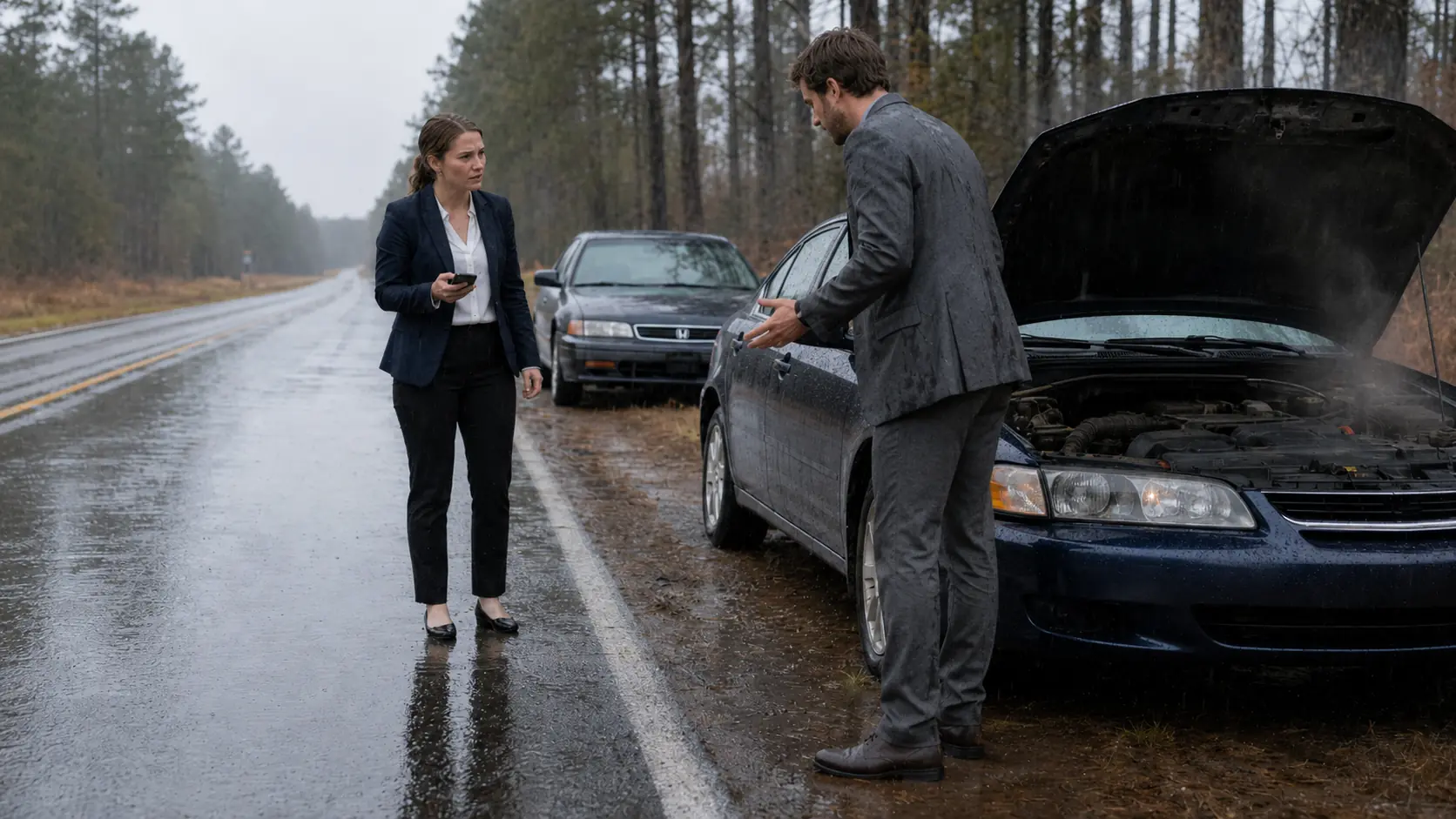
He walked back to his car feeling hollow. He had done the right thing, and it had cost him the one chance he had prayed for. When he called the warehouse to ask for more shifts, there were none available for the next few days.
At home, his mother Gloria was furious when he told her what had happened.
“You had one chance, Adam,” she said. “One chance to give Maddie a better future, and you threw it away for a stranger.”
“She was alone,” Adam said. “She was scared. She had no signal.”
“That was not your problem,” Gloria snapped. “Your problem is this apartment. Your problem is the bills on that counter. Your problem is your daughter.”
Her words hit him hard because part of him feared she was right.
Later, Maddie climbed into his lap and asked why Grandma was angry. Adam explained as simply as he could that he had been late because he stopped to help someone.
“But helping is good,” Maddie said.
“It is,” Adam answered softly. “But sometimes doing the right thing costs something.”
Maddie thought about that. “Like sharing a cookie?”
Adam smiled sadly. “Yes. Like sharing a cookie and having less for yourself.”
She nodded. “I’d still share.”
Adam held her close, trying not to cry.
Weeks passed. Adam returned to construction work under Carl, a rough but decent foreman who gave him steady shifts. The work was exhausting. Adam hauled lumber, carried cement, climbed scaffolding, and came home every night too tired to do more than make dinner, help Maddie with homework, and collapse.
He applied for engineering jobs at night, but rejections came one after another. He stopped telling people. He stopped hoping out loud.
Still, he thought about Sophie Brennan. He wondered if she had made it safely. He wondered if she remembered him. Then he told himself not to be foolish. To her, he was probably just a stranger who had helped on a bad morning.
Two months later, Adam was working on the fourteenth floor of a commercial building downtown when someone shouted that VIPs were coming to inspect the site. Workers straightened up. Supervisors appeared. A group of executives stepped from the elevator with Richard Hayes, the developer funding the project.
And behind him was Sophie Brennan.
Adam froze.
She looked completely different now. No frightened expression, no wrinkled blazer, no helpless pacing beside a broken car. She wore a tailored navy suit, her hair pulled back neatly, her posture calm and powerful. She moved like someone used to being obeyed.
Then Hayes turned to her and said, loud enough for Adam to hear, “Ms. Brennan, your investment in this project has been invaluable.”
Her investment.
Adam stared.
Sophie was not just a stranded commuter. She was one of the people funding the entire building.
Then she saw him.
Recognition crossed her face. She left the executives behind and walked straight toward him. The whole floor went quiet.
“Adam Walker,” she said softly. “The man who stopped.”
Adam swallowed. “Ms. Brennan.”
“I’ve been trying to find you,” she said. “I went back to that gas station. I asked around. I searched online. I didn’t know where to look.”
“You were looking for me?”
“Of course I was. You helped me when everyone else drove past.” Her expression shifted. “What happened with your interview?”
Adam looked down at his boots. “It didn’t work out.”
“Because you were late?”
“Because I was late.”
Sophie’s face changed. Something firm and determined appeared in her eyes.
“Adam,” she said, “we need to talk.”
She asked Carl to let Adam take a break, and ten minutes later, Adam sat across from her in an expensive coffee shop, still wearing dusty work clothes while businesspeople glanced at him from nearby tables.
Sophie ordered him coffee and told him the truth.
She was the CEO of Brennan Industries, one of the largest development companies in the region. Her father had built the company, and after his death, she had taken over. The morning Adam found her on Old Mill Road, she had been on her way to an important investor meeting. Her breakdown had caused her to miss much of it, and the consequences had been difficult.
“But that’s not why I needed to find you,” she said. “I needed to find you because of what you did. You had every reason to drive past me. You were on your way to something that could change your life, but you stopped anyway.”
Adam stared at his coffee. “It cost me everything.”
“I know,” Sophie said quietly. “That’s why I want to help.”
He looked up.
“I have connections,” she continued. “Including at Henderson and Associates. I can’t force them to hire you, and I won’t. But I can get you a fair second interview. No judgment based on that morning. Just your work, your qualifications, and your character.”
Adam could barely speak. “You’d do that?”
“You saved me, Adam. Let me open a door for you.”
Three days later, Henderson and Associates called. They invited Adam back for a second interview.
This time, Adam arrived forty-five minutes early.
Charles Henderson was still stern, still difficult to read. He made it clear that Sophie Brennan’s request had gotten Adam through the door, but nothing more.
“I reviewed your portfolio again,” Henderson said. “Your work is impressive. But I want to know why you stopped that morning. You knew what was at stake. Why help a stranger?”
Adam could have given a polished answer. Instead, he gave the truth.
“My wife would have wanted me to,” he said.
Henderson’s expression changed slightly.
Adam told him about Sarah, about the values she had lived by, about the kind of man he wanted Maddie to see when she looked at her father.
“I regretted losing the interview,” Adam said. “I regretted failing my daughter. But I never regretted helping Sophie. I couldn’t be the person who drove past.”
For a long moment, Henderson said nothing.
Then he quietly told Adam that his own wife had died years earlier, and that she, too, had believed character was revealed in costly choices.
The interview changed after that. Henderson asked about engineering. Real questions. Hard questions. Adam answered them with everything he had. They discussed bridges, load calculations, building codes, failures, lessons, and the kind of responsibility engineers carry when lives depend on their work.
The interview lasted two hours.
Five days later, Adam got the call.
Henderson and Associates offered him a senior structural engineer position with a real salary, full benefits, and a future.
Adam stood on the construction site holding his phone, unable to breathe. When Patricia from Henderson’s office welcomed him to the firm, tears filled his eyes.
He told Carl first. Carl shook his hand hard and said he always knew Adam was meant for bigger things. Even Derek, a younger worker who had mocked him for being “college boy,” apologized and congratulated him.
Gloria cried when he told her. She hugged him and said she had always believed in him, even when fear made her harsh.
Maddie’s first question was, “Does this mean we can get a dog now?”
Adam laughed and lifted her into his arms.
“Let’s start with a better apartment,” he said. “Then we’ll talk about the dog.”
Adam called Sophie that night.
“You did it,” she said.
“You made it possible.”
“I opened a door,” Sophie replied. “You walked through it.”
Two weeks later, Adam began work at Henderson and Associates. His office was small, with a desk, a computer, and a window that looked onto a brick wall, but to Adam, it felt like a palace. His name was on the door. His career was alive again.
The work was demanding, but he loved it. He remembered what it felt like to solve difficult problems, to think in structures and forces, to design things that would stand long after he was gone. Henderson watched him closely and soon began trusting him with more responsibility.
Adam also moved Maddie into a two-bedroom apartment on a tree-lined street near a small park. Maddie had her own room for the first time in her life. She chose pale purple paint and taped her old drawing of a house, a backyard, and a dog above her bed.
On the night they moved in, Adam sat on the living room floor surrounded by boxes and felt something he had not felt in years.
Home.
Months passed. Adam rebuilt his life piece by piece. His body recovered from construction labor. His confidence returned slowly. Maddie thrived at school. Gloria softened. Sophie became a real friend, meeting Adam once a month for coffee at the same table where she had first offered to help him.
Eventually, Henderson gave Adam the opportunity of a lifetime: lead engineer on a major bridge project across the river. It was the kind of project Adam had dreamed about when he was young, before grief and poverty had convinced him dreams were luxuries.
At the groundbreaking ceremony, Maddie stood beside him in a yellow dress, her hand in his. Gloria watched with tears in her eyes. Sophie stood among the Brennan Industries executives, smiling proudly.
Adam stepped to the podium and began with the technical details he had prepared, but then he stopped. Looking out at the crowd, he decided to tell the truth.
He told them about Old Mill Road. About a woman stranded beside a broken car. About the interview he lost. About the weeks when he thought kindness had ruined his future. Then he told them how that same act of kindness led him back to engineering, back to hope, back to the life he wanted for his daughter.
“This bridge will connect two parts of our city,” Adam said. “But long before we build with steel and concrete, we build with choices. We decide whether to stop or drive past. We decide whether to help or ignore. We decide what kind of people we are when no one is watching.”
The crowd applauded, but Adam barely heard them. Maddie ran to him and hugged his waist.
“That was amazing, Daddy,” she said.
Sophie approached afterward, her eyes bright.
“You reminded everyone what really matters,” she said.
Adam smiled. “You reminded me first.”
The bridge was completed eighteen months later, ahead of schedule and under budget. On opening day, Adam watched the first cars cross the span he had helped bring to life. Maddie squeezed his hand.
“You did it, Daddy.”
Adam looked at the bridge, then at his daughter, then at Sophie and Gloria standing nearby.
“We did it,” he said.
Later, Adam and Maddie adopted the dog she had dreamed about, a golden retriever puppy named Biscuit. Their apartment filled with laughter, paw prints, school drawings, engineering papers, and a kind of peace Adam once thought he would never feel again.
One evening, Maddie asked him why he had stopped for Sophie that day if he knew it might make him late.
Adam thought carefully before answering.
“Because I didn’t want to become the kind of person who drives past someone in trouble,” he said. “Sometimes kindness is easy. But sometimes it costs something. Those are the moments that show us who we really are.”
Maddie nodded, hugging Biscuit close.
“I’m glad you stopped.”
Adam smiled, feeling tears sting his eyes.
“Me too, baby girl. Me too.”
That night, after Maddie was asleep, Adam stood by the window and looked out at the city. Somewhere in the distance, the bridge he designed carried people across the river, connecting neighborhoods, families, workers, dreamers, and strangers.
He thought of Sarah. He thought of the promise he had made to give Maddie a good life. He thought of the morning he nearly kept driving but chose instead to stop.
For so long, Adam believed that kindness had cost him everything. Now he understood the truth.
Kindness had saved him.
It had brought Sophie into his life. It had restored his career. It had given Maddie a home, a future, and a father who was no longer just surviving.
Adam looked down at the old photo on his phone, Sarah holding newborn Maddie, both of them glowing with the life they had once imagined together.
“I did it,” he whispered. “I kept going. I took care of our girl.”
For the first time, the grief did not crush him. It stayed with him, gentle and quiet, a part of him but not all of him.
Tomorrow, he would go to work. He would design things that mattered. He would pick Maddie up from school, listen to her stories, walk Biscuit in the park, call his mother, and maybe meet Sophie for coffee again.
Life was not perfect. It never would be. But it was full again.
One act of compassion on a lonely road had changed everything. It had taught Adam that doing the right thing matters, even when it costs you. Especially when it costs you.
And for the first time in years, Adam Walker was no longer walking through darkness.
He was walking forward, head held high, heart open, toward the light.