My daughter tugged on my sleeve in the diner and whispered, “She looks like a princess.”
I chuckled and told her, “Maybe more like a queen.”
But the truth was, I had no idea who this woman really was, or how much she would change our story.
Rain hammered the sidewalks like a thousand small fists, turning the streetlights into fuzzy halos and soaking Jason’s jacket through to the lining before he could cross the block with Lily tucked under his arm.
He leaned his shoulder into the wind, shielding her head, counting the steps to the bus stop the way he always did after the night shift at the public library.
Thirty-two, curb, twenty more, light pole.
Just enough routine to feel like control.
He told himself the weather would pass, that seven-year-olds forget the cold if you make a game of it. And he lowered his voice into playful seriousness.
“Captain Lily, we’re cutting through the storm.”
She giggled into his collar and tightened her grip.
Jason was a single father. Routine was the rope he climbed every day.
He saw her at the corner. First a blur, then a figure.
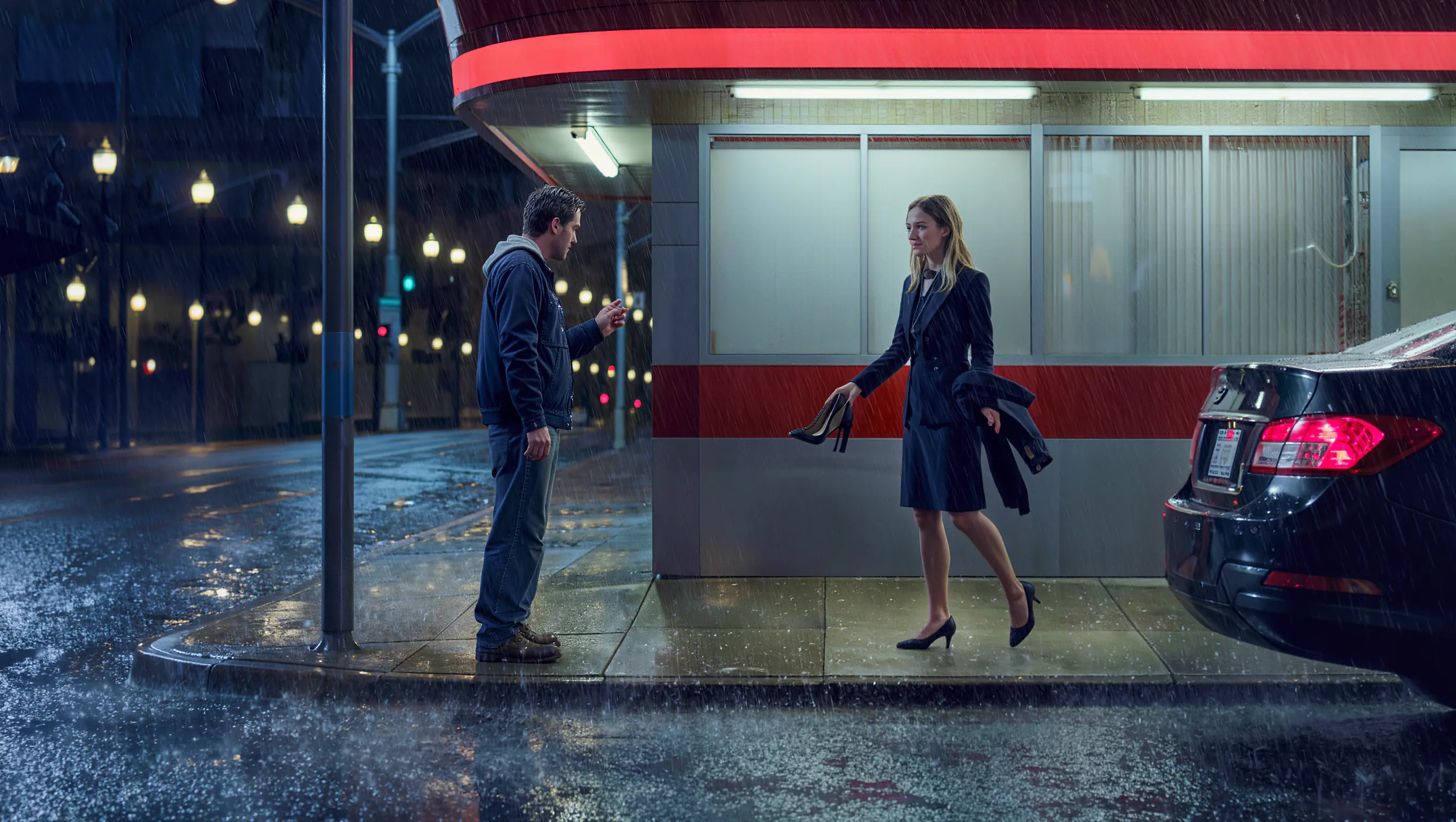
A woman in a business dress, bare feet on the wet curb, heels dangling from two fingers like an afterthought. Mascara traced the edges of her eyes in soft lines that the rain had not managed to erase, and she moved with the careful confusion of someone trying to remember where the ground lived.
She did not belong to this sidewalk.
Not tonight.
People funneled around her, hoods up, faces down, the way crowds learn to step over a dropped photograph.
Jason slowed.
He had somewhere to be, someone to keep warm. And yet the world narrowed to the way her shoulders curled against the rain.
“Miss, are you okay?” he asked, keeping his body between her and the street, Lily’s fingers still clutching his jacket.
He made his voice a bench, something to sit on for a second.
The woman blinked at the sound, trying to pull the present into focus.
“I… I missed my driver,” she said, each word choosing its footing. “They left me.”
The confession landed like a small, breakable thing between them.
Lily peered out, solemn as a little judge.
Jason felt the old knot in his chest, the one that tied him to every version of trouble he had ever walked through, tighten and hold.
“You’ll catch pneumonia out here,” he said.
Then, because it mattered to say it, he added, “I’m not trying to bother you. I’ve got a kid with me. Let me help you get safe.”
He heard his own caution and recognized it, the line a man draws when he knows the world reads him before it listens.
The woman’s balance wavered. Her toes curled against the cold, and a shiver climbed her arms. For a second, she looked past him like maybe the car would reappear if she stared hard enough.
It did not.
She nodded.
Jason nodded too, as if they had agreed to something more than a ride.
He raised his free hand and tried to flag a cab.
Headlights slid by in watery streaks. The first driver did not see him. The second did and did not care. The third angled toward the curb with the impatience of a man who believed rain was other people’s fault.
Jason hustled them closer, guiding the woman by the elbow, but letting her choose the pace, a choreography he had learned after Lily: how to help without taking.
“In you go,” he said gently.
Lily scrambled across the seat to make space, her small knees bumping forward like happy punctuation.
Jason patted his pocket, found the last twenty he had promised would stretch to Friday, and watched it turn into a wet green flag in his palm.
He did not hesitate.
Inside the cab, the city smeared into a watercolor. The woman pressed Jason’s jacket close around her, gathering the fabric beneath her chin as if it could teach her how to be warm again.
Jason studied the small map of raindrops clinging to a strand of her hair.
“You were in trouble,” he said. “I’ve been in trouble too. Nobody helped me then.”
He paused, letting the honesty stand on its own feet.
“I promised myself if I ever saw someone in that place, I wouldn’t walk away.”
Lily watched her father as if hearing those words for the first time, even though they were the quiet law of their household.
The woman looked at him like something was clicking into place, like the outline of a memory had just found its color. Her hand drifted across the seat until her fingers touched his.
Not pleading.
Not romantic.
Just an anchoring gesture.
Proof that the night still held a human edge.
“What’s your name?” she asked.
“Jason Miles.”
For a heartbeat, she went still.
Her breath caught, a surprised stillness that seemed bigger than the moment.
And then the exhaustion, patient and heavy, finally claimed what the rain had started. Her head tipped against the window. Her eyes slipped closed.
“It’s okay,” Jason murmured, adjusting the jacket so it covered her shoulders.
Lily mirrored him, tugging at the hem with solemn concentration.
When the cab stopped, Jason paid and guided them back into the weather’s gray breath. He considered the options in a quick inventory, none of them generous, all of them real, and chose the one he could stand behind in the morning.
He spoke to the dispatcher he knew, the one who never asked too many questions, and then to a women’s shelter that would.
“Her name’s unknown,” he said, giving his own contact, making sure his tone promised respect.
The van’s hazard lights blinked like a tired heartbeat as it pulled to the curb.
Jason lifted the woman carefully into the staff’s waiting care, the way you lift a sleeping child, supporting weight, protecting dignity.
The door slid shut.
The rain softened as if the sky had stepped back to breathe.
Jason stood with Lily’s hand in his, feeling the quiet after a decision, not knowing the night had just threaded itself into his future.
He turned for home. Lily squeezed twice, her code for “I’m okay,” and he answered with two squeezes back.
Routine returned.
Thirty-two steps, curb, twenty more, light pole.
But something had shifted, the way a room changes when someone places a new photograph on the shelf.
He did not have words for it yet.
He only had the jacket missing from his shoulders, the lightness that followed the giving, and the thought that sometimes the right thing is simply the next thing done without an audience.
Behind him, the taillights of the shelter’s van dwindled to two faint rubies and disappeared into the rain.
Before the shelter’s van and the rain’s calmer breath, there was a wedge of light in the night: the twenty-four-hour diner by their neighborhood, windows fogged, chrome edges bright as coins under fluorescence.
After the cab ride, Jason guided the woman and Lily through the door, a bell chiming like a small mercy. He slipped his jacket over the woman’s shoulders again and steered them toward a booth near the back, away from the draft that worried the floor.
It was warm here. It smelled of coffee and butter, and the kind of bread that forgives a day.
Jason’s last twenty had already gone to the fare. He decided he would make plain choices and make them count.
He caught the waitress’s eye, someone who had learned to read stories in the way people held themselves, and asked quietly for a mug of coffee, a glass of water, and some bread.
“Something gentle,” he said, half to her, half to the woman blinking under the jacket’s weight.
The waitress nodded and moved like a person who knew that speed could be a form of kindness.
Lily slid in beside her dad, knees bumping the vinyl with soft thumps. She stole glances at the woman, curiosity wrapped in caution. Jason kept one hand on the table open, the other resting near Lily’s shoulder, a touch without pressure.
“She looks like a princess,” Lily whispered, finally giving her wonder somewhere to sit.
Jason smiled despite the tiredness tugging at the corners of his eyes.
“She’s probably more like a queen,” he said, voice low, not to make light of the woman’s condition, but to offer Lily a shape that included dignity.
The woman heard that somewhere beneath the dizziness, the room’s soft spin, and she lifted her eyes as if answering to a title.
Her makeup had shifted in the rain, but the bones of her composure showed through now that the cold was loosening its hold.
The coffee arrived, steaming.
Jason wrapped the woman’s fingers around the mug so the heat could teach them how to be hands again. He nudged the water and bread forward.
“Sip this. Small sips,” he said.
She obeyed with the concentration of someone crossing a narrow bridge.
She watched him between sips. The thrift of his movements, the care that never turned into fussing, the way he stayed a half step back so she could keep whatever space still belonged to her.
There was no performance to it.
He was a man who had rehearsed this kind of steadiness in other rooms on other hard nights, and it fit him like something earned.
“Why?” she asked at last, the word both quiet and undeniable.
Her eyes had cleared enough to let the question carry weight.
“Why would you help me? You don’t even know me.”
The diner hummed around them: silverware, a cough, the soft laughter of second-shift workers done with their long hours.
Jason considered telling her everything, how trouble had once been a room he could not leave, how he had waited for a stranger’s hand and none had come.
But he knew some stories matter more when they are not retold.
“You were in trouble,” he said simply. “I’ve been in trouble too. Nobody helped me then. I promised myself if I ever saw someone in that place, I wouldn’t walk away.”
The promise felt the same every time he said it, like checking a door he had locked.
The woman studied him, and something in her gaze shifted from gratitude to recognition, the sense that she was not just being rescued, but being seen at her exact height.
She reached across the table and touched his hand, not to cling, but to mark the moment.
“What’s your name?”
The question felt ceremonial, like giving a shape to the person who had been only kindness until now.
“Jason Miles,” he answered.
The syllables settled between them.
She drew in a breath as if the sound had brushed against a memory she had been trying to place. Then the exhaustion that had been patient all this time rose up and closed its hand.
Her grip loosened. Her eyes fluttered. The coffee steam blurred. She slumped gently against the booth.
Jason caught the jacket before it slipped and tucked it closer around her. He glanced at Lily, who had gone very still, serious in the way children become when the room asks for it.
“She’s safe,” he said, because the words would become true if he guarded them.
He signaled the waitress, lowered his voice, and asked for a minute and the phone. He had done this once before for a stranger, learned which number to dial, which questions would come.
He gave the shelter what he had: her name was unknown, and then his own contact, his tone careful to carry respect rather than ownership.
He did not read the woman’s purse. He did not look for clues. He understood the boundary between help and intrusion like it was a map he carried folded in his chest.
When the shelter van arrived, hazards ticking in the wet like a metronome, the staff came in with practiced gentleness.
Jason lifted the woman with them, sharing the weight, making sure her head did not knock the door frame. He thanked the waitress, gathered Lily’s hand, and watched the team do what they were trained to do.
There was relief in handing a person to people who had built their lives around this kind of night.
As the van door slid shut, he felt the soft aftersound a decision leaves behind, the quiet that is not silence but completion.
Outside, the rain had moved from anger to persistence. Inside, the diner returned to its own ordinary courage. More coffee poured, plates cleared, life proceeding as though compassion were just one of the chores.
Jason exhaled, rubbed his thumb over Lily’s knuckles twice, and nodded toward the door.
“Home,” he said.
Lily’s answering nod was small and solemn.
He held the empty shape of his wallet in his mind and let it pass.
The math could be sorted tomorrow.
Tonight had already taught Lily something he had wanted her to know: that people are not problems to avoid in the rain.
They stepped back into the weather, carrying with them the warmth of the booth and the promise that the right act done without fanfare can change the direction of a life sometimes too.
The rain had not let up by the time the van pulled away from the diner, its red lights dissolving into the blur of wet asphalt.
Jason stood still, Lily’s small hand folded inside his, listening to the rhythm of rain against metal roofs and car hoods. The woman, who still had no name, was gone into the care of others, and yet her absence pressed against him in a way that was oddly present.
He told himself he had done what was right, placed her where warmth and walls could hold her, where strangers had dedicated themselves to the work of protection.
Still, some part of him remained with her, inside the van, like a coat he had not collected.
Carrying Lily through the short walk home, Jason felt the familiar tug between exhaustion and responsibility. She leaned her head against his shoulder, warm breath steady, the trust of a child absolute.
“Daddy,” she murmured drowsily. “Will she be okay?”
The question hit like a pebble against glass. Not hard enough to shatter, but impossible to ignore.
Jason adjusted his grip on her and answered with quiet conviction.
“Yes, sweetheart. She’ll be okay now.”
He did not tell her that sometimes okay depended on fragile threads, strangers keeping promises, systems not forgetting. Instead, he let the word be strong enough to steady her heart.
At home, the apartment greeted them with the smell of damp laundry and the faint drip of the kitchen faucet he kept meaning to fix.
He set Lily in bed, pulled the blankets high, and smoothed her hair. She fell asleep quickly, the way children can when they believe safety is permanent.
Jason lingered a moment longer, watching her face relax before retreating to the worn couch with springs that had learned the shape of his back.
The jacket he had given the woman was still missing, but in its absence, he felt something like relief. It had carried its usefulness as far as it needed to go.
The next morning, his alarm broke the silence at six.
He rose for work as always, boots on before the sun.
There was no sign of the woman in his mind until he passed the diner again, now quiet in the early light. The booth was empty, wiped clean, as if the night before had been a sketch erased from the paper.
He caught himself searching the corner window, half expecting to see her reflection, and shook his head at the foolishness of it.
He reminded himself, “People cross your path. You help if you can, and then they go where you cannot follow.”
That was the truth of it.
Throughout the week, routine wrapped itself tightly around him again. Long shifts at the library, Lily’s school meetings, the leaking faucet that resisted every wrench he owned.
Still, in the quieter minutes, the image of her lingered.
Bare feet on wet pavement.
Mascara blurred by rain.
Eyes asking questions as though answers might change her.
He replayed her hand touching his, tentative but deliberate, and her voice catching on his name. The sound haunted him, not because it promised anything, but because it had seemed to recognize something in him he did not know was visible.
On Thursday evening, as he folded Lily’s clothes into neat piles for the weekend, the phone rang once, a number he did not know.
He froze, waiting for the second ring, but it never came.
The silence that followed felt heavier than the sound.
He told himself it was nothing, maybe a wrong number, and yet his chest carried the pulse of anticipation long after he set the receiver back down.
He had given the shelter his contact information. Perhaps they would call if she needed something, or if she remembered his name.
But no call came.
By Sunday, the rain had passed, leaving the city scrubbed in early autumn light. Jason carried the trash out, Lily skipping beside him, her laughter chasing pigeons off the curb.
The ordinary life he had built, the one of routines and small promises, resumed its steady march. And though he would have sworn he had let the memory of that night drift away, he caught himself looking once more toward the street, as if the van might return, or a face might reappear among the moving crowd.
He shook the thought free.
It was just a night, he told himself.
Just a stranger helped, nothing more.
But the truth was quieter and less dismissible.
Some part of him knew that the story had not closed. It had only been folded like a letter slipped between the pages of a book, waiting for a hand to open it again.
The week unfolded with the weight of habit. Each day stitched to the next by necessity rather than choice.
Jason moved through it the way a man does when there is no luxury of pause. Boots on, jacket zipped, Lily’s hand in his before sunrise.
The library’s quiet hours stretched long, mops and polishers humming in corridors that smelled faintly of old paper and disinfectant.
He found a certain peace in the work, though his back ached and the paychecks never seemed to climb high enough. Peace was not abundance. It was survival without collapse.
Each evening, he retrieved Lily from the neighbor’s flat two doors down. Mrs. Alvarez would hand her over with a gentle pat on the head, a reminder that kindness still lived in small places.
Jason always thanked her twice, once for the watchfulness and again for never letting Lily feel like a burden.
Then he would carry his daughter upstairs, listening as she recited bits of her school day, stories woven with the untamed logic only children can manage.
It anchored him more than any paycheck ever could.
Yet in the spaces between, when dishes were drying on the rack, or when Lily hummed to herself as she colored, his mind would flicker back to the woman. Not in the shape of longing, but in the sharper outline of questions.
Who had she been waiting for that night?
Did anyone come looking for her?
Had she even remembered the man who gave her his jacket and his last twenty?
He told himself it did not matter.
He had done what was right, and that was enough.
But still, her voice lingered in the quiet, asking his name as though it meant something.
The faucet in the kitchen worsened, the drip turning to a stubborn leak that painted the sink basin with restless rhythm.
Jason knelt under the cabinet with a wrench, shoulders wedged against splintered wood. He muttered under his breath, coaxing old pipes like they were mules.
The repair did not hold, but the effort kept his hands busy.
Sometimes he thought about how much of life felt like that: temporary fixes, patched holes, moments held together by determination rather than design.
He had grown used to it.
Lily deserved better, but this was what he could give until the world widened.
Friday arrived with the weight of fatigue.
Jason stood in the school auditorium, folding himself into one of the small chairs while Lily’s class rehearsed for their upcoming program. She waved from the stage, grin loose and unselfconscious, and he lifted a hand back.
Parents filled the seats around him, murmuring about vacations, promotions, home renovations.
Jason sat silent, not ashamed, but aware.
His world did not stretch as far as theirs.
He reminded himself that Lily did not measure love in square footage or dollar signs. She measured it in presence, and in that, he never failed her.
That night, after Lily was asleep, he stepped onto the balcony with a chipped mug of tea. The city pressed around him, sirens at a distance, the murmur of traffic like a restless tide.
He thought again of the woman’s eyes when she had asked why he had stopped for her, and the way she had looked at him as though she had glimpsed more than just a man trying to do right.
He shook his head, almost embarrassed by the persistence of the memory.
She was gone.
The shelter would see to her.
His part in her story had ended.
And then, on Saturday morning, as Jason sorted laundry into uneven piles, the rumble of a sleek engine broke the rhythm of the street.
He looked out the window to see a black car pulling up, its surface gleaming like ink spilled across the curb.
For a moment, he thought it must be for someone else. No one came to his block in a car like that.
But when the door opened and a tall woman in a crisp blue suit stepped onto the pavement, Jason’s breath caught.
The face was unmistakable, though changed.
No mascara smeared.
No stumble in her walk.
Only composure sharpened to brilliance.
Her eyes found his window with unnerving precision.
The woman he had almost forgotten was standing outside his apartment.
The hum of the car’s engine lingered even after it shut off, like an echo not quite ready to leave the street.
Jason leaned slightly against the window frame, still holding a pair of mismatched socks in his hands, heart stumbling in his chest.
The woman who had been a rain-drenched stranger was now standing on the cracked pavement of his block, radiant and composed, the kind of presence that bent the attention of the street toward her.
The blue suit she wore fit her like armor, crisp lines and quiet authority. But it was her eyes that caught him: familiar, brown, and softened by something he could not name.
Jason shook himself free from the pause and set the socks aside.
He called for Lily, who padded in with a toy clutched to her chest.
“Stay inside for a second,” he murmured, brushing her hair back.
He stepped down the narrow stairwell and pulled open the apartment door.
She was already halfway up the walk, heels clicking with measured purpose, an envelope tucked under one arm. Rain no longer washed her face clean. Now she wore the calm power of someone who knew exactly who she was.
Yet when she reached him, she smiled.
Not the polite smile of a businesswoman, but something more personal.
“Jason Miles?” she asked.
Her voice was clear, steady, carrying a note of recognition that unsettled him.
“Yeah,” he said slowly, unsure if this was still about that night or something altogether different.
She extended the envelope.
“I’m Veronica Clark, CEO of Clark Enterprises.”
Jason blinked, struggling to reconcile the woman before him with the figure he had carried into a shelter van days ago.
“Clark Enterprises,” he repeated, the words clumsy on his tongue.
It was a name he knew from billboards, news articles, even the donation plaque in the library lobby where he scrubbed floors after midnight.
“You’re that Veronica Clark.”
Her smile deepened faintly at his disbelief.
“The very same.”
She held out the envelope.
“This is for you.”
Jason hesitated before taking it, fingers brushing hers. The paper was heavy, the kind you do not waste on ordinary correspondence.
He tucked it against his palm as though afraid the rain might return and wash it away.
“I don’t understand,” he said.
“You will,” she promised.
There was no arrogance in her tone, only certainty.
From the window above, Lily’s small face peeked out, framed by the curtain. She was careful, like her father had taught her, but her eyes were wide with curiosity.
Veronica noticed, her gaze softening.
“That’s your daughter?”
“Yes,” Jason said, his voice instinctively protective.
“She’s beautiful.”
Jason cleared his throat, unsure what to do with the compliment.
“She keeps me moving.”
For a long moment, the street seemed suspended between them, his modest apartment with its peeling paint, her polished presence, the envelope bridging the distance.
He wondered what she had come for, why she had remembered him at all.
The night at the diner had felt like something sealed, closed. But here she was, standing on his sidewalk, rewriting the ending he had accepted.
Finally, Veronica gestured toward the envelope in his hand.
“Everything you need to know is in there. I don’t want to overwhelm you, Jason, but I’ve been looking for you for a long time.”
The words fell into him like a stone dropped into water, creating ripples he could not control.
He opened his mouth to ask what she meant, but the questions scattered under the weight of her certainty.
Instead, he nodded, the only gesture that seemed possible.
“Read it when you’re ready,” she said gently.
Then, with a glance at Lily still watching from the window, she added, “I’ll explain everything, but I wanted to see you first, to make sure you knew I wasn’t just a name on paper.”
Jason stood rooted to the step as she turned back toward the car. The door closed behind her with a soft thud, the black surface swallowing the reflection of the street.
The engine stirred again, low and expensive, and the car eased away from the curb.
He looked down at the envelope, heavy in his hand, his name written in ink across the front.
The world had tilted in a way that felt both dangerous and full of promise.
He climbed the stairs slowly, opened the apartment door, and saw Lily waiting with wide eyes.
“Daddy,” she whispered. “Is she the queen?”
Jason did not answer right away.
He set the envelope on the kitchen table, staring at it as though it might open itself.
Finally, he murmured, “Maybe. Or maybe she’s something else entirely.”
Jason sat at the kitchen table long after the black car had gone, the envelope untouched, his fingers drumming against the wood in a rhythm he did not recognize.
The apartment was quiet except for the steady drip of the faucet in the sink, a sound that suddenly seemed louder than it had all week.
Lily perched on the couch with her toy, watching him with the patient curiosity of a child who senses something is happening, but does not know if it is safe to ask.
He drew a long breath, slid a finger beneath the flap, and opened the envelope.
Inside was a letter printed neatly on heavy paper. At first glance, it looked official, even sterile. But as he began to read, Jason realized the words were anything but.
Mr. Miles,
Years ago, Clark Enterprises created a philanthropic initiative to support single fathers across the country, men who carried extraordinary burdens with quiet strength. We received hundreds of applications. Yours was among them.
Jason’s breath caught.
He remembered that application.
He had filled it out late one night after Lily had finally gone to sleep, hunched over the kitchen table with a dull pencil and a stubborn hope. He had written about losing his wife, about raising a daughter with nothing but grit and prayer, about wanting to give her more than survival.
And then nothing.
He had mailed it, waited weeks, and heard silence.
Your application never reached us, the letter continued. It was misplaced in an administrative error. I discovered this months ago during an audit, and it has weighed on me ever since. I gave my word to myself that I would find you. At the time, all I had was your name, Jason Miles. I did not know if you still lived where you once did or if life had carried you elsewhere. But I promised myself I would not stop until I found you.
Jason’s hand tightened around the page.
His name, his ordinary, unremarkable name, had been carried through time and circumstance by a woman who had no reason to remember him.
He read on, pulse quickening.
I did not recognize you the night we met. But when I saw what you did, not for me as a CEO, but for me as a woman alone and vulnerable, I realized I had finally found the man I had been searching for. It was not just chance. It was perhaps the way the world insists on weaving people back into one another’s stories when the time is right.
Jason leaned back, the letter trembling slightly in his hands.
He remembered her eyes in the diner, the weight of her hand on his, the way she had whispered his name before exhaustion claimed her.
He had thought it was coincidence.
Now it felt like something larger, something deliberate, even if unseen.
The letter closed with an offer.
I want to correct what should have been corrected years ago. Not because you helped me that night, but because you are the kind of man this world needs. I want to offer you stability, a position that matches your integrity, and a chance for your daughter to grow in an environment worthy of her. This is not charity, Jason. It is recognition. Please, let me meet with you again.
The signature at the bottom was bold and confident.
Veronica Clark.
Jason set the letter down, staring at the name until it blurred.
His first instinct was disbelief.
Letters like this did not arrive at chipped kitchen tables.
Then came the wave of memory. Long nights stretching every dollar. Fixing leaks that would not stay fixed. Wondering if Lily noticed how often he chose not to eat so she could have enough.
And now this.
An offer that promised something better.
Not just for him, but for her.
Across the room, Lily slid off the couch and padded toward him.
“Daddy,” she whispered, peering at the paper. “What does it say?”
Jason folded the letter carefully, his throat tight. He crouched down so his eyes met hers.
“It says someone out there thinks we deserve more than this.”
Lily tilted her head.
“Serious? Is it the queen?”
Jason smiled faintly, brushing her hair back.
“Maybe,” he said. “But she doesn’t want us to bow to her. She wants us to stand up taller.”
He hugged his daughter close, the weight of the letter still pressing against his palm.
And for the first time in years, Jason felt that the future might hold more than just endurance.
It might hold possibility.
Jason barely slept the night after reading the letter.
He lay awake on the couch, staring at the ceiling while the refrigerator hummed and clicked in the corner. Each time he closed his eyes, he saw Veronica’s name in bold ink, her words pressing against the edges of his thoughts.
By dawn, he had made no decisions, only promises to himself that whatever happened, he would not let Lily be swept into something uncertain.
When the knock came later that afternoon, it was firm but not aggressive.
Jason opened the door to find Veronica standing there again.
No longer the rain-soaked woman in distress, nor the untouchable CEO glimpsed from afar, but something between the two: confident yet open, businesslike yet softened by recognition.
She carried no entourage, no assistants, just herself.
“May I come in?” she asked.
Jason stepped aside.
The apartment was small, worn at the corners, but she walked in without a glance of judgment. Instead, her eyes searched the room as though memorizing it, as though she wanted to understand the shape of his life before speaking.
Lily peeked around the hallway, cautious.
Veronica smiled at her, lowering herself slightly to meet the girl’s gaze.
“Hello, Lily,” she said gently. “I don’t know if you remember me.”
“You’re the queen,” Lily said matter-of-factly, clutching her toy rabbit.
Veronica laughed softly, not mocking, but delighted.
“I’m not a queen, but maybe your father is braver than one.”
She turned back to Jason, eyes steady.
“May we sit at the table?”
The letter lay folded. Jason gestured to it.
“I read it. I still don’t understand why someone like you would go through all this trouble.”
Veronica leaned forward, hands clasped.
“Because it wasn’t trouble. It was a responsibility. When I learned that your application had been lost, I knew something precious had been denied. Not just money, but recognition. I’ve spent years signing checks and creating programs, but most of the time I never see the people behind them. You reminded me why those programs exist.”
She paused.
“That night in the rain, you could have walked away. Most people did, but you didn’t. That told me more about you than any application ever could.”
Jason swallowed, uneasy under the weight of her words.
“I didn’t do it to be noticed. I just did what needed to be done.”
“That,” she said firmly, “is exactly why I’m here.”
From her bag, she pulled another envelope larger than the first. She slid it across the table.
“Inside is an offer. Employment at Clark Enterprises. A leadership role. Not cleaning floors or patching leaks, but guiding people. You have the character I want at the center of my company. Along with that, there is housing, a place where Lily will have her own room, her own desk for schoolwork, and schooling itself. We can help ensure she attends the kind of institution where she will be nurtured, not overlooked.”
Jason stared at the envelope, unwilling to touch it.
“This feels like charity.”
“No,” Veronica said, shaking her head. “Charity is pity wrapped in money. This is recognition. I believe in you, Jason. I believe in the way you choose to act when no one is watching. And I believe your daughter deserves a foundation stronger than the one you’ve been forced to build alone. You’ve carried the weight for too long. Let someone else shoulder part of it.”
Lily slipped into the kitchen, her rabbit dangling from one hand. She looked at her father, then at Veronica.
“Daddy,” she asked softly. “Is she here to help us?”
Jason met his daughter’s eyes and felt the question settle into him.
Help had always been something he gave, never something he expected to receive.
For a long moment, silence stretched between the three of them.
Then Jason exhaled, slow and steady, and reached for the envelope.
“I don’t know what comes next,” he admitted, voice low. “But if it means Lily has a better life, I have to try.”
Veronica’s expression softened into something beyond satisfaction.
Something like relief.
“Then let’s take the next step together,” she said.
And for the first time in years, Jason felt the weight on his shoulders lighten just enough to let hope step through the door.
The days that followed moved like a tide, pulling Jason toward a shore he had never believed he would reach.
Clark Enterprises was not just a company.
It was a world.
The first time Jason walked into the glass-paneled lobby, Lily’s small hand wrapped tightly in his, he felt as though he had stepped into another version of his own life. One where ceilings stretched high and doors opened without protest.
Employees in pressed suits greeted Veronica with respectful nods, but she redirected the attention toward him, introducing him not as a charity case, but as Mr. Jason Miles, our new leadership hire.
Jason’s heart thudded in his chest.
For years, his worth had been measured in mop strokes and overtime shifts. Now, people looked him in the eye as if his presence carried weight.
He kept glancing down at Lily, half expecting her to ask if they belonged there.
Instead, she squeezed his hand twice, her secret code for “I’m okay.”
Jason answered back with the same squeeze, though inside he was anything but steady.
Veronica guided them through each step with a patience that surprised him. She made clear that this was not a favor to be repaid, but an opportunity he had already earned.
“Your integrity is your resume,” she told him in her office one evening, the skyline glowing behind her. “Everything else can be learned, but character, that’s what I need around me.”
Jason nodded, humbled, words caught somewhere between gratitude and disbelief.
Life began to shift in small, almost imperceptible ways.
The new apartment was modest by Veronica’s standards, but luxurious by his. Two bedrooms, a kitchen that did not leak, windows that actually closed against the wind.
Lily decorated her room with drawings taped to the wall and books stacked neatly on her new desk. Jason watched her fall asleep that first night, surrounded by space she could finally call her own, and felt tears threaten.
He whispered into the quiet, “This is what you deserve,” though she was already dreaming.
At work, Jason found himself learning quickly.
The position required managing a team, solving problems that stretched beyond mops and tools. But the same qualities that had carried him through long nights, persistence, attention, the refusal to abandon people, translated seamlessly.
Co-workers respected him, not because Veronica said they should, but because he listened when they spoke and acted when others hesitated.
Slowly, the janitor who had once been invisible became someone others sought out for guidance.
And Veronica, once a stranger on a rain-slick curb, became more than a benefactor.
She visited Lily’s school play, sitting in the audience like family, cheering as loudly as Jason did when his daughter delivered her lines. She stopped by their apartment for dinners that were simple but filled with laughter, trading her tailored suits for rolled-up sleeves and stories that made Lily giggle.
There was no pretense between them, only the steady weaving of lives that had been running parallel until fate pressed them together.
One evening, as they walked home from the park, Lily tilted her head up at Veronica and asked the question that had lingered since the diner.
“Are you really a queen?”
Veronica knelt, smiling.
“No, sweetheart. But maybe your dad is the real king.”
Her words carried no irony, only admiration.
Jason felt the truth of it land inside him, not as grandeur, but as acknowledgment of the quiet strength he had carried for so long.
Jason looked down at his daughter, then at Veronica beside her, and realized something profound.
Kindness had been the seed, but this was the harvest.
Not riches.
Not titles.
But family.
A family rebuilt not from blood or luck, but from choices. His choice to stop that night in the rain, and her choice to search until she found him.
From then on, Jason’s life was not defined by what he had lost, but by what he had chosen to give.
And in giving, he had received something unexpected.
A legacy Lily would carry forward.
Proof that compassion was never wasted.
It was a foundation strong enough to build a future.