The fire-scorched helicopter sat beneath the hangar lights like a wounded animal everyone had already agreed to bury. Black soot ran down its blistered white fuselage, the windows were clouded by smoke, and several access panels hung open where mechanics had searched for catastrophic damage. Thirty technicians stood around it in exhausted silence, their tools scattered across carts and the concrete floor. For six days, the aircraft had turned over, coughed once, and refused to start.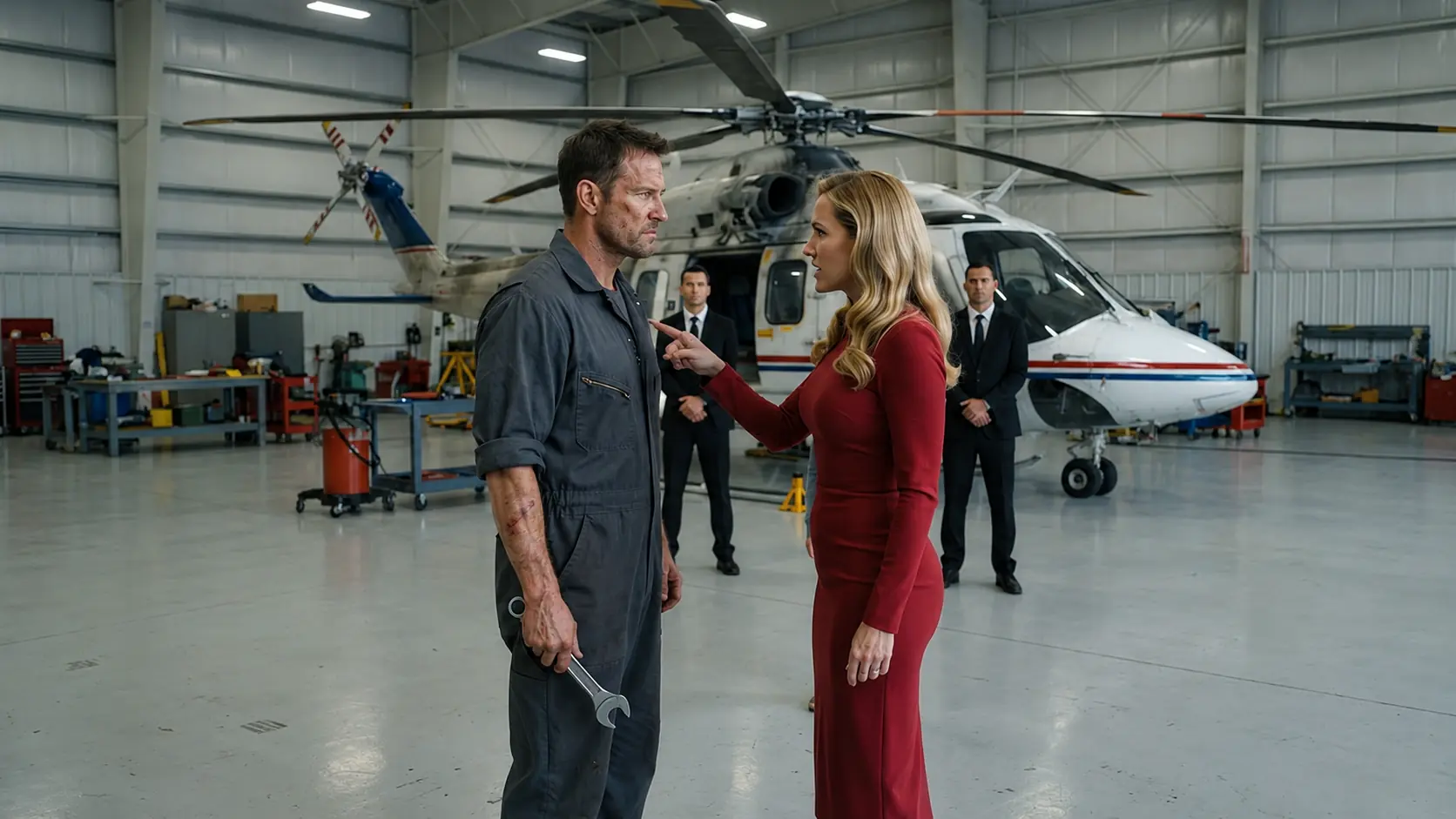
Camille Sterling stood in front of them wearing a fitted crimson-red dress and black heels that clicked sharply whenever she moved. At forty-four, she controlled an aviation empire worth billions and carried herself like every room belonged to her before she entered it. Her long blonde hair remained perfectly styled despite the heat inside the hangar, and irritation sharpened her blue eyes. She had spent nearly a week paying elite technicians to fail, and patience was not among the qualities that had made her rich.
Three corporate security guards stood behind her in dark suits. One held a tablet displaying the escalating repair costs, while another recorded the confrontation on a phone because Camille wanted the humiliation documented. She had decided the helicopter was finished and intended to prove that repairing it was financially foolish. The three-million-dollar wager was less a challenge than a public execution of everyone who still believed the aircraft deserved another chance.
Wyatt Briggs stood at the edge of the crowd beside his eleven-year-old daughter, Sadie. His charcoal coveralls were stained with old hydraulic fluid, his work boots were worn nearly smooth, and a faded scar disappeared beneath his rolled left sleeve. Unlike the technicians who stared at the burned panels, Wyatt studied the helicopter’s posture. He looked at switches, safety latches, soot patterns, and the position of the emergency controls.
Sadie held his battered diagnostic tablet against her chest. She had inherited his dark hair, serious gray eyes, and inability to ignore anything broken. Their garage contained drawers filled with switches, radios, toys, and appliances she intended to repair someday. Wyatt often found her rebuilding classroom staplers while her unfinished homework sat beside her.
Camille had laughed when he accepted the wager.
“You?” she asked. “Thirty certified mechanics failed, and you think you’re walking in from some roadside garage to save us?”
“I didn’t say I think I can.”
“What did you say?”
“I said I can.”
The certainty in his voice irritated her more than arrogance would have. Arrogant men usually became nervous when challenged by money or authority. Wyatt looked almost indifferent to both. He seemed concerned only with the machine behind her.
Camille pointed toward the helicopter. “Six minutes.”
“Five will do.”
“If you touch it and cause further damage, I’ll take the cost from whatever miserable business you own.”
Wyatt looked at the finger pressed against his chest. “Move your hand.”
She jabbed him again.
Wyatt knocked it aside.
The security guards stepped forward together, but Sadie moved between them and her father before anyone could touch him. She was small compared with the men, yet the fury in her face made the closest guard hesitate.
“My dad didn’t threaten her,” she said. “She threatened our home first.”
Camille glanced at the girl. “Your father entered a professional hangar and challenged people far more qualified than he is.”
Sadie looked toward the disabled aircraft. “Then they should have fixed it.”
Several mechanics lowered their eyes to hide smiles.
Camille’s mouth tightened. “Start the clock.”
A technician activated the timer on the hangar wall.
6:00.
Wyatt walked toward the helicopter without hurrying. Sadie followed until he raised one hand, signaling her to remain outside the marked safety line. The mechanics watched him approach the machine they had disassembled, tested, and condemned. Some looked irritated; others seemed desperate for him to find what they had missed.
The helicopter had belonged to a regional aerial-firefighting company recently purchased by Sterling Aviation Services. Three weeks earlier, it had spent nine hours attacking a wildfire threatening Silver Creek, the mountain town where Wyatt and Sadie lived. It had flown through smoke thick enough to hide the ground and heat strong enough to blister paint from its lower panels. The aircraft’s final water drop had stopped the flames less than a mile from Sadie’s school.
During its last flight, an engine-compartment fire warning appeared. The crew performed the emergency procedure, cut the fuel supply, activated suppression, and landed in a clearing. The aircraft came home by transport truck, burned but structurally intact. Camille saw an obsolete machine that could be replaced and written off for tax purposes.
Wyatt saw the bird that had saved his daughter’s school.
He stopped beneath the open engine panel. The other technicians had replaced wiring, tested injectors, removed control modules, examined turbine blades, and inspected every surface damaged by heat. Expensive diagnostic equipment remained connected to the aircraft. Yet Wyatt did not touch any of it.
He placed one palm against the scorched fuselage.
Camille glanced at the timer.
5:21.
“Is he comforting it?” she asked loudly.
A few executives laughed.
Wyatt ignored them.
Eight years earlier, he had been a crew chief aboard another firefighting helicopter. That aircraft had suffered an engine fire while crossing a canyon during a wind shift. Smoke filled the cabin, warning lights illuminated, and burning fuel streaked backward along the fuselage.
Wyatt had reached overhead and pulled the emergency fuel shutoff.
The action stopped fuel from feeding the flames but killed power to the engine. The pilot performed an autorotation while Wyatt triggered the suppression system and shouted instructions through smoke. They struck the ground hard enough to collapse one landing skid, but every person aboard survived.
The official report called him a hero.
The nightmares called him something else.
For three years after the crash, Wyatt woke smelling smoke that was not there. He startled when engines changed pitch and froze whenever Sadie lit birthday candles. His marriage broke beneath the weight of silence, anger, and the parts of himself he could not explain.
Sadie’s mother eventually left the state. She sent birthday cards and occasional messages, but Wyatt became the parent who remained. He abandoned fire-line aviation, opened a small civilian repair garage, and accepted every unglamorous maintenance job that allowed him to collect Sadie from school.
The decision saved him and nearly bankrupted him.
Briggs Aviation Repair occupied a leaking metal building beside a rural airstrip. Wyatt worked alone because he could not afford another technician. The bank had issued a final warning on his equipment loan, and the landlord planned to raise the rent at the end of the month.
Three million dollars could buy the property, replace the aging tools, secure Sadie’s education, and let Wyatt sleep without calculating which bill could wait.
But that was not why he accepted the wager.
He could not stand inside a hangar and listen to someone call a survivor junk.
Wyatt crouched beneath the firewall. Sadie placed the tablet on the floor beside the safety line and watched his face. She had seen that distant expression before, usually when he encountered an aircraft connected to his former life.
“Dad,” she called gently. “What did it do to survive?”
Several mechanics looked at her.
Wyatt nodded once. “That’s the question.”
Camille folded her arms. “The question is why the engine won’t start.”
“No,” Wyatt said. “That’s the symptom.”
He traced the fuel system visually instead of following the replacement parts. The engine had compression. The ignition system worked. The starter engaged. Every diagnostic report described an engine trying to run without receiving what it needed.
The mechanics assumed damaged injectors, blocked lines, or a failed control module.
Wyatt thought about the fire.
Machines did not understand that an emergency had ended. They simply held whatever position people left them in. If the crew had isolated the fuel to stop the flames and no one later reversed that action, the engine would behave exactly as this one did.
It would turn.
It would try.
It would starve.
Wyatt reached behind a protective panel near the firewall.
His fingers found the emergency shutoff linkage.
It was still closed.
The safety latch remained locked in the position used during the in-flight fire. Thirty mechanics had searched for burned wires and destroyed components but had never asked whether the machine was still obeying the command that saved it.
Wyatt looked toward Sadie.
She understood from his expression. “It isn’t broken.”
“No.”
“What is it doing?”
“Still fighting a fire that ended three weeks ago.”
The hangar became quiet.
Camille looked at the timer.
3:47.
“You have less than four minutes.”
Wyatt stood. “Your mechanics kept searching for damage because the scars frightened them.”
The lead technician, a respected engineer named Thomas Reed, stepped forward. “We checked the fuel system.”
“You checked pressure, pumps, injectors, and flow downstream.”
Thomas’s face changed as he realized what Wyatt meant.
Wyatt continued, “Did anyone verify the mechanical emergency shutoff at the firewall?”
Thomas looked toward the other technicians.
No one answered.
Camille raised her voice. “Stop talking and start it.”
Wyatt’s eyes hardened. “You wanted a show. Now listen.”
He pointed toward the blackened aircraft.
“This helicopter flew into a wildfire to protect a town. When fire entered the engine compartment, its crew cut the fuel because that was how they survived. It came home carrying scars, and every expert who saw those scars assumed something inside must have been destroyed.”
Camille glanced at the recording phone.
Wyatt held up the closed linkage.
“The emergency shutoff was never reset. You called the aircraft junk because it kept following the command that saved it.”
A murmur passed through the mechanics.
Wyatt looked directly at Camille. “The fire didn’t destroy your helicopter. It returned alive, and you punished it for still protecting itself.”
Her expression flickered.
For the first time, contempt gave way to uncertainty.
Wyatt disengaged the safety latch. He moved the linkage slowly, opening the fuel path with the care of someone releasing a clenched fist.
“Easy,” he whispered to the aircraft. “The fire’s out.”
Camille heard him. “Did you just speak to a machine?”
Wyatt climbed into the cockpit. “Machines listen better than some executives.”
Several mechanics laughed openly.
Camille glared at them.
The timer reached 2:51.
Wyatt placed on the headset, checked the controls, and began the startup sequence. Master switch. Fuel pump. Ignition. Starter engagement.
The turbine turned.
The same familiar dry rotation filled the hangar.
Camille’s confident smile began returning.
Then fuel reached the engine.
The turbine caught with a deep mechanical surge. Instruments illuminated across the cockpit, warning lights cleared, and the exhaust produced a sharp burst of dark smoke before stabilizing. A powerful roar spread through the hangar and shook loose dust from the steel beams.
The defeated mechanics stared.
The rotor blades began moving.
Slowly at first, then with growing authority.
Air rushed across the concrete, lifting papers, coat hems, and Camille’s perfectly styled hair. Her security guards stepped backward, shielding their faces. Sadie laughed and raised both arms as the helicopter came fully alive.
The timer displayed 1:38 remaining.
Wyatt had restarted it in four minutes and twenty-two seconds.
Thomas Reed looked toward the open firewall panel and then at Wyatt. Humiliation touched his face, but Wyatt gave him no mocking smile.
“You weren’t careless,” Wyatt said through the headset. “You were looking for fire damage.”
Thomas nodded slowly. “You recognized an emergency configuration.”
“I recognized fear.”
Camille shouted over the engine, “Shut it down!”
Wyatt allowed the aircraft to run long enough to verify stable temperature, pressure, and fuel flow. Then he performed the shutdown procedure and waited as the rotors slowed. The returning silence seemed larger than the noise.
He climbed from the cockpit.
Sadie ran toward him and wrapped both arms around his waist. Wyatt lifted her briefly despite the old pain in his shoulder. She pressed her cheek against his coveralls without caring about the grease.
“You did it.”
“We did.”
“I asked one question.”
“The correct one.”
Camille stood several feet away. Her red dress had settled, but her expression remained shaken. She looked at the scarred helicopter, then at the thirty mechanics, the witnesses, and the phone still recording.
Her attorney hurried from the executive office.
“The wager specified fixing the aircraft,” he whispered. “He merely reset a control. We can argue that no repair occurred.”
Sadie heard him.
She released her father and turned toward Camille.
“He told you what was wrong, corrected it, and made it work,” she said. “That’s fixing.”
The attorney started to answer, but Sadie continued.
“Everybody said it was dead. My dad understood why it couldn’t start. Now it runs.”
Camille stared at the child.
Sadie folded her arms. “Are you going to become a liar because you lost?”
The hangar held its breath.
Wyatt touched Sadie’s shoulder. “That’s enough.”
“No,” Camille said quietly. “It isn’t.”
She looked toward the phone recording the entire exchange. For most of her career, Camille had survived by finding favorable language after unfavorable outcomes. Contracts could be interpreted. Promises could be restructured. Responsibility could be moved through enough departments that it disappeared.
She could avoid paying.
But everyone would know.
More importantly, she would know.
“He won,” Camille said. “Authorize the three-million-dollar payment.”
Her attorney’s eyes widened. “Camille—”
“Today.”
The mechanics began applauding.
Wyatt did not celebrate immediately. He looked toward the helicopter, studying the soot running along its side. The machine was operational, but it still required structural inspections, replacement panels, wiring protection, and weeks of careful restoration before anyone should fly it.
Camille noticed his expression. “You proved your point. Why are you still looking at it?”
“Because restarting isn’t restoration.”
“You said it wasn’t broken.”
“It isn’t destroyed. That doesn’t mean it doesn’t need care.”
She looked at the burn marks. “My acquisition team recommended scrapping it.”
“Your acquisition team measures replacement cost. They don’t know what this aircraft survived.”
“It’s machinery.”
“It saved three hundred homes, a school, and your new company’s reputation.”
Camille’s eyes moved toward Sadie.
“Your school?”
Sadie nodded. “We watched the fire from the football field. That helicopter kept flying after the other aircraft had to refuel.”
Camille looked again at the scorched machine.
For the first time, she saw more than an asset whose maintenance costs exceeded projections. She saw the crews who trusted it, the town beneath the smoke, and the emergency procedure still locked in place because survival had required it.
“What would restoration cost?” she asked.
Thomas gave an estimate.
Camille’s attorney leaned closer. “A replacement makes more financial sense.”
She looked at him. “I didn’t ask what was easier.”
Everyone became silent again.
“Restore it,” she ordered. “Keep some of the scars.”
Thomas nodded.
Camille turned to Wyatt. “You’ll supervise.”
“I have my own garage.”
“I can purchase it.”
“No.”
“I can make you director of special aviation maintenance.”
“No.”
Her patience began cracking. “You just won three million dollars from me, yet you refuse a position most technicians would fight for.”
“I’m a single father. Jobs that own every hour of my life don’t impress me.”
“Name your terms.”
Wyatt looked toward Sadie.
She smiled because she already knew he had begun imagining something.
“I want an independent restoration facility,” he said. “Not part of your corporate maintenance chain.”
Camille waited.
“It takes aircraft your accountants call obsolete, damaged, or uneconomical. We inspect them honestly. Some should be retired. Others deserve repair.”
“And the three million?”
“That’s mine.”
A few mechanics laughed.
Wyatt continued, “You fund the facility separately if you want my expertise.”
Camille studied him. “You negotiate aggressively for a man who walked in wearing borrowed confidence.”
“It wasn’t borrowed.”
Thomas coughed to conceal another laugh.
Camille extended her hand. “Send me a proposal.”
Wyatt looked at it but did not take it immediately. “No clause allowing you to close the shop the first quarter it disappoints you.”
“You haven’t even written the proposal.”
“I already know how you treat things that struggle.”
The words landed more deeply than he intended.
Camille lowered her hand.
For eleven years, she had not spoken to her younger sister, Rebecca. Their estrangement began after their mother’s funeral, when Rebecca accused Camille of controlling the estate and treating grief like another transaction. Camille responded by removing Rebecca from a family foundation and telling herself the relationship had become toxic.
She had not called, apologized, or asked what repair might require.
She discarded the relationship.
Now a burned helicopter stood behind Wyatt, alive only because he recognized that survival behavior could resemble failure. Camille wondered how many people she had condemned while they were still bracing against fires she never tried to understand.
“Send the proposal,” she repeated, more quietly.
This time Wyatt shook her hand.
The three-million-dollar transfer arrived four days later without delay. Wyatt used part of it to purchase the airstrip property housing his failing garage. He paid every debt, replaced unsafe equipment, established a trust for Sadie, and kept enough money untouched to ensure neither of them would ever again fear losing their home.
Then he built the restoration facility.
He hired Thomas Reed as chief engineer after Sterling Aviation reorganized the hangar staff. Thomas initially refused, ashamed that Wyatt had found the problem so quickly. Wyatt told him what he had said on the day of the wager.
“You weren’t less intelligent. You had never pulled that shutoff during a real fire.”
Thomas accepted.
The facility began receiving aircraft no large company wanted. Fire-damaged helicopters, aging medical transports, training planes with long maintenance histories, and machines grounded after incidents that frightened potential buyers arrived every month.
Some could not return safely to flight.
Wyatt refused to lie about them.
But many had been condemned because replacing them was simpler than understanding them. His team restored those aircraft and gave them new roles in firefighting, rescue training, rural medicine, and disaster response.
He hired people the industry had also written off.
Veterans with damaged records, mechanics recovering from injuries, older technicians pushed aside for younger workers, and single parents who needed predictable schedules found places in his shop. Wyatt demanded precision but refused humiliation.
Sadie spent afternoons there after school.
A sign above her workbench read:
ASK WHAT IT SURVIVED BEFORE DECIDING IT’S BROKEN.
Camille visited twice during the restoration of the firefighting helicopter. The first time, she arrived with security and executive assistants. The second time, she came alone.
She stood beneath the aircraft while Wyatt’s crew installed a refurbished panel.
“You left the burn marks near the tail,” she observed.
“They don’t weaken anything.”
“They make it look damaged.”
“They make it look honest.”
Camille touched the edge of the darkened paint.
“I called my sister.”
Wyatt stopped working.
“How did it go?”
“She hung up.”
“Did you call again?”
“Yes.”
“And?”
“She told me not to contact her until I could explain what I was apologizing for.”
“That sounds fair.”
Camille almost smiled. “You are remarkably unsympathetic.”
“You don’t need sympathy. You need patience.”
She looked at the helicopter. “I’ve never been good at that.”
“Skills improve with practice.”
Camille called Rebecca every Sunday for three months. Most calls went unanswered. She wrote letters without defending herself and returned control of their mother’s charitable foundation. Eventually, Rebecca agreed to meet for coffee.
The relationship did not roar back to life in five minutes.
People were not machines, and apologies were not switches.
Repair required repeated honesty, boundaries, discomfort, and time. Yet the fact that restoration was difficult no longer convinced Camille it was foolish.
The helicopter returned to service six months after the wager.
Wyatt preserved a section of scorched paint beneath a clear protective coating. Beside it, the crew installed a small plaque naming the Silver Creek fire and the pilots who brought the aircraft home.
Camille invited the town to the relaunch.
Sadie sat in the copilot’s seat while Wyatt performed the final test flight. The helicopter lifted from the airfield and passed above the school it had helped save. Families stood below waving as the scarred aircraft crossed a clear blue sky.
Camille watched from beside Rebecca.
The sisters did not hold hands or pretend eleven lost years had disappeared. They simply stood close enough that their shoulders touched.
Above them, the machine Camille had called junk banked toward the mountains.
It had never needed to be replaced.
It had needed someone who understood that the position saving it during the fire had become the position keeping it grounded afterward.
Wyatt understood because he had spent eight years living the same way. He had returned from his own fire alive but remained braced, afraid to trust the sky, the work, or the part of himself that once loved both.
When he opened the helicopter’s fuel shutoff, he had not only told the machine that the danger had passed.
He had finally told himself.
Broken things were not always finished.
Sometimes they were survivors waiting for someone patient enough to say the fire was out.