Jake Mitchell’s breath formed white clouds in the frozen air as he dragged the metal garage door down with numb fingers. The hinges screamed in protest, metal contracting in the December cold.
9:15 p.m.
The street lamps cast orange halos through the falling snow, illuminating the empty parking lot of Mitchell’s Auto Repair. He should have closed two hours ago.
His hands shook as he locked the padlock, not from the cold, though the temperature had dropped to 14°. The tremor came from somewhere deeper, somewhere that made his chest feel hollowed out.
Forty-six hours.
That’s what Dr. Reeves had said this morning. Her voice professionally gentle but unyielding. Forty-six hours until they moved Tyler to palliative care. The insurance company had denied the experimental surgery. Without the $85,000 deposit, Boston General wouldn’t proceed.
Policy, she’d explained.
Her eyes had said, I’m sorry.
Her words had said, Your son is out of time.
Jake pulled his phone from his grease-stained jacket. The screen glowed with the bank app he’d checked 17 times today.
Balance: $7,342.18.
He’d sold his truck last week, driving his deceased wife’s old sedan now. He’d liquidated his retirement account, taking the penalties. He’d borrowed against the garage itself. His brother had sent $2,000. The church had collected $900.
Still $67,000 short.
The snow fell harder now, fat flakes that stuck to his eyebrows. He thought about Tyler’s face this afternoon when he’d visited during his lunch break. His 8-year-old son had been reading a comic book, oxygen tubes running to his nose, monitors beeping their steady rhythm. Tyler had smiled that gap-toothed grin that punched Jake in the heart every single time.
“Dad, can we go camping when I get out, like we used to?”
Jake had nodded, unable to speak past the boulder in his throat.
They’d gone camping every fall when Sarah was alive. She died three years ago, cancer, fast and merciless. Now Tyler’s heart was failing, a congenital defect they’d known about since birth, but had always stayed manageable until six months ago, when everything accelerated.
Jake started toward his car, boots crunching through two inches of fresh powder.
The garage sat on the edge of the industrial district, a neighborhood that emptied after dark. Most businesses had fled when the new highway bypass opened. Only Jake’s shop remained, held together by loyal customers and his reputation for honest work.
He’d built that reputation deliberately. Every diagnosis double-checked, every repair done right the first time, every customer treated like family. It was penance in a way. Atonement for the mistake that had cost him everything a decade ago.
His phone buzzed.
The hospital.
His pulse spiked.
“Mr. Mitchell. This is Nurse Patterson. Tyler’s stable. Just checking in. He’s asking for you.”
“Tell him I’ll be there in 30 minutes.” Jake’s voice cracked. “Tell him I’m bringing those gummy bears he likes.”
He ended the call and pressed his forehead against the car’s cold roof. The metal burned his skin through the thin barrier of his work shirt.
God, he was tired. Tired of fighting. Tired of watching his son hurt. Tired of calculating numbers that never added up.
The convenience store three blocks down would still be open. He could grab the gummy bears, maybe a coffee to stay awake during tonight’s vigil. He’d been sleeping in the chair beside Tyler’s bed, going home only to shower and change.
Jake climbed into the sedan, coaxing the engine to life. It coughed, protested, then caught. He was reaching for the gear shift when he heard it.
A sound that cut through the wind.
Crying.
Not wind, not an animal. A human voice, young and terrified. Somewhere in the white curtain of falling snow.
Jake killed the engine and stepped back into the storm. The temperature had dropped further, the kind of cold that made exposed skin ache within seconds. He squinted against the snow, trying to locate the source of the crying.
“Hello?”
His voice barely carried over the wind.
Movement near the intersection.
A figure stumbled into the glow of the streetlight. A teenage girl in a thin jacket, no hat, no gloves. She was maybe 16. Blonde hair plastered to her face, mascara running in dark streaks down her cheeks. Behind her, barely visible through the snow, sat a dark Mercedes sedan.
Even from 30 feet away, Jake could see it listing to one side.
The girl saw him and ran forward, slipping on the ice, catching herself against a parking meter.
“Please, please, my car. I don’t know what to do. My phone died, and I…”
Her words tumbled out between sobs, breath hitching.
Jake moved toward her, raising his hands in what he hoped was a calming gesture.
“Hey. Hey, it’s okay. You’re safe. What happened?”
“I was driving to see my grandmother. She’s in the hospital. She’s dying, and I have to get there. But my tire, it just exploded and everything started shaking. And I pulled over, but my phone’s dead and there’s no one.”
She was hyperventilating now, panic overtaking coherent speech.
“Okay, listen to me.” Jake kept his voice steady, the tone he used with Tyler during bad nights. “You’re going to be okay. Let me look at your car. All right?”
The girl nodded, hugging herself against the cold.
Jake guided her back toward the Mercedes, his mechanic’s eye already cataloging problems. The right front tire was shredded, rubber hanging in strips, but that wasn’t what made his stomach drop.
The car sat at an odd angle, too low in the front. And when he crouched beside the wheel well, shining his phone’s flashlight into the mechanism, he saw it.
The brake line. A slow drip of fluid forming an icy puddle on the pavement.
“Sophie.”
“Sophie, when did your tire blow?”
“Maybe 10 minutes ago. I was going 45, and it just… It was so loud.”
45 mph.
Jesus.
If she’d been going highway speed when the tire failed with brake lines already compromised…
Jake stood, brushing snow from his knees.
“Sophie, I need you to listen carefully. That tire didn’t just blow out randomly. Your brake system is failing. See this?”
He showed her the dripping line.
“Brake fluid. If you tried to stop suddenly, especially at high speed, your brakes might not have worked.”
Her eyes went wide.
“But I… I was supposed to take the highway. I only took this route because of the weather.”
“That probably saved your life.”
Jake pulled out his keys.
“Come inside the garage. It’s freezing out here. I’m going to fix this properly, not just change the tire.”
“I can’t pay you. My wallet’s in my bag, but I don’t have much cash and my cards…”
“Not asking you to pay. Come on.”
He unlocked the garage and flipped on the lights. The space flooded with fluorescent brightness, tool chests, hydraulic lifts, the smell of oil and metal. Sophie followed him inside, shivering violently.
Jake grabbed an old blanket from his office and draped it over her shoulders.
“Sit in that chair. There’s a space heater right there. Turn it on. I’m going to pull your car inside and see what we’re dealing with.”
“My grandmother…”
“Which hospital?”
“St. Catherine’s. Room 404.”
Jake pulled out his phone and dialed. After two rings, a nurse answered. He explained the situation. Sophie Carson’s granddaughter stranded in a blizzard. Safe but delayed.
The nurse’s voice softened.
“Mrs. Carson is stable for now. Tell Sophie we’ll take good care of her grandmother. Drive safely when you can.”
Jake relayed the message. Sophie’s shoulders sagged with relief, though tears continued streaming down her face.
“Thank you,” she whispered. “Thank you so much.”
Jake just nodded and headed back into the storm to retrieve the Mercedes.
As he worked, positioning the car inside the garage, getting it up on the lift, he thought about Tyler, about the irony of saving someone else’s child while his own ran out of time.
But that’s not how this worked. You didn’t get to choose who needed help. You just helped when you could, even when you were drowning yourself.
Jake worked for two hours straight.
The brake line replacement wasn’t simple. Whoever had installed the original system had done shoddy work, using inferior materials that had corroded over time. He replaced the entire brake assembly, checked every connection twice, tested the pressure three times.
Sophie dozed in the office chair, wrapped in the blanket, exhausted from panic and cold. Jake left her sleeping. The space heater hummed beside her.
At 11:30 p.m., he lowered the Mercedes and wiped his hands on a rag. The car was safe now. Better than safe. It would stop on a dime in any weather.
He gently woke Sophie.
“All set. Your brakes are completely rebuilt. New tire on. You’re good to drive.”
She blinked awake, disoriented.
“What time is it?”
“Almost midnight. But the roads are a bit clearer now. Highway crews have been out.”
Sophie reached for her purse.
“Please let me pay you something. I can call my mom and…”
“No payment.” Jake’s voice was firm. “Just drive carefully and get that car serviced regularly. Don’t trust whoever did your last brake job.”
“I don’t even know who. My mom handles all that.”
Jake helped her to the car, made sure she was buckled in, watched her pull slowly into the snowy night. The taillights disappeared around the corner.
He locked up the garage again, bone tired. The clock read 11:47 p.m.
He’d lost three hours. Three hours he could have spent with Tyler.
The guilt gnawed at him even as he knew he’d made the only choice he could.
He was halfway to his car when his phone rang.
Unknown number.
“Hello?”
“Is this Jake Mitchell?” A woman’s voice. Cultured, controlled, with an undertone of steel.
“Speaking.”
“Mr. Mitchell. My name is Victoria Carson. You just helped my daughter Sophie.”
Jake stopped walking.
“She made it to the hospital okay?”
“She did. Thanks to you.”
A pause.
“Sophie told me what you found. The brake lines. She also told me you refused payment.”
“It was the right thing to do.”
“Mr. Mitchell, do you understand what you prevented tonight?”
The woman’s voice remained calm, but something shifted in it, a tremor of emotion barely suppressed.
“My daughter was driving a car with catastrophic brake failure. If she’d been on the highway when that tire blew, if she’d needed to brake suddenly in traffic…”
Jake leaned against his car, the cold seeping through his jacket.
“I’m just glad I heard her crying.”
“Sophie says you own a garage.”
“Mitchell’s Auto Repair. That’s right.”
“I’d like to meet with you tomorrow morning if possible. There’s something I want to discuss.”
Jake’s mind raced. Was this about a lawsuit? About the car’s previous service?
“Mrs. Carson, if this is about who serviced the Mercedes, I don’t…”
“It’s not about that. I want to offer you something. 9:00 a.m. at my office. Can you make it?”
“I… I have to be at the hospital.”
“One hour of your time, please.”
Something in her voice made him pause. Not pleading, just certain, like someone used to being heard.
“Where’s your office?”
“The Meridian Building. 50th floor. Ask for Victoria Carson.”
The Meridian Building. The tallest skyscraper downtown, all glass and steel, home to investment firms and corporate headquarters. Jake had driven past it a thousand times, never imagining he’d step inside.
“I’ll be there,” he heard himself say.
“Thank you, Mr. Mitchell. Truly.”
The call ended.
Jake stood in the falling snow, staring at his phone.
The Meridian Building. 50th floor.
What could a woman in that kind of building possibly want with a mechanic from the industrial district?
He climbed into his car, mind spinning. The hospital first. Tyler.
The windshield wipers scraped across ice. The heater coughed warm air, and somewhere in the back of his mind, a small desperate voice whispered:
What if this is something?
The Meridian Building rose like a shard of ice against the morning sky. All reflective glass and sharp angles. Jake parked his wife’s old sedan in the visitor lot, feeling acutely aware of the salt stains on his boots, the grease under his fingernails he couldn’t quite scrub away, the cheap winter coat he’d bought at a discount store five years ago.
The lobby was something from another world. Marble floors polished to mirrors. A living wall of ferns and orchids climbing three stories. People in suits moved with purpose, their shoes clicking expensive rhythms against stone.
Jake approached the security desk where a man in a crisp uniform looked him up and down with barely concealed skepticism.
“Can I help you?”
“I have a meeting. Victoria Carson, 50th floor.”
The guard’s eyebrows rose slightly. He checked a tablet, then handed Jake a visitor badge.
“Elevators are on your left. You’ll need this badge to access the executive floors.”
The elevator was glass-walled, offering a dizzying view of the city as it climbed. Jake watched the streets shrink below. Watched the snow-covered rooftops spread out like a patchwork quilt. His stomach churned partially from the height, partially from nerves.
The 50th floor opened onto a reception area that probably cost more than Jake’s entire garage. Floor-to-ceiling windows overlooked the city. Modern art hung on walls painted in shades of gray and white. A receptionist sat behind a desk made of what looked like a single piece of polished walnut.
“Jake Mitchell,” he said. “For Mrs. Carson.”
The receptionist smiled, professionally warm, but not quite reaching her eyes.
“She’s expecting you. Through those doors and to the right.”
The corridor led to a corner office with windows on two sides. And there, standing with her back to the door, looking out over the city, was Victoria Carson.
She turned as he entered. Late 40s, Jake guessed. Dark hair pulled back in a style that probably had a fancy name. Suit that fit like it had been made specifically for her body. Eyes that assessed him in about two seconds flat.
“Mr. Mitchell, thank you for coming.” She gestured to a chair across from her desk. “Please sit.”
Jake sat, feeling the leather embrace him. His boots left faint tracks of melting snow on the pristine carpet.
“Can I get you anything? Coffee? Water?”
“I’m fine, thank you.”
Victoria sat across from him, folding her hands on the desk.
“I’ll get right to the point. I had my head of security review the work you did on Sophie’s car. He confirmed everything you told her. The brake system was on the verge of complete failure. The previous service done at a luxury dealership, ironically, had used substandard parts and improper installation techniques.”
Jake nodded slowly.
“It happens more than people think. Places charging premium prices but cutting corners where customers can’t see.”
“You could have just changed the tire. Sophie wouldn’t have known the difference. Instead, you spent hours rebuilding the entire brake system for a stranger, for free, in the middle of a blizzard when you had…”
She paused, consulting a folder on her desk.
“When you had your own son in the hospital?”
Jake’s blood went cold.
“How did you…”
“I did my research, Mr. Mitchell. I always do.” Her voice remained neutral, but her eyes, there was something there. “Tyler Mitchell, age eight, Boston General Cardiac Unit, awaiting approval for an experimental surgery.”
“Mrs. Carson, I don’t know what you want, but my son’s medical situation is private.”
“I’m not here to invade your privacy. I’m here to make you an offer.”
She stood, moving to the window.
“I run Carson Automotive Technologies. We design safety systems for vehicles. Everything from brake assemblies to collision avoidance software. Our systems are in 70% of new cars manufactured in North America.”
Jake’s mouth went dry. Carson Automotive. He knew the name. Everyone in the industry did.
“Last night, my daughter was nearly killed by a brake system failure. A failure that an entire team of certified technicians at a top-rated dealership missed. But you, a mechanic in a small garage, caught it immediately in a snowstorm in the dark.”
She turned to face him.
“That tells me something about your eye for detail, your standards, your integrity.”
“Mrs. Carson…”
“I want to offer you a position. Technical safety consultant. You’d review our prototype systems, inspect production samples, help develop better diagnostic standards. The salary is $150,000 annually, plus full benefits, including…”
She paused meaningfully.
“Comprehensive family medical coverage through our executive health plan.”
The number hit Jake like a physical blow.
$150,000.
More money than he’d made in any three years combined.
“That’s… That’s very generous. But I’m not an engineer. I don’t have the credentials.”
“You have something better. You have 20 years of hands-on experience, and you have a moral compass that works even when no one’s watching.”
Victoria returned to her desk, pulling out a packet of papers.
“Of course, this offer is contingent on a background check. Standard procedure for all executive hires. I’ll need you to sign some disclosure forms.”
Jake’s hands began to shake again. Not from cold this time.
Background check.
“Mrs. Carson, I need to tell you something. Before you run any checks, before this goes any further…”
She looked at him, eyebrow raised.
“There’s something in my past. Something you need to know.”
Victoria gestured to the chair.
“I’m listening.”
Jake sat back down, his mind racing through a minefield of memories he’d spent a decade trying to bury. The office suddenly felt too warm, too small despite its sprawling size.
“Ten years ago,” he began, his voice rough, “I wasn’t a mechanic. I was a senior engineer at Silverton Automotive, lead engineer for their brake systems division.”
Victoria’s expression didn’t change, but something flickered in her eyes. Recognition maybe, or the beginning of understanding.
“We were developing a new brake assembly for their luxury sedan line. Cutting-edge stuff. Adaptive pressure systems, failure redundancies. I’d worked on it for three years. It was going to be my legacy piece. The system that proved I belonged in the big leagues.”
His hands clenched into fists on his lap.
“Six months before production launch, during final testing, I found a flaw. It was small, a tolerance issue in the pressure valve housing. Under normal driving conditions, you’d never notice. But in specific circumstances, high speed, wet conditions, rapid deceleration, the valve could stick. Just for a second, maybe two.”
“A second is an eternity when you’re trying to stop,” Victoria said quietly.
“Exactly.”
Jake exhaled slowly.
“I flagged it. Wrote a 14-page report. Recommended we delay production, redesign the housing. The fix would have cost maybe $2 million and pushed our launch back six months.”
“What happened?”
“My supervisor called me into his office. VP of engineering was there. CFO. They had the numbers laid out. Our competitors were three months from launching their equivalent system. If we delayed, we’d lose market share. We’d never recover. Two million in fixes plus six months of delay meant $70 million in lost revenue minimum.”
Jake’s voice dropped to barely above a whisper.
“They told me the flaw was theoretical, that our models showed only a 0.03% chance of the failure scenario occurring in real-world conditions. They said the legal department had reviewed it. The risk was acceptable within industry standards.”
“And you accepted that?”
“I argued for two weeks. I pushed back. I showed them simulations. But I was 32 years old, making more money than I’d ever imagined, with a pregnant wife at home and a mortgage on a house in a good school district.”
He met Victoria’s eyes.
“So, yes. I accepted it. I signed off on the production approval.”
The silence stretched between them like a chasm.
“Eight months after launch,” Jake continued, his voice mechanical now, reciting facts like reading from a police report, “a man was driving home from work. Interstate 94, just outside Detroit. It had been raining. A truck swerved into his lane. He hit the brakes hard.”
Victoria’s face had gone pale.
“No.”
“The valve stuck for 1.3 seconds. At 70 mph, he traveled 128 feet before the brakes engaged. It wasn’t enough. He hit the median barrier. The car rolled four times.”
“Daniel,” Victoria whispered. “Daniel Carson.”
Jake felt the words hit him like bullets.
“Your husband. Sophie’s father.”
Victoria’s voice was ice and broken glass.
“I didn’t know his name at first. The accident was just a report number, one of three similar incidents that year. By the time the pattern emerged, by the time the investigation traced it back to the valve flaw, nine months had passed. Silverton did an internal inquiry. Very quiet. Very controlled.”
“Let me guess. They offered you a settlement.”
“$2 million and an ironclad NDA. In exchange, I’d resign quietly. Never work in automotive engineering again. Never speak about the flaw publicly.”
Jake’s laugh was bitter.
“I told them to keep their money. I was done anyway. I couldn’t look at blueprints without seeing those accident reports. Couldn’t sleep without hearing the crash.”
“So, you became a mechanic.”
“I figured I could at least fix things with my own hands. See the results of my work. Know that every car I touched was safer when it left than when it came in.”
He stood, unable to sit any longer.
“Mrs. Carson… Victoria, I can’t take your job offer. I can’t work in this industry in any capacity that matters. Not after what I did. Not after…”
“After you killed my husband.”
The words hung in the air like smoke.
“Yes,” Jake said simply. “I know the legal settlements and the corporate investigations cleared me technically. I know the lawyers found ways to spread blame across departments, but the truth is simple. I knew there was a flaw. I signed off anyway. Your husband died because I was a coward.”
Victoria stood slowly, moving to the window again. The morning sun caught the glass, creating prisms of light across the office.
When she spoke, her voice was steady but cold.
“I spent three years trying to understand how Daniel died. The official report said mechanical failure. The lawsuit settled out of court was against Silverton. I never knew there was a specific engineer who’d flagged the problem and been overruled. The NDA kept it buried until now.”
She turned to face him.
“Why are you telling me this? You could have walked away, taken the job. I would never have known.”
“Because Sophie could have died last night in a car with my company’s name on the system. Because I spent 10 years learning that you can’t outrun guilt. You can only try to do better going forward. And because…”
Jake’s voice cracked.
“Because my son is dying, and I won’t build his future on another lie, even if the truth costs me everything.”
Victoria was quiet for a long time. Outside the window, snow had begun falling again, soft flakes drifting past the glass like static.
“The night Daniel died,” she finally said, “Sophie was six years old. We’d just tucked her in. He was driving back from a presentation in Detroit, pitching a new contract that would have expanded our business into the European market.”
He called me from the road, said he’d be home by midnight, that we could celebrate over leftover Chinese food and bad wine.”
Her fingers traced patterns on the window glass.
“The police came at 1:00 a.m. By the time I got to the hospital, he was already gone. The doctor said it was instant, that he wouldn’t have felt pain. I don’t know if that’s true or if they tell all widows that.”
Jake stood frozen, every word landing like a physical blow.
“Sophie stopped talking for three months after the funeral. Completely silent. The therapist said it was a trauma response, that children sometimes shut down when the world becomes incomprehensible. I was running a company, raising a daughter alone, trying to understand how my husband could be alive one moment and gone the next.”
“Victoria…”
She held up a hand.
“Let me finish. The lawsuit gave us money we didn’t need. The settlement bought corporate silence, but no answers. I threw myself into the business, grew it, expanded it, made Carson Automotive into the industry leader. Every safety system we developed, I thought about Daniel, about making sure no other family got that midnight call.”
She turned from the window, her eyes red-rimmed but dry.
“And now you’re standing in my office telling me you’re the reason I’m a widow. That my daughter grew up without a father because you were too scared to fight harder. And you think confessing somehow makes it right. That honesty erases culpability.”
“No.” Jake’s voice was barely audible. “Nothing makes it right. I just… I couldn’t let you offer me a job, a future based on a false premise. You deserve to know who I am.”
Victoria walked to her desk and picked up the folder she’d shown him earlier. She opened it, revealing not just medical records, but photocopies of news articles, accident reports, a photograph of a younger Jake in a Silverton Automotive company photo.
“I knew,” she said quietly. “I knew before you walked into this building.”
Jake’s knees nearly buckled.
“What?”
“My head of security is very thorough. When Sophie told me about the mechanic who saved her life, I had him run a complete background check. Former Silverton engineer, resigned under mysterious circumstances, opened a small garage, works alone, has a reputation for being obsessively careful with safety inspections.”
She set the folder down.
“It took him six hours to connect the dots. The timing of your resignation, the pattern of settlements, the specific brake systems you’d worked on.”
“Then why… Why did you ask me here?”
“Because I wanted to see if you’d tell me yourself.”
Victoria’s voice was hard.
“I wanted to know if you were the kind of man who’d hide behind a decade of silence or if you’d actually changed. And I watched security footage of you working on Sophie’s car last night. Three hours in a freezing garage, checking and rechecking every connection. I saw you turn down payment. I read the service records from your garage. Not a single complaint in eight years. Dozens of testimonials praising your integrity, your attention to detail.”
She moved closer to him, close enough that he could see the fine lines around her eyes, the silver threading through her dark hair.
“I also know that you’re $48,000 short of saving your son’s life, that you’ve sold everything you own, that Tyler Mitchell will die if Boston General doesn’t get their deposit in the next 36 hours.”
Jake’s throat closed completely. He couldn’t speak.
“I could let that happen,” Victoria said, her voice dropping to a whisper. “I could call it justice. Eye for an eye. Let you feel what I felt that night when the police came to my door.”
“I know.”
“But last night you saved Sophie. You didn’t know who she was. Didn’t know I existed. You just saw a terrified girl in a dangerous car, and you fixed it because it was the right thing to do. If you hadn’t checked those brake lines, if you just changed the tire and sent her on her way, my daughter would be dead. She would have died exactly the way her father did. Brake failure. High speed, bad conditions.”
Tears ran down Jake’s face now, hot against his frozen skin.
“I’m sorry, God, Victoria, I’m so sorry.”
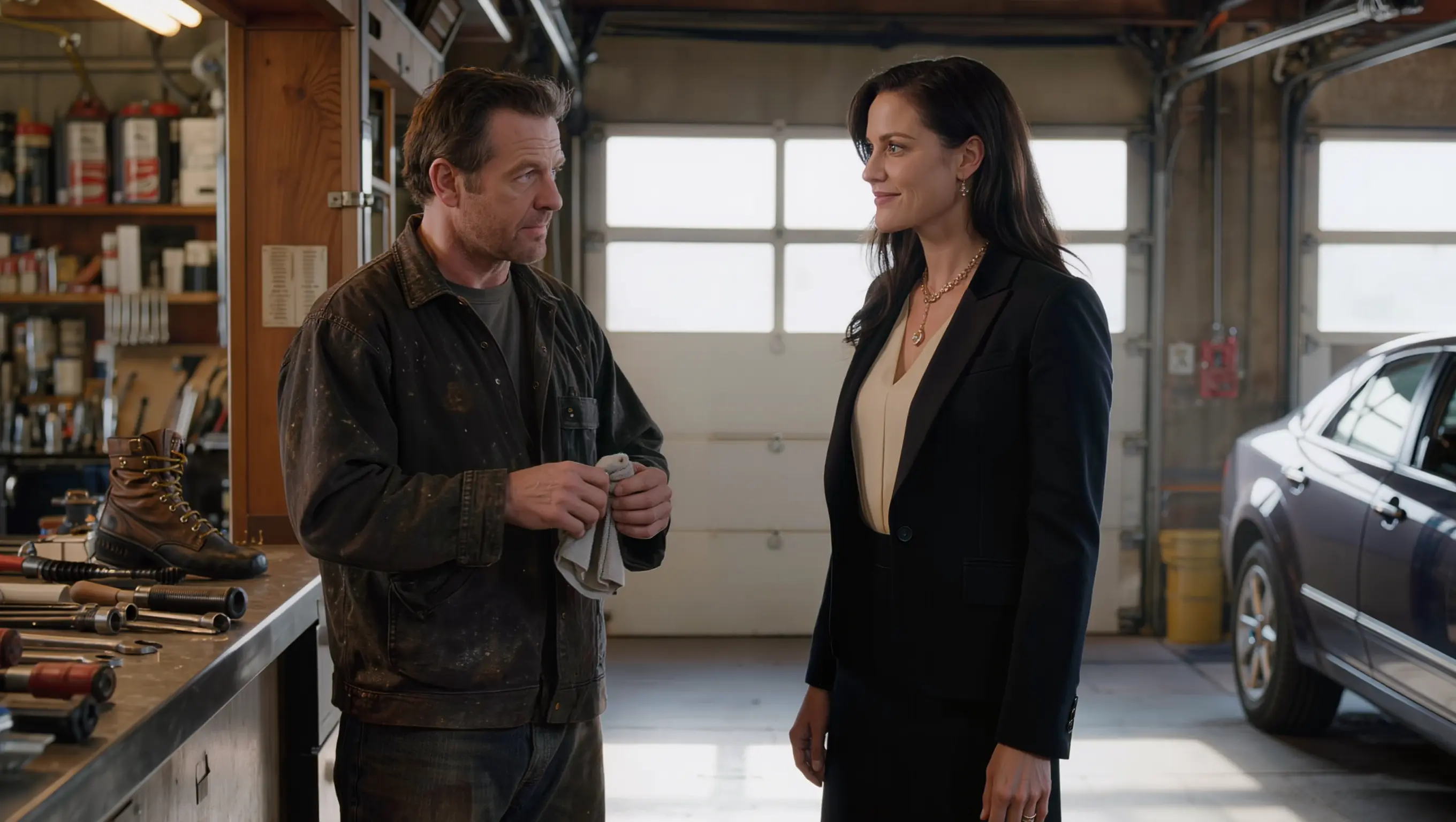
“Sorry doesn’t bring Daniel back.” Her own voice broke. “Sorry doesn’t give Sophie her father. Sorry doesn’t undo the three years I spent not understanding why.”
She walked to her desk and pulled out her checkbook.
Jake watched, numb, as she wrote with steady hands. Then she tore the check free and held it out to him.
“This is not forgiveness,” she said clearly. “This is not absolution. This is me making a choice that Daniel would have wanted me to make. He would never have let a child die because of his father’s mistakes. Neither will I.”
Jake stared at the check, unable to reach for it.
“I can’t.”
“Yes, you can. You’ll take this to the hospital. You’ll save your son. And then…”
Her voice turned to steel.
“You’ll spend the rest of your life making sure what happened to Daniel never happens to anyone else. Not as penance, as purpose. The job is still yours if you want it. Not to make yourself feel better. Not to earn forgiveness you’ll never get, but because you’re one of maybe five people in this country who would catch what you caught last night, and that skill, that obsessive attention to safety, needs to be put to use.”
Jake took the check with trembling hands. The paper felt impossibly light and impossibly heavy at once.
“Why?” he whispered. “Why would you do this?”
Victoria’s eyes were ancient and tired.
“Because I have a choice you didn’t have 10 years ago. I can let rage and grief make my decisions, or I can choose something else. Something harder.”
She walked to the door, opening it.
“Go save your son, Jake. Then decide if you’re brave enough to do the work that terrifies you.”
Jake ran through the lobby of the Meridian Building, ignoring the startled looks from security. His hands clutched the check like a lifeline, like a talisman against death itself.
The old sedan protested when he started it, engine coughing in the cold. He didn’t care. He drove too fast through snow-slicked streets, white-knuckling the steering wheel, mind spinning between disbelief and desperate hope.
The bank first. He couldn’t risk anything happening to the check. Couldn’t risk this impossible gift slipping through his fingers.
The teller took one look at the amount and called a manager. The manager verified the funds. Victoria Carson’s account was real. The check was good. The money would clear. They arranged a certified check made out to Boston General Hospital.
Jake held it and felt like he was holding Tyler’s life in paper form.
He called the hospital from the parking lot, hands shaking so badly he could barely dial.
“Dr. Reeves, this is Jake Mitchell. I have the money. I can be there in 15 minutes.”
A pause.
Then, “Mr. Mitchell, we can schedule the surgery for tomorrow morning. First slot. I’ll notify the surgical team. He’s going to be okay. We’ll do everything we can. Come to the cardiac wing. We’ll get the admission paperwork started.”
The drive to the hospital passed in a blur. Jake parked in the emergency lot, not caring about tickets or regulations. He sprinted through the automatic doors, took the elevator to the fourth floor, found Dr. Reeves waiting near the nurse’s station.
She reviewed the certified check, nodded, smiled.
“Let me get this processed. Tyler’s in his room. Go see him. Tell him to get a good night’s sleep. He’s got a big day tomorrow.”
Tyler was awake, reading the same comic book from yesterday. The oxygen tubes were still in place, the monitors still beeping. But when he saw his father’s face, he knew.
Jake couldn’t speak. He just pulled his son into a careful hug, mindful of the IV lines and wires, feeling the small body against his chest, the steady heartbeat that would soon be fixed, made whole, given a future.
“The surgery?” Tyler asked, voice muffled against Jake’s shoulder.
“Tomorrow morning. You’re going to be okay, buddy. You’re going to be okay.”
Tyler pulled back, his 8-year-old face serious.
“Can we still go camping? After?”
“Absolutely. We’ll go camping. We’ll climb mountains. We’ll do everything.”
Jake brushed tears from his own face, not caring that he was crying in front of his son.
“Everything, Tyler. I promise.”
A nurse came in, started explaining pre-op procedures. Jake listened with half his attention, the other half focused on Tyler’s face, on the hope there, the trust.
That night, Jake slept in the chair beside Tyler’s bed like he had for weeks. But this time, the weight on his chest had lifted. This time, he could breathe.
At dawn, they came for Tyler. The surgical team, five specialists, two nurses, the anesthesiologist, Dr. Reeves. She squeezed Jake’s shoulder as they wheeled Tyler down the hall toward the operating room.
“Seven to eight hours,” she said. “There’s a waiting room on the second floor. We’ll update you every two hours.”
Jake watched until Tyler disappeared through the double doors. Then he walked to the waiting room, sat in a plastic chair beneath fluorescent lights, and did something he hadn’t done since Sarah died.
He prayed.
Not for deals or bargains, not for miracles or interventions, just gratitude.
Just thank you.
Just please.
Seven hours became eight. Eight became nine. At hour 10, Dr. Reeves appeared in the doorway, still in surgical scrubs, mask pulled down. Her face was exhausted, but smiling.
“It went perfectly. Tyler’s in recovery. He’s going to be fine. Jake, he’s going to have a completely normal life.”
Jake dropped to his knees right there in the waiting room, hands covering his face, body shaking with sobs that came from somewhere so deep he didn’t know he still had tears left.
His son was going to live.
Three days later, Tyler was moved from ICU to a regular room. His color had returned. No more grayish pallor, no more labored breathing. He complained about the hospital food, asked for his tablet, wanted to know when he could go home.
Normal kid complaints. Beautiful, ordinary, life-affirming complaints.
Jake was reading him a chapter from one of the camping books they loved when there was a knock on the door.
He looked up to see Sophie Carson standing in the doorway holding a balloon bouquet shaped like cartoon bears.
“Hi,” she said shyly.
Tyler’s eyes lit up.
“Are those for me?”
“If you want them.”
Sophie approached the bed, tying the balloons to the rail.
“I’m Sophie. Your dad helped me when my car broke down.”
“He’s good at fixing things,” Tyler said proudly.
Sophie smiled, then looked at Jake.
“My mom told me about Tyler, about the surgery. I wanted to come say thank you in person, and to meet the person who…”
She trailed off, looking uncertain.
“The person whose dad saved you,” Tyler finished matter-of-factly. “He told me about it. You were stuck in a blizzard.”
“I was. I was really scared. And your dad stopped to help even though he was worried about you.”
“That’s because he’s brave,” Tyler said. “Like Captain America, but with more tools.”
Jake laughed, the sound surprising him.
“I don’t think Captain America fixes transmissions.”
Victoria Carson appeared in the doorway then, and the easy moment shifted. She looked different than she had in her office, wearing jeans and a simple sweater, hair down, less armor.
“Mr. Mitchell,” she nodded formally.
“Mrs. Carson. Can I speak with you for a moment?”
In the hall, Jake glanced at Tyler, who was already showing Sophie his comic book collection, explaining the intricate plot lines with eight-year-old enthusiasm.
He followed Victoria into the corridor.
“How is he?” she asked.
“Better every day. Dr. Reeves says he can go home next week if he keeps improving.”
“I’m glad.”
Victoria’s expression was unreadable.
“I wanted to tell you something. I’ve thought a lot about our conversation, about the job offer.”
Jake’s stomach clenched.
“I understand if you’ve changed your mind.”
“I haven’t. The offer stands. But I want to be clear about something.”
Her voice was level, controlled.
“This isn’t forgiveness. I don’t know if I’ll ever forgive you for what happened to Daniel. Some days I think I might. Other days the anger is so fresh it’s like he died yesterday.”
“I understand.”
“But I also meant what I said. Your skill, your obsession with safety. It needs to be used. Not for your redemption. For the people who will never know you saved their lives because the systems worked the way they were supposed to.”
Jake nodded slowly.
“I’ll take the job on one condition.”
Victoria’s eyebrow rose.
“You’re negotiating.”
“I want to donate 10% of my salary to a foundation in Daniel’s name for automotive safety research. Every year for as long as I work for you.”
For the first time since they’d met, Victoria’s composure cracked. Her eyes filled, though no tears fell.
“He would have liked that.”
“It’s not enough. It’ll never be enough. But it’s something.”
“Nothing will bring him back,” Victoria said quietly. “But maybe something good can grow from what happened if we’re willing to transform it into purpose.”
They stood in the hospital hallway, two people bound by grief and chance and the impossible mathematics of loss and redemption.
Finally, Victoria extended her hand.
“Welcome to Carson Automotive, Mr. Mitchell. Start date is whenever Tyler is fully recovered. Take the time you need.”
Jake shook her hand. Her grip was firm, professional, still holding him at a careful distance.
“Thank you,” he said, “for everything.”
Victoria didn’t respond. She just returned to Tyler’s room, where Sophie was reading him a picture book about camping, making Tyler laugh at her exaggerated character voices.
Jake watched from the doorway.
His son was alive. A future was possible. The weight of the past hadn’t disappeared. It never would. But maybe, just maybe, he could carry it differently now. Not as a burden that crushed him, but as a responsibility that drove him forward.
Fourteen months later, the campsite sat in a clearing surrounded by pine trees heavy with early December snow. Jake finished securing the tent stakes while Tyler gathered kindling for the fire. His movements strong and steady. No oxygen tubes, no monitors, just a healthy 9-year-old boy who loved the outdoors.
“Dad, look at this one.”
Tyler held up a branch shaped like a Y, perfect for roasting marshmallows.
Jake grinned.
“Good eye. Put it in the pile.”
They’d driven three hours north to this campground, one they’d visited with Sarah years ago. Jake had been nervous about coming back, afraid the memories would hurt too much. But Tyler had insisted.
“Mom would want us to go,” he’d said with the simple wisdom of children. “She always said camping made everything better.”
The fire caught quickly despite the cold. Jake showed Tyler how to bank the coals properly, how to create a bed of heat that would last for hours. They roasted hot dogs and burned marshmallows and told bad jokes until the stars came out.
“Dad.”
Tyler’s voice was quiet, reflective.
“Why do you always check everything twice?”
Jake looked at his son across the crackling flames.
“What do you mean?”
“Like you checked the tent stakes three times, and the fire ring, and the car before we left. You count stuff a lot.”
Jake considered how to answer. Tyler knew the broad strokes, that his dad had made a mistake at an old job, that it had consequences, that he tried to do better now. But not the details, not the full weight.
“Because details matter,” Jake said finally. “Small things that seem unimportant can turn out to be critical. A tent stake that’s not quite secure can mean the tent collapses in wind. A fire that’s not properly contained can spread. A bolt that’s not tightened correctly can fail when you need it most.”
“But doesn’t it make you tired? Always worrying?”
“Sometimes. But you know what makes me more tired? The thought that I might miss something important because I was rushing or got careless.”
Tyler poked at the fire with a stick, sending sparks spiraling into the dark.
“Is that why you helped that girl, Sophie?”
“Partly. I saw someone who needed help. And I had the skills to help them.”
“Even though you were worried about me.”
“Especially because I was worried about you.”
Jake pulled Tyler closer, wrapping an arm around his shoulder.
“Tyler, I want you to understand something. Being scared doesn’t mean you stop helping people. Being in pain doesn’t give you an excuse to ignore other people’s pain. Sometimes the hardest thing and the right thing are the same thing.”
“Like when you told Sophie’s mom about the old mistake you made.”
Jake was constantly surprised by how much Tyler understood.
“Yes, like that.”
“She’s still kind of scary,” Tyler said. “Mrs. Carson, I mean. But Sophie’s nice. She sends me books sometimes.”
“Mrs. Carson has reasons to be cautious around me. I hurt her family, even if I didn’t mean to.”
“But you saved Sophie.”
“That doesn’t erase the past, buddy. It just… It adds something different to the story. Both things can be true at once.”
They sat in comfortable silence, watching the fire. An owl called from somewhere in the dark trees. The temperature dropped further, their breath forming clouds.
“Tyler, there’s something I want you to remember. Something I learned the hard way.”
“What?”
“Courage isn’t about never being afraid. It’s about doing the right thing even when you’re terrified. And integrity, real integrity, means telling the truth, even when lying would be easier, even when the truth costs you everything.”
Tyler looked up at him, firelight reflecting in his eyes.
“Is that why you give money to that foundation every year? The one for Mr. Carson?”
“Yes. It won’t bring him back. But maybe it helps make sure what happened to him doesn’t happen to someone else.”
“That’s pretty brave, Dad.”
Jake felt his throat tighten.
“I don’t know about brave, but it’s necessary. You can’t change the past. You can only make sure it doesn’t repeat.”
Tyler yawned, leaning against Jake’s side.
“Can we still do this every year? Camping, I mean, even when I’m old?”
“Even when you’re old. It’s a promise.”
They stayed by the fire until Tyler started nodding off. Jake banked the coals properly, triple-checked that no embers could escape the ring, then guided his son into the tent.
Tyler was asleep within minutes, wrapped in his sleeping bag, breathing easy.
Jake lay awake, listening to the wind in the pines. He thought about Victoria Carson, about the professional distance she maintained even after a year of working together. He thought about Sophie, who’d recovered from that night in the blizzard and was thriving in college now. He thought about Daniel Carson, a man he’d never met, but whose absence shaped every decision Jake made.
The weight of the past was still there, but it no longer crushed him. It guided him instead.
Through the tent mesh window, Jake could see stars scattered across the winter sky like diamonds on velvet. The same stars that had looked down on every mistake he’d made, every person he’d failed, every moment of cowardice, but also on every car he’d fixed right, every system he’d improved, every life he’d quietly, carefully protected.
He couldn’t change the past, but he could damn well make sure it mattered.
Three years after that first camping trip, Jake sat in a conference room at Carson Automotive headquarters. The table was surrounded by engineers from six different companies, all reviewing the new industry-wide safety protocols Jake’s team had developed.
“The new brake system redundancy standards,” Jake explained, pulling up a schematic on the screen, “require three independent failure points before total system loss. We’re also mandating real-time diagnostic monitoring. Any degradation triggers a dashboard warning before it becomes critical.”
An engineer from a competing firm raised his hand.
“The cost increase is substantial. We’re looking at approximately $1,800 per vehicle.”
“$1,800 versus one life,” Jake said evenly. “We’ve run the models. These standards would prevent an estimated 230 deaths per year in North America alone.”
The room fell silent.
Victoria, sitting at the head of the table, spoke up.
“Carson Automotive is implementing these standards across all our systems immediately, regardless of what the rest of the industry decides. We’re also making our diagnostic software open source. Anyone who wants to use it can.”
After the meeting, Jake found Victoria in her office. She was reviewing reports, the same focused intensity he’d seen that first morning four years ago.
“The board approved your budget increase,” she said without looking up. “You can hire two more engineers for the safety division.”
“Thank you.”
“Don’t thank me. You’ve saved the company more in lawsuit prevention than the entire division costs.”
She finally met his eyes.
“How’s Tyler?”
“Starting eighth grade. He’s on the track team. Doctor says his heart function is completely normal.”
“Good.”
A pause.
“And the foundation? The Daniel Carson Automotive Safety Foundation?”
“We’re funding research at three universities now. MIT just published a paper on pressure valve design that references our grant.”
Victoria nodded, returning to her reports.
Jake turned to leave, then stopped.
“Victoria, can I ask you something?”
“What?”
“Do you hate me less than you did four years ago?”
She set down her pen slowly.
“That’s not a fair question.”
“I know. I’m asking anyway.”
Victoria was quiet for a long moment. Outside her window, the city spread out below, a web of streets and buildings and lives intersecting in ways people never saw.
“I don’t hate you,” she said finally. “I don’t know if I ever truly did. I hated what happened. I hated that Daniel was gone. I hated that someone knew there was a problem and didn’t fight hard enough to stop it.”
“I should have fought harder.”
“Yes, you should have.” Her voice was firm. “But Jake, I’ve watched you for four years now. I’ve seen you catch design flaws that would have killed people. I’ve seen you argue with executives who wanted to cut corners. I’ve seen you burn bridges and risk your reputation to make sure products are safe.”
“It’s the least I can do.”
“Maybe, but it’s also more than most people would do.”
She stood, moving to the window.
“Daniel used to say that character isn’t about never making mistakes. It’s about what you do after. Whether you hide or whether you fix things.”
Jake felt something loosen in his chest.
“I wish I could have met him.”
“He would have liked you. The you that exists now, anyway.”
Victoria turned, and for the first time in four years, her smile reached her eyes.
“Sophie’s graduating from college next month. She’s going into automotive safety engineering. Says you inspired her.”
“I’m just trying to do better.”
“We’re all just trying to do better.”
Victoria extended her hand.
“Keep fighting, Jake. Keep catching the things other people miss. Keep telling the truth, even when it’s hard.”
Jake shook her hand. This time, the distance between them felt different. Not friendship. Maybe it would never be friendship, but something closer to respect, to understanding, to peace.
That weekend, Jake and Tyler went camping again, the ritual they’d maintained for four years now. They hiked to the same clearing, set up the same tent, built the same kind of fire. Tyler was 12 now, gangly and growing fast, full of questions about girls in school and what it meant to be brave.
They roasted marshmallows and talked about everything and nothing. And when Tyler asked, as he always did, why his father checked everything twice, Jake gave the same answer he’d given for years.
“Because every detail matters. Because small things can save lives. Because I learned the hard way that you can’t be too careful when other people’s safety depends on you.”
“Do you ever wish you could go back?” Tyler asked. “Change what happened before?”
Jake considered this. He’d thought about it a thousand times. The moment he should have walked away from Silverton. The argument he should have pushed harder. The letter he should have written to regulators when internal pressure failed.
“Every day,” he admitted. “But Tyler, here’s what I’ve learned. You can’t change the past. You can only make sure it matters. Make sure the mistakes you made teach you something. Make sure the people you failed didn’t suffer for nothing.”
“Is that why you work so hard?”
“I work hard because I don’t want anyone else to lose what I took from them. I can’t give Mrs. Carson her husband back. I can’t give Sophie her father. But I can make absolutely sure that no other family loses someone the way they did. Not on my watch. Not if I can prevent it.”
Tyler poked at the fire, sending sparks dancing upward.
“That’s pretty brave, Dad.”
“It’s not brave. It’s necessary.”
“Sounds like the same thing to me.”
Maybe it was.
The stars came out, brilliant and infinite. The same stars that had witnessed every mistake, every failure, every moment of cowardice and courage. Jake looked at his son, healthy, strong, alive, and felt the weight of gratitude so profound it hurt.
He couldn’t change the past. He couldn’t erase his mistakes. But he could spend every remaining day making sure they mattered. Making sure the price others paid wasn’t paid in vain. Making sure that when he finally laid down for the last time, he could say, “I did better. I learned. I changed. I made it count.”
And in the end, perhaps that was all anyone could do. Not erase their failures, but transform them into purpose.
“Come on, buddy,” Jake said, pulling Tyler close. “Time for bed. We’ve got a long hike tomorrow.”
“Yeah. I’m glad you’re my father.”
Jake’s eyes burned.
“I’m glad you’re my son.”
They banked the fire properly, Jake checking twice as always, and retreated to the tent. Tyler fell asleep quickly, his breathing steady and strong.
Jake lay awake, listening to the wind, thinking about the long road that had brought him here. From coward to mechanic, from mechanic to engineer again, from grief to purpose, from mistake to meaning.
The weight was still there. It always would be. But he’d learned to carry it, not as punishment, as responsibility, as promise, as proof that change was possible, even for those who’d failed in the worst ways.
He couldn’t erase the past, but he could make sure it never repeated.
And that, in the end, was enough.