Luke Bennett’s pickup truck rattled like a dying animal as he pushed it past sixty on Route 12.
The Indiana rain turned the asphalt into a river of reflected headlights, and every passing car threw silver spray across his windshield. His dashboard clock glowed 8:17 a.m., each minute feeling heavier than the last. His interview at Carter Meridian Industries started at 8:30, and the office was still nearly twenty minutes away if traffic behaved. Traffic was not behaving.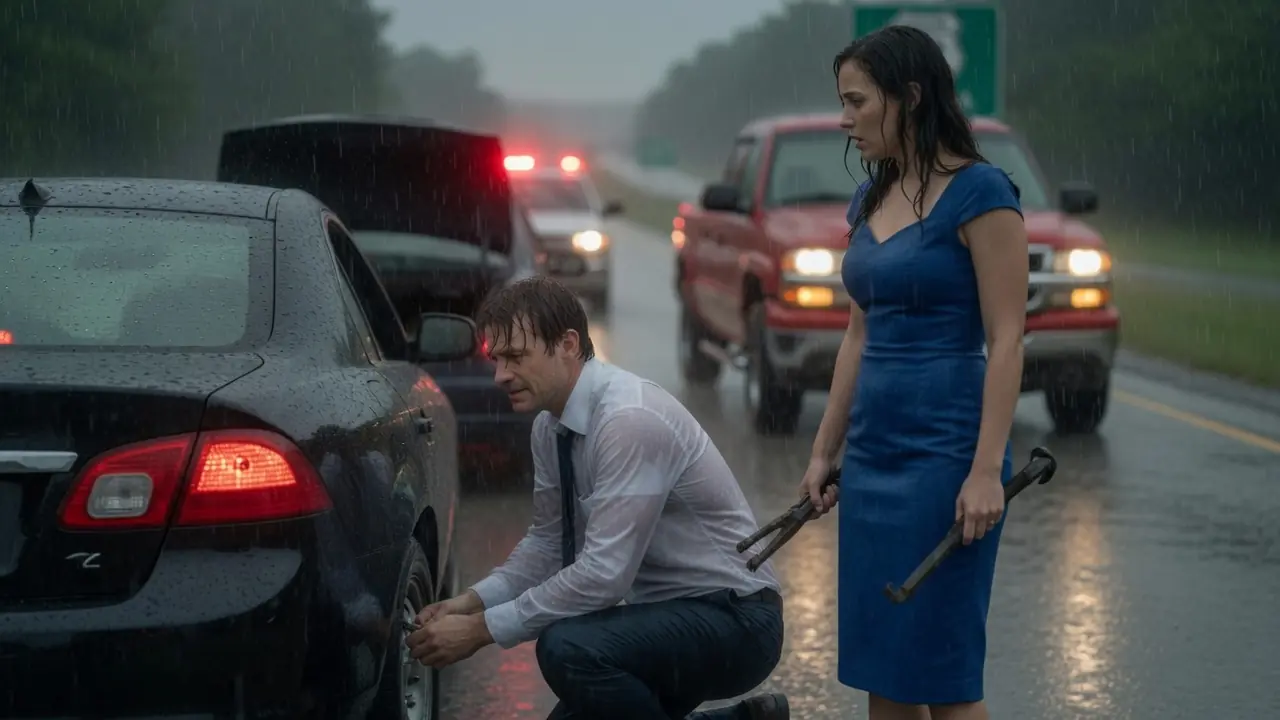
Luke tightened both hands around the steering wheel and leaned forward as if he could make the old truck move faster by sheer will. His navy suit jacket was damp at the shoulders because the driver’s window leaked, and the white shirt beneath it had a faint coffee stain near the cuff. He had ironed that shirt at 5:00 a.m. while his eight-year-old son, Caleb, slept on the couch under a faded Spider-Man blanket. It was the best shirt Luke owned, and this interview was the best chance he had seen in years.
Carter Meridian was hiring a facilities operations manager, a steady position with health insurance, regular hours, and a salary that sounded almost unreal compared to the temporary repair jobs Luke had been taking. For two years, he had worked wherever he could: warehouse maintenance, overnight equipment repair, small engine jobs, weekend construction, and whatever paid enough to keep rent from winning. Since Caleb’s mother had left, Luke had become father, cook, driver, nurse, homework helper, and bill negotiator all at once. He loved his son more than his own breath, but love did not stop electric bills from arriving.
That morning, Caleb had stood by the apartment door with his backpack hanging too low and a serious look on his face. “You’re going to get the job, Dad,” he had said. Luke had smiled like a man who believed it, though fear sat heavy in his chest. Caleb had handed him a folded piece of notebook paper before the bus came. Inside, in crooked pencil, were the words: Good luck, Dad. You fix everything.
Luke had tucked the note into his suit pocket.
Now his phone buzzed in the cup holder for the third time. The caller ID said Carter Meridian HR. Luke stared at it, then back at the road, his jaw tightening. He could not answer while rain hammered the windshield and the truck fought every gust of wind. He imagined a receptionist checking the clock, a hiring manager folding his résumé, someone deciding he was irresponsible before he even walked through the door.
“Come on,” Luke whispered to the truck. “Just get me there.”
Then he saw the black sedan.
It sat on the gravel shoulder, half in mud, half on wet grass, hazard lights blinking weakly through the rain. The trunk was open, and a woman stood beside the rear tire holding a broken jack in one hand. Her fitted blue dress was soaked at the hem, her blonde hair clung to the side of her face, and her expression was tight with fear and frustration. Cars passed her without slowing.
Luke’s foot eased off the gas.
“No,” he muttered to himself. “Not now.”
The interview. The job. Caleb’s school supplies. The overdue rent. The medical bill from Caleb’s asthma visit. Every reason to keep driving shouted in his mind. But then the woman stepped back from the car as a semi passed too close, throwing muddy water across the shoulder, and Luke saw the way she flinched.
He saw someone alone.
He saw danger.
And worse than that, he imagined Caleb someday standing on the side of a road, scared and soaked, while adults drove past because they had somewhere more important to be.
Luke cursed under his breath, hit the turn signal, and pulled over behind her.
The rain swallowed him the moment he stepped out. He grabbed his tool bag from behind the seat, slammed the door, and jogged toward the sedan. The woman turned sharply, gripping the broken jack like she was not sure whether to accept help or defend herself.
“What happened?” Luke called over the rain.
“The tire blew,” she said, breathless. “The jack slipped, and now it won’t lift. I’ve called roadside assistance, but they said forty-five minutes.”
Luke glanced at the tire. Flat, but not torn beyond control. The spare was already in the trunk. “You can’t stand out here that long. This shoulder is too narrow.”
“I know.” She looked at his suit, then at his face. “You’re dressed for work.”
“Interview,” Luke said, kneeling near the tire.
Her eyes widened. “You’re late for something important, aren’t you?”
Luke pulled his own hydraulic jack from the tool bag. “Looks like it.”
“Then don’t do this,” she said quickly. “I can wait.”
“No, you can’t.”
She stared at him as if kindness in bad weather confused her. “You don’t even know me.”
Luke positioned the jack under the frame and tested the ground with his hand. Mud. Not ideal. He grabbed a flat board from his truck bed and slid it under the jack for stability. “I’m a single dad,” he said, breathing hard as rain ran down his jaw. “If my little boy were ever stranded and I couldn’t reach him, I’d pray someone stopped.”
The woman went quiet.
Luke loosened the lug nuts, his fingers stiff from the cold rain. His phone buzzed again in his pocket, but he ignored it. Every buzz felt like a door closing somewhere in his life. Still, he kept working.
“What’s your name?” she asked softly.
“Luke Bennett.”
“I’m Evelyn.”
“Nice to meet you, Evelyn. Wish it were under better weather.”
She gave a small laugh, but it broke almost immediately. “I thought I could handle it. I used to change tires with my father when I was younger, but I couldn’t get the jack steady. Then it slipped, and I just…” She stopped and shook her head. “I hate feeling helpless.”
Luke looked up at her. “Needing help isn’t the same as being helpless.”
That sentence landed between them with more weight than he expected. Evelyn looked away toward the rain-silvered road, and for a moment, her face softened into something tired and human. She did not look like a polished professional anymore. She looked like someone who had spent a long time pretending she never needed anyone.
Luke lifted the sedan, removed the flat tire, and reached for the spare. Evelyn tried to step closer.
“Stay back from the road,” he said.
“I can hold the flashlight.”
“It’s daylight.”
“It’s raining sideways.”
He almost smiled. “Fine. Hold it steady.”
She took her phone, turned on the flashlight, and angled it toward the wheel. Rain streamed over both of them. Luke’s suit pants were soaked through at the knees, mud splashed his shoes, and his hair stuck to his forehead. The interview he had prepared for all night was slipping away, minute by minute, but his hands kept moving because stopping halfway would be worse than never stopping at all.
The phone buzzed again.
Evelyn looked down at his pocket. “Answer it.”
“I can’t.”
“It might be your interview.”
“I know.”
“Luke.”
He tightened a lug nut, then another. “If I answer and tell them I’m late because I stopped for a flat tire, they’ll think it’s an excuse. If I don’t answer, they’ll think I don’t care. Either way, I probably lost it.”
Her face changed. “Then why are you still helping me?”
Luke looked up at her, rain dripping from his eyelashes. “Because you were scared.”
Evelyn’s lips parted slightly, but she said nothing.
He finished tightening the spare, lowered the car, then checked the pressure by hand. It would get her to town if she drove carefully. He gathered the damaged tire, placed it in the trunk, and wiped his hands on a rag that was already wet enough to be useless.
“There,” he said. “Keep it under fifty. No sudden turns. You’ll want a full replacement today.”
Evelyn looked at the car, then at him. “How much do I owe you?”
“Nothing.”
“No, don’t do that.”
“Do what?”
“Act like this didn’t cost you something.” She glanced at his soaked suit. “You missed your interview.”
Luke swallowed, feeling the truth settle into him. The dashboard clock in his truck now read 8:46. Sixteen minutes late. Four missed calls. One voicemail. He thought of Caleb’s note in his pocket and felt his chest ache.
“I’ll figure it out,” he said.
Evelyn stepped closer. “Where was the interview?”
Luke hesitated. “Carter Meridian Industries.”
For the first time, Evelyn’s whole expression shifted. Not surprise exactly. Something deeper. Something like realization.
“What position?” she asked.
“Facilities operations manager.” He laughed quietly without humor. “Or, I guess, almost facilities operations manager.”
Evelyn stared at him in the rain.
Then she said his name slowly. “Luke Bennett.”
He frowned. “Yeah?”
She looked toward his truck, then back at him. “The interview you’re missing is with me.”
Luke blinked. “What?”
“My name is Evelyn Carter.”
The rain kept falling, but Luke suddenly felt as if the whole road had gone silent.
“Carter?” he repeated.
She nodded. “I’m the CEO of Carter Meridian Industries.”
Luke stood frozen beside the car, soaked to the skin, one hand still holding the wrench. For a second, he thought she had made a cruel joke. Then he remembered the way she had watched him, the careful questions, the sudden change in her face when he said the company name. His stomach dropped.
“You’re Evelyn Carter,” he said.
“Yes.”
“And I just missed an interview with you because I stopped to change your tire.”
Evelyn held his gaze. “No, Luke. You didn’t miss it.”
He almost laughed because that made no sense. “I’m standing on Route 12 covered in mud.”
“And I just learned more about your character on this roadside than I would have learned from any conference room question.”
Luke looked away, overwhelmed. He wanted to feel relieved, but fear was still louder. “Ms. Carter, with respect, I need that job. I can’t afford for this to be some inspiring moment that ends with a handshake and a story you tell your board.”
Evelyn’s eyes softened. “I understand.”
“I don’t think you do.” His voice cracked before he could stop it. “My son thinks I fix everything. But I’m behind on rent. My truck barely runs. His inhaler costs more than groceries some weeks. I needed to walk into that interview looking like a man who had his life together, not like someone who got dragged through a ditch.”
Evelyn looked at him for a long moment. There was no pity in her face, and Luke was grateful for that. Pity made him feel smaller. She gave him something better: respect.
“Then come with me,” she said.
“To where?”
“To the office.”
Luke looked down at himself. “Like this?”
“Exactly like this.”
He frowned. “That’s not professional.”
“No,” Evelyn said quietly. “It’s honest.”
The Carter Meridian headquarters stood fifteen minutes away, a glass and steel building on the edge of Fort Wayne with trimmed lawns and a security gate that recognized Evelyn’s car before she reached it. Luke followed in his old red pickup, the engine protesting every mile. His hands were still shaking when he parked in the visitor lot. Rainwater dripped from his sleeves onto the seat.
He almost drove away.
The building looked too clean, too expensive, too far from the life he knew. He imagined walking inside muddy and late while people in pressed shirts stared. He imagined being the story everyone laughed about in the break room. Then he looked at Caleb’s note, now damp at the edges in his pocket.
Good luck, Dad. You fix everything.
Luke got out.
Evelyn waited under the entrance canopy. She had fixed her hair as best she could, but her dress was still wet and muddy at the hem. She looked different from the executive portraits Luke had seen online, less untouchable and more real. When he approached, she nodded once, as if they had both agreed to walk into judgment together.
Inside, the receptionist stood quickly. “Ms. Carter, are you all right?”
“I’m fine,” Evelyn said. “Please tell Mr. Harlan and the hiring panel that Mr. Bennett has arrived.”
The receptionist looked at Luke, then at his mud-splattered shoes, and her expression flickered.
Evelyn noticed. “And please bring towels.”
The receptionist flushed. “Yes, ma’am.”
They took the elevator to the sixth floor. Luke stood beside Evelyn, trying not to drip too much onto the polished floor. The silence stretched until Evelyn finally spoke.
“My father built this company,” she said. “He used to say you can train skill, but you can’t install character.”
Luke glanced at her. “Sounds like a practical man.”
“He was.” Her voice softened. “He also stopped for people. Even when it made him late.”
The elevator doors opened.
The conference room was full. Three people sat at a long table: a gray-haired man with a stern face, a woman in a charcoal blazer, and another man flipping through papers. Their expressions changed when Evelyn entered with Luke beside her. The gray-haired man, Mr. Harlan, stood immediately.
“Evelyn, we were concerned. You weren’t answering.”
“I was stranded with a flat tire,” she said.
Harlan looked at Luke. “And Mr. Bennett?”
“Stopped to help me.”
The room went still.
Luke’s face warmed. He wanted to explain, apologize, defend himself, and disappear all at once. Before he could speak, Harlan looked at the clock.
“Mr. Bennett, your interview was scheduled for 8:30.”
“I know, sir,” Luke said. “I’m sorry.”
Harlan’s eyes narrowed. “Why didn’t you call?”
Luke stood straighter. “Because I was under Ms. Carter’s car changing the tire in heavy rain, and I didn’t want to give a half-excuse while leaving the job half-done.”
The woman in the charcoal blazer looked up sharply.
Harlan tapped the résumé in front of him. “You understand punctuality matters in operations?”
“Yes, sir.”
“And yet you were late.”
Luke nodded. “Yes.”
“Why should we overlook that?”
Luke could feel Evelyn watching him, but she did not rescue him. Strangely, he respected her more for it. This was still an interview, even if it had started beside a flat tire.
“Because the same reason I was late is the reason I’m worth hiring,” Luke said.
Harlan leaned back. “Explain.”
Luke took a breath. “Operations is not just schedules and reports. It’s what you do when something breaks and everyone else drives past because it isn’t their problem. Ms. Carter had a dangerous roadside situation. I had tools, knowledge, and the ability to help. I chose to solve the immediate problem in front of me.”
The room was silent.
Luke continued, voice steadier now. “I’m not proud that I was late. But I am proud that I didn’t leave someone standing alone in the rain because helping her was inconvenient. If that disqualifies me, I understand. But if this company needs someone who takes responsibility when things go wrong, then I’m that man.”
Evelyn looked down briefly, and Luke saw the smallest smile touch her face.
The interview continued for nearly an hour. They asked about maintenance schedules, vendor negotiation, emergency planning, inventory tracking, team leadership, safety checks, and crisis response. Luke answered honestly. He did not try to sound more polished than he was. When he did not know a corporate term, he explained the real-world version he had used in warehouses, shops, and job sites.
By the end, the woman in the charcoal blazer, Denise Park, had stopped looking at his muddy shoes and started taking notes.
Harlan closed the folder. “You have fewer formal management years than some other candidates.”
“Yes, sir,” Luke said.
“But more hands-on repair experience.”
“Yes.”
“And no degree.”
“No.”
“Why should a team of thirty technicians listen to you?”
Luke thought of Caleb. He thought of tired workers he had known, men who could smell fake authority before it entered a room. “Because I won’t ask them to do work I’m too proud to understand. And if something fails at 2:00 a.m., I’ll be there with them until it’s fixed.”
Denise Park nodded once.
After the interview, Luke waited in a small office while Evelyn and the panel spoke privately. Someone brought him dry towels and coffee. His hands wrapped around the cup, and suddenly exhaustion hit him so hard he had to close his eyes.
He had done all he could.
An hour later, Evelyn entered alone.
Luke stood quickly. “Ms. Carter.”
“Evelyn is fine.” She closed the door behind her. “The panel has concerns.”
His heart sank, but he nodded.
“You lack some formal credentials. You’ve worked temporary roles. Your résumé is strong but uneven.”
“I understand.”
She stepped closer. “But I told them that today, before anyone asked you a single prepared question, you demonstrated judgment, calm under pressure, mechanical skill, accountability, and compassion.”
Luke said nothing.
“They voted two to one in favor of offering you the position.”
He stared at her. “What?”
Evelyn smiled. “Congratulations, Luke. Carter Meridian would like you to join us as facilities operations manager.”
For a moment, he could not speak. His throat closed, and his eyes burned. He turned away, embarrassed, pressing one hand to his face. He had held himself together through rain, fear, the interview, and the weight of every bill waiting at home. But the word congratulations nearly broke him.
Evelyn’s voice softened. “Luke.”
“I’m sorry,” he said quickly. “I just… my son…”
“I know.”
He laughed once, unsteady. “He told me I fix everything.”
“And today you proved him right.”
Luke looked at her then, and the room blurred a little. “Thank you.”
“No,” Evelyn said. “Thank you for stopping.”
That evening, Luke picked Caleb up from after-school care ten minutes late. Caleb ran to him with his backpack bouncing and stopped short when he saw the damp suit, the mud on his shoes, and the strange expression on his father’s face.
“Dad?” Caleb asked. “Did it go bad?”
Luke crouched in front of him. “No, buddy.”
“Did you get the job?”
Luke nodded.
Caleb’s eyes went wide. “Really?”
“Really.”
The boy threw both arms around his neck so hard Luke almost fell backward. Luke held him there in the hallway, not caring who saw, not caring that his knees still ached from changing a tire in the rain. Caleb laughed into his shoulder and said, “I knew it! I knew you fix everything!”
Luke closed his eyes. “Not everything, buddy.”
Caleb pulled back. “But you fixed this.”
Luke smiled. “Yeah. We fixed this.”
His first weeks at Carter Meridian were difficult. Luke had to learn software systems, reporting structures, corporate policies, and the quiet politics of a large company. Some people respected him immediately. Others looked at his background and assumed Evelyn had hired him out of sentiment. Luke did not argue with them.
He worked.
He arrived early, walked the floors with technicians, learned every maintenance concern, and listened before giving orders. When a conveyor belt failed during a shipping rush, Luke rolled up his sleeves and repaired the jam beside two mechanics who had expected him to stand around giving instructions. By the end of the day, one of them said, “You actually know what you’re doing.”
Luke smiled. “That helps in maintenance.”
Evelyn watched from a distance, never hovering, never treating him like a charity hire. Their conversations stayed professional at first, but something warm lingered beneath them because both remembered the roadside. She asked about Caleb. He asked if she ever replaced the sedan tire properly. She admitted she replaced all four because Luke had looked so serious when he said not to trust the spare.
One Friday evening, nearly two months after the interview, Luke found Evelyn in the facilities bay looking at a newly repaired loading dock door. Rain tapped against the high windows, lighter than the storm from that first morning. She wore a simple black coat, no entourage, no polished distance.
“You stayed late,” Luke said.
“So did you.”
“I’m paid to.”
“So am I.”
He smiled faintly.
Evelyn looked toward the rain. “Do you ever think about that morning?”
Luke leaned against the workbench. “Every time it rains.”
“I almost didn’t tell you who I was.”
He looked at her. “Why?”
“Because for a few minutes, you treated me like a person before the title arrived.” Her voice was quiet. “That doesn’t happen often.”
Luke understood more than he expected. “Titles change the way people stand around you.”
“Yes.”
“I didn’t have a title,” he said. “So I just had to be useful.”
Evelyn smiled, but her eyes were soft. “You were more than useful, Luke.”
He looked down, uncomfortable with praise.
She stepped closer, not too close, but enough for the moment to feel honest. “When you said you stopped because you were a single dad, I kept thinking about it. You helped me because you imagined your son needing someone. That kind of love says something about a person.”
Luke swallowed. “Caleb is the best part of me.”
“I can tell.”
“He thinks I’m stronger than I am.”
“Maybe he sees you clearly.”
Luke looked at her then. For all her wealth, authority, and confidence, Evelyn Carter did not feel unreachable in that moment. She felt like the woman from the roadside again, rain in her hair, trying not to admit she was scared. And maybe he felt like himself too, not an employee, not a struggling father, not a man fighting to prove he belonged.
Just Luke.
A week later, Carter Meridian hosted a family open house for employees. Caleb wore his cleanest shirt and asked too many questions about forklifts, fire alarms, badge scanners, and vending machines. Luke introduced him to technicians, supervisors, and Denise Park, who told Caleb his father was doing excellent work. Caleb stood a little taller after that.
Evelyn came down from the executive floor near the end of the event. Caleb recognized her from Luke’s story before Luke could introduce them.
“You’re the tire lady,” Caleb said.
Luke froze. “Caleb.”
Evelyn laughed, bright and genuine. “I suppose I am.”
Caleb looked proud. “My dad said he helped you in the rain.”
“He did.”
“He said he almost missed his interview.”
“He didn’t miss it,” Evelyn said, kneeling slightly to Caleb’s level. “He had the most important part of it on the roadside.”
Caleb looked confused. “Changing a tire?”
Evelyn smiled at Luke, then back at Caleb. “Showing who he really was.”
That night, Caleb fell asleep in the truck on the way home, his head against the window, badge sticker still on his shirt. Luke drove through quiet streets under clearing skies, feeling something close to peace. The job had not fixed every problem. Life still required bills, schedules, doctor visits, school forms, and long days. But the constant fear had loosened.
Weeks became months. Luke’s confidence grew. He found ways to cut maintenance delays, built trust with his team, and helped Carter Meridian save more money than expected. Evelyn gave credit where it was due, publicly and without hesitation. Luke sent Caleb to a better summer program. He repaired the pickup. He bought groceries without counting every item twice.
On the anniversary of that rainy interview morning, Luke found a small envelope on his desk. Inside was a printed photo from the company open house: Caleb standing between Luke and Evelyn, grinning proudly while Luke looked embarrassed and Evelyn laughed. Beneath the photo was a note in Evelyn’s handwriting.
Luke,
One year ago, you stopped in the rain when it would have been easier to keep driving. You thought you were losing your chance, but you were showing me exactly why you deserved one. Thank you for reminding me that character still matters before titles, money, or timing.
Evelyn
Luke read it twice.
Then he folded it carefully and placed it in the same pocket where he still kept Caleb’s old good-luck note.
That evening, as he left the building, rain began to fall softly over the parking lot. Luke paused under the awning and looked toward the road beyond the entrance gate. He could still see that morning clearly: the black sedan, the broken jack, Evelyn standing in the rain, his phone buzzing with the interview he thought he had lost.
He had been afraid that stopping would ruin his life.
Instead, stopping had revealed it.
Caleb waited at home now with homework spread across the kitchen table and a new confidence in his father’s smile. Luke still did not believe he could fix everything, because no one could. But he believed in stopping. He believed in kindness even when it cost something. He believed that sometimes the road to your future did not begin when you arrived on time in a clean suit.
Sometimes it began when you knelt in the rain beside a stranger’s flat tire and chose to be the kind of man your child already believed you were.