It was a blazing Monday morning in the middle of summer when Daniel Brooks placed his company badge on the HR desk, ending twelve years of loyalty, overtime, and silence.
No argument.
No negotiation.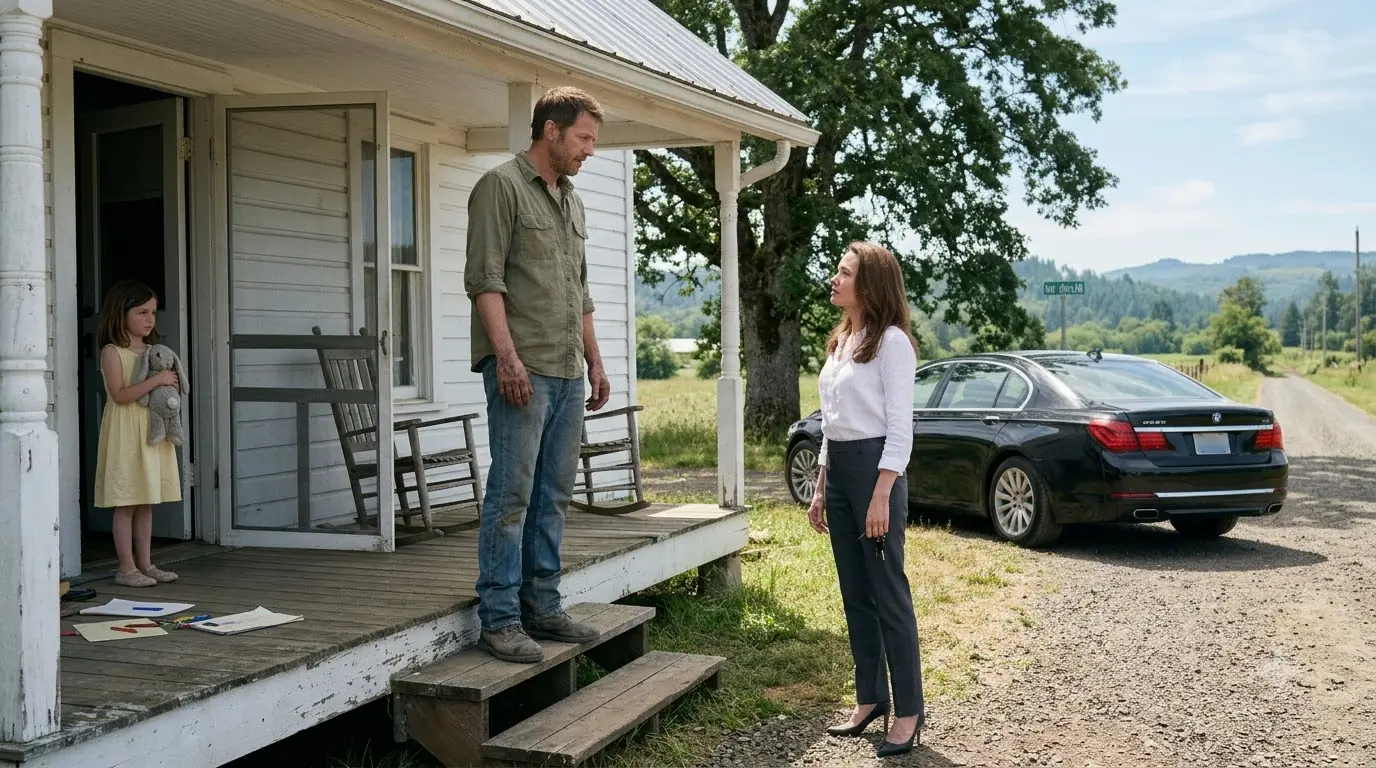
No angry speech about being overlooked or overworked.
Just one sentence.
“My daughter needs me.”
Margaret Okafor, the HR director at Arcturus Technologies, stared at the badge as if Daniel had placed a small piece of his heart on her desk instead of a rectangle of plastic with a faded photo and a barcode.
“Daniel,” she said carefully, “let’s slow down.”
He did not sit.
He had already decided that if he sat, someone would find a way to turn his decision into a conversation. A conversation would become a meeting. A meeting would become a review. A review would become another delay, another polite refusal, another reminder that companies were very good at making urgent human pain wait its turn behind policy.
“I can’t slow down anymore,” he said.
Margaret’s face softened.
She was in her late fifties, with silver threading through her dark hair and reading glasses hanging from a thin chain around her neck. A small succulent named Gerald sat on the edge of her desk, surviving under fluorescent lights with more dignity than most employees on the fourteenth floor.
“You’ve been here twelve years,” she said. “You don’t walk away from twelve years like this.”
Daniel looked down at the badge.
The photo on it was old. He was younger there. Less tired around the eyes. His hair had not yet started thinning at the temples, and the smile on his face belonged to a man who still believed loyalty and work would eventually be enough.
“I’m not walking away from twelve years,” he said. “I’m walking toward my daughter.”
Margaret folded her hands.
“Is this about the remote work request?”
Daniel did not answer immediately.
Six weeks earlier, he had submitted a formal request for a three-month remote work arrangement. Not permanent. Not a promotion. Not special treatment. Three months from the old family house in Sunridge so he could be with Lily while she stabilized after the accident, while her therapist adjusted her treatment plan, while school was out and the world felt less demanding.
He attached the documentation.
Doctor’s note.
Therapist’s recommendation.
Performance reviews.
Project completion history.
Twelve years of proof that Daniel Brooks did not need to sit under fluorescent lights to do his job well.
Victor Hale, the chief operations officer, denied it in two sentences.
Remote work is not aligned with the current operational model for this position. Request declined.
No call.
No conversation.
No alternative.
Just a polished corporate door closing quietly in his face.
“It’s about Lily,” Daniel said.
Margaret’s eyes dropped.
She knew enough to understand what that meant. People at Arcturus knew Daniel had lost his wife. They knew there had been a car accident. They knew his daughter had survived. They knew the appropriate amount of sorrow to express in the hallway.
They did not know that Lily had stopped speaking four days after the funeral.
They did not know that Daniel had spent months learning how loud a silent house could be.
Margaret stood and moved around the desk.
“Let me call someone from leadership,” she said. “There may be options we haven’t explored.”
Daniel gave a tired smile.
“There were options six weeks ago.”
“There may still be.”
“Not for me.”
“Daniel.”
He finally looked at her.
There must have been something in his face, because Margaret stopped.
She had seen thousands of employees over twenty-three years. New hires with nervous smiles. Managers pretending not to panic during layoffs. Burned-out staff trying to make resignation sound like an opportunity. She knew the difference between a person making a dramatic decision and a person who had already survived the drama privately.
Daniel was not asking to be persuaded.
He was informing her that he was gone.
“I appreciate everything,” he said. “I really do. But it’s done.”
He placed a white envelope beside the badge.
Formal resignation.
Effective immediately.
He had written it at two in the morning on the kitchen table while Lily slept upstairs, her stuffed rabbit tucked beneath her chin, her voice still locked somewhere behind grief.
Margaret looked at the envelope, then at him.
“I’m sorry,” she said quietly.
Daniel nodded once.
“So am I.”
He walked to his desk and spent twelve minutes clearing it.
A photo of Lily at the beach, age four, squinting into the sun with a missing front tooth. A ceramic mug she had made him at summer art camp before the accident. It had a crooked blue star painted on one side and the words Best Dad Ever on the other, though the V in Ever looked more like a Y.
A notepad with his handwriting on the top page.
A grocery list he realized was from three Saturdays ago.
Eggs.
Yogurt.
Lily’s apple juice, the kind without pulp.
He placed everything into a cardboard box someone had left in the supply room.
His coworker, Brendan Walsh, appeared at the edge of his cubicle with coffee in one hand and confusion all over his face.
“Hey,” Brendan said. “Is it true you’re leaving?”
Daniel kept packing.
“Yeah.”
“But the Morrison account. We’re presenting in three weeks.”
“Nathan can run it. He knows the file.”
“Daniel, come on. Nathan knows the file because you trained him on the file. That’s not the same thing.”
Daniel closed the cardboard box.
“He’ll be fine.”
Brendan lowered his voice.
“Is this because of Victor?”
Daniel said nothing.
Brendan looked around, then stepped closer.
“I heard they denied your remote request. That was messed up. Everybody knows you can do this job from anywhere.”
“Everybody except the people who decide.”
“Talk to Evelyn.”
Daniel almost laughed.
Evelyn Carter was the CEO of Arcturus Technologies. In twelve years, Daniel had been in the same room with her maybe four times. She was the kind of leader whose presence turned a hallway quieter before she even spoke.
Brilliant.
Controlled.
Almost frighteningly composed.
She did not do casual floor walks or cheerful birthday announcements. She appeared at quarterly presentations, investor events, and major internal meetings where everyone sat straighter when she entered.
“I’m not calling the CEO to ask permission to take care of my daughter,” Daniel said.
Brendan’s expression changed.
Softened.
“Is it Lily?”
Daniel picked up the box.
He paused for exactly one second.
“It’s always been Lily.”
He rode the elevator down alone.
The lobby was busy. People arriving. Badges scanning. Someone laughing at something on their phone. Someone else juggling coffee, laptop, and a half-zipped bag.
Life continuing, as it always had the nerve to do.
The revolving door pushed Daniel out into the summer morning, and the heat hit him immediately, solid and real, nothing like the recycled cold inside.
He stood on the sidewalk for a moment, box under his arm, looking up at the glass tower.
Fourteen floors of meetings and targets and performance reviews.
Twelve years of late nights, product launches, hallway coffees, canceled dinners, and weekends spent telling himself he was building something stable for his family.
Then he turned and walked toward the parking garage.
The thing about glass buildings is that you can see out, but you can never quite feel the sun.
He had forgotten what that felt like.
He was about to remember.
Claire Brooks died on a Tuesday in November.
She had gone out to pick Lily up from piano lessons, the same route she had driven forty times before, past the hardware store, the dry cleaner, and the corner with the broken traffic light the city had been promising to fix for two years.
A delivery truck ran the intersection.
The responding officer told Daniel it had been quick.
He said it like it was a gift.
Lily had been in the back seat.
She survived with a bruised collarbone and a cut above her left ear that needed four stitches. The pediatric trauma specialist used the words physically fine, then paused before continuing, as if making sure Daniel understood that physically fine did not mean fine.
At first, Lily cried.
Then she screamed.
Then she clung to Daniel so fiercely that he slept sitting upright for three nights because every time he tried to move, her small fingers tightened in his shirt.
Four days after the funeral, she stopped talking.
Not gradually.
Not reluctantly.
She just stopped.
The first morning, Daniel assumed she was tired. The second, he thought she was grieving in her own way. By the fourth day, when he asked what she wanted for breakfast and she only looked at him with a stillness that seemed too large for her seven-year-old body, he called the pediatrician.
Three specialists over six months.
A child therapist named Dr. Paula Reeves finally gave the silence a shape.
Selective mutism caused by trauma.
A withdrawal response.
A nervous system protecting itself from a world that had become too loud, too dangerous, too unpredictable.
“She is not refusing you,” Dr. Reeves had said gently. “She is surviving.”
Daniel held onto that sentence like rope.
Lily was not being stubborn.
She was surviving.
He repeated it to himself through mornings when she pointed instead of asking, through school meetings where teachers spoke gently around her, through nights when she sat beside him on the couch and watched old nature documentaries without saying a word.
Before the accident, Lily had been a child made of questions.
Why do clouds move faster when we’re in the car?
Do bees know they’re busy?
If you name a fish Pancake, does it know that’s funny?
She had been talking nonstop since she was two. Full sentences at two and a half. Complex questions by three. An unstoppable running commentary on everything she observed. The shape of clouds. Whether dogs dreamed about running or about being petted. Why grown-ups said maybe when they meant no.
After the accident, her silence made the house feel haunted by the child she had been.
Daniel went back to work two weeks after the funeral because the mortgage existed, and Lily’s therapy was not cheap, and grief did not pause automatic payments.
He hired a sitter named Barbara, a patient widow in her sixties who had raised four children and understood that silence from a child was not always a problem to be solved. Barbara brought knitting, tea bags, and a calmness that filled the living room without demanding anything from Lily.
Daniel would leave every morning with guilt clawing at his ribs.
He would drop Lily at school, drive forty-five minutes into the city, walk into Arcturus, sit through meetings where people used words like efficiency and alignment, and pretend he was not counting the hours until he could get back home.
Her teacher, Miss Holloway, emailed him every Friday.
Lily joined painting today. She chose blue.
Lily sat with the reading group. She tracked the pages.
Lily smiled when Theo showed her his drawing.
Small dispatches from a world where his daughter was managing, in her way, to continue.
Daniel told himself it was enough.
He told himself that every night.
But at two in the morning, when the house was quiet and the summer air pressed against the windows, he would sit at the kitchen table and stare at the chair where Claire used to sit.
Claire always left her chair slightly angled away from the table, one slipper half under it, as if she had only stepped away for a second.
After she died, Daniel could not bring himself to push it in.
The kitchen table became the place where he tried to calculate how to be two people at once.
A father fully present.
A professional still functional.
A grieving husband who had not completely collapsed.
He was managing all three.
Just barely.
And only by holding very still.
Lily still drew.
That had not left her.
Whole pads of paper filled with crayon and colored pencil. Animals, mostly. Houses. Trees. Birds with elaborate wings and impossible colors. Daniel studied them the way he used to study project briefs, looking for patterns, for meaning, for something he could act on.
One evening in June, seven months after the accident, he found a drawing she had left on the coffee table.
A small wooden house like his parents’ place in Sunridge, the one he had not been to in three years.
A yard.
A tree.
A tall figure and a small figure standing side by side.
Two people.
He counted them again.
Just two.
To the right of them, she had left space.
Not empty exactly.
Waiting.
Daniel sat down on the couch with the drawing in his hands.
The house was drawn in careful brown lines. The tree was green and full. The small figure had yellow hair like Lily. The tall figure wore a blue shirt, the color Daniel wore most often on weekends.
The missing figure was not erased.
It was not crossed out.
It was simply not there.
That hurt more.
He understood then, with the clarity of a man finally hearing what had been quiet for too long, that Lily was not asking for more therapy, more school support, more carefully structured evenings where he came home exhausted and tried to be gentle through his own fog.
She was asking for him.
Not his salary.
Not his job title.
Not his benefits package.
Him.
He quit the following Monday.
Sunridge, Oregon, was not a place that appeared on many travel lists.
It had a population of just over three thousand, a main street with a diner, a hardware store, a used bookshop, and a pharmacy that also sold fishing tackle. It sat in a valley between low rolling hills that turned golden in summer and dark green after rain.
The nearest city was almost two hours east, which felt, to the people of Sunridge, like exactly the right amount of distance from everything.
Daniel’s parents had bought the house on Birch Road in 1987. His father had been a high school shop teacher. His mother had worked at the county library for thirty years.
They had retired to Arizona six years earlier.
“The knees,” his father always said, “are done with Oregon winters.”
The house had sat mostly empty since then, used occasionally for holidays and summers, kept up by a neighbor named Walt who mowed the yard, checked the pipes, and reported any broken gutters with the seriousness of a military commander.
Daniel called his mother from the parking garage of Arcturus the day he quit.
“I need the house,” he said.
There was a pause.
“For how long?”
“I don’t know.”
Another pause, longer this time.
“Then Walt will have a key waiting. And Daniel?”
“Yeah?”
“Bring extra blankets. The upstairs radiator still runs cold.”
He closed his eyes.
“Thanks, Mom.”
“She needs quiet,” his mother said.
Daniel opened his eyes.
“What?”
“Lily. She needs quiet. And you need to stop pretending you don’t.”
The drive from Portland to Sunridge took ninety minutes.
Lily sat in the back seat with her stuffed rabbit, a gray lop-eared thing named Biscuit that had been with her since she was eighteen months old. She watched the landscape change through the window as buildings gave way to fields, fields to hills, hills to trees.
By the time the highway gave way to county roads and the valley opened around them, her face was pressed to the glass.
Daniel watched her in the rearview mirror and said nothing.
The house was exactly as he remembered it.
White clapboard.
Covered front porch.
Two rocking chairs that had been there since before he was born.
A backyard sloping down toward a narrow creek that ran year-round.
The oak tree he had climbed as a kid still stood in the side yard, its branches spreading wide and low enough that a child could reach the first one if she tried.
Daniel carried their bags inside while Lily stood in the middle of the living room and turned slowly, taking in the braided rug, the stone fireplace, the low shelves of old books, and the afternoon light falling through the west-facing windows in warm bars.
He watched her from the doorway.
She put Biscuit on the arm of the couch.
She walked to the window.
She stood there for a long time, looking at the backyard, at the creek catching sun, at the oak tree.
Then she reached out and touched the glass with one finger.
Daniel unpacked the kitchen.
He did not cry until she was asleep that night.
The weeks that followed had a different texture than anything he had lived in for the past fourteen months.
He found work with Walt’s son, who ran a small landscaping business and needed extra help for summer. It was physical work, honest and exhausting. Daniel hauled mulch, planted borders, dug out old roots, repaired fences, and came home with dirt under his nails instead of keyboard stiffness in his wrists.
Lily came with him most mornings, sitting in the shade with her drawing pad while Daniel worked. Walt’s son, Aaron, never pushed her to talk. He simply nodded at her drawings and said things like “Good tree” or “That bird looks smarter than me,” which sometimes made Lily’s eyes brighten.
She was quiet in the way she had been quiet since the accident.
But it was a different quiet.
Wider.
Less sealed.
She started noticing things.
The way a robin landed and tilted its head before pulling a worm from the dirt. The patterns the sprinkler made in the grass. The specific green of new growth against old wood. The sound of the creek when evening came.
She would point sometimes.
Just lift a finger and look at Daniel.
He would look and nod.
“I see it,” he would say.
It was enough.
For now, it was enough.
Meanwhile, Evelyn Carter had not personally reviewed an individual resignation file in four years.
She had a team for that. She had a head of people operations, an HR director, a succession planning lead, and two senior staffing analysts. She had processes. Frameworks. Dashboards. According to the most recent internal audit, she had thirty-seven direct and indirect reports whose entire function was to manage the kind of thing she was currently doing at 11:30 on a Thursday night.
She sat alone in her office with a cold cup of tea and a file that kept pulling her back.
Daniel Brooks.
Senior product operations lead.
Tenure: twelve years, four months.
Resignation: effective immediately.
Reason cited: family issue.
She had come across it by accident, or as close to accident as anything gets when you are the kind of person who reads everything.
A monthly summary document had flagged unusual voluntary departures, and his name had been highlighted because his exit had triggered a cascade. Three downstream projects without a lead. A client presentation rescheduled twice. A junior team member requesting reassignment. A retention risk note attached to his team.
Evelyn looked him up.
Twelve years of performance reviews, all strong, most exceptional.
A pattern of taking on projects that were underfunded and understaffed and delivering them anyway.
A note from three years earlier, filed by a previous manager, read:
Brooks has declined promotion to director level twice. Reason given: doesn’t want to travel. Family circumstances.
Evelyn opened the most recent HR exchange.
Six weeks before his resignation, Daniel had submitted a formal request for a three-month remote work arrangement, citing a documented family medical situation.
Victor Hale had denied it.
Remote work is not aligned with the current operational model for this position. Request declined.
Evelyn read the two sentences three times.
Then she leaned back in her chair.
Victor Hale was her chief operations officer. He was efficient, disciplined, and dangerously proud of being unsentimental. He believed a company was strong only when its systems did not bend for individual circumstances.
Evelyn had valued that once.
She was beginning to wonder how expensive that value had become.
She opened Daniel’s file again and read from the beginning.
By the time she finished, her tea was fully cold, and she had made a decision she would later be unable to explain entirely in rational terms.
She looked up his emergency contact.
She found the forwarding address.
She called her assistant at seven the next morning and said, “Clear my Friday.”
Her assistant, Simone, paused.
“All of it?”
“Yes.”
“You have the investor lunch.”
“Cancel it.”
“The Sinclair call?”
“Move it.”
“The Arcturus expansion review?”
“Monday.”
Simone was silent for one second too long.
“Are you all right?”
“No,” Evelyn said honestly. “But I am going to be.”
Three days later, in a quiet town miles away from glass towers and deadlines, a black luxury car pulled up in front of Daniel Brooks’s small wooden house.
Daniel was in the backyard when he heard it, the particular sound of something expensive moving slowly over gravel. He came around the side of the house in time to see the car stop at the curb.
He assumed it was lost.
People with cars like that were not usually looking for weathered clapboard houses in Sunridge.
Then the door opened.
He recognized her immediately, which struck him later as strange, because he had only been in the same room as Evelyn Carter perhaps four times in twelve years.
But everyone at Arcturus knew what she looked like.
She was wearing a white linen shirt and dark trousers, and she carried nothing except her car keys.
No security.
No briefcase.
No assistant.
No polished entourage of corporate urgency.
She looked slightly out of place in the way a person looks when she has made a decision and is committed enough to it not to feel embarrassed.
She saw him standing by the side of the house and walked toward him.
“Daniel Brooks,” she said.
“Ms. Carter.”
A pause.
They looked at each other across fifteen feet of sunlit lawn.
“You drove three hours,” he said.
“Two and a half. The county road is faster than it looks.”
He said nothing.
He wiped his hands on his work jeans.
“I read your file,” she said. “All of it. I read Victor’s denial.”
“Ms. Carter.”
“Evelyn.”
He stopped.
She held his gaze.
“I’m not here to ask you to come back,” she said. “I’m not here to make an offer. I’m not here to apologize on behalf of a company and then ask you to make the company feel better by accepting the apology.”
Daniel studied her carefully.
“Then why are you here?”
Evelyn looked toward the house.
The screen door stood open. From somewhere inside came the soft scratch of pencil on paper.
“Because something in how you left did not add up to me,” she said. “And I prefer to understand things I got wrong.”
Before Daniel could answer, the screen door creaked.
Lily appeared on the porch.
She wore a yellow sundress and held Biscuit with both arms. A crayon was tucked behind one ear. She looked at Evelyn with the frank, searching attention of a child who had not yet learned to pretend she was not staring.
Evelyn looked at Lily.
Something shifted in her face.
Not pity.
Daniel had seen pity.
He knew its texture.
This was something quieter and older.
“Hi,” Evelyn said.
Lily did not answer.
But she did not go back inside either.
She sat on the porch steps, set Biscuit beside her, and kept her eyes on Evelyn with a stillness Daniel had learned not to interrupt.
He looked at his daughter.
Then at his former CEO, standing alone on his lawn under the harsh summer sun.
“Do you want some coffee?” he asked.
Evelyn looked at him.
For a fraction of a second, she looked almost relieved.
“Yes,” she said. “Thank you.”
They sat on the porch for two hours.
Daniel made coffee in the old kitchen, apologizing for the chipped mugs without knowing why. Evelyn took hers black and held it with both hands, as if the warmth mattered more than the taste.
At first, the conversation was awkward.
Evelyn asked about Lily’s therapy.
Daniel answered carefully.
She asked about Sunridge.
He told her about the house, his parents, the creek, and Walt’s habit of knowing everyone’s business before breakfast.
She did not ask him why he had not fought harder.
He appreciated that.
Lily remained on the porch steps for twenty minutes, listening without looking like she was listening. Then she disappeared inside and returned with her drawing pad.
Evelyn noticed the birds.
“You draw cedar waxwings,” she said softly.
Lily’s pencil paused.
Daniel looked at Evelyn.
“You know birds?”
“My aunt Frances did,” Evelyn said. “She raised me for a while.”
Lily did not speak.
But she turned the drawing pad slightly so Evelyn could see better.
That was not nothing.
When Evelyn finally left, she stood beside her car for a moment before getting in.
“I’m sorry,” she said.
Daniel leaned against the porch railing.
“For Victor?”
“For building a company where Victor’s answer could be the final answer.”
He did not know what to say to that.
Evelyn nodded once and drove away.
Daniel spent the rest of the afternoon telling himself that was the end of it.
She came back on Thursday.
He had not asked her to.
She had not mentioned it when she left.
At eleven in the morning, her car appeared at the curb again.
This time, she carried a paper bag.
She set it on the porch railing without ceremony.
“I wasn’t sure what she liked,” Evelyn said. “There’s a set of watercolor pencils, the good kind, not the waxy ones, and two blank sketchbooks, and a field guide to Pacific Northwest birds.”
She paused.
“Because of the robin.”
Daniel stared at her.
“You noticed that?”
“She pointed at it for almost thirty seconds.”
He looked at the bag.
Then at Evelyn.
“You didn’t have to.”
“I know.”
She said it simply, without deflection.
Lily appeared in the doorway, drawn by some internal radar she seemed to have for the presence of the things she wanted.
She looked at the bag on the railing.
Then at Evelyn.
Then, with deliberate slowness, she came down the porch steps and approached the railing.
She looked inside.
After a long moment, she reached in and pulled out the bird guide. She held it with both hands, turned to a page in the middle, and studied whatever was there with deep seriousness.
“The cedar waxwing,” Evelyn said, coming to stand beside her.
Not over her.
Beside her.
“At least, I think that’s the page you found. They travel in flocks, and they pass berries to each other, beak to beak down the line.”
Lily looked at the page.
Then she looked at Evelyn.
Then, with great solemnity, she held out the book.
Evelyn took it, looked at the page, nodded as if this were a perfectly normal meeting, and handed it back.
Daniel watched from the steps and said nothing.
They stayed like that for a while, the three of them in the summer morning, the creek running behind the house, the oak tree doing nothing dramatic.
Later, when Lily had gone inside with her new supplies and the sound of her drawing could be heard through the screen door, Evelyn sat in one of the rocking chairs and said, “My mother died when I was nine.”
Daniel sat in the other chair.
“Car accident,” she said. “In January. The year everything was ice.”
He did not say he was sorry.
He had learned that people who had lost someone did not always need to be told the loss was sorry-worthy.
They knew.
What they sometimes needed was for the fact to exist in the room without being tidied away.
“My father didn’t know what to do,” Evelyn said. “He was a good man, but he had never had to figure me out before. My mother had always been the one who understood me. After she was gone, he kept trying harder with all the wrong tools.”
She looked out at the yard.
“I stopped talking for almost seven months.”
Daniel turned toward her.
Evelyn kept her eyes on the creek.
“No one called it selective mutism then. At least not to me. They said shock. Grief. Stubbornness. My father took me to doctors, counselors, private tutors. He asked me questions until I learned to look like I was listening while being somewhere else entirely.”
Her mouth tightened.
“Then my aunt Frances came to stay with us. Terrible cook. Tremendous human being. She gave me a notebook and a pencil and sat beside me without asking me to perform recovery for her.”
Daniel looked toward the kitchen wall, where Lily’s new drawing had already joined the others.
“What happened?”
“One day she drew a cup of tea and wrote too much sugar next to it.” Evelyn almost smiled. “She always put too much sugar in tea. I corrected her spelling. That was the first thing I wrote in months.”
“And then?”
“And then she made worse tea so I would keep correcting her.”
Daniel laughed once, quietly.
Evelyn looked at him.
There it was.
A small smile.
Not corporate.
Not polished.
Human.
“She saved me,” Evelyn said. “Not dramatically. Not all at once. She saved me by being there long enough that my nervous system believed her.”
Daniel sat with that.
He understood the sentence immediately.
Over the next month, Evelyn kept coming back.
At first for an hour.
Then an afternoon.
Then dinner.
No one announced the change. There was no conversation where Daniel agreed that his former CEO could become part of the rhythm of their quiet house. It happened incrementally, which was how most real things happened.
Then all at once.
Daniel started cooking more.
Not because Evelyn asked. She never asked. But because it felt strange to eat while a person who had just spent four hours talking to Lily about birds drove away hungry.
He made the kinds of things his mother had made in this kitchen.
Soup from scratch.
Bread that took too long.
A lemon cake Lily supervised with the focused intensity of a quality inspector.
Lily began using the watercolor pencils.
Her pages became loose and brilliant, colors bleeding into one another. Birds, mostly, drawn from the field guide and then reinvented, given extra wings, strange colors, and properties nature had not approved.
Daniel pinned them to the kitchen wall until the wall was mostly covered.
One afternoon, Evelyn sat at the kitchen table and said, “I want to tell you something. Not as your former employer. Just to tell you.”
Daniel sat across from her.
“Victor Hale should never have denied that request,” she said. “A twelve-year employee with a documented family medical situation requesting a three-month remote trial. That denial was a failure of basic judgment, and it happened without my knowledge, but it still happened inside the company I run.”
Daniel looked down at his coffee.
“I’ve been doing this work long enough to know the difference between someone who leaves because they’re done with the job and someone who leaves because the job made them choose,” she continued. “You weren’t done.”
“No,” he said. “I wasn’t.”
“I’m building something new. I’ve been planning it for eighteen months, but honestly, it never became urgent enough until you left.”
“What is it?”
“It’s called Project Lighthouse. A support framework for employees navigating major family transitions. Medical crises. Caregiving. Bereavement. Trauma recovery. Early parenthood. It would include remote work architecture, emergency leave banks, flexible project reassignment, manager accountability, and internal advocates who can escalate denials before people are forced out.”
Daniel stared at her.
“That sounds expensive.”
“It is.”
“Victor must hate it.”
“Victor hates anything that acknowledges employees have lives.”
Despite himself, Daniel smiled faintly.
Evelyn looked at the wall of Lily’s drawings.
“I want you to lead it.”
His smile vanished.
“What?”
“The role would be remote, structured around the reality you are living. That is the point. You would work from here, travel only when necessary, and build the program from the perspective of someone who understands what the current system failed to understand.”
He leaned back.
“I don’t want to go back.”
“I know.”
“I mean it.”
“I know.”
“No glass tower. No Victor. No pretending my daughter’s trauma fits neatly around office hours.”
Evelyn held his gaze.
“I’m not asking you to go back to what it was. I’m asking you to help build what it should be.”
Through the screen door came the sound of Lily in the backyard, the gentle thud of something dropping on the porch, probably the bird guide.
“She’s getting better,” Evelyn said.
It was not a question.
Slowly, Daniel nodded.
“Yeah.”
“Good.”
“But that’s how it usually works,” he said. “Slow. Then suddenly not slow.”
He looked at her.
“You’re not going to give me a deadline, are you?”
“No.”
He picked up his coffee cup.
“Give me a week.”
That evening, clearing the dinner things, he found a new drawing on the table.
Not birds this time.
A house.
The Birch Road house, clearly.
A yard.
An oak tree.
Three figures.
One tall.
One small.
One medium height, with dark hair.
Three.
He stood at the kitchen table holding it for a long time.
The space to the right had been filled.
The Arcturus Technologies boardroom occupied the corner of the fourteenth floor with floor-to-ceiling windows on two sides and a table long enough to seat twenty.
It was a room designed to make people feel that decisions made within it deserved the view.
Daniel had been there only twice in twelve years.
Once for a company-wide strategy session he had been asked to present at.
Once by accident, looking for a conference room that turned out to be on a different floor.
Now he was here by invitation.
Evelyn had briefed him the night before by phone.
“The board has questions about Lighthouse. Victor has been working the room. I need you there not as an employee, but as the person the policy would have helped. You don’t have to perform anything. You just have to tell the truth.”
He drove into Portland that morning and left Lily with Walt’s granddaughter Rosie, who was twenty-two, patient, and had once spent an entire Saturday watching Lily draw without once suggesting she do something else.
The room was full when Daniel arrived.
Evelyn sat at the head of the table, upright and still.
Victor Hale sat to her left, silver-haired and smooth, with the practiced ease of a man who had spent decades making doubt sound like common sense.
There were nine board members, a few Daniel recognized from company-wide communications. Most of them looked at him with the polite blankness of people confronted with someone whose relevance they had not yet determined.
Evelyn introduced him briefly.
“Daniel Brooks was a senior operations lead here for twelve years. He resigned in June following denial of a remote work request made under documented family medical circumstances. He has agreed to speak to what that experience meant.”
Victor spoke pleasantly.
“We appreciate the personal story, of course, but this is ultimately a financial and operational discussion. The question before this board is whether an initiative of this scope, with the staffing and structural costs involved, represents responsible use of company resources.”
“Victor,” Evelyn said evenly. “He hasn’t spoken yet.”
Daniel stood.
He had not prepared notes.
He had considered it, then decided notes would make it feel like a presentation.
This was not a presentation.
It was a fact.
“My daughter is seven years old,” he said. “Her name is Lily. Her mother died fourteen months ago in a car accident. Lily was in the car.”
The room went quiet.
“After the accident, Lily stopped speaking. Her trauma therapist explained that this is a documented response. It has treatment protocols. The treatment requires time, consistency, and presence. A lot of presence.”
He looked at the table in front of him.
“I asked for a three-month remote work arrangement. I documented the medical situation. I had twelve years of performance reviews. The request was denied in two sentences. No conversation. No alternative offered.”
He looked up.
“I’m not here to litigate that decision. I made my choice, and I would make it again. I’m here because Evelyn asked me to say what it felt like to be someone who built something here for twelve years and then had to choose between that and his child.”
He paused.
“It felt like the company didn’t know I existed as a person. It only knew I existed as output.”
Victor shifted in his chair.
“With respect, individual circumstances are difficult to build policy around.”
Daniel turned to him.
“I’m not asking the company to solve every individual circumstance. I’m saying that a structure that helps you keep good people, not by lowering standards but by acknowledging that people have lives, is not a cost. It is an investment.”
He sat down.
No one spoke for a moment.
The silence in that room had a different quality than the silence Daniel had learned to read at home.
At home, silence meant processing or protection or the slow accumulation of something that would eventually find its way out.
Here, silence meant calculation.
One board member, Patricia Weir, leaned forward.
“What would it have cost the company to grant Daniel Brooks a three-month remote trial?”
Nobody answered immediately.
Victor said, “The operational disruption alone would have been difficult to quantify.”
Patricia looked at him.
“What did losing him cost?”
Victor’s mouth tightened.
“In recruitment, institutional knowledge, delayed projects, morale impact, and the downstream attrition risk on his team,” Patricia continued. “What did losing him cost?”
Evelyn did not speak.
She let the question stand.
Victor looked at the printed report in front of him.
“We don’t have that number prepared.”
“Then perhaps our model is measuring the wrong things,” Patricia said.
Another silence.
A different kind.
Evelyn placed both hands on the table.
“I’m calling the vote.”
Victor leaned forward.
“Evelyn, this is premature.”
“No,” she said. “What is premature is building another fiscal year around systems we already know are failing.”
Her eyes moved across the boardroom.
“Project Lighthouse, as presented. Full structural implementation phased over eighteen months. Budget as proposed. Daniel Brooks as program lead.”
She paused.
“Those in favor.”
Patricia’s hand went up first.
Then another.
Then another.
Seven hands.
Victor sat very still.
“Motion carries,” Evelyn said.
Daniel looked down at his hands.
He breathed.
He drove back to Sunridge that afternoon while the light went gold over the hills.
When he pulled onto Birch Road, Lily was sitting on the porch steps with Biscuit and a drawing pad.
She looked up when she saw his car and watched him park.
He sat on the step below her.
She showed him what she had drawn.
A tall building with many windows.
A small figure walking away from it toward a car with a box under one arm.
She had drawn it from memory, or from some internal picture she had been carrying.
He looked at it for a while.
“That’s me,” he said.
She nodded.
“Walking away.”
She nodded again.
He looked at the drawing for another long moment.
Then he handed it back.
“I’d do it again,” he said.
She held the drawing in her lap and looked at it.
Then she put Biscuit on top of it and leaned back on her hands, looking at the evening sky.
He sat beside her until it got dark.
The notice went out to all Arcturus staff on a Wednesday in August.
It announced Project Lighthouse, described its purpose as a support framework for employees navigating major life transitions, effective immediately for all active staff and retroactively reviewed for departures in the past eighteen months.
It named Daniel Brooks as program lead.
It also announced, in a separate paragraph, that Victor Hale was transitioning out of his role as chief operations officer.
Victor’s transition was described as mutual.
It was not.
Daniel read the notice at the kitchen table in Sunridge with a second cup of coffee and felt something he had not expected to feel.
Not triumph.
Not revenge.
Something quieter.
A sense of the world righting itself by a small degree, which was about as much as anyone could reasonably ask the world to do at one time.
He was working from the Birch Road house three days a week and driving to Portland twice.
The rhythm was imperfect and occasionally chaotic, and he was learning to be okay with that.
He had enrolled Lily in a summer art program at the Sunridge Community Center on Tuesday and Thursday mornings. It was small, six kids, with a patient instructor named Georgia, who had taught elementary school for fifteen years and had the kind of voice that made things feel manageable.
Lily spent the first session sitting apart from the other children, drawing alone.
By the third session, she was sitting next to a boy named Theo, who liked to draw dinosaurs and who, by some wordless negotiation Daniel never fully understood, became her creative collaborator.
Theo drew the dinosaurs.
Lily drew the worlds they lived in.
Dr. Reeves, who had shifted to video sessions since the move, said this was exactly the kind of organic social engagement she had been hoping for.
She said it carefully, giving it room.
Daniel had stopped holding his breath every morning.
He noticed it about three weeks in, that he had been holding something tight in his chest for fourteen months and had, somewhere in the August heat and the landscaping work and the evenings on the porch, let it go.
Not completely.
Not permanently.
Enough to breathe normally.
On a Saturday afternoon in the third week of August, he was weeding the front garden, a task Walt had been gently suggesting for six weeks, when he heard Lily behind him.
She had been sitting on the porch steps with Biscuit beside her, watching him work.
He heard a sound he did not immediately recognize.
He turned.
She said, “Clear.”
A single word.
Clean and whole.
Delivered with no ceremony whatsoever, as if she said it every morning, which she had, before everything.
It was the most ordinary word she had ever used.
It was the most extraordinary thing he had heard in fourteen months.
He was on his knees in the dirt.
He looked at her, and she was looking back at him with those brown eyes, Biscuit under her arm, completely matter-of-fact, as if the word had always been there and she had simply decided it was time to use it again.
He did not manage to say anything.
He pressed the back of his hand to his mouth and looked at the sky over the oak tree and felt everything he had not let himself feel for fourteen months move through him at once.
The grief and the relief were the same thing for a moment.
He could not have told anyone whether what moved through him was sorrow for the months of silence or joy for the single word that had broken it.
It was both.
They were the same current.
Lily watched him cry without alarm.
She had seen him cry before.
She understood it the way children understand things they have not been taught, instinctively and without making it strange.
After a while, she climbed down from the steps, came to sit beside him in the dirt, and put her head against his arm.
They stayed like that until the light changed.
Evelyn came back to Sunridge on a Friday in early September.
She did not call ahead.
She appeared at the door at four in the afternoon with a bottle of wine from a vineyard she had passed on the county road.
Daniel opened the door.
Evelyn looked at him and said, “I should have called.”
“No,” he said, and meant it. “Come in.”
She stood in the hallway and looked at the wall of Lily’s paintings, which had expanded from the kitchen into the corridor, pinned in rough chronological order so that a person could see the progression if he stood back far enough.
Abstract shapes giving way to birds.
Birds giving way to houses.
Houses beginning to include figures.
“She’s speaking,” Daniel said from behind her.
Evelyn turned.
“Started three weeks ago. Single words at first, then phrases. Dr. Reeves says it’s consistent with her trajectory. The move here. The stability. The time.”
He paused.
“The structure.”
Evelyn looked back at the paintings.
“She gave herself a language first,” she said.
Daniel nodded.
“I think she did.”
He went to the kitchen and came back with a folded piece of paper.
“She drew something for you.”
Evelyn opened it carefully.
The Birch Road house.
The oak tree.
The yard in late summer.
You could tell it was late summer from the colors, amber and gold at the edges.
Three figures.
One tall.
One medium.
One small.
And in the corner, an orange tabby cat that, as far as Daniel knew, did not currently exist in their lives.
In the lower right, in careful, deliberate letters Lily had recently started writing again, she had written two words.
My family.
Evelyn stood in his hallway and looked at the drawing for a long time.
When she looked up, her eyes were bright.
Daniel was watching her.
“We don’t have a cat,” he said.
“That seems like a fixable problem,” she replied.
He laughed.
A real laugh.
The kind that surprised him from inside his own chest.
“Stay for dinner,” he said.
It was not a negotiation, and it was not a confession.
It was the kind of sentence that means something different from the words it uses.
It meant, I have thought about this.
It meant, Lily drew you into the picture.
It meant, the summer did something to me that I cannot entirely take back.
Evelyn put the drawing carefully in her jacket pocket.
“Okay,” she said.
They ate on the back porch as the sun went down over the hills.
The three of them.
Lily sat between the two adults with her feet not quite reaching the boards, pointing at things in the middle distance and naming some of them in a voice still soft from disuse.
“Bird.”
“Cloud.”
“Creek.”
Each word made Daniel’s heart move.
Each word made Evelyn go very still, as if witnessing something sacred.
At some point, Lily said, “More bread.”
Evelyn passed the bread.
It was the most ordinary transaction in the world.
It had the specific weight of something that would only happen once, this particular way, in this particular light.
Later, after Lily was asleep, Daniel and Evelyn sat on the front porch in the dark with the wine and the crickets.
The street was quiet.
Walt’s house glowed yellow across the road.
“I didn’t come here for the company,” Evelyn said.
It was not the first time she had said it, but it was the first time she said it while looking directly at him.
Daniel looked back.
“I know.”
The porch boards creaked.
“I don’t know what this is,” she said. “I want to say that clearly. I don’t have a plan for this part.”
“Neither do I,” he said.
“That’s unusual for me.”
“Me too. Mostly.”
A pause.
The creek ran somewhere in the dark behind the house.
“She’s going to want a real cat,” Evelyn said.
“I know. Orange tabby.”
“She was specific.”
“She’s always been specific.”
He stopped because something in his own voice surprised him.
The lightness of it.
The ease.
The way he had said always like it was a simple word again.
Evelyn was quiet.
She set her wine glass on the railing and looked at the dark street and the stars over the valley hills.
“I came to Sunridge because something in a file didn’t add up,” she said. “And now I’ve been here twelve times.”
“Thirteen,” Daniel said. “You’re forgetting the Thursday in July when you only stayed an hour.”
She turned to look at him.
This time, she smiled fully.
“Thirteen.”
In October, they found the orange tabby.
Or rather, the orange tabby found them.
It had been eating from Walt’s back porch for three weeks, according to Walt, who claimed loudly that he was not feeding it while filling a bowl with tuna. The cat was orange with a white patch under its chin and a deeply judgmental expression.
Lily named it Captain.
She did not explain the name.
When Daniel asked, she gave him a look that meant the question had already been answered.
He dropped it.
Captain moved into the Birch Road house with the confidence of a property owner inspecting tenants. He slept on Lily’s bed, ignored Daniel unless food was involved, and liked Evelyn immediately, which Walt said proved cats had poor judgment.
By Thanksgiving, Evelyn was at the house most weekends.
By Christmas, Lily was speaking in full sentences again, though still softly, still carefully, still with days when language seemed too heavy and drawing became easier.
No one rushed her.
That was part of the miracle.
No one demanded recovery on a schedule.
On Christmas Eve, they decorated the old house together. Daniel untangled lights badly. Evelyn followed printed instructions for assembling a gingerbread house and still somehow got frosting on her sleeve. Lily hung bird ornaments on the tree, including three cedar waxwings Evelyn had found in a small shop in Portland.
Before bed, Lily handed Evelyn a folded note.
Evelyn opened it.
In careful handwriting, Lily had written:
Please stay tomorrow morning. Dad makes bad pancakes but good memories.
Evelyn pressed the note to her chest.
Daniel stood in the doorway, unable to speak.
Evelyn stayed.
The next morning, Daniel burned the first batch of pancakes and undercooked the second. Lily declared them “emotionally uneven.” Evelyn ate three.
Project Lighthouse launched fully the following year.
At first, people were skeptical.
Employees had learned to distrust initiatives with poetic names and glossy internal announcements. But Lighthouse did not behave like a slogan. It behaved like structure.
A father in the finance department was able to work remotely after his newborn daughter needed heart surgery.
A senior engineer caring for her mother with dementia received a flexible schedule without being forced to choose between career and caregiving.
A manager who denied two emergency leave requests without documentation was required to undergo review and coaching.
A young employee whose brother died unexpectedly was given real bereavement support instead of three days and an automated sympathy email.
The program cost money.
It also saved people.
Retention improved.
Productivity did not collapse.
Teams adjusted.
Work continued.
And slowly, inside a company that had spent years mistaking pressure for excellence, the culture began to change.
Evelyn testified before a business leadership council about the program eighteen months after its launch.
Daniel sat in the audience.
So did Lily, who was wearing a green dress and holding a sketchbook in her lap.
Evelyn stood at the podium, calm but not armored.
“For years,” she said, “I believed strong companies were built by people who could separate work from life. I was wrong. Strong companies are built by people whose lives are not treated as interruptions to their usefulness.”
She looked toward Daniel.
“When Daniel Brooks left Arcturus, he exposed a failure in our system. He did not do it with a memo. He did it by choosing his daughter. The fact that our company made that choice necessary is something I will regret for the rest of my career. The fact that we had the chance to learn from it is something I will be grateful for just as long.”
Lily leaned toward Daniel and whispered, “She’s good at speeches.”
Daniel smiled.
“She is.”
“Not as good as Mom was at singing.”
“No,” Daniel said softly. “Not as good as Mom at that.”
Lily nodded, satisfied with the hierarchy.
Evelyn and Daniel did not fall in love like young people in movies.
There were no sudden grand confessions in the rain.
No dramatic airport scenes.
No music rising at exactly the right moment.
They fell in love the way adults often do after grief has taught them caution.
Through groceries.
Through winter mornings.
Through shared calendars.
Through Lily’s therapy appointments.
Through arguing about whether Captain needed a heated cat bed.
Through Daniel learning that accepting help did not make him weak.
Through Evelyn learning that presence could not be delegated.
One spring evening, almost two years after Daniel left Arcturus, they sat on the porch while Lily slept upstairs and Captain occupied both rocking chairs despite having no legal claim to either.
Evelyn looked out toward the oak tree.
“Do you ever think about Claire when I’m here?”
Daniel looked at her.
The question was soft, but it had cost her something.
“Yes,” he said.
Evelyn nodded.
“I thought so.”
“Not the way you think.”
“How do I think?”
“That love has to be replaced for new love to fit.”
She looked down.
Daniel reached for her hand.
“Claire will always be here,” he said. “In Lily. In this house now, somehow. In the way I pack lunches and fold towels wrong and know the words to songs I never would have learned if she hadn’t sung them first.”
Evelyn’s fingers tightened around his.
“That doesn’t mean there isn’t room,” he continued. “It means the room was built by love before you came. And you didn’t take anything from it. You brought light into it.”
Evelyn’s eyes filled.
“I don’t know if I know how to be part of a family.”
Daniel smiled.
“You’re already part of this one.”
“Lily drew me in first.”
“She’s usually ahead of us.”
“She is very strategic.”
“She is seven.”
“Still.”
Daniel laughed softly.
Then, because life had already taken enough from him to teach him that waiting for perfect courage was another form of fear, he said, “Move in.”
Evelyn turned toward him.
“What?”
“Not because it’s practical. Not because of the company. Not because Lily drew you into a picture. Because I want you here. Because I love you. Because this house feels more like itself when your keys are on the table and your tea goes cold beside mine.”
Evelyn did not speak.
For once, Evelyn Carter, CEO of Arcturus Technologies, architect of Project Lighthouse, woman who had faced boardrooms without blinking, had no immediate answer.
Then she cried.
Not dramatically.
Quietly.
Like someone whose life had given her too few places safe enough to fall apart.
“Yes,” she whispered.
Daniel kissed her on the porch under the oak tree while Captain watched from the railing with deep disapproval.
Lily approved faster.
The next morning, Daniel and Evelyn sat at the kitchen table and told her.
Lily listened, chewing toast.
Then she said, “Captain already knew.”
Evelyn blinked.
“He did?”
“He sleeps on your coat.”
Daniel nodded solemnly.
“That is legally binding.”
Lily smiled.
A full smile.
Not partial.
Not careful.
Full.
Evelyn moved in at the end of May.
She brought surprisingly little.
Books.
Clothes.
A few framed photographs.
A tea kettle that looked expensive enough to need insurance.
She left behind the penthouse.
Not sold immediately. Not abandoned dramatically. But slowly emptied of things that had once represented success and now mostly represented echo.
The Birch Road house changed too.
Not into something polished.
Evelyn knew better than to try.
It became more itself.
More books.
Better lamps.
A second desk for Evelyn in the room Daniel used as his office.
A new shelf for Lily’s art supplies.
A blue ceramic bowl for Captain, who preferred drinking from the bathtub faucet and considered bowls beneath him.
On the third anniversary of Claire’s death, the three of them went to the cemetery together.
Daniel had asked Lily privately if she wanted Evelyn to come.
Lily had thought for a long time.
Then she said, “Mom would like her because she stays.”
So Evelyn came.
She stood quietly beside them while Daniel placed flowers near Claire’s headstone. Lily brought a drawing of cedar waxwings passing berries down a line.
Evelyn did not try to make the day less sad.
She did not say anything about moving forward or healing or how grief changed shape.
She simply stood there.
Present.
After a while, Lily took her hand.
That was the moment Daniel knew.
Not believed.
Knew.
A year later, Daniel proposed on the porch.
No audience except Lily and Captain, though Lily was terrible at hiding behind the curtains and Captain had no respect for privacy.
The ring was simple. Evelyn could have bought one a hundred times more expensive without noticing the cost, but when Daniel opened the box, she looked at it as if it were made of moonlight.
“I had a speech,” he said.
Evelyn smiled through tears.
“Had?”
“Forgot most of it.”
“That seems unlike you.”
“You make me nervous.”
“Still?”
“Especially still.”
Lily whispered from behind the curtain, “Say the important part.”
Daniel laughed, then turned serious.
“You came to this house because a file didn’t add up. You stayed because a child handed you silence and you knew not to break it. You helped me build something that saved people I’ll never meet. You loved Lily without trying to replace her mother, and you loved me without asking me to become someone else first.”
Evelyn covered her mouth.
Daniel knelt.
“Evelyn Carter, will you marry me? Will you keep making tea you forget to drink, arguing with Captain, correcting my emails, passing bread to Lily, and staying in this life with us, even when it is messy and ordinary and nothing like a glass tower?”
Evelyn was crying openly.
“Yes,” she said.
Lily burst from behind the curtain.
“She said yes!”
Captain ran away from the noise.
They married in Sunridge the following summer, under the oak tree in the side yard.
There were no chandeliers.
No press releases.
No ballroom full of executives who wanted to be seen attending.
Just neighbors, family, close friends, Margaret from HR, Patricia Weir from the board, Dr. Reeves, Miss Holloway, and a few Arcturus employees whose lives had been changed by Project Lighthouse.
Daniel’s parents flew in from Arizona. His mother cried before the ceremony started. His father claimed allergies and then cried harder.
Lily wore a blue dress and carried a basket of wildflowers. She spoke during the ceremony, which made nearly everyone cry before the vows even began.
“My mom Claire is still my mom,” she said, standing beneath the oak tree with Biscuit tucked under one arm. “Evelyn never tried to erase her. She just came and stayed in the space that was empty. And now it is not empty anymore.”
Evelyn pressed a hand to her heart.
Daniel looked at the sky because if he looked at either of them, he would not make it through the vows.
When it was his turn, he said, “I spent a long time believing that surviving was the same thing as living. Evelyn, you taught me that showing up for one another is not weakness. It is the work. It is the whole work.”
Evelyn’s vows were even quieter.
“I used to build systems because systems felt safer than people,” she said. “Then I met a little girl who spoke in drawings, and a father who walked away from the life I understood because love required it. You both taught me that safety is not the absence of need. It is the presence of someone who stays.”
The wind moved through the oak leaves.
Lily reached for Evelyn’s hand.
The space was filled.
Years later, people at Arcturus still told the story differently.
Some said Daniel Brooks changed company policy by quitting.
Some said Evelyn Carter drove to a small town because she was too stubborn to leave an unanswered question alone.
Some said Project Lighthouse saved the company millions in retention and recruitment.
Some said it saved the company’s soul.
In Sunridge, people told a simpler version.
A father chose his daughter.
A woman came looking for an answer.
A little girl drew a family before the adults were brave enough to name it.
Daniel never corrected either version.
He kept working on Lighthouse from the Birch Road house. Evelyn kept running Arcturus, though not the way she once had. She delegated more. Listened better. Canceled meetings when they should have been emails. She went home for dinner more often than the old Evelyn Carter would have considered reasonable.
Lily grew.
She spoke more.
Then constantly.
Eventually, Daniel sometimes missed the quiet by four in the afternoon, though he never admitted that aloud.
She became an artist, then a teenager, then a young woman who painted birds with impossible wings and wrote essays about trauma, silence, and the architecture of safe places.
Captain lived to a rude old age and remained unconvinced that Daniel owned the house.
The oak tree stood through storms.
The creek kept running.
And on summer evenings, when the light turned gold across the yard, Daniel sometimes thought back to that Monday morning when he placed his badge on Margaret Okafor’s desk and said the only sentence that mattered.
“My daughter needs me.”
He had thought he was ending a life.
A career.
A future.
But sometimes the bravest departures are not endings at all.
Sometimes walking away from the wrong room is the only way to find the house where you are meant to be.
Sometimes a child’s silence is not empty.
Sometimes it is a map.
And sometimes the person who follows that map finds not only healing, but a new life waiting beneath an old oak tree, drawn first in crayon by the smallest and wisest heart in the house.