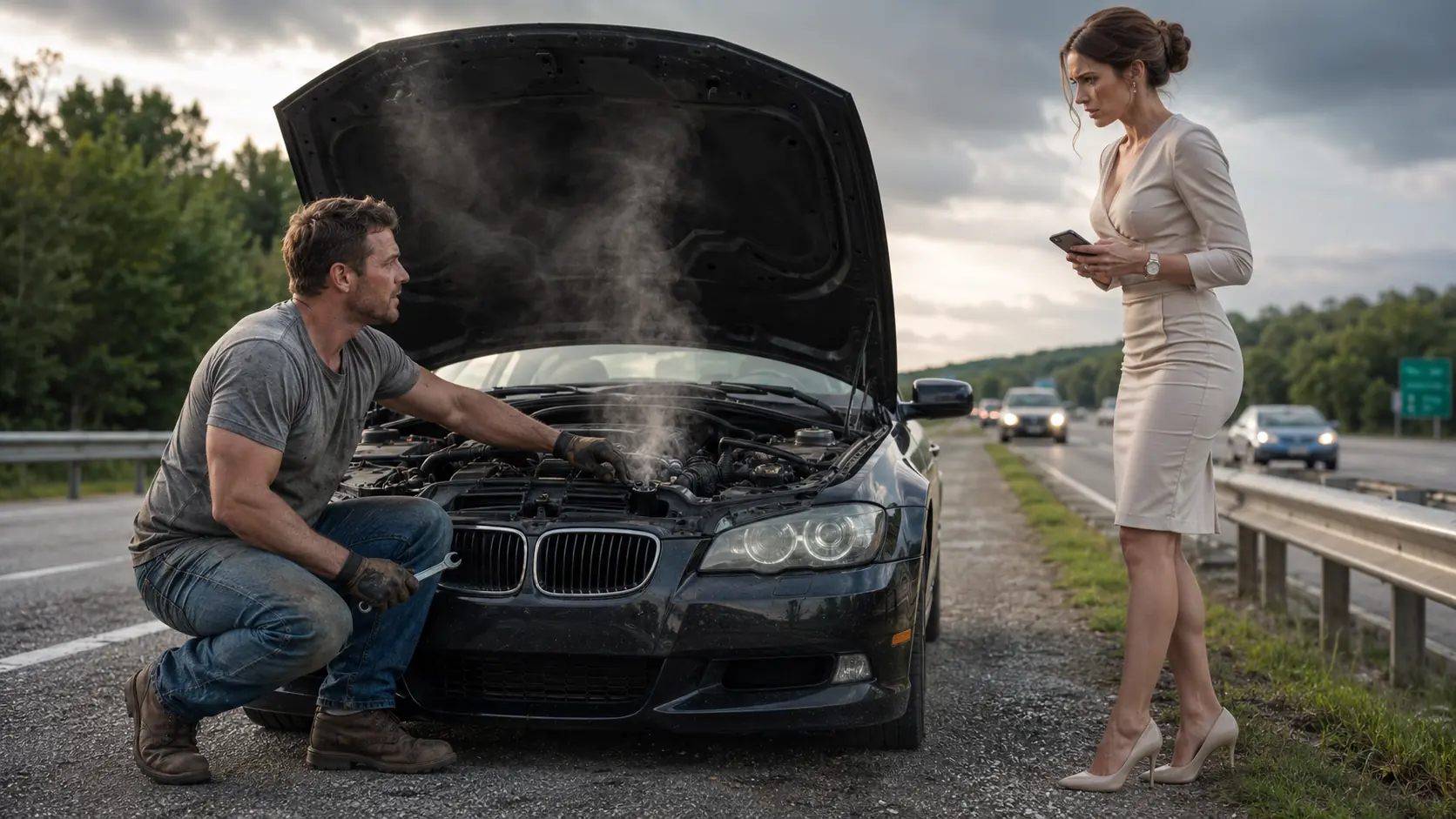
The woman’s BMW sat steaming on the shoulder like a wounded animal, its hood raised in surrender to the July heat.
I pulled my rust-eaten pickup behind her car, hazard lights blinking their quiet warning to the world.
Through my windshield, I watched her pace in designer heels that had no business on cracked asphalt, her phone pressed to her ear with the desperate grip of someone whose perfect world had just tilted sideways.
She wore a cream-colored suit that probably cost more than I made in three months.
But her shoulders sagged with the kind of defeat I recognized in my own mirror each morning.
“Stay in the truck, buddy,” I told my 7-year-old son, Marcus, who was already unbuckling his seat belt with the eager curiosity that made him equal parts blessing and heart attack waiting to happen. “Daddy’s just going to help this lady real quick. Then we’ll get those groceries home before the ice cream turns to soup.”
Marcus pressed his nose against the window, fogging the glass with his breath. “Her car’s sick, isn’t it, Dad?”
“Looks that way.”
I grabbed my toolbox from the truck bed, the metal handle warm from sitting in the sun. Twenty-three years of fixing things had taught me that broken usually meant fixable, if you were patient enough to figure out why something stopped working in the first place.
Cars, washing machines, leaky faucets. They all had their reasons for giving up. People were trickier.
The woman looked up as I approached, ending her phone call with a sharp jab of her finger. Up close, I could see the fine lines around her eyes, the kind that came from squinting at spreadsheets under fluorescent lights, or maybe just from carrying more weight than most people could see.
Her makeup was flawless, but there was something fragile underneath it, like expensive china with hairline cracks.
“I’m sorry,” she said, her voice crisp with the kind of authority that probably made boardrooms go quiet. “I don’t need. I’ve already called for assistance.”
“Ma’am, with respect, you’re going to be waiting a while out here.” I set my toolbox down and wiped my hands on my jeans, leaving dark smudges that would join the collection of stains that told the story of my days. “AAA’s backed up on Sundays, especially with this heat. Mind if I take a look? Won’t cost you nothing.”
She glanced at my truck, at Marcus, waving enthusiastically from the passenger seat, at my grease-stained T-shirt that advertised an auto shop that had closed down two years ago. I watched her calculating, weighing trust against necessity, probably wondering if I was the kind of stranger her mother had warned her about.
But the steam rising from her engine made the decision for her.
“I suppose, if you think you can help.” She stepped back, her heels clicking against the asphalt like a nervous heartbeat. “I’m Catherine, by the way. Catherine Westbrook.”
“Marcus,” I said, then caught myself. “I mean, I’m Marcus. Marcus Senior. That’s my boy in the truck, Marcus Jr. We were just heading back from the grocery store when we saw you here.”
Catherine Westbrook. The name tickled something in the back of my mind, like a song you can almost remember but can’t quite place.
I leaned over the engine, letting the familiar smell of hot metal and automotive fluids ground me in something I understood. The radiator hose had split clean through, antifreeze pooling on the ground like green blood.
“I honestly don’t know.” She sounded embarrassed, like admitting she didn’t speak car was some kind of character flaw. “My assistant usually handles things like that. I drive it. Someone else maintains it. That’s how it’s always been.”
I nodded, understanding more than she probably meant to reveal.
“Well, good news is, it’s fixable. Bad news is, you’re not driving anywhere today without a new hose. Even if I could patch this temporarily, you’d be right back here in five minutes.”
Catherine’s phone buzzed, and she glanced at it with the kind of urgent attention most people reserved for crying babies.
“I have a meeting tomorrow morning. Very important. There has to be something.”
“Ma’am, I can fix it, but I’d need to run to the parts store, and they close at 6:00 on Sundays. It’s 4:30 now.” I straightened up, my back protesting the movement with the familiar ache that reminded me I wasn’t 25 anymore. “Tell you what, why don’t you let me give you a ride wherever you need to go? I can come back for your car tomorrow. Get it running right.”
She stared at me like I’d offered to sprout wings and fly her to the moon.
“You would do that for a complete stranger?”
The question caught me sideways. Not because it was unreasonable, but because it made me realize how strange basic kindness had become in her world. I thought about Marcus Jr. watching us through the truck window, learning about the kind of man his father was by the choices I made when nobody was keeping score.
“My daddy always said, ‘You help folks when they’re stuck,’” I said. “Doesn’t matter if you know them or not. Stuck is stuck.”
Catherine’s phone rang again. And this time, when she answered, her voice carried the kind of controlled panic that came from watching carefully laid plans crumble.
“No, James, I understand the implications, but I’m literally stranded on the side of the highway. Yes, I know how important the Morrison account is. I’ll be there somehow. I’ll be there.”
When she hung up, her composure cracked just enough for me to see the person underneath the executive polish.
“I’m sorry. This is just... Everything is falling apart at once.”
“Where do you need to be?”
“The Grand View Hotel downtown. But you don’t understand. I have presentations to review, calls to make. My entire schedule is...”
“Ma’am, we can swing by there on our way home. It’s not far out of the way.” I glanced back at Marcus, who had moved to the rear window and was making faces at his reflection. “Only thing is, I’ve got my boy with me, and we need to get home soon. He’s got school tomorrow.”
Something shifted in Catherine’s expression when she looked at Marcus. The sharp edges of her executive mask softened, revealing glimpses of something warmer underneath.
“He’s beautiful. How old?”
“Seven last month. Smart as a whip. That one keeps me on my toes.”
“Is his mother...”
“Just us,” I said simply.
The whole story, Lisa’s cancer, the medical bills that ate our savings like hungry wolves, the three years of watching her fade until she was more memory than person, wasn’t something for roadside conversations with strangers.
“Has been for two years now.”
Catherine nodded, and I caught something in her eyes that looked like recognition. Not of me, but of the particular kind of tired that came from carrying more than one person’s worth of responsibility.
“I’m sorry. That must be incredibly difficult.”
“We manage.”
I started gathering my tools, muscle memory taking over while my mind wandered to the grocery list crumpled in my pocket, to Marcus’s soccer practice on Tuesday, to the mortgage payment that was already a week late.
“Let me get your car locked up, and we’ll get you where you need to be.”
The drive to the Grand View Hotel passed in comfortable silence, broken only by Marcus’s occasional commentary from the back seat. He’d appointed himself tour guide, pointing out landmarks with seven-year-old enthusiasm. The park where we fed ducks on Saturdays. The library where story time happened on Wednesday mornings. The pizza place that gave free breadsticks if you showed them a good report card.
Catherine listened with the kind of attention that felt genuine, asking questions that made Marcus glow with importance. When he told her about the rocket ship he was building from cardboard boxes, she leaned forward with interest that didn’t feel forced or polite.
“And it’s going to have real controls?” she asked.
“Well, not real real,” Marcus explained with the patience of someone addressing a particularly slow adult. “But they’ll look real. Dad’s helping me wire up some lights and switches from his electrical stuff.”
“Your dad sounds pretty handy.”
“He can fix anything,” Marcus said with the absolute faith that only children possessed. “When our washing machine broke, he took it all apart on the kitchen floor and put it back together. And it worked even better than before. And when Mrs. Patterson’s porch light went out, he climbed up there and fixed it, even though she didn’t have money to pay him.”
I caught Catherine’s eyes in the rearview mirror, saw her processing this information with the calculating look I’d noticed earlier.
“That was very kind of your father.”
“Dad says when somebody needs help, you help them if you can, even if they can’t help you back.”
The Grand View Hotel rose from the downtown skyline like a monument to the kind of wealth I’d only seen in movies. Marble columns, doormen, and uniforms that probably cost more than my truck. Valet parking that made my rust-bucket pickup look like it had wandered in from another century.
I pulled up to the curb, hazard lights blinking again, feeling suddenly conscious of every stain on my clothes, every ding in my vehicle.
“This is beautiful,” Marcus breathed, pressing his face to the window. “Do you live here?”
Catherine laughed, the first genuine laugh I’d heard from her. “Not exactly. I’m just staying here for business.”
She reached for her purse, a leather thing that probably had its own insurance policy, and I knew what was coming.
“Please, let me give you something for the gas, for your trouble.”
“No, ma’am.” I turned in my seat to face her fully. “Like I said, you help folks when they’re stuck. That’s just what you do.”
“But you’ve gone so far out of your way.”
“Not out of the way if it’s the right thing to do.”
Catherine stared at me for a long moment, and I had the strangest feeling she was seeing something she’d forgotten existed. When she finally got out of the truck, she moved with less certainty than when I’d first met her, like stepping onto ground that wasn’t quite solid.
“Marcus,” she said, leaning down to my boy’s window. “Thank you for sharing your dad with me today, and good luck with your rocket ship.”
“Thanks. Maybe you can come see it when it’s done.”
“I’d like that very much.”
She turned to me, and for a second, the executive mask slipped completely.
“Marcus Senior, I can’t thank you enough. This kind of kindness... It’s rare.”
“Shouldn’t be,” I said. “But you’re welcome.”
I watched her walk through the hotel’s golden doors, her heels clicking against marble instead of asphalt now, her cream suit fitting perfectly back into a world of luxury and power. But something had changed in the way she carried herself, a softness around the edges that hadn’t been there on the highway.
“Dad,” Marcus said as we pulled away from the curb. “Why did that lady look so sad?”
“Sometimes grown-ups carry heavy things, buddy. Things you can’t see from the outside.”
“Like when you’re sad about Mom, but you try to hide it so I won’t worry.”
Kids. They saw everything, felt everything, understood more than they had words for.
“Yeah, something like that.”
“Do you think we helped her feel a little better?”
I thought about Catherine’s laugh, about the way she’d listened to Marcus’s rocket ship plans with genuine interest, about the crack in her voice when she’d thanked me.
“I think maybe we did.”
That night, after Marcus was asleep with his rocket ship blueprint spread across his pillow, I sat at the kitchen table with a stack of bills and a calculator that kept giving me the same depressing answer, no matter how many times I punched the numbers.
The mortgage payment notice sat on top of the pile, stamped with red letters that meant business. Final notice. Thirty days to bring the account current or face foreclosure proceedings.
I’d been dancing this dance for months now, juggling payments, robbing Peter to pay Paul, hoping something would break my way before everything fell apart. Lisa’s medical bills had eaten through our savings.
Her life insurance had barely covered the funeral costs, and my small electrical contracting business was struggling to compete with the big companies that could underbid me on every job.
The house was all Marcus and I had left of the life Lisa and I had built together. Every room held memories. The kitchen where she’d taught me to make her grandmother’s pancakes. The living room where we danced to old jazz records while Marcus slept in his crib. The front porch where we’d planned his future and ours.
Losing it would mean losing the last physical piece of the woman who’d been my partner, my best friend, my anchor in every storm.
But the numbers on the calculator didn’t care about sentiment. They were cold, factual, final.
I was still staring at the bills when my phone rang. Unknown number, which usually meant telemarketer or collection agency. But something made me answer.
“Mr. Thompson, this is Catherine Westbrook. I hope I’m not calling too late.”
“Miss Westbrook.” I glanced at the clock. 9:15. “Is everything all right? Your car?”
“The car is fine. Well, it will be. I wanted to call because this might sound strange, but I’ve been thinking about what happened today, about what you did for me.”
“Ma’am, it wasn’t nothing special. Just giving somebody a ride.”
“That’s where you’re wrong.” Her voice carried a different quality over the phone. Softer somehow, less polished. “I’ve been in meetings all evening dealing with people who want things from me, who smile because they have to, who help because it benefits them somehow. What you did today... It was just decent human kindness. And I’d forgotten how rare that really is.”
I didn’t know what to say to that, so I waited.
“I did some research after we parted ways,” she continued. “Thompson Electrical. You used to have a bigger operation, didn’t you? Before your wife got sick.”
The words hit like a punch to the solar plexus.
“How did you...?”
“I make it my business to know about people who interest me. And Marcus, you interest me very much. I know about Lisa’s cancer, about the medical bills, about how you mortgaged everything to pay for treatments that didn’t work. I know you’re three months behind on your house payment.”
The phone felt heavy in my hand.
“Ma’am, I don’t know what you’re getting at, but...”
“I know because Westbrook Financial holds your mortgage.”
The kitchen tilted sideways. I gripped the edge of the table, my knuckles going white.
“What?”
“We purchased a portfolio of residential mortgages from Hometown Bank six months ago. Yours was among them. I’ve been reviewing the files of accounts in distress, trying to decide which ones to foreclose on and which ones might be worth working with.”
The red letters on the notice swam in front of my eyes.
“So this whole thing today, the broken car, the ride... That was some kind of setup?”
“No.” Her voice was firm, urgent. “Marcus, no. The car breaking down was completely real. I had no idea who you were when you stopped to help me. I didn’t make the connection until I was back in my room going through files. That’s when I realized the man who’d shown me such kindness was the same Marcus Thompson whose mortgage I’d been planning to foreclose on tomorrow morning.”
The silence stretched between us like a taut wire. Outside, a dog barked, a car door slammed, the ordinary sounds of a neighborhood settling into sleep. But inside my kitchen, the world had shifted on its axis.
“So, what happens now?” I asked.
“That depends. Tell me about your business. Not the numbers. I’ve seen those. Tell me what you do, why you do it.”
I thought about hanging up. This felt like a trap, like some elaborate corporate game I didn’t understand the rules to, but something in her voice, the same softness I’d heard when she’d talked to Marcus, made me stay on the line.
“I fix things,” I said finally. “Started when I was 12, helping my dad wire houses. Got good at it. Went to trade school, worked for other people until I could afford to go out on my own. Used to have three guys working for me, steady contracts with builders, good reputation.”
“What changed?”
“Lisa got sick. Cancer doesn’t punch a time clock. It comes when it comes. Needs what it needs. I started turning down jobs to take her to treatments. Spending days in hospitals instead of on job sites. Lost contracts, lost workers, lost momentum. By the time she... By the time it was over, I was starting from scratch with a pile of debt and a 7-year-old who’d already lost his mother.”
“But you kept going.”
“What choice did I have? Marcus needed me to keep going.”
“You could have declared bankruptcy. Walked away from everything. Started fresh somewhere else.”
“This is our home,” I said, looking around the kitchen where Lisa’s coffee mug still sat in the dish drainer, where Marcus’s school pictures covered the refrigerator like colorful prayers. “This is where his mother lived, where he learned to walk, where all his memories are. I couldn’t take that away from him, too.”
Catherine was quiet for so long, I thought the call had dropped. When she spoke again, her voice was thick with something I couldn’t identify.
“Do you know what I was doing when my car broke down today?”
“Going to a meeting. You said.”
“I was driving back from a site visit. A housing development we’re foreclosing on. Forty-three families who bought homes they couldn’t afford with mortgages they didn’t understand. From a builder who cut corners and disappeared when the foundation started cracking. Forty-three families who thought they were living the American dream until it turned into a nightmare.”
“That’s rough.”
“I was supposed to meet with my lawyers tonight to finalize the paperwork. Forty-three families out on the street by Christmas, but Westbrook Financial would recoup most of our investment by selling the land to a commercial developer. Clean, profitable, legally sound.”
“Supposed to?”
“I cancelled the meeting. After talking to Marcus, your Marcus, about his rocket ship, about how his dad can fix anything, about helping people even when they can’t help you back. I couldn’t stop thinking about those families, about their children, about what home means when you’ve already lost so much.”
I could hear papers rustling on her end of the line, the distant sound of a keyboard clicking.
“I’ve been going through the files all evening, really looking at them, not just the numbers, reading the stories behind the statistics. Single mothers working two jobs. Veterans with PTSD trying to rebuild their lives. Families like yours who got knocked down by circumstances beyond their control.”
“Ms. Westbrook.”
“Catherine, please.”
“Catherine, I don’t know what you’re trying to tell me.”
“I’m trying to tell you that today, when you stopped to help a stranger on the side of the road, you probably saved my soul.” Her voice broke slightly. “I’ve spent so many years looking at people as numbers on spreadsheets, as risk assessments and profit margins, that I’d forgotten they were human beings with stories and dreams and children who build rocket ships.”
The kitchen clock ticked loudly in the silence. Somewhere in the house, Marcus stirred in his sleep, probably dreaming of cardboard spaceships and adventures among the stars.
“What happens to my house?” I asked.
“Nothing. Your mortgage is being restructured. Lower payments, extended terms, forgiveness of the penalties and late fees. You’ll keep your home. Marcus will keep his memories. And maybe you can rebuild your business without that weight hanging over your head.”
“I can’t accept charity.”
“It’s not charity. It’s an investment in you. In Marcus, in the kind of world I want to live in, a world where people stop to help strangers. Where kindness matters more than profit margins. Where a man’s worth isn’t measured by his bank account, but by how he treats people when nobody’s watching.”
Tears I’d been holding back for months finally broke free. Silent and grateful.
“Why? Why would you do this?”
“Because today, you reminded me who I used to be before I became who I thought I had to be. Because your son talked about his father with the kind of love and respect that money can’t buy. Because sometimes, the universe puts broken-down cars and good people in the same place at the same time, and magic happens.”
“Catherine, I...”
“There’s one more thing. The housing development I mentioned, I’m not foreclosing. Instead, Westbrook Financial is partnering with a local nonprofit to help those families refinance and repair their homes. It’ll cost us money in the short term, but I think it might just save us in ways that matter more than quarterly reports.”
Two days later, I was back under the hood of Catherine’s BMW, installing the new radiator hose while Marcus provided commentary from his perch on the truck’s tailgate. The repair was straightforward, a $40 part, 30 minutes of work, but Catherine had insisted on paying my full hourly rate, plus a bonus that made me shake my head in amazement.
“All done,” I announced, closing the hood with a satisfying thunk. “Should run like new now.”
Catherine started the engine, and it purred with the contented sound of German engineering working as intended. She turned off the ignition and got out, wearing jeans and a simple sweater instead of her corporate armor, looking more like a person and less like a balance sheet.
“Thank you,” she said. “For everything.”
“Just doing my job.”
“No, Marcus. What you did on Sunday wasn’t your job. It was who you are.”
Marcus Jr. jumped down from the tailgate and ran over to us, his backpack bouncing with each step.
“Dad, can I show Catherine my rocket ship drawings?”
“If she’s got time.”
“I’ve got all the time in the world,” Catherine said, settling down on the grass as Marcus spread his blueprints around her like a cardboard constellation.
She listened with the same genuine attention she’d shown in the truck, asking questions that made his eyes light up with enthusiasm. Watching them together, I felt something shift inside my chest, a loosening of the tight knot of worry and fear I’d carried for so long.
The mortgage notice was gone from my kitchen table, replaced by a new payment book with numbers that wouldn’t keep me awake at night. But more than that, the crushing weight of doing everything alone had lifted just enough for me to remember that good people still existed in the world.
“You know what this rocket ship needs?” Catherine said, studying Marcus’s drawings with scientific seriousness.
“What?”
“A mission. Where’s it going to go?”
Marcus thought about this with the gravity of a NASA engineer.
“Maybe to the moon first, then Mars. Then maybe to find new planets where people could live if they needed to.”
“People who needed a new home?”
“Yeah, like if their old home got broken or they lost it somehow. The rocket could take them somewhere safe.”
Catherine caught my eye over Marcus’s bent head, and I saw understanding pass between us like a shared secret.
Sometimes home wasn’t a place, but a feeling. Sometimes it was found in unexpected kindness, in second chances, in the belief that tomorrow could be better than today.
“That sounds like a very important mission,” Catherine said softly. “The most important kind.”
As the afternoon sun painted the sky in shades of gold and amber, Catherine helped Marcus roll up his blueprints while I loaded my tools back into the truck. The BMW sat gleaming in the driveway, ready to carry her back to boardrooms and quarterly reports and the thousand decisions that shaped other people’s lives. But something fundamental had changed.
In helping a stranger, I’d been helped in return. In showing kindness without expectation, I’d received grace beyond measure. In being the kind of man I wanted Marcus to become, I’d found a piece of myself I’d thought was lost forever.
“Will we see you again?” Marcus asked as Catherine prepared to leave.
“I’d like that very much,” she said. “Maybe next time you can show me how the rocket ship controls work.”
“They’re going to have real lights,” Marcus announced. “Dad promised.”
“Then I’ll definitely have to see that.”
She turned to me, extending her hand for a formal shake that somehow felt like the beginning of something rather than an ending.
“Take care of yourself, Marcus. Both of you.”
“You, too, Catherine. And thank you for everything.”
“Thank you,” she said, “for reminding me that some things matter more than money. That kindness is never wasted. That sometimes the best business decision is the one that makes you remember why you’re human.”
We watched her drive away, the BMW disappearing around the corner with a whisper of expensive engineering. Marcus slipped his hand into mine, small fingers finding their familiar place in my palm.
“Dad.”
“Yeah, buddy.”
“I think she was sad when we first met her, but she looks happy now.”
“I think you’re right.”
“Do you think helping her helped us, too?”
I squeezed his hand, thinking about mortgage payments that no longer threatened our home, about the business cards Catherine had given me for contractors who might need electrical work, about the lightness in my chest where worry used to live.
“Yeah, Marcus. I think it did.”
That evening, as Marcus worked on his rocket ship at the kitchen table, and I reviewed work estimates that actually looked promising, I thought about the strange alchemy of kindness. How a simple act of decency could ripple outward in ways you never expected, touching lives and changing stories, proving that grace still moved through the world in the hands of ordinary people willing to stop for strangers.
Outside, the first stars were appearing in the darkening sky, distant points of light that had traveled unimaginable distances to reach us. Like kindness, I thought. Like hope. Like the unexpected ways broken things could be made whole again.