The rain came down hard and sideways the night Daniel Carter found her.
It was one of those autumn storms that seemed to arrive not from the sky, but from everywhere at once.
Out of the tree line.
Up from the asphalt.
Sideways off the guardrails.
Driving felt less like navigating and more like pushing through a wall of cold, dark water.
The wipers on Daniel’s old Chevy Silverado barely kept up.
He had the defroster cranked all the way, one hand tight on the wheel, the other wrapped around a gas station coffee that had gone lukewarm an hour ago.
He was not supposed to be on Millbrook Road that night.
He was supposed to be home by eight.
Emily had a spelling test in the morning, and she had asked him to quiz her at dinner.
He had promised.
But the Kellner file had sprawled into a two-hour mess at the office.
Disputed liability on a warehouse fire.
Three conflicting witness statements.
Photographs that did not add up.
By the time Daniel locked the building behind him, the sky had already broken open.
So he had taken the shortcut through the woods.
Millbrook Road ran along the eastern edge of Raven Hollow, a two-lane stretch of cracked asphalt threading between the state forest and a succession of dark farm fields.
In daylight, it was unremarkable.
At 9:15 on a Saturday night in October, with rain hammering the cab and the headlights catching nothing but wet blacktop and the blur of pine trunks, it felt like the edge of the world.
That was when he saw the shape.
At first, he thought it was a deer.
Some pale form frozen at the shoulder, caught in the spill of his high beams.
He eased off the accelerator.
Then the shape resolved, and his foot went to the brake hard enough to send coffee splashing across his jacket.
It was a person.
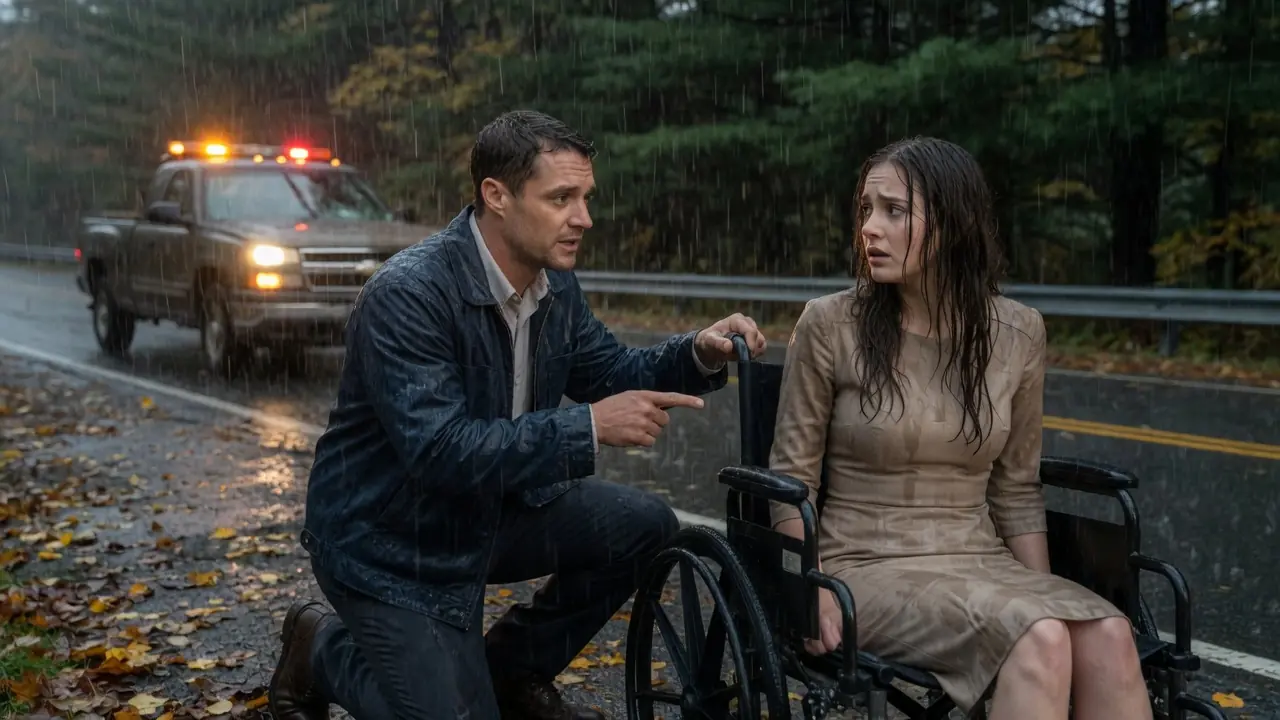
A young woman sitting in a wheelchair in the middle of the breakdown lane.
Her head was slightly bowed.
Her dark hair was plastered flat against her cheeks.
She wore a thin fleece pullover, mint green, completely soaked through.
Her hands lay open in her lap like she had stopped reaching for something and simply given up.
Daniel pulled over, put the hazards on, and was out of the truck before he had consciously decided to move.
The rain hit him like a fist.
He crossed the gravel shoulder in three strides, crouching beside the chair so his face was level with hers.
“Hey.”
“Hey, look at me.”
“Are you hurt?”
Her eyes opened.
Brown.
Very dark.
With a particular flatness that settled in when a person had passed through fear and come out the other side into something quieter and more dangerous.
She looked at him for a long moment before she spoke.
“My stepmother and stepbrother,” she said.
Her voice was barely audible over the rain.
“They brought me out here.”
She swallowed.
“They pushed the chair out of the car.”
A pause.
The headlights of the truck cast long shadows across her face.
“They drove away.”
Daniel knelt there in the rain and felt something settle in his chest.
Not surprise, exactly.
In eight years of insurance investigation, he had seen what people did to each other for money, for convenience, for spite.
He had photographed burned buildings and staged accidents and fraud schemes constructed with more care than most people put into raising children.
He knew what deliberate looked like.
“What’s your name?” he asked.
“Sophia,” she said.
“Sophia Bennett.”
He introduced himself.
Then he said, “Can you get into a truck seat if I help you?”
“Yes.”
“Okay.”
He stood and put his hand on the grip of the chair.
“Let’s get you out of the rain.”
The drive back to Daniel’s house took eleven minutes.
Neither of them spoke much.
Sophia sat with her hands wrapped around the travel mug of water he had found behind the seat, staring at the rain on the passenger window.
Daniel kept the heater on full blast and the radio off.
He lived on Birchwood Lane in the northeast corner of Raven Hollow, in a green-shuttered craftsman bungalow his wife Claire had picked out seven years ago.
Claire had been gone for three years now.
A cardiac arrhythmia.
Sudden and without warning on a Thursday morning in February.
Emily had been at school.
Daniel had been testifying at a deposition forty miles away.
He had never found a version in which anything was different.
He pulled into the driveway and killed the engine.
“My daughter’s inside,” he said. “She’s nine. Her name is Emily. She will immediately want to know everything about you, and I apologize in advance.”
Something shifted in Sophia’s face.
Not a smile.
Not quite.
But a small loosening around the eyes.
“I don’t mind,” she said.
He helped her transfer to the chair he had carried around from the truck bed.
They went up the ramp he had built along the side of the front porch.
It was there for Claire’s mother, who visited twice a year.
They entered through the front door into the yellow warmth of the entryway.
Emily appeared from the kitchen doorway before Daniel had finished hanging up his jacket.
She was small for nine, with her mother’s dark blonde hair and his own gray-green eyes.
She wore an oversized Northwestern sweatshirt that hung to her knees and held a half-eaten peanut butter cracker.
She looked at Sophia.
Then at her father.
Then back at Sophia.
“You’re really wet,” she said.
“Yes,” Sophia agreed.
“Dad brought home a wet person,” Emily announced to no one in particular.
Then she said, “Do you want dry clothes? I have ones that are too big for me, but probably too small for you. I don’t know your size. Are you cold?”
Daniel put a hand on Emily’s shoulder.
“Let’s get her inside first, Em.”
“Right. Sorry.”
Emily stepped back.
“Come in. Do you want tea? I know how to make tea. Dad taught me.”
Within twenty minutes, Sophia was on the living room couch in a pair of Daniel’s gray sweatpants and a flannel shirt.
Her wet clothes were cycling in the dryer.
A mug of tea warmed her hands.
Emily had produced a blanket from the hall closet, the quilted one Claire’s mother had made, blue and cream.
Daniel usually kept it folded on the top shelf.
Emily draped it over Sophia’s lap without asking.
“Better?” Emily asked.
“Much better,” Sophia said. “Thank you.”
Emily sat cross-legged on the floor at Sophia’s feet and looked up at her with the frank, unguarded attention of a child who had not yet learned to pretend she was not curious.
“What happened to you?” she asked.
“Emily.”
Daniel’s voice held a warning.
“It’s okay,” Sophia said quietly.
She held the mug in both hands and looked at the middle distance for a moment, as if deciding something.
Then she told them.
Her father, Robert Bennett, had died three weeks earlier.
Robert had built Bennett Freight and Logistics over thirty years, from a single delivery truck to a regional operation with forty-seven vehicles and contracts across six states.
He was sixty-one when his heart gave out.
A massive myocardial infarction.
The autopsy concluded it had almost certainly happened while he slept, which his doctor later told Sophia was the least painful way these things could happen.
Robert had been married twice.
His first wife, Sophia’s mother, had left the marriage when Sophia was four and moved to Portland, where she still lived and with whom Sophia had only intermittent contact.
His second wife was Victoria Marsh Bennett.
Sharp-featured.
Precise in her movements.
A former commercial real estate attorney who had married Robert eight years ago and spent those years conducting herself with the cool efficiency of someone managing an acquisition rather than a marriage.
Victoria had a son from her first marriage, Marcus.
He was twenty-nine and worked in the logistics company’s finance department.
In Sophia’s description, Marcus had never looked at her without a faint expression of calculation in his eyes.
Robert’s will had been reviewed and updated six months before his death.
The primary beneficiary was Sophia.
Forty-six million dollars in assets, including the company, two properties, and investment accounts.
There was one stipulation.
Sophia had to survive for twelve months following the date of Robert’s death.
During that time, the estate would remain in a trust administered by the family attorney, Gerald Whitfield.
If Sophia did not survive that twelve-month period, the entire estate would transfer to Victoria.
“Your father put that provision in himself?” Daniel asked.
“His attorney told me afterward that my father was concerned about estate tax timing. That was the explanation.”
Sophia set her mug down on the side table.
“I didn’t question it at the time. I didn’t have any reason to.”
For the first two weeks after the funeral, things had been strained but manageable.
Sophia lived in the main house, a large colonial in Harwick Heights, the moneyed end of Raven Hollow, along with Victoria and Marcus.
The arrangement had been in place since Robert’s illness the previous spring.
Then, gradually, the temperature in the house dropped.
Victoria stopped speaking to her at meals.
Marcus began making small, corrosive remarks about the terms of the will.
About what was fair.
About Sophia’s disability costs.
About how much the company had struggled with her father’s illness distracting him.
One morning, Sophia discovered that Gerald Whitfield had received a letter signed by Victoria claiming that Sophia was mentally unstable and requesting a review of her capacity to inherit.
“When did things change tonight?” Daniel asked.
“Marcus came to my room at six-thirty and said they were driving to the lake house for the weekend. Victoria’s property on Autumn Lake. It’s about forty minutes north of here. He said I should come along, that it would be good for me to get out of the house.”
Sophia paused.
“I didn’t want to go, but I thought… I don’t know what I thought. That refusing would make things worse.”
She stopped.
Emily, still on the floor, had pulled her knees up to her chest.
“They stopped on Millbrook Road,” Sophia continued. “Victoria said she needed air. She got out. Then Marcus opened the rear passenger door where I was sitting and told me there was something wrong with my chair. He said I needed to transfer to my manual chair while they checked the folding mechanism on the power chair.”
Her voice stayed level, but her hands tightened around the mug.
“Once I was in the manual chair and they had taken the power chair apart and put it in the trunk, I couldn’t propel myself fast enough. Marcus pushed me to the shoulder of the road.”
The mug went down again, hard enough to make a sound.
“Then they got in the car and left.”
The room was quiet for a long moment.
Emily’s voice, when it came, was very small.
“They left you in the rain on purpose?”
“Yes.”
Emily looked at her father.
Her expression was not the expression of a confused child.
It was something older and more resolved.
“We have to help her,” she said.
Not a question.
“I know,” Daniel said.
After Emily was in bed, a process that involved three separate goodnight requests and one question about whether Sophia would still be there in the morning, Daniel sat at the kitchen table with a legal pad and a pen.
He began thinking like the professional he was.
He had spent eight years investigating insurance fraud.
His particular gift, the thing that kept him employed through two company restructurings and made him the person senior partners called when a claim did not smell right, was his ability to move backward through a sequence of events and find the moment where the logic fractured.
He did not get emotional about it.
He just worked the chain.
He started with the premise.
Victoria and Marcus Bennett had deliberately stranded a disabled woman on a remote road during a heavy rainstorm at night.
He did not ask himself why yet.
He asked himself what they expected to happen.
If no one found her, she would have been in the rain for hours.
The temperature that night was forty-one degrees and dropping.
Sophia was in a manual chair with no rain gear and no phone signal.
Hypothermia was a realistic outcome.
Exposure on a road with almost no nighttime traffic was a realistic outcome.
If she died, it would look like an accident.
A disabled woman who somehow ended up alone on a road after dark, overwhelmed by conditions.
Except someone had found her.
He wrote, “Millbrook Road. Why there?”
The choice of location was deliberate.
Far enough from town that discovery was unlikely.
No streetlights except at the single intersection half a mile south.
No houses visible from the road.
But close enough to a route Victoria and Marcus would travel regularly that it could be framed as a familiar path Sophia must have gone out on her own and gotten disoriented.
He wrote, “They needed it to look accidental.”
That told him something important.
Whatever they were planning, it was not clean.
They were not willing to use outright violence.
They needed plausible distance.
That meant they had something to protect.
A story to maintain.
He turned the pad to a fresh page and wrote, “Evidence.”
Sophia had no cell signal on Millbrook Road.
She had confirmed it.
Daniel had tested it himself on the drive back.
But Millbrook Road intersected with Route 9, the main county road, and there was a Sunoco station at that corner that had been there since Daniel was a teenager.
He remembered a camera mounted above the pump bays.
He had noticed it without meaning to, the way investigators noticed things.
He wrote, “Sunoco camera. Check.”
He also wrote, “Attorney Gerald Whitfield.”
The man who held the trust had already received a letter from Victoria questioning Sophia’s mental stability.
That letter had been sent proactively, before anything had happened.
That was not the action of a grieving widow.
That was preparation.
He underlined the word.
Preparation.
Then he went to the window and stood for a while, looking at the rain.
He thought about the twelve-month provision.
He thought about forty-six million dollars.
He thought about the fact that Victoria had been a commercial real estate attorney.
A person who understood contracts, timelines, and how money moved through legal instruments.
He went back to the table and wrote one more line.
“This was planned before Robert died.”
He did not know if that was true.
But his gut, honed by eight years of reading the architecture of deception, told him the letter to Whitfield was not improvised.
The choice of Millbrook Road was not improvised.
The detail of transferring Sophia to the manual chair, removing her mobility, putting her power chair in the trunk, was not improvised.
Someone had thought this through.
He looked at the clock.
It was past midnight.
He closed the legal pad and went to check the locks on the front and back doors.
Sunday morning arrived gray and windless.
The storm had passed overnight and left behind a sky the color of old pewter.
Daniel was up at 6:15.
He made coffee, left a note for Sophia on the kitchen counter explaining where he was going, and added that Emily would be awake by seven and would absolutely make her own breakfast without supervision.
He also wrote that this was both true and somewhat alarming.
Then he drove to the Sunoco.
The station manager was a man named Terry Holt.
He was in his fifties, deliberate in his movements, with the easy watchfulness of someone who had spent decades observing who pulled off the highway and why.
He was replacing the filter in the coffee machine when Daniel walked in.
Daniel introduced himself and produced his investigator’s credential.
It was not law enforcement, but it carried enough professional weight that people generally cooperated.
He explained that he was looking into a potential incident on Millbrook Road the previous evening and asked about the exterior camera.
Terry Holt set down the coffee filter and led him outside without asking further questions.
The camera above the east-facing pump bay covered the intersection with clear sightlines to Route 9 and a partial view of the Millbrook Road turnoff.
The system stored forty-eight hours of compressed footage on a local drive.
They pulled it up on the small monitor in the office behind the register.
There it was.
At 9:07 p.m., a black Cadillac Escalade turned off Route 9 onto Millbrook Road.
The angle was not perfect.
The rear license plate was partially obscured.
But the vehicle was clearly identifiable.
A late-model Escalade, black, with distinctive aftermarket roof rails.
At 9:09 p.m., the same vehicle reappeared at the intersection from the Millbrook direction, turning south onto Route 9 and accelerating away.
No more than two minutes.
Long enough to stop.
Long enough to push someone out.
Daniel watched the footage three times.
Then he asked Terry Holt if he could copy it.
“For what?” Terry asked.
Not hostile.
Just careful.
“I think a woman was deliberately abandoned on that road last night,” Daniel said. “I need this for the police.”
Terry looked at him for a long moment.
Then he pulled a USB drive from the drawer under the register and plugged it in without another word.
Back at the house, Daniel found Emily and Sophia at the kitchen table.
Emily had made scrambled eggs, slightly overdone, which she freely admitted.
She was explaining to Sophia the rules of a card game she had invented.
It appeared to involve elements of Go Fish, War, and a complex point system of Emily’s own creation.
Sophia was listening with genuine attention.
She had the quality, Daniel noticed, of someone who had learned early to be still.
Not passive.
Her eyes were quick, and she asked precise questions.
But contained.
As though she had developed the habit of taking up as little space as possible.
“I got the footage,” Daniel said, putting the USB drive on the table.
Sophia’s expression shifted.
“You can see them?”
“The vehicle,” Daniel said. “Not the plates, but the car is identifiable. It’s enough to contradict any story that you wandered away on your own.”
“Victoria’s car is a black Escalade.”
“I know.”
Sophia looked at him across the table.
“Why are you doing this?”
He thought about it.
Emily gathered the playing cards, apparently deciding this was a private conversation.
The eggs were going cold.
“It’s what I do,” he said finally. “Find out what actually happened.”
“That’s your job.”
“I’m not a client.”
“No,” he agreed. “You’re not.”
The answer seemed to land somewhere different than an explanation would have.
Sophia nodded once, slowly, and did not ask again.
Raven Hollow did not have a dedicated detective division.
The department ran eight officers and a sergeant, but the county sheriff’s office had an investigative unit.
The deputy who caught the report on Sunday afternoon was a woman named Karen Hargrove.
Ten years on the job.
She had a particular face Daniel had seen before on people in her line of work.
Professionally neutral.
Privately alert.
Always waiting for the story to contradict itself.
She came to Daniel’s house because that was where the complainant was.
She sat in the living room armchair with a notebook on her knee and listened to Sophia for forty minutes without interrupting, except to ask for clarification on specific details.
The exact time Marcus came to her room.
The route they had taken.
The mechanics of the chair transfer.
Then Daniel showed her the footage.
Hargrove watched it twice.
Her expression did not change.
“Victoria Bennett’s vehicle is registered to what address?” she asked.
“The Harwick Heights property,” Sophia said. “Fourteen Crestwood Drive. The family home.”
“And Marcus Bennett drives?”
“A silver Range Rover, usually. But he sometimes takes Victoria’s car.”
Hargrove made a note.
“Ms. Bennett, have you been in contact with the estate’s attorney?”
“Mr. Whitfield?”
“Gerald Whitfield, yes. He called me Friday afternoon. Actually, the day before last night. He said Victoria had been in touch with him about my…”
She paused.
“About my mental health. He said it in a careful way. He seemed uncomfortable.”
“What exactly did he say?”
“He said Victoria had submitted a formal written concern to the trust that I was exhibiting signs of instability. He read from her letter. That I had been ‘making erratic financial requests and expressing paranoid ideation about the family.’”
Sophia’s voice was flat.
“None of that is true. I have made no financial requests. I have spoken to Gerald twice since my father’s death.”
Hargrove wrote something down.
“The letter was dated when?”
“Gerald said it arrived Thursday.”
“Four days after the forty-nine-day mark,” Daniel said.
He had been sitting quietly to Sophia’s left.
He leaned forward.
“That’s relevant.”
Hargrove looked at him.
“The twelve-month provision,” Daniel said. “If Sophia is deemed mentally incapacitated during that period, it may affect her ability to inherit under the terms of the trust.”
“You’re not her attorney?”
“No. I’m an insurance investigator. But the pattern here, the letter establishing a paper trail of instability before anything happened, then an incident designed to look like an accident, that’s a sequence I’ve seen before. Not this exact situation, but the structure of it.”
“Mr. Carter,” Hargrove said, her voice measured, “I’ll build this case based on evidence. What I have right now is footage of a vehicle and a complainant’s account. What I need is corroboration.”
“Surveillance of the Harwick Heights property,” Daniel said. “If they came back last night expecting to report her missing and she doesn’t come home, they’ll have to file a missing person’s report.”
“Or not,” Hargrove said.
“And the absence of a report tells you something.”
Hargrove considered him for a long moment.
“Eight years?” she asked.
“Eight years,” he said.
She closed the notebook and looked at Sophia.
“For the time being, I’d recommend you stay here rather than returning to Harwick Heights. I’d also recommend you contact Gerald Whitfield Monday morning and inform him of your location. As your trust administrator, he needs to know you’re alive and accounted for. Keep that conversation formal. Don’t tell him anything beyond your safety status.”
“She can stay here,” Emily said from the hallway, where she had clearly been standing for some time.
Hargrove looked at her.
“You must be the daughter.”
“Emily Carter,” Emily said with the particular dignity of a nine-year-old who considered herself a full participant in adult affairs. “She should stay. We have the pullout bed, and I can move my craft stuff.”
Victoria did not file a missing person’s report.
Hargrove called Daniel Monday morning to tell him this.
It was a significant absence.
A stepmother whose disabled stepdaughter failed to return home after a family outing should have generated a police report within hours.
Especially if the story was that Sophia had left the car voluntarily and had a history of erratic behavior.
Instead, there was nothing.
The Raven Hollow department had received no call.
The county had received no call.
“What does that mean to you?” Daniel asked.
“It means they don’t want anyone looking for her,” Hargrove said. “Whether that’s because they know where she is or because they want everyone to assume she’s gone on her own, either way, the absence of a report is notable.”
“They haven’t come here,” Daniel said. “Not during the day.”
“During the day?” she asked.
He had mentioned it Sunday night around eleven.
He had heard a vehicle slow on Birchwood Lane and then accelerate away without stopping.
He had caught the end of it, headlights sweeping the bedroom curtains.
He had gone downstairs and stood in the dark front hall for twenty minutes listening.
Nothing else came.
“Keep your doors locked,” Hargrove said. “I’m going to reach out to Victoria Bennett today for a voluntary interview. I want to see what she says when she doesn’t know what I know yet.”
After the call, Daniel made a second mug of coffee and stood at the kitchen window.
Sophia was in the backyard, wrapped in one of Claire’s old fleece jackets, watching Emily run laps around the oak tree for reasons that were not entirely clear.
The yard was still wet from the storm.
The grass caught the morning light in a way that made the whole scene look slightly unreal, like a painting done from memory.
Daniel watched Sophia watching Emily.
There was something in Sophia’s face that he recognized from a particular kind of grief.
The grief not of losing something, but of never having had it in the first place.
She was watching a child move freely and unselfconsciously through a space that was entirely safe.
And she watched it with careful, suspended attention.
The way you look at something you have always wanted and are only now allowing yourself to see.
He knocked on the glass.
She looked up.
He held up his mug in an offering gesture.
She smiled.
The first real one.
It changed her face completely.
Daniel went to put the kettle on.
The call came Tuesday at half past nine in the evening.
Daniel was in the kitchen finishing the dishes when his phone buzzed with an unknown number.
He almost did not pick up.
He let it go to three rings.
Then something, the investigator’s instinct, the refusal to let a variable pass unexamined, made him answer.
“Is this Daniel Carter?”
“Who’s asking?”
A pause.
“Marcus Bennett.”
Daniel set down the dish towel.
He walked quietly to the hallway and pulled the kitchen door most of the way closed.
“I’m listening.”
“I want to meet with you.”
Another pause.
“Not at your house. Somewhere public. Tomorrow morning. Early.”
“Why would I meet with you?”
“Because I have something you need.”
The voice was tightly controlled.
But underneath that control, Daniel could hear the tremor of a man genuinely frightened.
“And because I’m the only person who can give it to you before my mother realizes I’ve made contact.”
Daniel considered this.
“Seven a.m. The Overlook Diner on Route 9. You know it?”
“Yes.”
“Come alone.”
“Obviously,” Marcus said, with the edge of someone who found the instruction insulting.
Then, after a moment, his voice changed.
“Is she alive?”
The question landed differently than Daniel expected.
There was something in it.
Not the calculation of someone managing liability.
Something quieter.
More complicated.
Guilt.
“Yes,” Daniel said. “She’s okay.”
A long silence followed.
Marcus was already at the diner when Daniel arrived at ten to seven.
He sat in the back corner booth with a glass of water he had not touched and his hands flat on the table.
The posture of someone who had decided to do something and was waiting for it to become irreversible.
Marcus Bennett was twenty-nine and looked younger in person than he did in the mental picture Daniel had assembled from Sophia’s description.
Sandy-haired.
Angular.
With the slightly raw quality of a man who had not slept properly in several days.
He wore a plain gray jacket and no tie.
He looked like someone trying not to look like himself.
Daniel ordered coffee and sat down across from him without preamble.
“What do you have?”
Marcus reached into his inside jacket pocket and placed a phone on the table.
Not his primary phone, Daniel noted.
A small secondary device.
Prepaid, by the look of it.
“There’s one audio file on that phone,” Marcus said. “It’s eleven minutes long. It’s a recording of a conversation between me and my mother three weeks before my stepfather died.”
“Before his death,” Daniel repeated.
The precision mattered.
“What’s on it?”
Marcus was quiet for a moment.
Outside, early light came through the diner windows in low, flat panels, picking out the dust on the tabletop.
“She told me what she was planning,” he said. “The letter to Whitfield. She had that drafted before Robert died. The road. She had been to Millbrook twice in the month before, looking at it, timing how long it took to drive from the intersection to the spot where she wanted to stop.”
He paused.
“The phrase she used was that if something happened to Sophia during the grief period, it would be natural. People in grief make poor decisions. A young woman with mobility limitations in an unfamiliar emotional state might take unwise risks.”
Daniel held very still.
“She planned this before your stepfather was even gone.”
“Yes.”
Marcus looked at his water glass.
“I recorded it because… I don’t know why I recorded it. I told myself it was for protection. That if anything ever went wrong, I’d have a record that I had been told, not a participant.”
He stopped.
“That distinction matters a great deal less now than it seemed to at the time.”
“You drove the car,” Daniel said.
It was not an accusation.
It was just the chain of events.
Marcus closed his eyes briefly.
“I drove the car.”
“Where is she now?”
“My mother? At the lake house. She went up Sunday morning.”
He stopped.
“She told me if you tried to contact me, I should say I was traveling for work.”
“And instead, you called me.”
“I’ve been trying to convince myself for four days that Sophia would be found. That someone would help her and she’d be fine and it would all stop.”
He looked up.
“You found her.”
“I did.”
“Then it doesn’t stop,” Marcus said quietly. “It just continues and gets worse until someone stops it.”
Daniel picked up the phone.
“I’m going to take this to Detective Hargrove today. You’re going to need to make a statement. That means you’re going to need your own attorney.”
“I know.”
“The recording alone isn’t enough to arrest her. It establishes intent, possibly conspiracy. But combined with the footage and Sophia’s account…”
“I know,” Marcus said again.
He sounded exhausted.
He sounded like a man who had been carrying something too heavy for too long and was finally, with considerable ambivalence, setting it down.
“I’ll make the statement.”
Victoria Bennett walked into the county sheriff’s substation on Wednesday morning as though she were attending a meeting she had already prepared for.
She was fifty-three, dressed in charcoal wool, with the composed bearing of a former attorney who had never quite stopped being one.
She had brought her own lawyer.
A partner from her former firm named Harrison Cole.
He sat beside her and radiated the particular energy of someone very expensive being paid by the hour to say very little.
Hargrove conducted the interview.
Daniel watched through the observation window.
Victoria’s account was polished.
Sophia had become distressed during the drive to Autumn Lake.
She had asked to stop on Millbrook Road because she felt claustrophobic.
Victoria and Marcus had stepped out to give her air.
Then Sophia had, there was a small pause carefully placed, rolled away.
By the time they realized what was happening, they could not see her in the dark and rain.
The road was dangerous to walk.
They had driven ahead to find a turnaround and a place with phone signal to call for help.
By the time they returned, she was gone.
Harrison Cole interjected that his client had been distraught ever since, and that the suggestion of any deliberate action was frankly defamatory.
Hargrove nodded.
She wrote something down.
Then she set a photograph on the table.
It was a still from the Sunoco footage.
The Escalade pulling out of Millbrook Road and turning south onto Route 9.
“This was captured at 9:09 p.m.,” Hargrove said. “The vehicle turned south, away from the location where Ms. Bennett was found. Away from Raven Hollow.”
She set down a second photograph.
“This is the vehicle at 9:47 p.m., northbound on Route 9. That’s thirty-eight minutes later.”
Silence.
“You said you drove ahead to find a turnaround,” Hargrove said. “Where did you turn around?”
Victoria’s composure held, but something behind it shifted.
The faintest recalculation.
Visible only as a slight delay in the rhythm of her breathing.
“There was construction,” she said. “We had to go farther than expected.”
“Thirty-eight minutes farther?”
Harrison Cole said they were happy to cooperate with a full account submitted in written form through counsel.
Hargrove thanked them for coming in.
An hour later, Marcus Bennett sat in the same room with a public defender beside him and played the recording on the prepaid phone.
Daniel heard it through the window.
Eleven minutes and fourteen seconds.
Victoria’s voice was entirely recognizable.
Precise.
Unhurried.
Detailing the mechanism by which a woman’s death might be made to look like the consequence of her own poor judgment.
The phrase she used, three weeks before Robert Bennett was even in the ground, was the most elegant solution to a structural problem.
Hargrove’s expression did not change during the playback.
Afterward, she sat for a moment in the quiet.
Then she reached for her phone and made two calls.
They arrested Victoria Bennett on Thursday morning.
Daniel heard about it from Hargrove in a brief call at 8:47 a.m.
Two deputies had gone to the Harwick Heights house.
Victoria answered the door in a robe and responded to every question with a composure so practiced it was almost convincing.
That composure broke only once.
When the handcuffs went on.
When the performance became insufficient to the moment.
What replaced it was something rarer and uglier.
The face beneath the face.
She was charged with conspiracy to commit assault, attempted manslaughter, and filing a fraudulent document with a fiduciary instrument.
Harrison Cole was on his way before the patrol car left the driveway.
Marcus entered a formal cooperation agreement.
His charges, one count of criminal negligence, were referred to the county prosecutor’s office with a recommendation for probationary resolution.
His own lawyer had advised him to say nothing publicly, which was reasonable advice he appeared to be following.
Daniel told Sophia in the kitchen at ten o’clock over coffee.
She was quiet for a long time after he finished.
Morning light came through the window above the sink.
The house was very still.
The particular quality of silence in a house after a child has left for the day had settled over everything.
“How long will the case take?” Sophia asked.
“That depends on whether she goes to trial or agrees to a plea. Harrison Cole is a competent attorney. He’ll look at the recording and the footage and Marcus’s cooperation agreement and advise her that a trial is not favorable.”
Daniel wrapped both hands around his mug.
“If she accepts a plea, possibly eighteen months to resolution. If she fights it, two to three years.”
“And the estate?”
“Whitfield confirms that your status as beneficiary is intact. The letter Victoria submitted regarding your mental health has been formally withdrawn from the trust record. Whitfield did that himself once he understood the full picture. He called me yesterday. He sounded relieved.”
Sophia nodded slowly.
“The twelve-month period runs through the end of July,” Daniel continued. “Once you pass that date, the estate transfers fully. You’ll need your own attorneys, estate attorneys, not just the trust administrator. I’d recommend getting them in place within the next few weeks. The logistics of a company that size…”
“Daniel.”
He stopped.
“I know,” she said quietly. “You don’t have to manage all of it for me.”
He looked at her.
“I know that.”
“I know you don’t need me to,” she said. “I know you know. I’m saying I see you doing it, and I appreciate it, but I also want you to know that I understand what I’m walking back into. It’s a lot. It’s going to be hard. But I understand it.”
“Yeah,” he said. “I know you do.”
Outside, a crow landed on the back fence and regarded the yard with supreme indifference.
Then it lifted again and was gone.
“Can I ask you something?” Sophia said.
“Sure.”
“Why does Emily keep the blue quilt on the chair in the corner of the living room? She never uses it there. She carries it to the couch every time she watches something and then puts it back.”
Daniel was quiet for a moment.
“Her mother picked that quilt out. Claire’s mom made it.”
He paused.
“When Claire died, Emily started doing that. Putting it back in the exact same place every time. I think it’s… I don’t know. I think it’s her way of keeping things where they’re supposed to be.”
Sophia was quiet.
“I’m sorry,” she said. “About your wife.”
“Yeah,” Daniel said softly. “Yeah.”
He looked down at his mug.
“She would have liked you.”
He had not planned to say it.
It came out of the same place where honest things came from, the part that operated below strategy.
Sophia looked at him.
Something in her face, that careful containment she had carried since the first night, opened slightly.
Not all the way.
Not yet.
But enough.
“That means something,” she said. “Coming from you.”
The last day of July fell on a Thursday.
Sophia received the formal notification from Gerald Whitfield’s office at eleven in the morning.
An email with three attachments.
All dense with legal language.
All amounting to the same simple fact.
The twelve-month condition had been met.
The estate of Robert Bennett, in all its complexity and considerable scale, now belonged entirely to his daughter.
Sophia read the email twice in her car in the parking lot outside her new apartment.
A ground-floor unit in the renovated Clover Mill building, three miles from Birchwood Lane.
Accessible in every particular.
Exactly what she had described wanting when Daniel had driven her to see it in February.
Then she called Gerald Whitfield to confirm receipt and ask two practical questions.
After that, she sat for a while in the quiet of the car.
She thought about the rain on Millbrook Road.
She thought about the dark at the edge of Daniel’s headlights.
She thought about the cold of the fleece she had been wearing.
She thought about the specific quality of despair that came not from knowing you might die, but from knowing that the people who arranged it would not lose a night of sleep.
She thought about how different the same cold darkness looked when someone was walking toward you through it.
Then she drove to Birchwood Lane.
Emily was out of school for summer and had been running a project she called the backyard nature survey.
It appeared to consist of photographing every insect, bird, and plant she could identify and recording them in a spiral notebook with handwritten descriptions of considerable scientific ambition and occasional creative interpretation.
She was crouched over a patch of clover near the fence when Sophia came through the back gate.
“It happened,” Sophia said.
Emily looked up immediately.
She had known the date.
Of course she had.
She had asked Sophia about it three weeks ago and then apparently tracked it with the same attentiveness she brought to everything that mattered to her.
“It’s yours now?” Emily asked.
“It’s mine now.”
Emily stood, dusted her knees, and crossed the yard with the purposeful stride of someone going somewhere specific.
She put her arms around Sophia.
A frank, unselfconscious embrace of a child who had decided a thing was true and acted accordingly.
Sophia held on back.
She had learned to do that over the past seven months.
To let herself be held without immediately calculating what it meant or when it would end.
“Dad’s inside,” Emily said, pulling back. “He’s fixing the bathroom faucet, which means he’s been swearing quietly for about forty-five minutes.”
Sophia smiled.
“You should probably tell him.”
Daniel was, in fact, under the sink with a wrench when she found him.
Only his legs were visible.
The sound of metal on metal carried that particular quality of silence that came just before a word someone was not going to say out loud.
“Daniel?”
“Give me thirty seconds.”
A pause.
A final application of torque.
He slid out from under the cabinet, sat up, and looked at her.
He had a grease mark on his forearm and his reading glasses pushed up on his forehead.
“It came through?” he asked.
“This morning.”
He nodded.
He looked at her the way he had looked at her since the beginning.
Directly.
Without managing the distance between them.
She had come to understand that it was not carelessness, but its opposite.
He saw things clearly.
And he chose to let her see that he saw them.
It was a particular kind of courage she was still learning not to be frightened of.
“Good,” he said.
“I want to take you and Emily to dinner,” she said. “Not to celebrate. Just because I want to.”
“We’re free tonight.”
“I know. Emily already told me.”
She paused.
“She told me before I even asked.”
He smiled.
The smile was slow and genuine.
The kind that changed his whole face.
The kind he did not produce strategically or offer to the room in general.
“She’s been planning it,” he said.
“I know. She picked the restaurant.”
“The place with the good bread?”
“I know. She texted me.”
They looked at each other in the small bathroom, with its smell of old pipes and afternoon light coming sideways through the window above the tub.
In that moment, there was something that had been building for months.
Through the case.
Through the long dinners.
Through the slow, ordinary accumulation of Tuesday evenings and grocery runs.
Through Emily’s school events.
Through the particular late-night conversations that happen only in kitchens when the house is quiet.
It did not need to be named yet.
It was enough that both of them could feel it.
It was enough that neither of them looked away.
“I should wash my hands,” Daniel said.
“You should,” Sophia agreed.
She went back out to the yard to find Emily, who had resumed her nature survey with the composure of a scientist who considered human sentiment a worthwhile but secondary phenomenon.
“He smiled, didn’t he?” Emily asked, not looking up from her notebook.
“He did.”
“Good.”
Emily drew a careful, lopsided bee in the margin.
“He doesn’t do that enough.”
Autumn came back to Raven Hollow the way it always did.
Suddenly.
As though the trees had been waiting for permission and had all decided at once.
Victoria Bennett accepted a plea agreement in September.
Conspiracy to commit assault, one count, with a sentencing recommendation of four years.
Harrison Cole had looked at the recording, the footage, and Marcus’s signed cooperation statement, then delivered the advice of a man who did not waste his client’s time or money on unwinnable fights.
Victoria signed on a Monday morning in a room Daniel was not in and did not need to be in.
Marcus began attending a weekly counseling program as part of his probationary conditions.
Sophia had not spoken to him.
She did not know if she would.
She told Daniel once, in one of their late kitchen conversations, that she was not certain whether forgiveness was something she owed anyone or something she might eventually want for herself.
He did not try to answer that.
He just listened.
That was the right thing.
Gerald Whitfield transitioned the estate smoothly.
Sophia brought in an estate attorney, a clear-eyed woman named Patricia Howe, whom Terry Holt’s wife had recommended through a chain of acquaintances only small towns could produce.
The company was now in the early stages of a governance restructuring that Patricia described as necessary and Sophia described as enormous.
Sophia was learning, in ways she had not expected, that inheriting a freight company was less about money than about decisions.
Hundreds of them.
Small and large.
Arriving daily.
She was finding that she did not mind.
To her own mild surprise, she was good at it.
On the second Saturday of October, a year and four days after the night on Millbrook Road, Daniel and Emily came to Sophia’s apartment for dinner.
She had made pasta and a salad with ingredients from the farmers market.
Emily had brought her nature survey notebook to show Sophia the September editions.
The notebook included what Emily confidently identified as a rare variant of the common blue butterfly.
Sophia suspected it was simply a common blue butterfly, but declined to say so.
After dinner, they sat on the small patio that opened off the living room, with oak leaves coming down orange and copper in the early evening light.
Emily was inside with the notebook and a pen, absorbed in the serious work she had assigned herself.
“I drove past Millbrook Road last week,” Sophia said.
Daniel looked at her.
“On purpose,” she added. “I wanted to see what it looked like in daylight.”
“And?”
She considered.
“It’s a very ordinary road. Wide shoulders. Some nice trees.”
She paused.
“I didn’t feel what I thought I’d feel.”
“What did you think you’d feel?”
“Afraid. Or the echo of it.”
She turned her glass in her hands.
“But I felt fine. I felt like it was a road I had been on once when something happened, and it was over now.”
He nodded.
He understood that particular kind of geography.
The way places you survived eventually became just places.
“Good,” he said.
Inside, Emily called out, “I found the bee again. Same clover patch, different bee. This is a pattern.”
Sophia laughed.
The sound came easily.
Without restraint.
It was exactly the laugh of a person who had gotten back some things she thought she had lost permanently.
“She’s going to be a scientist,” Sophia said.
“Or a detective,” Daniel said. “I haven’t ruled it out.”
The leaves came down.
The light turned amber, then softer.
Emily emerged from the doorway with her notebook and a question about whether bees remembered individual flowers.
That generated a conversation that lasted until the stars came out and the air turned cold enough that they moved inside without deciding to.
Daniel washed the dinner dishes.
Sophia dried them.
Emily sat at the kitchen table with the notebook and worked, narrating occasionally to no one in particular about the structural habits of pollinators.
It was a very ordinary evening.
That, Daniel had come to understand, was the point.
Not the rescue.
Not the case.
Not the resolution of extraordinary events.
Those things had happened.
They mattered.
They left their marks.
But what you built afterward was the thing that lasted.
The ordinary evenings.
The meals.
The particular warmth of a kitchen where three people were simply present with each other.
Daniel handed Sophia the last mug to dry.
Their fingers overlapped on the handle for a moment longer than necessary.
Neither of them moved away.
Outside, October settled over Raven Hollow with the quiet authority of something that had always known how to endure.