Snow fell hard over Chicago that night, slow and silent, settling on the shoulders of a man who had forgotten how to breathe.
Caleb Harper stood frozen in the alley behind the Sterling Hotel, staring at a black leather bag half-buried in the slush beside the back tire of a Bentley.
The loading dock light above him flickered amber against the snow. 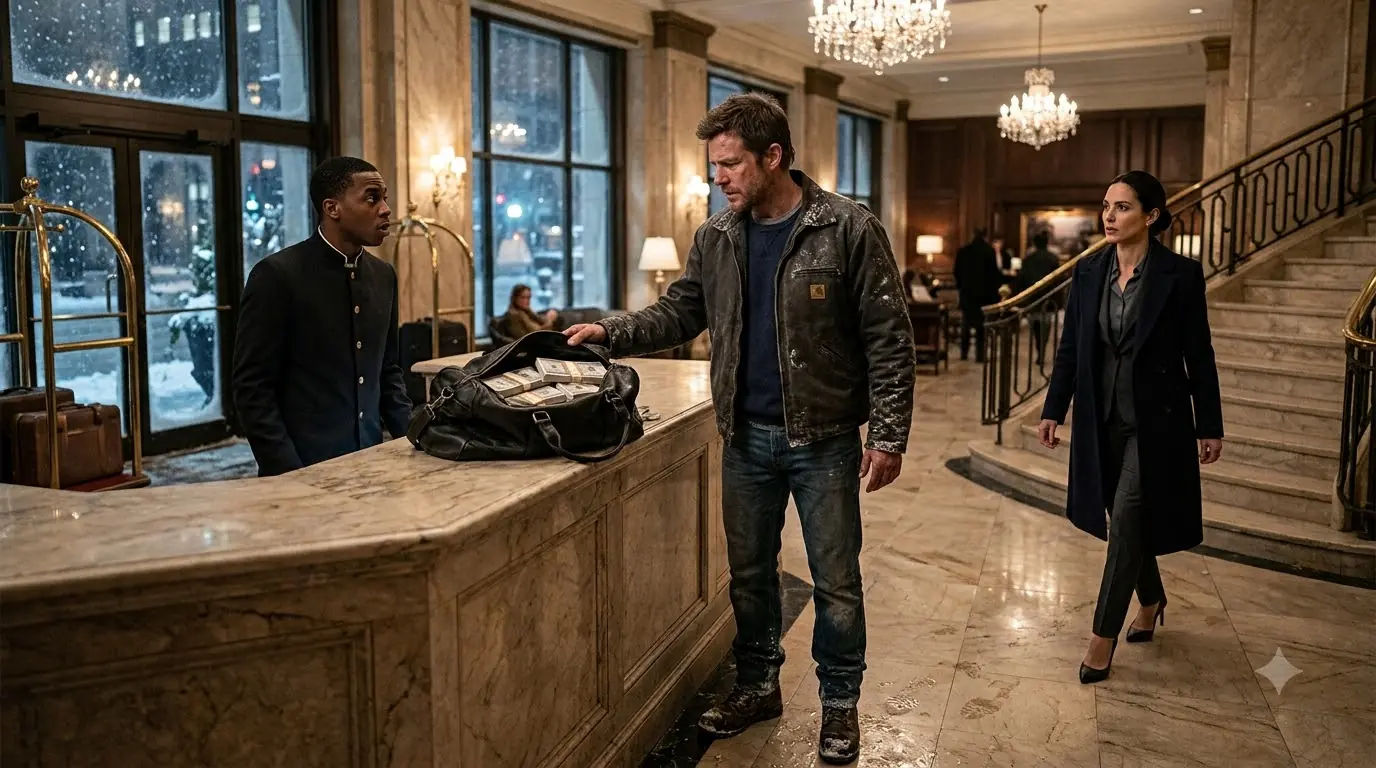
The wind moved through the narrow alley with a low whistle, carrying the smell of wet cardboard, exhaust, and restaurant grease from the hotel kitchens. Somewhere inside, music played faintly from a ballroom full of people in tuxedos and silk gowns.
Caleb barely heard it.
His eyes were fixed on the open zipper.
Inside the bag were stacks of cash.
Fifty thousand dollars.
Maybe more.
The bills were wrapped in clean bands, placed neatly in rows as if money could sleep peacefully when the world around it was falling apart.
Caleb had forty dollars to his name.
An eviction notice taped to his apartment door.
A seven-year-old daughter lying in a room with a broken radiator, wheezing through another asthma attack while he delivered catering crates to people who spent more on one auction paddle than he had seen in months.
There were no cameras in the alley.
No witnesses.
The Bentley was gone.
No one would ever know.
For almost two minutes, Caleb did not move.
The snow gathered on his hair, his shoulders, his eyelashes. His right knee, the bad one, throbbed from standing too long in the cold. He shifted his weight, and the pain climbed from the old injury into his hip.
He looked at the bag.
Then he looked toward the hotel door.
Then he thought of Sophie.
Her small chest rising too fast beneath a thin blanket.
Her inhaler sitting on the kitchen counter, almost empty.
Her voice that morning, soft but determined, repeating the sentence he had taught her because he needed her to believe something stronger than their circumstances.
Being poor isn’t a reason to be small.
He had said it so many times.
At the food pantry.
At the clinic.
On nights when the heat went out.
On mornings when she asked why other children had things she did not.
Being poor isn’t a reason to be small.
Caleb closed the bag.
Then he picked it up and walked back into the Sterling Hotel.
The lobby was bright enough to hurt his eyes after the alley. Marble floors shone beneath chandeliers. Tall flower arrangements stood in silver vases. Guests moved through the space with glasses of champagne, laughing softly, their coats taken by attendants before snow could melt on their sleeves.
Caleb crossed the lobby in his worn canvas jacket and work boots, the leather bag in one hand.
A young front desk clerk looked up, startled.
Caleb placed the bag on the polished counter.
“This was dropped in the alley by the rear lot,” he said. “There’s fifty thousand dollars in it. Maybe more. You’ll want to call security and lock it in your safe.”
The clerk stared at him.
“Sir, your name?”
“Doesn’t matter.”
“It does if we need to contact you.”
Caleb shook his head.
“Just get it back to whoever lost it.”
Then he turned and walked back into the snow.
On the second floor of the Sterling Hotel, behind a wall of curved glass overlooking the rear entrance, billionaire Scarlett Bennett watched him leave.
She had seen everything.
She had been standing near the window of a private reception room, holding a half-empty champagne flute and waiting for a donor named Holloway to deliver a cash contribution for her foundation. She had watched the Bentley pull away. She had watched the bag fall unnoticed into the slush. She had watched Caleb pick it up.
She had expected him to keep it.
Not because she wanted him to.
Because that was what people did.
At least, that was what Scarlett had trained herself to believe.
People took what they could take. They smiled when watched and cheated when they were alone. They spoke about loyalty until the cost of loyalty rose too high. They preached honesty until dishonesty became useful.
Her ex-husband had taught her that with a forged signature on a joint account.
Her co-founder had taught her with stolen code and a midnight exit.
Three board members had taught her during the year she almost lost the company.
Scarlett Bennett had built an empire on the understanding that everyone had a price.
Then she watched a man with cracked boots and a torn jacket return fifty thousand dollars without leaving his name.
She set the champagne flute down so carefully that the bubbles did not stir.
“David.”
Her assistant appeared at her side almost instantly.
David Marsh was thirty-two, polished, efficient, and so practiced at reading Scarlett’s silences that he rarely needed full instructions.
“Yes, ma’am?”
“The man who just walked out through the rear lobby. Canvas jacket. Brown hair. Delivery van outside.”
David glanced toward the window.
“I saw him.”
“I want a name.”
“Tonight?”
Scarlett looked at him.
“Now.”
David nodded once.
“Yes, ma’am.”
Outside, Caleb disappeared around the corner, his shoulders bent against the snow.
Scarlett kept watching long after he was gone.
She did not yet know that following him would tear open a five-year-old lie buried inside her company.
She did not know his daughter’s name.
She did not know that his medical bills, eviction notice, and ruined reputation were all connected to a file she had once initialed without reading.
She only knew that the man had done something impossible.
And she hated that she wanted to understand why.
The hallway light in apartment 306 flickered twice before holding.
Caleb had stopped reporting it to the building manager months ago.
He had stopped reporting most things.
The cracked window in the stairwell.
The elevator that had not worked since November.
The radiator in Sophie’s bedroom that coughed out heat only when it felt like it.
The kitchen sink that leaked into a plastic bowl under the cabinet.
Reporting things required believing someone cared enough to fix them.
Caleb did not believe that anymore.
He pushed the apartment door open quietly, careful not to wake Sophie, and set his tool bag on the floor.
The apartment was small, the kind of place where every sound traveled. The kitchen table sat only a few feet from the living room couch. The hallway was narrow, with peeling paint near the baseboards and a single crooked photograph of Caleb’s late wife, Emma, holding Sophie when she was three months old.
Caleb paused at Sophie’s bedroom door.
The room was dim except for the night-light shaped like a moon. Sophie lay curled on her side under two blankets, her brown curls spread across the pillow. Her chest rose and fell too fast.
Wheeze in.
Pause.
Wheeze out.
Caleb stood there and counted.
He had been a firefighter once.
Engine 21, west side of Chicago.
Seven good years of running toward flames while everyone else ran out. Seven years of sirens, smoke, steel-toed boots, and brothers who trusted him with their lives. Seven years before a beam came down inside the Ashford building and crushed his right knee so badly the surgeon never had to say the word retirement.
His body already knew.
He had lost the only job he had ever loved.
Then he lost Emma.
Three winters ago, a driver ran a red light two blocks from their apartment. Emma had been coming home from an overnight shift at the hospital, still in scrubs, carrying a paper bag with muffins because Sophie had asked for blueberry.
The firehouse had come to the funeral in dress uniforms.
They handed Caleb a folded flag because Emma had loved them all like brothers.
He kept the flag in the top dresser drawer beneath a stack of socks.
He had not opened that drawer in two years.
He went into the kitchen and turned on the small lamp.
Bills covered the table in three uneven stacks.
Hospital.
Utilities.
Rent.
The rent stack had a single sheet on top printed on heavy paper.
Final Notice To Quit.
Seven days.
The landlord had been patient, all things considered.
Caleb lowered himself into the chair and rubbed both hands over his face.
He thought again of the bag.
Fifty thousand dollars.
He could still see the bills when he closed his eyes.
He could have paid the rent. Replaced the radiator. Bought the nebulizer the pharmacy said cost six hundred dollars. Paid for Sophie’s inhalers, doctor visits, food, boots, coats, school supplies. He could have bought time, and time was the one thing poverty never gave.
From Sophie’s room came a small cough.
Caleb stood immediately and went to her door.
She stirred but did not wake.
He checked the humidifier beside the bed. Empty. He filled it from the bathroom sink, then sat on the edge of her mattress and brushed hair from her forehead.
“I’m trying, baby,” he whispered. “I promise I’m trying.”
Her hand moved in sleep, searching.
He placed his finger in her palm.
She held on.
Across the street, in a dark sedan parked beneath a dead streetlamp, Scarlett Bennett watched the thin curtain of apartment 306 glow with weak yellow light.
She had not planned to follow him.
That was what she told herself for the first ten minutes after her driver turned behind Caleb’s delivery van. Then for the next twenty, as they crossed into a part of Chicago Scarlett rarely entered without meetings, security, or press. Then for another hour as she sat outside his building and watched his kitchen window.
She watched him hang his jacket on the back of a chair.
She watched him check on the child.
She watched him eat half a sandwich, wrap the other half in foil, and put it in the refrigerator.
She watched him sit at the table with his head in his hands.
Then she watched him get up, take a screwdriver from a drawer, kneel beside the radiator, and begin taking it apart at one in the morning.
The driver cleared his throat.
“Ma’am?”
Scarlett did not answer.
The radiator came alive at 1:47 a.m.
She knew because the curtain shifted when warm air finally moved through the room.
The man stood, stretched his back, rubbed his knee, and limped to the child’s room again.
Only after the kitchen light went dark did Scarlett say, “Take me home.”
She did not sleep.
At seven the next morning, David Marsh entered Scarlett’s office with a folder under one arm and a face that told her the contents were unpleasant.
Scarlett stood at the window of the forty-second floor, watching Chicago wake beneath a clean white layer of snow.
“Name,” she said.
“Caleb Harper. Thirty-four. Widowed. One daughter, Sophie Harper, seven years old. Chronic asthma. Lives in an apartment on the South Side. Two months behind on rent.”
David placed the folder on her desk.
“Income?”
“Disability pension from the fire department, inconsistent handyman work, delivery shifts when available.”
Scarlett turned.
“Fire department?”
“Former firefighter. Engine 21.”
“Former.”
David nodded.
“Injured in the line of duty, March 2019. Ashford building fire.”
The name landed in the office with a weight Scarlett felt before she understood.
Ashford.
Six dead.
Eleven survivors.
A collapsed apartment building.
A faulty alarm system.
A public relations nightmare.
A wave of denied claims that had moved through Meridian Insurance, one of Bennett Holdings’ most profitable subsidiaries.
Scarlett had not handled the case personally. That was what she told herself first.
Then another memory surfaced.
A quarterly approval packet.
Forty-three claims.
A small line item beside a name she had not cared enough to read.
Harper.
Her mouth went dry.
“Pull the Ashford file,” she said.
“All of it?”
“All of it. Original fire marshal’s report. Claims memos. Internal communications. Settlement records. Everything.”
David hesitated.
“There’s something else.”
Scarlett looked at him.
“There’s been a local industry story for years that Harper was partly responsible. Negligence, bad call, delayed response. I don’t know where it started, but contractors know it. Building managers know it. It’s why his work is inconsistent.”
“Was he responsible?”
David’s eyes did not move from hers.
“The original report does not suggest that.”
Scarlett stood very still.
“Bring me the file.”
“Yes, ma’am.”
After he left, Scarlett looked down at Caleb Harper’s name printed on the folder.
The night before, she had believed she was studying an honest man.
Now she understood she might be looking at a man her company had helped destroy.
The Ashford file arrived at six that evening in a banker’s box.
Scarlett did not open it right away.
She finished two calls. Signed three documents. Read half of a press brief without absorbing a word. Then she sent everyone home and locked her office door.
The city outside had darkened. Snow reflected the streetlights below, making the streets look cleaner than they were.
Scarlett lifted the box lid.
She read Caleb’s statement first.
His handwriting was precise, blocky, controlled.
He described entering the Ashford building at 11:42 p.m.
Smoke on the third floor.
A woman in a blue nightgown carried down two flights of stairs.
Back inside.
A boy found inside a closet on the fourth floor, coughing blood onto the front of Caleb’s jacket.
Back inside.
A man with a broken ankle near the stairwell.
Back inside.
A woman trapped beneath part of a collapsed ceiling on the second floor.
Then the beam.
Scarlett read the line twice.
I knew the leg was finished before I was out of the building. I got her into the truck. After that, I don’t remember things in order. Eleven survivors. Three children.
He had not failed in that fire.
He had walked into it four times.
The fire marshal’s report confirmed the cause: a faulty alarm and electrical system the building owner had been cited for failing to repair twice in the previous year.
Not firefighter negligence.
Not delayed response.
Not Caleb Harper.
Then Scarlett read the Meridian claim memo.
Denied due to owner non-compliance.
Denied under section seven.
Denied across all related claims.
She turned to the approval page.
Her initials sat at the lower right corner.
Small.
Neat.
Unmistakable.
She had approved the quarterly batch of denials without reading the individual names.
A decision that looked clean on paper had pushed unpaid medical bills, lost housing, funeral expenses, and public blame onto people who had already lost almost everything.
Somewhere in the chaos, the false story about Caleb had found room to grow.
Meridian had never corrected it.
The silence had served the company.
Scarlett pushed the file away and stood.
Her reflection stared back from the office window.
Thirty-eight years old.
Billionaire.
CEO.
Founder.
A woman praised for discipline and feared for precision.
And behind her success sat pages like this.
Names she had not read.
Lives she had not counted.
She thought of Caleb kneeling beside a broken radiator at nearly two in the morning.
She thought of Sophie’s small shape beneath the blanket.
She thought of fifty thousand dollars returned by a man whose ruin had passed through her office as a line item.
Scarlett picked up her phone.
“David,” she said when he answered. “I need a house.”
There was a pause.
“What kind of house?”
“Small. Oak Park or Berwyn. Something that needs work. Buy it through a holding company that does not connect to Bennett. Have the deed in the name Sarah Bennett.”
“Sarah Bennett?”
“Yes.”
“Ma’am, what are you doing?”
For once, David asked.
Scarlett looked at the Ashford file.
“I’m going to find out who he is when he doesn’t know who I am.”
The house on Wesley Avenue was pale yellow, with a porch that sloped slightly to the left and a back door that required a shoulder to close properly.
By Friday morning, Scarlett had the keys, a story she had practiced in the mirror, and a local flyer with Caleb’s number circled.
She called from the empty kitchen.
“Harper Repair,” he answered.
His voice was even, tired, and lower than she remembered.
“My name is Sarah Bennett. I just bought a place on Wesley Avenue. It needs work. Someone gave me your number.”
“What kind of work?”
“I’m not sure. The inspection report mentioned wiring, water damage, loose railings, maybe the heater.”
A child’s voice murmured something in the background.
Caleb covered the phone briefly, then returned.
“I can come tomorrow at ten. I charge thirty-five an hour. I’ll give you an estimate before I touch anything.”
“That’s fine.”
“I’ll be there.”
He arrived at 9:57.
Scarlett had been standing behind the front curtain for twenty minutes.
In daylight, Caleb looked younger than he had through the snow. Not young exactly, but too young for the exhaustion in his shoulders. His brown hair was newly cut. His jaw carried two days of stubble. He moved carefully up the front walk, favoring the right knee without making it obvious.
When she opened the door, he removed his cap.
“Mrs. Bennett?”
“Sarah, please.”
“Caleb.”
He shook her hand.
His grip was firm, but gentle.
Not weak.
Careful.
He stepped inside and looked up at the ceiling, down at the baseboards, along the corners. He was already working, already reading the house the way some people read books.
“Whoever painted this front hall painted over water staining,” he said after thirty seconds. “Upstairs bathroom, maybe. I’d start there.”
“Whatever you think.”
He glanced at her, as if clients usually had stronger opinions.
“You just bought the place?”
“Yes.”
“First house?”
She almost laughed.
“In a way.”
He did not ask what that meant.
He inspected the wiring, the pipes, the porch railing, the water heater, the attic corner where insulation had been chewed by mice. He made notes on a small pad and explained every concern without condescension.
His estimate was too low.
Scarlett knew that immediately.
“That cannot be enough,” she said.
“It’s what the work costs.”
“And your time?”
“It’s in there.”
“You’re undercharging.”
He looked at her.
“I charge what lets me sleep at night.”
The sentence stopped her.
He said it without drama.
Without knowing that she had not slept properly in days.
He came back twice that week.
He worked quietly. Efficiently. Honestly.
He did not ask personal questions. He did not flirt. He did not look around the house as if calculating her wealth. He did not touch anything that did not need repair.
On the third visit, Scarlett tested him.
She hated herself for it, but she did it anyway.
She left her wallet on the kitchen counter with three thousand dollars in cash inside, then stepped into the living room as if taking a call.
When she returned, Caleb was outside on the back porch fixing a loose railing.
The wallet had not moved.
Later, she picked it up and said, “There was three thousand dollars in here.”
Caleb looked at her without confusion.
“I saw.”
“You didn’t count it?”
“It wasn’t mine to count.”
He went back to tightening the railing.
Scarlett stood in the doorway, holding the wallet, feeling something inside her chest shift painfully.
She had spent years believing no one passed a test unless the test was too small to tempt them.
Caleb kept proving her wrong.
The first time Sophie came to the house was on a Saturday.
Caleb called the night before.
“I don’t usually bring my daughter on jobs,” he said. “But her sitter canceled, and I can’t afford to lose the day. She’ll stay in the truck with a book. She won’t bother anyone.”
“It’s too cold for her to sit in the truck,” Scarlett said. “Bring her inside.”
A pause.
“You sure?”
“Yes.”
Sophie Harper stepped through the front door holding her father’s hand and a thick paperback with a unicorn on the cover.
She was small for seven, with soft brown curls, serious hazel eyes, and a pink hat that nearly swallowed her head. Her cheeks were pale, but her gaze was sharp. She studied Scarlett with the open intensity of a child who missed very little.
“Hi,” Scarlett said.
“Hi,” Sophie replied. “You have eyes like my mom in the photo.”
Caleb froze behind her.
Sophie continued matter-of-factly.
“Sad but pretty.”
Scarlett did not know what to say.
So she said, “Thank you.”
Sophie looked around the house.
“Do you live here alone?”
“For now.”
“That’s why it echoes.”
Caleb closed his eyes.
“Sophie.”
“What? It does.”
Scarlett surprised herself by smiling.
“She’s right.”
By noon, Sophie was sitting cross-legged on the living room floor with a sketchpad balanced on her knees while Caleb worked upstairs. Scarlett brought her a sandwich and apple slices, then pretended not to watch as the child drew.
After a while, Sophie tore a page from the sketchpad and handed it up.
It was Scarlett.
The proportions were uneven, but the expression was exact.
The sharp chin.
The pulled-back hair.
The guarded eyes.
At the bottom, Sophie had written:
Dad’s new friend.
Scarlett stared at the words for so long that Sophie tilted her head.
“Do you not like it?”
“I do,” Scarlett said quietly. “Very much.”
She folded the drawing once and slipped it into the inside pocket of her coat.
That night, she took it out at home and placed it beside the Ashford file.
The file accused the world.
The drawing accused her.
The first sign of trouble came eight days later.
Caleb lost a wiring job in Pilsen.
Then a basement repair in Logan Square.
Then a contractor who had promised him steady winter work stopped answering his calls.
He did not mention it to Scarlett, but she heard him in the backyard one afternoon.
“What story exactly are people telling?” he asked into the phone.
A pause.
“That was five years ago, and that’s not what happened.”
Another pause.
“No. I understand.”
He ended the call and stood motionless for almost a full minute.
Then he came back inside and resumed working on the kitchen sink as if nothing had happened.
Scarlett knew the source before she had proof.
Someone had restarted the old Ashford rumor.
Someone wanted Caleb discredited.
Someone did not want Scarlett getting closer to the truth.
That evening, in a parking garage beneath Bennett Holdings, David Marsh sat in his car with his phone pressed to his ear.
“She’s emotionally compromised,” he said quietly. “If she keeps digging, she’ll find things the board won’t survive. I’ll handle it.”
He hung up and drove home.
Three days later, everything fell apart.
Sophie was sitting on the floor of the Wesley Avenue kitchen, watching a small television while Caleb repaired tile upstairs. Scarlett had stepped into the living room to take a call from the foundation office.
A daytime business program ran a segment on powerful women in American industry.
Scarlett’s face appeared on screen.
The graphic beneath it read:
Scarlett Bennett, CEO, Bennett Holdings
Parent Company Of Meridian Insurance
Sophie stared.
Then she stood, walked to the foot of the stairs, and called up in a calm voice, “Dad, Miss Sarah is on TV.”
The silence from upstairs was immediate.
A tool was set down carefully.
Caleb came down the stairs slowly.
He stood in the kitchen doorway and watched the final seconds of the segment.
Scarlett entered behind him.
He did not look at her at first.
His eyes stayed on the screen, though her image was already gone.
Then he turned.
The look on his face was not rage.
It was worse.
It was a quiet, careful distance, the kind of expression worn by a man who had just realized he had been foolish enough to trust someone he should have known better than to trust.
“Have you had enough fun yet, Mrs. Bennett?”
“Caleb.”
“Don’t.”
“I can explain.”
“No,” he said. “You can’t. Not in a way that matters.”
Sophie looked between them, confused.
“Daddy?”
Caleb’s voice softened instantly.
“Get your coat, baby.”
“But…”
“Please.”
She went to the living room.
Scarlett stepped closer.
“I did not mean to hurt you.”
“You followed me home.”
Scarlett went still.
He knew.
“I saw the sedan three times before I admitted to myself it was yours,” Caleb said. “I told myself I was paranoid. Then you showed up as Sarah Bennett with a house that just happened to need a handyman.”
His voice remained low.
“You watched me. Tested me. Put money on counters. Let my daughter call you my friend.”
Scarlett’s face tightened.
“The night at the hotel, I saw you return the bag. I needed to understand why.”
“And did you?”
She could not answer fast enough.
He nodded once, as if the delay told him everything.
“You don’t come near her again,” he said. “You don’t come near me. Whatever project this was, it’s over.”
He placed the house key on the counter.
Then he took Sophie’s hand and walked out.
Scarlett stood alone in the kitchen for a long time after they left.
On the counter, beside the key, sat Sophie’s drawing.
Dad’s new friend.
Scarlett picked it up, and for the first time in seven years, her eyes filled with tears.
Forty-eight hours later, Caleb sat at his own kitchen table with a duffel bag at his feet and a Greyhound timetable in front of him.
He had sold the van.
He had sold the tools he could not carry.
Emma’s great-aunt lived outside Indianapolis and had said they could stay for a few weeks.
It was not a plan.
It was an escape.
Sophie came out of the bedroom holding her stuffed rabbit and stopped in the hallway.
“Daddy.”
He looked up.
He heard it before he saw it.
The wheeze was wrong.
Not the usual shallow rhythm.
This was tight, wet, and too fast.
He crossed the room in three steps.
“Sophie?”
She pressed one hand to her chest.
“I can’t…”
He grabbed the inhaler.
She tried.
Nothing changed.
Caleb carried her down three flights of stairs because the elevator still did not work. Snow fell hard outside. His bad knee screamed, but he did not slow down. Four blocks to Mercy General, Sophie’s breath against his neck like a failing machine.
The nurse at the emergency desk took one look at Sophie’s lips and called for a room.
Forty minutes later, the intake clerk looked at Caleb with practiced sympathy.
“The deposit for the intensive respiratory protocol is twelve thousand dollars. Do you have a card, sir? Or a family member we can contact?”
Caleb stared at her.
“Twelve thousand.”
“Yes, sir.”
“My daughter needs it.”
“I understand. But without coverage or deposit, we can maintain the basic protocol unless her condition becomes critical.”
His hands rested flat on the counter.
Somewhere behind the double doors, Sophie was fighting to breathe.
Then another clerk appeared.
“Mr. Harper, there’s been a payment.”
“What?”
“The deposit has been paid in full by wire.”
She printed the receipt.
Caleb saw the name.
S. Bennett.
His jaw tightened.
“Refund it.”
The clerk blinked.
“Sir?”
“Refund it.”
“All of it?”
“Yes.”
“But your daughter…”
“I said refund it.”
The clerk stared at him, then slowly returned to the computer.
Caleb went to the waiting room and sat in the farthest chair from the television.
For the first time in his life, he understood that pride could become sharp enough to cut the person he loved most.
Across the city, Scarlett opened an email from a Tribune reporter asking for comment on allegations that she had covertly followed and manipulated a working-class single father connected to a previously disputed Meridian Insurance claim.
The source was described as a senior executive staff member.
David.
Scarlett read the email once.
Then she opened the Ashford file again.
By two in the morning, the chairman of the board had sent her a resignation agreement.
By three, three board members had called.
By four, David’s access had been suspended, though he did not know it yet.
By five, Scarlett sat at her desk with two documents before her.
One was the resignation agreement, crafted to protect her fortune and quietly separate her from the company.
The other was the Ashford file.
She looked at the approval page with her initials.
Then at Caleb’s statement.
Then at Sophie’s drawing, now unfolded beside the file.
Dad’s new friend.
Scarlett picked up a pen and drew a diagonal line across the resignation agreement.
Then she called her communications director.
“Press conference,” she said. “Nine in the morning. Every outlet. No screened questions.”
“What’s the topic?”
“The Ashford fire.”
A silence.
“Ma’am, are you sure?”
Scarlett looked at the drawing.
“I have never been more sure.”
The press conference began at nine sharp in the lobby of Bennett Holdings Tower.
Scarlett stood at a wooden lectern in a plain navy suit, her hair pulled back, her face bare of the polished armor the media expected.
She did not thank anyone for coming.
“In March of 2019,” she began, “the Ashford apartment building caught fire on the west side of Chicago. Six people died. Eleven survived.”
The reporters quieted.
“Those eleven survived because a firefighter named Caleb Harper entered the building four times and carried people out. His final entry ended with a steel beam injury that destroyed his right knee and ended his career.”
Cameras clicked.
“The fire was caused by a faulty alarm and electrical system. The building owner had been cited twice for failing to repair it. The fire marshal’s report made no allegation of negligence against Caleb Harper or his crew.”
She placed both hands on the lectern.
“Meridian Insurance, a subsidiary of Bennett Holdings, denied every related claim. My initials are on the quarterly approval sheet. I did not read the names attached to those claims. That is not a defense. It is a confession.”
The lobby went completely still.
“A false story later spread through local trade networks suggesting Caleb Harper was responsible for the fire. That story was false. Meridian and Bennett Holdings did nothing to correct it because the silence benefited us.”
She did not blink.
“A man who saved eleven lives spent five years losing work, reputation, stability, and dignity because people with power chose paperwork over truth.”
A murmur moved through the press.
“Today, Bennett Holdings will reopen every Ashford-related claim and issue corrected payouts, backdated to 2019 with interest. I am personally committing eighty million dollars to establish the Emma Harper Foundation, named for Caleb Harper’s late wife. The foundation will support injured firefighters and their families with medical care, housing assistance, and emergency relief.”
Her voice shifted, just slightly.
“At the conclusion of this statement, I am resigning as CEO of Bennett Holdings. I will not retain a board seat. The page was wrong. The page was mine.”
A reporter shouted, “Ms. Bennett, is this connected to the allegations that you followed Mr. Harper?”
Scarlett looked directly at him.
“Yes.”
The room erupted.
She continued over the noise.
“I followed Caleb Harper after watching him return fifty thousand dollars in cash when he had every reason to keep it. I did so dishonestly. I entered his life under a false name. That was a violation of his privacy and his trust. I cannot excuse it.”
The noise faded again.
“But because of that wrong choice, I found a deeper wrong my company had allowed to stand for five years. I cannot undo the first without telling the truth about the second.”
She stepped back.
“I have no further statement.”
At Mercy General, Caleb watched the press conference on a muted television above the vending machine.
He watched Scarlett say his name.
He watched her tell the truth.
Not the soft version.
Not the version that protected her.
The truth.
A hospital administrator sat beside him ten minutes later.
“Mr. Harper, there’s been a change in Sophie’s coverage.”
He turned slowly.
“The Emma Harper Foundation has contacted the hospital. Sophie’s intensive respiratory protocol is approved under their injured firefighter family support program.”
Caleb stared at her.
“The foundation.”
“Yes, sir.”
“Not Scarlett Bennett.”
“The foundation.”
He understood then.
Scarlett had not sent another private payment for him to reject.
She had built a public structure that allowed him to accept help without surrendering his dignity.
Not charity.
A debt repaid.
A wrong corrected.
His eyes lowered to his hands.
“Move her,” he said.
Sophie improved over the next thirty-six hours.
When she woke fully, her voice was rough.
“Daddy?”
“I’m here.”
“Did we miss the bus?”
Caleb laughed once and cried at the same time.
“No, baby. We’re not taking the bus.”
She frowned.
“Are we still moving?”
He brushed hair from her forehead.
“I don’t know yet.”
“Can we think about it after pancakes?”
He smiled through tears.
“Yeah. We can think about it after pancakes.”
Six months later, Caleb opened a repair shop in Berwyn.
The storefront had once been a barbershop, then a storage space, then nothing at all. The tin ceiling was original. The floors creaked. The front windows faced west, catching afternoon light in a way Sophie declared “excellent for drawing.”
Caleb painted the door dark green.
Above it, he hung a wooden sign.
Harper & Daughter Repair.
The and daughter had been Sophie’s idea.
She had insisted.
“If I’m helping, I’m on the sign.”
“You mostly draw while I work.”
“I inspire the business.”
“You do.”
The shop did not make them rich.
It made them stable.
That was more than enough.
People came with broken lamps, old clocks, chairs with loose legs, radios that no longer turned on, bicycles needing chains, and small household problems too expensive to replace but too important to discard.
Caleb fixed what he could.
Charged what was fair.
Kept coffee in the back.
And every month, a check from the corrected Ashford settlement went into Sophie’s medical fund, her education account, and the rent for the small apartment above the shop where the radiator worked, the windows closed properly, and no one taped notices to the door.
Scarlett disappeared from the headlines after the first brutal weeks.
Bennett Holdings recovered under new leadership.
David Marsh was removed after the investigation revealed he had helped circulate damaging information about Caleb to protect board members tied to the original Meridian denials.
Scarlett did not return to the tower.
She moved into a smaller apartment on the north side, took a formal role only at the Emma Harper Foundation, and learned, awkwardly at first, how to do things without commanding a room.
She answered emails herself.
Sat in community meetings.
Listened more than she spoke.
It did not come naturally.
She did it anyway.
One warm morning in late May, Scarlett walked through Lincoln Park after a foundation meeting.
The trees were fully green, sunlight moving through the leaves like water. Children chased each other near the path. A man played saxophone near the pond.
Scarlett saw Sophie first.
The girl sat beneath an oak tree, sketchpad open across her knees.
She looked up, and her whole face brightened.
“Miss Sarah!”
Scarlett stopped.
Sophie ran across the grass and wrapped both arms around her waist.
“You look different,” Sophie said into her coat. “Your hair is longer.”
Scarlett slowly placed a hand on the child’s back.
“You grew.”
“I know. I had to get new shoes twice.”
Caleb rose from a bench nearby, holding a paper cup of coffee.
He walked over slowly.
For a moment, neither adult spoke.
“Hello, Mrs. Bennett,” he said.
“Scarlett, please.”
He nodded.
“Scarlett.”
Sophie looked between them, then lifted her sketchpad.
“I’m going to draw ducks. Adults talk weird, so I’ll be over there.”
She walked to a bench thirty feet away, close enough to watch, far enough to pretend she was not.
Scarlett and Caleb stood beneath the oak tree.
A breeze moved through the branches.
“Why did you follow me home?” Caleb asked.
Scarlett had prepared many answers over the months.
Most were too polished.
So she chose the simplest one.
“Because I watched a man with every reason to keep that money return it. And I needed to know if someone like that was real.”
He looked at her.
“And now?”
She looked toward Sophie, who was drawing with fierce concentration.
“Now I know you are. And I’m trying to become someone who would not need to test that to believe it.”
Caleb looked down at his coffee.
“You hurt us.”
“I know.”
“You lied to me.”
“Yes.”
“You helped save my daughter.”
“The foundation did.”
His mouth moved slightly, almost a smile.
“That’s what you want me to say.”
“That’s what is true.”
He looked at her for a long moment.
“I don’t know what to do with you.”
Scarlett nodded.
“That’s fair.”
“Sophie asks about you.”
Her breath caught.
“She does?”
“Too much.”
“What do you tell her?”
He looked toward his daughter.
“I tell her people can do wrong things and still choose to do right after. But choosing right later doesn’t erase what happened before.”
Scarlett swallowed.
“That sounds wise.”
“It sounds like something I’m still trying to believe.”
Sophie tore a page from her sketchpad and came back before either of them could say more.
She handed it to Scarlett.
The drawing showed three people standing beneath a tree.
A man with a coffee cup.
A small girl with curls.
A woman with longer hair.
At the bottom, Sophie had written:
The good ones.
Scarlett stared at it.
Caleb looked away first.
Sophie sighed.
“You both look sad again.”
Caleb laughed softly.
Scarlett did too, though her eyes were wet.
“Come by the shop sometime,” Caleb said after a moment.
Scarlett looked up.
“Are you sure?”
“No.”
That was honest enough to make her smile.
“But Sophie wants to show you the back room,” he said. “She says it needs better light for drawing.”
“It probably does.”
“And I have a kettle now.”
“You hate tea.”
“I have customers who don’t.”
Scarlett folded the drawing carefully.
“I’ll come.”
Caleb nodded.
“Not as Sarah.”
“No,” she said. “Never again.”
A year later, Harper & Daughter Repair had a front window full of Sophie’s drawings.
One showed a firefighter carrying a child through smoke.
One showed a woman standing at a podium.
One showed a black leather bag in snow.
And one showed a radiator glowing orange in a tiny apartment, with a man kneeling beside it and a girl sleeping safely in the next room.
Scarlett visited on Thursdays.
At first for foundation paperwork.
Then for tea.
Then because Sophie expected her.
Then because Caleb did.
Nothing happened quickly.
Trust, once broken, does not return because someone wants it back.
It returns by repetition.
By showing up.
By telling the truth when silence would be easier.
By paying debts without turning them into favors.
By learning the difference between repair and control.
Scarlett never became the woman she had pretended to be on Wesley Avenue.
She became someone harder and better.
Herself, without the armor.
And Caleb, who had once refused every form of help because help had so often arrived with hooks, learned that dignity did not mean standing alone until you collapsed.
Sometimes dignity meant accepting what was owed.
Sometimes it meant letting someone carry one corner of the weight.
Years later, when people told the story, they often began with the money.
Fifty thousand dollars in a leather bag.
A snowstorm.
A desperate father.
A choice no one would have blamed him for making differently.
But Caleb never thought the story was about money.
The money was only the test people understood.
The real story was about names.
His name, taken by rumors and returned in front of cameras.
Emma’s name, placed on a foundation that helped families like theirs.
Sophie’s name, written on drawings taped to the shop window.
Scarlett Bennett’s name, once attached to power, later attached to repair.
And Caleb Harper’s name, no longer whispered in trade circles with suspicion, but spoken by customers who came through his green door and said, “You’re the man who tells the truth.”
On winter nights, when snow returned to Chicago and the city grew quiet beneath it, Caleb sometimes stood at the shop window after closing and watched flakes settle on the sidewalk.
Sophie, older now, would sit behind him with her sketchpad, always drawing, always noticing.
Scarlett would make tea in the back room, usually too strong.
And for a moment, the world would feel not easy, but possible.
Caleb would think about that night in the alley behind the Sterling Hotel.
The bag.
The cash.
The cold.
The terrible temptation.
He had thought he was returning money.
He had not known he was calling truth out of hiding.
He had not known a woman watching from a second-floor window would follow him into the consequences of her own empire.
He had not known that one honest act would restore his name, save his daughter, and begin a slow, difficult, imperfect friendship that none of them had expected.
But that is how life works sometimes.
Not like a miracle arriving clean and bright.
More like a broken radiator at one in the morning.
A faulty wire found behind a wall.
A claim reopened after years of denial.
A person returning what is not theirs, even when they desperately need it.
Sometimes doing the right thing does not change your life immediately.
Sometimes it simply lights a path in the dark, and someone watching from far above finally sees the truth.
Then, if they are brave enough, they come down from the tower.
And if they are humble enough, they learn how to repair what they once helped break.