Owen Barrett knew he needed money. His rent was already past due.
His old truck had started throwing a warning light he could not afford to chase. And on that particular morning, he had just enough left in his account to carry him a few more days.
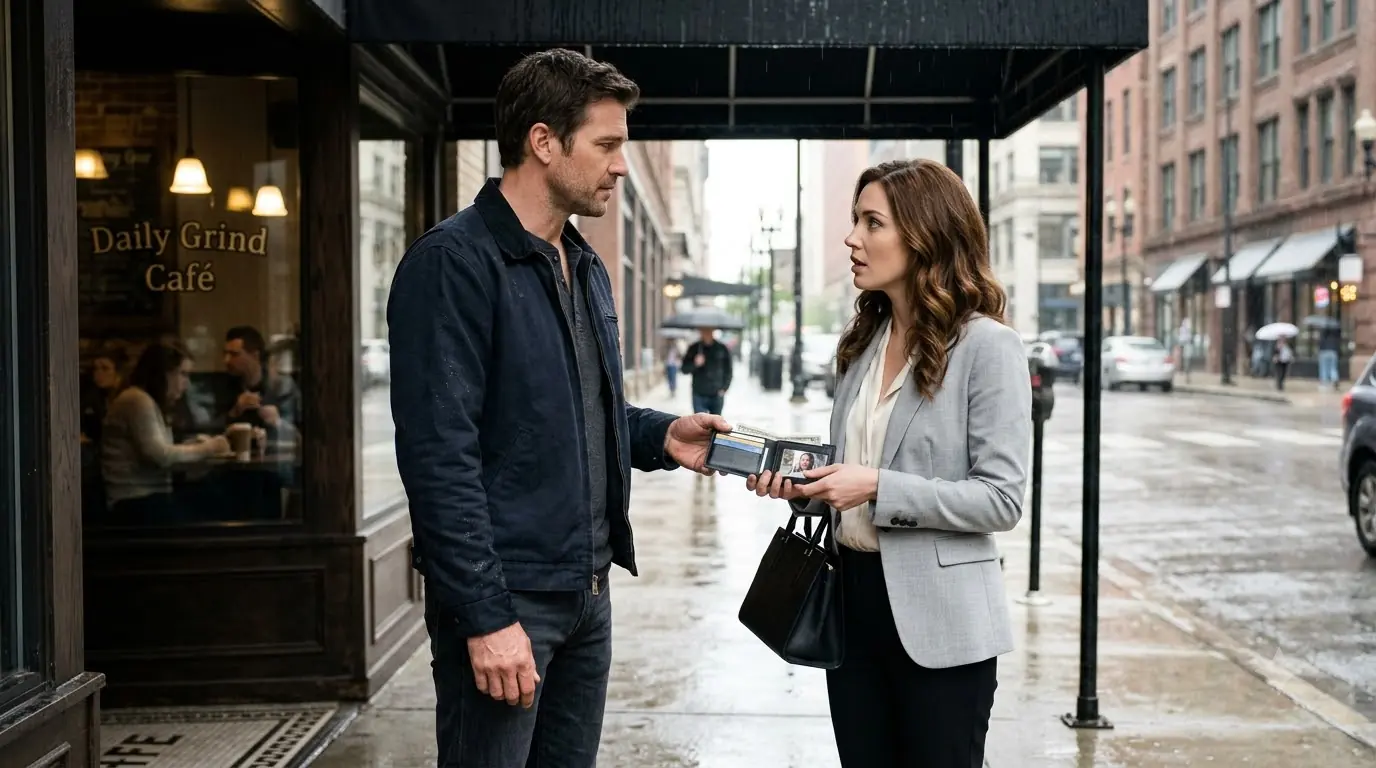
So when he found a black leather wallet under a table in a small coffee shop and saw that it belonged to Vivien Ashcroft, the billionaire who ran an empire worth tens of billions of dollars, he understood perfectly well why she slid a check across the table toward him. Owen only looked at the number, pushed it back, and said one sentence that silenced the room.
"I returned your wallet. I don't sell my decency."
I have watched a great many mornings settle over Chicago, and I can tell you that the cold ones in early spring are the least forgiving.
Rain came sideways off the lake that day, thin and gray, the kind that soaks a work jacket before a man notices it is happening. Owen Barrett had been awake since 4, had spent 3 hours rewiring a control panel in the back of a family-owned print shop on the west side, and had finished the job the way he always did, which was completely.
Then the owner had stood in the doorway, wringing his hands and asking whether payment could wait until the 15th, because a big client had gone quiet on him, too. I knew what Owen was thinking in that moment because I know the arithmetic that lives behind a tired man's eyes.
He said yes anyway, told the man to call him if the panel hiccuped again, and walked out into the rain with $420 still owed to him. His phone buzzed on the walk to the truck, and the notification told him what he already suspected.
The balance in his checking account had dropped below $100, and the automatic payment for his daughter's health insurance was scheduled to hit in 9 days. Owen did not curse or slam anything.
He had been divorced for 6 years and had been raising a child alone for most of them, and that arrangement burns the drama out of a person until only planning remains. He sat in the driver's seat with his hands on the wheel and did what he had trained himself to do, which was to break an impossible month into a sequence of solvable Tuesdays.
Then the engine turned over on the third try, which felt briefly like luck. He stopped at a coffee shop on the corner of a street where the neighborhood was still deciding what it wanted to become.
It was the cheap kind with mismatched chairs and a chalkboard menu that had not been updated since the fall. And he ordered the smallest coffee they sold because it came with free refills.
He sat by the window for 11 minutes, warming his hands, watching delivery trucks fight for the same 12 feet of curb. He thought about the $1,800 he owed on a credit card from a winter when the furnace in his apartment had failed, and about the note the building manager had slipped under his door.
Then he stood, pulled his hood up, and noticed something dark against the leg of the table beside him. It was a wallet, and even wet, it looked expensive in a way that had nothing to do with logos.
The leather was soft and had been resewn at the seams by someone who repaired things instead of replacing them. And Owen registered that detail before he registered anything else because he was a man who noticed maintenance.
He opened it to look for a name. Inside was a driver's license belonging to a woman named Vivien Ashcroft.
Three credit cards in a metallic color he had only seen in advertisements. Roughly $600 in cash.
A small rectangular security key on a black lanyard clip and a photograph turned face down against the leather so that only its aged white back showed. He recognized the name immediately because the Ashcroft Meridian Group had been in every business segment on the radio for a month.
Something about a merger the size of a small country's budget. He did not turn the photograph over.
I want that noted because most people would have and because the smallest choices are the ones that reveal a man before he has had time to arrange his face. He carried the wallet to the counter and told the young woman working there what he had found and she offered to lock it in the safe behind the register until somebody called.
Owen thought about it for a moment, then shook his head because he had once lost a tool bag to a lost and found and had learned that good intentions evaporate over a weekend. There was a business card tucked in the billfold with an address printed on it, a tower downtown he had driven past a hundred times without ever once looking up at the top floors.
He decided he would take it himself on his own gas on a morning he could not afford to spend. A man at the next table had been listening the way men in coffee shops listen and he laughed into his cup.
He said a woman like that would never miss a couple thousand and that the universe hands out gifts to people who need them and that a smart guy would take the cash and mail back the rest. Two other customers smiled at the joke because it was the kind of joke that feels like solidarity.
Owen zipped the wallet into the inside pocket of his jacket and answered without any heat at all. "But I'd know," he said, and then he walked out into the rain, and I swear the room went a little quieter than the weather could explain.
The Ashcroft Meridian Tower rose 41 floors above the river. All pale stone and glass that reflected the low clouds back at the city.
Owen parked six blocks away because the garage rate was $14 for the first hour and he was not going to pay $14 to give something back. He walked in with his boots leaving marks on marble the color of milk.
His jacket dripping, his hands still carrying the faint gray of machine grease that never fully leaves a man's knuckles, no matter how he scrubs. The lobby smelled like cold flowers and money.
Two security officers watched him cross the entire length of the floor before either of them moved. And when the older one finally stepped out from behind the desk, his voice was polite in the way a locked door is polite.
"You sure you've got a reason to be here?" Owen told him exactly what he had, which was a wallet belonging to the woman whose name was carved into the wall behind the desk.
And the officer's expression did not change at all.
He was asked to stand aside near a bench nobody ever sat on, while a call was made upstairs and then a second call. Fourteen minutes passed while he watched people in beautiful coats pass through turnstiles that opened for them without being asked.
A younger guard suggested that the wallet be surrendered at the desk so the visitor could be on his way and Owen declined, not rudely, simply saying he would hand it to the owner or to someone the owner named. That was when a woman in a charcoal suit came out of the elevator bank with two assistants trailing her, saw the wet man by the bench, and stopped the way a person stops when they smell something unpleasant and want to identify it.
Her name was Celeste Blackwood, chief strategy officer, 45 years old, the daughter of a family that had been buying and selling infrastructure since before the interstate system existed. She asked the guard what the situation was, listened to 11 seconds of it, and then turned her attention on Owen with a directness that was meant to be uncomfortable.
She asked whether he had taken anything out of the wallet. She asked how he had come to be in that particular coffee shop at that particular hour and whether he had been following anyone and whether he understood that attempting to leverage a lost item for access to an executive was a matter the company took seriously.
Owen answered the first question with one word and ignored the rest. And then he said that if she would simply call Vivien Ashcroft, this would be over in 90 seconds and everyone could get back to their day.
Upstairs, the woman in question had just discovered the wallet was gone. And I can tell you the panic in her chest had nothing to do with the money.
Vivien Ashcroft was 42, had run the company for 5 years since her father's death, and had spent those 5 years learning that a chief executive is never allowed to look frightened. She came down herself, which no one had expected, and she came fast, and the elevator doors opened on a lobby that had gone strangely silent.
She crossed the marble in shoes worth more than Owen's truck and stopped in front of a man who smelled like rain and solder and she held out her hand without a word. He put the wallet into it.
She checked it right there standing up in front of the guards and her own executives which was itself a kind of confession about how much it mattered. The cash was there.
The cards were there. The photograph was there, still turned face down, still untouched.
And something in her shoulders released when she saw it. And then her thumb found the small rectangular security key on its clip.
And she closed her eyes for one full second, and I watched a woman who negotiated with governments allow herself a single human breath. "Where did you find it?"
she asked.
And he told her plainly, "No embellishment, no story built to sound heroic." Celeste, standing three feet behind her, was watching Owen's face with an intensity that had nothing to do with gratitude.
Vivien asked for his name, and he gave it.