At a corner café on Church Street in Burlington, Vermont, Katherine Whitmore set her leather clutch on the counter while holding her phone to her ear.
Vincent Mallory’s voice came through the speaker, clipped and urgent. “Abort. Emergency.” Katherine took her coffee and walked outside without realizing she had left the clutch behind.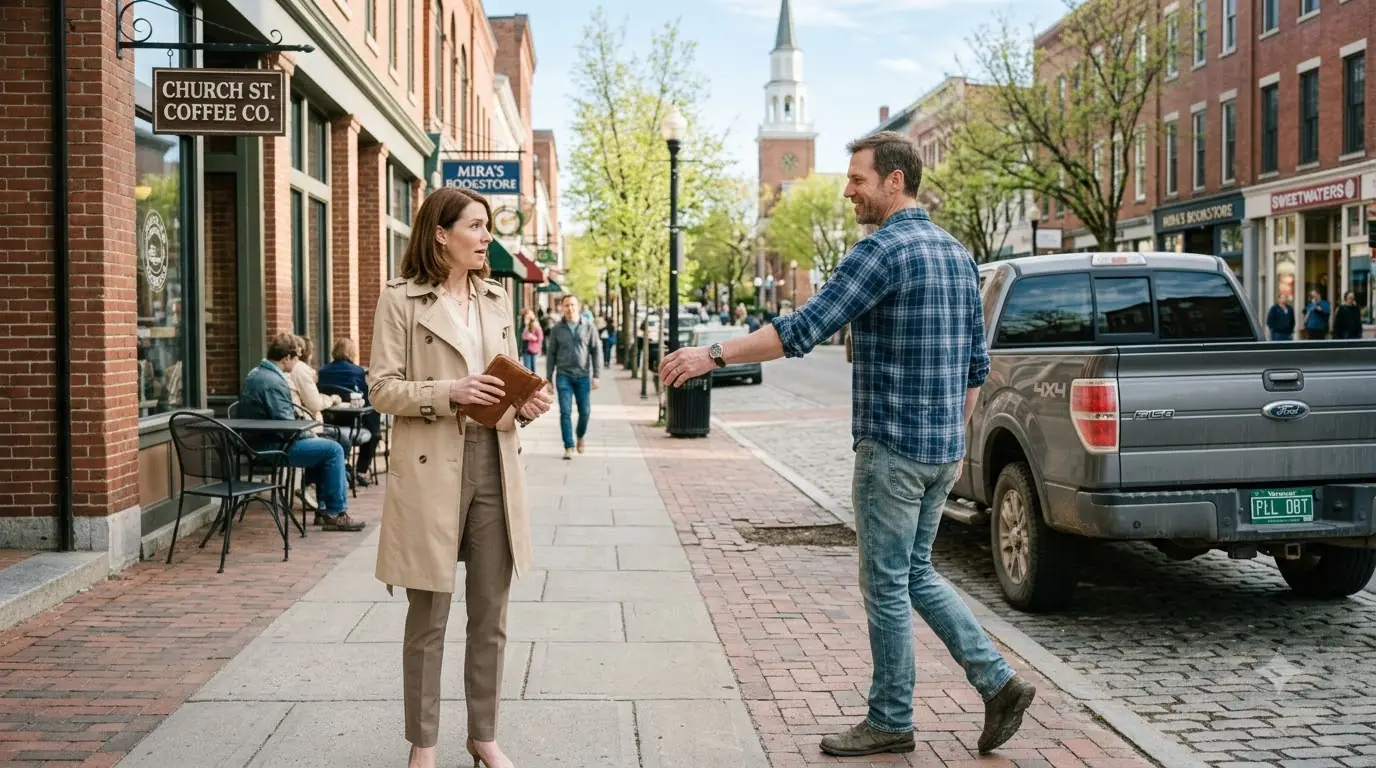
Three tables away, Daniel Reeve, forty-one, sat with the sleeves of his blue flannel shirt rolled above his forearms. His knuckles were scarred and rough from a generator he had repaired that morning.
When he noticed the clutch sitting unattended, he picked it up, opened it only far enough to identify its owner, and saw forty thousand dollars in cash, identification, and a folded slip of paper he did not unfold.
He caught Katherine at the curb. Without ceremony, he held out the clutch. She looked from the bag to his face, startled, but before she could ask his name, he turned and walked back toward the café.
Katherine stood frozen beside the curb, watching him go.
By eleven that morning, she was back at the Whitmore Foundation Tower on Main Street. She placed the clutch on her desk, closed the door, and opened it again. Forty thousand dollars. She counted the bills twice.
Not a single one was missing.
Her phone showed three missed calls from Mallory. She did not return any of them. The cash had been withdrawn that morning under a vendor cash-payment requisition her CFO had pushed through at the last minute.
“Urgent,” Vincent Mallory had called it.
“Off-cycle.”
Katherine had not questioned it then.
Now she tried to remember the stranger’s face. Blue flannel. Steady eyes. Work-worn hands.
And the way he had simply walked away, as though he did not require gratitude.
That was all she had.
Katherine sat on the board of the Burlington Business Improvement District. The district’s security feeds covered nearly every block of Church Street, and from her locked office she accessed the footage from 9:42 that morning.
There he was.
Daniel sat at a corner table drinking black coffee. He stood when Katherine left the café, picked up the clutch, followed her outside, then returned after giving it back.
He sat down again.
Finished his coffee.
Then carried the empty cup to the bus tray himself.
That last detail held her attention longer than the money.
A man had found forty thousand dollars and returned every cent. Then, instead of lingering for praise, he had gone back to finish his coffee and clean his own table.
Katherine called Eleanor Pace, the Whitmore Foundation’s senior accountant. Eleanor had worked with the Whitmore family for twenty-two years and knew almost every financial and administrative system connected to the foundation.
Katherine gave her the license plate of the dust-gray Ford pickup that had pulled away from Church Street three minutes after the footage ended.
“Can you get me an address?”
There was a pause.
Only half a second.
But Katherine noticed.
Eleanor gave her the address.
Katherine did not ask about the hesitation.
The house stood at the southern edge of Burlington, where the streets thinned into modest homes, chain-link fences, birch trees, and small yards patched by years of Vermont winters. Katherine parked across the road and immediately saw the man from the café.
He was not in his own yard.
Daniel Reeve was kneeling beside the neighbor’s fence, replacing a rotted post. He packed gravel around the base using a length of two-by-four, working with the patient concentration of someone who disliked leaving a job unfinished.
A small girl sat on the porch of the house Katherine had come to find. She looked nine or ten, with brown hair held away from her face by a plastic clip. A hardback book rested across her knees, and a worn stuffed rabbit sat beside her hip.
Daniel looked up.
He recognized Katherine immediately.
His face closed.
Katherine got out of the car and crossed the street slowly. In one hand, she carried a plain white envelope.
She stopped at the property line.
“For returning the clutch,” she said. “Five hundred dollars. It isn’t a reward. It’s just thank you.”
Daniel stopped packing the gravel.
He leaned the two-by-four against the fence post and stood. Wiping his hands on his jeans, he looked at the envelope and then at her.
“It isn’t that I don’t need it,” he said.
His voice was lower than she remembered.
“I just don’t want it like this.”
He turned back toward the fence.
The girl on the porch closed her book over one finger.
“Dad,” she called. “Who’s the lady?”
Daniel did not look up.
“Someone passing through.”
Katherine remained there with the envelope in her hand.
After a moment, she put it back inside her coat.
She walked to her car, sat behind the steering wheel, and stayed there for a long time before turning the key.
A man who repaired his neighbor’s fence without charging him.
A man who would not take five hundred dollars for returning forty thousand.
There was a mathematics to that kind of person.
Katherine could not solve it yet.
She also could not let it go.
The next evening, after a foundation board call she barely remembered attending, Katherine drove through the South End again. She had no appointment and no clear reason for being there.
She told herself she was simply curious.
Then she spotted Daniel’s Ford outside the Burlington Community Free Clinic on Pine Street.
The clinic was a flat-roofed building donated decades earlier by a doctor whose name remained on the entrance. Katherine parked two blocks away and walked back through the cold.
A brief snowfall had melted, leaving the sidewalk wet and shining under the streetlights.
One side window faced an examination room.
The blinds were lowered almost completely, but a narrow gap remained at the bottom.
Through it, Katherine could see the lower section of an examination table, one fluorescent ceiling panel reflected in a cabinet, and parts of three people.
One wore green scrubs.
The other wore flannel.
A teenage boy lay on the examination table with a serious wound beneath his ribs. His breathing was shallow.
Daniel Reeve was closing the injury.
The needle entered and emerged at nearly identical depth each time. The spacing was precise. The thread moved through with a controlled pull and no wasted motion.
The clinic physician stood beside Daniel with his arms folded.
He was not assisting.
He was watching.
Studying.
Katherine stepped away before either man could glance toward the window.
She drove home and sat at her kitchen island with her laptop.
She did not even remove her coat.
She typed:
Daniel Reeve, Vermont.
Nothing that matched.
A retired insurance broker in Rutland.
A high-school cross-country coach in Bennington.
No Burlington handyman.
She tried again.
Daniel Reeve MD.
The fourth result was an archived medical press page.
A photograph at the top showed a younger Daniel in formal service uniform, his face leaner but unmistakable. The caption identified him as Lieutenant Commander Daniel Reeve, Medical Corps, receiving a distinguished service medal for surgical work.
The date was 2015.
Katherine sat with one hand resting on the trackpad and the other covering her mouth.
She did not move for a long time.
The man who had returned her forty thousand dollars had not simply been an unusually capable handyman.
He had once been a decorated surgeon.
And for reasons she did not understand, he had chosen to disappear from that life.
Katherine closed the laptop.
She did not search further.
Some doors were not hers to open without permission.
The next morning was the Whitmore Foundation’s monthly board meeting. Katherine sat at the head of the long walnut table while Lake Champlain glittered beyond the floor-to-ceiling windows.
Vincent Mallory occupied the seat to her right, as he had for nine years.
He moved through the agenda with the relaxed precision of a man who had been managing Whitmore money since before Katherine finished college.
At item seven, he introduced a $2.3 million disbursement to Cascade Mountain Infrastructure Consulting.
Eleanor Pace’s pen hovered over the approval sheet.
Then her hand began to shake.
She signed anyway.
Katherine watched Eleanor’s hand.
Then she looked at Mallory.
“I’d like to review the full contract before the disbursement is released.”
The room became still in the peculiar way rooms filled with old money often did.
Mallory smiled.
His mouth moved.
His eyes did not.
“Of course, Katherine,” he said. “Anything for you.”
Then he moved calmly to item eight.
Katherine did not look down at her notes again for the rest of the meeting.
Three days later, she returned to Daniel’s house in the slow blue light before sunset. She left her business jacket in the car and wore a plain wool sweater instead.
She brought no envelope.
Daniel was on the porch sanding the rough edge of a step. Nora’s bicycle lay on its side in the grass, the chain loose and the front tire flat.
He looked up when Katherine approached.
He did not stand.
“Mr. Reeve,” she said. “I’d like to ask you something professional. Not offer you a reward.”
Daniel set the sandpaper aside.
Katherine told him about the Whitmore Foundation’s rural-health initiative. The project was intended to bring mobile primary care into isolated communities across Vermont’s Northeast Kingdom.
“We need a consultant who understands field medicine,” she said. “Difficult travel. Limited equipment. Low-resource environments. Someone who has worked in real conditions rather than designing everything from a hospital office.”
Daniel remained silent for a long time.
Finally he said, “I don’t practice anymore.”
“I know.”
Katherine hesitated.
Then, more quietly, “I saw you at the clinic.”
Daniel went still.
Not closed exactly.
Held.
“Personal reasons,” he said.
Katherine nodded.
She did not press.
Nora came down the porch steps wearing her school backpack. She saw Katherine and stopped.
“Hi,” Katherine said.
“Hi.”
The girl studied her.
“My tire’s flat.”
“I can see that.”
Daniel crossed the yard and knelt beside the bicycle. With two practiced motions, he worked the tire from the rim, located the puncture almost immediately, and sent Nora inside for a repair kit.
She returned running.
Daniel patched the tube, reseated the tire, pumped it, then tested the pressure with his palm.
His movements had the same economy Katherine had seen through the clinic window.
No wasted thought.
No wasted motion.
Nora watched Katherine watching her father.
“Dad,” she said, “can’t she stay for dinner?”
Daniel did not answer immediately.
He pressed his thumb over the repaired section one final time.
Then he nodded.
The kitchen smelled of garlic and butter.
A yellow ceiling fixture that looked as though it had not been replaced since the 1980s cast a soft amber light over the table. Dinner was spaghetti, a plain green salad, and a jug of water.
Nora talked.
Katherine listened.
“My mom used to draw maps,” Nora said, winding spaghetti around her fork. “Not real maps. Made-up ones. Like a country called Borrowwood with three rivers and a city where everyone lived in towers made out of books.”
“That sounds wonderful,” Katherine said.
“She knew all the winter stars too. All of them. She used to tell me about Orion and what people in Egypt called the stars.”
Daniel set down his fork.
Then picked it up again.
His knuckles had turned white around the handle.
The wedding ring remained on his left hand.
Katherine saw it without intending to.
“What happened to her?” Katherine asked gently.
“She got sick,” Nora said. “Two years ago. Almost three.”
She spoke the sentence the way children did when they had lived inside a fact long enough to carry it without understanding why adults found it difficult to hear.
Daniel kept his eyes on his plate.
After dinner, Nora hugged Katherine at the door without warning.
The embrace was quick and complete.
Then she ran upstairs to brush her teeth.
Daniel walked Katherine outside.
“Thank you,” she said.
He looked across the dark yard before looking at her.
“She doesn’t usually do that.”
“I know.”
He opened her car door.
Then he closed it after she got inside.
Katherine did not start the engine immediately.
She sat with both hands resting on the steering wheel, looking at the warm square of light from the kitchen window until it disappeared.
Over the next two banking days, Katherine buried herself inside the foundation’s accounts.
She asked Eleanor for eighteen months of Cascade Mountain Consulting invoices.
Eleanor promised them by Thursday.
Thursday came.
No invoices.
Eleanor said Friday.
Friday arrived.
Still nothing.
Katherine walked into Eleanor’s office and shut the door.
“Eleanor.”
The older woman removed her glasses.
She did not look up.
“Katherine,” she said, “please don’t dig there.”
That was all.
She turned back to her computer.
Her hands remained pressed flat against the desk so they would not tremble.
Katherine watched her for a moment.
Then she quietly opened the door and left.
She drove south after work.
The route had become familiar.
Daniel sat on the porch with a mug of coffee. Nora’s bedroom light upstairs was already off.
The porch light cast a dull circle over the steps but barely reached the yard.
Katherine sat in the chair opposite Daniel without waiting for an invitation.
She set the question between them as if it were something physical.
“If a nonprofit foundation withdraws forty thousand dollars in cash on a Monday morning for an emergency vendor payment,” she said, “what would you think?”
Daniel did not answer immediately.
A truck passed on the next street.
A dog barked twice.
Then stopped.
“Cash payments that large from a nonprofit usually point toward a very short list of problems,” Daniel said finally. “Bribery. Money intended to influence somebody. Or laundering.”
He spoke the words the way a physician might read a chart.
Flat.
Precise.
“Look at who signed the requisition,” he added. “That’s where it starts.”
Katherine studied his profile.
“How do you know that?”
Daniel looked toward the street.
“I knew a man once who learned the hard way.”
He said nothing else.
Katherine did not ask him to.
They sat in silence for several minutes.
When Katherine finally stood, Daniel stood too.
He did not walk her to the car that night.
He remained at the top of the porch steps, hands inside his pockets, watching her leave.
Katherine drove directly to the Whitmore Foundation Tower.
She used her key card at the side entrance.
The lobby was nearly dark except for the night-security desk.
The guard nodded.
He had known her since she was sixteen.
In her office, Katherine accessed the requisition archive.
There it was.
$40,000.
Off-cycle.
Vendor name redacted on the beneficiary line.
Signature block in the bottom-right corner.
Vincent K. Mallory.
Katherine sat in her chair.
The screen illuminated her face.
Outside, Lake Champlain looked like a sheet of black metal.
Far in the distance, a vessel moved slowly across the water.
For most of Katherine’s adult life, when something cracked beneath her, she called the family attorney.
Tonight she scrolled past his name.
Past Eleanor.
Past her mother.
Then stopped at a number she had saved without a surname.
She tapped it.
Daniel answered after two rings.
“Daniel,” she said. “I need you to tell me what to do next.”
The silence on the other end was not hesitation.
It was calculation.
“Don’t put anything in writing,” he said. “Don’t discuss it with Eleanor. And don’t sleep at your own place tonight.”
Katherine closed her eyes.
“All right.”
The next morning, she met Vincent Mallory in his office at nine.
The room had once belonged to her grandfather. The carpet was older than Katherine herself.
Mallory poured coffee without asking whether she wanted any.
“Katherine,” he said, leaning back, “I’ve been worried about you.”
She held the cup but did not drink.
“You’ve been under a great deal of strain,” he continued. “Your father carried more responsibility than he ever showed anyone. I watched him do it. I watched it destroy his health.”
Katherine said nothing.
“I don’t want that for you.”
He leaned forward.
“Take a few weeks. Bermuda. Aspen. Somewhere away from spreadsheets and board meetings.”
His tone was almost fatherly.
“Let me handle the routine matters. We can revisit the larger questions after you’ve rested.”
His voice was warm.
His expression was warm.
His eyes never left hers.
Katherine set the untouched coffee on the desk.
“I’ll think about it.”
She walked out.
She did not stop moving until the elevator doors closed behind her.
That afternoon, Daniel was working inside the Burlington City Hall Annex. A backup generator on the second floor had developed a routine electrical problem, and he was replacing worn components inside the panel.
The smell of ozone hung faintly in the room.
A window above the generator had been opened several inches for ventilation.
Through it, Daniel heard a man speaking in the office next door.
The voice was calm.
Lazy.
Familiar from nowhere Daniel could immediately place.
“Holcomb,” the man said. “Vincent here.”
Daniel’s screwdriver stopped against the brass plate.
“Listen, Katherine has been showing some signs. Paranoia. Asking for documents she has no business chasing.”
Daniel stood absolutely still.
“I’d like a wellness check available if this gets worse. She controls assets that, if mishandled, would be concerning.”
Daniel did not glance toward the window.
He counted silently to five before moving again.
The voice continued.
“Yes. Katherine Whitmore. Your old friend.”
Daniel turned the final screw slowly.
Then another.
He placed every tool back into his canvas bag one at a time.
He carried the bag down the back stairs.
He did not call Katherine from the parking lot.
He drove home.
Nora had a bad night.
At ten, she walked into the kitchen wearing green pajamas and socks, carrying Mr. Biscuit by one ear.
“I had a dream the door was open and you weren’t there.”
Daniel picked her up.
She was almost too big for him to carry now, but he carried her upstairs anyway.
He sat on the edge of her bed.
“Dad?”
“Yeah?”
“Are you sad sometimes?”
“Yes.”
“Like all the time?”
Daniel thought about the answer.
“Sometimes more than others.”
Nora rested her face against his shoulder.
They stayed that way for a while.
“Is Katherine coming back for dinner?”
Daniel did not answer.
When Nora’s breathing finally became even, he went downstairs.
He stood at the kitchen counter for a full minute.
Then he picked up the phone.
Katherine answered on the second ring.
“You’re being watched,” he said.
“How do you know?”
Daniel looked toward the dark window above his kitchen sink.
“Because I used to be the kind of person they sent into difficult situations when somebody needed watching.”
The following day, Eleanor Pace asked Katherine to meet her at a coffee shop in Winooski, across the bridge and far from anywhere foundation executives normally went for lunch.
The restaurant had green vinyl booths and a long counter that looked unchanged since the 1970s.
Katherine arrived first.
Eleanor entered wearing her coat.
She did not take it off.
She slid into the booth and pushed a small brass key across the table.
It was the kind used for a bank safe-deposit box.
“I have to say this all at once,” Eleanor said. “Don’t ask questions until I finish.”
Katherine placed one hand over the key.
“Vincent has been routing money through Cascade Mountain Consulting for almost three years.”
Katherine remained still.
“It isn’t an infrastructure company. It’s a pass-through.”
Eleanor swallowed.
“The end recipients are people connected to his nephew’s federal embezzlement case. Vincent has been paying some of them to disappear or stop cooperating. He has been using foundation money to do it.”
Katherine’s fingers tightened around the key.
“My son was the first person to notice.”
“Marcus?”
Eleanor nodded.
“He was an analyst at the foundation. He found the pattern in 2023.”
She took a breath.
“I told him to take it outside the foundation. To investigators.”
Her voice cracked once.
She forced it steady.
“Six weeks later, Marcus was riding his bicycle on Riverside Avenue. A brown SUV forced him into a guardrail and kept going.”
Katherine closed her eyes briefly.
“He survived,” Eleanor continued. “Both legs badly injured. He lost his spleen.”
Her eyes filled.
“They could never prove it was deliberate.”
She looked straight at Katherine.
“But there was a second incident.”
The café noise seemed to disappear around them.
“Federal authorities moved Marcus into protective custody after that. He has been there fourteen months.”
Katherine had known Eleanor for most of her adult life.
She had never known Eleanor had a son living under protection.
“I have copies of everything,” Eleanor said. “Wire transfers. Off-book ledgers. An audio file.”
She tapped the key beneath Katherine’s hand.
“They’re in a safe-deposit box at Montpelier Savings on State Street.”
“Why haven’t you—”
Eleanor raised one hand.
“Please. Let me finish.”
Katherine stopped.
“I cannot walk into that bank.”
Eleanor’s face had gone pale.
“If Vincent’s people see me there, they will know what the box contains. And if they know I preserved evidence…”
She stopped.
Her eyes filled again.
“My son is all I have.”
Katherine slowly wrapped her fingers around the brass key.
“You need someone outside the circle,” Eleanor said. “Someone whose name isn’t in our records. Not a vendor. Not a board member. Not an employee. Nobody appearing in internal email or meeting minutes.”
Katherine already knew who that person was.
She drove south that evening.
Daniel was on the porch.
He had been waiting.
She had not told him she was coming.
Katherine climbed the steps and placed the brass key on the small table between the two chairs.
For several seconds she said nothing.
Daniel looked at the key.
Then at her.
“If I do this,” he said, “I don’t get to go back to being invisible.”
Katherine nodded.
“Not afterward. Not really.”
“I know.”
“Nora doesn’t either.”
Katherine’s answer came more quietly.
“I know.”
Daniel picked up the key.
He turned it once between his thumb and forefinger.
“I’m not going to ask you to do this,” Katherine said.
Daniel looked directly at her.
“You’re not asking.”
He closed his hand around the key.
“I’m hearing.”
He held it for another second.
“I’ll go.”
Katherine released a breath she had not realized she was holding.
“For this town,” Daniel added.
He paused.
“For Nora.”
Another pause.
He did not look away from her.
“And for you.”
He did not say anything after that.
The sentence ended on the word you and remained there between them.
Katherine sat in the chair opposite him because she no longer trusted her knees.
Daniel went inside.
She heard his footsteps on the stairs and then his low voice in Nora’s bedroom, saying good night.
When he returned, he wore a clean shirt beneath a canvas jacket.
“We leave at four,” he said. “Before the morning staffing change at the bank.”
He turned off the porch light.
The drive to Montpelier took one hour and twelve minutes.
They spoke very little.
The predawn road was almost empty except for a highway-maintenance truck near Waterbury.
Montpelier Savings opened at eight.
Daniel went inside alone.
Katherine remained in the truck.
The brass key opened the safe-deposit box.
Inside was a small encrypted drive taped to a sheet of paper.
In Eleanor’s handwriting, the note read:
Passcode hidden in mother’s maiden name plus year of marriage.
Katherine knew Eleanor’s mother’s maiden name.
She also knew the year Eleanor had married.
Daniel returned to the truck at 8:23.
He did not take the highway.
Instead, he drove a secondary route through East Montpelier toward Stowe.
The road narrowed to two lanes.
Trees crowded both sides.
Cell service disappeared in the deeper valleys.
They were eleven minutes outside town when a black Suburban appeared behind them.
It closed the distance quickly.
Then another dark SUV crested a hill ahead.
It slowed.
Turned partly across both lanes.
Daniel reduced speed without jerking the wheel.
He guided the Ford onto the shoulder and put it in park.
“Stay in the truck.”
Katherine stared at the vehicle ahead.
“Daniel—”
“Lock the door after me.”
He turned toward her.
“If anything happens, slide over and drive. Don’t wait.”
She looked at him.
“Daniel.”
“Lock the door.”
He stepped outside.
Three men emerged from the two SUVs.
None wore uniforms.
One carried a handgun low beside his leg.
Katherine pressed the door lock.
What followed lasted only seconds.
Daniel approached the first man with his hands visible. The confrontation turned abruptly, and he disarmed the man before the weapon could be raised.
The second man came forward with a baton.
Daniel stepped inside the swing, redirected him, and forced him onto the gravel.
The third man saw the first two go down and ran toward the tree line.
The entire confrontation was over almost before Katherine understood it had begun.
There was nothing theatrical in Daniel’s movements.
No rage.
No unnecessary pursuit.
Only speed and function.
He returned to the truck.
One knuckle was scraped.
His breathing was slightly heavier.
That was all.
“We have to move,” he said. “Whoever sent them may send others when they don’t report back.”
He drove.
For ten minutes, he said nothing.
Then he stopped at a gas station outside Stowe and used an old public phone beside the building.
Katherine stayed near the truck.
Daniel spoke quietly into the receiver.
“I need a secure federal handoff in Boston within twenty-four hours.”
He listened.
“Yes. The evidence is sensitive.”
Another pause.
“Your choice of location.”
He hung up.
The safe house stood three miles outside Stowe on a private road.
It was a timber cabin belonging to an old friend Daniel had served beside years earlier.
The owner was away.
A spare key rested beneath a flowerpot filled with dry soil.
The kitchen had a low yellow lamp and a propane stove.
Snow began falling across the small lake outside.
Daniel made tea.
Then, sitting across from Katherine at the table, he finally told her the rest.
Johns Hopkins.
Walter Reed.
Two overseas deployments.
The medal in 2018.
Margaret’s diagnosis in early 2022.
Pancreatic cancer.
Eleven months.
Daniel took extended leave to be with her.
After she died in November 2023, he found he could no longer perform surgery the way he once had.
He stepped away from active medical practice, retained only limited reserve status, left Washington, and returned to Burlington.
He wanted Nora to grow up somewhere quiet.
Somewhere without hospitals defining every day.
Somewhere her memories of her father would not always involve emergency calls.
Katherine reached across the table.
Her hand covered his.
Daniel did not pull away.
He did not close his fingers around hers either.
He simply allowed her hand to remain.
Outside, snow continued falling.
By ten the next morning, they were in Boston.
The federal prosecutor’s office occupied the twenty-third floor of a building overlooking the harbor.
The prosecutor was Marisa Kang.
Daniel had known her years earlier through government service, before her federal career.
She accepted the drive.
Then she listened.
Katherine spoke for forty minutes.
Daniel spoke for another twenty.
Marisa asked five questions.
Then made one phone call.
By noon, two federal agents sat in the adjoining office reviewing the encrypted files.
Katherine was halfway through her second sworn statement when Daniel’s phone buzzed beside him.
The display showed the name of his mother-in-law.
Margaret’s mother.
She lived four blocks from Daniel in Burlington and had been keeping Nora overnight.
Daniel answered.
He listened.
Katherine could not hear the voice on the other end.
She saw what happened to Daniel’s face.
The calm cracked for one second.
Only one.
His eyes seemed to go somewhere far away.
Then they returned.
The expression sealed again.
“How long ago?” he asked.
He listened.
“What did the badges say?”
Another pause.
“Were they uniformed?”
Daniel stood.
“Go inside your house. Lock every door. Do not open it for anyone until I arrive unless Marisa confirms them personally.”
He ended the call.
“Two Burlington officers came to my mother-in-law’s home an hour ago,” Daniel said. “They presented what they claimed was an emergency child-welfare order.”
Katherine rose.
“On what basis?”
“Concerns regarding the father’s mental stability.”
Marisa Kang stood before he finished.
“Go,” she said. “I’ll make the calls from here.”
Daniel was already at the door.
Katherine grabbed her coat.
“Stay,” he said without turning.
“No.”
Daniel looked back at her.
He did not argue.
They drove north through the afternoon and into the night.
New Hampshire blurred past.
Vermont appeared dark and cold ahead of them.
Daniel did not drive recklessly.
He held the Ford only a few miles above the limit.
No weaving.
No unnecessary stops.
He would not allow urgency to create an excuse for anyone to delay him.
He said almost nothing about Nora.
He did not need to.
They reached the Burlington Police Department on Pine Street at two in the morning.
A desk sergeant looked up.
Detective Holcomb emerged from an interior hallway.
He crossed the lobby with his hands visible.
“Mr. Reeve,” Holcomb began, “we have your daughter in a protective interview. There’s a process.”
Daniel did not slow.
He pulled a black trifold credential wallet from inside his jacket.
His reserve and federal medical credentials had been reactivated during the previous day through emergency channels connected to the investigation.
“Daniel Reeve,” he said. “I’m here for my daughter.”
Holcomb looked at the identification.
Then at Daniel.
His expression changed.
He stepped aside.
Daniel walked past him without another word.
Katherine followed.
Nora sat in a small carpeted room at the end of the hallway.
A woman wearing a child-services identification badge sat nearby.
There was a spare stuffed rabbit in the corner.
Nora was not holding it.
She had her arms wrapped around her own knees on a beige sofa.
When the door opened, she looked up.
She did not run.
She stood slowly.
It was the way a child stood when she had already decided she would not cry in front of strangers.
Then she walked four steps.
She pressed her face against her father’s chest.
Daniel knelt.
He wrapped both arms around her.
One hand rested between her shoulder blades.
The other settled at the base of her neck, where her hair had tangled during the night.
He did not speak.
The social worker looked down.
Then quietly left the room.
Ten minutes later, they walked out of the precinct.
The parking lot was almost empty.
Yellow sodium lamps buzzed overhead.
Fine snow moved sideways in the wind.
Daniel held Nora beside the truck.
For a long time, he did not let go.
His shoulders shook once.
Only once.
Katherine stood three steps away.
She did not want to intrude on whatever passed silently between father and daughter.
Then Nora lifted her face.
She looked across the darkness toward Katherine.
One small hand reached out.
Katherine walked closer.
She took it.
The three of them stood beneath the parking-lot lights without speaking.
Their breath became small white clouds.
Then disappeared.
Dry snow moved across the asphalt.
Two days later, federal agents arrested Vincent Mallory at Burlington International Airport.
He carried a one-way ticket to Hamilton, Bermuda.
The passport in his possession used a name only slightly different from his own.
News cameras recorded him crossing the terminal in handcuffs.
The Whitmore Foundation’s emergency board meeting began at ten that morning.
By lunch, Mallory had been removed from the board by unanimous vote.
Marcus Pace came out of protective custody later that week.
Eleanor met him at the Burlington station.
He was thinner than Katherine expected.
Eleanor carried a coat that had once fit him but now hung loosely around his shoulders.
She wrapped it around him anyway.
Then held him.
Katherine watched from the platform without intruding.
After a long time, Eleanor finally stepped back.
She turned.
Saw Katherine.
For twenty-two years, the two women had worked together inside the same foundation.
They had handled audits.
Board crises.
Deaths.
Leadership transitions.
Millions of dollars.
They had never embraced.
Eleanor crossed the platform.
She hugged Katherine.
Katherine held her back.
After Mallory’s arrest, Katherine looked at the Whitmore Foundation differently.
No longer as an inheritance whose first purpose was preservation.
It was an instrument.
Something that could either protect power or redirect it.
She rewrote the foundation’s mission statement at her kitchen table over one weekend.
Then she asked Daniel to consult on a new rural trauma-response initiative.
Part-time.
Local.
On his terms.
He did not answer immediately.
They were sitting at his kitchen table.
Daniel held a mug of coffee between both hands while Nora sat on the living-room rug arranging three books into a perfectly balanced tower.
Daniel watched his daughter.
Then looked back at Katherine.
He nodded.
That was all.
He never said yes aloud.
He did not need to.
Six months later, late May finally reached Burlington.
The city had thawed.
Cherry trees along Battery Park were in bloom almost two weeks later than they would have been farther south, but they were bright in the way late things sometimes were.
On a Saturday afternoon, Daniel’s South End porch looked almost exactly as it had the first time Katherine arrived.
The neighbor’s fence was finished.
The neighbor had eventually insisted on paying Daniel in jars of maple syrup, which now lined a kitchen shelf.
Inside, Nora lay on the rug with a hardback book open across her stomach.
Mr. Biscuit rested beside her ear.
She was nearly ten.
She read with the same quiet intensity Margaret once had.
Outside, two wooden chairs faced the small yard.
A painted table between them held two mugs of coffee and a stapled twenty-two-page grant proposal.
The proposal covered three mobile trauma units scheduled for deployment across some of Vermont’s most rural counties beginning in October.
The Whitmore Foundation would provide forty percent of the funding.
The state would match the remainder.
Daniel had traced every proposed route on a paper map before approving it.
He had written the staffing model himself.
Katherine read the final page.
Then she looked at him.
“I’d like to name one of the units for Margaret Reeve.”
Daniel did not respond right away.
He looked beyond the rooftops.
Lake Champlain appeared as a thin pale line in the distance.
A sailboat moved slowly across it.
“She would have liked that,” he said.
His voice did not break.
It merely slowed.
The wedding ring remained on his left hand.
He had never removed it.
Katherine had stopped thinking of that ring as a question requiring an answer.
Daniel’s right hand rested on the wooden armrest between them.
Katherine’s hand was over his.
She had not placed it there intentionally.
He had not moved away.
Neither of them looked down at where their hands met.
The screen door opened.
Nora stepped onto the porch wearing socks and carrying the hardback book against her chest.
She looked at Daniel.
Then Katherine.
Then at their hands.
She said nothing.
She walked between the chairs and sat on the porch step at their feet.
Then she leaned her head against Katherine’s knee.
Katherine placed one hand gently over the girl’s hair.
Nora opened the book.
On the page was a small ink drawing of a paper boat floating on a single thin, wavy line.
There was handwriting in the margin.
Margaret’s handwriting.
Nora began reading aloud.
Her voice was soft.
The wind coming off the lake carried away some of the words before Katherine could hear them.
She did not catch every sentence.
She did not need to.
Daniel listened.
His fingers turned beneath Katherine’s hand.
This time, they closed gently around hers.
Then relaxed again.
Light from the lake moved slowly across the side of the house.
Daniel had not returned the clutch for a reward.
Katherine had not followed him because she was searching for a story.
Neither had been looking for the other.
And perhaps that was the only reason, after everything they had survived, that both of them could trust what had begun between them was real.