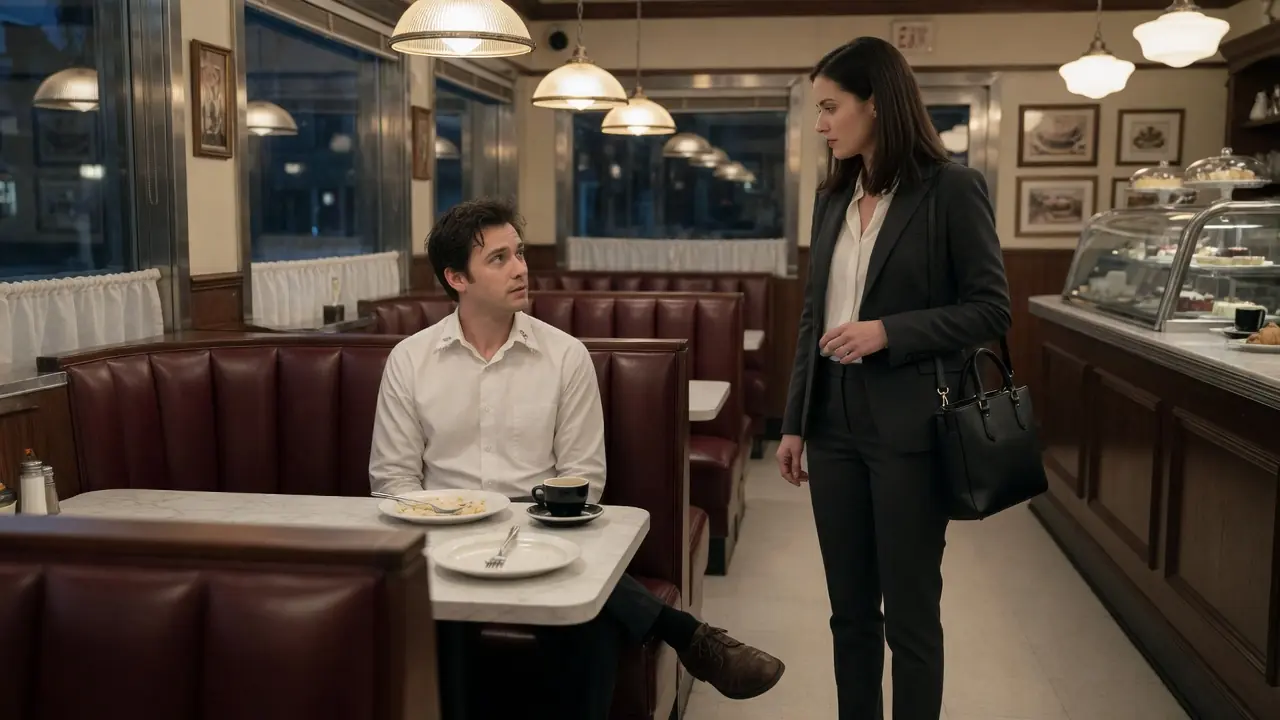
Every Friday evening, at exactly seven o’clock, Wyatt Bennett sat alone in the far corner booth of Maple Street Diner.
He always wore the same white button-down shirt, clean but frayed at the collar. His trousers were dark, pressed as neatly as he could manage, and his worn leather shoes were polished until the cracked tips caught the diner’s amber light.
In front of him, the waitress always placed two plates.
One for Wyatt.
One for the person who never arrived.
Nobody at Maple Street knew the whole story. They only knew that Wyatt came in five minutes early every Friday, chose the booth by the window, ordered two dinners, two glasses of water with lemon, and two cups of black coffee.
The second plate was never touched.
The second cup always cooled.
The second chair stayed empty.
The waitresses whispered about it sometimes behind the counter. The regulars noticed, of course. People in small diners notice everything, especially things that repeat. But no one dared to ask.
Not after Linda, the Friday night waitress, had tried once.
That had been six years ago, during Wyatt’s first year of coming alone. She had approached the table gently, balancing a coffee pot in one hand.
“Are you waiting for someone tonight?” she had asked.
Wyatt looked across the table at the empty chair.
Then he said, quietly, “She’ll be here soon.”
There was no madness in his voice. No anger. No embarrassment. Only a calmness so tender that Linda felt as though she had touched something sacred by mistake.
She never asked again.
Maple Street Diner had stood on the corner since the 1950s. Its red vinyl booths were cracked in places and repaired with silver tape. The ceiling fans moved slowly overhead, as if even they had grown tired after decades of watching people come and go. The old jukebox near the entrance had not played properly in years, but nobody removed it because it belonged there.
The diner smelled of coffee, pie crust, and frying butter. It was not elegant. It was not modern. But on cold evenings, when the windows fogged and the streetlights blurred through the glass, the place felt like a memory that had learned how to stay alive.
Wyatt liked that about it.
His son, Caleb, was seven years old that autumn. He had his father’s dark hair and his mother’s wide brown eyes, the kind that seemed to take in more than a child should understand. Caleb was quiet, but not unhappy. He observed things carefully before speaking.
Every Friday evening, Caleb stayed with Mrs. Pauline, the elderly woman who lived next door. She made him cocoa, let him watch nature documentaries, and never asked questions she already knew were painful.
Caleb had grown up understanding that Friday nights belonged to his father.
He did not know why.
Not completely.
Once, when he was six, he had asked while Wyatt buttoned his coat for school, “Does Mama come to the diner on Fridays?”
Wyatt’s fingers stopped for half a second.
Then he finished the last button, smoothed Caleb’s collar, and said, “We’re going to be late, buddy. Mrs. Pauline made muffins this morning.”
Caleb did not ask again.
But he noticed his father’s eyes stayed wet until they reached the sidewalk.
Outside of Friday evenings, Wyatt lived a practical life. He worked as a handyman for a small repair service, taking whatever jobs came his way. Leaking sinks. Broken fences. Loose porch steps. Faulty outlets. He was careful, quiet, and reliable.
Clients requested him by name because he never rushed and never left a job half done.
He woke before dawn every weekday to make Caleb breakfast. He packed the boy’s lunch in a brown paper bag, folding the top twice and writing Caleb’s name in black marker. He walked him to school, picked him up exactly two minutes before the dismissal bell, helped with homework, cooked dinner, and read aloud every night.
And every Friday, he kept an appointment with an empty chair.
Sophia Clark did not intend to eat at Maple Street Diner the first night she saw him.
She was twenty-six years old and the CEO of a logistics technology company that had doubled its revenue in a single year. She lived by calendars, projections, and decisions made before emotion could complicate them. Her apartment downtown had floor-to-ceiling windows, white furniture, and no clutter. Her meals arrived in labeled containers. Her meetings began on time. Her phone never stopped lighting up.
She was successful because she had removed uncertainty from her life.
Or so she believed.
That Friday, a four-hour board meeting left her with a headache so sharp she felt it behind her left eye. Her driver was unavailable, her assistant had gone home, and the thought of returning to her spotless apartment felt suddenly unbearable.
So she drove without a plan.
When she saw the sign for Maple Street Diner glowing beside the road, she pulled in.
It was not her kind of place. The parking lot was cracked. The neon sign flickered. Inside, the booths looked old enough to remember other people’s grandparents.
But it was warm, ordinary, and alive.
Sophia ordered soup and coffee without reading the menu. She opened her phone, intending to skim an email thread, but something in the corner of her vision made her look up.
The man in the far booth was sitting perfectly still.
Stillness was the first thing she noticed. In a diner full of small movements, forks lifting, cups being refilled, napkins being folded, people leaning forward and laughing, he sat with both hands resting open on the table.
In front of him were two plates.
The second plate had not been touched.
The fork beside it had been aligned carefully with the napkin. The water glass was full. The coffee had stopped steaming.
Sophia watched him for several minutes.
He ate slowly. Once, he glanced at the door. Once, he checked his watch and smiled faintly, not as a man disappointed by lateness, but as a man remembering someone’s habit of being late.
The expression bothered her.
Not because it was strange.
Because it was sincere.
Sophia had built her life around efficiency. Waiting, to her, was waste. Empty chairs were problems to be solved, not rituals to be honored.
Before she could talk herself out of it, she stood and walked to his booth.
“Excuse me,” she said. “Are you expecting someone?”
Wyatt looked up.
His eyes were dark, tired, and calm.
“I’m waiting for a promise,” he said.
Sophia frowned slightly.
“A promise?”
He did not explain.
She looked at the second plate, then back at him.
“Whoever it is, they’re very late.”
Wyatt’s gaze moved to the empty chair.
“Yes,” he said softly. “She always was.”
Something about the answer made Sophia feel suddenly intrusive, but she did not leave.
“People don’t keep promises forever,” she said.
Wyatt looked at her again, not offended, only patient.
“Some promises are not kept because the other person is still there to receive them,” he said. “Some are kept because you need to remember who you are.”
Sophia had no response.
That almost never happened to her.
She returned to her booth, paid for soup she barely touched, and drove home in silence.
The next Friday, she came back.
She told herself it was curiosity. Her mind liked patterns, and Wyatt Bennett had become one. She arrived at 7:15, ordered coffee, and sat where she could see his booth.
He noticed her.
He said nothing.
The ritual repeated exactly.
The third Friday, she arrived earlier. The fourth, she stopped pretending it was an accident.
By then, Sophia had learned his name from Linda. She had also learned that he was a widower, a handyman, and a single father. She learned that the little boy sometimes came in for pie on Saturday afternoons. She learned that Wyatt paid for both meals every week and left a tip generous enough that the staff protected his corner booth without discussion.
What she could not learn from anyone was why he kept doing it.
So she asked him again.
This time, she sat across from him only after he nodded toward the seat.
“Tell me about her,” Sophia said.
Wyatt set down his fork.
For a long moment, he looked at the untouched plate. Then he began.
“Her name was Claire.”
His voice did not tremble. That made the story more painful, not less.
Claire had been twenty-one when they met, twenty-two when they married, twenty-three when Caleb was born. She had been twenty-four when she died on an icy interstate in January, six years before that autumn.
Wyatt had been young, exhausted, and terrified when Caleb was born. Claire had laughed at his fear and told him he would learn.
“You don’t have to be ready,” she had said. “You just have to show up.”
Maple Street Diner had been their place by accident. One Friday night, a power outage closed half the restaurants nearby. They stumbled into Maple Street hungry, cold, and slightly irritated with each other. They ordered meatloaf, coffee, and pie. By the time they left, they had talked for three hours and forgotten what they had been irritated about.
The next Friday, Claire asked if they could go back.
Then it became theirs.
Every Friday, seven o’clock.
No matter how difficult the week had been. No matter how much money they had. No matter whether Caleb had kept them awake the night before. They came to Maple Street, sat in the far booth, and remembered they were more than bills, diapers, repairs, and exhaustion.
They were two people who had chosen each other.
The last Friday before the accident, Claire had sat in that booth and talked about spring. She wanted a small backyard garden. She wanted to paint the kitchen yellow. She wanted to take Caleb to the lake when he was old enough to splash without being afraid.
Then, halfway through her coffee, she reached across the table, placed her hand over Wyatt’s, and said, “Whatever happens, I’ll always meet you here on Fridays.”
She had said it lightly.
Carelessly.
The way people speak when they believe time is endless.
Four days later, she was gone.
After the funeral, Wyatt spent weeks moving through life without understanding how the world had continued. Caleb was four months old. Bills still came. Formula still had to be bought. Laundry still piled up. The baby still cried in the night.
One Friday, after putting Caleb to sleep, Wyatt found himself standing in the kitchen at 6:30 p.m. with no idea what to do with his grief.
Then he remembered Claire’s words.
I’ll always meet you here on Fridays.
“So I came,” Wyatt said.
Sophia looked at him across the table.
“And you kept coming.”
“Yes.”
“You know she isn’t coming back.”
“I know exactly what death means.”
His answer was not defensive. It was almost gentle.
“I’m not waiting for Claire to walk through that door,” he said. “I’m keeping the promise alive where Caleb can see it one day. I want him to grow up knowing that love is not just something you feel when the person is beside you. It is something you honor after it costs you.”
Sophia looked at the empty chair.
For weeks, she had thought Wyatt’s ritual was about refusing to move forward.
Now she understood that it was the opposite.
He was moving forward with care.
That realization followed her home.
It followed her into her office on Monday morning. It sat beside her in meetings. It stood behind her when her assistant, Paula, entered with a file and the cautious expression of someone used to being delayed.
Eight months earlier, Sophia had promised Paula a promotion.
“You’ve earned it,” Sophia had said.
Then the quarter became complicated. Investors wanted restructuring. Senior partners pushed back. There were budget concerns, timing concerns, optics concerns.
Sophia delayed.
Then delayed again.
Paula never complained, but something in her face had changed. Trust had quietly begun leaving the room.
That Monday, Sophia called her in.
“I owe you an apology,” Sophia said.
Paula blinked.
Sophia continued, “I made you a promise, and then I treated it like a flexible option. It wasn’t. Your promotion will be processed this week. The delay was my failure, not yours.”
Paula’s eyes filled, but she held herself together.
“Thank you,” she whispered.
Sophia thought of Wyatt aligning a fork beside an untouched plate.
Small acts mattered.
Repeated acts mattered more.
That Sunday, Sophia called her mother for the first time in months.
Her mother answered on the second ring.
“Sophia?”
The surprise in her voice hurt.
“I’m sorry,” Sophia said.
“For what?”
“For promising Sunday calls and then acting like promises expire when work gets busy.”
Her mother was quiet.
Then she said, “I’ve missed you.”
Sophia closed her eyes.
“I know. I’m calling now.”
The shift in her life did not happen dramatically. It happened through corrections. One kept call. One fulfilled promise. One honest apology. One decision not to treat human beings like calendar items that could be moved indefinitely.
And every Friday, she returned to Maple Street.
Eventually, she stopped sitting nearby and sat with Wyatt.
Not in Claire’s place at first. Wyatt was not ready, and Sophia respected that. She sat beside the aisle, in the adjacent booth, close enough to talk but far enough not to intrude.
One Friday in December, Wyatt did not come.
Sophia noticed at 7:05.
By 7:20, Linda was glancing toward the door.
At 7:30, Sophia called him. He did not answer.
She drove to his apartment.
Wyatt opened the door with Caleb coughing behind him on the couch. The boy’s cheeks were flushed, his eyes glassy, his toy red pickup clutched in one hand.
“He has a fever,” Wyatt said.
“How high?”
“101.8. I’m watching it.”
Sophia stepped inside.
“It’s Friday.”
“I know.”
“You were still thinking of going.”
Wyatt said nothing.
Sophia looked at him, shocked.
“Your son is sick.”
“I would be gone one hour. Mrs. Pauline can sit with him.”
“Wyatt.”
His jaw tightened.
“It matters.”
“So does he.”
The words hit the room hard.
Wyatt turned toward Caleb, then back to Sophia. For the first time since she had known him, his calm seemed to crack under the pressure of two loves colliding.
“I made a promise,” he said.
“And Claire made you a father,” Sophia replied softly. “What do you think she would ask you to keep tonight?”
Wyatt’s eyes changed.
He looked at the boy on the couch. Caleb coughed again and stirred under the blanket.
Something in Wyatt’s face shifted, not because he had been defeated, but because he had heard the truth spoken clearly enough to recognize it.
He sat beside Caleb and placed a hand on his forehead.
“I’m here, buddy,” he whispered.
Caleb opened his eyes halfway.
“Diner?” he murmured.
Wyatt swallowed.
“Not tonight.”
Caleb blinked sleepily.
“Mama won’t be mad.”
The room went completely still.
Wyatt bowed his head.
Sophia turned away to give him privacy.
That night, Wyatt did not go to Maple Street.
The world did not collapse.
The promise did not vanish.
Instead, it changed shape.
The following Friday, Wyatt brought Caleb with him.
Sophia arrived at 6:45 and found Linda already setting the corner booth. This time, there were three plates and one small bowl of applesauce for Caleb.
Wyatt stood beside the booth for a moment, looking at the empty chair.
Then he looked at Sophia.
“You can sit there,” he said.
Sophia’s breath caught.
“I don’t want to replace anyone.”
“You won’t.”
Caleb climbed into the booth first, his red toy truck placed carefully beside his napkin.
Sophia sat slowly across from Wyatt, in the chair that had held absence for six years.
For a moment, nobody spoke.
Then Caleb looked at the untouched fourth setting Linda had quietly placed at the edge of the table.
“Is that for Mama?”
Wyatt nodded.
“Yes.”
Caleb studied it.
Then he said, “Can we tell her about my spelling test?”
Wyatt’s hand moved to his son’s hair.
“Yes, buddy. We can.”
So they did.
Caleb told the empty place setting that he got nine out of ten words correct, and that the word “because” was unfair because it sounded like it should have a z in it. Sophia laughed before she could stop herself. Wyatt smiled.
Not the faint, private smile he gave his watch.
A real one.
Spring came.
Then summer.
Wyatt continued working as a handyman, but Sophia eventually learned he had once been more than that. She discovered it by accident when Caleb asked her to reach a board game from the hallway closet and a folder slipped from the shelf.
Inside were engineering diagrams.
Not hobby sketches.
Professional work.
Sophia recognized the company name on one of the documents. A major infrastructure consultancy. Wyatt had been a structural systems engineer before Claire died.
“You never told me,” she said later.
Wyatt put the folder away.
“It stopped mattering.”
“Did it?”
He looked toward Caleb’s room.
“I had a baby. The job required travel two weeks a month. Claire was gone. There was nobody else.”
“So you gave it up.”
“I stepped back. Then time passed.”
A month later, Sophia’s company faced a serious infrastructure problem in one of its warehouse automation systems. Consultants offered expensive answers that did not satisfy her. Everyone seemed to be treating symptoms, not causes.
Sophia thought of Wyatt’s diagrams.
She went to his apartment that Thursday evening and laid out the issue at his kitchen table.
“I want you to consult,” she said.
Wyatt listened without interrupting.
When she finished, he said, “I won’t work Fridays.”
“I know.”
“I won’t miss Caleb’s school pickup.”
“I know.”
“I won’t travel overnight.”
“I know.”
He studied her.
“That’s not how your world works.”
Sophia smiled faintly.
“Maybe my world needs better rules.”
He accepted.
On his terms.
For the next nine months, Wyatt worked four days a week with Sophia’s company. He diagnosed the system failure with quiet precision, redesigned a major process, saved the company millions, and refused every offer that required sacrificing his evenings with Caleb or his Fridays at Maple Street.
Sophia watched senior executives adjust to him.
They were not used to a man who knew his value but did not worship opportunity.
One executive tried to pressure him into a Friday emergency meeting.
Wyatt simply said, “No.”
The man laughed.
Sophia did not.
“Friday is unavailable,” she said.
The meeting moved.
That was how Sophia learned that leadership was not always about demanding more from people. Sometimes it was about protecting what made them whole enough to give their best.
One year after Sophia first walked into Maple Street Diner, the Friday before Thanksgiving arrived cold and bright.
The diner was full. Paper leaves were taped to the windows. Pumpkin pie cooled under glass domes near the counter. The old jukebox, repaired by Wyatt and Caleb over two Saturday afternoons, played softly for the first time in years.
Wyatt arrived at 6:55.
Caleb held one hand.
Sophia was already in the corner booth, her coat folded beside her, her coffee untouched.
Linda brought four plates.
One for Wyatt.
One for Sophia.
One for Caleb.
And one for Claire.
The fourth plate still mattered. But it no longer made the table feel empty.
Caleb ate green beans one at a time, lining them on his fork like tiny logs. Sophia told him about bridges and weight distribution because he had recently become obsessed with how things stayed standing. Wyatt listened, smiling.
Halfway through dinner, Caleb placed his battered red toy truck beside Claire’s plate.
“For Mama,” he said.
Wyatt looked at the toy.
Then at his son.
Caleb continued, “Because she’s here, right? Not like sitting here sitting here. But here.”
He touched his chest.
Sophia looked down, suddenly unable to speak.
Wyatt covered Caleb’s small hand with his own.
“Yes,” he said quietly. “Exactly like that.”
The diner carried on around them. Coffee poured. Plates clinked. Someone laughed near the counter. The repaired jukebox hummed gently through an old love song no one could quite name.
And in the far corner booth, a promise kept breathing.
Not because nothing had changed.
Because everything had.
Wyatt had once thought keeping his promise meant sitting alone with grief. Then he learned that promises, like love, sometimes grow larger when shared. Claire had not asked him to stop living. She had asked him to remember what mattered.
He had.
He had remembered through loneliness.
Through fatherhood.
Through empty chairs and cooling coffee.
Through the ache of showing up when no one else understood why.
And because he kept showing up, Caleb learned that a person’s word has weight. Sophia learned that efficiency without integrity is just polished emptiness. Maple Street learned that a booth could become sacred not because of who was missing, but because of what remained.
Years later, when Caleb was old enough to understand more fully, he would remember his father sitting at that table every Friday.
He would remember the untouched plate.
He would remember Sophia’s voice, Linda’s coffee, the red toy truck, and the way his father never spoke of promises as burdens.
He would carry that lesson into the man he became.
Sophia carried it, too.
She called her mother every Sunday.
She kept her promises at work.
She stopped treating commitment like something that could be postponed until life became convenient.
And Wyatt, who had once been known only as the quiet man with two plates, became known for something else.
Not grief.
Not waiting.
Devotion.
Because a promise is not a transaction. It does not expire when the other person is no longer present to collect it. A promise is a mirror. It shows you who you are when nobody is watching and nobody can reward you for keeping it.
Wyatt Bennett understood that before anyone else did.
Every Friday evening, at exactly seven o’clock, he still came to Maple Street Diner.
But he no longer sat alone.
Caleb sat beside him.
Sophia sat across from him.
And at the edge of the table, a fourth plate waited quietly under the amber diner light, untouched and honored.
Not as a sign that Wyatt had failed to move on.
But as proof that love, when carried with grace, does not trap the living.
It teaches them how to live.