On a freezing Christmas Eve in Manhattan, billionaire James Carter was walking through the crowded street with his four-year-old son when Liam suddenly pulled his arm.
Just a few steps away, a young homeless woman sat curled on a frozen bench, holding a four-year-old boy whose face was turning pale from the cold.
James tried to keep moving.
But Liam gripped his hand and whispered, “Dad, the boy’s freezing.”
That single whisper made James turn back.
He walked toward the bench, knelt in the snow, and wrapped his son’s red scarf around the little boy to keep him warm, never sensing that this simple gesture would tie their lives together forever.
The cold hit differently on Christmas Eve in New York City.
Not the kind of cold you complained about.
The kind that got into your bones and stayed there.
James Carter pulled his coat tighter and glanced down at his son.
Liam’s small hand gripped his with the fierce determination only four-year-olds possessed, like he was afraid his father might disappear if he let go.
“Dad, look at all the lights.”
Liam’s breath came out in little puffs of fog as he pointed at the storefront displays.
James forced a smile.
“Yeah, buddy. Pretty amazing, right?”
But James was not really looking at the lights.
His phone buzzed for the third time in five minutes.
Marcus from the office again.
James declined the call without reading the message.
Not tonight.
Tonight was supposed to be about Liam.
Tonight was supposed to be about trying to feel something other than the hollow ache that had lived in his chest for two years.
Two years since Sarah died.
Two years since James had held her hand in that hospital room and watched the life drain from her eyes.
She had made him promise something in those final moments, and the memory hit him now like a physical weight.
“Take care of our boy,” she had whispered. “Teach him to be kind. Teach him to see people, really see them.”
He had promised.
Of course, he had promised.
But lately, James wondered if he was keeping that promise or just going through the motions.
They walked past a Starbucks where a barista was handing out candy canes to children.
Past a couple arguing about which subway line to take.
Past a street performer playing a half-frozen saxophone.
The city buzzed with that manic pre-Christmas energy.
Everyone rushing somewhere.
Everyone seeing no one.
Then Liam stopped.
He stopped dead in the middle of the sidewalk, nearly yanking James’s arm out of its socket.
“Liam, come on. We need to…”
“Dad.”
Liam’s voice came out quiet, serious in a way that made James’s stomach tighten.
“Dad, look.”
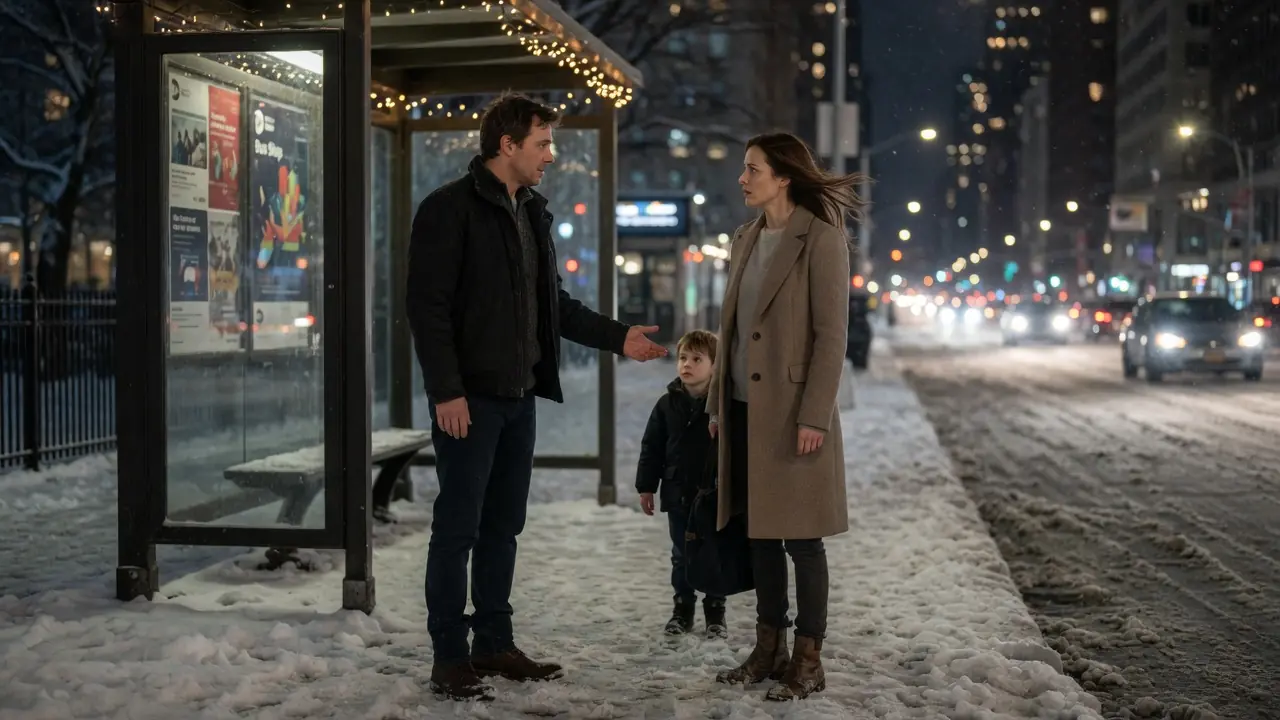
James followed his son’s gaze to the bus stop shelter across the street.
At first, he almost did not see them.
His brain tried to categorize what he was looking at as just another piece of the city’s background noise.
Something you walked past.
Something that was not your problem.
But Liam saw them.
Really saw them.
A young woman sat hunched on the stone bench.
Her thin coat did absolutely nothing against the wind that whipped down the avenue.
She could not have been more than twenty-five.
Dark circles sat under her eyes, the kind that spoke of too many sleepless nights and too much fear.
In her arms, wrapped in a blanket that looked more like an old beach towel, was a small boy.
He looked about four years old, maybe the same age as Liam.
His cheeks were pale.
His lips trembled.
His little body shook in short, exhausted shivers, but he was not crying.
That was what made James’s chest constrict.
The boy was too quiet.
Too still.
Too tired to even complain.
“She needs help,” Liam said.
It was not a question.
It was a simple statement of fact.
James felt his jaw tighten.
He knew this situation.
Every New Yorker knew this situation.
You walked past because you could not help everyone.
Because getting involved meant complications.
Because the city had shelters and programs.
Because it was complicated.
Because you were too busy.
Too important.
Too scared.
His phone buzzed again.
He ignored it.
“Liam, listen,” James started.
He was already forming the explanation in his head.
The one about how they could not help everyone.
The one about how the city had systems.
The one about how some problems were bigger than one person.
But Liam was not listening.
His son was staring at the little boy with an intensity that made something crack in James’s carefully built wall.
“Dad,” Liam whispered, his voice trembling. “He’s cold. Really cold.”
And just like that, James was back in the hospital room.
Sarah’s hand in his.
Getting colder and colder no matter how tightly he held on.
The way her fingers had gone from warm to cool to cold.
The way he had kept holding them anyway, as if his warmth could somehow bring her back.
Teach him to be kind.
Sarah’s voice echoed in his memory.
Teach him to see people.
James looked at his son.
Then he looked back at the woman and the small boy.
The woman’s eyes were closed.
Her head tilted back against the glass of the bus shelter.
She looked exhausted in a way that went beyond physical tiredness.
The kind of exhaustion that came from fighting a battle you knew you could not win.
The little boy gave a tiny cough, barely audible over the traffic.
That sound did it.
James felt something shift in his chest, like a door he had been holding closed suddenly swung open.
He reached up and unwound the red scarf from around Liam’s neck.
“Hey,” James said quietly, meeting his son’s eyes. “We’re going to need this back. But first, we’re going to let someone else borrow it. Okay?”
Liam nodded.
His face was serious and solemn in a way that made him look much older than four.
James took a breath and stepped off the curb.
The walk across the street felt longer than it should have.
Each step was a decision.
A commitment.
As they approached the bench, James saw the woman more clearly.
Her clothes were worn but as clean as they could be under the circumstances.
Her shoes had holes in them.
The blanket around the boy was thin and threadbare.
James knelt beside the bench, moving slowly so he would not startle her.
Up close, he could see the boy’s lips had a bluish tint.
His eyes were half open, unfocused, and heavy with exhaustion.
His tiny hands were tucked under his arms, trying to find warmth that was not there.
“Excuse me,” James said softly.
The woman’s eyes snapped open.
In that instant, James saw pure terror flash across her face.
Her arms tightened around the boy.
Her whole body tensed like she was preparing to run or fight.
“It’s okay,” James said quickly, holding up his hands. “I’m not going to hurt you. We’re not going to hurt you.”
The woman stared at him, breathing fast and shallow.
Her eyes darted from James to Liam and back again, calculating the threat.
“My son noticed you were cold,” James continued, keeping his voice calm. “We thought maybe…”
He held up the red scarf.
For a long moment, nobody moved.
The woman’s eyes fixed on the scarf.
Then on Liam, who stood slightly behind his father, watching with worried eyes.
“I don’t want your charity,” the woman said.
Her voice surprised James.
It was stronger than he expected.
There was an edge to it.
Pride, not yet broken.
“We’re fine.”
“I can see that,” James lied smoothly.
Then he said, “But it’s Christmas Eve, and my son would really feel better if your little boy had this. Would that be okay?”
It was a risk, putting it on Liam.
But something told James that appealing to her as a mother might work where pity would not.
The woman looked at Liam again.
Really looked at him.
Then her gaze dropped to the boy in her arms, and James saw her face change.
He saw the exact moment her pride lost the battle against her fear.
The boy’s lips were definitely blue now.
His shaking had slowed.
That was worse.
Much worse.
“Okay,” she whispered.
The word seemed to cost her everything.
James moved slowly, showing every motion before he made it.
His fingers brushed against the child’s cheek, and his heart clenched.
The boy was ice cold.
“How long have you been out here?” James asked, trying to keep the urgency out of his voice.
“That’s none of your business.”
The defiance was still there, but it was weakening.
She looked down at the boy, and James saw her eyes fill with tears she refused to let fall.
“You’re right,” James said. “It’s not. But here’s what is my business. That child needs to be somewhere warm now. Not in an hour. Not after we debate about it. Now.”
“I don’t have anywhere.”
“I know a place.”
James stood and held out his hand.
“Will you let me help you, please?”
The woman stared at his outstretched hand like it was a trap.
Like accepting it would cost her something she could not afford to lose.
“My name’s James,” he said quietly. “This is Liam. What’s yours?”
She hesitated.
“Clare.”
“And your son?”
“Noah.”
“Nice to meet you, Clare.”
James kept his hand extended, steady and patient.
“Now, will you please let us help you and Noah get somewhere warm?”
He watched the struggle play across her face.
Pride against love.
Independence against survival.
The need to protect her dignity warring with the need to protect her child.
Noah coughed again.
Barely a sound.
That decided it.
Clare’s cold, trembling hand reached up and grasped his.
The heated seats in James’s Range Rover kicked in almost immediately.
James watched in the rearview mirror as Clare’s shoulders began to shake.
Not from cold.
She was crying silently.
Her face turned toward the window so Noah would not see.
Liam sat in his car seat next to Noah, stealing glances at the boy wrapped in his red scarf.
The two boys were the same age, but they looked like they had come from different worlds.
Liam’s cheeks were pink from the cold.
His coat was thick.
His boots were dry.
Noah sat bundled in a threadbare blanket, his dark hair damp against his forehead, his small fingers curled weakly in his lap.
Liam watched him for a long time.
Then he whispered, “Hi. I’m Liam.”
Noah looked at him slowly.
His lips moved, but no sound came out at first.
Then he whispered back, “Noah.”
Liam nodded seriously.
“You can keep my scarf until you’re warm.”
Noah looked down at the scarf like it was treasure.
“Thanks.”
James gripped the steering wheel tighter.
Those two tiny voices in the back seat nearly undid him.
“Where are we going?” Clare asked.
“Somewhere safe,” James said, navigating through Christmas Eve traffic. “Somewhere warm.”
“A shelter?”
There was resignation in her voice.
Like she had been to plenty of those and knew exactly what to expect.
“Not exactly.”
James pulled out his phone and dialed.
It rang twice before Margaret Hill’s crisp voice answered.
“Mr. Carter, Merry Christmas Eve.”
“Margaret, I need the Aspen Suite prepared. Full amenities. And get a second child’s bed set up. We have a boy, about four years old.”
There was a pause.
Margaret Hill had been with the Carter family for thirty years.
She had worked for James’s father before James took over the company.
Very little surprised her anymore.
“How soon will you be arriving?”
“Twenty minutes.”
“Consider it done.”
No questions.
No judgment.
That was Margaret.
James ended the call and caught Clare’s eyes in the mirror.
“We’re going to a hotel I own. The Archer on Fifth Avenue. You and Noah are going to stay in one of the suites.”
“I can’t afford…”
“I’m not asking you to pay.”
Clare’s jaw tightened.
“I don’t need your pity.”
“Good, because I’m not offering pity.”
James took a breath, choosing his words carefully.
“Look, Clare, I don’t know your situation, and you don’t have to tell me. But I do know your son is in danger right now. Not maybe. Not possibly. Right now. His lips are blue. He’s barely talking. Do you know what that means?”
Clare’s arms tightened around Noah.
Her eyes widened with fear.
“It means his body is shutting down,” James said gently. “It means he’s trying to conserve energy. That is not something you fix by toughing it out on a bench for another night.”
“So what do you want from me?” Clare asked, her voice cracking. “What is this going to cost me?”
The question hit James harder than it should have.
What kind of world had taught this woman that help always came with a price?
“Nothing,” he said firmly. “It will cost you nothing. You’re going to stay in that suite for as long as you need. You’re going to get warm. Noah is going to get warm. Tomorrow, if you want to leave, you can leave. No strings. No debt. No obligation.”
“People don’t do that.”
“I just did.”
They drove in silence for several minutes.
James could feel Clare’s eyes on the back of his head.
Still calculating.
Still waiting for the catch.
“Why?” she finally asked.
James glanced at Liam, who was drawing patterns on the fogged window with his finger.
“Because my son saw you,” James said. “Really saw you.”
He paused.
“And maybe we all need to be seen sometimes.”
The Archer rose before them, all glass, steel, and warm lights spilling onto Fifth Avenue.
The doorman straightened as James pulled up to the curb.
“Mr. Carter, welcome back.”
Roberts opened the door with practiced efficiency.
Then he saw Clare and Noah.
To his credit, his professional smile did not falter.
“Good evening, miss. Welcome to the Archer.”
Clare climbed out of the car like she was stepping onto foreign soil.
Her eyes moved across the marble entrance, the crisp uniforms, the warm light flooding from the lobby.
Her throat worked as she swallowed hard.
“I can’t go in there,” she whispered. “Look at us.”
James came around the car and stood beside her.
“You look like someone who needs help. That is all anyone in there is going to see, because that is all I am going to let them see.”
He held out his hand again.
Steady.
Patient.
Waiting.
This time, Clare took it faster.
The lobby of the Archer was everything James had designed it to be.
Elegant without being cold.
Luxurious without being intimidating.
At least that was what the architecture magazines had said.
But watching Clare walk through those doors with Noah clinging to her hand, James wondered if any amount of good design could bridge the gap between her world and this one.
Noah stared up at the chandelier with wide eyes.
“Mommy,” he whispered. “Are we allowed here?”
Clare’s face broke.
James knelt in front of him.
“Yes, buddy,” he said gently. “You are allowed here.”
The boy stared at him like nobody had ever told him he was allowed anywhere.
David Chen, the concierge, looked up from his desk with a professional smile that warmed when he saw Liam.
“Mr. Carter. Young Mr. Carter. Out late tonight, I see.”
“David, this is Clare and Noah. They’re going to be staying with us for a while. The Aspen Suite. Is Margaret getting it ready?”
“Already done, sir. I’ll have someone bring up extra blankets.”
David’s eyes flicked to Noah, and his expression softened almost imperceptibly.
“I’ll make sure the suite temperature is set properly. May I offer to have hot chocolate arranged, and perhaps soup?”
“That would be perfect. Thank you.”
As they walked toward the elevators, Clare leaned closer to James.
“They’re staring.”
“They’re not,” James said.
He knew some of the guests were casting curious glances.
“And even if they were, so what? You’re a guest here. You have just as much right to be here as anyone else.”
The elevator doors closed, sealing them in reflective gold-paneled silence.
Clare’s reflection stared back at her from every angle.
Hollow-eyed.
Thin.
Holding the hand of a freezing four-year-old boy wrapped in an old beach towel and a little boy’s red scarf.
“I don’t belong here,” she said quietly.
“Neither did I once,” James replied.
Clare looked at him.
James continued, “My father built this hotel from nothing. Started as a carpenter, worked his way up to contractor, then developer. When I was Liam’s age, we lived in a one-bedroom apartment in Queens. My mother worked three jobs. I used to fall asleep to the sound of her crying at the kitchen table, trying to figure out how to pay the electric bill.”
Clare looked at him for the first time.
Really looked at him.
“You’re lying.”
“I’m not.”
James looked down at Liam, who was barely staying awake.
“My father used to tell me that money doesn’t change who you are. It reveals who you have always been. The question is whether you use it to build walls or bridges.”
He looked back at Clare.
“I’m trying to teach my son to build bridges.”
The elevator chimed softly as they reached the top floor.
The Aspen Suite was, to put it simply, too much.
James saw it through Clare’s eyes as the doors opened.
The sprawling living room with floor-to-ceiling windows overlooking the city.
The fireplace already crackling.
A small bed set up near the bedroom door with fresh blankets and a stuffed gray elephant resting on the pillow.
A child-sized table with crayons, coloring books, pajamas, socks, and a stack of picture books.
Clare stopped in the doorway like she had hit an invisible wall.
“I can’t,” she breathed. “This is too much.”
Then Noah coughed.
A dry, tired cough that made his whole little body curl inward.
Clare’s paralysis broke.
“Noah first,” she whispered.
James nodded.
“The bedroom is through there. The bathroom is attached. There’s a tub if you want to warm him up slowly. Margaret stocked it with everything you might need.”
Clare moved like a sleepwalker, drawn by her son’s needs more than any conscious decision.
She sat Noah on the edge of the bed and started unwrapping him from the towel and scarf.
In the warm light of the suite, James could see how bad it really was.
The boy’s skin was pale and mottled.
His eyes were heavy.
His hands were stiff from cold.
“He needs a doctor,” James said.
“No.”
Clare’s response was immediate and sharp.
“No hospitals.”
“Clare…”
“I said no.”
She pulled Noah close, as if James might take him.
“They’ll take him. They’ll say I’m unfit, and they’ll take him away from me.”
James held up his hands.
“Okay. No hospital for now. But let’s get him warm. Let’s get food in him. Then we can talk about what comes next.”
He watched the tension in her shoulders.
The way she was ready to run despite having nowhere to go.
“I lost someone too,” he said quietly.
Clare’s eyes snapped to his.
“My wife, Sarah. Two years ago.”
James swallowed hard.
“She died giving birth to our second child. Complications. They tried everything. Our daughter didn’t make it either. We were going to name her Emma.”
“I’m sorry,” Clare whispered.
He could tell she meant it.
“Me too,” James said. “Every single day.”
He moved toward the door.
“But Sarah made me promise something before she died. She made me promise to teach Liam to be kind. To see people. To help when he could.”
He paused with his hand on the doorknob.
“Tonight my son saw you. And if I walked away, if I let him learn that seeing someone’s pain means nothing unless it is convenient, then I would be breaking my promise to her.”
“So this is for her? For your son?”
“No,” James said honestly. “This is for you and Noah. Because you both deserve to be warm and safe and fed, regardless of how you ended up on that bench.”
He opened the door.
“Margaret will check on you in the morning. Room service menu is on the desk. Order whatever you want, whenever you want it. The phone is programmed. Hit zero if you need anything.”
“James.”
He turned back.
Clare stood in the doorway, Noah clinging to her side with the red scarf still around his shoulders.
In the warm light of the suite, with her defenses finally crumbling, she looked impossibly young and unbearably tired.
“Why did you have a child’s bed ready so fast?”
The question hit him hard.
James looked at Liam, who was half asleep on his feet.
Then he looked back at Clare.
“This was supposed to be Sarah’s suite,” he said. “After Emma was born, this was where we were going to stay for a few weeks. Close to the hospital, close to my office. We had ordered everything for a baby then. Margaret kept some things in storage. Tonight, she adjusted the room for Noah.”
Understanding dawned in Clare’s eyes.
Then pain.
“Get some rest,” James said softly. “Tomorrow will be better.”
He took Liam’s hand and headed for the elevator.
Behind him, Clare stood silhouetted in the doorway of a room that was supposed to hold all of James’s hopes.
Now it held someone else’s desperate need.
In the elevator, Liam leaned against his father’s leg.
“Dad?”
“Yeah, buddy?”
“Did we do good?”
James thought about Sarah’s cold hand in his.
About promises made and kept.
About his son’s eyes seeing what so many adults had trained themselves to ignore.
“Yeah,” he said, his voice rough. “We did real good.”
Clare stood in the doorway long after James and Liam disappeared into the elevator.
The click of the closing doors echoed down the hallway.
Suddenly, she was alone in a silence so complete it felt like pressure against her eardrums.
Noah coughed beside her.
Clare jolted back to awareness.
“Okay, baby,” she whispered, kneeling before him. “We’re okay now.”
But her hands were shaking as she helped him out of his wet shoes.
His socks were soaked.
His toes were red and cold.
She rubbed them gently between her palms.
Noah whimpered, not loudly, just enough to tell her it hurt.
“I know, sweetheart,” she whispered. “I know. I’m sorry.”
The bathroom stopped her cold.
It was bigger than the last three places they had slept combined.
Marble everywhere.
Heated floors.
A shower that looked like something from a magazine.
The tub was huge, already filling with steaming water because apparently this place had preset temperatures or some other rich-people magic she did not understand.
Clare caught sight of herself in the mirror and flinched.
The woman staring back at her was a stranger.
Hollow-eyed.
Gaunt.
Her hair hung in matted clumps.
A bruise sat on her cheekbone from where a security guard had shoved her three nights ago when she tried to sleep in a subway station.
She looked exactly like what she was.
A woman who had given up on everything except keeping her son alive.
The sob came out of nowhere.
It surprised her with its violence.
Clare clamped a hand over her mouth and stumbled back from her reflection.
She could not break down.
Not now.
Not when Noah needed her.
But the warmth of the room, the safety of locked doors, and the simple fact that nobody was telling her to move along hit her all at once.
She sank to the bathroom floor with her back against the tub and let herself cry for exactly one minute.
She counted the seconds in her head.
Sixty seconds to fall apart.
Then she had to pull herself together.
At fifty-eight, she forced herself to breathe.
At sixty, she stood.
Noah first.
Always Noah first.
She brought him into the bathroom and slowly helped him into the warm bath.
Not hot.
Warm.
Careful.
His little shoulders relaxed almost instantly.
“Mommy,” Noah whispered, his voice hoarse. “This water is nice.”
Clare covered her mouth again.
“I know, baby.”
“Can we stay here?”
The question broke her.
She crouched beside the tub and brushed wet hair from his forehead.
“Just tonight,” she said, because it was the only promise she could safely make.
Noah looked disappointed but too tired to argue.
After the bath, she dried him with towels so soft they felt unreal.
She dressed him in the warm pajamas Margaret had left on the bed.
Blue flannel with little stars on them.
Noah touched the sleeve in wonder.
“Are these mine?”
“For tonight,” Clare said.
“No, honey. They’re yours.”
She said it before fear could stop her.
Noah smiled.
A tiny smile.
The first real smile she had seen from him in days.
Room service arrived with soup, grilled cheese, hot chocolate, and apple slices.
Noah ate slowly at first.
Then faster.
Clare watched every bite like it was a miracle.
He drank half the hot chocolate, got whipped cream on his nose, and laughed when Clare wiped it away.
That laugh nearly dropped her to her knees.
After dinner, Noah climbed into the small bed and pulled the red scarf close to his chest.
“Can I keep it?” he asked sleepily.
“It belongs to Liam,” Clare said.
“He said I can keep it until I’m warm.”
“You’re warm now.”
Noah’s eyes fluttered closed.
“Maybe tomorrow too.”
Clare sat beside him until he fell asleep.
Then she went back to the bathroom and finally showered.
She had not had a real shower in two weeks.
The last one had been at a shelter in Brooklyn, the water running cold after three minutes while five other women waited outside the stall and banged on the door.
The shower spray hit her like absolution.
Clare stood under the hot water and felt it strip away days of grime, cold, and fear.
It ran brown and gray at her feet, circling the drain, taking pieces of the nightmare with it.
She shampooed her hair three times.
She used conditioner even though it felt wasteful.
She scrubbed her skin until it was pink and tender and clean.
Then, because the tub was still full and inviting after Noah’s bath, she drained it, refilled it, and stepped inside.
The heat was almost painful at first.
Her body was so used to cold that it did not know how to process warmth.
But she sank in anyway, submerging herself up to her chin, and felt her muscles finally begin to loosen.
That was when the memories hit.
She had been good once.
Actually good at something.
Rhode Island School of Design.
A full scholarship.
Professors telling her she had a real eye for color and composition.
Her father had called it frivolous.
He said art was not a real career.
But her mother had secretly slipped her money for supplies.
Then she met Derek.
Derek with his easy smile and beautiful promises.
He had seemed different from her cold, judgmental family.
Free.
Creative.
He understood her in a way nobody else did.
Until she got pregnant.
Then he vanished so quickly it was like he had never existed.
Blocked her on everything.
His friends said they had never heard of her.
Three years together, and he erased her like chalk from a sidewalk.
Her family had been worse.
“You’ve brought shame on this house,” her father had said, standing in the doorway of her childhood home, physically blocking her from entering.
“Dad, please.”
“Don’t call me that. Not anymore. You made your choice. Now live with it.”
The door had closed in her face.
Nineteen years of being their daughter, gone because she had made one mistake.
The shelter system became a maze she could not navigate.
Too many forms.
Too many requirements she could not meet.
No permanent address.
No job history stable enough to satisfy anyone.
No family support.
The maternity home had helped for a while after Noah was born, but help always had an expiration date.
After that, it was just her and Noah, surviving wherever they could find a corner that security guards had not claimed yet.
Clare slid lower in the water until her ears submerged and the world went muffled.
She could hear her heartbeat.
She could hear the water lapping against the sides of the tub.
For one moment, she let herself imagine this was real.
A warm bed.
Clean sheets.
Noah safe and fed.
A life where they woke up without fear.
But that fantasy was dangerous.
This was not her life.
This was borrowed.
Tomorrow, or the next day, or whenever James Carter decided he had done his good deed for the year, she would be back on that bench.
And it would be harder because she would know what she was missing.
When the water cooled, she climbed out.
She dried herself with towels so soft they felt like clouds.
She wrapped herself in the plush robe hanging on the door and padded back into the bedroom.
Noah was still sleeping peacefully in the child’s bed.
Clare stood over him and watched the rise and fall of his small chest.
She loved him so much it hurt.
This perfect, innocent little boy had done nothing to deserve the life she could give him.
He deserved stability.
Safety.
A future.
Everything she could not provide.
The thought crept in before she could stop it.
Maybe he would be better off with someone else.
She shoved it away violently.
No.
Nobody would love him like she did.
Nobody would fight for him like she would.
They just had to make it through tonight.
Then tomorrow.
Then the day after that.
One day at a time.
Clare climbed into the massive bed.
The sheets were crisp and clean.
The pillows were perfect.
The blanket was warm without being heavy.
She tried to stay awake.
To keep watch.
To maintain the vigilance that had kept them alive for months.
But her body had other ideas.
Two months of sleeping with one eye open caught up to her all at once.
The last thing she remembered before sleep dragged her under was Noah’s peaceful breathing and the distant sound of the city below, muffled by glass and warmth and walls that kept the world outside.
For one night, Clare Miller let herself feel safe.
She woke to sunlight streaming through floor-to-ceiling windows and the sound of Noah whispering to himself.
For three full seconds, she did not remember where she was.
Then it rushed back.
The bench.
James.
The hotel.
The impossible kindness of strangers.
She bolted upright.
What time was it?
Had they overstayed?
Was someone coming to kick them out?
Her clothes from yesterday sat in a neat pile on a chair by the window.
Someone had been in the room while she slept.
The realization made her stomach twist.
She had been so exhausted she had not heard anyone enter.
She had not protected Noah.
Noah.
She turned quickly.
He was sitting up in the small bed, holding the gray stuffed elephant Margaret had left on the pillow.
His face was pink and healthy.
When he saw her, his mouth curved into a sleepy smile.
“Mommy, the elephant stayed.”
Clare let out a breath she had not realized she was holding.
“Yeah, baby. He stayed.”
“Can we stay too?”
Her chest tightened.
Before she could answer, a knock sounded at the door.
“Miss Miller,” a crisp female voice called. “My name is Margaret Hill. May I come in?”
Clare tightened the robe around herself.
“Just a minute.”
She checked Noah, smoothed his hair, and opened the door.
Margaret Hill stood in the hallway with the kind of posture that suggested she had never slouched a day in her life.
She was in her sixties, dressed in a perfectly tailored navy suit, her silver hair pulled into an elegant bun.
Everything about her suggested old money, high standards, and zero tolerance for nonsense.
Her eyes swept over Clare in one efficient glance.
The oversized robe.
The defensive posture.
The child watching from the bed.
“Good morning,” Margaret said. “Mr. Carter asked me to check on you. May I come in?”
It was not really a question.
Clare stepped back.
Behind Margaret, a small figure darted forward.
Liam.
He held a wrapped package and wore the biggest smile.
“I brought something for Noah,” he announced.
“Liam,” Margaret said in a tone of patient suffering. “We discussed boundaries.”
“But I wanted to see if he was okay.”
Liam looked past Clare with earnest eyes.
“Is he better? He looked really cold yesterday.”
Clare felt her walls crack slightly.
“He’s much better. Thank you for asking.”
“I brought him a present.”
Liam held up the wrapped box.
“It’s another scarf. Not red because red is my favorite, but it’s blue, and blue is also good. And I brought cars because I thought maybe he likes cars.”
“Liam Carter,” Margaret said firmly. “Miss Miller may not be ready for visitors.”
“It’s fine,” Clare heard herself say.
Margaret’s eyebrow rose slightly, but she nodded.
“Very well. Liam, you may say hello while I speak with Miss Miller about the arrangements.”
“Arrangements?” Clare asked.
The word sent her anxiety spiking.
Margaret moved to the sitting area and sat down with perfect grace.
“Mr. Carter has informed me that this suite is yours for the week. The room charges will be handled directly by him. There is no need for you to concern yourself with billing.”
“A week?”
Clare’s voice came out strangled.
“I can’t. That’s too much. I just needed one night to get Noah warm. We’ll leave this afternoon.”
“And go where exactly?”
The blunt question hung in the air.
“That’s none of your business,” Clare said, trying to summon what little dignity she still had.
“You are quite right. It isn’t.”
Margaret folded her hands in her lap.
“However, it is my business to ensure Mr. Carter’s generosity is not misplaced. So I am going to ask you some direct questions, Miss Miller, and I would appreciate direct answers.”
Clare’s jaw tightened.
Here it came.
The judgment.
The assumptions.
The inevitable conclusion that she was a charity case at best and a con artist at worst.
“Fine. Ask.”
“How long have you been without stable housing?”
“Two months.”
“And before that?”
“A temporary family shelter. Before that, a friend’s couch until she got tired of me.”
Clare lifted her chin.
“Before that, I had a life. I was a person. I had plans and dreams and a future.”
“What happened?”
“Life happened. Bad choices. Worse luck.”
She glanced at Noah, who was now sitting on the carpet with Liam, both boys pushing toy cars along the edge of the coffee table.
“Look, I appreciate what Mr. Carter did. I really do. But I don’t need a lecture or an intervention or whatever this is. Noah and I have been managing.”
“Managing?”
Margaret’s tone stayed neutral, but something flickered in her eyes.
“Your son was nearly hypothermic last night. That is not managing. That is surviving. Barely.”
The words hit like a slap.
Clare felt shame and anger rise together.
“I’m doing the best I can.”
“I am sure you are.”
Margaret stood and walked to the window, looking over the city.
“My daughter was twenty-three when she died. Drug overdose. I spent years trying to help her, but she was too proud to accept it. Too certain that accepting help meant admitting failure.”
Clare was not expecting that.
“I’m sorry.”
“So am I. Every day.”
Margaret turned back to her.
“I see that same pride in you, Miss Miller. That same stubborn certainty that you must do everything alone. But pride does not keep children warm. It does not feed them or clothe them or give them the life they deserve.”
“So what are you saying? That I should just take handouts? That I should become some rich man’s charity project?”
“I am saying you should accept the help being offered without assuming every gesture has an ulterior motive.”
Margaret’s voice softened slightly.
“Mr. Carter is a good man. Grieving, yes. Struggling, yes. But good. What he did last night was not about pity or power. It was about seeing another human being in need and having the means to help.”
“And when the week is up? When he’s done feeling good about himself and we’re back on that bench, how does that help Noah?”
“What if you use this week to build a better plan than a bench?” Margaret countered. “What if you let us help you access resources, find permanent housing, get back on your feet?”
“There are no resources. I tried. The waiting lists are months long. The requirements are impossible. The system is designed to keep people like me out.”
“The system is designed poorly,” Margaret agreed. “But Mr. Carter has connections. He can make calls you cannot. He can open doors that are closed to you.”
She paused.
“Would you rather let your pride stand in the way of that, or would you rather give your son a real chance?”
Clare looked at Noah.
He and Liam had lined up the toy cars in careful rows.
Noah’s little hands looked less red today.
His cheeks had color.
He looked like a child again.
Not a survivor.
“What does he want in return?” she asked quietly.
“Nothing.”
Margaret’s answer was immediate and firm.
“And before you scoff at that, understand something. James Carter does not need anything from you. He has more money than he knows what to do with. What he needs is to feel like he is keeping a promise to his late wife. Let him do that.”
Liam appeared at Clare’s elbow.
“Are you going to stay? Dad said you could stay if you wanted. We have lots of rooms.”
Clare looked from Liam to Margaret to the city beyond the windows.
She thought about the bench.
The cold.
The way Noah’s lips had turned blue.
“One week,” she heard herself say. “And then we figure out what comes next.”
“That is all we are asking,” Margaret said.
Another knock came at the door.
Margaret opened it to reveal a young woman pushing a cart loaded with breakfast.
Eggs.
Toast.
Fruit.
Coffee.
Pancakes.
Hot chocolate.
A full spread.
“Breakfast,” Margaret announced. “Mr. Carter insisted. He also instructed me to inform you that clothes are being sent up from Nordstrom for you and Noah to choose from. Keep what fits. Send back what does not.”
Clare opened her mouth.
Margaret raised a finger.
“And before you argue about the expense, understand that this hotel spends more on fresh flowers each week than those clothes will cost.”
Clare wanted to argue.
Every fiber of her being screamed that this was too much.
That this was a trap.
That there had to be a catch.
But Noah reached toward the pancakes on the cart, his eyes wide.
And Clare realized how desperately hungry they both were.
“Thank you,” she whispered.
Margaret nodded briskly.
“I will be back this evening to discuss next steps. In the meantime, eat. Rest. Take care of that boy.”
She paused at the door.
“And Miss Miller, pride is a luxury you cannot afford right now. Learn to accept help gracefully. It is harder than it looks, but it is worth it.”
She left, sweeping Liam along with her despite his protests that he wanted to stay and play with Noah.
Alone again, Clare sank onto the couch and pulled the cart close.
She fed Noah first.
Small pieces of pancake.
Apple slices.
Warm milk.
He ate with both hands, barely stopping to breathe.
Then Clare made herself a plate and ate like she had not eaten in weeks.
Because she had not.
Not like this.
The clothes arrived an hour later.
Three bags from Nordstrom filled with practical things.
Jeans.
Sweaters.
Comfortable shoes.
A winter coat for Clare.
Snow boots for Noah.
Warm socks.
Gloves.
Pajamas with dinosaurs on them.
Nothing flashy.
Nothing that screamed charity.
Just clothes that fit.
Clean.
New.
Theirs.
Clare tried on jeans and a soft gray sweater, staring at herself in the mirror.
She looked normal.
Not like a street person.
Not like someone who had slept on a bench.
She looked like someone who deserved to be here.
That thought terrified her more than anything.
Because if she let herself believe it, losing everything again would break her completely.
But Noah was sitting on the rug in dinosaur pajamas, eating apple slices and making little car noises with the toys Liam had brought.
And Clare realized that maybe she could be brave enough to try.
Just for one week.
Just to see what happened.
One day at a time.
The invitation came that evening, delivered by Liam himself with Margaret standing behind him, looking mildly exasperated.
“Dad wants you to come see our house,” Liam said, bouncing on his toes. “It’s in Connecticut. It has a big yard and a Christmas tree and everything.”
Clare looked helplessly at Margaret.
“Mr. Carter thought you might appreciate some space outside the city,” Margaret explained. “He has a guest house on the property that is currently vacant. More privacy. Quieter for the children. The offer is entirely optional.”
“Connecticut,” Clare repeated. “That’s really far from here.”
“An hour’s drive. Mr. Carter uses it as his primary residence. He keeps the penthouse here for work obligations, but prefers the estate for Liam’s sake. More room to play. Better schools nearby.”
An estate.
Of course.
The luxury hotel was not enough.
The man also had an estate.
“I don’t think that’s a good idea,” Clare said carefully. “Noah and I should probably stay in the city. More resources here. More options if we need…”
“If you need to run,” Margaret finished bluntly. “You are planning your escape route before you have even accepted the invitation.”
Clare flushed.
“Can you blame me?”
“No,” Margaret said, surprising her. “But I can point out that fear is making your decisions. The guest house has a full kitchen, two bedrooms, and privacy. You can come and go as you please. The train station is ten minutes away if you decide to leave.”
“Please come,” Liam said, looking up at her with devastating earnestness. “Noah needs to see the Christmas tree before we take it down. And Dad makes really good pancakes.”
Clare looked at Noah, who was standing beside Liam and clutching the gray stuffed elephant.
Her son looked happier than she had seen him in months.
Fed.
Warm.
Playing with another child.
Everything she wanted for him.
Everything she could not provide alone.
“Okay,” she heard herself say. “But just for a few days. Just until I figure out the next step.”
“Excellent,” Margaret said. “I’ll have a car brought around in an hour.”
“I don’t have things,” Clare said automatically.
Then she looked around at the Nordstrom bags, the supplies for Noah, and the comfort she had allowed herself to touch for just one day.
“I mean, I didn’t have things. Now we have some things.”
Margaret’s expression softened almost imperceptibly.
“Yes,” she said. “Now you have some things.”
The drive to Connecticut was surreal.
James drove his own car this time.
A different SUV.
More worn in than the Range Rover, with Liam’s car seat already installed and a collection of Hot Wheels cars scattered on the floor.
A second child seat had been added for Noah.
“Sorry about the mess,” James said as Clare climbed in. “Liam’s idea of cleaning is shoving everything under the seats.”
“I heard that,” Liam protested from the back.
Noah giggled.
It felt normal.
Too normal.
Like they were two families heading home after a long day.
Not a billionaire driving a homeless woman and her four-year-old son to his Connecticut estate.
Clare kept waiting for the catch.
For James to explain what he really wanted.
For the other side of the bargain to reveal itself.
But he just drove.
Pointing out landmarks to Liam and Noah.
Asking if Clare wanted the heat turned up.
Asking if Noah was comfortable.
The estate took her breath away even though she had tried to prepare herself.
The main house was beautiful without being ostentatious.
Warm stone.
Large windows.
Soft lights glowing against the twilight.
But the guest house was what made Clare’s chest tighten.
It was small and cottage-like, with a red front door and window boxes that probably held flowers in spring.
It looked like a home.
A real home.
“The previous owners used it for their adult daughter,” James explained as he carried two small bags toward the door. “It’s been empty since we bought the place, but Margaret had it cleaned and stocked.”
Inside was even better.
A small living room with a fireplace.
A kitchen with actual appliances.
A bedroom for Clare with a real bed.
A small second bedroom for Noah with a twin bed, a night-light, books, toys, and a blue blanket folded neatly at the foot.
Clare stood in the doorway of Noah’s room and could not move.
Noah ran past her.
“Mommy, a bed!”
He touched it like he was not sure it was real.
“Is this mine?”
Clare opened her mouth, but no sound came out.
James answered softly from behind her.
“Yes, buddy. While you’re here, it’s yours.”
Noah climbed onto it and hugged the pillow.
Clare turned away before he could see her cry.
“Why are you doing this?” she asked without looking at James. “And don’t say it’s because Liam saw me. Don’t say it’s about your wife’s promise. Tell me the real reason.”
She heard James move behind her.
Then the creak of the rocking chair in the corner.
“Sarah died on Christmas Eve,” he said quietly. “Two years ago tomorrow.”
Clare turned.
James stared at Noah’s little bed, his expression distant.
“We had been at the hospital for three days. Complications with the pregnancy, then the birth. They did an emergency C-section, but Emma didn’t make it. And Sarah…”
His voice caught.
“There was too much bleeding. They couldn’t stop it.”
“That wasn’t your fault.”
“I know that intellectually,” he said, rubbing his face. “But knowing something and feeling it are different. For two years, I’ve been going through the motions. Taking care of Liam. Running the company. Doing everything I’m supposed to do. But part of me died in that hospital room and never came back.”
“So this is about making yourself feel better,” Clare said, trying to keep bitterness out of her voice.
“Maybe.”
James looked at her directly.
“Is that so wrong? If helping you helps me deal with my grief, if it makes me feel like I’m keeping my promise to Sarah, if it gives my son a lesson in compassion, does it matter what my motives are if you and Noah are safe?”
Clare wanted to argue.
She wanted to find fault in his logic.
But she was too tired.
He was too honest.
And Noah was too comfortable in that little bed.
“I don’t know how to do this,” she admitted. “I don’t know how to accept help. I don’t know how to trust that there won’t be a price I can’t afford.”
“Then don’t trust it yet,” James said simply. “Just take it one day at a time. Wake up tomorrow in a warm bed. Feed your son in a real kitchen. Take a walk outside if you want. If at any point you feel uncomfortable, unsafe, or like this is wrong, leave. No questions. No judgment.”
“Just like that?”
“Just like that.”
They stared at each other across the small room.
Two broken people trying to decide if they could help each other heal.
“I should go,” James said finally. “Let you get settled. But Liam made me promise to invite you to breakfast tomorrow. Fair warning, he will cry if you say no.”
“I wouldn’t want to make him cry.”
“Eight o’clock. Main house. Just follow the path through the trees.”
After he left, Clare stood in the silent guest house and tried to process everything.
The cottage.
The privacy.
The simple kindness of leaving her alone to breathe.
She fed Noah, helped him brush his teeth with the new dinosaur toothbrush on the sink, and tucked him into the little twin bed.
He clutched the gray elephant and Liam’s red scarf.
“Mommy,” he whispered.
“Yes, baby?”
“Are we safe?”
Clare swallowed hard.
“For tonight, yes.”
He nodded.
That was enough for him.
A minute later, he was asleep.
Clare should have slept too.
Instead, she walked through the cottage, touching things.
The kitchen counters.
The soft couch.
The books on the shelves.
The framed prints on the walls.
Evidence of a normal life.
The kind of life she thought was lost to her forever.
In the bedroom, she found a note on the dresser in Margaret’s precise handwriting.
Miss Miller,
The drawers are empty for your use. Fresh linens are in the closet. The bathroom is stocked. The phone in the kitchen is a direct line to the main house if you need anything.
Sleep well.
M.H.
Sleep well.
As if that were something Clare could simply decide to do.
But that night, in a real bed with clean sheets and a warm blanket, with her son breathing peacefully in the next room and locks on the doors, Clare slept.
And for the first time in months, she did not dream about falling.
She woke to winter sunlight and Noah whispering to the gray elephant.
For the second morning in a row, she had that moment of disorientation.
Where am I?
How did I get here?
Is this real?
This time, the answer felt less frightening.
The guest house.
Connecticut.
James’s property.
Safe.
She helped Noah dress in jeans, a sweater, and warm socks.
For once, his clothes fit properly.
A knock at the door decided whether she should go to breakfast.
Liam stood on the doorstep in pajamas and snow boots, his hair sticking up in five different directions.
“Dad says breakfast is ready and you have to come because he made too much food and it’ll go to waste. Also, Margaret says I’m not supposed to bother you this early, but I wanted to see if Noah was awake. And Dad said to ask if you like chocolate chip pancakes or blueberry pancakes because he has both.”
Clare could not help but smile.
“Both sound good.”
“I knew it,” Liam said, pumping his fist. “Dad said you’d say both. I said you’d pick chocolate chip.”
“He knows everything?”
“Well, not everything. He doesn’t know how to beat the dragon level in my video game, but he knows most things.”
Noah ran to the door.
“Are there pancakes?”
Liam nodded with great seriousness.
“A lot.”
The two boys ran ahead on the path, both bundled in winter coats, their boots leaving prints in the snow.
Clare followed slowly, watching them.
Two four-year-old boys.
One born into safety.
One nearly frozen on a bench.
And now they were running toward the same warm kitchen.
The thought nearly broke her.
The kitchen was enormous and warm, smelling like coffee, maple syrup, and cinnamon.
James stood at the stove in jeans and a Harvard sweatshirt that had seen better days, flipping pancakes with surprising competence.
“Morning,” he said without turning around. “Coffee is fresh. Liam, Noah, wash your hands. Clare, there’s a booster seat by the table if Noah wants it.”
It was so domestic.
So normal.
Clare felt her throat tighten.
This was what she had imagined her life might look like once.
Before Derek left.
Before her parents disowned her.
Before everything fell apart.
She settled Noah in the booster seat and poured herself coffee, hyperaware of how out of place she felt in this kitchen with its expensive appliances and farmhouse sink.
“Relax,” James said quietly, sliding a stack of pancakes onto a plate. “You look like you’re about to bolt.”
“I’m fine.”
“You’re terrified. There’s a difference.”
He brought the plates to the table.
Chocolate chip for Liam.
Blueberry for Clare.
Plain for himself.
One small pancake cut into tiny squares for Noah.
“But I get it,” James said. “This is a lot. Strange house, strange people. Probably feels like you’re in someone else’s life.”
“That is exactly what it feels like.”
“Want to know a secret?”
James sat across from her.
“This whole house feels like someone else’s life to me too. Sarah designed it. She picked every piece of furniture, every paint color. I walk through these rooms and see her vision everywhere, but she is not here to enjoy it.”
Liam climbed into his chair, oblivious to the heaviness of the conversation.
“Dad, can Noah have more syrup?”
“Noah’s mother gets to decide that.”
Noah looked at Clare with enormous hopeful eyes.
Clare sighed.
“A little.”
Liam whispered, “That means yes.”
They ate in comfortable silence for a few minutes.
Clare tried to remember the last time she had eaten a real breakfast at a real table.
It felt like a lifetime ago.
“I need to go into the city today,” James said eventually. “Board meeting at the office. You’re welcome to stay here. Margaret can help with anything you need.”
“We should probably head back to the hotel,” Clare said automatically.
“Why?”
“Because we can’t just move into your guest house.”
“Why not?”
James met her eyes.
“I’m serious. It’s sitting empty. You need a place to stay. Seems like a logical solution.”
“Nothing about this is logical.”
“Maybe not. But it’s practical, and it works. Unless you’d rather go back to the city.”
Clare thought about the hotel suite.
Beautiful but sterile.
The noise of the city.
The feeling of being watched and judged.
Then she thought about Noah’s peaceful sleep last night.
The quiet trees outside.
The kitchen where she could make her own meals.
“We can stay here?”
“Really. The guest house is yours as long as you need it. I’ll arrange a car if you want to go into the city. The grocery store is ten minutes away. Margaret can drive you, or you can take one of the cars if you want privacy.”
“I don’t know how to repay…”
“Then don’t,” James interrupted. “Just take care of Noah. Get back on your feet. Figure out what comes next. That’s enough.”
Liam tugged on Clare’s sleeve.
“After Dad leaves, can Noah and I watch Frozen? Noah said he likes snowmen, and Frozen has a snowman.”
Noah nodded eagerly.
“Olaf.”
Despite everything, Clare laughed.
A real laugh.
The first one in a long time.
“Yeah. You can watch Frozen.”
After breakfast, James left to get ready for his meeting.
Margaret appeared and efficiently whisked Liam away to get dressed.
Clare was left in the kitchen with Noah, staring at the remains of breakfast and trying to process the strange turn her life had taken.
The business section of The New York Times sat on the counter.
Clare’s eyes caught the headline.
Carter Investments Under Pressure. Proxy Battle Looms.
She picked up the paper.
James Carter, CEO of Carter Investments, faces mounting pressure from board member Victor Reeves to accept a buyout offer from Meridian Capital. Sources close to the situation suggest Reeves has been cultivating support among shareholders, arguing that Carter’s personal struggles following his wife’s death have left him unable to lead effectively.
Clare’s hands tightened on the paper.
Personal struggles.
They were using his grief as a weapon.
“That’s been brewing for weeks.”
James’s voice came from the doorway, making her jump.
He had changed into a suit that probably cost more than Clare had made in months.
“Victor has been after control of the company for years,” James said. “He thinks he can use Sarah’s death to paint me as unstable.”
“That’s disgusting.”
“That’s business.”
James poured himself more coffee.
“Don’t worry about it. I’ve dealt with worse.”
But Clare saw the tension in his shoulders.
The tightness around his eyes.
This was not just business.
This was his legacy.
His father’s work.
Everything he had built being used as ammunition against him.
“What happens if Victor wins?”
James was quiet for a long moment.
“Then I lose the company my father spent his life building. Victor Reeves dismantles it piece by piece for profit.”
“That can’t happen.”
“It probably won’t. I still have majority shareholder support. But it’s going to be an ugly fight.”
He checked his watch.
“I need to go. Margaret is here if you need anything.”
Then he paused.
“And Clare, thank you for breakfast. It has been a long time since this house felt like a home in the morning.”
He left before she could respond.
Clare stood in the warm kitchen, holding a newspaper article that revealed just how fragile James Carter’s perfect life really was.
Maybe they were not so different after all.
Maybe they were both trying to survive their own kinds of storms.
The thought was oddly comforting.
The storm arrived three days later in the form of a phone call.
Clare was in the guest house kitchen making lunch while Noah napped in his new little bedroom when the phone James had given her rang with an unknown number.
She almost did not answer.
But something made her pick up.
“Clare Miller.”
The voice was male, smooth, and calculated.
“Miss Miller. Victor Reeves. I’m a board member at Carter Investments. I was hoping we could have a conversation.”
Clare’s blood went cold.
“How did you get this number?”
“I have resources. And I have concerns about James Carter. His judgment. His stability. And you.”
“I don’t know what you’re talking about.”
“Really? So you are not currently living in the guest house on his Connecticut estate? You did not spend Christmas Eve in his luxury hotel suite? You are not the homeless woman he picked up off the street with your son?”
The words hit like slaps.
Clare gripped the counter until her knuckles went white.
“What do you want?”
“I want you to understand what is really happening. James Carter is a grieving man making poor decisions. Taking in a stranger and her child. Giving you access to his home, his family. These are not the actions of a stable CEO.”
“He was helping me. Helping my son.”
“Or he is having a breakdown and using you as some replacement for the family he lost. Have you considered that? Have you thought about what happens when he realizes you cannot fill that void?”
Clare’s throat tightened.
Yes.
She had thought about that.
Late at night, when she could not sleep.
When the guest house felt too comfortable.
When Liam’s laughter sounded too much like belonging.
“I didn’t ask for any of this,” she said quietly.
“I’m sure you didn’t. But you are caught in something bigger now. James is facing a vote of confidence from the board. His judgment is being questioned. You, Miss Miller, are exhibit A in the case against him.”
“That’s not fair.”
“Maybe not. But it is reality. I’m calling because I want to give you a chance to step away before this gets ugly. Before the media gets wind of it. Before photographs of you living in his guest house hit the front page.”
Clare felt sick.
“You wouldn’t.”
“I would prefer not to. But if James forces my hand, if he insists on fighting the takeover attempt, then all options are on the table.”
Victor paused.
“However, if you were to quietly distance yourself, return to the city, perhaps even speak publicly about how uncomfortable you are with his attention, that might change the narrative.”
“You want me to betray him.”
“I want you to think about your own interests. James Carter will be fine regardless of what happens. He has money, lawyers, resources. You are one story in the tabloids away from becoming a national punchline.”
His voice sharpened.
“The homeless woman who used her child to get close to a grieving billionaire. How do you think that plays?”
“I didn’t use anyone.”
“Doesn’t matter. Perception matters. Right now, the perception will be that you took advantage of a vulnerable man, unless you control the narrative first.”
Clare hung up.
Her hands shook so hard she nearly dropped the phone.
For a long moment, she stood there breathing hard, trying not to panic.
Then she called James.
He picked up on the second ring.
“Clare, is everything okay? Is Noah…”
“Victor Reeves called me.”
The words tumbled out.
“He knows about the guest house. He threatened to go to the press. He wants to use me against you in the board fight. James, I’m sorry. I should have left before this happened.”
“Clare, slow down. Take a breath.”
She forced herself to breathe in through her nose and out through her mouth, the way a counselor at a shelter once taught her.
“Tell me exactly what he said.”
She repeated the conversation as best as she could remember it.
She hated how easily Victor had found her weaknesses.
James was quiet after she finished.
Then he said, “Okay. This is what we’re going to do. You are going to stay exactly where you are. You are not going to run. You are not going to make statements. You are not going to let that bastard manipulate you.”
“But if he goes public…”
“If he goes public, he proves my point that he is willing to destroy people to get what he wants. The board will not love that.”
“People will judge me.”
“They already judge people they do not understand,” James said. “That does not mean they get to decide your worth.”
“But your company…”
“Is just a company.”
“It’s your father’s company.”
“Yes. And my father built it so he could help people build lives, not so men like Victor could use fear as a weapon.”
James’s voice hardened.
“If I let Victor scare you away, then what was the point of helping you? What am I teaching Liam about standing by people when things get hard?”
Clare felt tears burning in her eyes.
“This isn’t fair to you.”
“Life isn’t fair, Clare. We both know that. But we choose how we respond.”
She could hear him moving, probably pacing his office.
“I have a board meeting at four. I’m going to address this head-on. I’m going to put Victor on notice. If he goes after you or Noah, he will discover exactly how ruthless I can be.”
“James…”
“Trust me,” he said softly. “Just this once. Trust that I know what I’m doing.”
After they hung up, Clare sank onto the couch and pulled her knees to her chest.
Noah slept peacefully in the next room, oblivious to the storm gathering around them.
She thought about running.
Packing their few belongings.
Disappearing before she could do any more damage to the man who had saved them.
Then she thought about Liam’s face when he played with Noah.
About Margaret’s grudging acceptance.
About the way James looked at her sometimes, like she was a person who mattered.
Not a problem to be solved.
She thought about Sarah’s promise.
Teach Liam to be kind.
Teach him to see people.
Maybe staying was its own kind of courage.
Maybe letting James fight for her was the bravest thing she could do.
Clare picked up her phone and sent him a text.
I trust you.
Three dots appeared immediately.
Then his response came.
Thank you. That means more than you know.
That night, after an emergency board meeting James refused to discuss, Margaret arrived at the guest house with Liam in tow.
“Mr. Carter is tied up with conference calls,” she said briskly. “He asked if Liam could have dinner here tonight. The boy insisted, and frankly, I think you could both use the company.”
Clare looked at Liam, who was already whispering loudly outside Noah’s room.
“Noah, are you awake?”
Noah came running out, still sleepy but smiling.
“Liam!”
“We’d love that,” Clare said.
Margaret nodded approvingly.
“I’ll send food over. Liam, mind Miss Miller and be in bed by eight. Understood?”
“Yes, Margaret.”
After Margaret left, Liam turned to Clare with surprising seriousness.
“Is Dad in trouble because of us?”
Clare’s heart clenched.
“Why would you think that?”
“I heard Margaret talking on the phone. Something about bad men trying to take Dad’s company because he helped you. I don’t understand why helping people is bad.”
Clare knelt to his level.
“It’s not bad, Liam. Your dad did the right thing. Some people just don’t like it when other people are kind. It makes them uncomfortable.”
“That’s stupid.”
“Yeah,” Clare said softly. “It really is.”
“Dad is really smart, though. He’ll fix it.”
Liam’s confidence was absolute.
The kind only a four-year-old could have.
“He fixes everything.”
Clare wished she had that kind of faith.
But as she watched Liam and Noah sit side by side on the rug, sharing toy cars and arguing about which one was fastest, she realized something.
Whatever happened with the board, whatever Victor Reeves threw at them, this was worth fighting for.
Not just for her and Noah.
For Liam too.
For the lesson he was learning about standing by people even when it became hard.
Maybe that was what Sarah had meant all along.
New Year’s Eve arrived with snow falling soft and steady over Connecticut.
Clare had been living in the guest house for six days.
Each morning, she woke expecting it to disappear.
But the cottage remained solid, warm, and real.
Noah was thriving.
He had gained weight.
His cheeks were pink.
He laughed easily now.
The transformation was almost painful to see because it showed how close she had come to losing him.
The knock came at noon.
James stood at the door in jeans and a sweater, holding a garment bag.
“I need a favor,” he said.
“Okay.”
“The New Year’s Eve gala is tonight in the city. Carter Investments hosts it every year. Investors, board members, press. I usually dread it, but this year I need to show up strong. Show Victor and his allies I am not shaken by their games.”
Clare’s stomach tightened.
“What does that have to do with me?”
“I want you there with me. As my guest.”
“James, that’s insane. I can’t. I don’t belong at something like that.”
“Neither do half the people who will be there. That does not stop them from showing up.”
He held up the garment bag.
“Margaret picked this out. It is not charity. It is armor.”
“I don’t understand.”
“I am not asking you to be arm candy or play pretend. I am asking you to stand with me while I make it clear that I am not ashamed of helping you. I am not sorry. Anyone who has a problem with it can deal with me directly.”
“You want to use me to send a message to Victor.”
“I want to show the board I made a choice based on compassion, and I stand by it. I am not hiding you. I am not apologizing for you. You are not a scandal to manage. You are a person I chose to help because it was the right thing to do.”
Clare sank onto the couch.
“If I go, every camera, every reporter, they’ll want to know who I am. Where I came from.”
“I know. I would not ask if it were not important. But Victor is going to make sure they find out anyway. At least this way, you control the narrative. You walk in on your own terms, with dignity.”
“I don’t have dignity. I was living on a bench a week ago.”
“That is called survival. That is called strength.”
James set the garment bag on the chair.
“I won’t force you. If you say no, I will respect it. But I think you are stronger than you believe. Showing up tonight might remind you of that.”
After he left, Clare stared at the garment bag for a long time.
Finally, she unzipped it.
The dress inside was beautiful.
Deep emerald green.
Simple and elegant.
Long sleeves.
A modest neckline.
Nothing flashy.
Nothing that screamed poor girl dressed up by a rich man.
Just a dress any confident woman might wear to a formal event.
Margaret appeared an hour later with a makeup artist and calm, no-nonsense energy.
“We are not making you into someone you are not,” Margaret said firmly as the artist worked. “We are polishing what is already there.”
“I look like a mess.”
“You look like someone who has been through hell and survived. Now we will make sure everyone sees the survivor, not the hell.”
By six o’clock, Clare stood in front of the mirror and barely recognized herself.
The dress fit perfectly.
Her hair fell in soft waves around her shoulders.
The makeup was light but effective, covering the worst of the exhaustion and highlighting features Clare had forgotten she had.
She looked almost pretty.
Almost like someone who belonged.
“Noah is staying here with me tonight,” Margaret said, adjusting Clare’s collar. “I raised three children. I know what I am doing.”
“I’ve never left him this long.”
“Then it is time you practiced. He will be fine. You will be fine.”
Margaret met her eyes in the mirror.
“And Miss Miller, hold your head high tonight. You have nothing to be ashamed of.”
The car ride into the city felt eternal.
James sat beside her in his tuxedo, checking his phone occasionally, but mostly quiet.
“You okay?” he asked as they approached Manhattan.
“Terrified.”
“Good. That means you understand what is at stake. But Clare, you are not alone in this. I am with you the whole night.”
The gala was at the Archer.
Clare recognized the entrance even through her nervousness.
But now, instead of arriving in dirty clothes with a half-frozen child, she stepped out of a town car in an evening gown.
The transformation should have felt empowering.
Instead, it felt like wearing a costume.
Cameras flashed as they entered.
James’s hand was steady on her back, guiding her through the lobby toward the ballroom.
“James Carter,” a reporter called, shoving a microphone forward. “Can you comment on rumors about your relationship with a homeless woman?”
Clare froze.
James did not miss a beat.
“I can comment on the fact that our society has failed when helping someone in need becomes newsworthy. Next question.”
They kept walking.
Inside the ballroom, crystal chandeliers cast light over hundreds of guests in formal wear.
Waiters circulated with champagne.
A string quartet played in the corner.
Clare felt every eye turn toward them.
“They’re staring,” she whispered.
“Let them,” James replied. “You look beautiful. Hold your head up.”
He introduced her to investors, board members, and their spouses.
Some were polite.
Some curious.
Some openly skeptical.
Clare shook hands, smiled, and tried to project confidence she did not feel.
Then Victor Reeves appeared.
He was younger than she expected, mid-forties, handsome in a shark-like way, with expensive teeth and eyes that calculated the value of everything they saw.
“James,” Victor said. “Miss Miller. What an interesting choice for tonight.”
“Is it?” James asked mildly. “I thought bringing a friend to a party was standard.”
“A friend? How touching.”
Victor turned to Clare.
“Are you enjoying the attention, Miss Miller? All these cameras. All this interest in your story.”
“I’m not here for attention,” Clare said, forcing her voice steady. “I’m here because James invited me.”
“And how much did that invitation cost? In favors? In obligation? Curious minds want to know.”
“That’s enough,” James said.
His voice cut like a blade.
“You want to come at me, Victor? Do it. But leave her alone.”
“Oh, I’m just making conversation. Though I have to wonder, does the board know about your newest project? Are they comfortable with your judgment these days?”
“The board voted two days ago. Seven to five in my favor. Your little coup failed, Victor. We are done here.”
Victor’s smile tightened.
“For now. But when this all falls apart, and it will, remember that I tried to warn you.”
He walked away.
Clare felt her knees go weak.
“I need air,” she whispered.
James guided her through the crowd to a balcony overlooking the city.
The cold hit her face like a blessing, clearing the fog of panic.
“I’m sorry,” she said. “I shouldn’t have come. I’m making everything worse.”
“You are not making anything worse. Victor is desperate, which means I am winning.”
James leaned against the railing.
“The board voted before the gala. That is what I could not tell you yesterday. I did not want to jinx it. But we won, Clare. He tried to force me out. Tried to use you as evidence of my poor judgment. And the board said no.”
“They sided with you?”
“They sided with doing the right thing. Turns out most people do not actually want to work for a sociopath.”
He turned to face her.
“But there is more. I need to tell you something, and I need you to hear it.”
Clare’s heart began pounding.
“You being here. Noah being in our lives. The way Liam talks about both of you. It has changed things for us. For me.”
He paused.
“I wake up in the morning, and the house does not feel empty anymore. Liam laughs again. Really laughs. And I feel like maybe I am allowed to move forward. Like maybe Sarah would want me to.”
“James…”
“Let me finish. I am not expecting anything from you. I am not asking you to feel what I feel. But I need you to know that what started as helping someone in need has become more. You matter to me. Noah matters to me. And I do not want you to leave.”
“The week was up three days ago,” Clare pointed out, her voice shaky.
“I know. But you are still here.”
“Because I don’t have anywhere else to go.”
“Is that the only reason?”
Clare looked out at the city.
At millions of lights representing millions of lives.
Somewhere out there was the bench where all of this had started.
The place where she had been certain her life was over.
“I don’t know what I feel,” she admitted. “Everything happened so fast. A week ago, Noah and I were freezing on a bench. Now I’m at a New Year’s Eve gala wearing a designer dress, and my son is healthy and happy, and I’m terrified of how much I want this to be real.”
“It is real.”
“For now.”
“No.”
James cut her off gently.
“No what-ifs. No planning for the worst-case scenario. Just be here now. With me.”
He reached into his pocket and pulled out a small velvet box.
Clare’s breath caught.
“This was my grandmother’s,” James said, opening the box to reveal a sapphire ring, simple and stunning. “She gave it to my father, who gave it to me. It has been sitting in a safe for thirty years because Sarah did not want to wear it. She had her own family jewelry.”
He met Clare’s eyes.
“I think it is time it had a purpose again.”
“James, we’ve known each other for six days.”
“I know. Which is insane. And if you say no, I will completely understand. But Clare, I also know what it feels like to waste time waiting for the perfect moment. I lost Sarah because we thought we had more time, and we didn’t. I do not want to make that mistake again.”
“You’re asking me to marry you.”
“I am asking you to consider a future where you do not have to be afraid anymore. Where Noah grows up with a father figure, Liam has a mother figure, and we build something new out of all our broken pieces.”
Tears streamed down Clare’s face.
“This is crazy.”
“Completely crazy,” James agreed. “But maybe crazy is what we both need.”
Clare looked at the ring.
Then at James.
Then out at the city one more time.
She thought about the bench.
The cold.
The moment Liam’s small voice had said the boy was freezing.
The moment James had stopped.
The moment kindness had interrupted the ending she thought was inevitable.
“Ask me properly,” she whispered.
James smiled.
A real smile.
The rare kind that made him look ten years younger.
He got down on one knee on the balcony and held up his grandmother’s ring.
“Clare Miller, will you marry me? Will you let me be Noah’s father, give Liam a mother, and build a family out of this impossible situation we found ourselves in?”
“Yes,” she whispered. “God help me. Yes.”
The ring slid onto her finger like it had been waiting there all along.
James stood and pulled her into a kiss that tasted like hope, possibility, and second chances.
Inside the ballroom, someone began counting down to midnight.
Ten.
Nine.
Eight.
Clare laughed against James’s mouth, dizzy with the impossibility of it all.
Seven.
Six.
Five.
Through the glass doors, she could see the guests gathering with champagne in hand.
Four.
Three.
Two.
“Happy New Year, Clare,” James murmured.
One.
“Happy New Year,” she replied.
As fireworks exploded over the city and the ballroom erupted in cheers, Clare Miller stood on a balcony with a sapphire ring on her finger and believed, finally, in happy endings.
Six months later, Clare stood in the cottage kitchen, no longer the guest house but officially her home, watching Noah and Liam build a cardboard castle across the living room floor.
Liam lay on his stomach, drawing elaborate maps of imaginary kingdoms.
Noah sat beside him, placing toy dragons on every tower.
“Mom,” Liam called without looking up, “can Noah be in charge of dragons?”
Clare’s heart still stuttered every time he called her that.
“I think Noah would be an excellent dragon master,” she replied.
Noah lifted a green plastic dragon proudly.
“I’m the boss dragon.”
The wedding had been small.
Just Margaret, Liam, Noah, and a judge.
No press.
No spectacle.
Two people promising to try their best with each other.
James had transferred the cottage deed to Clare’s name alone, insisting she needed something completely hers.
She cried for an hour when he told her.
The guest room had become her studio.
She painted in the mornings while the boys were at preschool or playing with Margaret in the garden.
Real paintings.
Real supplies.
Real canvases.
A gallery owner in Greenwich Village had offered her a show in two months.
James burst through the door, barely contained excitement on his face.
“It’s approved,” he said.
“What’s approved?”
“The board approved the funding. The Bench Project is officially launching.”
“James.”
Clare set down her plate.
“Really?”
“Really. Five cities to start. New York, Los Angeles, Chicago, Boston, Seattle. Emergency housing, financial assistance, job training, childcare support. Everything you wished had existed.”
He opened his laptop and showed her the plans.
Partnerships with shelters.
A twenty-four-hour hotline.
Social workers.
Transportation vouchers.
Medical care coordination.
Childcare.
Emergency motel stays.
Warm rooms for mothers with young children.
Everything Clare had needed and could not find.
Now it was being built for others.
“There’s one more thing,” James said.
He showed her a photo of a converted warehouse in Brooklyn.
The flagship location.
What made Clare’s breath catch was the mural on the front.
A stone bench painted in realistic detail, surrounded by dozens of handprints in different colors, all reaching toward it.
Above the mural were the words:
For every story that deserves a second beginning.
“I thought we could do the ribbon cutting together,” James said. “Show people that second chances work.”
Clare kissed him, cutting off whatever else he meant to say.
“It’s perfect.”
Three months later, Clare stood before her first solo exhibition at the Walker Gallery.
The collection was called From the Bench.
Twelve paintings inspired by that night and everything that followed.
The centerpiece showed the stone bench at night.
Harsh.
Cold.
But covered in ghostly handprints.
Impressions left by everyone who had ever sat there, suffered there, hoped there.
Around it hung smaller pieces.
Noah sleeping in warm light.
Liam’s red scarf.
James’s profile.
Grief and hope mixed together.
The cottage windows glowing in the distance.
Four hands joined in an unbroken circle.
The opening was crowded.
The press came because of the story.
But Clare watched people respond to the work itself, not just the headline.
“They’re beautiful,” Margaret said, appearing at her elbow. “Haunting, but hopeful.”
“That’s how it felt,” Clare said. “Being on that bench. Haunted by everything I had lost, but somehow still hoping.”
“And now?”
“Now I’m terrified this is all a dream.”
“That is not how life works, dear,” Margaret said. “You do not go backward. You only move forward.”
Margaret’s hand briefly touched Clare’s shoulder.
“You have earned this. Remember that.”
The show sold out.
Every painting was purchased by collectors who wanted to own a piece of the story that had captivated the city.
The money went into a trust for Noah’s future, with a portion donated to the Bench Project.
One year after the bench, on Christmas Eve, James suggested a walk after dinner.
They drove into the city, Christmas lights blazing everywhere.
Streets were full of people rushing home to warmth and safety.
Clare knew where they were going before they turned the final corner.
The bus stop.
The bench.
It looked exactly the same.
Cold gray stone.
Harsh streetlight.
No real shelter from the wind.
But tonight, someone had placed a small plaque on the back.
Here is where second chances begin.
Clare felt tears sting her eyes.
“The city approved it last week,” James said quietly. “They’re adding them at major bus stops. Little reminders that people should see each other.”
Liam pulled a package from his coat.
It was carefully wrapped, though the bow was crooked.
“We got something for the bench,” he announced. “For anyone who needs it tonight.”
Inside were two red scarves and a note.
If you’re cold, take one.
If you’re warm, leave one.
We’re all in this together.
Noah added a second package.
Inside were gloves, granola bars, and small toy cars.
“For kids,” he said seriously.
They left the packages weighted down with a stone.
As they turned to leave, Clare looked back.
A young woman approached the bench, thin and tired, holding the hand of a small child.
She saw the package.
Read the note.
Her face crumpled with relief and disbelief.
Clare started forward.
James caught her hand gently.
“Let someone else help her,” he said. “That’s the point. Starting a chain.”
The woman wrapped one scarf around her child and tucked the other back for the next person.
The chain had begun.
Five years after the bench, Noah and Liam were nine.
They went to school together.
They fought over toys, shared secrets, and insisted they were brothers even before adults used the word.
The Bench Project operated in twenty-five cities, helping more than fifteen thousand families.
Clare’s third book of paintings reached the New York Times bestseller list.
They took vacations.
Disney World.
The Grand Canyon.
Cape Cod.
But every Christmas Eve, they returned to that bench.
They brought scarves, blankets, hot chocolate, gift cards, children’s coats, gloves, snacks, and toy cars.
They left everything in weatherproof containers with notes.
You are not alone.
Help is here.
Every year by Christmas Day, everything was gone.
Used by people who needed it.
Evidence that the chain of kindness continued to grow.
Fifteen years after the bench, the tradition continued.
This year, a documentary crew followed them, filming a special about the Bench Project’s impact.
“Tell us about that first night,” the interviewer asked Clare.
Clare looked at the bench.
It was still there.
Still gray stone.
But now it was a landmark.
A symbol.
“I was dying,” she said simply. “Not dramatically. Slowly. Every day a little colder, a little more hopeless. Noah was freezing too. I had accepted that our story would end on that bench, forgotten in the cold.”
“What changed?”
Clare looked at James.
At Liam, now nineteen and towering over her.
At Noah, also nineteen, filming on his phone while pretending he was not emotional.
“A four-year-old boy saw us,” she said. “Really saw us. Not as a problem. Not as a statistic. As people who needed help. And his father was brave enough to listen.”
“Do you ever think about what would have happened if they had walked past?”
“Every day,” Clare admitted. “Every single day, I think about how close we came to a different ending. It makes me grateful not just for being saved, but for learning that kindness is not weakness. Seeing people, really seeing them, might be the most important thing any of us can do.”
The interview wrapped.
The crew packed up, leaving the family alone.
Liam, now studying social policy at Harvard, placed the packages with practiced efficiency.
Noah added a new element.
A QR code linking to mental health resources, emergency services, shelters, hotlines, and the Bench Project’s assistance page.
“Tech upgrade,” he explained.
James pulled Clare close against the cold.
“You okay?”
“More than okay.”
She smiled.
“Happy. Actually happy. Who would have thought?”
“A four-year-old boy,” James said.
Clare laughed softly.
“That’s who.”
They stood together, four people who had become a family through impossible circumstances.
They looked at a bench that represented both their worst moment and their best beginning.
“Ready to go home?” James asked.
Clare looked one more time at the bench.
At the packages.
At the plaque reminding people that second chances existed.
“Yeah,” she said. “Let’s go home.”
As they walked away, another woman approached the bench.
Young.
Exhausted.
Holding the hand of a little boy wrapped in a thin coat.
She saw the packages.
Read the note.
For the first time in days, hope flickered across her face.
The chain continued.
Kindness becoming kindness.
One person helping another.
Second chances rippling outward like waves from a stone dropped in still water.
Life was still hard.
The system was still broken.
There were still too many people on too many benches on too many cold nights.
But there was also this.
A family who had found each other in darkness.
A project that had helped thousands.
A reminder that one act of compassion could change everything.
Clare Miller, former homeless mother, survivor, artist, wife, and mother, had learned the most important lesson of all.
Being seen, truly seen by another human being, might be the most powerful force in the world.
Sometimes all it took was one person stopping to help.
One person choosing kindness over comfort.
One person believing that everyone deserved a second beginning.
Everything else flowed from there.