At 6:40 in the evening, on the third Friday of November in Ann Arbor, Michigan, rain needled the windows of Larksburg Kitchen.
Desmond Price stood over a corner table, his voice pitched toward Carrie.
“She’s not ordering. She needs to leave.”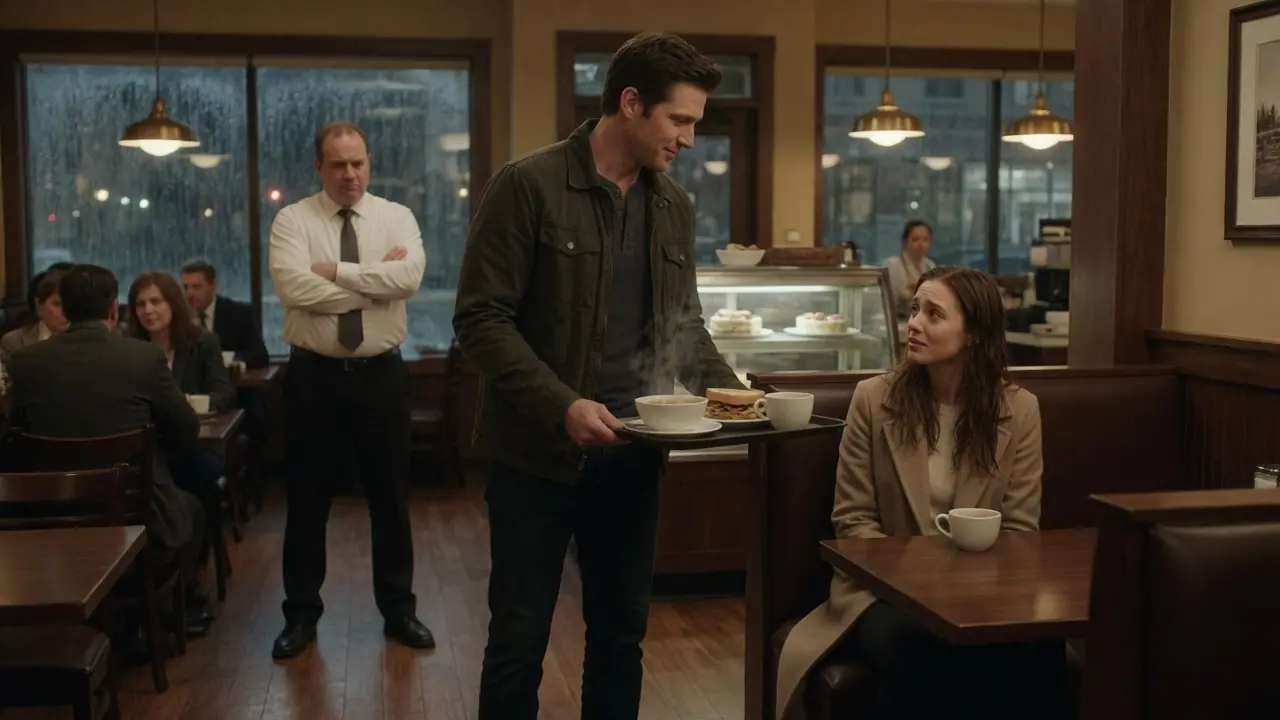
The woman at the table said nothing. She kept her hands folded around an empty cup like it still held warmth.
No one at the counter moved to help her.
The bell over the door rang.
Grady Sutton walked in with a pharmacy bag under one arm, seven dollars folded in his pocket, and the tired posture of a man who had already spent his strength for the day.
He stopped.
He looked at the corner table.
Something in him decided before his mind caught up.
She had given the waitress a name earlier that evening, when she asked for something small and promised to pay when she could.
“Marion,” she had said.
The waitress had looked at her shoes, then at the empty cup, then walked away without writing anything down.
A man at the next booth had laughed under his breath. A woman two tables over had pulled her purse closer to her body, the way people do around something they have decided is contagious.
Marion had lowered her eyes and folded her hands tighter around the cup.
That was the moment Grady Sutton pushed through the door with rain still running off his collar.
He did not look like anyone’s idea of help arriving. His jacket was worn thin at both cuffs. His boots still carried the pale stain of last winter’s road salt, the kind that never fully washes out.
He crossed the diner floor, set his tray down on Marion’s table without asking permission, and pulled out the chair across from her, only far enough to prop one boot against it, not to sit.
“Eat while it’s hot,” he said.
Desmond looked him over with the particular amusement of a man who had never once gone without.
“And who exactly are you?”
“Somebody sharing dinner.”
“With what money?” someone murmured from the counter.
Grady heard it.
Marion heard it.
He did not answer.
He reached into the pharmacy bag, drew out a slice of bread already wrapped in a paper napkin, and tucked it into his jacket pocket instead of setting it on the tray.
That piece was not for the woman across from him.
That piece had a purple heart drawn on the napkin in crayon, and it was going home.
Grady Sutton had not planned on becoming the kind of father who counted quarters in a laundry room and called breakfast for dinner a treat.
Ten years earlier, he had worked installation for a heating and cooling company. He made steady money and came home most evenings to porch lights and noise in the walls, which meant somebody was glad he had made it back.
He worked nights now at the Larksburg distribution center on the edge of town, loading trucks from eleven at night until seven in the morning. On weekends, he fixed bicycles in the alley behind his building for thirty dollars a job whenever anyone in the neighborhood needed one fixed.
Two years earlier, his wife, May, had been killed in a highway accident outside town. The last thing she had asked of him from a hospital bed, with her hand loose in his, was simple enough to carry and heavy enough to break a man who was not careful.
Keep their daughter safe.
Keep her kind.
Never let her learn that love is something you earn with money.
Since then, every day had become a quiet negotiation with survival.
Rent first.
Whatever was left stretched over groceries and was made to look like enough.
At home, above the shuttered hardware store where they rented two rooms, six-year-old Marlo was waiting, coloring a house with yellow windows the way she always did when she wanted the world to feel steady under her.
Grady had promised her soup and bread that night.
Nothing more.
It was supposed to be their good meal before his next paycheck, split carefully, made cheerful by a father who had learned how to smile around an empty stomach.
Some nights, the warehouse floor manager let him clock out ten minutes early so he could catch the last bus home before the cold really settled in. Other nights, he walked the forty minutes instead, saving the fare and telling himself the walk kept him sharp.
He had stopped counting which nights were which a long time ago.
What he counted instead was smaller and steadier.
How many days were left until payday. How many unopened bills sat on the counter. Whether Marlo’s boots still fit, or whether that conversation would have to wait another month.
Above the shuttered hardware store, the apartment held two rooms and a kitchen barely wide enough for one person to turn around in. But May had painted the trim yellow the year before she died, and Grady had never once considered painting over it.
Earlier that evening, before the rain started, Marlo had stood by the window in her pajamas, holding a crayon drawing of the two of them at a long table covered in food.
“Daddy,” she had asked, “when payday comes, can we get the soup with the little noodles?”
Grady had smiled in a way that cost him more than she would ever know.
“We can do better than that,” he told her. “Maybe bread, too.”
She had grinned like he had promised her a castle.
That grin was most of the reason he had stopped at the diner on his way home at all.
It was not just soup he was carrying.
It was proof he could still bring something home.
Marion lifted the spoon. Her hand shook, and it was not from the cold in the room. She took one small bite, and something crossed her face, quiet and private, the look people get when they are trying hard not to be seen feeling something.
Grady turned toward the rain-streaked window instead of watching her eat, giving her room to have the moment without an audience.
Six weeks earlier, he had filed a written complaint at the distribution center reporting pallets of food, still weeks from actual expiration, being sealed and thrown into the dumpster behind the building instead of donated to anyone.
The complaint had come back three days later stamped, “Low priority. No further action required.”
It was initialed by a name he had not yet understood the full weight of.
Desmond folded his arms.
“This is sentimental nonsense,” he said. “I’m going to ask you one more time to leave.”
Grady turned to face him fully.
“And I’m going to ask you one more time to let her finish eating.”
His voice did not rise.
It did not need to.
There is a stillness that makes disrespect show its own face in a room, and the diner went quiet around it. Forks paused halfway. A waitress froze near the coffee station. A man in a blue shirt lowered his phone as though the joke in his hand had gone sour in his grip.
Two mornings before that Friday, on the thirty-first floor of the Larksburg Kitchen headquarters in Detroit, Josephine Winslow sat with a spreadsheet she did not like.
The Open Table Initiative, the program her father had started in 1994, promised a free seat and a free meal at every Larksburg location for anyone who needed one, no questions asked. It was budgeted at $340,000 a year across the Midwest region.
The reported meals served had dropped ninety-two percent over eighteen months.
The money on paper was still spent down to the dollar.
“Where did it go?” she asked Desmond Price over a video call.
Her voice was even.
“We restructured,” he said, smooth and immediate, the kind of answer that had clearly been rehearsed before it was needed. “The old model wasn’t efficient. Too easy to abuse. We redirected it into something more sustainable.”
“Restructured into what?”
He changed the slide instead of answering. He moved on to quarterly labor costs as though the question had already been settled.
Two board members nodded along. An assistant kept typing as if conscience could be recorded in bullet points.
Josephine did not raise her voice.
Her father had taught her that a raised voice gives people permission to stop listening.
Holt Winslow had opened the first Larksburg Kitchen on a corner in Lansing with a loan from his own father and a rule he never once broke in thirty years of running it.
Nobody who sat down hungry left without eating, whether they could pay or not.
He used to say food was never just food. It was welcome. It was the first language of mercy a stranger ever spoke to another stranger.
Josephine had grown up doing homework at the counter of that first store, watching him slide a plate toward someone in a torn coat without a word about it either way.
When he died four years ago, the company had kept growing at a pace her grief could not match. Men like Desmond had learned somewhere along the way how to wrap cold decisions in language warm enough that nobody in the room noticed the temperature had changed.
She thanked Desmond, ended the call, and sat for a long moment with a photograph on her desk.
Holt Winslow stood beside a small hand-carved wooden sign outside that first Larksburg Kitchen, back when the company was one storefront and a promise nobody had tested yet.
The sign read:
Reserved. No questions asked.
It had vanished from the corporate archives seven years earlier. No one had ever offered an explanation, and until that morning, no one had ever asked her to want one.
She did what she did every quarter, and what almost no one at the company knew she did.
She left her phone and her driver behind, pulled an old coat from the back of a closet she rarely opened, took eighty-one dollars in cash from a drawer, and became, for one evening, a woman named Marion Doyle.
She rode a bus two hours west to Ann Arbor, to the one Larksburg location that had reported zero Open Table meals for six straight months running, in a city carrying one of the highest unemployment rates in the state.
She wanted to see it with her own eyes before she let herself call it fraud out loud, even to herself.
Her chief of staff, Carol Wexler, was the only person who knew where she went on those nights. Carol had learned long ago not to ask why a woman who could buy the building instead chose to sit outside it in the rain.
That, Josephine would say much later, was the only decision she made on her own that whole night.
Everything that followed belonged to other people.
To a waitress who would not look at her.
To a man in a blue shirt who laughed.
And to a stranger with salt-stained boots who had not asked her name before deciding she mattered.
Desmond stepped closer to the table, close enough that his polished shoes nearly touched the puddle forming beneath Marion’s coat.
“You’re making everyone uncomfortable,” he said.
Grady looked around the diner at the lowered eyes, the half-finished plates, the phones angled just slightly in his direction.
“No,” he said. “Hunger makes people uncomfortable. I’m just putting a bowl in front of it.”
Desmond’s mouth thinned.
He studied Grady more carefully now, not as a stranger anymore, but as a name he was working to place.
“Sutton,” he said slowly. “You’re the one from the warehouse. The complaint about the food.”
“It wasn’t a complaint,” Grady said. “It was an accusation. It was food.”
Three words, plain and heavy enough to make the room shrink around them.
Outside, the storm pressed harder against the glass.
Desmond took one more step, lowering his voice just enough to sound personal while making certain the whole room could still hear it.
“You know what I think? I think men like you love a cause because it distracts from your own failure. You can’t fix your own life, so you point at everyone else’s.”
Grady’s hands stayed loose at his sides.
He did not list the double shifts, the unpaid bills, or the nights he had gone cold so his daughter could stay warm.
A man does not always answer every insult.
Sometimes he lets it stand there naked, ashamed of itself in the silence.
“Is this how you feed your daughter?” Desmond said, tilting his head. “Giving away dinner to strangers so people can clap for you?”
The words landed hard.
Marion looked up sharply.
Grady’s jaw tightened once and went still again.
“Leave my daughter out of this,” he said.
“Why?” Desmond said. “She’s part of the story, isn’t she? Struggling father, sad little girl, a heroic bowl of soup. It’s almost touching.”
Then, with a careless sweep of his arm, he knocked the edge of the tray.
The bowl tipped.
Soup spread across the table, onto the tile, and over the toe of Grady’s boot.
No one laughed this time.
The sound was small, almost nothing. Ceramic scraping. Liquid spreading. A spoon spinning once before it went still.
But it felt like the loudest thing that had happened in the room all night.
Grady looked at the mess on the floor.
He looked at Marion, whose eyes had filled with something closer to fury than sadness.
Then he knelt, picked up the spoon, and set it gently back on the table.
“You should not have done that,” he said, quiet and plain.
Desmond smirked.
“What are you going to do about it?”
Grady reached for a stack of napkins from the dispenser and began wiping the floor himself, slowly, carefully, without a word.
Not because Desmond deserved it.
Not because the diner deserved it.
Because his daughter had once asked him why anyone should clean up a mess they had not made, and he had told her.
Because the world gets better when someone chooses to.
“Thank you,” Marion said quietly once she had stood.
“Find somewhere dry tonight,” Grady told her.
He walked her out under a broken awning while rain swept sideways across the sidewalk. He took off his own jacket despite the cold and set it around her shoulders while they waited for the bus together.
He did not ask her name.
She did not offer one.
When the bus pulled up, he stepped back to let her board with room to breathe, the way a man does when he wants someone to leave with their dignity still intact and unremarked on.
Before he turned to walk home, he checked the folded bread in his pocket.
Dry.
Whole.
Still shaped like a promise.
He left two quarters on the table inside, the only tip he had left to give, and walked out into the rain alone.
Someone near the door had been filming for the last two minutes of it and posted the clip before the door had fully swung shut behind him.
The video did not open on Grady offering the meal.
It did not show Desmond mentioning his daughter.
It opened on the spilled bowl and Grady kneeling over it, with a caption already written to make the world unkind in a different direction.
Angry warehouse worker causes scene at Larksburg Kitchen.
By morning, it had traveled from Ann Arbor to Detroit and well past both.
At 6:15 the next morning, Grady’s shift supervisor called.
“I have to suspend you,” he said, “pending review.”
He did not sound cruel about it. Only tired, the way people sound when they are following a rule they do not fully believe in themselves.
“I saw the clip,” he added. “So did everyone else.”
Grady sat at his kitchen table in the blue light before sunrise, his boots drying near the radiator, the apartment smelling faintly of last night’s rain and cold coffee.
He did not argue.
There was not a version of arguing that made a suspended man employed again.
An hour later, his landlord, Mrs. Iverson, left a voicemail about the lease renewal. Her tone was careful in the way people get when they have heard half a story and are deciding how much of it to believe.
She had heard he might be out of work. They should talk before the end of the month, she said, before she could sign anything new.
Grady played the message twice, then deleted it, because there was nothing in it he could do anything about before eight in the morning.
He spent twenty minutes at the kitchen table doing the math he already knew by heart.
Two weeks of suspended pay against rent due.
Three bicycle jobs that might cover the gap if enough people in the building needed flat tires fixed before spring.
None of the numbers changed no matter how many times he added them.
He folded the paper in half anyway and put it under the bread box, out of sight, the way a man puts away a problem he cannot solve before breakfast so it does not sit on the table where his daughter eats.
Outside, the street was still wet from the night before. A neighbor two doors down was already out scraping frost off a windshield, breath visible in the porch light.
Grady stood at the window a moment longer than he needed to, watching the ordinary business of a street waking up around a problem it knew nothing about.
He thought about calling the diner to ask whether Marion had made it somewhere dry.
Then he realized he had no way to reach her, even if he had wanted to. No name beyond the one she had given a waitress who had not believed her anyway.
When Marlo came into the kitchen rubbing sleep from her eyes, he had already decided the morning would be an ordinary one on purpose.
“We’re drawing a house with three windows today,” he told her.
She grinned like he had promised her something enormous.
For one hour, it worked.
And that hour was enough to get them both dressed and out the door.
In Detroit, Josephine watched the edited video once, then again with the sound off, because a lie often shows itself more clearly in silence than in noise.
She called Carol Wexler before eight.
“Get me every camera at the Ann Arbor location. Every angle we have. Audio, if they kept it.”
Carol hesitated.
“Desmond’s going to ask why we’re pulling footage without looping him in.”
“Let him ask,” Josephine said, and hung up before Carol could say anything else.
Three hours later, the footage arrived in separate files, each one timestamped, each one colder than the last.
Josephine watched from the very beginning, this time alone in her office with the blinds drawn.
The waitress refusing the coffee.
Desmond stepping in, calm and cutting, enjoying himself in a way the audio had not captured but the posture made obvious.
Grady walking through the door, counting coins at the register before he had even glanced toward the corner table, setting down the only meal he had paid for without a flourish, without checking to see if anyone was watching him do it.
She watched Desmond needle him about the warehouse complaint.
She watched him mention Grady’s daughter.
She watched the tray go over, the soup spill, and Grady kneel to clean it without being asked twice.
Then came the parking lot camera.
Grady’s jacket around a stranger’s shoulders in the cold.
Him stepping back before she boarded the bus so she would not feel crowded into gratitude.
Him standing alone under the awning afterward, checking a folded napkin in his pocket like it still mattered whether the bread inside had survived the rain.
Josephine pressed a hand to her mouth and sat with that image longer than she had planned.
“Do you want this for legal?” Carol asked, already reaching for a notepad.
“For the record to be set straight,” Josephine said. “Pull his personnel file first.”
By noon, she had it.
Six years of shift reports. No disciplinary history worth mentioning. And a complaint from six weeks earlier, marked, “Low priority. No further action required.”
Initialed by Desmond Price.
A widowed father trying to keep food on his own table had been called low priority by a company built, on paper at least, around the idea that no one should ever have to go without a seat at one.
She read the two words again.
Low priority.
She thought about the last time she had used a phrase like that herself, casually in a meeting, without once picturing a specific kitchen table it might land on.
She thought about calling Desmond directly and asking him to explain the number in front of her.
She decided against it.
A man who could smile through a spilled bowl of soup on camera would smile through a phone call, too.
She had learned watching her father run the company for thirty years that some conversations only mean anything once you are already holding the proof.
That same afternoon, Carol laid something else on Josephine’s desk.
It was a service contract pulled from regional accounting, dated three years earlier, engaging a vendor called Birwood Sourcing Partners to handle, in the contract’s own careful language, surplus inventory no longer fit for donation.
The signature at the bottom was Desmond Price’s.
When Carol traced the business registration through the state database, the listed owner of Birwood Sourcing Partners was Colleen Price, Desmond’s wife.
There was nothing illegal on its own about a company contracting with a vendor owned by an employee’s spouse, provided it was disclosed and priced fairly.
Neither of those things had happened.
The disclosure form in Desmond’s personnel file, the one every director signed each year listing any financial conflicts of interest, had Colleen’s name nowhere on it.
Josephine read that particular line three times before she set the page down.
“How does something like this run for three years without anyone catching it?” Carol asked, more to the room than to Josephine directly.
“Because he was the one who was supposed to catch it,” Josephine said.
They worked through the night, spreading printouts across the conference table until the room looked less like an office and more like the inside of someone’s unraveling story.
Carol cross-referenced shipping manifests against the donation logs line by line, while Josephine read invoices twice each, the way her father used to read contracts before he signed anything with his name on it.
What surfaced was not carelessness.
It was a system built slowly and maintained carefully.
For three years, Desmond had been logging still-good food from the Open Table Initiative as unfit for distribution, then selling it at a fraction of its value to Birwood Sourcing Partners, which turned around and resold it at full market price to restaurants across the region.
Three hundred and forty thousand dollars a year had been redirected, most of it eventually landing in accounts that traced straight back to the Price household.
Around two in the morning, Carol found the pattern behind the pattern.
Every single location Desmond had personally visited in the last three years reported a sharp drop in Open Table meals within a month of his visit.
Ann Arbor had been the seventeenth store on the list.
Grady’s complaint from six weeks earlier had not been a nuisance to be filed and forgotten. It had been the one loose thread that, pulled hard enough, could unravel the entire arrangement.
That explained, with an ugliness Josephine had not expected to feel in her own chest, exactly why Desmond had gone after him with such precision that Friday night.
It had not been random cruelty.
It had been a warning aimed squarely at the one person who had already come close enough to the truth to be dangerous.
Further back in the accounting archive, past the point where the trail should have gone cold, Carol found an older record.
Seven years old.
A disposal log for company property no longer in use.
One line read:
Item 1994B, hand-carved signage. Condition obsolete. Authorized by D. Price.
It was her father’s sign.
Desmond had ordered it thrown away the same year he had begun quietly starving the very program it stood for, long before Birwood Sourcing Partners had a name or a bank account, back when the damage was still small enough to hide behind a budget line.
“There’s no photograph of the sign in the disposal file,” Carol said quietly, reading over Josephine’s shoulder. “Just the line item, like it was furniture.”
Josephine did not answer right away.
She was thinking about the last time she had seen the sign in person.
She had been twelve years old, standing on a step stool so she could reach it, tracing the carved letters with one finger while her father told her a customer had once tried to pay him for the meal in the reserved seat.
Her father had told the man his money was no good there.
Not that day.
Josephine sat alone in her office long after midnight. The printouts fanned out in front of her like evidence in a trial only she had attended so far.
This had stopped being a story about one rude regional manager.
Someone had been dismantling her father’s legacy for seven years, one small decision at a time, and no one above him had ever looked closely enough to notice.
Including, for longer than she wanted to admit, herself.
Tuesday morning, nine o’clock.
The thirty-first-floor boardroom at Larksburg Kitchen headquarters in Detroit.
Eleven board members. Two attorneys. Carol Wexler. And Desmond Price, who had arrived early with a prepared statement calling the incident unfortunate and inconsistent with company values.
His tie was centered. His folder squared with the edge of the table.
Josephine walked in last, still wearing the same coat from Friday night, the hem faintly stained where the storm had reached it.
Desmond half rose.
“Josephine, we were just reviewing the incident. We have a strategy.”
“No,” she said. “You have a cover story. Sit down.”
One of the attorneys glanced at the other, the small look of two people recalculating how long this meeting might actually take.
A regional director near the back set down her coffee without drinking it.
Josephine set a remote on the table and turned to the screen at the far wall.
The edited public clip played first, the one the whole room had already seen more than once over the weekend.
Then she played the full footage underneath it, unedited, every angle.
Desmond’s own voice came clearly over the speakers.
“She’s not ordering. She needs to leave.”
A few faces in the room changed.
Small at first. A jaw tightening. A chin dropping half an inch. The particular discomfort of people recognizing a truth before they are ready to say its name out loud.
She let the tray tip on screen.
She let the soup spread across the tile.
She let the whole room watch Grady Sutton kneel down and clean a mess he had not made.
“That angle doesn’t show the full context,” Desmond said.
“Then let’s keep watching,” Josephine said.
Someone at the far end of the table murmured that this could have waited for legal to review first.
Josephine did not look toward the voice.
“It’s had a weekend,” she said. “That’s long enough.”
She played the parking lot footage next.
Grady’s jacket around a stranger’s shoulders in the cold rain.
Him waiting until the bus came.
Him stepping back before she could board so she would not have to say thank you in front of a stranger.
Then she put the vendor contract for Birwood Sourcing Partners on the screen.
Desmond’s signature at the bottom.
Colleen Price’s name listed plainly as owner.
Three years of payments totaling just over one million dollars flowing quietly out of a program meant to feed families who had nowhere else to sit down.
Then the seven-year-old disposal log.
Her father’s sign marked obsolete and authorized for destruction the same year the whole pattern had begun.
The room had gone still enough that the air-handling system sounded loud overhead.
One attorney closed his folder without being asked to. A public relations officer turned her prepared statement face down on the table in front of her, as if that alone might undo it.
“This company cannot be run on sentiment,” Desmond said, standing now, his voice starting to lose its polish at the edges.
“It’s been run on your version of efficiency for three years,” Josephine said. “I’ve seen what that costs. I have the number in dollars, if the board would prefer that language.”
Josephine looked at him for a long moment before she continued.
“This company serves food,” she said. “If hunger doesn’t move us, we have no business being in this business.”
She placed a single printed page on the table in front of him.
“Desmond Price, effective immediately, your employment is terminated. Every transaction connected to Birwood Sourcing Partners goes to legal and to federal investigators by end of day. The board voted nine to zero.”
Desmond opened his mouth once, and nothing came out.
For the first time in the room, the man who had always known exactly what to say had nothing left to say at all.
He gathered his folder and walked out without looking at anyone, his footsteps too loud in the quiet.
“The Open Table Initiative is fully restored effective today,” Josephine told the room once the door had closed. “And Grady Sutton will have a public apology before sunset.”
That same afternoon, Grady was on his knees in Marlo’s room, taping a sheet of plastic over a drafty window and turning a problem into a project the way he had learned to for her sake.
The apartment smelled faintly of toast and laundry soap and the soup he had never managed to bring home.
There was a knock at the door.
Three light taps.
Nothing official about the sound of it.
He expected Mrs. Iverson or another envelope asking him to prove once again that he was enough.
Instead, a woman stood in the hallway holding a covered box of hot food in both hands.
No coat over her shoulders this time.
No disguise.
No one standing behind her.
Recognition came slowly, then all at once.
“Marion,” he said.
She shook her head.
“Josephine Winslow.”
Marlo peeked around the kitchen doorway, small and curious. Josephine knelt in the hallway so they were eye to eye before she said another word to either of them.
“Is this pity?” Grady asked, still standing in the doorway.
A man the world has embarrassed learns to be careful when it comes back around holding gifts.
“No,” Josephine said, her voice steady even though her eyes were not. “This is justice arriving late.”
She handed him a folder.
Inside was a written apology from the company. Confirmation that his suspension had been lifted with full back pay. Notice that his complaint from six weeks earlier had been formally reopened and credited.
And something beyond all of that.
An offer to lead the Open Table Initiative for the entire Midwest region, reporting directly to the board, with no one like Desmond Price ever standing between him and the people he was meant to feed again.
Grady finally stepped back from the door enough to let her stand fully inside the frame of it, without either of them calling it an invitation.
“The man who spilled that soup,” he said. “He still work there?”
“No,” Josephine said. “He doesn’t.”
Grady nodded once, slow, like a man setting down something heavy he had been carrying since Friday.
“I didn’t ask for this,” Grady said, reading slowly, his hands going still on the last page.
“I know,” Josephine said. “That’s why it matters.”
Marlo stepped forward then, holding half a cookie wrapped carefully in a paper napkin.
“Are you the lady Daddy gave soup to?”
“Yes, sweetheart,” Josephine said. “I am.”
Marlo studied her for a moment, the serious way children study things they have decided are important, then held the cookie out with both hands.
“We share things here.”
Josephine took it the way a person takes something they understand is sacred.
Grady looked away, not to hide anything, but to give her room to have the moment without being watched inside it.
Before she left, Josephine set one more thing on the kitchen table.
A small wooden sign, cleaned and whole.
Reserved. No questions asked.
“My father made this,” she said. “I think it belongs somewhere with someone who already understands what it means without being told.”
Grady looked at it for a long time and said nothing at all, because there was nothing left that needed saying out loud.
Six weeks later, federal investigators had opened formal proceedings against Desmond and Colleen Price for fraud and misappropriation of company assets.
Birwood Sourcing Partners had its accounts frozen within days of the referral.
Of the just over one million dollars diverted across three years, the company recovered $890,000, and every cent of it went directly into rebuilding the Open Table Initiative across the region. None of it was spent on advertising or press releases about the recovery itself.
Desmond never called the house.
Never sent a message.
Never showed up anywhere near Ann Arbor again.
Grady heard about the case the same way everyone else did, in a short article buried on the fourth page of the business section. Four sentences long. No photograph.
He read it once at his kitchen table, folded the paper, and did not mention it to Marlo.
Some things a father decides are his to carry alone so the house can stay light for someone smaller.
Mrs. Iverson, once she read the story in the local paper, called Grady herself and renewed his lease for two more years, lowering the rent by fifteen percent without being asked.
She said only that she would rather have good tenants than a story to explain later.
Grady went back to work, but he did not take the new title right away, and nobody at the company pushed him to.
He spent the first three weeks visiting every Larksburg Kitchen location across the region, quietly, off the clock most days, watching how staff treated the people who walked in and did not order anything.
He took notes in a spiral notebook he kept in his jacket pocket, saying little to anyone until he was ready to say something useful.
At one location outside Kalamazoo, he watched a teenage cashier turn away a man in a thin coat without looking up from the register.
Instead of writing the kid up, Grady sat down with him after close and asked what he would have wanted someone to say to him at seventeen, working his first job, unsure of the rules.
The kid started doing it differently the next week on his own, without being told twice.
One evening, at the corner table where all of it had started, Grady hung Holt Winslow’s sign back up with his own hands.
He drilled the holes himself and checked the level twice, not because anyone at the company had told him to, but because some things deserved to be done correctly.
By spring, the corner table at the Ann Arbor Larksburg Kitchen always had the sign above it. Most evenings, there was one extra meal set aside, no questions asked of whoever sat down to eat it.
The staff had started calling it Holt’s Table without anyone officially naming it that.
Marlo, comfortable with Josephine now after a handful of visits, sat coloring at a nearby table on a quiet afternoon, nothing but ordinary light and ordinary noise around her.
Josephine came in without calling ahead and sat across from Grady, who was finishing coffee after his first morning officially running the program across three states.
He did not ask why she had come.
Lately, she came often enough that the question had stopped needing an answer, and neither of them had bothered naming what that meant yet.
She set a small carved wooden spoon on the table between them.
No name on it.
Just one line burned along the handle.
Eat while it’s hot.
Grady turned it over in his hand, running a thumb along the letters.
“You make this yourself?”
“I learned from someone who showed me what it looks like to share something without needing to be thanked for it.”
Marlo glanced up from her drawing of a house, now with a third window added since the last time Josephine had seen it, then went quietly back to her coloring.
“Are you staying for lunch?” she asked, not looking up.
It was the question of a child who had decided someone belonged somewhere before the adults had caught up to the idea.
Grady did not answer for her. He looked at Josephine instead, waiting the way a man waits when he already knows what he hopes the answer will be but is not going to say so first.
“If there’s room,” Josephine said.
“There’s always room,” Grady said. “That’s the whole point of the sign.”
Marlo added a small figure to her drawing, standing at the third window. She did not explain who it was supposed to be, and nobody asked her to.
Outside the window, the last of the season’s snow was thinning along the sidewalk, and somewhere down the block, a bus pulled away from a stop without either of them noticing.
She had gone looking for a number missing from a spreadsheet and found a man who saved half a slice of bread for his daughter without knowing he had just saved his employer’s entire reason for existing.