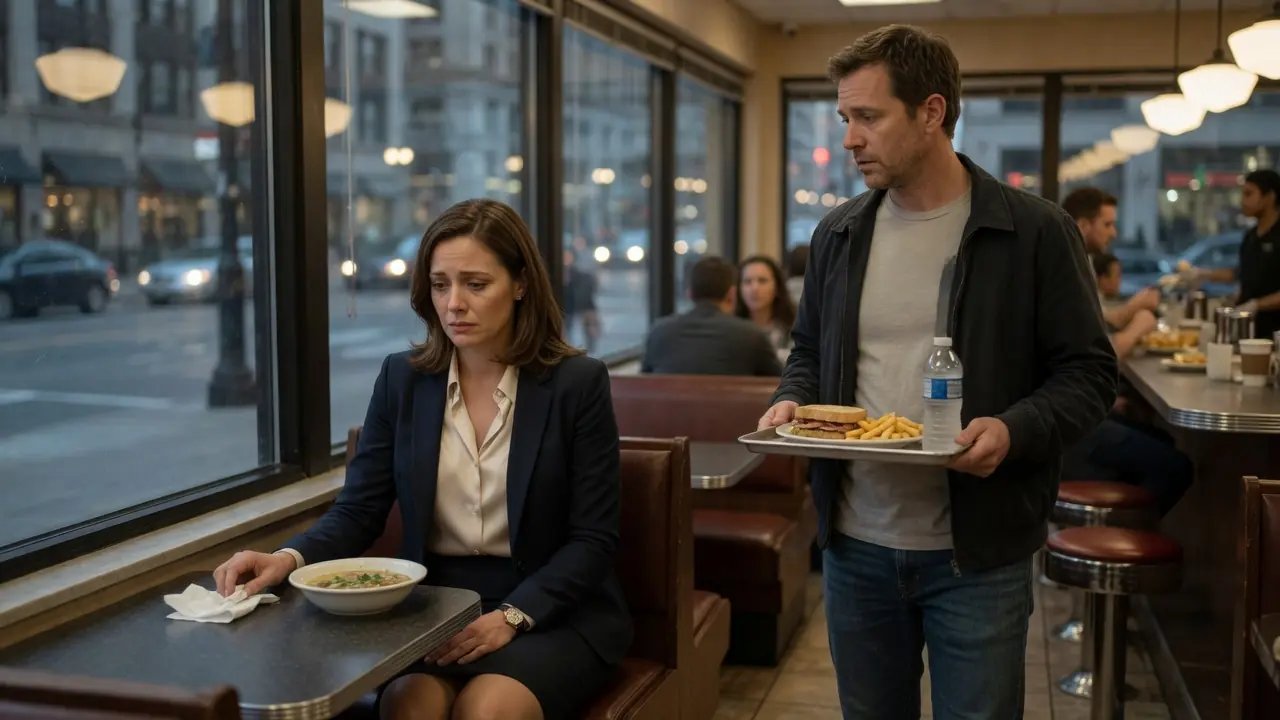
A small lunch diner. The smell of hot noodles filled the air. A single dad in an oil-stained work uniform stood holding a cheap meal tray. He looked around. No empty seats.
Finally, he walked toward a corner table. A woman sat there alone, a female CEO. He asked quietly, almost embarrassed, "Can I sit here?"
The CEO looked up. Her eyes were slightly red from crying. She answered, "Only if you eat too."
The entire diner turned to look. Why would the city's coldest CEO say that to a complete stranger? What happened next froze everyone in place.
His name was Mark Ellis, 38 years old, an air conditioning repairman, recently divorced, raising an eight-year-old daughter named Ella. Lunch for Mark was always the same: a cheap sandwich, maybe some fries he barely touched.
Every dollar saved went to Ella's piano lessons, art supplies, school trips. He never complained. This was his life now.
Her name was Clara Hastings, 32 years old, CEO of a tech company worth hundreds of millions. But today, she felt like nothing.
An hour ago, she had sat in a bank meeting. The loan officer looked at her pitch and laughed. Not out loud, but the kind of laugh that lives in silence. The kind that says, "You're a woman. You're young. You don't belong here."
Her partner walked out mid-presentation. Said she was too emotional to lead.
Clara left the building. She couldn't go back to her office. Not yet. Not like this. So she walked into a small diner, the kind of place no one from her world would ever visit. She ordered soup, sat in the corner, and cried quietly into her napkin.
That's when Mark walked in.
He had just finished fixing an AC unit two blocks away. His hands were covered in grease. His uniform smelled like motor oil. He was exhausted. The diner was packed: construction workers, delivery drivers, office workers on lunch break. Every table was full except one.
Mark hesitated. He saw the woman sitting alone, well-dressed, expensive watch, designer bag on the chair. She didn't belong here either, but he had nowhere else to go.
He walked over slowly, cleared his throat.
"Can I sit here?"
Clara looked up. Her makeup was smudged. Her eyes were red. For a second, she didn't say anything. Then she noticed something.
Mark's tray. A sandwich. Half a bottle of water. A small pile of fries pushed to the side.
She spoke softly.
"Only if you eat too."
Mark blinked, confused.
"I, um... I am eating."
Clara pointed at the fries.
"That's not eating. That's surviving."
Mark felt his face turn red. He didn't know what to say. Around them, people started whispering. The regulars. The waitress. Everyone knew who Clara Hastings was. Her face was on magazine covers, billboards, business blogs. And now, she was sitting with a repairman in a stained uniform.
Mark pulled out the chair, sat down carefully like he might break something.
"If this is uncomfortable, I can leave."
Clara shook her head.
"No. Stay, please."
For the first time all day, she felt like someone saw her. Not the CEO. Not the failure from the meeting. Just her.
Mark opened his sandwich and took a small bite. Clara watched him.
"You work nearby?" she asked.
"Yeah. AC repair. Just finished a job down the street."
"Sounds hard."
Mark shrugged.
"It's honest."
"You should try this. It's better than that sandwich."
Mark hesitated. Then he took a spoonful. It was warm, rich, tasted like something his mother used to make.
"Thank you," he said quietly.
Clara nodded.
"Thank you for sitting with me."
Neither of them knew it yet, but this table, this moment, this one question, it would change everything.
They ate in silence for a few minutes. Not the awkward kind. The comfortable kind. Then Clara noticed something.
A fresh cut on Mark's hand, red, still bleeding a little.
"You're hurt," she said.
Mark looked down. He'd forgotten about it.
"Oh, yeah. Occupational hazard. Cut it on some sharp metal this morning."
He wiped it with a napkin like it was nothing.
Clara frowned.
"You should clean that properly."
"It's fine. I've had worse."
She didn't push, but she kept looking at it, concerned. Mark noticed. He smiled.
"Really, I'm okay. I work nights too, so I'm used to little injuries like this."
Clara's expression changed.
"Nights? You work two jobs?"
Mark nodded.
"Maintenance gig at a warehouse. Pays extra. My daughter, Ella, she's eight. She loves art, wants to take painting classes."
His voice softened when he said her name.
"Those classes aren't cheap, but when I see her smile after finishing a drawing..."
He trailed off.
"Worth every bruise."
Clara stared at him. Really stared. Here was a man who bled for his daughter's dreams. No complaints. No self-pity. Just love.
She felt something crack inside her chest.
Around them, the whispers grew louder. The regular customers. The waitress. The cook in the back.
"Is that Clara Hastings?"
"The CEO?"
"Why is she sitting with a repairman?"
"Look at his uniform. It's filthy."
"Maybe she's doing some charity thing."
Mark heard them. His face flushed red. He looked down at his tray.
Clara heard them too, but she didn't move. Didn't react. Instead, she leaned forward.
"Tell me about Ella."
Mark looked up, surprised.
"You really want to know?"
"I do."
So he told her about Ella's favorite colors, purple and yellow. About how she painted a picture of the moon last week and hung it on the fridge. About how she asked him every night if he was okay, even when she was the kid.
Clara listened, and for the first time in months, she forgot about board meetings, investors, stock prices, partnerships. She just listened to a father talk about his daughter.
Then the door opened.
A man in a sharp suit walked in. Mid-40s. Expensive shoes. Bluetooth earpiece. He was one of Clara's senior managers, Robert Chen. He scanned the diner, saw Clara, and his eyes went wide.
He walked over quickly. Too quickly.
"Miss Hastings," he said loudly, loud enough for the whole diner to hear. "I've been looking everywhere for you. We have the VIP room reserved at the Carlisle. You don't need to sit here with..."
He looked at Mark, his oil-stained uniform, his cheap meal.
"With him."
The entire diner went silent. Every head turned. Every eye on Mark. Mark's hand shook slightly. He gripped his napkin and looked down.
Clara felt rage burn in her throat. She stood up slowly, calmly. Her voice was ice.
"I sit here because I want to."
Robert blinked.
"Ma'am, I just thought..."
"Because he treats me better than half the boardroom."
Robert's face went pale. The diner stayed frozen.
Clara continued.
"He didn't interrupt me. Didn't dismiss my ideas. Didn't look at me like I was a failure."
She looked at Mark, then back at Robert.
"He saw me as a person. Can you say the same?"
Robert stammered, tried to speak, couldn't.
"Leave," Clara said.
Robert left. The door swung shut behind him. Clara sat back down. Her hands were shaking now too, but not from fear. From relief.
Mark stared at her.
"You didn't have to do that."
"Yes, I did."
They sat in silence again, but this time something had shifted.
Clara looked at Mark's wrist, at a faded red fabric bracelet tied there, worn, almost falling apart.
She pointed at it.
"That bracelet. Where did you get it?"
Mark touched it instinctively, like it was sacred.
"It's... it's kind of a long story."
"I have time."
Mark hesitated. Then he spoke.
"A few years ago, I lost my job. My wife left. I was about to lose my apartment. Ella and I were going to be on the street."
His voice cracked.
"I was at my lowest, sitting on a bench, didn't know what to do."
Clara leaned closer.
"A woman sat next to me. Older. Kind eyes. She didn't ask what was wrong. She just sat there."
Mark looked at the bracelet.
"Before she left, she gave me this. Told me it was a symbol, a reminder that someone believed in me, that I wasn't alone."
His eyes were wet now.
"She said when life gets heavy, this would remind me to keep going."
Clara's breath caught.
"What? What did she look like?"
Mark described her. Gray hair, gentle smile, a small scar on her left hand.
Clara's face went white. Her voice was barely a whisper.
"That symbol. That bracelet. Where exactly did she give it to you?"
"A park near the old library on Fifth Street. Why?"
Clara pulled out her phone, her hands trembling. She scrolled, found a photo, and turned the screen toward Mark.
It was a picture of a woman. Gray hair. Gentle smile. Scar on her left hand. She was standing with a group of women, all of them wearing the same red fabric bracelets.
Mark stared at the photo, his eyes wide.
"That's... that's her. Who is she?"
Clara's voice broke.
"My mother."
The diner disappeared. The noise, the people, everything. Just Clara and Mark, and a bracelet that connected them across time.
Mark couldn't breathe. He looked at the photo, then at Clara, then back at the photo.
"Your mother?"
Clara nodded, tears streaming down her face.
"Her name was Eleanor Hastings. She passed away three years ago."
Mark's hands went to his mouth.
"I... I didn't know. She never told me her name. She just said..."
He stopped, remembering.
"She said the bracelet belonged to a group of women. Women who help people quietly, without recognition, without reward."
Clara wiped her eyes.
"The Red Thread Project. My mother started it 20 years ago. A network of women who found people at their breaking point and gave them hope."
She touched her own wrist. Under her expensive watch was another bracelet, identical to Mark's, hidden from view.
"She made these herself by hand. Every single one."
Mark stared at his bracelet, the frayed edges, the faded color.
"I've worn this every day since she gave it to me. It's the only reason I kept going."
Clara's voice shook.
"She never told me the names of the people she helped. She said their stories weren't hers to share, that they deserved privacy, dignity."
She looked at Mark.
"I always wondered who they were. If they made it. If her help mattered."
Mark's tears fell freely now.
"It mattered. She saved my life."
Clara covered her face and sobbed. Around them, the diner had gone completely silent. Everyone watched. Some were crying too.
Mark reached across the table, hesitated, then gently took Clara's hand.
"I'm so sorry for your loss."
Clara squeezed his hand.
"I'm so grateful she found you."
They sat like that for a long moment, two strangers connected by a woman who believed in kindness and second chances.
Finally, Clara pulled herself together and took a breath.
"After she died, I found her journals. Pages and pages of people she'd helped. But no names. Just stories. Just hope."
She pulled up another photo on her phone.
"This was her last entry."
Mark leaned in and read the words written in elegant handwriting.
Today I met a father who loves his daughter more than his own comfort. He's broken but not beaten. I gave him the last bracelet I made. I hope it reminds him that love is the strongest currency we have.
Mark's breath hitched.
"That's me. That's about me."
Clara nodded.
"She died two weeks after writing that. Heart attack. Sudden. I never got to ask her about you."
Mark closed his eyes.
"I wish I could have thanked her. Told her what she did for me."
"You just did," Clara whispered.
The door opened again. Robert walked back in, face tight, uncomfortable.
"Miss Hastings, I apologize for interrupting again, but your car is ready. You have the investor call in 30 minutes."
Clara didn't look at him.
"Cancel it."
Robert froze.
"Ma'am?"
"Cancel the call. Cancel the afternoon. Cancel everything."
She looked at Mark.
"I'm staying."
Robert's jaw dropped.
"But the investors. They flew in from Singapore for this."
Clara finally looked at him, her eyes steel.
"Then they can fly back. Tell them I'm busy."
"Busy with what?"
Clara gestured to Mark.
"With something that actually matters."
Robert opened his mouth, closed it, turned, and left. The diner erupted in whispers, then applause. Slow at first, then louder. Clara ignored it, focused on Mark.
"Tell me about Ella. Everything."
So Mark did.
For the next hour, he told her about Ella's drawings, her laugh, her questions about the world, how she asked about her mother sometimes, how Mark tried to be enough for both parents.
Clara listened, asked questions, laughed at the funny stories, cried at the hard ones. Then she made a decision.
"I want to help."
Mark shook his head immediately.
"No. I can't accept charity."
"It's not charity."
"Then what is it?"
Clara's voice was firm, clear.
"It's gratitude. You kept my mother's legacy alive. You proved her work mattered. Let me continue what she started."
Mark looked torn.
"I don't need money. I need to provide for Ella myself. That's what fathers do."
"I'm not offering money," Clara said. "I'm offering opportunity."
She pulled out a business card and wrote something on the back.
"This is the contact for the city's best youth art program. Full scholarship. Room for 20 students. They have one spot left."
She slid it across the table.
"Ella deserves a chance to grow her gift. Not because you can't provide, but because talent like hers shouldn't be limited by circumstance."
Mark stared at the card.
"I can't."
"You can, and you will, because that's what my mother would want."
Mark's hands trembled.
"Why are you doing this?"
Clara reached into her purse and pulled out a small envelope, old and worn.
"When my mother died, she left me this. I've been carrying it for three years, too afraid to open it."
She placed it on the table.
"But I think... I think she meant for me to open it now, with you here."
Mark watched as Clara's fingers carefully opened the envelope. Inside was a note and another red bracelet, brand new, unworn.
Clara read the note aloud, her voice breaking.
My dearest Clara, if you're reading this, I'm gone, but my work isn't finished. I made one final bracelet. Give it to someone who needs to remember they're not alone. Someone who will carry the thread forward. Love always, Mom.
Clara held up the bracelet. Then she did something that made Mark's heart stop.
She tied it around his other wrist.
"You're not carrying this alone anymore. We're in this together."
Mark looked at both bracelets, one old and one new, both from the same hands. He looked at Clara.
"I don't know what to say."
Clara smiled through her tears.
"Say you'll let me meet Ella. Say you'll let me honor my mother by helping you both. Say this table wasn't just coincidence."
Mark wiped his eyes.
"It wasn't coincidence. It was her watching over both of us."
Clara nodded.
"Then let's not waste what she gave us."
They shook hands, not as CEO and repairman, not as rich and poor, but as two people connected by love, by loss, by a woman who believed strangers could become family.
Two days later, Clara met Ella.
Mark's apartment was small, clean but worn, furniture that had seen better days. But the walls were covered in drawings, dozens of them, all by Ella. Butterflies, sunsets, portraits of Mark, a family that no longer existed.
Clara stood in the doorway, taking it all in. Then she saw her.
Ella, eight years old, messy brown hair in a ponytail, paint-stained fingers, big curious eyes. The little girl looked up from her sketchbook.
"Are you Daddy's friend?"
Clara knelt down, eye level.
"I am. My name is Clara."
Ella studied her, then smiled.
"You're pretty. Can I draw you?"
Clara laughed, a real laugh.
"I'd be honored."
For the next hour, Ella drew. Clara sat perfectly still. Mark made tea in the background, watching them. He'd never seen Ella warm up to someone so quickly.
When Ella finished, she showed Clara the drawing.
It was beautiful, simple but full of emotion. Clara in colored pencils, smiling, surrounded by red threads connecting her to stick figures labeled Daddy and Me.
Clara's eyes filled with tears.
"This is incredible, Ella."
Ella beamed.
"Daddy says I'm good, but I want to be great."
Clara looked at Mark, then back at Ella.
"You will be. I promise."
Ella tilted her head.
"How do you know?"
"Because," Clara said softly, "I knew someone just like you. Someone who believed in people, who saw beauty in everyone, who..."
Clara touched her bracelet.
"My mother. And she would have loved you."
Ella looked at the red bracelet on Clara's wrist, then at her father's.
"Can I have one too?"
Clara's breath caught. She looked at Mark. He nodded.
"One day," Clara promised. "When you're ready."
After Ella went to bed, Clara and Mark sat in the small kitchen, coffee between them. Clara pulled out papers, the scholarship application already half filled out.
"The program starts next month. It's every Saturday. Transportation included. Art supplies provided."
Mark stared at the papers.
"I still don't know if I can accept this."
Clara's voice was gentle.
"Mark, you're not taking anything from anyone. You're giving Ella a chance. That's not weakness. That's love."
Mark's jaw tightened.
"I've spent her whole life teaching her we don't need handouts, that we work for what we get."
"And you have," Clara said. "Look around. This home. Her happiness. Her safety. You did that alone."
She pushed the papers closer.
"This isn't replacing what you've done. It's adding to it. My mother believed people deserved help, not because they were weak, but because they were strong enough to accept it."
Mark rubbed his face, tired, conflicted.
"What if I can't give her everything she deserves?"
"You already have," Clara said. "You gave her love. A father who bleeds for her dreams. That's everything."
Mark looked at the papers, at Clara, at the closed door to Ella's room. He picked up the pen and signed.
Clara smiled.
"She's going to do amazing things."
"She already does," Mark whispered.
Before Clara left that night, she handed Mark another envelope.
"What's this?"
"The foundation my mother started. The Red Thread Project. It's been dormant since she died. I couldn't bring myself to run it without her."
She looked him in the eyes.
"But I think I found the person who can help me start again."
Mark opened the envelope. Inside was a job offer.
Community Coordinator. Red Thread Project. Helping single parents navigate life after loss.
Salary. Benefits. Flexible hours.
Mark's hands shook.
"Clara, I'm not qualified for this."
"You're the most qualified person I know. You've lived it. You've survived it. You can help others do the same."
Mark stared at the offer, his mind racing.
"This is real?"
"Very real. We start rebuilding next month. I need someone who understands. Someone who won't give up on people."
Ella's voice called from her room.
"Daddy, can Clara come back tomorrow?"
Mark and Clara both smiled. Clara whispered.
"I think your daughter just made the decision for you."
Mark looked at the job offer, at the scholarship papers, at the bracelets on his wrists.
"She really did bring us together, didn't she? Your mother."
Clara nodded.
"I think she's been planning this longer than we know."
One year later, the small diner looked the same. Same worn booths. Same smell of noodles. Same corner table. But everything else had changed.
Mark walked in wearing a clean shirt. No grease stains. No exhaustion in his eyes. He carried a folder with the Red Thread Project logo on the front.
Ella walked beside him, taller now, carrying a portfolio of her artwork. She had just won second place in the city youth art competition.
Clara was already sitting at their table, the corner one, two cups of soup waiting. She waved them over. They sat just like that first day, but this time, no one stared. No one whispered.
The regulars knew them now. Knew their story. The waitress brought extra fries and smiled.
"Good to see you three again."
Ella immediately started showing Clara her latest drawings, a series about family, about connection, about red threads that tie people together.
Clara listened, asked questions, promised to hang them in the foundation office. Mark watched them, his daughter and the woman who changed everything, laughing together like they'd known each other forever.
Clara caught him staring.
"What?"
Mark shook his head and smiled.
"Nothing. Just thinking about... about how I almost sat somewhere else that day."
Clara's expression softened.
"But you didn't."
"No, I didn't."
Ella tugged Clara's sleeve.
"Tell the story again about Grandma Eleanor."
Clara always called her that now. Grandma Eleanor. It made Ella feel connected to something bigger.
Clara pulled out her phone, showed Ella the picture of Eleanor and the women with red bracelets.
"She believed that everyone deserves a seat at the table, no matter who they are, no matter where they come from."
Ella touched the screen.
"I wish I could have met her."
"You do meet her," Mark said softly. "Every time Clara helps someone. Every time we run the program. Every time you create art that makes people feel something."
Ella thought about that and nodded.
Clara reached into her bag and pulled out a small box.
"I have something for you, Ella."
Inside was a bracelet, child-sized, red fabric, handmade.
"I made this the way my mother taught me. It's yours now."
Ella's eyes went wide.
"Really?"
"Really. You're part of this legacy too."
Ella put it on immediately, held up her wrist next to Mark's, next to Clara's.
Three bracelets. Three people. One thread.
Clara raised her cup.
"To Eleanor, and to tables we never planned to share."
Mark raised his.
"To family we never expected to find."
Ella raised hers.
"To red threads that never break."
They clinked cups. Around them, the diner hummed with life. People eating, talking, living. And in the corner, at a table that started with a simple question, three people sat together.
Not because they had to.
Because they chose to.
Some people come into your life at a table you never planned to share and leave you with a home you never thought you'd have.