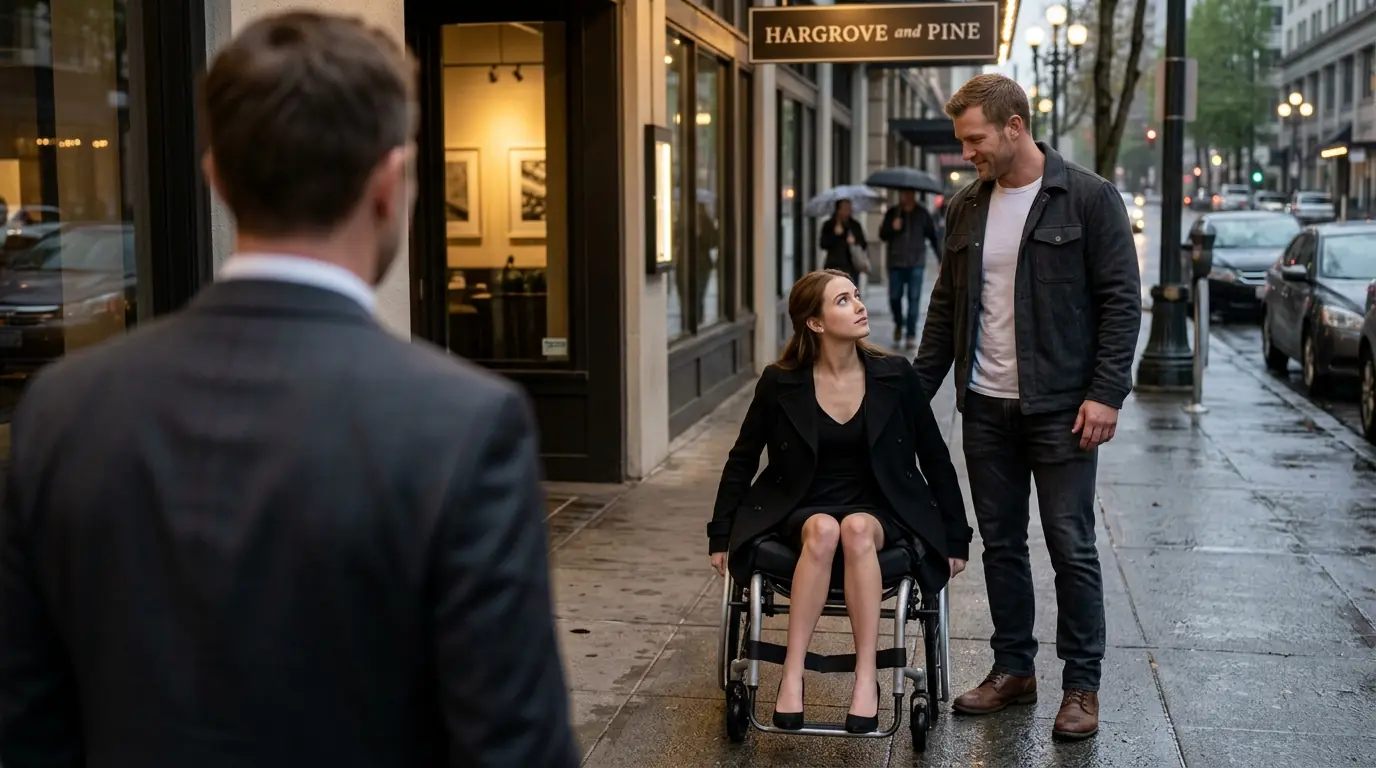
A cold, rainy evening. The entrance to one of the city’s most celebrated restaurants. A woman in a wheelchair sits alone in the amber glow of the doorway. Not because she cannot pay, not because she failed to reserve a table, but because someone decided her presence did not fit the image.
The crowd outside watches. No one moves. Then a single father, his small daughter’s hand wrapped around his fingers, steps forward. He does not shout. He does not argue. He asks one question, and the entire courtyard goes still.
Five minutes later, the manager’s face drains of color. Ten minutes later, the truth changes everything.
The rain that evening was the kind that never quite decided what it wanted to be. Too fine to send anyone running for cover, too persistent to ignore. It clung to the brass letters above the entrance of Hargrove and Pine, a restaurant that had spent 11 years cultivating a reputation built on exceptional food and deliberate exclusivity.
The awning out front was forest green, edged in gold. Two potted topiaries flanked the glass doors like sentries. Inside, the lighting was warm and low, the kind of amber that made every guest look as though they had just returned from somewhere interesting.
Charlotte Vance had eaten at Hargrove and Pine exactly once before, three years ago, attending as a silent observer rather than the woman who had ultimately signed the lease on the building. She had not announced herself then. She did not plan to announce herself now.
She wore a dark navy coat over a simple gray blouse, her hair pulled back without ceremony. The wheelchair she used was lightweight and unadorned, nothing that telegraphed wealth. Nothing that invited conversation. She had learned over 14 months since the accident that people revealed themselves most completely when they did not know who they were talking to.
She reached the entrance at 7:43 and paused just beneath the awning. Out of the worst of the drizzle, through the glass, she could see the dining room. White tablecloths. Candlelight. A bar lined with bottles that caught the light. Several tables appeared open. She had called ahead at 4:00 and been told a reservation had been noted under the name C. Vance, party of one for 8:00.
She was early. She did not mind waiting. What she minded was what happened next.
Madison Reed, the evening’s front-of-house host, spotted Charlotte through the glass and composed an expression that was not quite a smile before opening the door. She was 25, professionally dressed, and carrying the tightly wound energy of someone whose performance review was overdue.
“Good evening. Do you have a reservation?”
Charlotte confirmed that she did.
A pause followed, longer than necessary.
“I’m so sorry,” Madison said, her voice dropping into a register that managed to be simultaneously apologetic and final. “I’m afraid we’re fully booked for the evening.”
Charlotte looked past her. A couple stepped through the doors without being stopped, escorted immediately toward a table by the window. Another pair arrived moments later and received the same treatment. A smile. A quick scan of the tablet. The warm gesture inward.
She looked back at Madison and said simply, “You have a reservation under Vance.”
Madison’s expression did not shift.
“I apologize for the confusion. Perhaps another evening.”
She began to turn back toward the host stand. Charlotte did not raise her voice. She simply stayed where she was, in the rain, watching.
Jason Miller emerged from near the back of the lobby with the practiced ease of a man accustomed to managing problems before they became public. He was 40, broad-shouldered, with the kind of posture that comes from years of believing he was the most important person in whatever room he occupied. He looked at Charlotte with an expression he almost certainly believed was sympathetic.
“Ma’am,” he said, “we have a certain standard we maintain at Hargrove and Pine. I hope you understand.”
He did not elaborate. The meaning was complete without him.
The people near the entrance observed the scene the way crowds observe injustice in public, with discomfort they did not translate into action. Wyatt Brooks was standing 30 feet away, his daughter’s hand in his, watching every second of it.
He had not always been a single father. He had been a husband first, and then a widower, and then a man who reorganized his entire existence around a 6-year-old named Ella, who had her mother’s eyes and an instinct for noticing things that most adults had long since trained themselves to overlook.
They had been on their way to a pizza place three blocks east when Ella spotted the scene at the entrance. Children notice stillness the way animals notice whether something in the air changes, and they feel it before they can name it.
“Daddy,” Ella said, tugging once on his hand. “Why won’t they let that lady in?”
Wyatt had taken it all in: the host’s turned back, the manager’s folded arms, the couple who passed through unimpeded while Charlotte remained in the rain. He understood it the way you understand a bruise, not because anyone explains it, but because you recognize the shape.
He stood still for a moment. He was not the kind of man who made speeches. What he was, at his core, was someone who had been raised by a woman who had told him exactly once that the worst thing a person could do was watch something wrong happen and decide it was not their business. He had been 12 years old when she said it.
He crouched to Ella’s level and said quietly, “Stay close to me.”
She nodded. They walked toward the entrance together.
Jason was still standing near the door when Wyatt approached. Charlotte had not moved. Wyatt stopped a few feet away and said nothing for a moment.
When he spoke, his voice was even. There was no heat in it.
“Excuse me. Can you explain what the standard is? The one you mentioned?”
Jason’s posture stiffened.
“Sir, this is a private matter between the restaurant…”
“And I understand that,” Wyatt said. “I’m just asking you to explain the standard. What does it mean exactly?”
Jason’s eyes moved briefly to Ella, then back to Wyatt. He said nothing.
Wyatt waited. He was comfortable with silence in a way that made other people uncomfortable. After a long moment, he said, “If this woman could stand up right now, if she didn’t need the chair, would she be allowed in?”
The question landed in the damp air like something dropped from a height.
Madison, still holding her tablet, looked at the floor. Jason’s jaw tightened. He did not answer. The answer was visible in the half second of stillness before his expression rearranged itself into something neutral.
Around them, the small cluster of onlookers had gone very quiet. Charlotte, for the first time since arriving, looked directly at Wyatt. He did not look back at her. He was still watching Jason with a calm that had nothing aggressive in it. No challenge, no provocation, just attention.
Ella stood beside him with her hand in his, her eyes moving between the adults with the focused seriousness of a child who understands that something important is happening, even if she cannot yet name every part of it.
Somewhere inside, a fork clinked against a plate, the ordinary sounds of an ordinary evening in a place that had just, in the space of 30 seconds, become something more complicated than it had intended to be.
Jason Miller had been managing restaurants for 16 years, and he had developed a particular skill: the ability to determine quickly whether a situation would resolve itself quietly or require escalation.
This situation required escalation, not upward, but outward.
He straightened his shoulders and said, with the clipped civility of a man who believes volume is for other people, “Sir, I’m going to need to ask you not to interfere in matters that don’t concern you. If you have a reservation, I’m happy to have Madison assist you.”
He gestured toward the host stand as though he were offering something generous.
“I do have a reservation,” Wyatt said. “But that’s not what I asked you.”
He kept his voice at the same level, the same temperature.
“I asked you to explain the standard.”
Jason’s eyes moved to the phones appearing in the crowd. Most people in his position would have modulated accordingly. Jason Miller, who had spent too many years believing that his authority inside these walls was total, did not modulate.
He said, with considerable finality, “Our policy is our policy. If you’re not satisfied with it, you’re welcome to dine elsewhere.”
Ella’s hand tightened around Wyatt’s fingers. He felt the small pressure of her grip. He glanced down. Her expression was not frightened. It was something more precise. She was concentrating, the way she concentrated over a puzzle. Her brow furrowed slightly. Her attention total.
He looked back at Jason and said, “This woman called ahead. She made a reservation. She arrived on time. Is the reservation in the system or not?”
The question was simple enough that it could not be deflected. Madison’s hand tightened around her tablet.
Jason said, “That information is not something I’m at liberty to…”
“So, it might be there,” Wyatt said.
He was not accusing. He was simply noting.
“It might be there. And she’s still sitting in the rain.”
The crowd had grown: guests who had stepped outside, a couple who had paused on the sidewalk. Jason could feel the geometry of the situation shifting against him. He folded his arms.
“I don’t intend to debate our policies with…”
“I’m not debating,” Wyatt said. “I’m just standing here.”
And he was, literally, just standing there, a man on a sidewalk in the rain with his daughter. Refusing to be moved by the social gravity that usually made situations like this collapse back into silence.
That refusal, quiet, inconvenient, impossible to dismiss, was its own kind of force.
Jason looked at him with the focused dislike of a man who wants very much to say something sharp and cannot find the angle.
Charlotte had been watching Wyatt with an expression that had shifted from careful neutrality to something more difficult to categorize. She was not accustomed to being observed in moments of difficulty without pity or discomfort coloring the face of whoever was looking.
What she saw in Wyatt Brooks was neither. He was simply present. He was simply refusing to let the moment pass the way moments like this usually passed, absorbed into the general noise of a city that was very good at moving on.
Charlotte Vance had, in her professional life, hired and fired hundreds of people. She knew, with the particular certainty of someone who had spent years reading rooms, that she was looking at a genuinely good one.
The crowd on the sidewalk had grown enough now that it occupied the edge of the street. A woman near the back said something quietly to the man beside her. Jason looked out at the assembled faces and felt, for the first time, the specific cold of a situation that had moved past the point where he could manage it back into shape.
It was a guest, not an employee, not anyone with a stake in the outcome, who changed the shape of the evening.
He was a man in his 60s, silver-haired, wearing a suit that suggested he had been coming to Hargrove and Pine for long enough that the staff knew his name. He stepped forward with the unhurried authority of someone who had long since stopped needing to perform confidence.
He looked at Jason and said simply, “I was near the host stand when she called. She has a reservation. I heard the confirmation myself.”
Jason’s expression did not collapse. It restructured, the small, precise rearrangement of a man catching himself before something showed.
He looked at the man, then at Madison, then back. Madison was already looking at her tablet. The silence that followed lasted perhaps six seconds. And in those six seconds, the entire texture of the evening changed.
Madison’s face did something complicated. She looked up at Jason and said, in a voice she tried to keep private and failed, “It’s here. C. Vance, 8:00. VIP flag. VIP.”
The letters were small on the screen, but enormous in the air.
Jason’s eyes moved to Charlotte. Charlotte said nothing. The rain continued.
Wyatt had not moved, and he did not move now. He had known somewhere in the part of him that recognized wrongness by its texture rather than its details that the reservation existed. He was not surprised.
What surprised him, faintly, was that he felt no satisfaction at being confirmed right. He felt tired, the way you feel tired when something that should not have happened has happened anyway.
Jason straightened. His instinct now was the same it had always been. Contain, redirect, manage.
“There appears to have been an error in our system,” he said. “We apologize for the inconvenience. If you’d like to come in now…”
Charlotte did not move. She looked at him with an expression that was not angry. Anger would have been easier. What was in her face was something quieter and considerably harder to absorb. Disappointment, clear-eyed and specific.
“The table was there 20 minutes ago,” she said. “The system didn’t change. What changed?”
Jason had no answer for that. He was not designed for questions that arrived already containing their own answer.
The man in the silver suit looked at the ground. Madison was studying her tablet with an attention it did not merit. The crowd had heard enough to understand the shape of what had happened, even those who had arrived only moments before.
Wyatt was still standing precisely where he had been. He had not said anything in several minutes. He did not need to. The truth had arrived without his help. Which was, he suspected, how truth usually worked when you gave it enough room.
Ella had been watching Charlotte for a long time. Children process the world in a different sequence than adults. They feel first, then observe, then ask. She had felt the wrongness of the situation before she could have named it. She had observed Charlotte’s stillness, the way Charlotte held herself without crumbling, the small set of her jaw that communicated, even to a 6-year-old, something about endurance.
And now she asked.
She stepped forward. Just stepped forward, pulling slightly against her father’s hand, and looked up at Charlotte.
“Do you want to come eat with us?” Ella said.
Her voice was the simple, matter-of-fact voice of a child who has not yet learned to treat kindness as a complicated decision.
“We were going for pizza. You can come if you want.”
The offer was so uncalculated that it took the remaining air out of the moment entirely. Jason did not speak. Madison did not speak. The silver-haired man looked at Ella with something that might have been the expression a person makes when they remember something they had forgotten about being human.
Charlotte looked at Ella for a long moment. The child had her father’s stillness. The same quality of simply being where she was without apology or performance. Charlotte had spoken in front of boards of directors, had negotiated contracts worth hundreds of millions of dollars, had sat in hospital rooms in the weeks after the accident, and found words for things she did not know how to say.
She was not a woman easily undone, but something in Ella’s face, the total absence of agenda in it, the clean simplicity of one human being extending something toward another, moved through whatever composure she had maintained all evening and reached something underneath it.
She smiled. Not the calibrated smile she had learned to use in conference rooms, but the other kind. Smaller, involuntary, the kind that arrives before you have decided to let it.
“That’s very kind of you,” Charlotte said.
Ella nodded with the satisfied air of someone who has solved a problem and is ready to move on.
Wyatt was watching Charlotte with an expression that was difficult to read, not because it was closed, but because it was a face that did not translate easily into the ordinary vocabulary of public emotion.
“You don’t have to,” he said to Charlotte. “She means it, but you don’t have to.”
It was the kind of thing only a particular sort of person would add, someone who understood that generosity offered without acknowledgement of the recipient’s autonomy was its own kind of pressure.
Charlotte looked at him. She had assessed Wyatt Brooks in the first 60 seconds of watching him, and she had not revised since. He was precisely what he appeared to be. That was rarer than it should have been.
“I appreciate the invitation,” she said.
She meant it in a way that encompassed more than pizza. She was about to say something else when her phone, tucked in the side pocket of her coat, began to vibrate.
It was Marcus, her assistant, whom she had instructed to call only if something required immediate attention. He had been contacted by her driver, who was circling the block and had spotted something: a corporate vehicle parked at the far end of the street, registered to the Hargrove and Pine Group, the executive kind.
Charlotte was quiet for a moment.
“Tell him to come around front,” she said. “Now is fine.”
Jason Miller received a call on his personal cell at 7:59, one minute before Charlotte’s reservation was set to begin. Whatever was said lasted less than 90 seconds. When he returned to the front, something had changed in his face. Charlotte noticed. She noticed most things.
Madison had meanwhile been approached by a colleague who leaned close and said something that made Madison go very still.
“There’s a corporate audit scheduled for this location. Unannounced visits.”
Madison looked at her tablet, then at Jason, then at the door.
The word audit had a gravitational quality in the restaurant industry that few other words matched. Charlotte gave nothing away. She had spent 14 months learning to wear patience the way other people wore armor.
Ella was examining the brass letters above the entrance with the focused interest she brought to any new text, sounding each one silently against her lips.
Inside the restaurant, at a corner table near the back, a man named Dominic Hale was eating alone. He was 51, impeccably dressed, and had arrived without a reservation because he did not need one. As deputy director of the Hargrove and Pine Group, he occupied a position adjacent to power rather than above it, which was both his professional reality and his deepest source of frustration.
Dominic had known Charlotte was conducting unannounced visits to the group’s locations. He had not known she would come here tonight. He set down his fork with considerable deliberateness and took out his phone.
The call he placed was brief. The person on the other end was someone he had spoken to before about what Dominic had described as image-consistency standards and what the policy documents carefully called guest-experience optimization.
The policy had been quietly inserted into the operational guidelines of four Hargrove and Pine locations over the past eight months. It had not come from Charlotte. It had come from Dominic. And it had been implemented by managers like Jason, who understood, without being told explicitly, what the policy was actually selecting for.
What stood outside the restaurant tonight was not just one woman in the rain. It was the thing Dominic had been hoping would never arrive.
The car that pulled to the curb was black and understated, no livery, no insignia, just the quiet good quality of something very expensive trying not to announce itself. The driver opened the rear door and a man in a dark vest emerged. His name was Marcus O’Shea, and he moved with the quick competence of someone whose job it was to be useful in exactly this kind of moment.
He did not look at the crowd. He looked at Charlotte. And then he said, in a voice pitched just above the rain, “Miss Vance, I have the documents you requested.”
The name reached Jason Miller before the rest of it did.
Miss Vance.
The initials on the reservation.
C. Vance.
He turned his head very slowly toward Charlotte. And the sequence of understanding crossed his face in stages, each one worse than the one before it.
Charlotte Vance, CEO of the Hargrove and Pine Group. Since she had taken the position at 31 and spent the following year restructuring a portfolio of 12 restaurants into something that turned an $80 million loss into a margin that made the board look like geniuses.
Charlotte did not look at him. She accepted a folder from Marcus. Opened it. Reviewed the top document with the calm of someone who was not surprised by anything in it. And then looked up.
Not at Jason. Not at the crowd.
She looked around the entrance, the topiary, the brass lettering, the amber light leaking through the glass, with the particular gaze of someone who is seeing a place and simultaneously seeing what the place should be.
It was, Wyatt thought, watching her, the look of a person who owns something and is measuring the distance between what it is and what she intended.
When she finally looked at Jason, she did not raise her voice.
“How long has the image policy been in effect at this location?” she said.
His mouth opened. He made the beginning of a sound that was not a word. Charlotte waited.
“How long?” she said again, not as a demand but as a correction.
Jason said, “Six months.”
And then, because the truth had begun and there was no clean way to stop it, “Eight. Maybe eight months.”
Charlotte nodded and wrote something in the folder.
The silver-haired man near the door exhaled slowly.
Ella looked up at her father.
“Is that lady the boss?” she said in a stage whisper that was somewhat less private than she intended.
Wyatt said quietly, “Something like that.”
Ella appeared satisfied.
Charlotte moved her wheelchair forward until she was inside the entrance, inside the building that bore her name and had spent nearly eight months applying a policy she had never authorized. She did not survey the room with triumph. She simply sat in the entrance and felt the weight of what the numbers in the folder meant.
Dominic Hale had not yet stood up from his corner table. He would wait, Charlotte knew, to see which way the room settled before deciding what posture to adopt. She had hired him, and she knew his instincts as well as her own.
In the corner of the dining room, he finally stood. He walked toward the entrance with the forward-leaning composure of a man who has decided to take the initiative rather than receive a summons.
“Charlotte,” he said warmly, “I didn’t know you were coming in tonight. Why don’t we find somewhere…”
“Sit down, Dominic,” Charlotte said without looking at him.
He stopped. He stood very still. Then he sat back down.
It was, in its way, the most decisive moment of the evening. Not the revelation, not the folder, but those three words delivered without heat by a woman who had been sitting in the rain 30 minutes ago and whose authority had never, for a single moment, been diminished by it.
Charlotte asked Marcus to pull the full incident logs for all locations covered by the image policy. She had spent six weeks suspecting what the data would show and three weeks confirming it. What had brought her here tonight, in person, dressed like a civilian, in the rain, was the final step. Not the data, but the experience.
She had wanted to feel what it felt like from the other side of the door.
The policy, as Dominic had written it, used language that was clean and corporate. Guest experience optimization, brand consistency standards, alignment with our premium service positioning.
What it meant operationally was that front-of-house staff at four locations had been given unofficial guidance passed through middle management in conversations that left no written record that certain guests should be redirected, not turned away, redirected. The language was careful. The effect was not.
People had been turned away from restaurants that bore Charlotte Vance’s name by a policy she had never seen and never signed.
Dominic’s calculation had been elegant in its way. He had been deputy director for three years and had wanted the director’s chair for two of them. Charlotte believed, with a consistency that had cost her relationships with certain board members, that hospitality was not a luxury good. At its core, it was a human practice. The restaurant business existed because human beings needed to eat together, and the quality of the welcome you gave them was not separate from the quality of the food. It was the food, in a sense.
Dominic did not disagree with this in public. He simply worked around it. He had built the infrastructure for a policy Charlotte would have refused, housed it in language she might have missed in a busy quarter, and handed it to managers like Jason, who were too pressured to interrogate it.
Charlotte looked up from the folder and found Wyatt. He was where he had been all evening near the entrance with Ella, not inserting himself, not performing the virtue of his earlier intervention, simply remaining.
She had been turning something over in her mind since he first spoke to Jason. It was not complicated. This man had done what every person who had walked past her in the rain that evening had been capable of doing and had not done. He had not done it because of who she was. He had done it before anyone knew.
Charlotte turned to Jason.
“You’ve been managing this location for how long?”
“Four years,” he told her.
“In those four years, were you ever given explicit written documentation of the policy that you applied tonight?”
A pause.
“No.”
She wrote something.
“Were you told the policy came from the executive level?”
He said, “I was told it was aligned with brand direction.”
Charlotte did not look up when she said, “Your employment with the Hargrove and Pine Group is terminated effective tonight. You’ll receive documentation by morning.”
Jason said nothing. He had known, somewhere below the level of articulation, that this was possible. He nodded once, retrieved his coat, and did not return.
Charlotte looked at Madison. The young woman had done what she had been trained to do and been given no reason to question it.
“You’re suspended pending review,” Charlotte said, “not terminated. You’ll go through a full retraining program, and when it’s complete, you’ll have a decision to make about whether you want to continue with the company. That decision will be yours.”
Madison managed a nod and excused herself from the entrance, her chin doing something complicated that she was not quite managing to control.
Marcus read from the folder. Four locations, eight months, an estimated several hundred incidents of redirected guests based on criteria that included visible disability, perceived socioeconomic status, and age.
Charlotte set the folder down. She looked at the room, the white tablecloths, the candlelight, the bar lined with bottles, and she said to no one in particular and everyone present, “There is no standard at Hargrove and Pine that ranks above basic human respect. If there is, it doesn’t survive tonight.”
Then she looked across the dining room at Dominic and said, “Stay in the city. My legal team will be in contact tomorrow.”
He picked up his phone and said nothing.
Charlotte turned to Wyatt last. She had been aware of him at the edge of the room throughout, the way you are aware of something stable in a situation that has been anything but.
Ella had sat down on the bottom step of the entryway stairs and was drawing invisible shapes on the floor with one finger, quietly self-contained in the way of children who are giving adults room to do their work. Wyatt was watching his daughter with the expression he wore when he thought no one was watching him: unguarded, soft, the face of someone for whom love was not a complicated subject.
Charlotte moved toward them. Wyatt looked up. She stopped a few feet away and said, “You did what anyone could have done. That’s not a small thing. It might be the whole thing.”
He looked at her with the direct, uncomplicated attention she had come to associate with him.
“You would have been fine,” he said. “You didn’t need me to do anything.”
“No,” she said, “but I was still in the rain.”
He held her gaze for a moment, and something moved in his face, not quite a smile, not quite its absence. He understood what she meant. She did not mean she had needed saving. She meant something more specific and more human. That being seen, when you have been deliberately made invisible, has a weight independent of whether you could have managed without it.
“We’d like you to have dinner here tonight,” Charlotte said. “Both of you. Whatever you’d like. It would mean something to me.”
Wyatt glanced down at Ella, who had looked up from her invisible drawing at the word dinner with focused interest. Ella looked at Charlotte.
“Do they have pizza?” she asked.
Charlotte did not laugh, but something in her face released, the particular release of someone who has been holding something careful and is suddenly allowed to set it down.
“I believe they can manage something close,” she said.
Ella considered this with appropriate gravity and nodded. Wyatt looked around the restaurant, the same room that had been, 40 minutes ago, a place that would not let Charlotte in. Something in the room’s relationship to itself had shifted, the way a room shifts after something true has been said in it.
He said, “All right.”
It was, in its simplicity, exactly the right answer.
They were seated at a table near the window, the three of them. The view looked out onto the street, where the rain had finally gentled into something more like mist. The amber light from inside fell through the glass and touched the wet pavement in a way that made the ordinary sidewalk look, for a moment, like something considered.
Ella pressed her face briefly against the glass and then sat back with the satisfied expression of a naturalist who has confirmed a hypothesis.
Charlotte had asked Marcus to handle the documentation and give her the evening. He had nodded in the way that very good assistants nod, completely, without question, and excused himself with the folder.
The restaurant around them had slowly resumed the sounds of itself. Cutlery, low voices, the specific acoustic warmth of a room being used the way it was designed. The silver-haired man, on his way past their table, paused and placed his hand briefly on Charlotte’s shoulder without saying anything. She looked up and nodded. That had been sufficient.
Wyatt ordered a club soda. Ella studied the menu with the dedicated focus of someone approaching a document for the first time and wanting to get it right. Charlotte ordered water and watched Ella read, the way she moved her lips slightly over unfamiliar words, the way she looked up occasionally at her father for confirmation.
There was something in the child’s attention that settled something in Charlotte. She had been alone for most of the past 14 months. Not in the simple sense of being without company, but in the more specific sense of having moved through the world in a body that now required things of public spaces that public spaces did not always provide, and feeling the particular loneliness of that.
The evening had not been what she planned. She had not planned to sit in the rain. She had not planned to be the subject of a child’s uncalculated kindness or a quiet man’s uncalculated courage. She was not sure, looking back over the past hour and a half, which part had moved her most. She thought it might have been Ella’s offer, that simple, direct, devastating invitation extended to a stranger in the rain with no theory behind it at all.
Ella had been building toward a question for some time, and when it arrived, it arrived with the directness that was her particular signature.
“You’re actually the big boss?” she said.
Charlotte told her yes, of this whole place and a few others.
Ella’s eyebrows moved upward. She looked at her father, who confirmed this with a small nod. She looked back at Charlotte.
“So, you can make things better?” she said. “Like, for everybody? You can make things better for people who come here?”
Charlotte was quiet for a moment. The question was the most honest thing that had been said in the restaurant all evening, which was something, given what the evening had contained.
It was not a complicated question. Children rarely asked complicated questions. They asked the questions that adults had stopped asking because they had decided the answers were too uncertain.
Charlotte looked at Ella with the full weight of her attention.
“I’m working on it,” she said.
Ella nodded slowly with the nod of someone who has received an acceptable answer and intends to hold the speaker to it. She looked at her menu again, then back up.
“Good,” she said with the serene finality of a six-year-old who has rendered a verdict and closed the case.
Wyatt caught Charlotte’s eye across the table. He said nothing. There was, in the small silence between them, something that was not yet anything definable, not friendship, not the beginning of something, just the acknowledgement between two people who have shared an unrepeatable evening and arrived on the other side of it, changed in ways they have not yet finished measuring.
The rain had stopped by the time their food arrived. Through the window, the street was the clean-washed color of a city that had been given a night off from itself.
Ella ate with the methodical satisfaction of a child who had been promised something close to pizza and found that the kitchen had delivered. Charlotte ate slowly, watching the room she owned, thinking about the work that would begin tomorrow: the documentation, the meetings, the policy rewrite, the careful work of rebuilding something that had been quietly damaged.
It was not small work. She did not pretend it was. But she had learned in the past 14 months that the work most worth doing was rarely the work that was easiest to begin.
They left together into the clean post-rain air of the street. Marcus was waiting near the car. Ella walked between Charlotte and her father for half a block before she slipped her hand into Charlotte’s on one side as naturally as though she had always known where that hand was and kept it there until the corner where their paths diverged.
Charlotte looked down at the small hand in hers. There was nothing to say that the moment was not already saying more precisely than she could have managed. She held it until the corner, and then she let it go.
She watched a man and his daughter walk away down a street that was bright now with the specific clean light that follows rain. She stayed where she was for a moment before turning toward the car, because some things deserved to be watched until they are out of sight, and she had learned this year not to look away from the things that mattered.