The rain had been falling since 2:00 in the afternoon, not hard, not dramatic. Just the quiet kind that softened the edges of everything and made the world feel slightly older than it was.
Daniel Carter noticed the sedan on the shoulder before he noticed much else. A black Mercedes S-Class. Hazard lights blinking amber in the gray light. Sitting with the patient resignation of a very expensive machine that had decided, for once, not to cooperate.
He was heading home from a job in Briarwood, a radiator flush and a busted alternator on an ’09 pickup owned by a retired schoolteacher who tried to pay him in cornbread.
He’d taken the cornbread. He usually did.
He had no good reason to stop.
He stopped anyway.
That was the thing about Daniel Carter that most people understood within ten minutes of meeting him. He didn’t calculate things the way other people did. He saw a problem, he moved toward it, and he figured out the rest after.
It had cost him more than once.
It had also saved him more than once.
He’d long since stopped trying to decide which one outweighed the other.
He pulled his truck onto the gravel behind the Mercedes, killed the engine, and sat for a moment watching the rain trace slow lines down his windshield.
He was 34 years old. His hands were permanently stained at the knuckles with something that no amount of soap had ever fully removed. His jacket was the same canvas field coat he’d worn since he was 22, re-stitched twice at the left elbow. He had a six-year-old daughter named Emily who was currently at his sister’s house eating macaroni and cheese from a box.
And he needed to be home by 7:00.
He got out of the truck.
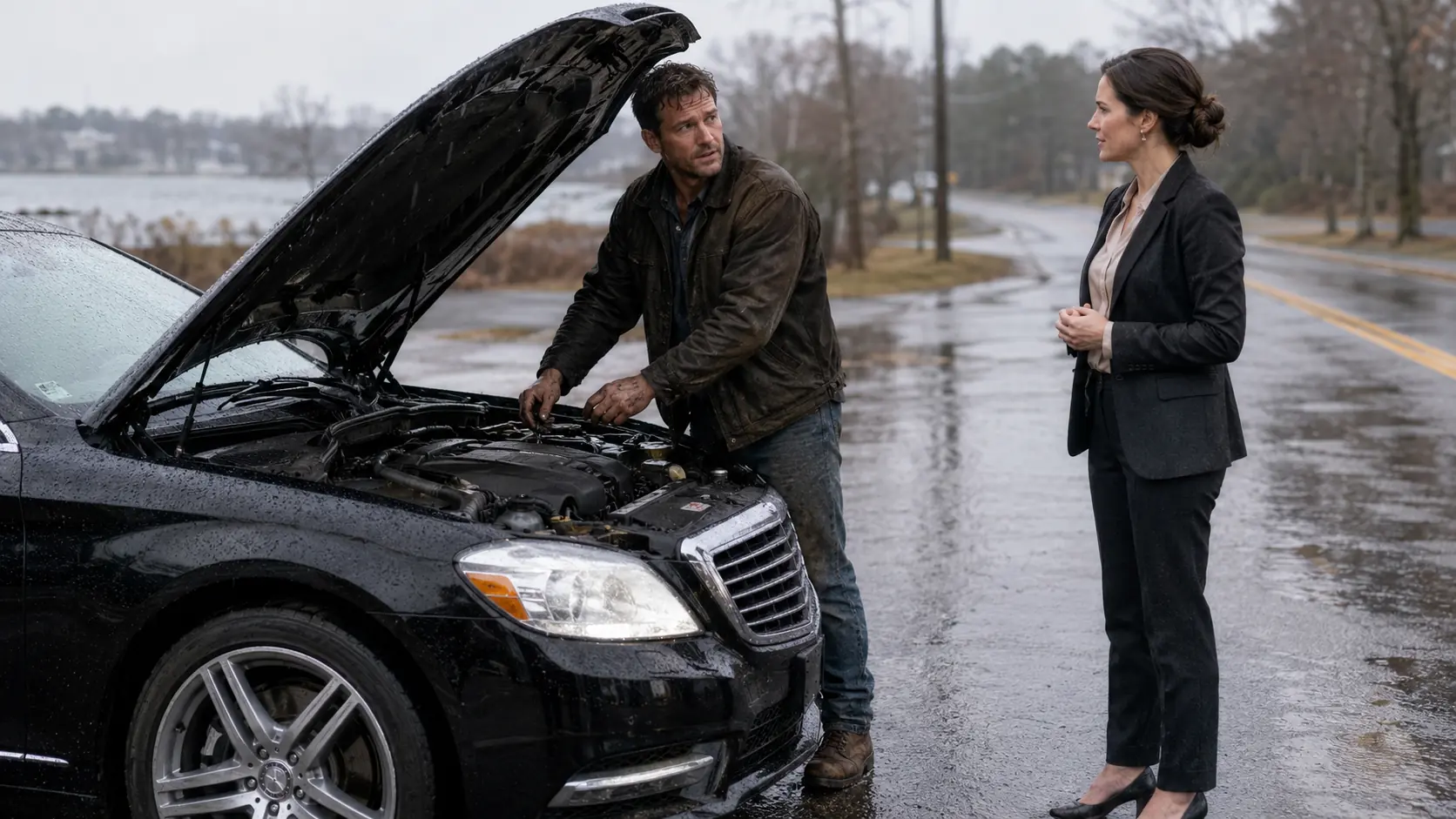
The woman standing beside the Mercedes was not dressed for rain. She wore a charcoal blazer over a silk blouse, dark trousers, low heels that had already absorbed enough water to be ruined. She had her phone pressed to her ear with one hand and was gesturing at nothing with the other, the particular gesture of someone who was on hold and had run out of patience for it.
Her hair was dark and pulled back. And there was something precise about the way she stood. Even in the rain, even in this particular frustration, it suggested she had spent a long time learning how to take up exactly as much space as she needed and no more.
She looked up when she heard his boots on the gravel.
“I already called a service,” she said.
Her voice was professionally calm. The kind of calm that is built, not born.
“Okay,” Daniel said.
He wasn’t offended. He crouched beside the front left tire without being asked, then stood and moved to the hood.
“Mind if I look?”
She studied him for a moment. He was wearing a jacket with a grease stain on the shoulder, and he had arrived in a truck with mud on the wheel wells. She made the calculation that most people made about Daniel Carter, and she made it quickly.
“Be my guest,” she said.
He found the hood release on the first try, which required knowing where to look, and she watched him find it.
He lifted the hood, and the smell of hot metal and a slightly sweet burning edge came up with it. He leaned in. Rain fell on the back of his jacket.
“Your cooling fan seized,” he said. “Engine overheated. You’ve got a little coolant loss, too. See that residue on the reservoir cap? You’ll want to let her sit before you do anything.”
The woman on the phone said something into it, listened, said, “Then escalate,” and lowered the phone. She looked at the engine as though she were looking at a quarterly report that had contradicted her instincts.
“How long?”
“Twenty minutes, maybe thirty.”
She absorbed this the way people absorb things they cannot change. Without expression, but not without feeling.
She put the phone in her blazer pocket.
“Evelyn Hayes,” she said, and extended her hand.
“Daniel Carter.”
He wiped his right hand on his jacket, a reflex, not quite enough to matter, and shook hers. Her grip was firm without being performative.
She looked at the engine again.
“Is this fixable? Here, I mean.”
“Not completely. You’ll need the fan replaced at a shop, but I can get you running well enough to make it somewhere. I have some coolant in the truck.”
“Why do you have coolant in your truck?”
He almost smiled.
“Because I’m the kind of person who has coolant in his truck.”
She looked at him for another moment, and something shifted in her expression. Not much, but enough. She stopped being the woman waiting for a service call and became something slightly less defended. Not warmer exactly, more present.
“All right,” she said.
He went to get the coolant.
The rain continued to fall, unhurried and unconcerned, and the amber hazard lights kept their slow count of the seconds. The road was empty in both directions as far as either of them could see.
He worked methodically and without commentary, which was not what she had expected. Most men, in her experience, narrated their competence. They explained what they were doing as they did it, not for her benefit, but for their own, as though the words made the work more real.
Daniel Carter was not like that.
He added coolant slowly, checked a second line she hadn’t noticed, pressed something near the radiator cap, listened.
He was quiet in the way that certain places are quiet. Not empty, just settled. A cove. A room with good insulation. A library on a weekday.
She stood under the slight overhang of the open hood, which provided no practical shelter from the rain but gave her something to stand beside.
The phone in her pocket buzzed twice. She ignored it both times.
“Do you do this professionally?” she asked.
“Stop and help strangers?”
“I fix cars professionally. The stopping is free.”
“What’s your shop?”
“I don’t have one. I work on my own. House calls, mostly. Word of mouth.”
She filed this away with the particular efficiency with which she cataloged all information.
“Business must be difficult to scale.”
He glanced up from the engine. There was no judgment in his look, just mild attention.
“Probably,” he said. “I haven’t tried.”
“Why not?”
He was quiet for a moment. Not evasive, just considering whether the answer was worth the words.
She had met people who performed thoughtfulness, the pause before the polished answer, the tilted head, the slight frown of apparent deliberation.
This was different. This was someone who actually took a moment because the question actually required one.
“My daughter’s six,” he said finally. “She’s in first grade. She gets out at 3:15. If I had a shop, I couldn’t be there at 3:15.”
The phone buzzed again. She reached into her pocket and silenced it.
“What’s her name?”
“Emily.”
He said it with a particular quality. She noticed not tenderness exactly, but gravity, the way people say the name of something they have decided is more important than almost everything else.
She had heard executives say the names of their companies that way. She had never heard anyone say a name quite that way about a person.
“She likes cars,” he said. “She likes the tools. She lines them up by size. I let her help when it’s safe.”
He checked the coolant level again.
“What about you?”
“What about me?”
“Kids?”
“No.”
The word came out clean, without apology or explanation, which was how she’d learned to say it. She had stopped adding qualifiers years ago.
“No time” suggested regret.
“Not yet” suggested hope she wasn’t sure she had.
Just “no” was honest, and honest was what she could manage.
He nodded, accepting it, and went back to work.
She watched the rain.
There was something disorienting about standing here on the shoulder of a road in Fairhaven County, with no forward momentum, no meeting to walk into, no agenda to advance, nothing she could act on or optimize. Just time unfurling at its own pace, entirely indifferent to her schedule.
She couldn’t remember the last time she’d stood somewhere with nothing to do but wait.
She ran the calculation quickly. Possibly her last dental appointment in March, and even then, she’d been answering messages in the chair.
She found, unexpectedly, that she didn’t entirely hate it.
“You seem very calm,” she said, “for someone helping a stranger in the rain.”
“I was already wet,” he said.
She almost laughed.
Almost.
The impulse surprised her, not the fact of finding something funny, but the fact that it rose so quickly, without the half-second lag she had developed over years of professional conversation, that monitoring for appropriateness.
“Evelyn Hayes,” he said, as though trying the name again.
His voice had changed slightly. Not much. He was still looking at the engine.
“You said that already.”
“I know.”
He straightened up and looked at her directly for the first time.
He had dark eyes and a stillness about his face that was different from blankness, the stillness of someone who had trained himself not to react before he was ready. Not suppression. Patience.
“Where did you go to high school?”
The question was odd enough that she answered it honestly.
“Fairhaven Regional,” she said, “but only for a year. I moved junior year.”
Something happened in his expression. She couldn’t have named it. It was subtle enough that she might have missed it if she hadn’t been watching his face, and she had been watching his face more than she’d intended to.
“Try starting it,” he said.
She got in. She turned the key.
The engine turned over, faltered, caught, and settled into a low and steady idle.
She got out.
“You should be fine for twenty miles or so,” he said. “Get the fan replaced before you drive it again after that. The temperature gauge will tell you if you’re pushing it.”
“Thank you.”
She reached into her blazer for her wallet.
“No charge.”
She looked up.
He was watching her with that same careful attention, and she realized he was looking slightly to the left of center, at something near her eye.
She didn’t know what.
Most people, when they looked at her, looked slightly past her, the way people look at anyone they consider important. Not at the face itself, but at the idea of the face, a focal point somewhere behind the eyes.
She had grown so used to that particular form of non-attention that real attention, directed at a specific, physical, unremarkable thing, felt almost startling.
He was looking at something specific.
“You have a scar,” he said.
His voice was very quiet.
“Left brow. Small one. Right at the edge.”
Her hand went up before she could stop it. Her fingertip found the ridge of it, a thin white line, faint now, barely there.
She had stopped noticing it years ago. Makeup covered it completely. In photographs, it was invisible.
She had not thought about it in months, maybe longer.
“Bicycle accident,” she said. “A long time ago.”
He didn’t say anything else.
He was looking at her, and the rain was falling, and the hazard lights were still going, and Evelyn Hayes had the sudden, groundless, inexplicable sensation that something was about to change.
He didn’t say her name right away.
He stood in the rain and looked at the scar above her left brow, and he was 17 years old again, briefly and completely, the way memory sometimes works, not as a gradual return, but as a sudden arrival.
The smell of cut grass.
A summer afternoon.
The sound of her bicycle hitting the curb wrong, and then the sound of her not making any noise at all, which was somehow worse.
He had been walking back from the hardware store, three blocks from his grandmother’s house, carrying a paper bag of drill bits his grandfather had asked for.
He hadn’t known her. She’d been visiting a cousin on his street.
He saw her fall, and he went to her without thinking, which was already the central habit of his character at 17. He’d pressed his grandmother’s handkerchief against the cut above her eye and told her, with more confidence than he felt, that it was going to be fine.
She had looked up at him with gray eyes that were very steady for someone who was bleeding and said, “I know. I just need a minute.”
He had walked her to the community health clinic on Aldercroft.
It was six blocks.
She held the handkerchief against her eye and walked beside him, and they talked about nothing important, about the neighborhood, about where she went to school.
At the clinic, he sat in the hard plastic chair in the waiting area for an hour and forty minutes until a nurse came out and said the girl was fine. Just stitches. Her cousin had been called.
He left before she came back out.
He didn’t know why.
It had seemed like the right thing to do. She hadn’t needed him anymore.
He thought about those gray eyes for the rest of the summer.
He thought about them, honestly, at various points for the rest of his life, the way you think about a song you heard once in a car with the windows down.
He looked at Evelyn Hayes and said her name.
Not Hayes.
The other one.
The name she’d had at 17, the name he’d heard from the clinic receptionist when she’d been checked in.
“Evelyn Marsh,” he said.
The change in her face was immediate and total.
It didn’t last more than two seconds, but in those two seconds, he saw something move across her expression like light across water.
Recognition.
Disbelief.
Something older than both of those things.
Then the composed surface came back, but not all the way. There was a hairline fracture in it now.
“That’s my mother’s maiden name,” she said. “I haven’t used it in…”
She stopped.
She looked at him differently than she had been looking at him.
“Aldercroft Street,” she said.
“July,” he said. “You were visiting the Pattersons.”
She was very still.
The rain fell around them.
A car passed on the road without slowing down.
“You left,” she said, “before I came back out.”
“I didn’t think you’d want some stranger hovering.”
She looked at him with the gray eyes he remembered.
And they were 34 now, both of them.
Everything was different, and nothing was different, and he had no idea what to do with any of this.
“Daniel,” she said.
“Yeah.”
The hazard lights kept blinking.
The engine idled quietly.
The rain came down soft as old regret, and neither of them spoke.
They stayed by the car.
Neither of them suggested moving.
The rain was not uncomfortable, and the alternative, getting into their separate vehicles and driving away in opposite directions, had become somehow impossible without being discussed.
She leaned against the passenger door. He stood with his hands in his jacket pockets.
At 17, they had walked six blocks together and talked about nothing, and somehow that had mattered more than most conversations he’d had since.
“I looked for you,” he said.
He had not planned to say it.
He said it anyway, because he had learned at some cost that things left unsaid have a way of staying in the body, collecting interest.
“I moved that fall. My father got a position in Boston. We left in August.”
She paused.
“It happened fast. We didn’t have…”
She stopped again.
“There was no way to reach anyone. I was 16.”
“Seventeen,” he said.
She looked at him.
“You remember my age.”
“You told me you were turning 17 in August. At the clinic.”
Something passed through her expression, not quite pain, something quieter than pain.
“We were there for two hours, and I told you when my birthday was.”
“You were nervous and you were talking. You told me a lot of things.”
She turned her face toward the road.
He watched her profile.
She had grown into herself in ways that were hard to define. The girl from Aldercroft Street had been sharp-edged and uncertain. This woman had found her edges and built something solid along them. But underneath the CEO and the blazer and the carefully composed expression, he could still find the shape of the girl who had looked up from the pavement with steady eyes and said, “I just need a minute.”
“I thought about that afternoon,” she said.
She did not look at him when she said it.
“A number of times.”
“So did I.”
They were quiet.
“What happened after?” she asked.
“After I left? I stayed in Fairhaven. Got my certifications. Worked at a shop for a few years. Got married.”
He paused.
“That didn’t work out. She left when Emily was 18 months old. It’s been the two of us since.”
She looked at him then.
“I’m sorry.”
“Don’t be. Emily’s the best thing that’s ever happened to me.”
He meant it completely and without performance.
“And you? What happened after Boston?”
“College. MBA. Then twelve years of climbing whatever needed to be climbed.”
She said this as though reading from a resume she had long since memorized.
“Hayes Industries. My husband’s company. He retired and passed leadership. Then we divorced. That was four years ago. Now it’s just the company.”
He noticed that she listed the company last and the husband before it. He noticed that she said “the company” and not “my company,” even though presumably it was.
“How many people work for you?” he asked.
“Fourteen hundred, give or take.”
He was quiet for a moment.
“That’s a lot of people’s 3:15.”
She looked at him without understanding.
“3:15,” he said. “Pickup time. A lot of parents who work for you. A lot of 3:15s you’re making decisions about.”
She was very still.
“I hadn’t thought about it that way.”
“Most people in your position don’t.”
He said it without accusation, just as a thing that was true, and something about the absence of judgment in his voice made it land harder than criticism would have.
Her phone rang.
She looked at the screen, silenced it.
“You keep doing that,” he said.
“My VP of operations,” she said. “He’ll leave a message. Or the thing he’s calling about will get worse while he’s leaving it.”
She half-smiled.
It was the first time he’d seen her face do that, and it changed the whole landscape of her expression.
“You sound like a man who’s fielded a lot of urgent calls.”
“I’ve fielded a lot of calls from people who thought their car problem was urgent.”
He paused.
“Most of them could wait. Some of them really couldn’t.”
She looked at him for a long moment.
Then she took the phone out and called the VP back.
He went to check the engine temperature while she talked.
The engine was cooling steadily, which was what it needed to do.
She finished the call in four minutes, a crisis that had apparently been manageable all along, requiring only one clear decision and the authority to make it.
When she lowered the phone, she looked slightly embarrassed, which was an expression he suspected she didn’t wear often.
“It was manageable,” she said.
“Usually is.”
She looked at her shoes, the ruined heels, and then back at him.
“Can I ask you something?”
“Sure.”
“Did it bother you that I left without saying goodbye that summer?”
He thought about this seriously, the way he thought about most things. Not searching for the polite answer, but for the accurate one.
“For a while,” he said finally. “I was 17. I built a story about it that probably wasn’t fair to you, the way you do when you don’t have information.”
“What story?”
“That you’d seen where I lived and decided I wasn’t worth the effort.”
She closed her eyes briefly.
When she opened them, the gray was very clear.
“That’s not what happened.”
“I know that now.”
“I was sixteen, and my father made a decision, and I had no agency over any of it. We left in ten days. I didn’t have your phone number. I didn’t know your last name. I only knew that there was a boy named Daniel on Aldercroft Street who had walked me to a clinic and sat with me for two hours, and I had never properly thanked him.”
She stopped.
“I looked, actually, when I was in college. Tried to find you. I knew the street. I knew the approximate year. I knew your first name. It wasn’t enough.”
He was quiet for a moment.
“You looked?”
“Yes.”
The rain had softened further, barely more than a mist now, the kind that you don’t notice until you realize your hair is damp.
A hawk turned one slow circle above the field on the other side of the road and disappeared into the gray.
“I’m sorry I made a story out of it that wasn’t yours,” he said.
“I’m sorry I disappeared.”
They stood with that for a moment, not trying to resolve it, just letting it be what it was.
Two people who had carried an unfinished thing for 17 years and had now, by the particular accident of a seized cooling fan and a quiet road, found the end of it.
There is a specific kind of grief for things that almost were.
It is different from the grief for things that were and ended.
It is lighter and more patient, and it sits in you without demanding anything, just occasionally rising to the surface on days when the light is a certain color or the rain falls a certain way.
She had felt it over the years without ever naming it.
The boy on Aldercroft Street.
The boy who left before she came out.
He had felt it, too.
“I’m glad I stopped,” he said.
She looked at him.
“So am I,” she said.
And she meant more by it than those three words were able to carry, and they both knew it, and neither of them said the rest out loud.
Not yet.
The afternoon was still here.
There would be other moments, or there wouldn’t. That was the nature of this particular kind of thing. You couldn’t engineer it. You could only not close the door.
“The engine should be fine now,” he said.
“I know.”
She didn’t move toward the car.
Her phone rang again.
She looked at it, and this time she answered immediately.
The alert had changed, the name on the screen different from before. He watched her face sharpen as she listened. The CEO came back, and she let it come back, because this one was different.
“How long ago?” she said.
And then, “Don’t release the statement yet. Not one word until I’ve seen it.”
And then, “I’m thirty minutes out.”
She lowered the phone and looked at Daniel with an expression he recognized, the expression of someone who is needed somewhere else and knows it.
“Trouble?” he said.
“A data irregularity. Could be nothing. Almost certainly isn’t.”
She gathered herself. The slight straightening of posture, the resettling of the composed surface.
“I need to go.”
“I know.”
She reached into her blazer for the second time, and he said, again, “No charge.”
And she stopped.
“This is the second time you’ve refused payment,” she said.
“You helped me fix my car in high school,” he said. “This is roughly even.”
She looked at him for a moment.
He thought she might argue.
She didn’t.
“The company,” she said carefully. “If you wanted to bring the truck in sometime, Hayes Industries has a fleet. Twelve vehicles. They’re serviced by a contract firm, but the quality has been…”
She paused.
“I’m not explaining this well.”
“You’re offering me work.”
“I’m saying there might be work if you wanted it.”
She said this carefully, not as a CEO making a business decision, but as something else, as a woman trying to find a reason that was practical enough to be acceptable.
“You’d have to come to the building.”
“All right,” he said.
She looked at him as if she’d expected him to say no.
“All right.”
“Give me a number,” he said. “I’ll call about the fleet.”
She took a card from her wallet and held it out. It was a proper business card, heavy stock, simple font.
Evelyn Hayes, Chief Executive Officer, Hayes Industries.
He took it and held it with two slightly dirty fingers and looked at it and put it in his jacket pocket.
“Thirty minutes,” she said, more to herself than to him.
She moved toward the driver’s side.
He moved toward his truck.
“Evelyn,” he said.
She turned.
He almost said, “It’s good to see you.”
Which was true, but insufficient.
He almost said, “I’m glad it was you.”
Which was true, but strange.
What he said was, “Drive slow for the first few miles. Let the engine tell you if it’s happy.”
She held his gaze for a moment.
Then she nodded once, got in the car, and drove away.
He stood on the shoulder and watched the black sedan until its taillights disappeared around the bend and the amber hazard lights went with them, and the road was just a road again.
He stood there a little longer than he needed to.
Then he got in his truck and drove home to his daughter.
He called about the fleet.
He told himself he called because twelve vehicles on a contract was three months of Emily’s extracurricular fees and a new compressor for the shop space he rented on Tuesdays and Thursdays.
Both of these things were true.
He did not spend much time examining whether they were the only true things.
He left a message.
She called back within the hour, which was faster than he’d expected.
“I’m going to be honest with you,” she said without preamble. “The current contract isn’t up for another four months. I can’t break it cleanly before then.”
“Okay,” he said.
“But I’ve been thinking.”
She paused.
And in the pause, he could hear the specific quality of someone choosing words with care.
“There’s a review we do quarterly on the fleet. The service provider sends reports. I look at numbers. I don’t actually understand what I’m looking at. If you were willing to come in and look at the maintenance records, not as a bid, not as a commitment, just as a second opinion, it would be useful to me.”
He understood what she was doing.
She was building a ladder from where they were to where she wanted them to be, and she was building it one careful rung at a time, and she was doing it in language that gave them both an exit if they needed one.
“I can do that,” he said. “I’d need to bring Emily. I don’t have coverage on Friday afternoons.”
There was a brief silence.
“That’s not a problem,” she said.
And her voice had changed slightly in a way he noticed, but didn’t name.
“One more thing,” he said.
“What’s the actual make and year of the fleet vehicles?”
She laughed.
It was unexpected and brief, and he thought it was probably the most genuine sound he’d heard from her.
“I have absolutely no idea,” she said. “I’ll have my assistant send you the records.”
The records came that afternoon.
He spent the evening going through them at the kitchen table while Emily sat beside him, drawing horses on blank printer paper, occasionally leaning over to ask what he was looking at and then losing interest and going back to her horses.
He went through three cups of coffee.
The fleet records were, as he had suspected, a minor disaster of deferred maintenance and misreported service intervals.
He called back the next morning.
“You’ve got two vehicles that shouldn’t be on the road,” he said. “And the transmission on your primary executive car has been flagged and reflagged three quarters in a row without anyone actually addressing it.”
A long pause.
“The firm said it was within acceptable parameters.”
“The firm has a financial incentive to defer expensive repairs,” he said. “What the records actually show is a transmission that is going to fail. Maybe not tomorrow. Maybe not next month. But it’s going to fail at an inconvenient moment.”
“That car takes our VP of operations to the airport,” she said, “twice a month.”
“I know. I read the logs.”
Another pause.
“Come in Friday,” she said. “Bring Emily.”
He came in Friday.
Hayes Industries occupied the top four floors of a building on Meridian Boulevard, the kind of building designed to remind you, at every level, that you had arrived somewhere that had a standard.
The lobby had a marble floor and a receptionist behind a desk made of something that wasn’t wood, but had been designed to suggest wood.
The security guard looked at Daniel’s truck through the glass front and then looked at Daniel and then at Emily and made the calculation in real time.
“Visitor?” he said.
“Carter,” Daniel said. “Two o’clock.”
The guard checked the screen. He found it, which seemed to mildly surprise him.
“Sign in here.”
Emily, holding her father’s hand and looking at the marble floor with great interest, was wearing her blue corduroy jacket, and her hair was in two braids that Daniel had done that morning, which meant one of them was slightly crooked.
She looked up at the guard with the cheerful lack of self-consciousness of a six-year-old who has never felt unwelcome anywhere because it hasn’t occurred to her that she could be.
“Your floor is shiny,” she told the guard.
“Yes, ma’am,” the guard said.
And his voice had changed.
Evelyn met them at the elevator on the 14th floor.
She was in the same register as before, blazer, trousers, hair pulled back, but something was different.
She was in her environment now. There was more certainty in the way she occupied the space, but there was also something else.
She saw Emily, and her composure did something very brief and private.
“Hi,” Emily said.
“Hi,” Evelyn said. “I’m Evelyn.”
“I’m Emily. We have the same first letter.”
“We do,” Evelyn said.
She looked at Daniel.
He looked back at her.
They had the brief compressed exchange of two adults who both found the same child delightful and were mildly surprised to find themselves sharing the observation.
The walk through the office was not comfortable.
The open-plan floor had a certain atmosphere that Daniel felt the way you feel a change in air pressure. Nothing visible, just a pervasive awareness that he did not belong here.
Two junior staff members near the window cluster stopped talking to watch him pass. A woman in a headset looked up from her screen, looked at his jacket, looked at Emily’s crooked braid, and looked away.
A man with the specific body language of someone who considered himself important came across the floor with a tablet and stopped when he saw Daniel.
“Evelyn, I didn’t know you had—”
“Marcus, this is Daniel Carter. He’s reviewing the fleet records.”
Her voice was level and matter-of-fact.
“I’ll come find you when we’re done.”
Marcus looked at Daniel the way people look at things they can’t quite categorize.
He nodded and left.
Evelyn guided them into a glass-walled conference room and closed the door.
“I’m sorry about that,” she said.
“Don’t be,” Daniel said.
He meant it the same way she’d meant it about his marriage, not as dismissal, but as actual release.
Emily had found the white marker on the glass conference table and was looking at it with the expression of someone who wanted to draw on things.
“You can have that,” Evelyn said.
Emily looked at her father.
He nodded.
She began, very carefully, to draw a horse on the corner of the glass wall.
“Is that okay?” he asked.
“It wipes off,” Evelyn said.
She was watching Emily draw.
She said it again, more quietly.
“It wipes off.”
They went through the records for forty minutes.
Daniel had printed his notes, actual printed pages from an actual printer, with handwritten annotations in the margins. Evelyn kept reaching for a legal pad to write things down rather than using her laptop, which he noticed.
She asked good questions, not the questions of someone performing understanding, but of someone who actually wanted to know.
“You have mechanical intuition,” he said partway through.
“I understand systems,” she said. “Cars are systems. I just don’t know the vocabulary.”
“Same intelligence, different language.”
She looked at him.
“That might be the most generous thing anyone has said about my automotive ignorance.”
He wasn’t trying to be generous.
He was just saying what he saw.
Emily, by this point, had drawn three horses and a truck on the corner of the glass wall and had fallen asleep in the large conference chair with her cheek resting on the table and her hand still holding the marker.
Daniel put his jacket over her without breaking the sentence he was in the middle of.
Evelyn watched him do it, then looked at her legal pad for a moment before looking up again.
“She’s very easy,” Evelyn said, not meaning simple, meaning restful.
“She’s always been like that. Easy in herself.”
He paused.
“Her mother was like that, actually. Whatever else went wrong.”
Evelyn was quiet for a moment.
“Do you miss her?”
“The marriage?”
He thought about it honestly.
“I miss the idea of it. What it was supposed to be. The actual thing, no. The actual thing was two people who had married for reasons that sounded right at 24 and turned out not to be.”
“I know that feeling exactly,” she said.
They looked at each other across the conference table with the sleeping child between them and the glass walls on three sides and the city visible in the gray afternoon light, and Daniel thought, This is a strange place to feel comfortable.
But he did.
Three weeks later, the company’s crisis found him.
He was in the shop on a Thursday morning when she called, not the measured, composed voice of the first afternoon, but something that moved faster and showed its edges.
“The transmission,” she said. “The one you flagged. It failed this morning on Route 9. Marcus was in the car. He’s fine, the car isn’t. But the issue isn’t just the car.”
He listened.
“The service firm had been marking it as inspected,” she said. “For three quarters. It was never inspected. I had legal pull the service logs. They haven’t physically seen that vehicle in eight months.”
“Fraudulent reporting,” he said.
“Yes.”
A pause.
“I have two other contracts with this firm for other aspects of operations. If they’ve done this with the fleet…”
“Then you don’t know what else they’ve misreported.”
“Correct.”
He could hear her moving somewhere, the click of heels on a hard floor.
“I need someone to look at all twelve vehicles. Not to review the records. To actually look at the vehicles this week, if possible.”
“I can do it over two days,” he said.
“I’ll have all twelve in the garage by Friday morning.”
He was quiet for a moment.
“Evelyn.”
“Yes?”
“This is going to be worse than the transmission.”
“I know.”
“You’ll need a new contract. A different firm or someone in-house. The inspection cycles, the actual maintenance. It’s going to cost more than what you were paying.”
“I know that, too.”
“And the fraudulent reporting, you’ll need to document everything before you do anything else. Legal and otherwise.”
“I have a lawyer.”
“Good.”
A brief pause.
“Daniel. I’d like you to manage the fleet directly on a permanent basis. Whatever arrangement makes sense for your schedule.”
She said it carefully, as she said most things.
“I’m not asking you to come in-house. I mean a proper contract on your terms. Emily’s pickup time stays at 3:15.”
He was quiet long enough that she added, “You don’t have to answer now.”
“I know,” he said. “I was going to say yes.”
She exhaled.
“Okay. Okay.”
He paused.
“I’ll bring Emily on Friday. She’s been asking about the horses on the glass wall.”
He heard something in her voice that he recognized because he’d learned to listen for it, a smile she hadn’t decided to make.
“They’re still there,” she said. “I haven’t wiped them off.”
He put the phone down and stood in his shop looking at the cars in various states of repair and thought about the shape of things changing.
He had been afraid of change once, after the marriage ended and Emily was 18 months old, and the shape of his life had narrowed to just the two of them and the work and the 3:15.
He had arranged his world very carefully around that shape.
It fit.
It held.
He was not afraid now.
He was not sure why.
He picked up his wrench and went back to the car on the lift.
She came to the garage on a Saturday in November, and she was not wearing the blazer.
This is a small thing to say, and it was not a small thing.
She wore jeans and a gray sweater, and her hair was loose, and she was carrying a thermos of coffee that she had made herself, which she mentioned only because he asked and which she said with the slight defensiveness of someone who has been told more than once that they are not domestic, as though that were a flaw.
“I know how to make coffee,” she said.
“I didn’t say you didn’t.”
“You looked like you were about to.”
“I looked like I was grateful for it,” he said, which was true.
Emily was in the corner of the garage on her stool, the particular stool with the wobbly leg that she refused to let him fix because she had declared the wobble to be a feature, sorting bolts by size into a partitioned tray.
She had been doing this for twenty minutes with the deep concentration of a person for whom this activity was exactly right.
She looked up when Evelyn came in.
“Hi, Evelyn,” she said.
“Hi, Emily.”
“I found a bolt that goes in none of the sections,” Emily said, and held it up.
It was an M8 flange bolt, slightly corroded, and it had indeed been sorted into its own isolated compartment of the tray. Emily had written unknown on a small piece of masking tape and stuck it to the compartment’s edge.
Evelyn crouched down and looked at the bolt.
“How do you know it’s unknown and not just a different category?”
Emily considered this.
“Because everything else knew where it went,” she said. “This one didn’t. So it gets its own place until we figure it out.”
Evelyn looked at the bolt in its labeled compartment.
And something in her expression shifted in the way things shift when a child says something that turns out to be true about more than bolts.
She stood. She leaned against the workbench beside Daniel. She offered him the thermos. He poured two cups into the spare mugs on the shelf, mismatched, slightly chipped, entirely functional.
They drank coffee in the garage and watched the November light come through the high window at the angle it comes in November, low and golden and patient.
Emily sorted bolts.
Outside, a car passed on the street and then another.
And then it was quiet again.
“I canceled the Singapore trip,” Evelyn said.
He looked at her.
“The one in December. There’s a board meeting I can do by call. And the partnership review doesn’t actually require me to be on the ground. I’d been assuming it did.”
She paused.
“My COO pointed out that I’d been operating on the assumption that my presence was required everywhere. He said it with more diplomacy than that.”
“Good COO,” Daniel said.
“He’s been saying it for two years,” she said. “I heard it this time.”
She wrapped both hands around her mug.
“I’ve been thinking about what you said. About 3:15.”
“You’ve been thinking about it for a while.”
“Yes.”
She looked at Emily, who had found a second unknown bolt and was making a second labeled compartment for it.
“It’s not the same thing,” she said. “I know that.”
“I know,” he said. “It doesn’t have to be the same thing.”
She was quiet for a moment.
The garage smelled of oil and cold air and coffee.
Somewhere outside, a dog barked twice and was done.
“I keep thinking about that afternoon,” she said. “On the road. I keep thinking…”
She stopped.
Tried again.
“I have spent 17 years optimizing for arrival, for the destination, and I met you when I was 16 on a street I didn’t live on. And I couldn’t find you afterward. And somehow, in all the optimizing, I…”
She stopped again.
He waited.
“I don’t know how to do this slowly,” she said. “I don’t have the vocabulary. I optimize. I execute. I deliver. I don’t know how to just…”
She looked at him.
“Be somewhere.”
“You’re being somewhere right now,” he said.
She looked around the garage. The mismatched mugs. The partitioned bolt tray with its unknown compartment. The November light. Emily, who had given up on sorting and was now drawing a horse on the back of a receipt with a grease pencil she’d found.
“I am,” she said, as though this surprised her slightly.
They stood beside each other at the workbench and did not touch, and did not need to.
There was a particular quality to the silence between them that is difficult to describe. It had the ease of two people who have already said the hardest things and have arrived at the part that doesn’t require words.
The past was not gone.
The years between 16 and 34 were not a wound that had closed exactly.
But they had been named.
And that is its own kind of medicine.
Emily looked up from her receipt drawing.
“Evelyn,” she said.
“Yes?”
“Do you want to help me do the other tray?”
She held up a second partition tray.
“These are the ones that go with the engine. I know where most of them go.”
Evelyn looked at the tray.
She looked at Emily.
She pushed off the workbench and went to the stool beside Emily’s wobbly one and sat down.
Emily moved the tray between them and said, “Okay, so the rule is we sort them by size first and then by whether they have a flat top or a round top.”
And Evelyn said, “All right,” and bent her head over the bolts with the same focused attention she brought to everything.
Which was the thing Daniel had known, in some wordless way, from the very beginning.
She brought herself fully to whatever she was doing.
That had been true at 16 on a borrowed bicycle.
It was true now.
He watched them for a moment.
His daughter explaining the bolt system with the earnest precision of someone who had thought about it carefully, the woman from Aldercroft Street listening as though it was the most important briefing she’d attended all year.
He turned back to the car.
There was a valve cover gasket to replace, and the light was still good, and 3:15 was not until Monday.
He had time.
Outside, the November sky had moved from gold to the particular deep blue that comes just before dark, the hour that feels, on the right afternoon with the right company, like the world has taken a breath and is holding it gently, not in anxiety, but in the way you hold something because you’re glad it’s still there.
The garage light came on automatically when the natural light fell below a certain threshold.
It hummed softly.
Emily said something that made Evelyn laugh, a real laugh, the open kind, surprised by itself.
The sound of it moved through the garage, and Daniel did not look up from the engine.
He didn’t need to.
He knew that sound already, somehow.
Knew it in the way you know the sound of a window seat in an old house, a thing you have never experienced but recognize at once as something that should have always been there.
He tightened the last bolt, straightened up, and wiped his hands on the cloth that lived in his back pocket.
The valve cover gasket sat correctly.
The engine would be quiet now.
It was a small thing to have fixed.
It had taken him eleven minutes.
And it would last for years if maintained.
That was the thing he loved about mechanical work, had always loved about it since his grandfather first showed him the inside of a ’74 Buick on a summer afternoon when Daniel was nine.
It was honest.
Parts either fit or they didn’t.
Problems either had causes or they didn’t.
Fix the cause, the problem went away, unlike most other things in a person’s life, where you could do everything right and still arrive at the wrong answer.
Emily had fallen asleep in the bolt tray.
Not literally. She was six, not narcoleptic. But she had lost interest in the sorting and was now lying on her side on the wide shop couch against the far wall, the one with the cracked vinyl that Daniel had fixed with electrical tape so many times it had become a kind of patchwork record of the years.
Her eyes were still nominally open. She was watching Evelyn clean up the bolt trays with the expression of someone who had decided that everything was fine and sleep was not entirely out of the question.
Evelyn put each section tray back into the larger case with the same methodical attention she’d given everything that afternoon.
She noticed which bolts Emily had marked unknown, and she left them exactly where they were, in their labeled compartments, undisturbed.
“Hey,” Daniel said.
Emily looked up from the couch.
“You want to stay for dinner?”
He was looking at the bolts, at Emily.
But the question had a direction, and all three of them knew it.
The question was addressed to the room, which was fair. It was Emily who would need to be asked, and Emily who would decide, in the way of children, the true answer by her response.
Emily sat up.
She looked at Evelyn with the calm, appraising gaze of a six-year-old who had thought about things more carefully than adults generally credit.
“Dad makes pasta on Fridays,” she said, “with the kind of sauce from the jar, but also with the other stuff he adds.”
She paused, evidently deciding this needed clarification.
“It’s good. It’s not just jar sauce.”
“It sounds good,” Evelyn said.
“Do you like pasta?”
“Very much.”
Emily nodded.
The matter was settled.
She picked up the marker from earlier and went back to the receipt she’d been drawing on. The decision had been made and did not require further deliberation.
Evelyn set down the bolt she was holding.
She looked at Daniel.
She looked at the garage, the high window, the humming light, the mismatched mugs still on the workbench with their cold coffee still in them, at Emily, who had already returned to her receipt drawing with the serene confidence of a child who knows the answer before it’s given and has never wasted much energy on the space between question and outcome.
“Yes,” Evelyn said.
Nothing else needed to be said.
And so, nothing else was.
They locked up the garage at 6:30, Daniel throwing the heavy bolt, Emily turning off the shop light with the specific satisfaction she always brought to this particular task, Evelyn standing in the doorway with her hands in the pockets of her sweater, watching the street outside.
The November air had that particular quality of the season’s first real cold, clean and direct, without the softening that came earlier in fall.
You couldn’t pretend it was still summer.
It was what it was.
They walked to the house across the small side yard, the dry grass pale under the streetlight.
Emily went ahead. She was explaining something to herself, or possibly to an imaginary companion. She did this sometimes, a running commentary on her own life that she did not seem to require an audience for.
Evelyn walked beside Daniel.
Their shoulders were close but not touching.
There was no calculation in this, on either side. It was just the width of the path and the natural proximity of two people moving in the same direction at the same pace.
“November is my least favorite month,” she said.
“Why?”
“Everything’s already let go, but winter hasn’t committed yet.”
She paused.
“It feels indecisive.”
He thought about it.
“I like it,” he said. “For the same reason. It’s in between. It’s not trying to be something it isn’t.”
She was quiet for a moment.
“You would say that.”
“Is that a criticism?”
“No,” she said. “It’s an observation.”
They went inside.
The house was warm and slightly cluttered in the particular way of houses where one adult and one child have established genuine comfort. Books on the floor beside the couch, a pair of small boots beside the door, a drawing of a horse taped to the refrigerator with three pieces of masking tape.
Emily took off her jacket and hung it on her hook and went to wash her hands without being asked, which Evelyn noted and filed alongside all the other things she was filing about this particular afternoon.
Daniel put water on.
Evelyn sat at the kitchen table.
And that, in the end, was the whole of it.
Not a grand gesture.
Not a declaration.
Not a scene from something larger and more dramatic than itself.
Just water coming to a boil in a kitchen in November while a child washed her hands and a woman sat at a table she had not sat at before, but that already felt, in some quiet way, like a table she might sit at again.
Some arrivals announce themselves.
Others simply happen, and you look up and find that you are somewhere you meant to be.