Jackson Reed sat in his truck outside the Turning Point Cafe at 6:45 on a Saturday evening, staring at his phone like it might spontaneously combust.
Honestly, he was hoping it would.
If his phone exploded right there in his hand, if sparks shot out of the screen and smoke rose from the case, then at least he would have a legitimate excuse to drive home, order pizza for his daughter, and pretend the whole disastrous idea had never happened. 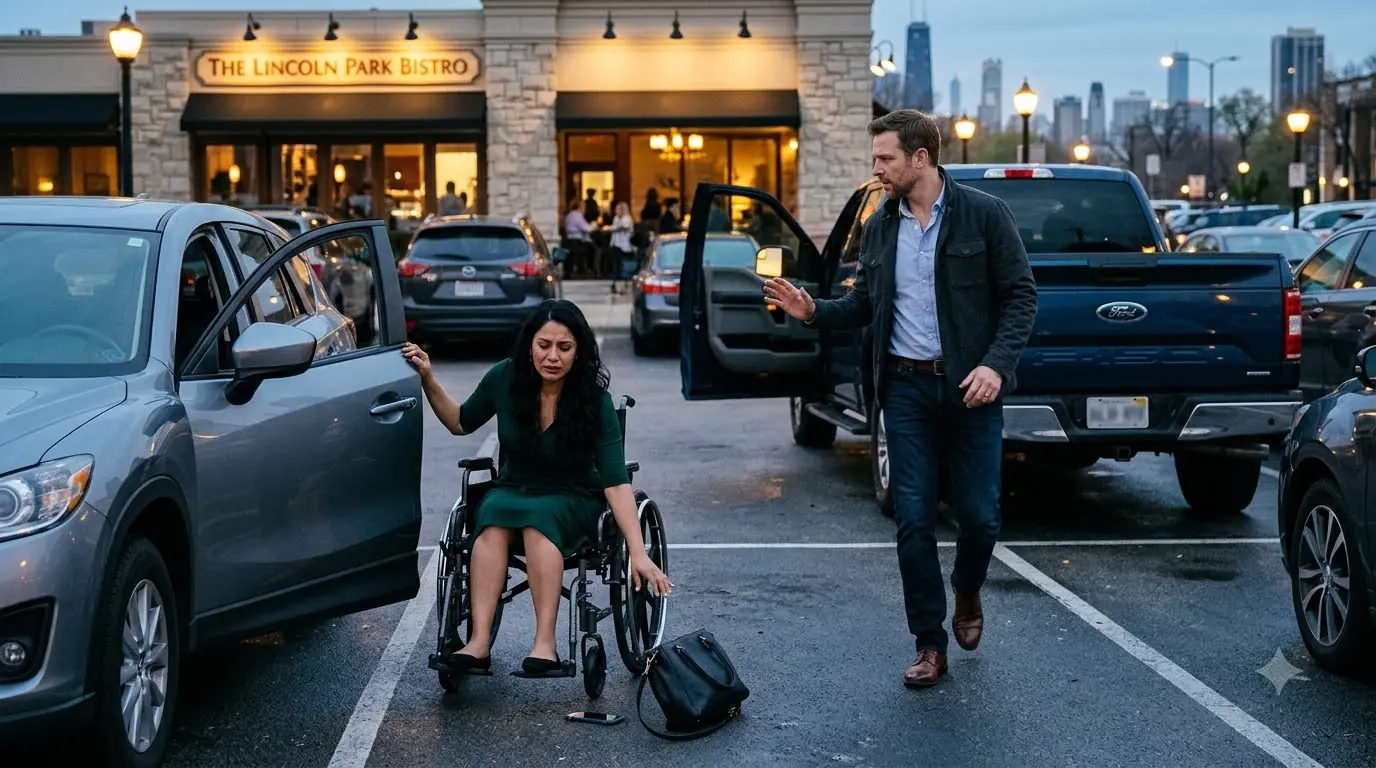
But the phone remained stubbornly intact, glowing in the dim cab of his truck with another message from his older sister Vanessa.
You promised. She’s already inside waiting. Don’t you dare cancel on her.
Jackson leaned his head back against the seat and closed his eyes.
Vanessa Reed did not make empty threats. She had known him since he was a skinny kid with missing front teeth and an impressive talent for getting stuck in trees. She knew every embarrassing story, every dumb decision, every secret he had hoped adulthood had buried. If Vanessa said “don’t you dare,” it meant she had already chosen the memory she would weaponize if he disobeyed.
It was his first date in three years.
The first time he had put on a clean button-down shirt for someone who was not his daughter’s teacher, his boss, or a funeral director. The first time he was supposed to sit across from a woman and ask normal questions like a normal man. Favorite movies. Favorite food. Whether she liked coffee or tea. Whether she believed pineapple belonged on pizza.
The first time he was supposed to pretend he was a functional human being instead of a man who went to work, came home, made dinner, folded laundry, kissed his daughter good night, and repeated the cycle until every day blurred into the next.
The first time sitting across from someone who was not Sarah.
His late wife.
His best friend.
The woman whose laugh used to fill the kitchen, whose wheelchair had once stood beside the back door, whose hands had trembled near the end but still found his when fear became too heavy.
Jackson opened his eyes and looked at the cafe.
The Turning Point was glowing warmly through its front windows, all amber light and hanging plants and mismatched chairs. It had once been Sarah’s favorite place. The owner, Margaret, had known them before the diagnosis, through the diagnosis, and after the funeral. Sarah used to say Margaret made the best tomato soup in Illinois and gave the best advice without making it sound like advice.
Jackson had not come here for dinner since Sarah died.
That should have been his first sign that Vanessa was up to something.
His phone buzzed again.
Jackson. I swear. Get out of the truck.
He typed back.
I can’t do this. I’m not ready. It’s only been three years.
He stared at the words.
Only three years.
Some people acted like three years was a long time.
Long enough to heal.
Long enough to move on.
Long enough for the grief to become a framed photograph and a sad smile instead of a living thing that still reached into his chest without warning.
But grief did not follow calendars.
Some mornings, Jackson could make breakfast, pack Mia’s lunch, answer work emails, and talk to clients without feeling the old wound open. Other mornings, he would find one of Sarah’s hair ties in the back of a drawer and have to sit on the bathroom floor until the room stopped spinning.
He had been thirty-five when Sarah died.
She had been thirty-four.
Their daughter Mia had been six.
Three years later, Jackson was thirty-eight, Mia was nine, and Sarah was still everywhere.
In the blue mug nobody used but nobody moved.
In the dance shoes still tucked in the hall closet.
In Mia’s eyes when she laughed.
In the silence at the dinner table when Jackson almost asked Sarah whether they needed more paper towels before remembering she was not in the next room.
He lifted his thumb to hit send.
Then movement in the parking lot caught his eye.
Three spaces over, a woman was struggling to get a wheelchair out of the back seat of a dark blue sedan. The chair was folded awkwardly, one wheel half detached, the metal frame catching against the door. Her hands shook so badly she dropped one of the pieces onto the pavement.
It clattered loudly under the overhead lights.
The woman froze.
Then she covered her mouth with one hand, and Jackson saw the tears.
Something inside his chest squeezed so sharply that he forgot the message on his screen.
He knew that scene.
Not in the exact details.
But in the shape of it.
He had seen Sarah fight her chair in parking lots before the disease took more from her. He had seen her drop parts because her fingers would not close properly. He had watched pride and exhaustion battle across her face whenever she needed help doing something her body had once done automatically.
At the end, when her multiple sclerosis became severe, Jackson had learned the mechanics of her wheelchair better than he knew his own truck.
How to unfold it without pinching skin.
How to lock the brakes before transferring.
How to angle it close enough to the car seat without trapping her legs.
How to help without making her feel helpless.
He was out of his truck before his brain could talk him out of it.
He approached slowly, hands visible, posture open.
“Excuse me,” he said gently. “Can I help you with that?”
He kept his voice soft, the way he had learned to do with Sarah when her pride was at war with her limitations.
The woman looked up.
Her eyes were deep brown, bright with frustration and embarrassment. She was probably in her mid-thirties, with warm olive skin, dark hair pulled into a loose bun, and a face that looked like it had once been used to stage lights, applause, and confidence. Tonight it was tense and tired, her jaw locked as if refusing to let the tears win.
“I’ve got it,” she said quickly. “I’m fine.”
Then her hands betrayed her by dropping the wheel assembly again.
It bounced once on the pavement and rolled toward Jackson’s boot.
He picked it up without asking permission and crouched beside the chair.
“Left wheel?” he asked.
She blinked.
“Yes.”
He nodded and started assembling it with the kind of muscle memory that lived deeper than thought.
“You’ve done this before,” the woman said.
It was not a question.
Jackson tightened the release pin, checked the axle, then locked one brake.
“My late wife had MS,” he said. “I know all the tricks. Which screws go where. How to lock the brakes so the chair doesn’t roll away from you when you least need betrayal from gravity.”
The woman’s defensive posture crumbled a little.
“I hate this,” she whispered.
Jackson did not look up immediately.
He knew sometimes people could say true things if they did not feel watched while saying them.
“I hate needing help for everything,” she continued, voice breaking. “I used to be a dancer. I used to fly across stages. Now I can’t even get out of my own car without turning it into a public tragedy.”
Jackson clicked the final piece into place.
“How long?” he asked.
“Eight months.”
“What happened?”
She was quiet long enough that he thought she might not answer.
Then she said, “Car accident. A drunk driver hit the passenger side. I remember headlights, glass, and then waking up in the hospital unable to feel my legs.”
Jackson’s hands stilled.
“I’m sorry.”
“My fiancé was sorry too,” she said, bitterness slipping into the words. “For about two months. Then he said he couldn’t handle it. Said he didn’t sign up for damaged goods.”
Jackson felt his jaw clench so hard his teeth hurt.
He had heard that phrase before.
Not from Sarah.
Never from Sarah.
But from people around her. Friends who stopped visiting when the illness became inconvenient. Relatives who whispered in hospital hallways as if disability erased hearing. One woman from Sarah’s old dance group had once said, “It must be hard for Jackson, being married to someone so damaged now.”
Sarah had pretended not to hear.
Jackson had not.
“Then he’s an idiot,” Jackson said.
The force in his voice surprised both of them.
The woman stared.
He looked up from the wheelchair and met her eyes.
“Anyone who can’t see past a wheelchair to the person inside isn’t worth your time.”
For a moment, she looked at him like he had spoken a language she had forgotten existed.
Jackson realized he was still kneeling beside her car like some kind of parking-lot knight with emotional baggage, so he stood and offered his hand.
“Let me help you transfer.”
She looked at his hand.
Then at his face.
There was a long pause where pride and exhaustion argued behind her eyes.
Finally, she placed her hand in his.
Jackson supported her carefully as she shifted from the car seat into the wheelchair. The process took less than a minute, but the intimacy of it hit him harder than he expected. The weight of another person trusting his balance, the familiar angle of a shoulder under his hand, the careful silence so she could keep her dignity.
For one wild second, memory overlapped with reality.
Sarah in the passenger seat after a doctor’s appointment.
Sarah laughing weakly because he had bumped his head on the car door.
Sarah telling him, “Don’t make that face, Jack. I’m still me.”
Then the woman settled into her chair and released a long breath.
“Thank you,” she said, wiping her cheeks with the back of her hand. “Really. You’ve been incredibly kind.”
Jackson stepped back to give her space.
“No problem.”
“My date is probably inside wondering where the hell I am,” she added, trying for humor and not quite reaching it.
Jackson felt his stomach drop.
Right.
His date.
The whole reason he was in this parking lot having a private meltdown.
“He’ll wait,” Jackson said. “And if he doesn’t, he’s not worth it either.”
The woman smiled for the first time.
Small.
Genuine.
A little broken at the edges, but bright enough to make his chest tighten.
“You sound like my sister.”
Jackson grinned.
“Smart woman.”
“She’s bossy.”
“Still sounds smart.”
The woman laughed, a bright sound that did not match the tears still drying on her cheeks.
Jackson began pushing her wheelchair toward the restaurant entrance before he thought too hard about whether he should ask. Sometimes asking made people feel worse, like accepting help required a public vote. He kept his hands light on the handles, guiding over the uneven pavement and around the speed bump.
She did not protest.
“I’m Elena, by the way,” she said over her shoulder.
“Jackson,” he replied. “Nice to meet you, Elena. Even if the circumstances are kind of terrible.”
“That’s one way to put it.”
They reached the entrance, and Jackson held the door open while Elena wheeled herself inside.
The smell of coffee, garlic, warm bread, and tomato soup rushed out to meet them.
Elena turned back to look at him.
“Thank you again, Jackson. You’ve been a lifesaver. I hope your night goes well.”
His phone buzzed in his pocket.
Probably Vanessa threatening to expose the time he cried during a dog food commercial.
“You too,” he said. “Good luck with your date.”
He watched Elena wheel herself toward the hostess stand, then pulled out his phone.
Vanessa’s newest text read:
Table 7 by the window. Her name is Elena. Be nice.
Jackson read the message once.
Then twice.
Then a third time, because surely his brain had betrayed him.
He looked up.
Elena was at table seven by the window, looking down at a menu.
She had not seen him yet.
Jackson stood in the doorway like an absolute idiot while his entire world rearranged itself.
Margaret spotted him first.
She was behind the counter, silver hair pulled back, glasses hanging from a chain around her neck. She had owned the Turning Point Cafe for nearly twenty years, and the place felt like her living room because she treated every regular like family and every stranger like a future regular.
Margaret was deaf.
Sarah had loved her like a second mother.
Jackson had learned enough ASL over the years to understand her, though his own signing was slower and clumsier than Sarah’s had ever been. Sarah used to tease him that he signed like a man trying to fold fitted sheets.
Margaret walked over with a knowing smile and signed, She’s lovely. Your sister picked well.
Jackson swallowed.
He signed back, awkwardly, I think I already met her.
Margaret tilted her head, amused.
Jackson did not have the signs for “I helped my blind date assemble her wheelchair in the parking lot while trying to cancel the date,” so he just looked helplessly toward table seven.
Margaret followed his gaze.
Then Elena looked up from her menu and saw him.
Her eyes went huge.
“You’re Jackson,” she said.
Her voice was somewhere between shocked and mortified.
“You’re my date?”
Jackson finally remembered how to use his legs and walked to the table on autopilot.
“You’re Elena?” he said. “The woman Vanessa set me up with?”
They stared at each other for what felt like an hour but was probably ten seconds.
Then Elena’s expression changed.
The surprise hardened into something cold and defensive.
“So now you know I’m paralyzed,” she said. “Still want to stay? Or are you going to cancel after all?”
Jackson sat down hard in the chair across from her because his legs had stopped being reliable.
“What? No. I wasn’t trying to cancel because of you. I didn’t know you were paralyzed.”
Elena crossed her arms.
“My sister told Vanessa I updated my profile. I’m upfront about this because men always run.”
Jackson shook his head.
“I didn’t see a profile. Vanessa barely gave me your name because she knew I’d overthink myself into a coma.”
Elena’s jaw remained tight.
“So why were you trying to cancel?”
He looked down at his hands.
Then back at her.
“My wife died three years ago,” he said. “And I’m terrified of feeling anything again. That’s why I was trying to cancel. Not because of anything to do with you.”
The anger drained from Elena’s face.
Her shoulders softened.
“I’m sorry about your wife,” she said quietly.
Jackson’s throat felt like sandpaper.
“I’m sorry about your accident. And your ex. And anyone who’s ever made you feel like you’re less than you are.”
Elena blinked fast.
“For what it’s worth,” Jackson added, “I would have helped you even if I’d known you were my date.”
Her voice was barely a whisper.
“How do I know that?”
Jackson met her eyes.
“Because I helped you before I knew. That’s the whole point.”
Elena looked away toward the window, where the last of the evening light had turned the glass amber.
For a moment, neither of them spoke.
Then Margaret appeared at the table with menus neither of them needed and a look that said she had already decided she approved.
She studied Elena for a long moment, then signed and spoke at the same time.
“Have we met before? You look so familiar.”
Elena shook her head.
“I don’t think so.”
Margaret tilted her head.
“What’s your full name, sweetheart?”
“Elena Martinez.”
Margaret’s hand flew to her mouth.
Her eyes filled instantly.
“Oh my God,” she said.
Jackson frowned.
“What?”
Margaret’s voice shook as she spoke and signed.
“You’re the Elena Martinez. The modern dancer.”
Elena looked confused.
“I was, before the accident. How do you know my name?”
Margaret pressed one hand to her heart.
“Sarah used to come to your performances. Every show you did in Chicago when she could still travel. She talked about you constantly. She said you were the most talented dancer she had ever seen.”
Jackson felt the floor tilt under him.
“What?”
Elena’s face had gone completely white.
“Sarah Reed was your wife?”
Margaret looked from one to the other, then whispered, “Wait here.”
She disappeared into the back office and returned two minutes later carrying a worn leather journal.
Jackson recognized it immediately.
Sarah’s.
He had not seen that one since the funeral. Sarah had kept journals everywhere. In nightstands, tote bags, beside the couch, under stacks of medical forms. Some were full of sketches. Some of prayers. Some of pain she had not wanted Jackson to carry while she was alive.
Margaret opened the journal to a page marked with a pressed flower.
The entry was dated three weeks before Sarah died.
Margaret slid it across the table.
Jackson saw Sarah’s handwriting and forgot how to breathe.
I saw Elena Martinez dance tonight on an old recording Margaret found for me. I’ve seen her live before, back when walking across a lobby did not feel like crossing a continent. She moves like grief learned how to become light. I do not know her, but I am grateful for her. There are days my body feels like a locked room, and watching her reminds me that beauty can still happen inside limitation.
Jackson pressed his hand over his mouth.
Elena was crying now, silently.
The journal continued.
If Jackson ever meets her someday, I hope he tells her she gave a dying woman joy in one of the darkest rooms of her life. I hope he tells her dance is not only legs. It is breath. It is hands. It is courage. It is still choosing music when the body changes the steps.
Jackson could not see through his tears.
Margaret reached over and gently touched his shoulder.
“She knew,” Jackson whispered. “Somehow, she knew.”
Elena pulled something from her purse with shaking hands.
It was a small silver ballet shoe charm on a delicate chain.
“I don’t understand this,” she whispered. “She gave me this after my last performance of Swan Lake in Chicago. She was in the lobby with a cane. She told me it was for luck, for when I felt like giving up. I thought she was just a kind stranger.”
Jackson stared at the charm.
His heart seemed to stop.
He knew that charm.
He had given it to Sarah for their eighth anniversary, back when they still believed they had decades to spend badly wrapping gifts for each other.
“She wore that every day for six months,” he said.
Elena looked down at it.
“She told me she wanted me to have it.”
Jackson closed his eyes.
That was Sarah.
Always giving away pieces of herself to people she thought needed them more.
They talked until the cafe closed at ten.
Dinner went mostly untouched. Margaret brought tomato soup anyway, saying Sarah would haunt her if she let Jackson cry on an empty stomach. Elena laughed through tears at that, and the sound loosened something in the room.
They talked about Sarah’s MS.
About Elena’s accident.
About grief and survivor’s guilt.
About learning to live with loss when the world kept moving and expected them to move with it.
Elena told him she had trained in ballet before moving into modern dance. She had performed in Chicago, New York, and once in Paris. She had believed her body was the truest language she knew, and then a drunk driver took that language from the waist down in one violent moment.
Jackson told her about Sarah’s diagnosis.
The cane.
The walker.
The wheelchair.
The months where Sarah grieved each new limitation like a separate death.
The way she still insisted on dancing in the kitchen with Mia while seated, arms moving, shoulders swaying, laughter breaking through pain.
Elena listened without pity.
Jackson listened without fear.
That alone felt impossible.
When Margaret finally kicked them out by flicking the lights and signing, Go home before I adopt both of you, Jackson walked Elena to her car.
The parking lot was quieter now, silver under the streetlights.
“Can I see you again?” Jackson asked. “Not as a date, necessarily. Just… I want to hear more about Sarah. And I think she would want me to help you if you’ll let me.”
Elena’s eyes narrowed slightly.
“I don’t need charity.”
“Good,” Jackson said. “Because I’m not offering it.”
“What are you offering?”
“Friendship,” he said. “And maybe something else, eventually, if we don’t both panic first.”
Despite herself, Elena smiled.
Jackson continued.
“I also know someone who could use a dance teacher. My daughter used to dance, but she stopped after Sarah died.”
Elena’s smile faded.
“I can’t dance anymore.”
Jackson thought about Sarah’s journal entry.
“Sarah wrote that you could. Just differently.”
Elena looked away.
“My daughter needs to remember that dance is about joy, not perfection,” Jackson said. “You could teach her that.”
Elena was crying again.
“I don’t know how to teach from a wheelchair.”
Jackson helped her transfer into her car, careful and steady.
“Then we’ll figure it out together.”
Jackson called Vanessa at seven o’clock the next morning.
The day after the date.
She picked up sounding like death warmed over because normal people did not get calls at seven on a Sunday unless someone had died, been arrested, or broken a pipe.
“This better be good,” Vanessa groaned.
“I almost canceled,” Jackson said.
“No kidding.”
“Then I helped her in the parking lot before I knew who she was.”
There was a long silence.
Then Vanessa sat straight up in bed so fast he could hear the sheets rustle.
“What?”
He told her everything.
The wheelchair.
The accident.
Sarah’s journal.
The ballet shoe charm.
The fact that Elena was the dancer Sarah had written about weeks before dying.
By the end, Vanessa was crying into the phone.
“Sarah planned this,” she said. “I know she did.”
Jackson rubbed his eyes.
“Vanessa.”
“I’m serious. She always said you’d find someone who needed you as much as you needed them.”
“I don’t want to turn Elena into a sign from my dead wife.”
“I’m not saying that. I’m saying maybe Sarah loved you enough to leave doors open even after she was gone.”
Jackson could not answer that.
Vanessa sniffed.
“Are you going to see her again?”
“I asked if she’d meet Mia. Maybe help her dance again.”
Vanessa made a sound that was half sob, half laugh.
“You’re already in love with her, aren’t you?”
Jackson looked toward the hallway where Mia’s bedroom door was still closed.
He did not deny it.
What was the point?
Saturday morning at ten sharp, Jackson’s doorbell rang.
Mia ran to answer it before he could stop her, then immediately hid behind his legs when she saw Elena in the wheelchair.
Kids did not have filters about that kind of thing.
Elena wheeled herself inside with a nervous smile.
“Hi, Mia. I’m Elena. Your dad said you used to dance.”
Mia’s voice came out so quietly Jackson barely heard it.
“I don’t dance anymore.”
Elena nodded as if this answer made perfect sense.
“Can I ask why?”
Mia looked down at her socks.
“Because Mommy’s gone, and dancing makes me sad.”
Elena’s whole face softened.
She wheeled closer, but not too close, giving Mia space.
“Can I tell you a secret?”
Mia peeked out from behind Jackson’s legs.
“What?”
“Dancing makes me sad too,” Elena said. “I used to dance on big stages with my legs, and now I can’t use my legs at all.”
Mia looked at the wheelchair, then quickly back at Elena’s face, as if remembering she should not stare.
“Then how do you dance?”
Elena’s smile widened.
“Want me to show you?”
Mia hesitated.
Then nodded.
Elena asked Jackson for music.
He opened the old cabinet where Sarah’s CDs still sat in rows. His hand hovered over them, then landed on Sarah’s favorite song, a soft piano piece she used to play on rainy mornings.
When the music began, the house changed.
Elena sat tall in her wheelchair.
At first, only her fingers moved.
Then her wrists.
Then her arms lifted slowly, fluidly, as if they were pulling light from the air. Her shoulders followed, then her head, then the subtle curve of her spine. Every movement was precise, emotional, full of something Jackson could not name but felt in his throat.
It had nothing to do with legs.
It had everything to do with feeling music in the bones.
Mia watched like she was witnessing magic.
Elena’s arms swept outward, then folded back toward her heart. Her fingers trembled in the air, not from weakness, but expression. She turned the chair slightly with one hand and let the movement become part of the dance instead of an interruption.
When the music faded, nobody spoke.
Then Mia whispered, “Can I try?”
Jackson turned away before his daughter saw him crying.
Every Saturday after that, Elena came over for lessons.
At first, Mia moved cautiously. She had spent three years treating dance like a locked room filled with memories too painful to enter. Elena did not force her. She gave her small movements. Hands first. Arms. Breathing. Turning sadness into shape.
“Dance does not ask you to stop missing your mom,” Elena told her during the third lesson. “It gives your missing somewhere to go.”
Mia thought about that for a long time.
Then she danced harder.
After lessons, they all ate lunch together.
At first, Jackson ordered sandwiches because he did not trust himself to cook while Elena sat at his kitchen table looking like the beginning of a second life. Then Mia demanded pancakes one Saturday, and Elena somehow convinced Jackson that pancakes counted as lunch if you served fruit beside them.
Slowly, the house changed.
Elena’s laughter entered rooms that had been quiet too long.
Mia taped drawings of wheelchairs with wings to the refrigerator.
Jackson stopped feeling guilty every time he smiled.
One month in, Jackson made Elena a job offer over sandwiches while Mia colored at the other end of the table.
“My architecture firm is designing a new performing arts center,” he said. “We need an accessibility consultant. Someone who understands performance and disability from the inside.”
Elena put down her sandwich.
“I’m not qualified for that.”
“You’re more qualified than anyone.”
“I’m a dancer who can’t dance.”
“You’re a dancer who understands stage access, backstage movement, audience sightlines, dressing room realities, ramps, transfer spaces, and how humiliating bad design can be,” Jackson said. “You’ve lived both sides.”
She looked suspicious.
“How much does it pay?”
“Fifty thousand a year with benefits.”
Elena stared at him.
That was more money than she had seen since the accident.
“This feels like charity.”
Jackson heard the walls going up in her voice.
“It’s not charity. The position exists. I made sure you knew about it. You still have to interview. My boss Richard will decide.”
“And you’ll influence him.”
“No,” Jackson said. “I’ll recommend you because you’re qualified. Then you’ll walk into that room and prove it better than I ever could.”
She took the interview.
She blew Richard away in twenty minutes.
Elena spoke about wheelchair-accessible stages, not as afterthoughts but as part of artistic design. She explained backstage ramps, dressing room layouts, emergency exits, sensory-friendly performance spaces, adjustable mirrors, and rehearsal rooms that allowed disabled performers to move without asking permission from architecture.
Richard leaned back when she finished.
“Why has no one told us this before?”
Elena looked him directly in the eye.
“Because most disabled performers are too busy fighting to enter the building to be invited into the design meeting.”
She was hired on the spot.
Jackson watched her wheel out of the building that day with her shoulders straighter than he had ever seen them.
He knew then he was in trouble.
Not because she needed him.
Because she did not.
And he wanted to stand beside her anyway.
Three months later, Elena was invited to speak at a national accessibility conference.
She called Jackson at midnight, having a panic attack.
“What if I ruin it?”
“You won’t.”
“What if people laugh?”
“They won’t.”
“What if they realize I’m a fraud?”
Jackson sat up in bed, instantly awake.
“Elena, listen to me. You designed parts of a performing arts center that architects with twenty years of experience missed. You taught my daughter to dance again. You built a class out of grief and made it joy. You are not a fraud.”
“I can’t breathe.”
“Yes, you can. In for four. Hold. Out for six. With me.”
He stayed on the phone for an hour.
The next day, he and Mia sat in the front row while Elena spoke from her wheelchair beneath bright conference lights.
She wore a deep green blazer and silver earrings shaped like tiny wings. Her hands trembled slightly when she first touched the microphone, but then she looked at Jackson, then Mia, and began.
“I lost the use of my legs eight months after dancing the lead role in a production I thought would define my career,” she said. “For a while, I believed dance had ended for me. Then a little girl taught me that dance doesn’t live in your legs. It lives in your spirit.”
Mia started crying.
So did half the audience.
Elena’s speech went viral within the accessibility design community. Invitations followed. Interviews. Consulting requests. New students.
She started teaching adaptive dance at the community center on Tuesday nights to a class of twelve people who had been told their dancing days were over. Some used wheelchairs. Some walkers. Some braces. Some had chronic illnesses that made movement unpredictable.
Jackson sat in the back with Mia and watched Elena work magic.
She did not teach them to imitate able-bodied dancers.
She taught them to stop apologizing for the bodies they had.
Every time, Jackson fell in love with her again.
One night, after Mia went to bed, Jackson and Elena sat on his porch with mugs of tea.
The air smelled like rain and cut grass.
Elena looked at him over the rim of her mug.
“Thank you for believing in me when I didn’t believe in myself.”
Jackson looked at her in the porch light.
“Thank you for giving Mia her joy back.”
The silence changed.
They leaned in at the same time.
Jackson stopped just before their lips touched.
His breath caught.
Elena’s eyes searched his.
“What?”
“I need to tell you something.”
Her expression tightened slightly.
“What?”
Jackson forced himself to pull back.
“I’m falling in love with you,” he said. “But I’m scared.”
Elena became very still.
“Scared of what?”
“That I’m loving you because Sarah led me to you. That I’m trying to make grief feel like destiny. That I’ll hurt you because part of me is still standing in a hospital room three years ago.”
The hurt that flashed across Elena’s face made him want to take the words back.
“Is that what you think I am?” she asked. “A replacement?”
“No.”
“Then why say it?”
“Because I need to be sure. For both of us.”
Elena pulled back completely.
“I’m not a test you get to take until you feel emotionally clean enough to pass.”
“Elena…”
“I have spent enough time being treated like half a person. I won’t be half a ghost too.”
She left that night with tears in her eyes.
Jackson did not stop her.
Because he did not know how to fix something he had broken by telling the truth badly.
She still came every Saturday for Mia because she would not abandon the child.
But the easy conversations stopped.
The lingering looks ended.
Jackson watched Elena teach his daughter with gentleness and professionalism, then leave before lunch. The house felt colder after each visit.
Three months passed in that awkward dance around each other.
Then Sarah’s birthday came.
She would have turned thirty-eight.
Jackson took Mia to the cemetery like they did every year. Mia wore a yellow coat Sarah had bought too large, hoping she would grow into it. She had. Jackson carried flowers and a letter Mia had written in purple marker.
He did not expect to see Elena there.
She was beside Sarah’s headstone in her wheelchair, flowers in her lap.
When she saw them, she did not look surprised.
“Vanessa told me,” Elena said. “I wanted to thank her.”
Jackson stood frozen.
Elena turned back to the headstone.
Then she started talking as if Sarah could hear her.
“I don’t know if you meant for this to happen,” Elena said, voice shaking, “but I fell in love with your husband, and I love your daughter like she is sunlight. I promise I’m not trying to replace you. I wouldn’t know how. I just want to honor what you started.”
Jackson’s chest broke open.
Elena continued.
“You gave me your charm when I thought it was just kindness. You gave him my name when he needed a reason to live again. You gave Mia dance back through someone who almost gave up on it. I don’t know what to do with all that except be grateful.”
Mia was crying silently beside Jackson.
Jackson dropped to his knees beside Elena’s wheelchair and took her hands.
“You’re not her replacement,” he said, his heart hammering. “You are your own person. And I love you. Not Sarah’s memory. Not the idea of healing. You.”
Elena’s eyes searched his face.
“Are you sure?”
Jackson had never been more sure of anything in his life.
“I’ve spent three months being an idiot because I was scared,” he said. “But I’m more scared of losing you than I am of loving again.”
Elena let out a broken laugh.
“That is the most Jackson sentence you’ve ever said.”
“Is that good?”
“I’m deciding.”
Mia stepped forward.
“Please decide yes.”
Elena laughed through tears.
Jackson looked at Sarah’s headstone.
Then back at Elena.
“Can I kiss you?”
Elena’s answer was to pull him closer.
They kissed right there in the cemetery, with Mia cheering in the background and the wind moving through the trees like applause.
Six months after that first date, Elena performed for the first time since her accident.
It was an adaptive dance showcase at the new performing arts center she had helped design. The space had wide aisles, adjustable seating, accessible backstage routes, and a stage ramp so beautifully integrated into the architecture that nobody had to feel like an afterthought.
Elena dedicated the piece to Sarah.
She called it The Music Never Stops.
Jackson and Mia sat in the front row.
Elena moved in her wheelchair beneath soft white stage light, her arms carving grief into grace. At one point, Mia joined her on stage, dancing beside her with the confidence of a child who had learned sorrow did not have to end joy.
Halfway through the performance, Jackson stood.
He signed to Elena from the front row.
Will you marry me?
Elena saw it.
For the first time in her professional life, she completely lost composure mid-performance.
Her hands flew to her mouth.
Then, through tears, she signed back.
Yes.
The audience had no idea what was happening, but Jackson and Mia rushed the stage anyway.
There was a group hug, happy tears, confused applause, then a standing ovation once Margaret shouted from the side, “He proposed, you fools!”
The applause became thunder.
Elena became Jackson’s official girlfriend about two seconds after Mia announced it at the grocery store by yelling, “That’s my dad’s girlfriend!” loud enough for three aisles to hear.
But Elena still would not move in with them, no matter how many times Jackson suggested it.
“I need to do this right,” she said.
Jackson respected that, even though every fiber of his being wanted her close. He wanted to wake up with her there. Wanted Mia to have Elena at breakfast instead of only on weekends. Wanted the house to feel full again without feeling like he had betrayed Sarah’s memory.
So they dated the old-fashioned way.
Dinners.
Museums.
Accessible hikes where Jackson pushed Elena’s chair over uneven trails while Mia ran ahead pointing out birds, bugs, and rocks shaped like animals.
Movie nights.
Bad pancakes.
Good coffee.
Long talks after Mia fell asleep.
Everything felt almost perfect.
Until the day Elena got a phone call that made her hands shake so badly she almost dropped the phone.
Juilliard wanted her.
Not as a student.
As an adaptive dance instructor and program developer.
It was her dream job.
New York City.
A real salary.
National visibility.
A chance to build a program that could change the future for disabled dancers who had been told to leave the stage.
When she told Jackson, she watched his face fall like a building collapsing in slow motion.
“That’s incredible,” he said.
But his voice was hollow.
“You should take it.”
Elena’s chest tightened.
“Come with me. You and Mia. We could all go to New York together.”
Jackson shook his head.
“I can’t. My firm is here. Mia’s school is here. Sarah’s grave is here.”
Elena felt something crack inside her.
“She’s dead, Jackson. I’m here. I’m alive. I’m asking you to choose me.”
Jackson’s face went hard.
“That’s not fair.”
“Neither is asking me to give up my dream because you’re afraid to leave a cemetery.”
The words hit as soon as they left her mouth.
Jackson flinched.
Elena wished she could pull them back.
But pain had already chosen its weapon.
They fought for the first time.
Really fought.
Voices were raised.
Old grief became sharp.
New fear became cruel.
Elena accused him of loving the past more than their future.
Jackson accused her of asking him to uproot his daughter to prove his love.
She left with tears streaming down her face.
Jackson punched the wall hard enough to leave a dent and immediately regretted it because Mia heard.
An hour later, Mia found him sitting on the porch steps with his head in his hands.
She climbed into his lap even though she was getting too big for it.
“Are you and Miss Elena breaking up?” she asked.
Her voice was so small it broke what was left of Jackson’s heart.
“I don’t know, baby.”
Mia was quiet for a minute.
Then she said, “Mommy wouldn’t want you to be sad forever.”
Jackson closed his eyes.
“I know.”
“And Mommy’s in heaven,” Mia continued, “but Miss Elena is here. You should pick the people who are here, Daddy.”
Out of the mouths of babes, Jackson thought.
His daughter had more wisdom than he did.
Monday morning, Jackson walked into Richard’s office and said, “We need to talk about opening a New York office.”
Richard looked at him like he had grown a second head.
“We don’t have a New York office.”
“I know. We should. Accessible design is growing there. We already have three pending clients on the East Coast. Let me head it up.”
Richard leaned back.
“This is about Elena.”
“This is about the future of the firm,” Jackson said. “And Elena. But mostly the firm.”
Richard stared at him.
Jackson stared back.
After a long conversation, several financial projections, and some aggressive negotiating, Jackson walked out with approval to relocate and develop an accessibility-focused New York branch.
He called Elena immediately.
She did not pick up.
Their one-year anniversary was coming.
The anniversary of the date he had tried to cancel.
Jackson asked Margaret to help him plan a proposal at the Turning Point Cafe.
Margaret cried when he asked.
Then slapped his arm and signed, About time.
She helped him coordinate with Elena’s adaptive dance students to surprise her.
On the night of the anniversary, Jackson showed up at the cafe in the same button-down shirt he had worn the night they met. The Turning Point was full, but not with regular customers. Elena’s students were there. Vanessa was there. Richard was there. Margaret stood near the counter with tissues already in hand.
Elena was not there because she thought they had broken up.
Then Margaret called her and said, “You need to get here right now. Trust me.”
Elena arrived confused, tired, and guarded.
The cafe lights dimmed.
Music began.
All twelve of her students performed the piece she had choreographed called The Music Never Stops.
Some moved in wheelchairs.
Some with canes.
Some seated.
Some standing.
All of them dancing.
Jackson walked through them and knelt beside Elena’s wheelchair.
“One year ago, I tried to cancel this date,” he said. “Best decision I never made.”
Elena was already crying.
“You taught my daughter to dance again,” Jackson continued. “You taught me to live again. You taught me that grief doesn’t have to be a locked room. Elena Martinez, will you marry me? Will you let me follow you to New York? Will you let us be your family?”
Mia appeared from behind the counter holding a glitter-covered sign.
PLEASE SAY YES. I ALREADY PACKED.
Elena laughed through her tears.
“You’re moving to New York?”
Jackson pulled out the ring.
“Wherever you dance, that’s where I want to be.”
Elena sobbed out, “Yes. Yes. A thousand times, yes.”
The whole cafe erupted in applause.
Margaret brought out champagne, sparkling cider for Mia, and tomato soup because, as she said, no major life event should happen without soup.
Sarah’s photo on the memorial wall seemed to smile down at them.
Eight months later, they got married at the Turning Point Cafe.
The ceremony was entirely accessible.
Ramps.
Wide aisles.
An ASL interpreter.
Space for every person to move comfortably.
No hidden entrances.
No awkward back routes.
No one treated as an afterthought.
Mia danced down the aisle instead of walking because Elena had taught her that movement was personal. Vanessa cried before anyone even said vows. Margaret officiated with her voice and her hands, signing every word with the fierce tenderness of someone who had loved both Sarah and the family Sarah left behind.
Elena wheeled herself toward Jackson in a beautiful choreographed piece she had created just for the ceremony. Her arms rose and fell like waves. Her chair turned with the music. Mia joined halfway down the aisle, dancing beside her.
Jackson was crying before Elena even reached him.
Because how did a person get this lucky twice in one lifetime?
His vows came out shaky.
“You taught me that second chances aren’t about replacing what you lost,” Jackson said. “They’re about honoring it by living fully. Sarah brought us together, but you made me stay. I promise to follow wherever you dance.”
Elena’s vows were just as tear-soaked.
“You saw me when I felt invisible,” she said. “You helped me before you knew my name. You loved me when I thought I was unlovable. I promise to honor Sarah’s memory by living the life she wanted for you. I promise to love Mia with my whole heart. And I promise to keep dancing, because you taught me the music never stops.”
Their first dance had Jackson waltzing with Elena in her wheelchair.
Then Mia joined them.
Then all the guests joined, some in wheelchairs, some not, in a beautiful adaptive dance flash mob Elena had secretly choreographed.
It was the most joyful, inclusive celebration of love anyone there had ever seen.
Three years later, they were living in New York.
Elena ran an adaptive dance studio called Sarah’s Legacy Dance. The sign outside was simple: Movement Belongs to Everyone. Jackson’s architecture firm was thriving, known now for accessible performance spaces that did not treat ramps like apologies. Mia, now twelve years old, helped teach the younger kids’ classes at her mom’s studio.
And Elena was eight months pregnant with a baby doctors had once said was unlikely but not impossible.
One Sunday, they were having brunch at their favorite cafe when Elena’s phone rang.
It was Margaret calling from Chicago.
“The Turning Point is hosting Sarah’s Memorial Scholarship Gala,” Margaret said. “Will you come speak?”
Elena looked at Jackson.
“We’ll be there,” she said. “All four of us.”
Jackson blinked.
“Four?”
Elena took his hand and placed it on her belly.
“Her name is Sarah,” she said softly. “If that’s okay with you.”
Jackson could not speak through his tears.
He just nodded.
Mia squealed so loudly the waiter dropped a spoon.
“Baby Sarah is going to be the best dancer ever.”
They flew to Chicago for the gala, and Elena performed with Mia at the Turning Point.
Afterward, Margaret brought out Sarah’s journals and handed Jackson the one he had been too afraid to finish.
“There’s a page you need to read,” she said.
Jackson opened to the last marked page.
Sarah’s handwriting filled the paper.
If you’re reading this, it means you found her. The dancer.
Jackson’s hands trembled.
Elena leaned closer.
Mia rested her chin on his shoulder.
The entry continued.
Tell her thank you for finishing what I started. Tell her the music never stops. Tell my daughter that Mommy is dancing in heaven and cheering for all of you. I love you, Jackson. I love you, Mia. And I love whoever has the strength to love you both after I’m gone. Dance on.
Jackson wept openly.
So did Elena.
So did Margaret.
So did Mia, though she insisted afterward that she had only been “emotionally leaking.”
Sometimes the dates we try to cancel become the moments that change our lives.
Sometimes helping a stranger in a parking lot becomes the beginning of everything.
Sometimes the person we are meant to love arrives in a form we never expected and teaches us that strength has nothing to do with legs and everything to do with heart.
Jackson tried to cancel a date.
Elena had almost given up on love.
Sarah’s memory brought them together, but they chose each other every single day after that.
Because real love is not about perfect timing or perfect bodies.
It is about showing up.
Helping before you know the name.
Staying after the truth gets complicated.
Choosing the person in front of you without abandoning the person you lost.
Dancing even when the music changes.
And learning, again and again, that the music never truly stops.
You just have to listen differently.