Ryan Hail lost his job on the coldest morning of October.
The heater in the breakroom had been broken for three weeks, and Ryan could see his own breath curling in front of him as he signed out at 6:47 a.m. He was exhausted from a twelve-hour shift at the Regis Hollister warehouse, his hands aching from lifting crates through the night.
Before he could leave, Carl Voss, his supervisor, appeared in the doorway.
“Hail, Mr. Delaney needs you in his office.”
Ryan knew from Carl’s tone that something was wrong. Minutes later, he sat across from Martin Delaney, the warehouse manager, while Carl stood against the wall with his arms crossed.
Martin looked ashamed before he even spoke.
A shipment of medical equipment had gone missing. Eleven crates had disappeared between the warehouse and the distribution center in Albany. The paperwork pointed to Ryan. The dock camera showed him near the crates at 11:47 p.m. The records showed he signed them out minutes later.
Ryan felt the room tighten around him.
“I didn’t take those crates,” he said.
Martin finally looked at him. “I know, Ryan. But corporate wants someone off the payroll while they investigate.”
Ryan stared at the termination notice on the desk. His name was correct. His employee number was correct. The date was correct. Everything was correct except the lie.
He thought of his seven-year-old daughter, Emma. He thought of her boots with the hole in the toe. He thought of the $42 in his wallet and the rent due soon.
Then he signed.
As Ryan walked out, he stopped beside Carl.
“Your lanyard’s showing.”
Carl’s hand snapped to his collar. For one second, the hidden key beneath his shirt flashed in his eyes.
Ryan said nothing else.
Outside, the cold cut through his jacket. He sat in his old Ford Ranger with a cracked windshield and did not start the engine right away. He thought about calling his sister in Phoenix. He thought about calling Rosa, his late wife’s mother, but he could not bring himself to ask for help.
So he drove home the long way.
She sat on the bench with a small black suitcase beside her. Her wool coat looked expensive, but not warm enough. Her hair was neat once, but the night had worn it loose. She looked tired in a way Ryan recognized.
He drove past her.
Then he slowed.
A block later, he turned around.
“Ma’am?” he called through the passenger window. “You all right?”
She looked up. “I’m fine. Thank you.”
“That bus doesn’t run anymore.”
She blinked.
Ryan nodded toward the sign. “They cut the route years ago. Whatever you’re waiting for, it isn’t coming.”
She admitted she was waiting for an Uber that had canceled twice. Her car had broken down on the interstate, she had been towed as far as town, and every motel was full. She was trying to get to Burlington eventually.
Ryan offered to take her to a diner three blocks away. She hesitated, looking at him, his dirty work jacket, and his battered truck.
“I can call you a cab instead,” he said. “I’ll pay for it.”
She tilted her head. “Why would you pay for a cab for a stranger?”
Ryan thought of Marlene, his wife, gone four years now.
“My wife used to say the world runs on people doing small, dumb things for each other,” he said. “I don’t know if she was right, but I figure I won’t find out by not doing them.”
The woman watched him quietly.
“I’ll take the diner,” she said. “If you don’t mind.”
On the way, she told him her name was Celeste. Just Celeste, for now. She noticed his white knuckles on the steering wheel and asked if he had a bad morning.
“I got fired about forty-five minutes ago,” Ryan admitted.
“For what?”
“They think I stole something I didn’t steal.”
Celeste studied him. “Why didn’t you steal it?”
Ryan looked at her, surprised.
“If you had the chance,” she said, “and you needed money, why didn’t you?”
He answered honestly.
“Because my daughter is seven. Someday she’s going to have to do something hard, and I want her to be able to do it because I did hard things first.”
Celeste looked out the window and said nothing.
At the diner, she paused before getting out.
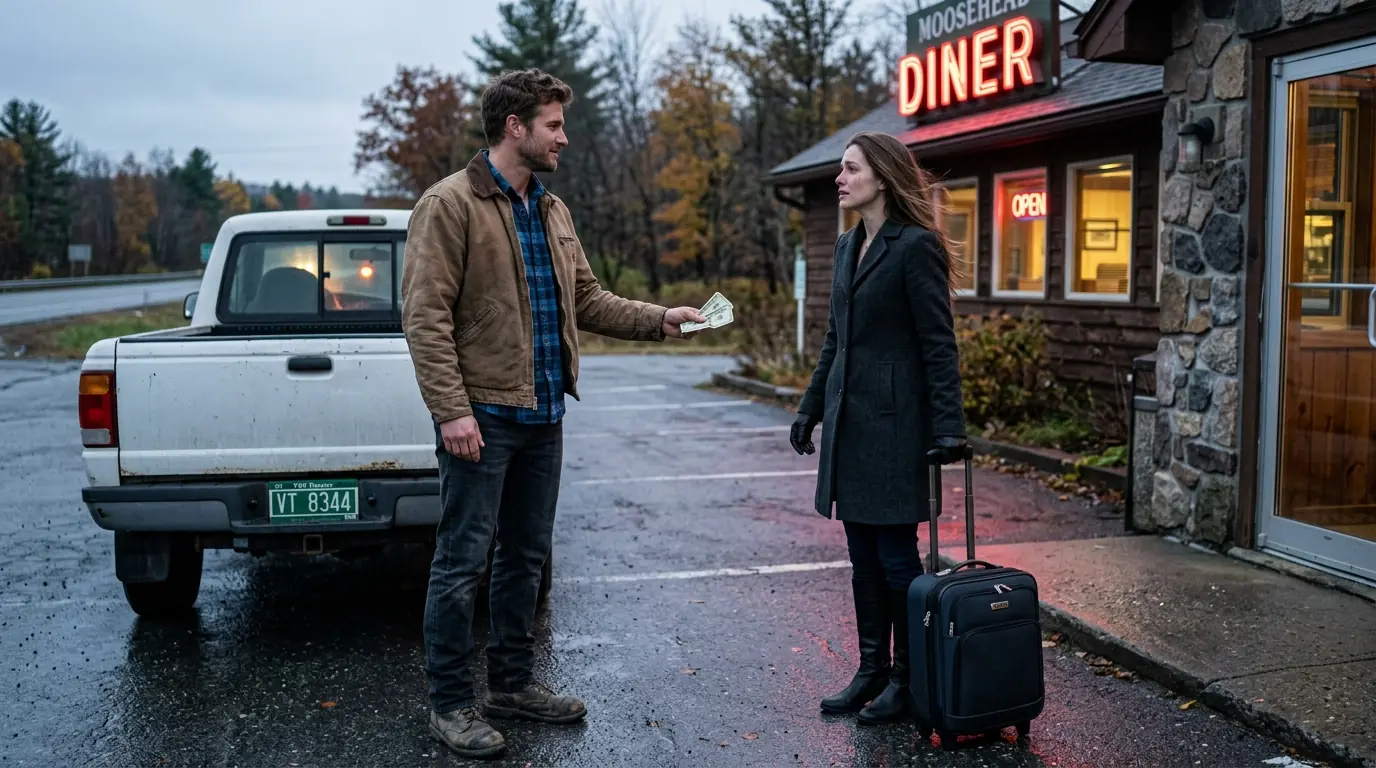
“My wallet was in the car,” she said. “The diner is cash only before nine. I meant to ask for ten dollars. I’ll pay you back.”
Ryan opened his wallet. Two twenties. Two ones.
Forty-two dollars.
He took out the two twenties and handed them to her.
“No, Ryan,” she said. “You just told me you lost your job.”
“I did.”
“And you have a daughter.”
“I do.”
“Then why?”
“Because you need it more than I do right now,” he said. “I’m going home to a kid who loves me. You’re going into a diner alone in a town you don’t know. Forty bucks won’t save my life. It might make yours less terrible for an hour.”
Celeste took the money slowly.
“I will pay you back,” she said.
Ryan smiled tiredly. “Don’t worry about it.”
He drove home with two dollars left.
Emma was already awake, sitting at the kitchen table in her pajamas, eating cereal straight from the box because they were out of milk. Her hair was messy, and a library book sat open beside her.
“You’re home early,” she said.
Ryan sat across from her.
“I lost my job this morning.”
Emma stopped chewing.
“It’s going to be okay,” he said quickly. “I’ll find another one. Things might be tight for a little while.”
“Tighter than now?”
“A little.”
She nodded. “Can we still get the boots?”
Ryan almost lied.
“Maybe not this weekend.”
Emma reached across the table and put her small sticky hand over his.
“Daddy, did you do anything bad?”
“No.”
“I know you didn’t.”
She said it so simply that Ryan almost broke.
That afternoon, his phone rang three times from an unknown number. On the third call, he answered.
It was Celeste.
She wanted to pay him back. She asked if he would be home the next morning at nine.
“How did you get this number?” Ryan asked.
“I have my ways.”
“That’s not an answer.”
“I know. I’ll explain tomorrow.”
“Who are you?”
A long silence followed.
“Someone who owes you a debt,” she said.
The next morning, Ryan heard engines before nine.
He looked out the window and saw four black SUVs parked along Birch Street. Men in suits stepped out and took positions around the building.
Three knocks came at the door.
A tall man introduced himself as Marcus Pel and said Ms. Ardan was waiting downstairs.
“Celeste Ardan?” Ryan asked.
“Yes.”
The name felt familiar, but he could not place it.
In the back of the fourth SUV, Celeste sat in a charcoal coat, her hair brushed neatly around her shoulders. She poured him coffee as if this meeting had been planned for weeks.
“You lied to me yesterday,” Ryan said.
“I told you my name was Celeste. I did not say it was my full name.”
“Most people call that lying.”
“Most people are imprecise.”
Then she told him the truth.
She was Celeste Ardan, CEO of Ardan Logistics International, a company with operations in forty-one countries and eighteen thousand employees. One of its subsidiaries was Regis Hollister.
Ryan stared at her.
“You own the company that fired me.”
“My company owns the company that fired you.”
“That’s splitting hairs.”
“Maybe.”
Celeste admitted she had been near the bus stop on purpose. For months, she had been visiting towns where her company operated, watching from the ground level because she no longer trusted reports from the top. Something was wrong inside her company, and shipments were disappearing.
She had been watching the Regis Hollister facility for six weeks.
“I did not expect a man who had just been fired from my company to pull over in a truck with a cracked windshield and give me his last forty dollars,” she said.
Then she handed Ryan dispatch logs.
The missing weight variances were small at first, then larger. The dates all lined up.
Tuesdays. Late nights. Carl Voss’s closing shifts.
Ryan saw the pattern immediately.
Celeste already had a compliance team building a case, but she needed Ryan’s help. He knew the warehouse floor. He knew the blind spots. He knew which doors closed quietly and which forklifts crossed which paths.
“You were the man they tried to destroy,” Celeste said. “The cleanest way to end this is for the man they tried to destroy to put the evidence on the table.”
Ryan thought of Emma.
“I can’t do anything dangerous.”
“I’m asking you to work with my legal team, my security team, and my compliance team,” Celeste said. “And with pay.”
The offer was a six-month compliance contract, a settlement for wrongful termination, and a $60,000 payment that week.
Ryan stared at her.
“It is not generosity,” Celeste said. “It is arithmetic.”
Ryan agreed, not for the money, but because Carl had chosen him as someone nobody would miss.
At Celeste’s private operations site outside Montpelier, Ryan met Dileia Whitmer, the woman who ran internal compliance. She was sharp, direct, and impossible to impress. She showed him the dock footage from the night he was framed.
In one corner of the frame, a second figure moved behind a forklift.
For a fraction of a second, something on the man’s chest caught the light.
A lanyard.
Ryan leaned forward.
“I recognize him.”
For weeks, Ryan worked in a windowless room with three monitors, studying shipment logs, badge swipes, camera footage, weight variances, and routing records. The theft ring was larger than Carl. It involved Everett Sharp, a regional operations director, and Linda Marrow in corporate accounts.
Then Celeste asked Ryan to do something harder.
She wanted him to meet Everett Sharp while wearing a recording device. Ryan would pretend he had evidence and wanted $60,000 to disappear quietly.
Sharp believed it.
In his office, he listened as Ryan described Tuesday night shipments, missing crates, and paperwork signed off by corporate. Sharp finally offered to put him in touch with someone who could pay him quietly.
“In exchange,” Sharp said, “you never speak about Tuesday nights again.”
He also warned Ryan that certain people would be unhappy in a way he would not find survivable.
Ryan left the office shaking, but the recording was enough.
Days later, Ryan received a call telling him to meet on an old logging road off Route 12A with the records. Celeste’s team prepared him carefully. He went in wearing a protective vest and a wire, with Marcus’s people watching from a distance.
In the clearing, three men waited beside two vehicles. They took the envelope of fake records and handed Ryan $60,000 in cash.
Before leaving, Ryan asked how high the theft went.
One man laughed.
“You think Sharp is the top of this? Sharp is middle management.”
Then he gave the name.
Douglas Reinneck, chief operating officer.
When Ryan returned, Celeste went pale. Reinneck was one of her father’s old hires, a trusted executive, a man who had helped design the company’s internal reporting systems. He had built those systems so honest employees would be crushed before their complaints reached anyone who could help.
Two days later, Celeste walked into Reinneck’s office with Ryan behind her.
Reinneck looked up from his desk, startled.
Celeste introduced Ryan as her new deputy for field operations.
Ryan faced the man who had never known his name.
“I worked for you indirectly,” he said. “Until Carl Voss framed me for moving eleven crates of insulin pumps off a loading dock.”
Reinneck tried to speak privately with Celeste.
She refused.
“There is a federal team in the lobby,” she said. “You will not touch your phone. You will not touch your computer. You will stand up, hand me the fountain pen in your top drawer, and walk out of this office.”
Reinneck obeyed.
At the door, he looked at Ryan.
“You understand this was not personal.”
Ryan remembered Dileia warning him those exact words would come.
“That’s the thing,” Ryan said. “It was personal. It was personal to me. It was personal to my daughter. It was personal to everyone who would have hired me and now wouldn’t. It was personal to the kids in hospitals who didn’t get their insulin pumps. You just didn’t think you would be the one to pay for it.”
Reinneck had no answer.
The federal agents came up. Reinneck, Sharp, Carl, and Linda were all brought down by the case Celeste’s team had built and Ryan had helped complete.
Celeste offered Ryan a permanent role as deputy to the CEO for field operations. The salary was more than he had ever imagined. Ryan accepted on one condition.
“I want Emma to see where I work,” he said. “I don’t want her thinking my job is a secret.”
Celeste’s expression softened.
“We’ll make her a badge,” she said. “Dileia will pretend to hate it. She’ll love it.”
Over the months that followed, Ryan visited warehouses across the Northeast, not as a distant executive, but as someone who understood the floor. He drank bad coffee in cold breakrooms, listened to workers, wrote down what the company had never bothered to learn, and brought those truths back to Celeste every Friday.
Emma got her new boots. Then a new desk. Then a life where her father came home tired, but no longer defeated.
Celeste became part of that life slowly. First through work. Then through quiet dinners. Then through birthday cake in Ryan’s small apartment, where she badly frosted Emma’s cake and Emma declared it perfect.
Years later, Ryan and Celeste married at the old bus stop where everything had begun. The town had placed a small plaque there that read:
“Kindness has been known to stop here.”
Ryan stood beside Celeste in the cold Vermont air, with Emma holding flowers nearby, and thought about the morning he had given away his last $40.
Most people who give away their last money never get a billionaire at their door the next day. Most people never get rewarded for kindness in a way that changes their whole life.
But that was not the point.
The point was becoming the kind of person who would do the right thing even when no door opened.
Because sometimes kindness comes back.
And sometimes, on the day you least expect it, it pulls up in four black SUVs and changes everything.