“Don’t open that door, Mama.”
Seven-year-old Zoe Thompson whispered from behind Maya’s hip, her little fingers gripping the sleeve of her mother’s damp hospital scrubs.
Outside their apartment, beneath the flickering porch light in the cold Milwaukee rain, an elderly man sat under the narrow awning like a shadow the world had forgotten. 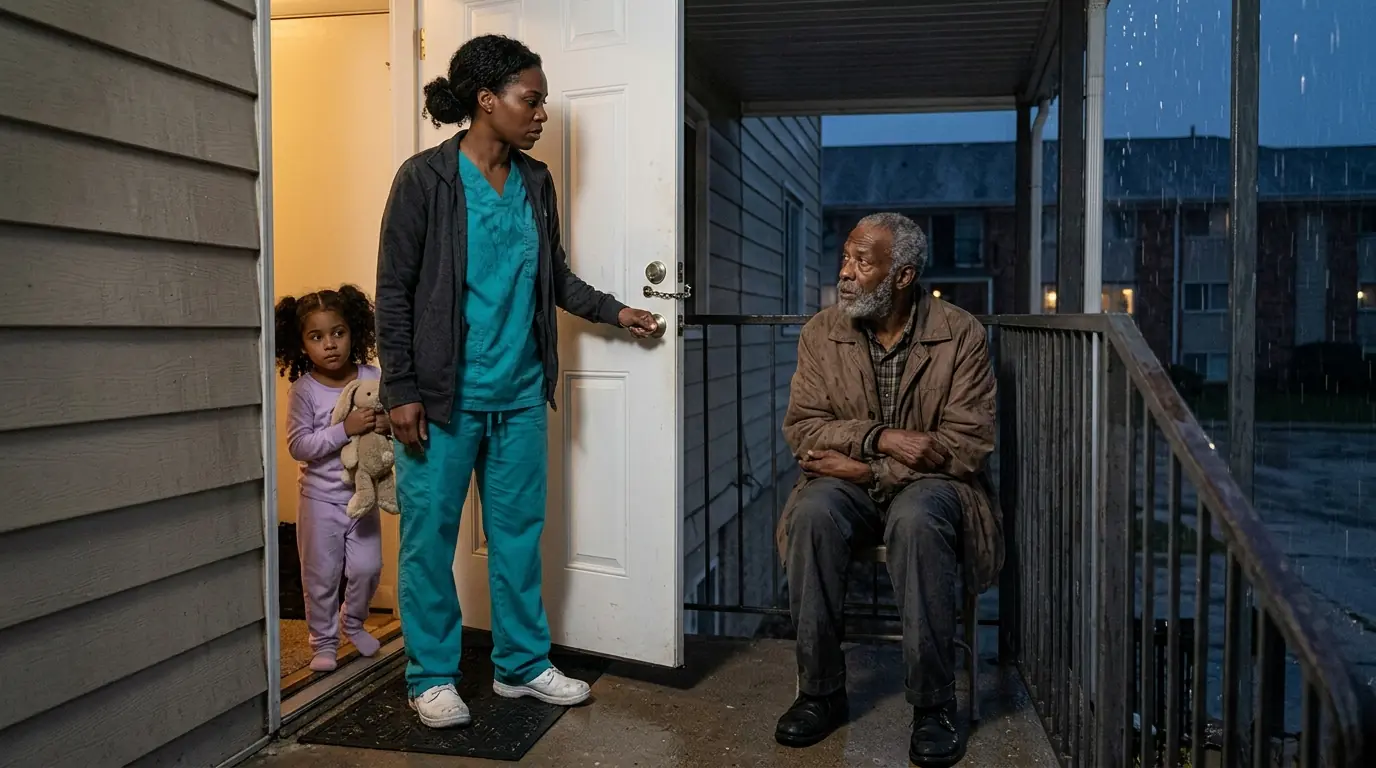
His coat was soaked, his gray beard dripped water onto his collar, and his hands were folded neatly in his lap.
He was not begging.
He was not knocking.
He was simply sitting there, shivering quietly, as though even asking for help would be too much.
Maya Thompson stood frozen with one hand resting on the deadbolt.
She had every reason not to open the door.
Maya was thirty-five years old, a single mother who understood the cost of one wrong decision. She had worked twelve hours at St. Anne’s Hospital, cleaning rooms, changing linens, and helping nurses lift patients who rarely learned her name.
Her feet ached.
Her back burned.
Her paycheck had already disappeared before reaching her account.
Rent.
The electric bill.
Zoe’s school lunch balance.
Gas for the aging Honda.
After everything was paid, Maya had eleven dollars inside her purse until Friday.
Still, the man outside did not appear dangerous.
He did not seem intoxicated, angry, or unpredictable. He looked exhausted in a way Maya understood too well, the kind of exhaustion that did not merely rest on the face but lived deep inside the bones.
Maya leaned toward the door but kept the security chain fastened.
“Sir, are you all right?”
The old man slowly raised his head.
His eyes were dark, gentle, and painfully alert.
“I’m sorry to bother you, ma’am,” he said. “I tried to reach the shelter on Vine Street, but they locked the doors before I arrived.”
Maya said nothing.
Zoe pressed closer against her side.
Rain hammered against the metal stair railing. Somewhere on the lower floor, a dog barked once and then fell silent.
“I’m not asking for money,” the old man continued. “I only need somewhere dry until morning. A hallway, a basement corner, anything.”
The answer should have been no.
Every instinct inside Maya told her to refuse.
She thought about Zoe’s bedroom, the pink backpack beside the door, and the little sneakers drying near the radiator. She remembered every warning she had ever heard about strangers and vulnerable women.
A woman living alone could not afford to be careless.
A mother could not afford to be soft.
“I have a daughter,” Maya said.
The old man immediately nodded and lowered his eyes.
“Then you do whatever keeps her safe. There is no shame in that.”
He began standing slowly, using the brick wall for support.
His left knee nearly collapsed beneath him.
For one brief second, his face twisted with pain he was too proud to show.
Maya saw it.
Without warning, she thought about her mother.
Lillian Thompson had died eight years earlier with a hospital identification bracelet around her wrist and apologies on her lips. Even during her final days, she had tried to remain gentle with a world that had never treated her gently.
Something old and tender broke open inside Maya’s chest.
“Mama,” Zoe whispered again.
Maya looked down.
Her daughter’s eyes were still frightened, but something else lived there too.
Compassion.
The dangerous and beautiful beginning of mercy.
Maya closed her eyes for half a second.
Then she opened the door only as far as the chain allowed.
“I need to see identification.”
The old man blinked.
Then he slowly reached inside his coat using only two fingers, careful not to frighten her. He removed an old state identification card worn around the edges but still readable.
Raymond Hale.
Age sixty-nine.
Maya photographed the card with her telephone and sent the image to Mrs. Alvarez in the apartment next door.
Then she looked at Raymond again.
“You may sleep on the couch,” she said. “One night only.”
Raymond listened carefully.
“My neighbor knows your name. Zoe’s bedroom door remains locked, and if I tell you to leave, you leave immediately.”
He stared at Maya as though she had offered him something far greater than shelter.
“I will cause no trouble,” he said softly. “I promise.”
Maya removed the chain.
The apartment was small, warm, and worn down by survival.
A tear in the sofa was hidden beneath a crocheted blanket. The carpet contained stains no amount of scrubbing could remove.
Zoe’s drawings hung on the refrigerator beneath mismatched magnets.
One showed a yellow sun.
Another showed a crooked yellow house.
A third showed a stick-figure family containing only two people.
Raymond looked at the picture of the yellow house a moment longer than necessary.
Then he turned away.
“I’ll bring you a towel,” Maya said.
“There is no need to dirty one.”
“It is already laundry day,” she replied, although it was not.
When Maya handed him a faded blue towel, Raymond accepted it with both hands.
“Thank you, miss.”
“Thompson,” she said. “Maya Thompson.”
Something changed in Raymond’s face when he heard her name.
It was only a flicker, like an old wound suddenly remembering itself.
Maya noticed.
“Do I know you?”
Raymond lowered the towel against his chest.
“No, ma’am,” he answered quietly. “I don’t believe you do.”
His voice had become thin around the edges.
That night, after Zoe fell asleep, Maya sat at the kitchen table with her telephone beside her and a knife within reach.
She watched Raymond sleeping on the couch beneath the crocheted blanket. His breathing was slow but uneven.
Near two in the morning, he moved.
Maya immediately sat upright.
Raymond did not stand or approach the hallway.
He merely turned his face toward the wall and whispered one name.
“Lillian.”
Maya’s blood seemed to turn cold.
Lillian was her mother’s name.
For a long moment, Maya did not move.
She listened to the rain and watched the stranger sleeping on her couch.
Then she told herself it was only a coincidence.
Milwaukee had many women named Lillian.
The world was filled with ghosts wearing ordinary names.
Twenty-one days after that rainy evening, a lawyer would stand at the same door holding a rusted tin box and a letter written in Lillian’s hand.
When that happened, Maya would remember everything.
She would remember the rain, Raymond’s hesitation, and the way his eyes had rested on Zoe’s drawing of the yellow house.
She would finally understand that Raymond Hale had not arrived at her door by accident.
He had come carrying the last promise her mother had ever made.
By 6:30 the following morning, Maya was awake.
She sat at the kitchen table with one hand wrapped around a coffee mug and the other near the drawer where she kept the knives.
The rain had stopped, but Milwaukee still looked gray through the window, as though the entire city had been washed and left outside to dry.
Water dripped from the fire escape.
The heater clicked in the corner, producing more noise than warmth.
Raymond was awake too.
That was the first thing Maya noticed.
He had folded the crocheted blanket into a neat square and placed it on the arm of the sofa. The faded blue towel hung carefully over the back of a kitchen chair.
His shoes were aligned beside the door with their toes facing outward, as though he had prepared himself to leave before anyone asked.
“You did not have to do all of that,” Maya said.
In the morning light, he appeared older than he had the night before. His face was deeply lined, his shoulders were stiff, and the damp coat hung around him like something heavier than cloth.
“I do not leave a place worse than I found it.”
Maya said nothing.
It was a simple sentence, but it reached a tired place inside her.
Most people who entered Maya’s life left something unpleasant behind.
A bill.
A broken promise.
A wound too small to explain but too deep to forget.
Raymond Hale had slept on her couch and left the blanket folded.
Zoe appeared from the hallway wearing pajamas, her curls wild from sleep and a stuffed rabbit tucked beneath one arm.
“Is Mr. Raymond still here?”
“Only long enough to say thank you,” Raymond replied.
Zoe studied him.
“Did you sleep okay?”
“Better than I deserved.”
Maya frowned.
“Do not say that.”
Raymond lowered his eyes.
“Yes, ma’am.”
The apartment became quiet.
Maya opened the refrigerator.
Two eggs.
Half a carton of milk.
One end piece of bread.
A jar of peanut butter.
Payday remained two days away.
Maya closed the refrigerator before Zoe could look too closely.
Raymond noticed the contents.
Then he politely turned away.
That small act meant more than Maya wanted to admit.
A man with nowhere to sleep still possessed enough grace not to stare at her poverty.
“Zoe, brush your teeth,” Maya said. “We need to leave soon.”
Raymond reached for his coat.
“I’ll go to the shelter now.”
When he stood, his left hand trembled.
He tried to conceal it by pressing his palm against the wall, but Maya had worked too many hospital shifts not to recognize pain.
“Are you sick?”
Raymond paused.
“No more than most men my age.”
“That is not an answer.”
He offered a tired smile.
“I’m only exhausted.”
Raymond stepped toward the door.
His knee nearly failed beneath him.
“Mama,” Zoe whispered.
Maya’s jaw tightened.
“Sit down.”
“Miss Thompson, I will not become a burden.”
“I did not ask what you would become. I told you to sit.”
Raymond obeyed.
Maya stretched the two eggs into three small portions by adding milk. She cut the toast into triangles because Zoe believed triangles tasted better than squares.
Raymond received the chipped blue plate.
Maya kept the smallest portion for herself.
He looked down at the food as though accepting it caused him pain.
“Eat,” Maya said.
Raymond ate slowly, almost reverently.
After breakfast, Maya asked where he intended to go.
“There is a church near Walnut Street,” he replied. “Sometimes they allow people to sit inside when the pastor is present.”
“And when he is not?”
Raymond gave a small shrug.
Maya hated that shrug.
It belonged to people who had practiced living without answers.
She thought about every warning she had ever heard.
She thought about Zoe’s bedroom door.
Then she remembered Raymond whispering her mother’s name while sleeping.
“Two nights,” Maya said.
Raymond looked up.
“No, ma’am.”
“That was not a negotiation. The same rules apply.”
Maya counted them again.
“You sleep on the couch. You stay away from Zoe’s room. Mrs. Alvarez has your identification.”
Raymond’s eyes softened, not with victory but something closer to grief.
“I do not know how to repay you.”
“Begin by not making me regret it.”
That evening, Maya returned from another hospital shift with rain inside her shoes and pain across her back.
She expected to find disorder.
Instead, Zoe was asleep at the kitchen table with one cheek resting on an open picture book.
The floor had been swept.
The sink was empty.
A small pot of soup simmered on the stove. It had been made from one potato, half an onion, and scraps Maya had believed were too small to become dinner.
Raymond stood beside the counter wiping it clean.
“I hope you don’t mind,” he said. “The little one said she was hungry.”
Maya looked at the soup.
Then Zoe.
Then Raymond.
For the first time in years, someone had noticed her exhaustion without making her ask for help.
Raymond reached for his coat.
“I can leave in the morning.”
Maya looked at her sleeping daughter.
Then she looked at him.
“Morning,” she said.
Deep inside, Maya knew one night had already become two.
Two nights were beginning to feel like the edge of a story her mother had started long before Maya opened the door.
The next morning, Maya woke to a sound she had not heard in months.
Silence.
It was not complete silence.
Milwaukee continued breathing beyond the window. Cars hissed across wet pavement, pipes knocked inside the old building, and a child cried faintly in the apartment below.
Inside Maya’s kitchen, however, the faucet was no longer dripping.
For three months, that faucet had followed Maya through every night.
Drip.
Drip.
Drip.
The sound entered her sleep, her bills, and the heavy hours before dawn when she counted everything she could not repair.
Now it was quiet.
Maya stood in the doorway wearing a faded T-shirt, staring at the sink as if it had performed a miracle.
Raymond sat at the kitchen table with a small screwdriver, an old rag, and a cracked rubber washer beside his elbow.
He looked up cautiously.
“I hope I did not overstep. The faucet was wasting water.”
“You fixed it?”
“It was not difficult. The washer was worn. I found an old replacement inside the drawer.”
Maya walked closer and turned the handle.
Not one drop appeared.
For reasons she could not explain, that almost made her cry.
She swallowed the emotion.
“You did not have to do that.”
Raymond folded the rag neatly.
“No, ma’am. But I knew how.”
The answer remained with her.
He did not say he wanted praise.
He did not suggest she owed him.
He simply knew how.
Zoe ran into the kitchen wearing her school uniform and one crooked ponytail.
“Mama, listen.”
She pointed toward the sink.
Maya tried not to smile.
“I hear it.”
Zoe grinned.
“Nothing.”
One corner of Raymond’s mouth lifted.
During breakfast, Maya watched him more closely.
He ate very little.
When he believed no one was looking, he pushed food around his plate.
His hands were strong, but they occasionally trembled.
Whenever Zoe laughed, something passed over Raymond’s face like sunlight crossing a dark room.
It was not exactly happiness.
It looked like memory.
After Zoe left for school, Maya found Raymond kneeling before the refrigerator.
The old appliance had been making a grinding noise for weeks, like a tired animal trapped behind metal.
Maya learned to ignore it because ignoring broken things was sometimes the only way to survive them.
“What are you doing?”
Raymond did not turn.
“I am trying to convince this refrigerator that it is not ready to die.”
Despite herself, Maya laughed.
The sound surprised both of them.
Raymond smiled without looking up.
“The fan cover is loose. It is not the motor.”
“You know appliances too?”
“I know a little about things people throw away too soon.”
Maya leaned against the counter.
Something about the way he said it made the room feel smaller and gentler.
It seemed he was not only speaking about refrigerators.
By noon, the grinding had stopped.
By evening, the loose cabinet door no longer slammed whenever Zoe reached for a cup.
By the third day, the apartment seemed to exhale.
The faucet remained dry.
The refrigerator hummed quietly.
The cabinet closed properly.
Raymond never announced what he repaired.
Maya simply returned from work and discovered one fewer small misery waiting for her.
That was what unsettled her most.
She was accustomed to people helping loudly.
People who reminded her what they had done.
People who delivered kindness like a receipt they expected her to sign.
Raymond did the opposite.
He repaired things and moved away from them as though goodness was meant to be left quietly behind.
On the fourth evening, Maya arrived late and found Zoe sitting beside him on the sofa.
A picture book rested across their laps.
Raymond read slowly.
His voice was deep and rough around the edges, but gentle enough to make every sentence feel safe.
“And the little house waited through the winter,” he read, “because it knew spring would come.”
Zoe leaned against the sofa arm and listened with her entire heart.
Maya stopped in the doorway.
No man had ever read to her daughter.
Not Zoe’s father.
Not an uncle.
Not anyone who stayed.
Raymond looked up and immediately began closing the book.
“I’m sorry,” he said. “She asked.”
“Mama, he does the voices,” Zoe announced.
Maya wanted to be strict.
She wanted to remind Zoe not to become attached.
She wanted to remind herself too.
Instead, she placed her bag on the floor.
“One story.”
Zoe beamed.
Raymond nodded, but the old sadness returned to his eyes.
He opened the book again.
While he read, Maya stood in the kitchen pretending to wash a cup that was already clean.
The words moved gently through the apartment.
Zoe laughed.
Raymond chuckled.
The refrigerator hummed without groaning.
The faucet did not drip.
For the first time in a long while, Maya’s home did not sound like survival.
It sounded like shelter.
Near the end of the story, Raymond paused and looked at Zoe’s face.
“You have her eyes,” he whispered.
Maya turned off the water.
“What did you say?”
Raymond closed the book.
His hand trembled slightly against the cover.
“I said she has kind eyes.”
Maya knew what she had heard.
“You said she has her eyes. Not kind eyes. Her eyes.”
The name Lillian began rising again inside Maya, quiet as a ghost and impossible to ignore.
That night, she could not stop hearing Raymond’s words.
He had corrected himself too quickly.
He claimed he meant Zoe possessed kind eyes, but Maya had lived long enough to recognize when someone covered a wound with a bandage made of silence.
She did not question him in front of Zoe.
Her daughter sat cross-legged on the sofa, requesting one more page, then another, and one more after that.
Maya rinsed the same cup twice and watched from the corner of her eye.
Raymond treated every sentence as though it deserved a safe place to land.
He gave the bear in the story a clumsy, deep voice.
He gave the grandmother a gentle Southern accent.
Zoe covered her mouth to keep from laughing too loudly.
Maya felt her heart tighten.
The warmth was dangerous.
It resembled something they had needed for years.
When the story ended, Zoe leaned against the cushion, sleepy and smiling.
“Did you read stories to your children?”
Raymond’s hand froze on the book.
Maya turned toward him.
“No,” he answered after a pause. “I never had children.”
“Then who did you read to?”
Raymond looked at the book.
His thumb moved along the worn edge.
“A friend,” he said. “A long time ago.”
“What was her name?”
“Zoe,” Maya said gently. “That is enough.”
Raymond answered before the silence could close around him.
“Lillian.”
The name fell into the room like a key dropped onto a wooden floor.
Maya became completely still.
Zoe was too young to understand how a name could stop the blood inside an adult’s body.
“My grandmother’s name was Lillian,” Zoe said.
Raymond looked at her.
Something bright and painful moved through his eyes.
“I know,” he whispered.
Maya tightened her grip on the cup.
“You know?”
Raymond’s expression changed.
The softness disappeared and was replaced by fear, not fear of Maya, but fear that he had stepped into the truth too early.
“I mean, you mentioned her before, didn’t you?”
“No.”
The word was quiet but struck hard.
Raymond lowered his eyes.
Zoe looked between them.
“Mama?”
Maya carefully placed the cup on the counter.
“Go brush your teeth, baby.”
Zoe hesitated.
“Now, please.”
Her smile disappeared.
She slid from the sofa and walked toward the bathroom with the stuffed rabbit beneath one arm.
The moment the door closed, Maya faced Raymond.
“How do you know my mother’s name?”
He did not answer.
Wind pushed rain against the window.
The repaired refrigerator hummed softly.
The faucet remained silent, as though even the apartment were waiting.
“Mr. Hale, I asked you a question.”
Raymond closed the book and placed it gently on the coffee table.
“I once knew a woman named Lillian.”
“There are many women named Lillian.”
“Yes.”
“Did you know my mother?”
Raymond looked toward the hallway where water ran from Zoe’s toothbrush.
Then he looked at Maya.
“I knew someone kind,” he said. “Someone who loved her daughter more than she loved breathing.”
The words struck a place Maya had worked hard to protect.
“My mother has been dead for eight years.”
Raymond slowly nodded.
“I’m sorry.”
The apology was too heavy.
Too personal.
Maya stepped closer.
“That is not an answer.”
Raymond rested his shaking hands on his knees.
“I do not want to bring pain into your home.”
“You already brought questions.”
He lifted his eyes.
The sadness inside them was so old that it almost seemed patient.
“Some questions need the proper time.”
Maya gave a short, bitter laugh.
“I allowed you to sleep on my couch. You eat at my table. You read bedtime stories to my daughter.”
Her voice tightened.
“Do not stand inside my living room and tell me the truth needs better timing.”
Raymond lowered his head.
For the first time, he appeared smaller than his age.
“You are right. You have every reason to ask.”
“Then tell me.”
Raymond opened his mouth.
Before he could speak, Zoe called from the hallway.
“Mama, my nightlight will not turn on.”
Maya looked toward her daughter.
The interruption saved Raymond from answering.
Perhaps it also saved Maya from hearing too much at once.
“This conversation is not finished,” she told him.
“No, ma’am,” Raymond replied. “It is not.”
Later, Maya repaired Zoe’s nightlight, tucked her into bed, and kissed her forehead.
“Mama?” Zoe whispered, already half asleep.
“Yes, baby?”
“Mr. Raymond looks sad when he says Grandma’s name.”
Maya’s throat tightened.
“I know.”
“Did Grandma know him?”
Maya looked toward the living room.
Raymond sat alone beneath the weak lamp with both hands folded over the storybook as though he were guarding a grave.
“I don’t know yet.”
Deep down, Maya knew that was no longer true.
Raymond Hale had not entered their lives by chance.
The following morning, Maya woke with a question pressing against her chest.
Did Raymond know her mother?
She attempted to continue her normal routine.
Maya packed Zoe’s lunch, brushed lint from her school sweater, checked the Honda’s nearly empty gas gauge, and drove through Milwaukee’s gray morning toward the school.
Raymond’s voice followed her.
“I knew someone kind. Someone who loved her daughter more than she loved breathing.”
Those were not the words of a stranger.
At the hospital, Maya changed beds, emptied trash, cleaned counters, and nodded when nurses hurried past with tired smiles.
Her mind remained inside the apartment.
She remembered how Raymond’s face changed when he heard her name and how he stared at Zoe’s picture of the yellow house.
By the end of her shift, Maya had made a decision.
She was finished waiting.
When she arrived home, the apartment smelled of warm rice and stewed tomatoes.
Zoe sat at the kitchen table coloring with her tongue pressed between her teeth in concentration.
Raymond stood beside the stove and stirred a pot carefully.
“I used what remained,” he explained. “I hope that is acceptable.”
Maya looked into the pot.
“You continue making something from almost nothing.”
Raymond smiled faintly.
“That is the first thing poor people learn.”
The sentence was gentle, but it cut more deeply than he understood.
After dinner, Zoe requested another story.
Maya almost refused.
She needed answers, not bedtime tenderness.
Zoe’s eyes were bright, and Raymond was already reaching toward the picture book as though it were the only prayer he still remembered.
“One story,” Maya said.
Zoe cheered softly.
Halfway through the book, Raymond coughed.
It was not loud, but it bent him forward.
The book slipped from his hand.
Zoe immediately sat upright.
“Mama.”
Maya crossed the room.
“Mr. Hale?”
“I’m fine,” Raymond whispered.
His face had become pale.
“No, you are not.”
Maya helped him sit back.
His coat was folded across a nearby chair.
When Maya reached for it to find his handkerchief, his old wallet fell from the pocket and opened on the floor.
A photograph slid out.
Maya froze.
It was an old photograph with edges worn smooth by years of being touched.
A young woman stood in the picture with bright eyes and a wide, tired smile. Her hair was tied back beneath a blue scarf.
Beside her stood a younger Raymond Hale, taller and stronger, with one hand resting on the hood of an aging pickup truck.
Maya recognized the woman before her mind could accept it.
Her mother.
Lillian Thompson.
Not sick.
Not fading inside a hospital bed.
Not apologizing through pain.
Young.
Alive.
Smiling as though the world had not yet broken its promises.
Maya slowly bent and lifted the photograph.
Her hand trembled.
Zoe leaned over the sofa.
“Is that Grandma?”
Raymond closed his eyes.
Maya looked at him.
“You lied to me.”
He opened his eyes.
The pain inside them was no longer concealed.
“I did not want to.”
“But you did.”
Maya’s voice lowered.
“How long have you carried this?”
Raymond looked at the photograph as though it contained both heaven and punishment.
“More than thirty years.”
“Thirty years?”
It existed long before Zoe.
Long before hospital bills and collection notices.
Long before the funeral home handed Maya a small box containing her mother’s earrings and a folded church program.
“How did you know her?”
“We were friends,” Raymond answered. “When we were young, before life separated people the way it does.”
“Friends?”
His gaze fell.
“Almost family.”
Maya released a wounded laugh.
“Almost family does not sleep on my couch for five days without explaining who he is.”
“I know.”
“Almost family does not whisper my dead mother’s name and pretend it means nothing.”
“I know.”
“Then why?”
Raymond’s mouth tightened.
For a moment, he looked toward Zoe.
Then he looked away.
“Because your mother asked something of me before she died.”
Maya’s anger became still.
“What?”
Raymond did not answer quickly.
That frightened her more than an immediate answer would have.
“What did my mother ask you?”
His hand moved toward the photograph.
Maya held it away.
“No. You do not touch this until you tell me the truth.”
Raymond bowed his head.
“She asked me to find you, if I ever could.”
Maya felt the floor shift beneath her.
“She knew where I lived.”
“Not near the end.”
Maya shook her head.
“What does that mean?”
“You moved after a rent increase. Your telephone number changed.”
Raymond spoke carefully.
“Some records were under your married surname. Others still listed Thompson.”
He looked at Maya.
“Your mother was already very sick. Sicker than she allowed you to understand.”
Maya’s eyes burned.
“She was ashamed that she had lost track of paperwork while trying to remain alive.”
Maya turned away.
She remembered those years in fragments.
Packing boxes in a hurry.
Changing telephone numbers after collection calls.
Signing documents under a surname she no longer used.
Trying to keep Zoe fed while Lillian’s health declined faster than anyone admitted.
“She never told me about you.”
“She had reasons.”
“What reasons?”
Raymond seemed to age with every question.
“Some stories belonged to your mother. Some are not mine to open carelessly.”
Maya’s eyes filled, but her voice hardened.
“My mother is gone. If she left a story, I am the only person still here to hear it.”
Raymond looked at her fully.
For the first time, Maya did not see a stranger, a burden, or an old man hiding secrets beneath a wet coat.
She saw someone who had carried grief for a very long time.
“I have something for you.”
“What?”
“It is not here. I do not have it with me.”
“What is it?”
“A box.”
Maya tightened her hand around the photograph.
“What kind of box?”
Raymond’s voice broke quietly.
“The kind your mother made me promise I would give you when I found you.”
Zoe stepped down from the sofa and placed her small hand inside Maya’s.
No one moved.
The city lights trembled against the wet street outside.
Maya stared at the photograph of her mother smiling beside Raymond Hale.
Every wall she had built around the past began to crack.
Raymond had still not told her everything.
Maya could feel that the truth was much larger than one photograph.
After the discovery, nothing inside the apartment felt ordinary.
The tear remained beneath the crocheted blanket.
The refrigerator still hummed.
Zoe’s drawings continued hanging beneath mismatched magnets.
Every object now seemed to carry a question.
Who was Raymond Hale?
What had Lillian trusted him to keep?
Maya slept badly.
She remained awake with one hand near Zoe’s bedroom door, listening to the quiet apartment.
Raymond slept on the couch like a man who had been forgiven nothing.
Even in sleep, his face looked burdened.
By morning, Maya expected a complete explanation.
Raymond offered none.
Instead, he made oatmeal and sliced the last apples from the refrigerator into it.
He served Zoe first, as always.
Maya watched from the counter.
“You said there was a box.”
Raymond’s hand paused above the pot.
“There is.”
“Where?”
“With an attorney.”
“What attorney?”
“Daniel Price. Your mother knew him.”
Maya’s jaw tightened.
“You decided not to tell me that either.”
Raymond looked down.
“I came to make certain I had found the correct person.”
“You knew my name.”
“I knew your name, but I also carried fear.”
Maya remained silent.
Raymond placed the spoon beside the pot.
“I spent more than two years searching for you. I used library computers, old addresses, churches, county records, and shelter bulletin boards.”
His voice remained low.
“I had very little money. When my health became worse, I lost most of the stability I still possessed.”
Raymond continued.
“By the time I located this building, I had already slept in three bus stations and two church basements.”
Maya’s expression changed.
“That evening in the rain, I was not pretending to have nowhere to go.”
He met her eyes.
“I truly had nowhere to go.”
Raymond drew a breath.
“I saw your name on the mailbox downstairs. I could not force myself to knock, not immediately.”
“Why?”
“I was trying to gather courage.”
Maya looked toward the yellow house drawn on the refrigerator.
“You sat outside my door in the rain?”
“Yes.”
For the first time, she had no reply.
Raymond looked at her.
“I did not come to test your kindness. You owed me nothing.”
His voice softened.
“If you had closed the door, you still would have been right to protect your daughter.”
Maya’s anger did not disappear.
It softened around the edges.
During the next several days, Raymond did not pressure her.
He remained quiet, helpful, and almost invisible.
He repaired a loose kitchen drawer.
He fixed the chain on the front door so it moved smoothly for the first time in years.
When Mrs. Alvarez left a small bag of groceries outside and pretended they were extra food, Raymond carried them upstairs.
Everyone understood that the groceries were kindness.
Raymond never entered Zoe’s room.
He never raised his voice or asked for money.
He never made himself larger than the space Maya allowed him.
Twelve days passed inside the small apartment.
Twelve days of quiet repairs.
Twelve days of soup, rice, oatmeal, and toast cut into triangles.
Twelve evenings of Zoe sitting beside Raymond after dinner, requesting the bear story, the train story, and the story about the little house waiting for spring.
By the ninth night, Zoe stopped calling him Mr. Raymond unless Maya reminded her.
By the tenth, Maya stopped checking the knife drawer every hour.
On the eleventh day, she returned from the hospital and found a note folded on the counter.
“Ms. Thompson, Zoe completed her reading homework. The faucet still holds. Soup is on low. Please eat before it becomes cold. R.H.”
Maya held the note for a long time.
No one had written anything that gentle to her in years.
On the twelfth morning, Raymond was already dressed when Maya entered the living room.
His coat was buttoned.
His old wallet rested inside one hand.
The photograph of Lillian was no longer inside it.
Raymond placed the photograph carefully on the kitchen table.
Maya stared at it.
“What are you doing?”
“Leaving.”
Zoe was tying her shoes beside the door.
Her head lifted sharply.
“Leaving for where?”
Raymond smiled at her, but his mouth trembled.
“Somewhere I need to go, little one.”
“No. You have not finished the spring story.”
“I believe your mother can finish that one.”
Maya folded her arms to hide the sudden pressure inside her chest.
“You said the box was with an attorney.”
“It is.”
“Then why leave before I receive answers?”
Raymond looked at her with an exhaustion deeper than age.
“Because I did not come here to become something you would have to lose twice.”
The words silenced the room.
Maya could not answer.
Raymond turned toward Zoe and slowly knelt, his knees stiff with pain.
He did not touch her without permission.
He merely extended one hand.
Zoe stepped forward and embraced him.
Maya’s breath caught.
Raymond closed his eyes as though the small hug brought both comfort and punishment.
When Zoe stepped away, he looked at her face.
“You are a brave girl,” he said. “You have the eyes of someone I loved very much.”
This time, he did not correct himself.
Maya felt tears sting her eyes.
At the door, Raymond stopped.
He looked around the apartment one final time.
The repaired sink.
The clean counter.
Zoe’s pictures.
The couch where he had slept for twelve nights.
Then he looked at Maya.
“Your mother was proud of you before you ever understood how hard life would become.”
Maya’s voice cracked.
“How do you know?”
Raymond’s eyes filled.
“Because she told me.”
He opened the door.
Cold air entered the apartment.
Before stepping into the hallway, he turned back.
“Your daughter is very much like someone I once knew.”
Maya did not ask who he meant.
She already knew.
Raymond walked down the stairs without looking back.
For the first time since he arrived, the apartment felt too quiet.
Nine days later, Raymond Hale died.
Twenty-one days after the rainy evening, the attorney came.
Maya continued finding traces of Raymond throughout the apartment.
They were not objects he had forgotten.
They were things he had repaired.
The faucet no longer dripped during the night.
The refrigerator hummed instead of growling.
The cabinet closed without striking the frame.
Even the chain lock moved smoothly beneath Maya’s fingers.
It seemed Raymond had repaired not only metal but the small daily irritations that had worn Maya down for years.
Zoe missed him in the unguarded way children missed people.
At bedtime, she sometimes stopped beside the sofa.
“Do you think Mr. Raymond finished the spring story somewhere else?”
Maya always offered the same answer.
“I hope so, baby.”
Hope had begun to feel uneasy.
Raymond did not call, return, or leave a message with Mrs. Alvarez.
Some nights, Maya told herself his absence was for the best.
He had been a stranger, even though he carried Lillian’s name like a wound.
Other nights, Maya sat alone at the kitchen table after Zoe fell asleep and stared at the photograph Raymond had left behind.
Lillian Thompson and Raymond Hale.
Young.
Smiling.
Alive inside a time Maya had never been invited to know.
On a Tuesday afternoon, someone knocked.
It was not the quick tapping of Mrs. Alvarez or the uncertain knock of a neighbor.
This knock was firm, measured, and official.
Maya looked through the peephole.
A white man wearing a dark overcoat stood in the hallway.
A leather folder rested beneath one arm.
He held a small rusted tin box in both hands.
Maya’s stomach tightened.
“Who is it?”
“Miss Maya Thompson?”
“Yes.”
“My name is Daniel Price. I’m an attorney.”
Maya’s fingers became cold.
In the neighborhoods she knew, the word attorney rarely arrived carrying simple news.
Zoe appeared in the kitchen doorway holding a half-eaten apple.
“Mama?”
Maya raised one finger, signaling her to remain silent.
“What do you want?” she asked through the door.
“I am here on behalf of Raymond Hale.”
At Raymond’s name, Maya removed the chain before fear could change her mind.
Daniel stood very still, as though he understood the danger of surprising a woman who had spent her life protecting herself.
“I’m sorry to arrive without warning. Mr. Hale asked me to wait until today before contacting you.”
“Is he alive?”
The question escaped Maya before she could soften it.
Daniel lowered his eyes.
For one terrible second, the hallway seemed to tilt.
“He died nine days ago.”
Zoe dropped the apple.
It struck the floor with a small, helpless sound.
Maya gripped the doorframe.
“No.”
“I’m very sorry.”
Zoe began crying first.
It was not loud.
It sounded like a storybook closing before the final page.
Maya wanted to comfort her daughter, but she could not move.
She saw Raymond folding the blanket.
Raymond fixing the faucet.
Raymond kneeling with difficulty so Zoe could embrace him.
Raymond telling Maya he had not come to become something she would lose twice.
He had known.
He had known he was leaving them again.
Daniel extended the tin box.
“This belonged to your mother.”
Maya looked down.
The box was old and rusted at the corners, the kind that might once have contained cookies.
Three words had been written across the lid in faded marker.
“For My Maya.”
Her knees nearly failed.
Zoe moved beside her and placed one trembling hand into Maya’s.
“Grandma wrote that.”
Maya could not answer.
Daniel opened the leather folder and removed an envelope yellowed with age but carefully sealed.
“There is also a letter from Lillian Thompson. Raymond kept it safe until he found you.”
Maya stared at her mother’s handwriting.
“Maya girl.”
No one had called her that since the hospital room where Lillian took her last breath.
Maya covered her mouth.
Daniel kept his voice low.
“There are documents as well. I can explain them whenever you are ready.”
“What documents?”
He hesitated.
“Property records, a basic trust agreement, and a modest savings account your mother arranged with Mr. Hale’s assistance.”
Maya slowly shook her head.
“My mother owned nothing.”
Daniel looked at the rusted box.
“She owned more than she allowed you to see.”
The words broke something inside Maya.
They did not sound like wealth.
They sounded like sacrifice.
A woman skipping medicine to save twenty dollars.
A mother pretending not to be hungry.
Hands folding small bills into envelopes while reassuring a daughter that everything was fine.
Maya stepped away from the door.
“Come inside.”
Daniel entered carefully.
He sat at the kitchen table and placed the tin box between them.
The apartment remained quiet except for Zoe’s soft crying and the steady hum of the refrigerator Raymond had repaired.
Maya touched the lid with shaking fingers.
Three weeks earlier, she had opened her door to a stranger in the rain.
Now the past had returned to the same door.
Inside a rusted tin box, her mother was about to speak again.
Maya sat at the table staring at the envelope as though it might breathe.
Across the front were two words she had not seen for eight years.
“Maya girl.”
That was what Lillian called her on soft mornings before bills, illness, hospital hallways, and final prayers.
“Maya girl, come eat.”
“Maya girl, do not allow this world to make your heart small.”
“Maya girl, you were loved before you ever learned to be strong.”
Zoe stood beside the chair with one hand resting on Maya’s sleeve.
“Is Grandma inside the letter?”
Maya swallowed.
“In a way, baby.”
Daniel sat across from them with his hands folded.
The rusted box rested between them, quiet and heavy.
It appeared too small to contain an entire life.
Too ordinary to carry eight years of unanswered grief.
Maya carefully broke the seal.
The paper was yellow around the edges.
Lillian’s handwriting trembled in several places, as though the lines had been written on days when pain was stronger than her hands.
Maya began reading.
“My sweet Maya girl,
“If this letter reaches you, it means Raymond found you. Please do not be angry with him for taking his time. He is a good man, but good men can still become frightened when a promise is larger than their own hearts.”
Maya pressed her fingers against her lips.
Zoe leaned closer.
“I wanted to tell you everything before I left this world, but illness stole more days from me than I believed it would.
“I continued waiting for one good morning, one clear breath, or one hour when I could sit upright and speak without making you cry.
“That hour never came.”
Tears moved down Maya’s face.
She remembered the hospital bed.
The thin blanket.
The machines.
The way Lillian tried to smile even when smiling caused pain.
Maya had believed her mother was concealing physical suffering.
Now she understood.
Lillian had been concealing a story.
“Years ago, before you were old enough to remember, I owned a small house outside the city.
“It was nothing grand. It had yellow curtains, a porch leaning slightly to one side, and a patch of yard where I once imagined you running barefoot during the summer.”
Maya stopped reading.
“A house?”
Daniel nodded but remained silent.
She forced herself to continue.
“When the hospital bills began, I became afraid that they would take everything.
“Raymond helped me protect what little remained.
“The house was placed inside a simple legal trust, not because I wanted to keep secrets from you, but because I wanted you to possess one thing the world could not swallow before you were ready to receive it.”
Maya’s breath broke.
She had grown up believing Lillian left behind only love and debt.
Maya had never blamed her.
Most days, love had been enough.
The thought of her mother quietly struggling to protect a roof for her daughter left Maya feeling both cherished and shattered.
“There is also a small savings account.
“It is not much. I wish it were more.
“Every dollar came from days when I said I was not hungry, extra shifts I told you were easy, and birthday money I pretended to spend on myself.
“Do not mourn those sacrifices.
“A mother does not count what she gives her child as a loss.”
Zoe began crying again, even though she could not fully understand.
Maya pulled her close with one arm.
“Raymond promised that he would find you if I could not place these things inside your hands myself.
“He was my oldest friend.
“During a time when I had no one else, he remained beside me.
“If he comes to you looking worn down by life, please understand that he carried more than his own sorrow.
“He carried mine too.”
Maya looked toward the sofa.
She could almost see Raymond sitting there.
The folded blanket.
The tired hands.
The quiet eyes.
He had not come to test her.
He came carrying Lillian’s final act of love.
The last lines became difficult to see through Maya’s tears.
“Maya girl, I am sorry for every difficult day you survived without me.
“I am sorry that I could not remain long enough to watch Zoe grow.
“But if you are reading this, some part of me has reached you after all.
“Take the house.
“Take the money.
“Take the rest of what I could not give you while I was breathing.
“And when life becomes heavy, remember this.
“You were never abandoned.
“Love was still walking toward you, even when it arrived late wearing an old coat in the rain.
“Your Mama,
“Lillian.”
Maya lowered the letter.
For a long moment, no one spoke.
The peeling walls.
The tired carpet.
The repaired faucet.
The humming refrigerator.
Every object seemed touched by a grief older than the room.
Zoe touched the paper with one small finger.
“Grandma loved you a lot.”
Maya broke.
There was no loud cry or dramatic collapse.
She bent over the letter, pressed it to her chest, and cried with the grief of a daughter hearing her mother’s voice cross eight years of silence.
Daniel waited.
Zoe wrapped both arms around Maya’s waist.
Inside that small Milwaukee kitchen, between a rusted tin box and a child’s trembling embrace, Maya understood the truth.
Her mother had not left her empty-handed.
She left love hidden inside the safest place she could find.
Inside a promise.
Inside a friend.
Inside a house Maya had never known was waiting.
Daniel did not rush her.
He remained quietly at the table while Maya held Lillian’s letter against her chest as though paper could become arms and ink could become a heartbeat.
Outside, Milwaukee continued moving without knowing that inside one small apartment, a daughter had received eight years of love all at once.
When Maya finally lifted her face, her eyes were swollen.
Her voice was steady.
“Tell me about him.”
“Raymond?”
She nodded.
“I need to understand who I allowed into my home.”
Daniel removed a second envelope from the folder.
It was not sealed.
Raymond’s name appeared on the front in careful block letters.
“He asked me to give you this after your mother’s letter.”
Daniel rested it on the table.
“Before you read it, there are things you should understand.”
Maya wiped her cheeks.
Daniel folded his hands.
“Raymond and Lillian met when they were young. They worked at the same laundry service near the old South Side.”
He continued.
“Lillian was seventeen. Raymond was twenty.”
Daniel glanced at the photograph.
“According to Raymond, your mother was the first person who made him believe his life could still become decent.”
Maya looked at Lillian’s smile.
It appeared different now.
Not merely younger.
Freer.
“Were they together?”
Daniel gently shook his head.
“Not in the way people might assume.”
He considered his words.
“I believe Raymond loved her. However, Lillian chose your father, and Raymond respected that choice.”
Maya closed her eyes.
There was something painful and beautiful about a man who loved without attempting to possess, someone who remained without demanding to be chosen.
“When your mother became ill, she contacted Raymond,” Daniel continued. “She understood that her time was shorter than she had told you.”
He gestured toward the box.
“She feared medical debt and disorganized records would consume the house before it reached you.”
“Why didn’t she tell me?”
“Because she knew you would attempt to carry the house while already carrying everything else.”
The answer hurt because it sounded exactly like Lillian.
Maya remembered her mother’s thin hand against her cheek.
“Do not worry about me, Maya girl. Take care of that baby.”
Even while dying, Lillian attempted to make herself lighter for her daughter.
“Raymond helped place the property in a simple trust,” Daniel said. “It was not a fortune or a complicated estate.”
He pointed toward the documents.
“The arrangement prevented creditors and administrative errors from taking the house before you could be located.”
“Raymond became the trustee?”
“Temporarily. Your mother trusted him not to misuse the property.”
Maya looked down.
“And he truly searched for me?”
“For more than two years.”
She stared at Daniel.
He nodded.
“You had moved several times. Your telephone number changed, and your records appeared under more than one surname.”
Daniel’s voice softened.
“Raymond was already ill. He had little money.”
He explained how Raymond used public library computers and walked through neighborhoods where he believed Maya had once lived.
Some weeks, Raymond spent his limited money on bus tickets, copies of records, and beds inside shelters where no one asked too many questions.
Maya covered her mouth.
She imagined Raymond inside the old coat, sick and exhausted, searching a city that had no reason to help him.
“Why did he not explain everything when he arrived?”
“He was frightened.”
“Of what?”
“That you would believe he was trying to deceive you.”
Daniel paused.
“He feared you would close the door before he could explain the promise.”
Maya’s eyes flashed with pain.
“The correct Maya Thompson was barely surviving.”
“I know,” Daniel said. “Raymond knew too.”
He drew a breath.
“That is why he called me the day after leaving your apartment.”
Maya looked up.
“He called you?”
Daniel nodded.
“He said, ‘I found Lillian’s girl. She is tired, but she has her mother’s heart. The child laughs like spring.’”
Zoe wiped her cheeks.
“He said that about me?”
“Yes,” Daniel answered. “He did.”
Maya opened Raymond’s envelope with trembling fingers.
One page rested inside.
“Miss Thompson,
“If you are reading this, I completed the promise I made to your mother.
“I should have told you sooner. I know that.
“A man who has lost much can become a coward around the things that still matter.
“I was afraid you would see only an old stranger.
“I feared that I would bring more fear than comfort.
“Your mother did not leave because she wanted to leave. She fought to remain.
“Every breath near the end was pointed toward you and Zoe.
“I came to your door in the rain because I needed to see the woman Lillian loved so fiercely.
“I found her.
“I found her in the way you protected your child.
“I found her in the way you offered shelter while still afraid.
“I found her in the way you possessed almost nothing and still made room.
“Do not believe I tested you.
“You owed me nothing.
“I was the person receiving a gift.
“For twelve days, I sat inside a home where your mother’s love remained alive.
“Thank you for the couch.
“Thank you for the soup.
“Thank you for allowing an old man to complete a promise before the Lord called him home.
“Raymond Hale.”
Maya lowered the letter.
Zoe was crying openly.
Maya lifted her daughter into her lap and held her tightly.
For years, Maya believed help never arrived unless it expected repayment.
Raymond asked for nothing.
Lillian asked for nothing.
Both had loved Maya from places she could not see.
Daniel slid the property documents across the table.
“The house belongs to you, Maya. To you and Zoe.”
Maya stared at the papers.
For a moment, she could not imagine owning anything larger than survival.
Then she looked at her daughter.
Zoe’s cheeks were wet, but her eyes were bright.
“Does it have yellow curtains?”
Maya looked at the letter.
“I think we should go and find out.”
For the first time in years, the future did not resemble a locked door.
It felt like a road waiting beneath morning light.
The small house stood at the edge of a quiet street outside Milwaukee beneath a pale sky.
It was not grand.
The porch leaned slightly to one side.
The white paint had faded to the color of old paper.
Weeds grew through cracks in the walkway, and one shutter hung unevenly beside a front window.
Behind the glass were yellow curtains.
Zoe noticed them first.
“Mama,” she whispered from the back seat. “Grandma’s curtains.”
Maya kept both hands against the steering wheel even though the Honda had already stopped.
For a long moment, she could not move.
She stared at the house her mother protected through years of illness, debt, silence, and distance.
Daniel waited beside the front gate with a folder beneath his arm and a key in his hand.
Maya slowly left the car.
Cold air touched her face.
Zoe took her hand.
Together, they walked along the cracked path.
Every step felt unreal.
Maya spent years entering places she did not own.
Rented apartments.
Hospital rooms.
Laundromats.
Grocery stores where she counted coins before approaching the register.
She had become familiar with temporary things.
Temporary employment.
Temporary peace.
Temporary hope.
This house was not temporary.
It had waited.
Daniel placed the key inside Maya’s palm.
“Your mother wanted you to have it.”
Maya examined the old brass key.
It appeared too small to carry so much love.
She unlocked the door.
The house smelled of dust, wood, and time.
Sunlight passed through the yellow curtains and created soft squares across the floor.
The living room was almost empty.
An old rocking chair stood near one wall.
A covered sofa rested opposite it.
A small table sat beside the window.
On the table was a framed photograph of Lillian Thompson.
She was young and smiling on the porch of that same house, with one hand raised to block the sunlight.
Maya walked toward the picture.
Her fingers trembled as she touched the frame.
“Oh, Mama.”
Zoe stood beside her.
“She looks happy here.”
Maya nodded as tears gathered.
“I think she was.”
They moved slowly through the house.
The kitchen was small but bright.
The cabinets required cleaning.
The sink was stained but solid.
Upstairs, the second bedroom faced the backyard, where a maple tree stood bare and patient.
Zoe entered the room and turned in a circle.
“Is this mine?”
Maya looked at the peeling wallpaper, narrow window, and dusty floorboards.
Then she looked at her daughter.
“Yes, baby.”
Her voice broke.
“This is yours.”
Zoe ran toward the window and pressed both hands to the glass.
“I can place my books there. My rabbit can go beside the bed.”
She turned excitedly.
“Maybe I can have a small desk.”
Maya smiled through her tears.
A small desk.
Such a simple dream.
Such a sacred thing.
Daniel left them alone later that morning.
Maya and Zoe sat on the front steps with their coats pulled tightly around them.
The neighborhood was quiet.
A dog barked nearby.
A wind chime sounded from another porch.
Maya held Raymond’s letter in one hand and Lillian’s in the other.
Two voices.
Two promises.
One came from the woman who gave Maya life.
The other came from the man who carried that love the rest of the way.
Zoe leaned against her shoulder.
“Do you think Mr. Raymond can see us?”
Maya looked at the yellow curtains glowing behind the window.
“I hope so.”
“Do you think Grandma can see us?”
Maya kissed the top of her daughter’s head.
“I believe love like theirs does not disappear.”
She looked along the quiet road.
“I believe it finds paths we do not know exist.”
Zoe remained silent for a moment.
“He wasn’t truly a stranger, was he?”
Maya looked down at the damaged walkway.
She remembered the rain, the old coat, the folded hands, and the exhausted voice requesting only somewhere dry until morning.
“No,” she said softly. “He was a promise.”
During the following weeks, Maya and Zoe did not become wealthy.
No miracle erased every bill.
No carriage arrived to remove every struggle from their lives.
They possessed a roof that belonged to them.
They had a porch where Zoe could read during spring.
They had a kitchen where soup could simmer without the fear of eviction.
Slowly, one piece at a time, the house began breathing again.
Maya painted the front door blue.
Zoe planted marigolds beneath the window.
Mrs. Alvarez arrived with a casserole and cried when she saw the yellow curtains.
On the first warm Saturday, Maya placed Raymond’s photograph beside Lillian’s on the small table near the window.
Two guardians of a life finally returned.
That evening, Maya stood in the doorway while Zoe ran barefoot across the yard beneath the maple tree.
Her daughter’s laughter moved through the air.
For the first time in years, Maya did not feel she was merely surviving the day.
She felt rooted.
She felt protected.
She felt loved by hands that were no longer alive but were somehow still working.
As the sun lowered beyond the house with yellow curtains, Maya understood what Lillian had been trying to tell her.
Her mother had not left her empty-handed.
She left Maya a home.
She left her a friend.
She left proof that kindness, once given, could travel through grief, time, and rain before arriving at the correct door.
Maya looked toward the sky.
Tears shone in her eyes, but they no longer fell from pain.
“Thank you, Mama.”
Then she looked through the window toward Raymond’s photograph.
“Thank you for finding us.”
Behind her, the house stood warm and quiet.
Ahead of her, Zoe laughed beneath the maple tree.
For the first time in a very long while, Maya Thompson opened the door not from fear or mercy, but from peace.
She was finally home.