Clara Bennett set the grocery bag down on the counter, looked her manager straight in the eye, and said, “She didn’t have enough money. I covered the rest out of my own pocket. That is all I did.”
Richard did not look back at her.
He simply slid the paper across the desk.
“Your personal items have been boxed up. Security will walk you out.”
Clara had thirty-eight dollars left in her checking account.
She had a seven-year-old daughter waiting at home after school.
She had rent due in two weeks, a refrigerator that made strange noises at night, and a school field trip permission slip still sitting unsigned on the kitchen table because the fee was forty-two dollars.
And now she had just been fired for helping an old woman buy a carton of milk.
But there was one thing Clara did not know.
The woman she helped was not just any ordinary grandmother.
And the world that old woman came from was about to turn Clara Bennett’s life completely upside down.
Clara was thirty-two years old, and she had long since stopped expecting life to be fair.
She only expected it to be manageable.
Manageable meant the lights stayed on.
Manageable meant her daughter had clean clothes for school.
Manageable meant there was enough food in the apartment to make dinner look intentional, even when Clara was quietly calculating how many meals could be stretched from one bag of rice, one carton of eggs, and whatever vegetables were on sale.
She worked the morning shift at Dalton Fresh Market, a mid-sized grocery store in the outer ring of Columbus, Ohio.
The store smelled like floor wax, cold produce, and old refrigeration units.
It sat between a tire shop and a pharmacy on a block that had seen better decades.
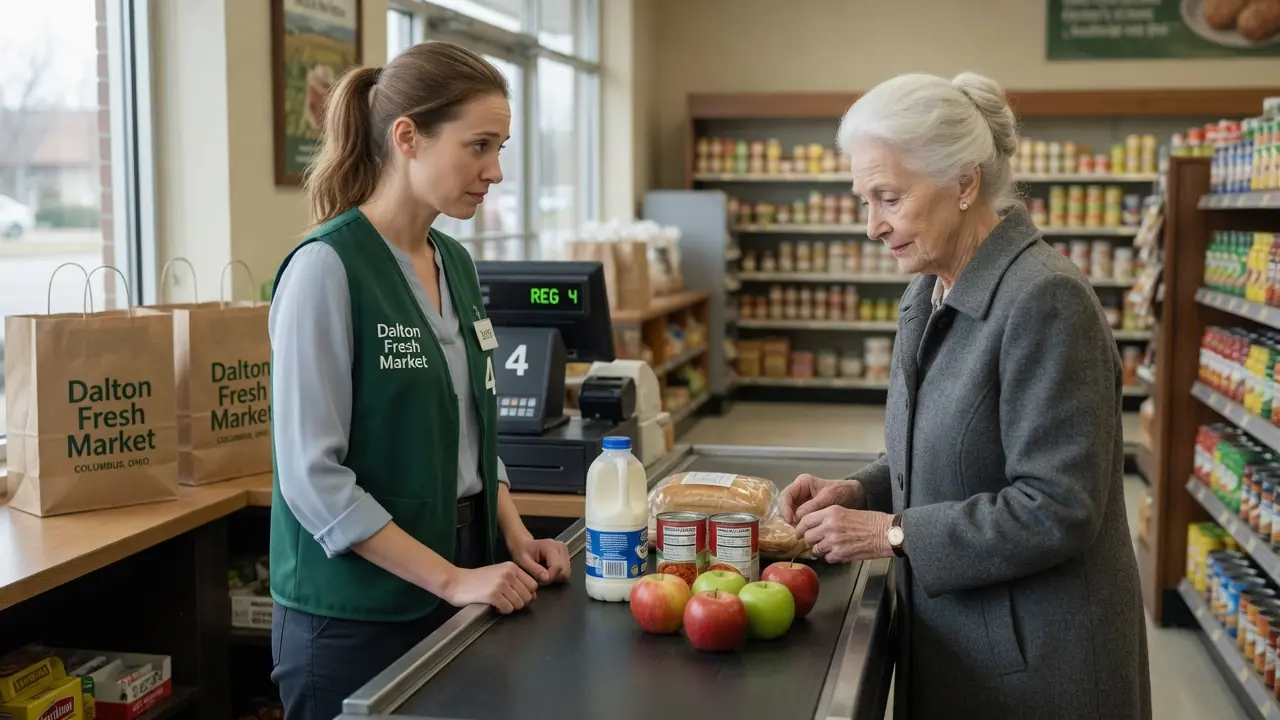
Clara worked register four, the one farthest from the entrance, where the light fixture overhead flickered every few minutes and the conveyor belt moved a little slower than the others.
She had been assigned to register four for almost three years.
She had requested maintenance on the light twice.
After the second request disappeared into whatever system swallowed small problems, she stopped mentioning it.
Seventeen dollars an hour.
Morning shift.
7:30 to 3:30.
Monday through Saturday.
No benefits worth naming.
No safety net.
No room for mistakes.
Clara was a single mother.
Her daughter, Mia, was seven years old, bright, serious, and too aware of money for a child her age.
Mia’s father had left when she was three.
There had been no dramatic ending.
No custody battle.
No tearful promise to stay involved.
Just fewer calls, fewer visits, then nothing at all.
Clara had stopped waiting for explanations around the same time Mia stopped asking when he was coming back.
At home, there was a photo of Mia at age five standing on a beach, squinting into sunlight with both arms stretched wide, as if she could hug the whole sky.
The photo was taped beside the refrigerator calendar.
Clara looked at it every morning before work.
Not for comfort exactly.
For instruction.
Keep going.
That was what the picture told her.
The logistics of Clara’s life required precision.
She rented a small two-bedroom apartment two miles from the store, in a building where the heating worked only when it felt respected.
Her neighbor, Margaret Ellis, was sixty-eight, patient, sharp-eyed, and capable of making soup out of almost nothing.
Margaret watched Mia after school in exchange for Clara carrying her groceries up the stairs twice a week and fixing whatever small thing in the apartment needed attention.
A lamp.
A stuck window.
A cabinet hinge.
No paperwork.
No formal agreement.
Just two women helping each other survive.
Every weekday followed the same rhythm.
Up at 6:00.
Breakfast by 6:25.
Lunch packed by 6:45.
Mia’s hair brushed, braided, and tied with one of the ribbons she insisted were “lucky.”
School drop-off by 7:10.
Clara at register four by 7:25.
After school, Mia walked with a group of children to the apartment building, where Margaret opened her door before Mia even knocked.
It was a system with no slack.
A sick day, a late bus, a school delay, one unexpected bill, any single thing could send everything sideways.
Clara knew this.
She managed it with the discipline of a woman who had learned that love was not always soft.
Sometimes love was a schedule.
Sometimes it was a packed lunch.
Sometimes it was saying, “I’m fine,” when you were not fine at all.
Most people who worked with Clara knew her as quiet, dependable, and occasionally funny when the day was bad enough to require humor.
What they did not know was that Clara had once studied accounting at Ohio State.
She had been good at it.
Very good.
She liked the clean logic of numbers.
She liked the way a balance sheet told a story if you knew where to look.
She left school when Mia was born and money became less an academic concept than a daily emergency.
She did not regret choosing her daughter.
Not regret for Mia.
Never that.
Regret for the woman Clara might have become if life had given her more than one path to walk.
In her work vest pocket, Clara kept a small spiral notebook.
Inside were columns of numbers written in pencil.
Cost-per-unit calculations.
Inventory patterns.
Margin estimates.
Notes about which items sold fastest when placed near the register.
Questions about why Dalton Fresh Market wasted so much money overstocking products customers did not buy while under-ordering basic staples people came for every week.
She had been filling that notebook for two years.
Not because anyone asked her to.
Not because she expected anyone to care.
Because her mind still worked that way.
Because some part of her still needed proof that she was more than a woman scanning coupons beneath a broken light.
On this particular Tuesday in November, Clara arrived seven minutes early, unlocked her register, checked the receipt paper, and began what she believed would be an ordinary day.
She was wrong.
The morning had started with Mia.
The girl woke up with a loose tooth, a missing sock, and a deeply emotional complaint about oatmeal.
“Mom,” Mia said, pushing the bowl away, “why does oatmeal look tired?”
Clara paused with the coffee pot in one hand.
“Because it works hard.”
“It tastes like sadness.”
“It tastes like breakfast.”
“Can sadness have cinnamon?”
Clara sighed and added cinnamon.
The milk carton was nearly empty.
Clara tilted it over her coffee and got three pale drops.
She typed a reminder into her phone.
Buy milk today.
Mia noticed.
“We’re out?”
“Almost.”
“Can we get the chocolate kind?”
“When you become rich.”
Mia nodded seriously.
“When I become rich, I’m buying chocolate milk and a house with stairs inside.”
“We already have stairs outside.”
“Inside stairs are fancier.”
Clara smiled despite herself.
While tying Mia’s hair, she caught her own reflection in the dark microwave door.
Her blouse collar was fraying at the edge.
She tucked it under the vest so it would not show.
Mia saw anyway.
“When you’re rich, what will you buy first?” Mia asked.
Clara finished the braid.
“New shoes for you.”
Mia frowned.
“No, for you.”
“I just told you.”
“Mom.”
“What?”
“You never buy anything for you.”
Clara grabbed both their bags from the chair.
“Time to go.”
She did not answer the question.
She rarely answered the ones that were really about her.
At 7:30, the shift began at register four.
By 10:00, the store had settled into its quiet morning rhythm.
A few retirees.
A woman with a toddler.
A man in a construction jacket buying coffee, bananas, and batteries.
Clara had just finished replacing the receipt paper when she heard the slow drag of a shopping basket along the tile.
The basket came to rest at the end of her conveyor belt.
The woman holding it looked to be in her mid-seventies.
White hair pinned back with a single clip.
A gray wool coat, well-kept but worn.
Leather shoes polished to a low shine.
A watch with a cracked leather strap on her left wrist.
Nothing about her looked careless.
But everything about her looked careful.
The woman placed her items on the belt one by one.
A carton of whole milk.
A bottle of vitamins.
A loaf of white bread.
Two cans of soup.
A small bag of apples.
Clara scanned them through.
The total appeared on the screen.
Forty-six dollars and eighteen cents.
The woman opened her purse and took out a plain wallet.
Cash only.
She laid the bills on the counter.
Three tens.
One five.
A scattering of coins.
She counted once.
Then again.
Her lips moved slightly.
Forty-one dollars and thirty cents.
She was short by four dollars and eighty-eight cents.
The woman looked up at Clara.
She did not ask for help.
She did not explain.
She did not offer the embarrassed smile people sometimes use when they want a stranger to make the moment easier.
She simply looked at Clara with the eyes of someone who had spent her whole life solving problems and had now been stopped by one small, humiliating piece of arithmetic.
Clara knew that look.
She had worn it herself in pharmacies, school offices, and grocery lines.
She did not think for more than a second.
She reached into her vest pocket, took out her wallet, and removed a five-dollar bill.
The woman immediately lifted a hand.
“No, dear. I can put something back.”
Clara entered the payment before the woman could finish.
“You’ve got milk in that bag,” Clara said quietly. “It’s cold outside. Don’t make it a problem.”
The woman stared at her.
For one second, something moved across her face.
Not just gratitude.
Recognition.
“What’s your name?” the woman asked.
“Clara.”
“Clara what?”
“Bennett.”
The woman nodded.
Not politely.
Carefully.
As if she were writing it somewhere inside herself.
Then she picked up her bags and walked out.
Grace, working register three, glanced over.
She did not say anything.
But her expression said, I saw that.
Clara tucked her empty wallet back into her pocket.
That five dollars had been her lunch money.
She would drink coffee from the break room and call it enough.
She did not feel heroic.
She felt slightly hungry and mildly irritated by the unfairness of milk costing almost five dollars.
Two hours later, Richard called her into the back office.
Richard Marsh was fifty-two, a regional store lifer who managed three locations from the same rolling chair and spoke in carefully neutral tones.
He was not naturally cruel.
That almost made it worse.
Cruel people enjoy punishment.
Richard simply trusted procedure more than people.
There was a sheet of paper on the desk.
He did not offer Clara a chair.
“This morning,” Richard said, “you used the register to offset a customer’s payment shortfall.”
Clara kept her voice even.
“I used my own cash.”
“That creates a policy issue.”
“The drawer will balance.”
“That is not the only concern.”
Clara looked at him.
“Then what is the concern?”
Richard shifted slightly.
“We cannot allow employees to make unilateral decisions that alter transactions at point of sale. It creates an optics problem.”
“Optics.”
“Yes.”
Clara stared at him.
“I paid five dollars so an old woman could leave with milk and soup.”
Richard did not meet her eyes.
“The decision has been made.”
“By you?”
He still did not answer.
Through the glass panel of the office door, Clara noticed a man standing near the cereal aisle.
Gray suit.
Mid-forties.
Lean face.
No shopping basket.
Phone held loosely at his side.
He was not browsing.
He was watching the office.
Something about him made Clara’s stomach tighten.
Richard slid the paper across the desk.
“Your employment is terminated effective immediately.”
Clara did not raise her voice.
She had learned long ago that panic spent energy she could not afford.
She signed where required.
Took the copy.
Walked to her locker.
Her belongings had already been placed into a cardboard box.
A phone charger.
A granola bar.
A sweater.
Mia’s beach photo.
Three pens.
And the small spiral notebook.
Grace appeared at the end of the hallway.
Her face was pale.
“Clara,” she whispered. “After that woman left, someone called the front office. I was close enough to hear your name.”
Clara went still.
“Who called?”
“I don’t know. But Richard came out looking like someone had threatened him.”
Clara looked toward the sales floor.
The man in the gray suit was gone.
She picked up her box and walked out into a November afternoon the color of old pewter.
For one full minute, she stood in the parking lot.
Then she looked down at Mia’s photo on top of the box.
Her daughter’s arms were thrown wide toward the beach sky.
Clara whispered, “Okay.”
Not because it was okay.
Because something had to be.
She picked Mia up at the usual time and said nothing about the job.
Dinner was pasta with jarred sauce, the cheap sweet kind Mia liked.
They ate with the television off.
Mia talked about a girl at school who claimed clouds were made of cotton.
Clara listened.
Smiled in the right places.
Asked the right questions.
After Mia went to bed, Clara sat at the kitchen table with her laptop and a legal pad.
She made a list.
Checking account: thirty-eight dollars.
Rent due in fourteen days: eight hundred fifty.
Mia’s school field trip: forty-two.
Phone bill: due Friday.
Groceries: low.
Job: gone.
She opened a job listing site and typed cashier, Columbus, immediate start.
Then assistant manager.
Then bookkeeping.
Then accounting assistant.
She stared at that last search longer than the others.
Most postings required a degree she had never finished.
She applied anyway.
Four applications.
Careful cover letters.
Neutral language around her separation from Dalton Fresh Market.
No mention of milk.
No mention of being fired for kindness.
The apartment was quiet.
The refrigerator hummed.
Outside, a car passed slowly through the alley.
Clara opened the small spiral notebook and stared at the pencil columns.
Two years of work written after Mia’s bedtime, in the silence between exhaustion and sleep.
She almost put it in a drawer.
Instead, she left it on the table.
Her phone buzzed.
Unknown number.
I heard you lost your position at Dalton Fresh Market today. I’d like to speak with you. SH.
Clara read it twice.
Then deleted it.
A scam, probably.
Or someone from some job agency trying to sell her a resume service.
She turned off the kitchen light and lay down beside Mia, because some nights being a mother meant letting your child’s breathing remind you that you still had something solid in the world.
She did not sleep for a long time.
Outside, at the far end of the street, a dark sedan sat with its lights off.
Someone was inside.
Watching.
The next morning, Clara walked Mia to school, came home, changed into her cleanest blouse, and prepared to apply in person to three grocery stores and one accounting office that might or might not be hiring.
When she opened her apartment door, a woman was standing in the hallway.
She was in her late thirties.
Tailored slacks.
A black cashmere sweater.
Dark brown hair pulled back low.
No jewelry except a watch that looked expensive without trying to.
She stood with her back straight, hands folded in front of her, calm eyes already assessing Clara before Clara had fully registered that someone was there.
“Ms. Bennett,” the woman said.
“Yes?”
“My name is Sophia Hartwell. The woman you helped yesterday is my mother.”
Clara looked at her.
“I don’t need to be thanked.”
“I didn’t come only to thank you.”
The answer was precise.
Not rude.
Just measured.
Sophia asked if she could ask a few questions.
Not about the five dollars.
About what happened afterward.
Specifically, what Clara saw in Richard’s office.
And specifically, the man in the gray suit she had noticed through the glass.
Clara described him.
Height.
Approximate age.
The way he stood.
The phone at his side.
The fact that he had no basket.
Sophia listened without interrupting.
When Clara finished, Sophia was quiet for a few seconds.
“That is more useful than you know,” she said.
She turned as if to leave.
Clara spoke before she could stop herself.
“Why was your mother at that store with only cash?”
Sophia stopped.
When she turned back, something in her face had shifted.
Not broken.
But moved.
“My mother refuses to let me buy things for her,” Sophia said. “She says she wants to manage on her own while she still can.”
A pause held more weight than the words.
“I did not know she was cutting it that close.”
Clara said nothing.
Sophia’s expression settled back into control.
“I’ll be in touch.”
Then she left.
Clara stood in the doorway long after Sophia disappeared down the stairs.
She understood, slowly and certainly, that she had stepped into something larger than a firing.
That afternoon, a man named Charles met Clara at a coffee shop two blocks from her building.
He was silver-templed, lean, and carried a folder he did not open immediately.
He introduced himself as Sophia Hartwell’s personal legal counsel.
He wasted no words.
Sophia Hartwell was the CEO of Hartwell Capital, a private investment fund managing assets of approximately two billion dollars.
Dalton Fresh Market was among the companies on Hartwell’s acquisition watch list.
Three weeks earlier, Hartwell had quietly begun an operational review of several Dalton locations, assessing management practices, customer treatment, and branch-level performance.
Eleanor Whitfield, Sophia’s mother, had participated informally.
On her own terms.
No announcement.
No company credit card.
No corporate badge.
Just a seventy-six-year-old woman with cash in her wallet, paying attention.
She had miscalculated the price of groceries by four dollars and eighty-eight cents.
The milk price had changed ten days before her visit.
The man in the gray suit had not come from Hartwell.
He was a private investigator hired by a competing acquisition group that had discovered Hartwell’s interest in Dalton.
Their goal was to collect evidence that Dalton’s stores were poorly managed and customer service was failing, which could damage Hartwell’s position and suppress the chain’s value in a competing bid.
An elderly woman being humiliated at a register would have been useful.
Instead, Clara covered the difference.
The footage became useless for its intended purpose.
So someone made a phone call.
Richard fired her quickly.
Not because of the five dollars.
Because Clara had seen the investigator’s face.
Clara set her coffee cup down carefully.
“So I was fired because I noticed him.”
Charles did not say yes.
He did not have to.
The silence answered.
Clara thought about Richard’s office.
The paperwork prepared too quickly.
The way he avoided her eyes.
The man in the suit watching through the glass.
The termination had not been a store policy reaction.
It had been cleanup.
That made it worse.
But also clearer.
Clara looked at Charles.
“What happens now?”
“That depends,” he said, sliding the folder toward her. “On whether you want to do anything with what you know.”
The next morning, Clara requested a formal meeting with Richard and corporate HR.
She cited her right to receive written clarification regarding the grounds of her termination.
Richard agreed, likely expecting her to ask for her job back.
Clara did not go alone.
She brought Grace from register three.
She also brought Charles, who stood on the main floor of the store visible through the office glass, reading calmly from his phone.
In the office sat Richard and a human resources officer named Renata, who wore wire-rimmed glasses and a perfectly neutral expression.
Clara placed a printed document on the desk.
Exterior camera timestamps showed the investigator entering the store eleven minutes before Eleanor arrived at Clara’s register.
He purchased nothing.
He remained for thirty-one minutes.
“Can you explain who this man is?” Clara asked.
Richard’s face changed color.
Renata looked at him.
Grace placed a second document on the desk.
A call log from the manager’s office landline.
She had printed it before the end of her shift, quietly, because she had known something was wrong even before she understood what.
Clara looked at Richard.
“I am not here to beg for my register back. I want to know who called you and why you acted so fast.”
Richard stood.
“This meeting is over.”
Renata said, “Sit down, Richard.”
He sat.
For the first time since Clara had walked out of Dalton Fresh Market holding a cardboard box, she did not feel like the smallest person in the room.
The investigation that followed moved quickly.
Dalton’s corporate HR opened an internal review.
The call log led to a consulting firm registered through a Delaware address.
That firm traced to the competing acquisition group.
The investigator was identified.
Richard was not immediately fired, but he was removed from store-level authority and transferred to an administrative role with no hiring power.
For Clara, that part mattered less than she expected.
She did not want revenge.
She wanted stability.
She wanted rent paid.
She wanted Mia to stop asking if field trips were only for children with two parents and better shoes.
Eleanor Whitfield, when Sophia told her the full truth, was silent for a long moment.
Then she asked, “What did Clara look like when she paid?”
Sophia described it.
Calm.
Matter-of-fact.
Like a woman doing something obvious.
Eleanor nodded.
“She didn’t make me feel small.”
That sentence stayed with Sophia.
Perhaps because money had taught her how often people confused help with control.
Perhaps because her mother, proud and aging and stubborn, had accepted five dollars from a cashier because the cashier had made the moment feel like dignity instead of pity.
Sophia called Clara that afternoon.
She asked her to come to Hartwell Capital’s temporary Columbus office.
Clara arrived on a Tuesday, eleven days after losing her job.
She wore the same clean blouse from the hallway meeting, carefully pressed, with her fraying collar turned under.
She considered leaving the spiral notebook at home.
Then she put it in her bag.
Sophia’s office overlooked the city.
Not the glamorous part of Columbus.
The ordinary part.
Parking lots.
Low buildings.
Traffic lights.
Apartment roofs.
Places where people lived entire lives without appearing on anyone’s investment report.
Sophia offered Clara a role.
Internal operations analyst.
Reviewing branch-level financial performance.
Identifying inventory inefficiencies.
Studying customer access patterns.
Reporting to the operations director during Hartwell’s acquisition review.
The salary was more than three times Clara’s grocery store wage.
Full benefits.
A predictable schedule.
Remote work two days a week after training.
Clara did not say yes immediately.
“Why me?” she asked.
Sophia seemed prepared for the question.
“Because I need people who make the right call when no one is watching.”
“That sounds nice.”
“It is also practical.”
Clara looked at her.
“I don’t have a degree.”
“I know.”
“I’m a single mother with school pickup constraints.”
“I know.”
“I was fired from a grocery store.”
“I know that too.”
“Then why would you trust me with financial analysis?”
Sophia leaned back slightly.
“Because you have been doing it already.”
Clara went still.
Sophia gestured gently toward the bag.
“May I see the notebook?”
Clara looked down.
Then slowly took it out and placed it on the desk.
Sophia opened it.
She read without rushing.
Cost-per-unit calculations.
Margin notes.
Waste estimates.
Questions about inefficient stocking patterns.
Pencil columns created during breaks and after bedtime.
Her expression did not change, but something in her attention sharpened.
When she closed the notebook, she placed one hand on top of it.
“This is not a hobby,” Sophia said. “This is work.”
Clara blinked.
For a moment, she could not answer.
Those words landed in a place she had not realized was still waiting.
Work.
Not scribbling.
Not dreaming.
Not pretending.
Work.
Sophia continued.
“You do not yet have formal training. That can be solved. What cannot be taught quickly is disciplined observation. You have that.”
Clara looked out the window.
The city was gray, familiar, and unimpressed by anyone’s private turning points.
She thought of Mia.
The field trip slip.
The empty milk carton.
The question about buying something for herself.
She looked back at Sophia.
“Was this offer made because I helped your mother, or because I’m useful in the legal process?”
Sophia did not look away.
“Both,” she said.
The honesty surprised Clara.
Sophia added, “You deserve to know that before you decide.”
Clara appreciated that.
Not because it made the decision simple.
Because it made the ground visible.
She rested her fingers on the notebook.
“If I accept, I need my schedule in writing. My daughter comes first.”
“Of course.”
“No last-minute evenings unless I agree.”
“Understood.”
“And I don’t want pity.”
Sophia’s eyes softened by a fraction.
“I do not hire people out of pity.”
Clara believed her.
She said yes.
The first weeks were hard.
Not because Clara could not do the work.
Because she could.
That was the frightening part.
She understood reports faster than she expected.
She noticed irregularities before anyone pointed them out.
She asked questions that made senior analysts look twice at numbers they had been skimming for years.
But the office was another world.
People spoke in acronyms.
Coffee was free.
No one cried in the bathroom over a bounced payment.
At least, not where others could see.
Clara kept waiting for someone to realize she did not belong.
Then one afternoon, an operations director named Miles handed her a file and said, “You caught something in the Westerville branch report I missed.”
Clara looked up.
“You missed it?”
“Clearly.”
He did not sound offended.
He sounded pleased.
She went back to the report.
But her hands shook for several minutes.
At home, Mia noticed the difference immediately.
“You smile when you come home now,” she said one evening.
Clara looked up from unpacking groceries.
“I smiled before.”
“Not with your eyes.”
Clara paused.
Mia was sitting at the table doing homework, pencil tucked behind one ear like a tiny accountant.
“Do you like the new job?” Mia asked.
Clara thought about it.
“I’m still learning.”
“That means yes?”
“That means I don’t dread going in.”
Mia nodded solemnly.
“That’s a good start.”
Clara smiled.
“It is.”
The first new thing Clara bought after her first paycheck was not for herself.
It was Mia’s field trip fee.
Then groceries.
Then a proper winter coat for Mia.
Then she stood in the women’s clothing aisle at a department store for twenty minutes holding a blouse.
For herself.
She almost put it back three times.
Finally, she bought it.
When she wore it to work the next day, Sophia noticed.
“Good color,” she said while passing Clara’s desk.
Clara looked down at the sleeve.
“Thank you.”
It was a small thing.
But some small things were proof.
Eleanor came to the Hartwell office in late March.
No one warned Clara.
She was reviewing a cost report when the elevator doors opened and Eleanor stepped out in the same gray coat, the same polished shoes, and the same cracked leather watch.
For one second, Clara was back at register four.
Milk.
Coins.
Five dollars.
Then Eleanor turned and saw her.
They met in the hallway between two conference rooms.
Neither had prepared a speech.
Eleanor looked at Clara.
Clara looked at Eleanor.
The moment lasted perhaps five seconds.
Then Eleanor said, “You let me keep my dignity.”
Clara’s throat tightened.
“You needed milk.”
Eleanor smiled faintly.
“And you needed lunch.”
Clara said nothing.
Eleanor reached into her purse and took out a folded piece of paper.
Not money.
A note.
“I wrote this the day after it happened,” she said. “I did not know when I would see you.”
Clara took it carefully.
Eleanor continued walking toward Sophia’s office.
Clara unfolded the note later at her desk.
It read:
Dear Clara,
Most people think kindness is measured by the size of the gift. They are wrong. Kindness is measured by how carefully it protects the pride of the person receiving it. You did not make me feel poor. You made me feel seen.
Eleanor Whitfield
Clara read it twice.
Then put it inside her spiral notebook.
Three months after her firing, Clara walked Mia home from school on a bright February afternoon.
Mia talked about the water cycle, about how one boy in class believed clouds were made from steam escaping giant invisible soup pots, and how she had decided not to correct him because “it seemed important to his imagination.”
At the apartment steps, Mia looked up.
“Mom?”
“Yes?”
“If we had a lot of money, what would you buy first now?”
Clara thought about the old answer.
New shoes for you.
A better apartment.
A full refrigerator.
Safety.
Instead, she looked at her daughter and answered honestly.
“A desk.”
Mia frowned.
“A desk?”
“For myself. A real one. Not the kitchen table.”
Mia smiled slowly.
“For your numbers?”
“For my numbers.”
Mia nodded.
“That’s a good answer.”
Clara agreed.
It was.
By summer, Clara had moved into a permanent analyst role.
Hartwell Capital completed the acquisition of Dalton Fresh Market, though the company changed more slowly than newspapers suggested.
Clara’s work focused on store-level fairness.
Stocking essential goods consistently.
Reducing waste.
Building better employee reporting protections.
Preventing local managers from punishing workers for good-faith decisions.
Her first major recommendation was simple.
An emergency customer assistance fund at each branch, small, documented, and manager-approved, created specifically for situations where elderly customers, parents, or vulnerable shoppers came up short on basic needs.
Milk.
Medicine.
Bread.
Baby formula.
Not gift cards.
Not publicity.
Just a quiet way to keep a small shortage from becoming humiliation.
Sophia approved it.
Eleanor named it.
The Dignity Fund.
Clara cried when she heard the name, but only in the restroom, and only for two minutes because she had a meeting.
The pilot program began in five stores.
Then twenty.
Then all Dalton locations under Hartwell ownership.
The first month, the fund helped 412 customers.
Most shortfalls were under ten dollars.
A loaf of bread.
A prescription co-pay.
A gallon of milk.
A bus pass.
A package of diapers.
Small amounts.
Large consequences.
Grace, still at Dalton, called Clara one afternoon.
“You know your fund helped a woman today buy groceries for her grandkids?”
Clara leaned back in her office chair.
“Good.”
“She cried.”
“Did you make it awkward?”
“I told her the system covered it. No big speech.”
Clara smiled.
“Perfect.”
“You did that,” Grace said.
Clara looked down at her notebook.
“No,” she said softly. “Five dollars did that.”
Grace laughed.
“Same thing.”
But Clara knew it was not quite the same.
The five dollars had been a choice.
The fund was what happened when a choice became structure.
That was the part that mattered.
One year after Clara lost her job, Hartwell hosted a small internal event at the Columbus office.
Clara did not want to attend.
Sophia told her attendance was not optional because the event was partly about her.
Clara said that made it worse.
Sophia said, “Yes.”
At the event, Eleanor spoke briefly.
She did not mention wealth.
She did not mention acquisitions.
She did not mention the investigator or Richard or corporate pressure.
She only told the room about standing at a grocery register, short by four dollars and eighty-eight cents, and the woman who made sure she left with milk without making her feel ashamed.
Then Sophia spoke about the Dignity Fund and its early impact.
Then, without warning, she invited Clara to speak.
Clara glared at her.
Sophia’s expression remained calm.
Mia, seated beside Margaret in the front row, whispered loudly, “Go, Mom.”
So Clara went.
She stood at the front of the room, hands slightly shaking.
“I don’t think kindness should depend on whether the right cashier is working that day,” she said.
The room went quiet.
“I helped one person because I happened to be there. That should not be the whole system. People need structures that allow decency to happen without someone losing their job over it.”
She glanced at Sophia.
Then at Eleanor.
Then at Mia.
“I was fired for making a human decision inside a system that had no room for one. The work now is making room.”
The applause came slowly.
Then fully.
Clara did not enjoy it.
But she did not run from it either.
Later, Mia hugged her around the waist.
“You sounded like a boss.”
Clara laughed.
“Is that good?”
“Very good.”
Eleanor approached with her cane in one hand and a small wrapped box in the other.
“For your desk,” she said.
Clara opened it later at home.
Inside was a small brass nameplate.
Clara Bennett
Operations Analyst
Mia placed it carefully on Clara’s new desk by the window.
Then stepped back.
“Now it’s official.”
Clara looked at the nameplate.
At her daughter.
At the notebook beside the lamp.
“Yes,” she said softly. “Now it’s official.”
Years later, Clara would still think about register four.
The flickering light.
The slow conveyor belt.
The old woman counting coins.
The five-dollar bill leaving her wallet.
For a long time, she had believed that moment cost her everything.
Her job.
Her stability.
Her plan.
But life was strange.
Sometimes the thing that looked like a loss was really the first crack in a wall you had mistaken for the edge of your world.
Clara never became someone who believed everything happened for a reason.
She had lived too much life for that.
Some things were simply unfair.
Some losses were just losses.
Some people suffered without a hidden reward waiting behind the curtain.
But she did come to believe this.
A good decision is still good even when the world punishes it first.
And sometimes, if enough people are brave enough to build around that decision, one small act of mercy can become policy.
Can become protection.
Can become a fund that helps thousands of people leave the store with milk, medicine, bread, and dignity.
All because one tired single mother, with almost nothing extra to give, saw an old woman trying not to be embarrassed at a grocery register and quietly paid the difference.
Clara did not know the woman was wealthy.
She did not know someone was watching.
She did not know her life was about to change.
She only knew what it felt like to be short.
And because she knew, she helped.
That was all she did.
And somehow, it became the beginning of everything.