At thirty-one, Claire Donovan had learned that winter in Montana did not ask permission before it changed your plans.
It simply arrived.
Hard.
Silent.
And everywhere at once.
It covered roads, swallowed headlights, erased distance, and turned familiar highways into blank white uncertainty.
Claire ran a small roadside diner called “Millie’s Diner,” named after her late mother.
It sat along Highway 94, twenty miles outside the nearest town, surrounded by open fields and long stretches of nothing that looked peaceful in summer but unforgiving in winter.
Claire was a single mother with a six-year-old son named Eli.
She had straight brown hair usually tied into a low bun, tired green eyes that still softened when she smiled, and hands that always smelled faintly like coffee, flour, and frying oil.
She was not the kind of person who dreamed of owning a diner.
But after her husband left three years earlier, and her mother passed away six months after that, the diner was what remained.
So she kept it alive.
For Eli.
For herself.
For anyone driving too far from home.
That evening, the sky had started changing before noon.
A pale gray ceiling pressed low over the highway.
By four o’clock, snow began falling in thin, uncertain threads.
By five, it was steady.
By six, it was a wall.
Claire stood behind the counter watching it through the diner’s wide front windows.
Flakes hit the glass and disappeared into streaks of white.
The road outside was still visible, but barely.
Trucks passed slowly, their headlights diffused into glowing haze.
Eli sat in a booth near the back coloring on a paper placemat, occasionally glancing at the storm like it might notice him back.
“Mom,” he said, “is it a big snow?”
Claire looked outside again.
“It’s a big one.”
“Bigger than last year?”
“Yes.”
Eli thought about this seriously.
“Do big snows get hungry?”
Claire smiled despite herself.
“No, baby.”
“Then why do they eat roads?”
That made her laugh softly.
“They don’t eat roads. They just cover them.”
Eli seemed satisfied with that answer and returned to his drawing.
Claire wiped down the counter again even though it was already clean.
She had learned that in quiet hours, motion helped keep fear from settling in.
At 6:40 p.m., the diner was almost empty.
Only one customer remained, an older man drinking coffee near the window, watching the snow with a tired expression.
Claire considered closing early.
But highway diners did not close early when storms came.
Not unless they had to.
At 7:03 p.m., the first truck arrived.
It came slowly, almost cautiously, as if the driver was unsure whether the road still existed beneath the snow.
Then another vehicle followed.
Then another.
Within twenty minutes, the parking lot began filling with headlights.
Trucks.
A delivery van.
Two SUVs.
A long-haul semi that looked like it had barely made it off the highway.
Claire stepped outside briefly and felt the wind hit her like a solid wall.
Three men stood near the trucks, shouting over the wind.
“Highway’s shutting down up ahead!”
“State patrol says no further southbound travel!”
“Plows can’t keep up!”
Claire’s stomach tightened.
That meant one thing.
Stranded travelers.
She went back inside and locked the door manually, flipping the sign from OPEN to CLOSED, then immediately flipping it back to OPEN.
Eli looked up.
“Mom?”
“Stay inside the booth, okay?”
“Okay.”
Within minutes, the diner filled.
Not with customers ordering casually.
But with drivers seeking shelter.
Men and women in heavy coats, snow-dusted hats, frozen eyelashes, and windburned cheeks.
Some were shaken.
Some frustrated.
Some simply exhausted.
Claire moved quickly.
“Coffee is on the house,” she said. “Soup too if you need it.”
A truck driver with a red beard nodded gratefully.
“Road’s gone,” he said.
“I know,” Claire replied.
Another driver rubbed his hands together.
“We’ve been crawling for miles. Thought we wouldn’t make it here.”
“You made it,” Claire said.
That was all that mattered.
Eli watched from the booth, eyes wide.
“Mom, why are so many people here?”
“They got stuck in the storm.”
“Like lost?”
“Like paused.”
He liked that word better.
The wind outside howled harder.
Snow piled against the windows in thick waves.
Within an hour, Highway 94 was officially closed.
Claire heard it on the emergency radio behind the counter.
“Non-essential travel prohibited. Multiple vehicles stranded between Mile Marker 112 and 140. Expect overnight conditions.”
Claire exhaled slowly.
Overnight.
She looked around her diner.
Twenty-seven people.
Maybe more.
Most of them had nowhere else to go.
The nearest motel was thirty miles back, buried under worse conditions.
The next town was unreachable.
Claire made a decision.
She stepped onto the small raised platform behind the counter and spoke clearly.
“Okay,” she said. “Everyone listen for a second.”
The room quieted.
Even the storm outside seemed to pause against the glass.
“This diner is staying open tonight. You’re safe here. We have food, heat, and floor space if needed. But we need to organize things so everyone is comfortable.”
A few relieved murmurs spread.
A truck driver raised his hand.
“You serious?”
“Yes,” Claire said. “But I need help from all of you too.”
That got attention.
“I need tables cleared for sleeping space. I need anyone with blankets or extra coats to share. I need people to stay calm so my son doesn’t think this is normal life.”
That made a few people laugh gently.
The tension broke slightly.
A woman in a blue parka stood.
“I’ve got extra blankets in my truck.”
Another man nodded.
“I’ve got a sleeping bag.”
Claire nodded back.
“Good. We’ll make it work.”
She turned to Eli.
“Buddy, you okay with a sleepover party?”
Eli looked around the crowded diner.
Then at the snow piling outside.
“Are they staying too?”
“Yes.”
He thought about it.
“Okay. But can I be in charge of cookies?”
Claire smiled.
“You already are.”
The next hours turned into quiet chaos.
Not panic.
Not fear.
Something else.
Something like temporary community.
Truckers pushed tables together.
Claire and two drivers moved chairs aside.
Soup simmered on the stove.
Coffee pots ran nonstop.
Eli handed out napkins like they were important documents.
A woman helped fold clean towels from the storage closet.
A mechanic checked the diner’s generator “just in case.”
Outside, the world disappeared into white.
Inside, people stayed warm.
At around 10:30 p.m., Claire noticed one man sitting alone near the far booth.
He hadn’t spoken much since arriving.
He was in his late fifties, wearing a dark coat dusted heavily with snow, his hands resting on a worn duffel bag.
Something about him felt different.
Not unsafe.
Just… tired in a deeper way.
Claire approached gently.
“Can I get you more coffee?”
He shook his head.
“No, thank you.”
“You okay?”
He hesitated.
Then nodded.
“I will be.”
That answer made Claire pause.
She sat across from him.
“You were heading somewhere important?”
He looked down at his hands.
“My wife is in the hospital in Helena.”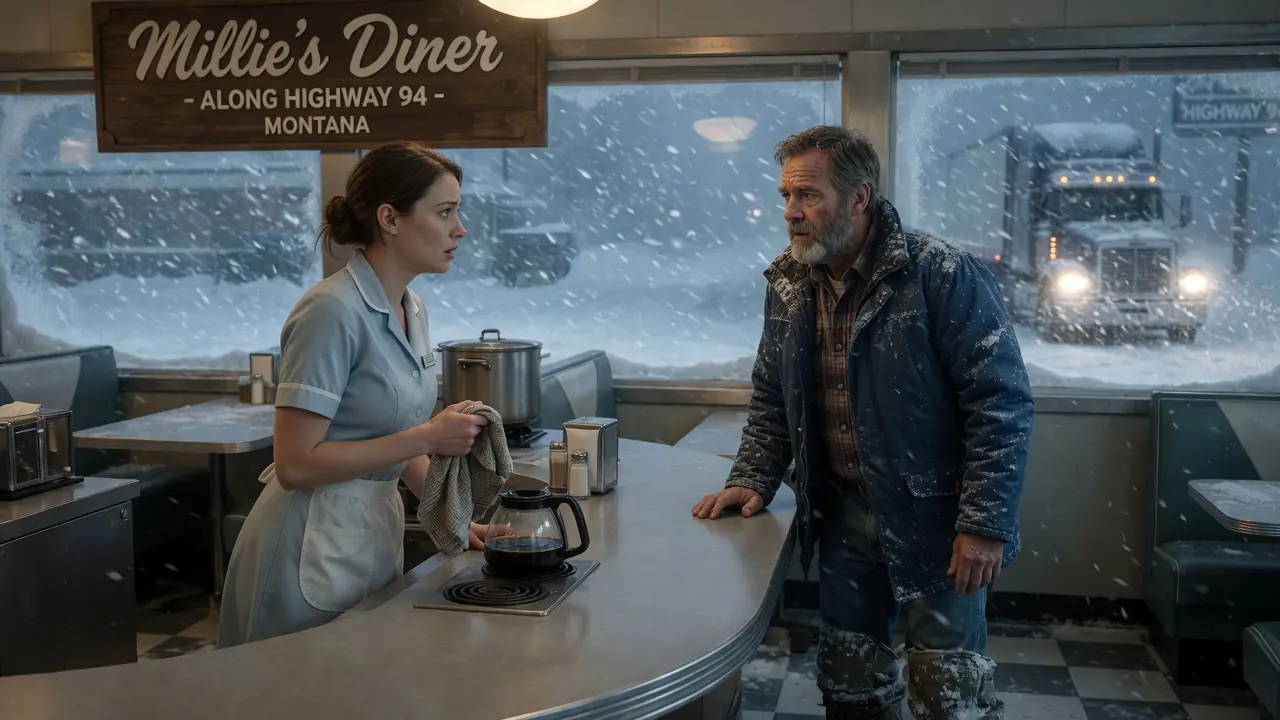
Claire’s chest tightened.
“I’m sorry.”
“They said I might not make it there tonight anyway. Storm came faster than expected.”
He glanced toward the window.
“I’ve driven through worse. But tonight wasn’t about me.”
“What was it about?”
He looked at her.
“I promised her I’d be there before midnight.”
Claire didn’t know what to say.
Promises were heavy in storms.
She knew that.
“I can’t get you there,” she said honestly.
“I know.”
“But you’re not stuck alone here.”
He nodded slightly.
“That matters more than you think.”
Claire stood.
“I’ll make you something to eat.”
He hesitated.
Then added quietly.
“Thank you for not closing.”
Claire looked back at the storm outside.
“If I had closed, I would’ve left all of you out there.”
She didn’t say the rest.
I’ve been the person left out before.
At midnight, the diner was fully quiet.
Most people had found sleeping space on benches, booths, or the floor with blankets.
The storm still roared outside, but inside, warmth held.
Eli slept curled in a booth under a pile of coats.
Claire sat behind the counter, exhausted but awake.
The man with the duffel bag still sat near the window.
Watching.
Waiting.
Claire walked over again.
“You should rest.”
“I can’t.”
She followed his gaze.
“You’re worried about your wife.”
He nodded.
“Sometimes waiting feels like the only thing you can do that still counts as doing something.”
Claire understood that more than she wanted to.
She sat beside him again.
“Tell me her name.”
“Marjorie.”
“What’s she like?”
That changed his face.
Softened it.
“She laughs at the wrong times. She corrects people’s grammar when she’s nervous. She once rearranged a hospital room because she said it ‘felt sad.’”
Claire smiled.
“She sounds strong.”
“She is.”
He paused.
“And stubborn.”
“That helps,” Claire said.
“Yes. It does.”
Outside, wind shook the diner walls.
Inside, the heater hummed steadily.
At 2:14 a.m., the radio crackled.
“Emergency update: Highway partially reopened for escorted medical travel and critical cases. Conditions still severe.”
Claire straightened immediately.
The man looked up.
She turned toward him.
“Go.”
He blinked.
“What?”
“You can get there now with escort vehicles.”
His hands tightened around the duffel bag.
“I can’t ask—”
“You didn’t ask,” Claire said. “The road opened for people like you.”
He stood slowly.
For a moment, he just looked at her.
“You kept this place open for strangers in a storm.”
Claire shrugged slightly.
“It’s just a diner.”
He shook his head.
“No. It’s not.”
He reached into his wallet, then stopped.
Claire raised a hand.
“No.”
“I need to—”
“No,” she repeated gently. “Just go.”
He nodded once.
Then paused.
“Your name?”
“Claire.”
“Claire,” he said. “I won’t forget this.”
Then he left into the snow.
Morning came slowly.
The storm softened around dawn.
Plows finally carved lines back into the world.
Cars began moving again.
One by one, the stranded travelers left the diner.
Some thanked her.
Some left notes.
Some simply nodded, too tired for words.
By 9 a.m., only a few people remained.
Claire stood behind the counter, exhausted, hair messy, eyes heavy.
Eli slept in a booth again.
The diner smelled like coffee, soup, and melted snow.
A convoy of trucks pulled into the parking lot.
Not random trucks.
These were organized.
State transport vehicles.
Community service vans.
A few police escorts.
Claire stepped outside cautiously.
The cold air hit her face.
A group of people approached.
The same man from last night was among them.
But now he was standing upright.
Beside him was a woman in a hospital coat.
Marjorie.
She walked slowly but steadily toward Claire.
Claire froze.
The man smiled.
“She made it.”
Claire’s breath caught.
Marjorie reached her.
Her voice was soft.
“I was awake when the storm hit. I heard what you did for people last night.”
Claire shook her head.
“It was just a diner.”
Marjorie looked around at the still-snow-covered building.
“No,” she said. “It was shelter.”
Behind her, others stepped forward.
One man from the night before spoke.
“We told people about this place. Emergency services are setting up a formal winter shelter route because of you.”
Claire blinked.
“What?”
The man nodded.
“Your diner became the safe point. It saved lives last night. They want to formalize it into the storm response map.”
Claire looked back at the small building.
Snow still clung to the roof.
Eli was visible through the window, still sleeping.
Her hands shook slightly.
“I just didn’t close the door.”
Marjorie stepped closer.
“That’s exactly why it matters.”
Claire didn’t know what to say.
She had only done what felt necessary.
What any mother would do.
What any person should do.
But as she looked at the people gathered in the clearing snow, she realized something quietly.
Sometimes not closing the door was the most important decision a person ever made.
Years later, “Millie’s Diner” became a designated winter emergency shelter point for Highway 94.
Claire never planned it.
She never built it as a project.
She simply survived one storm and made sure others could too.
And every winter after that, when snow began to fall, she kept the lights on just a little longer than necessary.
Because somewhere in her memory, she still heard the sound of trucks pulling in through the storm.
And the quiet truth that had stayed with her ever since that night:
A warm place doesn’t need to be big.
It just needs to stay open when everything else closes.