A sudden blizzard struck over Christmas, turning Detroit into a white maze of blocked roads and buried sidewalks.
In a small house at the end of Maple Street, Kesha Williams was struggling with no electricity, a broken heater, and her two-year-old son shivering from the cold.
In a small house at the end of Maple Street, Kesha Williams was struggling with no electricity, a broken heater, and her two-year-old son shivering from the cold.
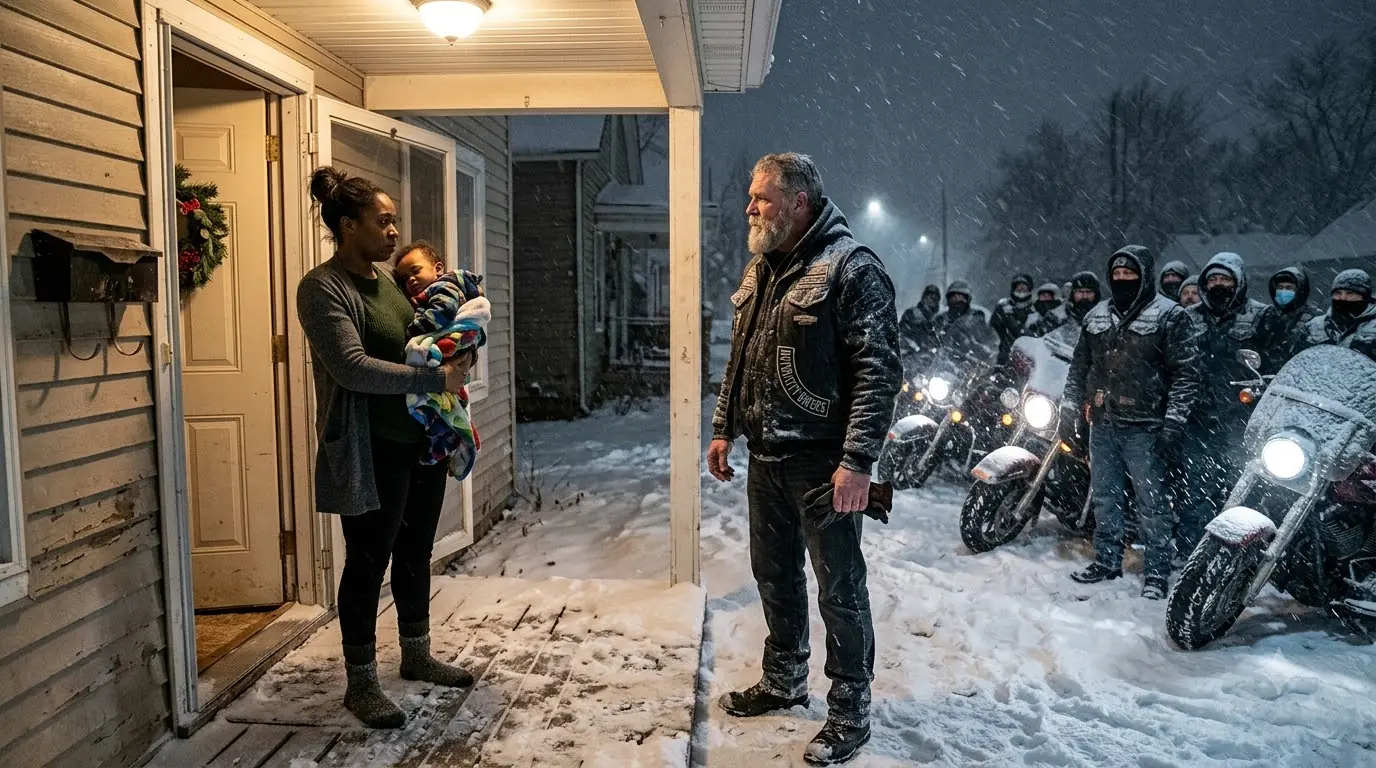
Then came the sound outside.
Motorcycle engines.
Twenty-five riders appeared through the snow and gathered at her door, desperate for somewhere to escape the storm. Kesha was terrified, but when she realized one of them was hurt and the others were freezing, she made the choice that would change all of their lives.
Three days later, 1,500 motorcycles would thunder onto Maple Street.
But Kesha knew none of that yet.
The clock on the cracked kitchen wall read 3:47 in the morning when Kesha finally allowed herself to sit down. Her calloused hands trembled as she counted the crumpled bills scattered across the wooden table.
Seven dollars and thirty-two cents.
That was all that stood between her two-year-old son, Marcus, and an empty belly come morning.
Kesha pressed her palms against her tired eyes, feeling exhaustion sink deep into her bones. At 32 years old, she looked older than she felt she should.
Her dark skin had lost some of its youthful glow, replaced by the weary look of someone who worked constantly just to stay afloat. The little house around her creaked under the winter wind, each sound reminding her how alone she had become.
Marcus slept peacefully in the corner of the kitchen, curled inside a makeshift bed Kesha had built from blankets and couch cushions. The heater in his bedroom had broken two weeks earlier, so she kept him close to the kitchen where the house was warmest.
His tiny chest rose and fell with each breath, completely unaware that his mother was drowning beneath unpaid bills and broken plans.
The house sat isolated at the end of Maple Street in Detroit, separated from the other homes by an empty lot nobody had bothered developing. Sometimes Kesha felt as if the neighborhood itself had pushed her to the edge.
Many of the families in the better-kept houses farther down the street barely acknowledged her. When they did, it was often with suspicious looks or whispered conversations that stopped when she approached.
“Why did you have to leave us, Jerome?” she whispered into the empty room.
Her ex-husband had walked out eight months earlier, claiming he needed to find himself. He had apparently found himself living with a 23-year-old waitress in Tennessee while ignoring nearly every responsibility he had left behind.
The divorce papers sat inside a folder on top of the refrigerator.
Kesha’s phone buzzed against the table, making her jump.
A text from her manager at the cleaning company glowed on the screen.
Don’t bother coming in tomorrow. We’re letting you go. Your kid was crying too much during your shift yesterday. Customers complained.
Kesha stared at the message.
She read it again.
Then again.
That was the third job she had lost in two months.
The laundromat had fired her after Marcus became sick and she had no one else to watch him. The diner had let her go after she fell asleep during a shift following an exhausting stretch of back-to-back work.
“How am I supposed to work if I can’t find anyone to watch you, baby?” she whispered, looking toward her sleeping son.
Daycare cost money she did not have.
Family help was gone since her mother had passed away three years earlier, taking with her the last person who had truly understood Kesha’s struggles.
Her mother’s voice returned in memory.
“Kesha, honey, remember what I taught you about my grandmother’s fried chicken recipe. That spice blend has been in our family for generations.”
“One day, when times get hard, that recipe might just save you.”
Kesha had smiled when her mother said it.
She had never imagined she might someday need saving by a handful of herbs, spices, and memories.
She walked to the old wooden cabinet where she kept her mother’s recipe box. The index cards inside were yellowed with age and covered in her mother’s careful handwriting.
The fried chicken recipe was still there.
So were instructions for sides, sauces, breads, and desserts from the small soul food restaurant her mother had once run.
“Maybe it’s time to try again,” Kesha whispered.
Doubt immediately followed the thought, but desperation was stronger.
The next morning, Kesha used nearly all the money she had to buy chicken and a few basic ingredients. She placed two folding tables in the living room beside the tiny kitchen and created a makeshift dining area.
Then she made a handwritten sign and placed it in the front window.
Mama Kesha’s Kitchen.
Authentic soul food made with love.
Marcus sat in his high chair, babbling happily while the smell of seasoned fried chicken filled the house.
The secret was her mother’s spice blend, which produced a crisp, flavorful coating that made people stop after the first bite.
But as the hours passed, reality settled in.
Kesha watched people walk past on their way to the bus stop. Some slowed when they noticed the sign.
Then they looked through the window.
Most kept walking.
Mrs. Henderson from three houses down stopped long enough to read the entire menu.
Kesha’s heart jumped.
She hurried to the door.
“Good morning, Mrs. Henderson. Would you like to try some of my fried chicken? It’s made from my grandmother’s recipe.”
The older woman’s expression hardened.
“I don’t think so.”
Kesha’s smile faltered.
Mrs. Henderson looked her up and down. “I’ve heard about you. Single mother. No husband around.”
Kesha said nothing.
“I don’t eat food from people like that.”
The words cut deeply, but Kesha kept her composure.
“The food is really good, ma’am. I promise it’s clean and fresh.”
“I said no.”
Mrs. Henderson’s voice sharpened.
“And you shouldn’t be running a business from your house. This is a decent neighborhood.”
She turned away.
“Keep your trouble to yourself.”
Kesha watched her neighbor walk home, humiliation and anger tightening her chest.
She closed the door and leaned against it.
Marcus stared at her from his high chair, his innocent eyes wide and trusting.
“It’s okay, baby,” Kesha whispered, lifting him into her arms. “Mama’s going to figure this out.”
“I promise.”
But when she looked around her empty little restaurant and smelled all the food nobody wanted to buy, Kesha wondered whether some promises were too heavy for one person to carry.
Outside, Detroit winter pressed against the windows.
Inside, the isolation felt just as cold.
Her phone rang again.
Probably another bill collector.
She let it go to voicemail.
Tomorrow she would have to look for another job, assuming anyone would hire a single mother who sometimes had no choice but to bring her child with her.
Marcus reached up and touched her cheek.
“Mama.”
“I’m here, baby.”
Her voice thickened.
“Mama’s right here.”
Three weeks passed.
Mama Kesha’s Kitchen attracted exactly four customers.
All four tasted her fried chicken and told her it was among the best they had ever eaten.
But four customers could not pay the rent.
They could not keep the lights on.
And they could not stop the stack of unpaid bills on Kesha’s table from growing taller.
December 23 arrived beneath an ominous gray sky.
Weather reports had warned about the storm for days.
Meteorologists were calling it one of the worst winter systems Detroit had seen in decades.
Kesha stood at her kitchen window watching the first snowflakes fall while she stirred a pot of chicken and dumplings.
At least she had food.
The few customers she had served had given her enough money to buy ingredients in bulk, hoping for a Christmas rush that never came.
“Mama, cold,” Marcus said from his high chair.
Kesha wrapped another blanket around him.
The house felt colder than usual.
Outside, the wind began rattling the windows.
By evening, snow fell in sheets thick enough to hide the houses farther down Maple Street.
Cars disappeared from the road.
The neighborhood became silent except for the wind and the occasional creak of tree branches beneath accumulating snow.
Kesha fed Marcus dinner and prepared him for bed while trying not to think about how cold the house was becoming.
She checked the thermostat again.
Something was wrong.
On Christmas Eve morning, she woke to a house that felt like a freezer.
Her breath formed pale clouds in front of her face.
Marcus was shivering beneath every blanket she owned.
Kesha rushed to the thermostat.
An error message blinked on its small display.
“No,” she whispered.
“Not now. Please, not now.”
She called a heating company.
An automated recording informed her that the storm had created a massive backlog of emergency calls and that service could be delayed for days.
Marcus began crying.
Kesha gathered him into her arms and held him close.
The power failed that afternoon.
One sharp click plunged the house into darkness.
Kesha found candles and matches while fighting the panic rising inside her.
Outside, the storm raged with almost unnatural intensity.
She moved Marcus into the kitchen, one of the smallest rooms in the house, and kept him bundled while she prepared warm food and hot water on the gas stove that was still functioning.
“It’s going to be okay, baby,” she whispered.
“Mama has food. We’re going to stay together.”
The ingredients she had purchased for her restaurant became their salvation.
Beans.
Rice.
Flour.
Canned vegetables.
Seasonings.
Enough food to survive several days if she was careful.
By the second day, however, the cold had become brutal.
Kesha wrapped herself and Marcus in layers of blankets and coats as they remained together in the warmest part of the house.
Marcus developed a cough.
Every time his little body shook, fear moved through her.
The snow had piled so high against the windows that much of the daylight disappeared.
Then, on the third night, Kesha heard something through the wind.
At first, she thought it was thunder.
Then she listened more closely.
Motorcycle engines.
A deep, rolling growl of multiple Harley-Davidson motorcycles moving through the storm.
The sound grew closer until it seemed to surround the little house.
Through a narrow gap in the snow-covered window, Kesha saw headlights.
“Who would be riding motorcycles in this weather?” she whispered.
The engines stopped.
Silence followed.
Then came footsteps.
Many of them.
Heavy boots crunching through deep snow toward her front door.
Kesha heard rough voices outside.
Marcus stirred in her arms.
Then came the knock.
Three deliberate blows against the door.
Kesha froze.
Another knock followed.
“Ma’am,” a man called through the storm. “We need help.”
“We’re freezing out here.”
Kesha’s mind raced.
Who were these people?
Why had they come to her house?
And why were people riding motorcycles during one of the worst blizzards Detroit had seen in years?
Marcus began to cry softly.
Kesha rocked him, trying to calm him while staring at the front door.
The wind howled.
The knock came again.
“Please, ma’am,” the voice called.
“We’re not here to hurt anyone. We just need to get out of the storm.”
Kesha crept closer to the front window.
What she saw made her breath catch.
Twenty-five men stood in the yard wearing heavy leather jackets, helmets, scarves, and patches.
Snow clung to their shoulders.