On a freezing Christmas night, a single mother is sitting alone, crocheting by the dim light of her kitchen. Suddenly, there's a frantic knock at the door.
When she opens it, she finds an elderly woman and a young boy shivering and lost in the storm.
Without thinking, she brings them inside.
What she doesn't know is that this single act of kindness will change her life and an entire community forever.
Snow had been falling since noon, slow, steady, unbothered by time, turning the narrow stretch of Pine Street into a long white corridor of silence.
The houses there were small and old, their roofs sagging under years of winter, the kind of neighborhood the city forgot to decorate for Christmas.
But from the last house at the end of the street, a soft golden light pulsed through the frosted window. It flickered every now and then, like a candle fighting to stay alive.
Inside, Maryanne Brooks sat hunched over a wooden table, scarred with scratches and paint stains, her fingers moving rhythmically through a skein of red yarn.
Her hands worked from habit more than hope.
The clicking of her crochet hook was the only sound in the room besides the soft hum of the space heater and the faint whisper of a radio playing Have Yourself a Merry Little Christmas somewhere in the background.
The air smelled faintly of cinnamon and wax, the leftovers of an old candle she'd melted down to make it last another night.
The Christmas tree in the corner wasn't really a tree at all, just a few pine branches she and her kids had gathered from the park and placed in an empty coffee tin.
They had strung it with paper stars, bits of colored thread, and a single ornament that still shimmered when the light hit it just right, a small silver snowflake that used to belong to her mother.
Maryanne paused, looking at it for a long moment.
Then she exhaled and went back to work.
Outside, the wind howled against the thin walls, but she ignored it. She'd learned long ago not to flinch when the cold crept in.
Her job at the textile mill had ended two weeks before Christmas. Another cost adjustment, the manager called it, though it really meant that single mothers like her were the easiest to let go.
She hadn't told her kids how bad things were.
Noah, nine years old, still believed the world could fix itself if you prayed hard enough. Chloe, six, still believed Santa never missed a house.
Maryanne didn't have the heart to tell them that Santa, like their landlord, probably stopped visiting this part of town a long time ago.
She pulled the blanket tighter around her shoulders and looked at the clock.
Almost 9:00 p.m.
The kids were asleep in the next room, curled together under mismatched blankets. On the small shelf above their bed sat a row of tiny knitted animals she'd made, a fox with one ear, a rabbit with uneven legs, a penguin with button eyes too large for its head.
Each one had sold well on her Etsy shop last month, but she couldn't bear to ship these out.
They were proof that even small, imperfect things could survive the cold.
Her phone buzzed.
A notification.
She reached for it, heart skipping.
New order, one red holiday beanie, $18.50.
Maryanne smiled faintly. Eighteen dollars wasn't much, but it was milk, eggs, and maybe a little cocoa for the kids if she stretched it.
She tapped accept and whispered, "Thank you," as if the buyer could hear her through the screen.
She worked another hour, weaving red and white yarn together into the soft spiral of a Christmas hat. Her fingers were sore. The skin around her nails cracked, but she didn't stop.
Each loop of thread was more than a stitch.
It was survival.
A gust of wind rattled the window, making her glance up. Through the frosted glass, she could see the faint reflection of her own face, tired eyes, hair tied back in a loose bun, lips dry and pale.
Behind her, the little Christmas tree glowed faintly, its paper stars trembling from the draft.
Maryanne closed her eyes for a moment and let herself drift to the Christmases she used to have when her husband was still alive, before the accident, before everything turned into counting bills and skipping meals.
She remembered laughter, music, the smell of roasted ham. Then she remembered the day the phone call came and the silence that followed.
Her hands froze mid-stitch.
Then she shook her head gently and forced herself back to the present.
The yarn wasn't going to finish itself.
When the clock struck ten, she got up, stretched her back, and moved toward the window.
Outside, Pine Street lay buried under a quilt of snow. The streetlight at the corner flickered weakly, casting long shadows across the frozen sidewalk.
There were no cars, no people, only the sound of wind scraping against old shutters.
Maryanne pulled on her old parka and stepped onto the porch. The cold bit instantly at her cheeks.
She had spent all day crocheting small ornaments, tiny red hearts, snowflakes, and mittens, and now she began to hang them on the railings outside.
Every year, she decorated the porch for the neighborhood kids who passed by on their way to the shelter.
It wasn't much, but she liked to imagine that for a few seconds, someone might see her window and feel less alone.
Her breath came out in white clouds. The sky above was the color of pewter, heavy with more snow to come.
As she hung the last ornament, she whispered to herself, "Merry Christmas, Pine Street."
Then she went back inside, shut the door, and leaned against it.
The house felt smaller somehow, quieter after the wind. She rubbed her hands together and checked the heater, still humming, but weak. The last bill had nearly broken her.
She returned to her chair, wrapped herself in a blanket, and began to crochet again, the rhythm of the hook steady and sure.
In the other room, Noah coughed softly in his sleep, and Chloe murmured something about reindeer.
Maryanne smiled.
Somewhere deep inside her, a simple truth remained, unshaken by the bills, the cold, or the empty cupboards.
If she could keep the light on, even for one night, maybe the world wasn't all darkness after all.
Outside, the snow kept falling.
Inside, the little house at the end of Pine Street glowed like a lantern against the storm.
The wind had shifted sometime after midnight.
It no longer sang.
It screamed.
The kind of scream that rattled windows and turned every loose shingle into a drum.
Snow fell thick and fast, burying the porch steps Maryanne had swept clean just hours earlier.
Inside, she sat near the window, yarn pooled at her feet, trying to ignore the sound, but every gust felt like a hand pounding at the walls, testing them.
The heater flickered once, then steadied again.
Maryanne glanced toward the bedroom door.
Still quiet.
Noah and Chloe were asleep, safe under a mountain of blankets.
She sighed and went back to her work. Two more rows and the Christmas beanie would be done. Her fingers moved slower now, the ache in her wrists deep and dull, the kind of tiredness that lives in your bones.
When the storm hit harder, she got up, crossed the room, and peered through the curtain.
The street was gone, nothing but white. The lamppost outside was a ghostly blur.
For a moment, she thought she saw something move, a shape.
Then it vanished behind the swirl of snow.
"Probably just the wind," she whispered.
She turned to check the latch on the front door.
A faint, sharp cry.
It wasn't the wind.
It was human.
High, desperate, a child.
Maryanne froze, her breath caught halfway.
The cry came again, closer this time, followed by a woman's voice shouting something broken and panicked.
She didn't think.
She grabbed her parka from the hook, threw it over her shoulders, and yanked the door open.
The cold punched her in the face like a wall of ice. Snow rushed in, stinging her skin.
"Hello!" she shouted into the blizzard. "Is someone there?"
Nothing, just the roar of wind.
Then movement again near the gate.
Two shadows struggling forward, one smaller, one bent. A flickering beam of light, the faint glow of a dying flashlight, swayed toward her porch.
Maryanne squinted, her heart racing.
"Over here!" she called out, waving her arm. "This way!"
The shape stumbled closer.
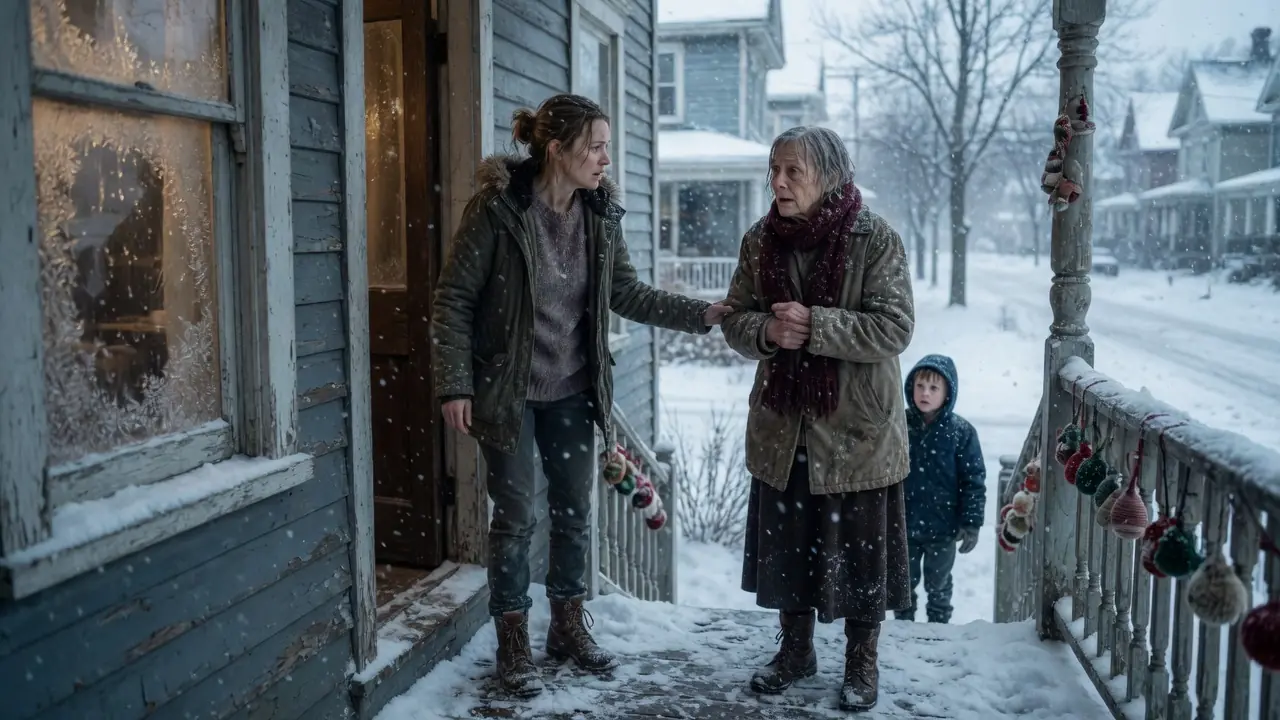
An elderly woman, hair plastered to her face, holding the hand of a little boy no older than five. His coat hung off him like it belonged to someone twice his size, and his tiny boots sank with every step.
The woman's lips moved, but her words were lost to the wind.
"Come on!" Maryanne shouted again, stepping out into the snow.
Her boots disappeared past the ankles, the cold slicing through her jeans. She ran the last few feet, caught the boy by the arm, and guided them both up the steps.
By the time she pulled them inside, her breath came in gasps. The door slammed shut behind them, muting the storm into a dull roar.
For a moment, the three of them just stood there, dripping puddles onto the floor.
The woman's eyes were wide and glassy, her breath ragged. The boy shivered violently, his fingers purple where they clutched the hem of her coat.
Maryanne kicked off her boots and grabbed two towels from the rack by the door.
"Here, honey," she said softly, kneeling to wrap the boy first. "You're okay now. You're safe."
He looked up at her, lips trembling.
"My grandma. She... she doesn't feel good."
Maryanne turned to the woman.
"Ma'am, can you hear me?"
The old woman blinked. Her mouth opened, but no words came. She seemed to be looking right through Maryanne, past her, as if the room didn't exist.
"All right," Maryanne murmured, voice gentle but firm. "We're going to get you both warm."
She guided them toward the couch near the heater. The old springs groaned under the weight, but it held. Maryanne tossed another blanket over their shoulders and hurried to the kitchen.
The kettle was still on the stove. She filled it with water and set it to boil, then rummaged through the cabinet for the last two packets of instant soup.
When she came back, the boy was still shaking, his cheeks flushed red from cold. The woman, his grandmother, she assumed, was staring at the wall, mumbling something under her breath.
"What's your name, sweetheart?" Maryanne asked, crouching down beside the boy.
"Oliver," he said quietly.
"And this is your grandma?"
He nodded.
"Her name's Edith. We were walking home from church. She... she got lost."
His voice cracked.
"Then she didn't know where we were. She didn't know me."
Maryanne's chest tightened.
"Okay," she said softly. "You did the right thing bringing her here."
"I didn't know where else to go."
She smiled gently.
"You came to the right place."
The kettle whistled.
Maryanne poured hot water into two mugs, stirring the soup until steam curled up in soft ribbons. She carried them back, careful not to spill.
"Here," she said, offering one to Oliver. "Drink slow. Okay? It'll warm you up."
He took it with both hands, nodding.
Maryanne knelt in front of Edith.
"Ma'am," she said softly. "I made you something warm."
The woman blinked again, finally focusing on Maryanne.
"I was supposed to buy jam," she muttered, voice trembling. "There was a train. Where's Michael? He was here a moment ago."
Maryanne felt the chill crawl up her spine. The look in the woman's eyes was lost, haunted. She'd seen it once before, her old neighbor, who had slipped quietly into dementia before anyone noticed.
She reached out, gently touching Edith's hand.
"It's all right," she said. "You're safe now. You're inside."
For a second, the old woman relaxed, her shoulders softening. Then she started to cry, soft, frightened tears that made Maryanne's throat ache.
"It's okay," Maryanne whispered, wrapping the blanket tighter around her. "I've got you."
Oliver set his cup down and leaned against his grandmother's arm, whispering, "I'm here, Grandma. I'm right here."
Maryanne stood quietly, watching them.
Something deep inside her stirred, the kind of ache that wasn't sadness exactly, but recognition.
The fragile, invisible thread that connects strangers in a storm.
The wind howled again outside, but the sound was distant now. In that small flickering room, warmth had begun to win, and for the first time that night, Maryanne didn't feel quite so alone.
By the time the clock struck two, the storm had swallowed the world whole. The windows were white with frost, the glass breathing faint clouds with every gust of wind.
The little house on Pine Street felt more like a ship at sea now, adrift in a blizzard that showed no mercy.
Maryanne sat on the couch beside the small boy Oliver, who had fallen asleep halfway through his soup. His tiny fingers still clutched the corner of the blanket, his eyelashes damp from earlier tears.
On the other side, Edith sat rigid and pale, her lips trembling as she murmured something inaudible, her gaze lost in a place Maryanne couldn't follow.
The heater hummed, but the air still felt cold in her lungs.
She rose quietly, went to check on her own kids.
Noah and Chloe were still asleep, their faces peaceful in the dim glow of the nightlight. For a moment, Maryanne just stood in the doorway watching them.
She had promised herself they would never know the kind of fear that kept her up at night, the fear of empty fridges, overdue rent, or the hollow silence of an unpaid power bill.
When she stepped back into the living room, she heard it.
The soft, uneven wheeze of a child's breath.
Oliver shifted, his brows slick with sweat, his cheeks burned bright pink.
Too warm, too fast.
"Oh no," Maryanne whispered.
She placed her hand on his forehead.
Hot as fire.
The kind of heat that makes every mother's pulse quicken.
"Oliver," she whispered, shaking him gently.
He stirred but didn't open his eyes.
Fever.
Maryanne rushed to the kitchen. The cabinet above the sink held a mismatched collection of medicine bottles, half-empty boxes, and the kind of cough syrup that had expired last spring.
She found a small bottle of children's acetaminophen, barely half a dose left, and poured what remained into a spoon.
When she returned, Edith was stirring too, her voice sharp and frightened now.
"He's burning up," Maryanne said gently, crouching beside her.
Edith blinked, confusion clouding her features.
"Who? Who are you? Where is this?"
"It's okay," Maryanne whispered. "You're safe. You're in my home. You came in from the storm."
The old woman's hands trembled.
"The storm," she repeated softly, as if tasting the word for the first time.
Then her eyes darted toward Oliver.
"My boy. He's sick. He needs his mother."
Maryanne swallowed hard.
"He needs care," she said. "And he'll get it. I promise."
Edith reached out, grasping Maryanne's wrist. Her grip was surprisingly strong.
"Don't let him go," she whispered. "They always go. Everyone goes."
Maryanne didn't know what to say, so she just stayed there, her hand covering Edith's until the older woman's breathing steadied again.
When Oliver coughed, small, weak, but sharp, Maryanne sprang into motion. She dampened a cloth in cold water, placed it on his forehead, and pulled the blanket tighter around him.
She added another log to the fire, then lit the small string of Christmas lights she kept over the window.
The soft colored glow filled the room, reds, greens, golds, like tiny stars had come down to rest in her living room.
She sat beside him and began to hum.
At first, it was tuneless, just something to fill the silence. Then, without realizing, the melody shaped itself into Silent Night.
Her voice was low, cracked at the edges, but gentle enough that even Edith's trembling stopped for a while.
The house seemed to breathe with her.
Each note drifted through the air, soft as falling snow.
Silent night, holy night.
Her mother used to sing it every Christmas Eve, back when there were lights strung around the whole block and laughter spilling out of every house.
Back when Maryanne still believed that kindness was something permanent, that it couldn't be taken or lost or starved out by bills.
The memory stung, but she kept singing anyway.
At some point, Edith fell asleep sitting up, her head drooping onto the back of the couch. Oliver's fever broke and rose again, his breathing ragged.
Maryanne stayed beside him, replacing the cloth on his forehead every few minutes, whispering soft reassurances he couldn't hear.
"You're okay, sweetheart," she murmured, half to him, half to herself. "You're safe here. I won't let anything happen to you."
Outside, the storm began to die down.
The wind no longer screamed.
It sighed.
Through the thinning snow, the faint glimmer of stars appeared above the rooftops, distant but steady.
Maryanne looked toward the window, her reflection framed by strings of light and frost.
The room was dim, the walls worn, the furniture tired. Yet somehow, in that fragile stillness, there was beauty.
For once, the world outside her door didn't feel cruel.
It felt listening.
When Oliver stirred again, whispering something in his sleep, "Grandma, don't leave," Maryanne reached for his hand and held it until his small fingers relaxed in hers.
Then for the first time that night, she let herself rest too.
Not to sleep, just to breathe, to feel the quiet miracle of a house still standing, a child still fighting, and a night that hadn't swallowed them whole.
Somewhere in the distance, the church bells of Pine Street began to ring, faint and hollow through the snow.
Midnight had passed.
Christmas had come.
And though Maryanne had no tree, no gifts, and no feast waiting on her table, she had something rarer.
She had given warmth to strangers in a storm, and the stars outside seemed to burn a little brighter for it.
Morning came quietly, almost shyly. After a night of chaos and wind, the world outside had gone still, like the storm had finally run out of rage.
The snow lay thick and soft across Pine Street, a perfect white sheet glistening under a pale sunrise. The silence was so complete that Maryanne could hear the faint crackle of the fire and the rhythmic drip of melting ice sliding from the roof.
She stirred awake in the armchair, her neck stiff, her hands still resting on the blanket draped over Oliver. The boy was sleeping deeply now, his fever broken, his cheeks flushed with healthy color instead of red heat.
Beside him, Edith lay half reclined on the couch, wrapped tightly in the faded quilt Maryanne had sewn years ago from old clothes.
Maryanne blinked, disoriented, until the memories of the night came flooding back, the knocking, the storm, the fever, the song.
She rubbed her eyes and glanced at the clock.
6:20 a.m.
Christmas morning.
The world smelled faintly of wet wool and soup. Her body ached, but there was a strange peace in the room, the kind that comes only after surviving something that could have gone much worse.
She got up quietly, trying not to wake them, and slipped into the kitchen.
The kettle sat on the stove, waiting. She filled it, set it to boil, then leaned against the counter, staring at the frost flowers blooming on the windowpane.
Beyond them, the light was soft, silver, an honest kind of light that didn't promise much but still arrived on time.
The whistle of the kettle cut through the silence.
She poured the last of her peppermint tea into a chipped mug and stepped back into the living room.
That's when she froze.
Edith was sitting up, her posture straighter, her eyes clear, not the drifting far-off look from the night before.
She turned her head slowly toward Maryanne and smiled, small but real.
"Good morning," she said, her voice raspy but grounded.
Maryanne stood there a moment, gripping the mug with both hands.
"Good morning," she replied softly. "How are you feeling?"
"I think..." Edith exhaled shakily. "Better than I deserve."
Her eyes flicked to Oliver, still sleeping, and softened.
"He made it through the night."
Maryanne nodded.
"He's okay now. The fever broke around four."
Tears gathered in the corners of Edith's eyes. She pressed her trembling fingers against her lips, whispering, "Thank God."
For a long moment, they just watched the boy sleep, the golden light of morning spilling gently across his hair.
Maryanne set the tea on the side table and knelt down beside the couch.
"You were confused last night," she said carefully. "You got caught in the storm. Do you remember?"
Edith's gaze drifted toward the window as if searching through fog.
"Pieces of it," she murmured. "I remember walking with him after church. The snow started. I wanted to buy jam. And then..."
She paused, her brow furrowing.
"Then everything went dark, like someone turned off the world inside my head."
Her voice cracked.
"And when it came back, I didn't know who he was."
Maryanne reached out, resting a gentle hand over hers.
"You're safe now. That's what matters."
Edith nodded faintly.
"Where are we?"
"My house," Maryanne said. "Pine Street. You found your way here last night."
Edith's eyes widened.
"You let us in."
"I couldn't leave you out there."
Something like wonder crossed the old woman's face.
"You don't even know us."
Maryanne gave a small smile.
"Storms don't wait for introductions."
That made Edith laugh, a soft, shaky laugh that turned quickly into a sob.
"You must think I'm foolish," she whispered.
"I think you're brave," Maryanne replied simply.
Edith covered her face with her hands for a moment, then lowered them, revealing a smile wet with tears.
"You remind me of someone," she said. "My daughter-in-law. She passed away when Oliver was three. She had the same eyes, the same way of speaking, like every word had to be kind before it could leave her mouth."
Maryanne swallowed hard. She didn't know what to say to that.
Edith looked back toward Oliver.
"He's all I have left. My son works too much, always in another city, another meeting. I told myself I was fine, that I could manage. But last night proved me wrong."
"You're not wrong," Maryanne said quietly. "You just got tired."
Outside, the first sound of the day reached them, a car somewhere in the distance, tires crunching over fresh snow. It made the silence in the room even deeper.
After a while, Edith whispered, "I should call him. My son. He'll be sick with worry."
Maryanne hesitated, then nodded.
"Of course."
She handed over her old phone, the one with the cracked corner and screen protector full of bubbles.
"It still works."
Edith stared at it for a moment as if it were a relic, then dialed with trembling hands.
The line rang twice before a voice answered, sharp and breathless.
"Mom! Mom, where are you?"
Edith's voice broke.
"I'm safe, Daniel. I'm safe. I'm so sorry."
Maryanne turned away, giving her space. She opened the curtains fully, letting sunlight pour into the room.
The brightness painted everything gold, the couch, the floor, the sleeping boy. Outside, the snow glittered like diamonds.
For a moment, she let herself breathe it in, the sight of life returning, of things still whole after the storm.
When Edith hung up, she wiped her eyes and smiled weakly.
"He's coming," she said. "He's already on his way."
Maryanne nodded, warmth rising in her chest that had nothing to do with the heater.
"Then let's get you both something to eat before he gets here."
She moved to the kitchen, pulling bread from the counter, heating soup on the stove.
Behind her, she heard Oliver stir. Then a soft, sleepy voice.
"Grandma."
Maryanne turned just in time to see Edith's face light up. She reached for him with trembling arms, pulling him close.
The boy buried his face in her shoulder, mumbling, "You remember me?"
"I do," she whispered, tears spilling freely now. "I do, my love."
And in that small living room, surrounded by the scent of soup and snow and peppermint tea, Maryanne felt something she hadn't felt in a long time.
Pure, wordless grace.
Outside, sunlight broke through the clouds in full, scattering over Pine Street like a quiet blessing.
By midmorning, the sound of an engine broke the calm. It came fast, cutting through the soft hush of falling snow, a dark SUV gliding up the narrow street until it stopped in front of Maryanne's house.
The exhaust rose in slow white curls against the air.
From the kitchen window, Maryanne saw a man step out, tall, mid-30s, maybe early 40s. His dress shirt was wrinkled, collar open, the suit jacket slung carelessly over one arm.
His movements were quick but uneven, more desperate than deliberate. He looked around once, eyes darting across the white landscape until they locked on the small porch with its crooked railings and hanging ornaments made of yarn.
Then he ran.
Maryanne barely had time to wipe her hands on a towel before a knock sounded.
Three hard, urgent wraps that rattled the door.
She opened it.
The man's breath came in clouds.
"You're the one who called. My mother, Edith Reeves..."
Maryanne nodded.
"They're both safe. Come in."
He stepped inside, dragging cold air with him. The warmth of the house hit his face, fogging his glasses. He yanked them off, blinking rapidly.
His eyes, storm gray, rimmed red, swept the room until they found the couch.
"Mom."
The word broke out of him like something long caged.
He crossed the room in two strides and dropped to his knees beside Edith, taking her hands.
"I've been calling every hospital in the city. I thought..."
He couldn't finish.
Edith smiled weakly.
"You worry too much, Daniel."
"You wandered into a blizzard."
His voice cracked, torn between anger and relief.
"I know," she whispered, squeezing his hand. "But look, we made it home."
Daniel exhaled shakily, pressing his forehead against her fingers.
For a moment, it was just the two of them, mother and son, reunited after a night of fear neither would ever speak of the same way.
When he finally looked up, his gaze found Maryanne.
He straightened, breath still uneven.
"You... you took them in."
Maryanne nodded once.
"They were caught in the storm. Your mother was confused. The boy was burning with fever. I just did what anyone would have done."
Daniel shook his head slowly, almost disbelieving.
"Not everyone would have opened their door."
Maryanne shrugged lightly.
"Storms don't wait for permission."
Something in the way she said it made him pause. A quiet conviction. Simple and unadorned.
He looked around the house. Then really looked, the small handmade decorations, the crooked shelves lined with jars of yarn, the old heater humming faithfully in the corner.
His gaze lingered on a half-finished scarf draped across the table.
"You made these?" he asked.
She hesitated, then nodded.
"I sell them online. It's my way of keeping the lights on."
He picked up a tiny crochet angel, turning it in his hand. The stitches were impossibly fine, precise but full of heart.
"They're beautiful."
"They keep us fed," she said simply.
Daniel smiled faintly, almost to himself.
"You work with textiles?"
"Used to. The mill closed last month."
He fell silent for a moment, still studying the angel.
Then he said, "I run a design company, Reeves and Company. We specialize in handmade decor and artisan goods. We've been trying to find authentic work like this for years."
He trailed off, then looked at her again, eyes narrowing with focus.
"You're exactly what we've been missing."
Maryanne blinked.
"Excuse me?"
"I'm serious." His tone steadied, turning professional, but still warm. "Your craftsmanship is remarkable. If you're willing, I'd like to discuss a partnership. We could feature your work, expand your production, make sure you're paid what it's worth."
Maryanne stared at him, unsure whether to laugh or cry.
"You don't have to do that. I didn't help your family for a favor."
"I know," he said quietly. "That's why I want to."
He set the angel gently back on the table as if it were something fragile and straightened his shoulders.
"This isn't charity. You have talent and vision. Let me help you bring it to more people."
The room went still.
Even the heater seemed to hush for a beat.
Behind him, Edith smiled, her voice trembling with pride.
"See, Daniel? The world still rewards goodness."
Maryanne's throat tightened. She glanced down at her hands, calloused, red, flecked with yarn fibers, and then back at Daniel.
"I don't know anything about running a business," she admitted.
"That's all right," he said. "I do."
Something in his tone, steady, certain, made her believe him.
She let out a slow breath.
"If I say yes, what happens next?"
Daniel smiled for the first time that morning.
"Then we build something together, something that lasts longer than a storm."
For a moment, Maryanne couldn't speak. The sunlight from the window spilled across the table between them, catching on the tiny crochet angel like a spark.
"All right," she said finally. "Let's talk."
The words felt like the start of something larger than either of them could see.
Outside, the snow had stopped falling. The air was clear now, the sky pale blue, and from somewhere far down Pine Street came the faint sound of church bells.
Christmas morning had arrived in full, and inside the little house that had sheltered three strangers through the storm, something new began.
Quietly, like the first breath after survival.
A promise.
Three weeks later, Pine Street looked different.
The snow had begun to melt, revealing patches of muddy grass and slush that gleamed under the weak January sun. The Christmas decorations still clung to windows and fences, some tattered, some crooked, but still holding on.
At the far end of the block, the once empty unit behind the East Side Market was alive again.
Fresh paint covered the brick walls. The old windows had been scrubbed until they gleamed. A new wooden sign hung over the door, carved by hand and painted soft cream with blue letters that read, Starlight Threads, Handmade with Heart.
Inside, the space smelled of sawdust, yarn, and coffee. Bolts of fabric lined one wall, baskets of brightly colored wool the other. A long table stood in the middle, its surface scarred from decades of use but sanded smooth, ready to hold scissors, needles, and dreams.
Maryanne stood at that table now, a pencil tucked behind her ear, a tape measure hanging loosely from her neck. Her hands were still rough, but there was light in her face, a glow that hadn't been there since long before the blizzard.
She watched as two women argued cheerfully over a spool of ribbon. Another woman, older and shy, sat at the back, stitching the edge of a blanket.
The air buzzed with the low hum of conversation and the rhythmic whisper of thread pulling through fabric.
These women weren't employees.
They were survivors, single mothers, widows, retired seamstresses with stories written in their hands. Women who had been told the world didn't need them anymore.
Now they did.
"All right, ladies," Maryanne said, clapping her hands once, smiling. "Break's over. Let's make some miracles."
A ripple of laughter moved through the room.
Near the doorway, Daniel watched quietly, coffee in hand, the corners of his mouth lifted in a proud half smile.
He was different now, too. Less boardroom polish, more earth and warmth. His sleeves were rolled up, his hair slightly unkempt, his expensive shoes dotted with paint from helping fix the floorboards the week before.
He approached the table.
"You've turned this place into something real," he said softly.
Maryanne brushed a lock of hair behind her ear, cheeks flushed.
"It's still small."
"Everything that matters starts small."
She smiled at that, but said nothing.
When the workshop had opened, Daniel's company had provided the initial funding, equipment, rent, materials, but every design, every pattern, every stitch of identity was hers.
Starlight Threads was built on the same principle that had kept her alive through years of hardship.
If your hands still work, your hope still breathes.
The first week had been chaos. Machines jammed, orders mixed up. One shipment of yarn arrived in the wrong color.
But every night, Maryanne had locked up the shop, stood in the quiet, and whispered to herself, "Tomorrow it'll be better."
And slowly, it was.
On the second Friday, Daniel had shown up late in the evening, finding her asleep at the table, surrounded by half-finished scarves. He hadn't said anything, just draped his coat over her shoulders and gone about cleaning the workspace.
When she woke, the lights were still on, the floor swept, and a note taped to the coffee pot.
You don't have to do this alone.
Now, weeks later, the words felt like a promise fulfilled.
At noon, Edith and little Oliver arrived. Edith's steps were careful but steady, her mind clearer since the hospital checkups. She carried a small basket of yarn over one arm.
Oliver trailed behind her, clutching a paper bag of cookies.
"Morning, Miss Maryanne," Oliver said shyly.
Maryanne bent down to his level, smiling.
"Morning, partner. Did you bring the cookies I ordered?"
He nodded solemnly.
"Extra chocolate chips?"
"Then I might have to pay you double."
Edith chuckled, setting down the basket.
"He takes cookies as payment, dear. You'll go broke in a week."
Maryanne grinned, but there was a flicker of emotion behind her eyes as she looked at them, this family that had stumbled into her life like a winter storm and left it forever changed.
She guided Edith to a seat by the window.
"You feeling all right today?"
"Better than I deserve," Edith said, the same phrase she'd used that Christmas morning. "And grateful to be useful. These hands still remember how to work, even if my memory forgets everything else."
"Then they're exactly the kind of hands we need."
They started the day together, stitching, nodding, laughing. The heater hummed, the light through the window slanted warm and golden.
Outside, the world went on as usual, cars passing, people shopping.
But inside Starlight Threads, something sacred was being built, stitch by stitch.
Community.
Later that afternoon, Daniel stood with Maryanne by the front counter, reviewing receipts and sketches.
"The board's still skeptical," he admitted quietly. "They think it's sentimental, not scalable."
Maryanne arched an eyebrow.
"Sentimental doesn't sound like an insult to me."
He laughed under his breath.
"You'd fit right in at our meetings."
She leaned against the counter, thoughtful.
"They think kindness is weakness, but I've seen it survive blizzards. I've seen it keep a stranger alive."
Daniel studied her for a long moment, his expression softening.
"Then we'll build it your way. I'll handle the business side. Keep the sharks off your back. You just make it worth believing in."
Maryanne nodded.
"Deal."
When he turned to leave, she called after him.
"Daniel."
He looked back.
"Thank you for trusting me."
He smiled, that same quiet smile that carried a hint of disbelief.
"No," he said. "Thank you for reminding me why trust matters."
As the sun began to set, the last light of day poured through the window, catching the threads of yarn scattered across the table. Red, gold, blue, silver, shimmering like small tangible pieces of hope.
Outside, Pine Street glowed again, the same way it had that Christmas night.
Inside, Maryanne Brooks looked around at the women, the laughter, the humming of sewing machines, and thought, not for the first time, maybe miracles weren't made of magic at all.
Maybe they were made of hands.
By the time February came, Starlight Threads was no longer just a quiet corner in the East Side Market.
The small workshop buzzed daily with noise and warmth, women chatting, children laughing, the gentle whir of sewing machines mixing with the scent of fresh coffee and dyed wool.
What began as a room of six women had grown to 12.
Orders trickled in from all over the state, handmade scarves, winter hats, embroidered wall pieces signed with a tiny tag that read, Made with Grace.
And yet, in the midst of that gentle success, a storm was gathering, one not made of snow this time, but of men in suits.
It started with a meeting.
Maryanne had been up since dawn, sorting invoices at the counter, when Daniel arrived with his laptop and that look, half tired, half braced for bad news.
He didn't even remove his coat before saying softly, "The board wants to meet today."
Her hands paused mid-count.
"Here?"
He hesitated.
"No. Downtown."
The word felt heavier than it should have.
Downtown, where everything smelled like glass and ambition. Where kindness was a marketing strategy, not a purpose.
Maryanne exhaled slowly.
"All right," she said, folding the papers neatly. "Then let's hear what they have to say."
The conference room sat on the 20th floor, overlooking the city skyline. Maryanne had never been in a place like it.
White marble floors, walls of glass, a table that looked like it cost more than her entire workshop.
She smoothed the hem of her sweater, feeling suddenly aware of the small hole near the cuff.
Daniel stood beside her, calm but distant.
Across the table, four board members sat waiting. Men and women dressed in tailored confidence.
"Miss Brooks," one of them began, smiling thinly. "We've heard a lot about Starlight Threads, and first let me say, we admire your story. Truly. But stories don't sustain growth."
Maryanne said nothing.
Another leaned forward.
"Your products are charming, but our data shows the market leans toward upscale, precision-made goods. If we position your workshop as a luxury artisan brand, we can expand nationally within six months."
Maryanne frowned.
"Luxury artisan."
"Exactly," the man said, nodding. "We'd hire trained professionals, streamline production, elevate presentation. Your current team? Well..."
He hesitated, searching for a polite word.
"They lack polish."
Her pulse quickened.
"You mean the women who built this with me?"
He gave a polite smile.
"They've done wonderfully for what they are, but sentiment doesn't sell long term."
Maryanne stared at him. Her voice, when it came, was quiet but steady.
"Then maybe you've forgotten what Christmas was supposed to sell. Hope."
The room went still.
Another board member, a woman in a gray blazer, spoke next.
"Miss Brooks, we appreciate your passion, but emotional value won't pay overhead. If Starlight Threads is to survive, it has to evolve. You have to choose between community or company."
Maryanne looked toward Daniel.
His eyes met hers.
Steady, conflicted.
She saw the war inside him, reason versus belief, numbers versus people.
He finally spoke.
"We can't strip away what makes this work meaningful. That's the point. The human story is the brand."
The first man leaned back, unimpressed.
"With all due respect, Daniel, human stories don't scale."
Daniel's jaw tightened.
"Neither does integrity."
Maryanne watched him, a flicker of warmth rising in her chest.
The conversation dragged on. Percentages, projections, risk, words that felt miles away from the smell of yarn and the laughter of women learning to sew again.
When it ended, Daniel walked her out of the building. The sun outside was blinding against the snow.
They stood by his car, the city wind cutting between them.
"You don't have to fight for me," Maryanne said quietly.
He looked at her.
"I'm not fighting for you, Maryanne. I'm fighting for the kind of world I want to believe still exists."
She searched his face, this man who had once looked like every corporate executive she'd avoided her whole life, now standing in the cold defending something he didn't have to.
"What happens now?" she asked.
"They voted to suspend new funding until we show profit growth," he said. "But I used my personal account to cover rent for the next three months."
Her eyes widened.
"You what?"
He shrugged, trying to make it sound smaller than it was.
"It's my investment, too. I'm not watching this die because someone in a suit doesn't understand heart."
Maryanne's throat tightened.
"You didn't have to do that."
"I did."
He met her eyes.
"Because you were right. Sentiment doesn't sell, but truth does. And your truth is worth something."
The silence between them filled with the sound of distant traffic, the hum of a world that didn't slow down for anyone.
Finally, she said, "Then we build it our way. We prove them wrong."
Daniel smiled faintly.
"You lead the heart. I'll protect the business."
Maryanne extended her hand.
"Deal."
He took it, his grip firm.
"Deal."
Later that night, back at the workshop, Maryanne stood alone by the window. The market had long closed, the lights of downtown flickering faintly in the distance.
Her reflection looked tired but alive.
Behind her, half-finished scarves hung on racks, silent testaments to dozens of women who had trusted her dream.
She thought of the boardroom's polished voices, their talk of numbers and image.
Then she looked at her hands, scarred, rough, still smelling faintly of wool, and smiled.
Some things didn't need polish.
They just needed purpose.
Outside, snow began to fall again, soft, delicate, unhurried.
And Maryanne whispered to the quiet glass, "Let them count their profits. I'll count my people."
Winter returned with teeth.
The snow that had once looked soft and merciful now came down like ash, gray, relentless, and cold. The joy that had filled Starlight Threads in its first months began to fade, little by little, replaced by the quiet exhaustion of struggle.
Orders slowed. Supplies delayed. Bills multiplied.
And though the lights still glowed warm behind the shop's front window, there were nights when Maryanne sat at the counter long after everyone had gone home, staring at the ledger like it was written in another language.
The math never lied.
Hope didn't pay rent.
It started with small cracks.
A batch of scarves came back from a wholesale client, returned for inconsistency in stitching. One of the new volunteers quit without notice.
Then the local newspaper that had once praised them published a story suggesting Starlight Threads was exploiting emotional marketing to gain sympathy sales.
The headline stung worse than the cold.
Daniel saw it first early one morning in his office. He called her immediately.
"Don't read it," he said.
But she already had.
"It's fine," she answered quietly. "People will believe what they want."
"They're accusing you of running a charity front for profit, Maryanne. This isn't fine."
"Then we'll show them who we really are."
Her voice was calm, but her hand trembled when she hung up.
By mid-January, several orders were cancelled. The board had been right about one thing. Sentiment didn't scale easily.
Yet Maryanne refused to let the place die.
Each morning, she unlocked the door, shoveled the snow from the stoop, turned on the heater, and greeted whoever still came through the door with the same steady warmth as before.
But one evening after closing, when the last woman had left and the laughter had faded, Maryanne finally sat down on the floor beside the cutting table and let the silence in.
Her hands were raw, fingertips cracked from days of working through the cold. She pressed them together and whispered, "Please, just one more chance."
The door creaked behind her.
She turned to see Daniel standing there, still in his suit, but without his usual composure. His hair was windblown, his tie loose, his eyes rimmed with fatigue.
"I told you to go home," she said softly.
"And miss your grand breakdown? Not a chance."
Maryanne huffed a laugh, one sharp breath that broke halfway into a sob.
"You shouldn't have to keep cleaning up my failures."
"Failures?"
He stepped closer.
"You've kept this place alive with nothing but willpower and yarn. Maryanne, that's not failure. That's a miracle."
She shook her head.
"A miracle doesn't have red ink."
He crouched down beside her, resting his forearms on his knees.
"Miracles don't balance ledgers. People do. And you've already done more than most of them would even try."
For a moment, neither spoke. The only sound was the hum of the heater, steady and small.
Finally, Maryanne whispered, "What if they're right? What if I was foolish to think kindness could be a business?"
Daniel looked at her for a long time.
"Then let it be foolish," he said. "I'd rather build something foolish and good than something brilliant and hollow."
His words landed deep somewhere behind her ribs.
Maryanne pressed the heel of her hand to her eyes.
"I'm just so tired, Daniel."
He reached into his coat and pulled something out.
A folded newspaper clipping.
The same article that had hurt her, now marked up with red pen.
"I called the editor. Told him they missed a few facts. He's sending someone next week. A real journalist. They'll see this place for what it is."
Maryanne blinked.
"Why would you do that?"
He shrugged.
"Because I believe in it. And because I believe in you."
That last part hung in the air.
She didn't answer.
She didn't need to.
Instead, she looked around the dim room, the piles of fabric, the spools of thread, the scraps of color on the floor, and felt something flicker again.
The faintest spark.
She reached for a half-finished scarf and handed it to him.
"Then help me fix this."
Daniel smiled faintly.
"You sure you trust my technique?"
"I'll teach you."
He sat beside her on the floor. She showed him how to loop the yarn, how to pull it just enough, but not too tight.
His stitches were terrible.
They both laughed softly, the kind of laughter that comes not from joy, but from survival.
Outside, snow began to fall again. Slowly this time, no longer the angry kind, just quiet flakes drifting through the glow of the streetlight.
Hours later, the lights inside Starlight Threads were still on. Through the window, two silhouettes sat side by side, surrounded by color in a world gone white.
By the end of that week, something shifted.
The journalist Daniel had called came. She listened, took notes, watched the women work, saw their joy and exhaustion alike.
The article she published days later was simple but piercing.
The Hands That Heal, a Workshop Turning Hardship into Hope.
It went viral overnight.
By morning, online orders had doubled. By evening, the inbox overflowed with messages, some from customers, some from women asking if they could join the program, learn, contribute.
Maryanne read them with trembling hands.
Her eyes stung, and when she looked up, Daniel was already standing by the door, coat over his arm, smiling like he'd known all along this day would come.
"Told you," he said softly. "Foolish things have a way of saving the world."
Maryanne laughed, a real laugh this time. Then she reached out, squeezing his arm.
"Don't ever get tired of being right, do you?"
He grinned.
"Only when you make it look this easy."
That night, as she locked up the shop, the last light in the window caught her reflection. Behind her, the room glowed golden again, warm, alive, full.
She whispered to the empty space, "We made it through another winter."
And for the first time in months, she believed it.
Spring didn't burst in. It arrived slowly, like someone knocking softly before entering.
By late March, the snow that had buried Pine Street was gone, replaced by puddles glinting under the morning sun. The air smelled faintly of wet earth, soap, and something alive.
For the first time in months, Maryanne Brooks woke up to the sound of birds instead of wind.
Starlight Threads opened early that morning. The market's corridor was still quiet, the kind of quiet that hums with possibility.
Maryanne unlocked the door, switched on the lights, and stood there for a moment, just breathing it in.
The smell of yarn, coffee, and wood polish, the gentle warmth that no heater could fake.
It had been a long winter, but somehow the light had stayed.
Inside the shop, everything had changed.
The long table was now surrounded by women, a dozen, sometimes more. Hands moving with rhythm, voices weaving over each other like overlapping melodies.
The shelves, once bare, overflowed with color, soft blue scarves, sunflower yellow blankets, and tiny crocheted animals that somehow carried the fingerprints of joy.
Maryanne moved among them, tying ribbons, checking patterns, answering questions.
She still wore the same old gray sweater with a loose thread at the sleeve, but she carried herself differently now. Shoulders straighter, steps lighter, like someone who had stopped surviving and started living.
Across the room, Edith Reeves sat by the window, sunlight haloing her silver hair. She hummed softly while sorting yarn into neat bundles.
Her hands shook, yes, but her eyes were clear, steady.
Oliver, now a little taller, sat beside her at his own small table, threading needles with the careful concentration of someone performing sacred work.
"Grandma," he said proudly. "I made this loop myself."
Edith smiled.
"Then you're officially faster than me."
Maryanne watched them from across the room, her heart tightening in that way gratitude sometimes hurts.
She still remembered the night they'd arrived. A storm, a knock, a fevered child, a frightened woman.
How something so chaotic had turned into this, a quiet morning of color and calm.
The bell above the door jingled.
"Good morning, boss," said Tasha, a single mother of three who joined the workshop after seeing their story online.
She carried a box of yarn on her hip and a grin big enough to light the room.
"Morning, Tash. How's your little one?"
"Teething. Loud. Alive. All good things."
Maryanne laughed.
"That's what I like to hear."
She crossed to the back counter where Daniel was pouring coffee into two mugs. He'd arrived early, sleeves rolled, jacket off, already talking with a supplier on the phone.
He still ran his company downtown, but lately he spent more time here, not to oversee, but to belong.
He handed her a mug.
"Inventory's up 22%. We're on track to break even this quarter."
Maryanne raised an eyebrow.
"Break even. That's our new celebration point?"
He smirked.
"When you've built something from nothing, yes, survival's a milestone."
She laughed softly, taking a sip. The coffee was too strong, but she didn't mind.
He looked around the shop, at the women, the laughter, the light.
"You realize this started because you refused to shut your door."
Maryanne shrugged.
"I didn't plan any of this."
"Exactly," he said. "That's why it worked."
By late April, Starlight Threads had become more than a store.
It was a refuge, a rhythm, a living thing.
Every week, new faces appeared. Women from different corners of the city. Some carried resumes, others just carried exhaustion.
Maryanne greeted them all the same way, with a cup of tea and a question.
"What do your hands remember how to do?"
One woman, Gloria, had spent ten years cleaning offices at night. She hadn't touched a needle in decades. Within two weeks, she was teaching others how to embroider initials into cloth.
Another, Lena, came from a shelter, shy and withdrawn. The first scarf she ever finished sold online to a woman in Germany who wrote back saying it felt like a hug.
Lena framed that message.
Maryanne didn't keep track of how many they'd helped.
Numbers weren't the measure here.
Faces were.
Sometimes Daniel would bring his laptop to the long table, pretending to work while secretly watching them all.
"You've turned this place into a machine powered by compassion," he told her one afternoon.
"It's not a machine," Maryanne said, wiping her hands on her apron. "It's a family that found its work."
She didn't mean it as poetry, but he smiled anyway.
It happened on a Thursday.
A small-town newspaper journalist had come to do a follow-up story on their winter recovery. But when she arrived, she didn't just interview Maryanne. She stayed the whole day helping wind yarn, drinking tea, laughing with the women.
She saw what numbers couldn't tell.
The quiet heroism of people who refused to quit.
Her article published under the title, The Hands That Keep the Light, spread faster than anyone expected.
Within a week, Starlight Threads was flooded, not with investors or corporations, but with letters.
Boxes of mail arrived every morning.
One from a retired teacher in Oregon, who sent a check for $50 with a note.
I used to crochet with my mother. Thank you for reminding me it mattered.
One from a girl in Ohio.
My mom says you're what I want to be when I grow up.
Even one from a women's collective in Nairobi.
Your story reached us. We are starting our own workshop today.
The world had noticed.
Maryanne was overwhelmed. She stayed late that night reading letters until her eyes burned.
When Daniel stopped by after his board meeting, he found her surrounded by envelopes, laughing and crying at the same time.
"They're writing from everywhere," she said breathlessly. "Look. Peru. Iceland. South Africa. Daniel, people see us."
He smiled, leaning against the doorframe.
"You didn't build a workshop, Maryanne. You started a ripple."
She shook her head.
"I didn't do anything special."
"Exactly," he said softly. "That's what makes it special."
By early summer, the mayor's office called. The city wanted to honor Starlight Threads for outstanding contribution to community growth.
A small ceremony was scheduled right in front of their shop.
The day came bright and clear, sunlight spilling across Pine Street like forgiveness. Local reporters gathered, microphones on stands, cameras flashing.
Maryanne stood by the door, trying to make herself smaller. Public speaking wasn't her gift. She'd spent most of her life blending into the background, not standing at podiums.
Edith squeezed her hand.
"Just tell the truth, dear. The truth's always enough."
Maryanne took a deep breath and stepped forward.
The small crowd hushed.
She looked out at the faces, the women from her shop, her kids, Daniel, the townspeople who once walked past her window without noticing.
She cleared her throat.
"I never thought I'd be standing here," she began. "Last Christmas, I lost my job and a storm took out half this street. I thought the world was getting smaller, colder. But then two strangers knocked on my door, and everything changed."
Her voice caught, but she didn't stop.
"People ask what made this place possible. I don't have a big answer, no business plan, no grand design, just one choice to open the door when it would have been easier to keep it shut."
The crowd was silent.
Even the camera lights dimmed a little.
"This shop isn't built on money," Maryanne continued. "It's built on hands. Hands that tremble. Hands that heal. Hands that remember what kindness feels like. Every stitch here is a piece of someone's story. And together those stories remind us, hope is still handmade."
A long pause.
Then applause.
Real, raw, rising like a wave.
Daniel clapped the hardest, pride bright in his eyes.
After the speeches, the mayor unveiled a small bronze plaque fixed beside the shop's door. It read:
In memory of that one Christmas night, when kindness opened the door.
Maryanne ran her fingers over the engraved words. For a moment, the noise of the crowd faded, replaced by the quiet hum of the past, the storm, the warmth, the first small act that had led here.
She whispered under her breath, "We made it."
When evening came, the shop emptied slowly, leaving behind laughter, crumbs, and the faint smell of coffee. The lights glowed soft against the dusk.
Maryanne lingered by the window long after everyone left.
Outside, the street shimmered with puddles reflecting gold from the lamps. Inside, the shelves gleamed under gentle light.
She could see the women's work everywhere, scarves stacked neatly, quilts folded, little yarn animals waiting for new homes. The heater clicked softly in the background.
Edith had gone home early with Oliver, promising to bring cookies in the morning. Daniel had stayed behind to lock the back door, now emerging with his coat over his arm.
"You should go home, too," he said.
"I will," she said. "Just not yet."
He nodded, understanding without asking why. He looked around the room one last time.
"You know they'll keep this going long after us."
"I hope so."
"They will," he said, "because the light's already in them."
He left quietly, the bell over the door giving one last soft chime.
Maryanne walked to the center of the room and touched the worktable with her hand. The surface was smooth now, worn down by hundreds of small miracles.
She ran her fingers across a stray strand of red yarn and smiled.
She thought of the night everything had begun, the snow, the knock, the fever, the fear, and how impossible it would have sounded if someone had told her then that this was what waited on the other side.
Maybe miracles weren't lightning bolts or winning lotteries.
Maybe they were just moments when you refused to stop believing the world could be good again.
She moved to the front window, looking out at Pine Street.
It was quiet now, but not empty. A few windows across the street glowed. Laughter echoed faintly from the diner on the corner.
"The light stayed," she whispered.
And she meant it.
Not just the bulbs, not just the shop sign, but the deeper kind. The kind that hums beneath skin and memory, the kind you pass from hand to hand until the world is a little less cold.
She turned off the lamp, leaving only the string of soft golden lights above the display window.
From outside, Starlight Threads looked like a small lantern against the night, one that had outlasted the storm and was still shining quietly without asking for attention.
As Maryanne locked the door, she caught her reflection in the glass.
Behind her, the plaque shimmered faintly, the engraved words glowing under the streetlight.
Kindness opened the door.
She smiled.
Then she stepped into the cool evening, the scent of rain in the air, her hands still warm from work.
A letter arrived from Nairobi from the women who had written months ago.
Inside was a photo.
Twenty women standing outside a small workshop holding up handmade scarves. The sign above their door read, Light Stitch Cooperative, inspired by Starlight Threads.
Maryanne pinned it to the wall above her counter, next to the first photo ever taken of her shop.
Two worlds apart, stitched together by kindness.
Every once in a while, someone new would walk into the store, tired, nervous, carrying more worry than hope.
And Maryanne would smile and say the same words she'd once whispered to a child on a stormy night.
"You're safe here. We'll start from what your hands remember."
And as they sat down at the long table, the light would catch on the golden thread stretched across it, soft, glowing, endless.
Because the truth was simple.
The storm had passed.
But the kindness, the quiet, ordinary, world-changing kindness, it stayed.
And it always would.