Whispers followed Basia Parker through Telluride long before anyone began whispering about her wedding. They followed her into the mercantile, down the wooden boardwalk outside the bank, through Sunday services, and even into the narrow aisles of Mrs. Talbot’s dress shop, where women sometimes pretended not to stare while the seamstress measured the broad curve of Basia’s waist. At twenty-four, Basia had grown accustomed to lowering her eyes before strangers could decide she was challenging them merely by existing. She had learned that a woman could be condemned without committing a sin, provided her body offended enough people.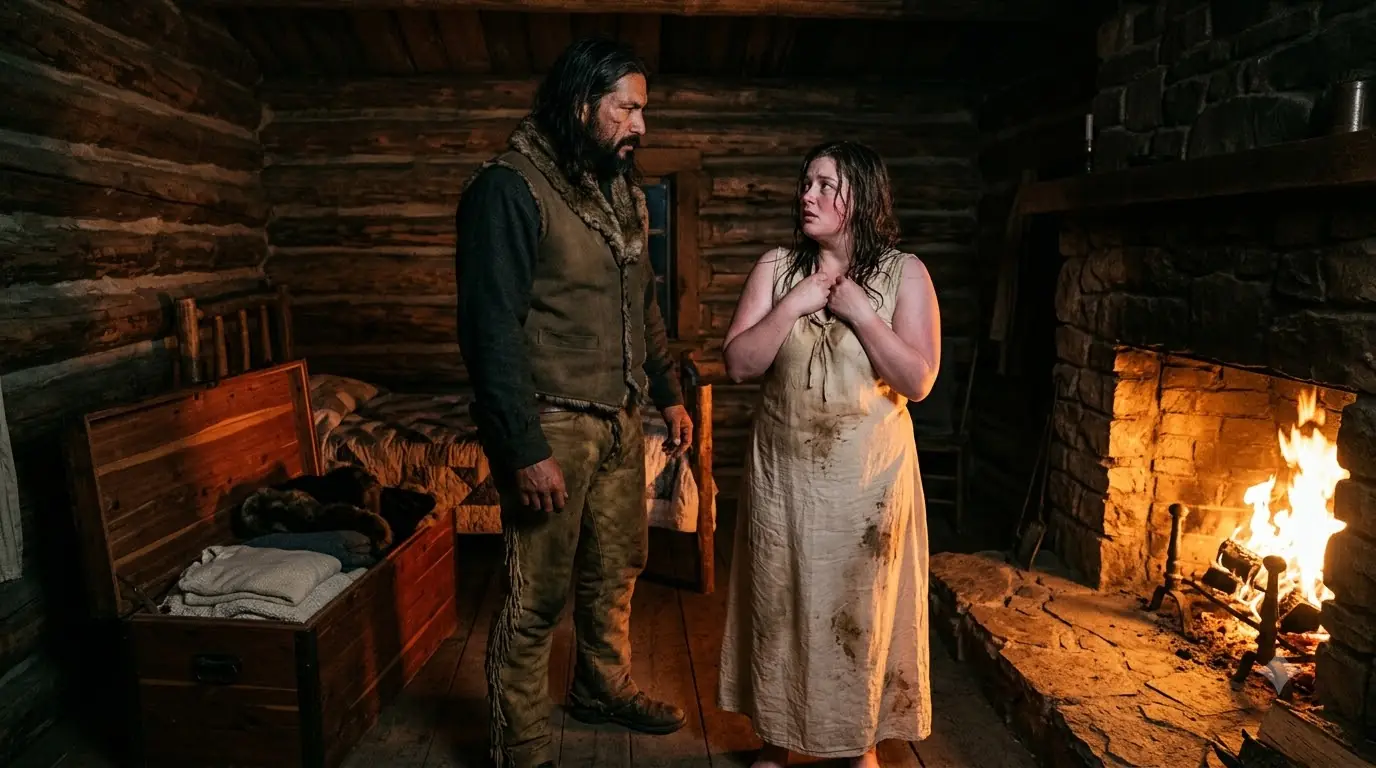
Basia was tall for a woman of her time, though not extraordinarily so, and she carried weight across her hips, thighs, stomach, and chest with a softness that fashionable society treated like evidence of moral failure. Her father’s acquaintances back in Boston had called her unfortunate before she was old enough to understand the word, always in that careful tone wealthy people used when cruelty needed to sound compassionate. Harrison Parker had responded by buying tighter corsets, darker gowns, and expensive tutors who taught Basia how to sit without appearing to occupy too much space. Nothing changed what she was, but every attempt taught her something else: the world believed she required correction.
When Harrison dragged her west in 1886, he promised Colorado would be different. Telluride was young, rough, hungry, and overflowing with men who had come seeking silver, land, or escape, and Harrison insisted nobody on the frontier cared about Boston standards. Yet wealth created its own standards wherever men gathered enough of it, and within months the wives of mine owners had recreated the same drawing-room hierarchy Basia thought she had left behind. Only now the insults were less refined. Instead of calling her unfortunate, men in saloons called her “a whole winter’s worth of woman.”
Harrison heard those remarks and never defended her. Sometimes he laughed because he feared becoming the next target, and sometimes he glanced at Basia afterward with an expression that made the wound deeper than any stranger’s joke. He had once been a banker with polished boots and enough confidence to make foolish men trust him. By the winter of 1887, he was instead borrowing money against silver claims that produced almost nothing, lying to partners, and drinking bourbon before noon.
His final creditor was Santos Delgado. Unlike the bankers Harrison understood, Santos kept no elegant office and employed no clerks. He lived miles above Telluride in the San Juan Mountains, descended only when he had pelts, timber contracts, or carefully documented debts to settle, and rarely remained in town overnight. Nobody knew precisely how much money he possessed, but everyone agreed that a man who could survive twenty winters in those mountains did not require permission from banks to be wealthy.
Stories about Santos became darker every time they were repeated. Some claimed he had killed a grizzly with a hunting knife, others that he had once dragged an injured miner eight miles through a blizzard while carrying the man’s broken leg against his own chest. A bartender swore Santos had buried three claim jumpers behind his cabin, though the same bartender could not remember whether they had supposedly been killed in 1881 or 1884. Basia suspected half the stories were nonsense. The half she believed frightened her enough.
Harrison had borrowed nearly six thousand dollars from Santos after two banks refused him further credit. The money had been intended to secure machinery for the Parker Silver Company, but Harrison diverted much of it toward older debts and a disastrous land speculation south of town. By March 1888, Santos held liens against nearly everything Harrison still possessed. The remaining house, furniture, wagon, and shares were worth less than half the debt.
On the evening of March thirty-first, Harrison called Basia into the parlor. He had not lit enough lamps, perhaps because darkness made cowardice easier. One suitcase stood near the doorway, already packed, and a half-empty bourbon bottle rested beside his chair. Basia knew before he spoke that he intended to leave.
“You will marry Santos Delgado tomorrow,” Harrison said.
Basia stared at him. For several seconds her mind refused to understand the sentence, converting the words into sounds without meaning. Then she noticed the papers on the desk and saw Santos Delgado’s name written beneath several lines of legal language. Her stomach tightened so sharply that she pressed one hand against her corseted ribs.
“You cannot promise me to settle a loan,” she said.
Harrison poured another drink although his glass was not empty. “Do not turn this into melodrama. Delgado requires a wife, and I require the debt discharged. You require a future, though you have done remarkably little to secure one yourself.”
Basia looked at him as if he had struck her. “You mean because no man has proposed.”
“I mean because you are twenty-four.”
“And because I am fat.”
Harrison flinched, but only because she had spoken the word plainly. “Basia.”
“Say it.”
He swallowed bourbon instead. “You are not suited for society as other young women are. Delgado does not participate in society. That may prove fortunate for both of you.”
Basia had imagined cruelty many times, but she discovered that its worst form was not shouting. It was administrative. Harrison spoke about her marriage the way he might discuss selling mining equipment whose maintenance had become inconvenient.
“You are selling me,” she whispered.
“I am saving what remains of this family.”
“What remains of this family is standing in front of you.”
Harrison finally looked at her, and Basia saw something she had never expected: shame. For one foolish second she hoped shame might stop him. Then his jaw hardened and he looked away.
“Tomorrow at noon,” he said. “Wear the blue velvet.”
The courthouse wedding drew a larger crowd than Basia expected. Telluride residents loved tragedy when it belonged to someone else, and the Parker collapse had entertained the town for months. Basia climbed the courthouse steps in her dark blue velvet gown while whispers gathered behind her like insects. The corset beneath the dress had been pulled so tightly that every breath stopped halfway into her lungs.
Santos arrived exactly at noon. He came without family, friends, flowers, or formal clothing, wearing heavy buckskin trousers, a dark wool shirt, and a weathered coat lined with fur. He was broader than Basia remembered from the few times she had seen him across town, and taller as well, with long dark hair brushing his collar and a beard that failed to conceal the jagged scar running from his left temple toward his cheek. When his storm-gray eyes settled on Basia, they did not travel over her body the way other men’s eyes did.
That absence unsettled her more than staring would have.
Judge Ezekiel Stanton cleared his throat and conducted the brief ceremony. Harrison stood ten feet away, avoiding Basia’s gaze while Santos listened with a stillness that made him seem carved from the mountains behind him. When asked whether he accepted Basia Parker as his lawful wife, Santos answered with a single word.
“Yes.”
Basia’s answer came quieter.
“Yes.”
The judge declared them husband and wife. Nobody applauded.
Santos gestured toward the wagon waiting beside the courthouse. “Bring your things.”
No endearment. No smile. No touch.
Basia walked down the steps while laughter followed.
Martha Higgins stood near the bottom beside another woman and did not lower her voice. “He likely bought her by the pound.”
The women laughed.
Basia kept walking.
Her first trunk nearly slipped from her hands as she tried to lift it into the wagon. She waited for Santos to help, but he remained on the driver’s bench staring down the road, and humiliation burned hotter through her face. She finally wrestled both trunks aboard by herself, climbed beside him, and folded her shaking hands into her lap.
Only when they were leaving Telluride did she notice Santos looking toward the courthouse.
Not at the townspeople.
At Harrison.
Basia followed his gaze and discovered her father was gone.
The wagon climbed for hours. Telluride disappeared beneath them, first becoming a cluster of roofs and then a gray scar against the valley. The road narrowed into a rough trail carved along steep slopes where melting snow turned the ground to mud and loose stone. Basia’s body slammed against the wooden seat until every muscle hurt.
Santos said almost nothing. Twice he stopped to check the horses. Once, when sleet began striking Basia’s face, he reached beneath the seat and tossed a thick wool blanket over her lap without comment. She wrapped it around herself and wondered whether even wolves occasionally performed acts that looked like kindness.
The storm worsened near dusk. Purple clouds swallowed the highest peaks, and wind tore through the pines with the sound of distant surf. Basia’s fingers had gone numb beneath her gloves when Santos finally guided the horses into a clearing. A broad log cabin stood against the tree line, smoke rising from its stone chimney.
“We’re here,” he said.
Basia climbed down too quickly and nearly fell. Santos noticed but said nothing as he unhitched the horses. She told herself that she preferred his silence. Silence could not insult her.
She attempted to lift her trunks again.
This time Santos crossed the clearing, moved her gently aside with one hand, and lifted the first trunk onto his shoulder. The second he carried in his other hand.
Basia stared.
“You could have done that in town,” she said before she could stop herself.
Santos paused.
“Yes.”
“Then why didn’t you?”
His eyes settled on hers. “Because everyone was watching to see whether I treated you like cargo.”
Basia waited.
“I wanted to see whether your father helped you.”
The answer hit harder than expected.
“He didn’t.”
“No.”
Santos carried the trunks inside.
The cabin was cleaner than Basia imagined. Animal pelts covered part of the floor, but the table had been scrubbed, shelves held neatly stacked dishes, and dried herbs hung above a cast-iron stove beside the massive stone fireplace. A large bed occupied one corner, covered beneath dark quilts and thick fur blankets.
Basia noticed the bed immediately.
Santos noticed her noticing it.
Neither spoke.
He built the fire higher and told her about the creek behind the cabin. Basia heard the instruction as a test. She was determined not to fail anything on her first night, so she took the iron bucket and stepped outside before Santos finished explaining where the bank became steep.
Ten minutes later, she was drowning.
The creek had swollen with mountain runoff. Basia knelt near the edge, her corset preventing her from bending comfortably, and reached toward the water. The mud collapsed beneath her left boot.
She plunged forward.
The cold erased thought. Water closed over her head and the enormous blue velvet skirt transformed instantly into dead weight. Basia kicked desperately, but the dress dragged behind her while the corset prevented her lungs from expanding.
Her fingers caught a root.
She screamed.
Footsteps struck the ground above her.
Santos came down the bank so quickly he nearly fell himself. One massive hand locked around Basia’s forearm while the other grabbed the back of her dress. He hauled her upward with a roar of effort and dragged her onto solid ground.
Basia collapsed.
She expected anger.
Instead Santos lifted her into his arms.
She weighed more than most women, a fact she had been taught to apologize for almost daily, yet Santos did not grunt, mock, or hesitate. He gathered her against his chest and carried her up the path as though the decision required no thought. By the time he kicked the cabin door open, water was running from both of them.
He lowered Basia onto the rug beside the fire.
Her entire body shook violently.
Santos stripped off his wet coat and threw more wood into the hearth. Then he turned toward her, taking in the soaked velvet, mud, blue lips, and the rigid shape of the corset beneath the dress. His expression hardened.
“Take off everything.”
Basia stopped breathing.
Santos stepped closer.
“Everything they made you wear.”
She gripped the front of her dress.
The fear in her face stopped him instantly.
For several seconds they stared at one another.
Basia had spent the entire day imagining this moment. She had expected commands once the cabin door closed, expected him to remind her that Harrison had traded her into marriage, expected the bed to become another place where somebody else decided what happened to her body. Now the command had finally arrived.
“If this is what you purchased,” she whispered, “then at least have the courage to say it.”
Santos’ expression changed.
“Purchased?”
“My father gave you a wife to clear his debt.”
“I cleared Harrison Parker’s debt.”
“You see a difference?”
“Yes.”
Basia laughed once, bitterly.
Santos looked at her wet dress and then at her face. “You’re freezing.”
“I understand that.”
“That corset is soaked.”
“I understand that too.”
“You’ll get sick.”
“And you want me naked.”
“No.”
The answer was immediate.
Basia blinked.
Santos stepped backward.
Then he turned around.
His broad back faced her completely.
“There’s a blanket on the chair,” he said. “Change behind me. Or throw the whole damned blanket around yourself first. I won’t look.”
Basia stared at him.
“Why?”
“Because you don’t want me to.”
The simplicity of the answer dismantled something inside her.
Santos crossed toward the far wall instead of waiting. He moved aside a stack of split firewood, revealing an iron ring set into the floorboards. Basia watched as he pulled upward.
A large cedar chest rested beneath a shallow concealed compartment.
He lifted it free.
Basia forgot the cold for a moment.
Santos opened the chest.
Inside were clothes.
Not the dark, shapeless gowns Harrison always selected for her. Not punishing corsets, stiff bonnets, or narrow shoes. Folded carefully across the top were two heavy wool nightgowns, soft flannel undergarments, knitted stockings, and a fur-lined robe.
Beneath them lay dresses.
Beautiful dresses.
One was deep forest green with a broad waist and adjustable side ties. Another was burgundy wool with generous sleeves. A third was soft cream, simple but carefully made.
Basia moved closer despite herself.
“These are too large for you,” she whispered.
Santos almost smiled.
“They’d look terrible.”
Her eyes snapped toward him.
Then she realized he was making a joke.
It might have been the first joke Santos Delgado had made in ten years.
“For whom?” she asked.
“You.”
Basia stared into the chest.
Her fingers trembled as she touched the green fabric.
“You had these made?”
“Yes.”
“When?”
“Three months ago.”
Her hand stopped.
Three months.
Her father claimed the marriage arrangement had been made only yesterday.
Basia slowly turned.
“You knew.”
Santos’ face became guarded.
“You knew my father would offer me.”
“No.”
“But you had these before he did.”
“Yes.”
“Then why?”
Santos looked toward the fire.
For the first time since Basia met him, the mountain man seemed uncertain.
“Your mother,” he said.
Basia went completely still.
“My mother has been dead fourteen years.”
“I know.”
Santos walked to a shelf and removed a small wooden box. From inside he took a folded piece of paper stained yellow with age. He held it out.
Basia recognized the handwriting before she touched it.