Sweat dripped onto the grease-stained concrete as the ground beneath Oildale Customs began to vibrate.
It was not an earthquake.
It was the synchronized thunder of hundreds of motorcycles approaching the dead-end industrial park.
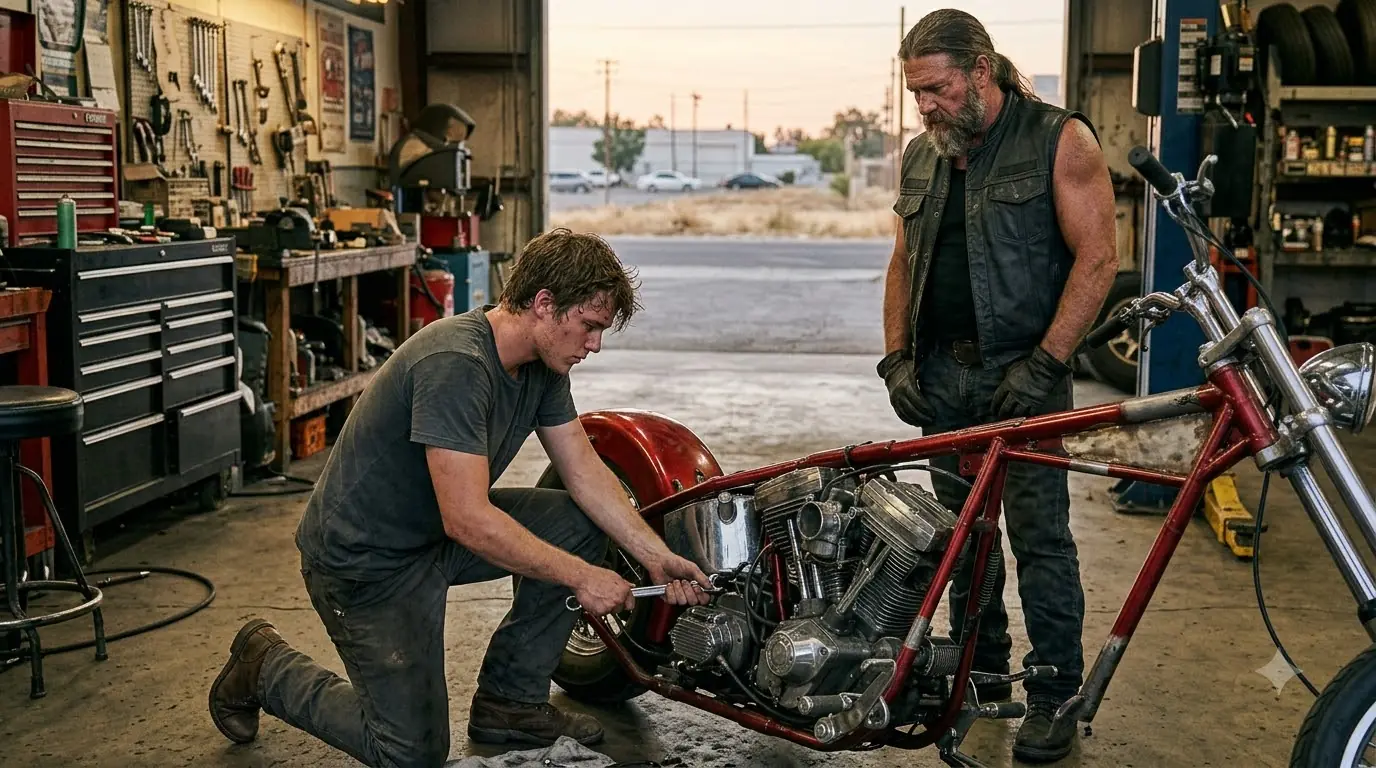
Nineteen-year-old Caleb stood in the middle of his failing repair shop staring at a dismantled pile of chrome, steel, cables, and painted bodywork spread across the floor.
He had just taken apart the prized motorcycle of one of the most feared bikers in the San Joaquin Valley.
And now the entire club was coming to collect it.
The mid-July heat outside Bakersfield was oppressive enough to distort the horizon. Heat shimmered above the cracked asphalt, dust collected against the corrugated walls of abandoned warehouses, and the ancient swamp cooler hanging in the office window barely moved the hot air inside the shop.
But Caleb’s problems had nothing to do with the weather.
They were cold, hard facts.
He was nineteen years old.
He was broke.
And he was drowning beneath the debts his late uncle had left behind.
Oildale Customs looked like a relic from another era. Faded racing posters covered the walls. Rust had begun creeping along the bottom edge of the bay doors. Half the fluorescent lights buzzed without illuminating much of anything, and the old workbenches bore forty years of burns, dents, oil stains, and forgotten repairs.
The banks were threatening foreclosure.
Suppliers had stopped extending credit.
Most local riders had begun taking their motorcycles to cleaner, brighter dealerships with glass waiting rooms and computerized service counters.
Caleb had almost nothing those businesses had.
Except talent.
With a wrench in his hand, the kid understood engines in a way that made older mechanics uncomfortable.
He could listen to an idle for ten seconds and tell when one cylinder was working harder than another. He could place his fingertips against an engine case and identify vibrations other mechanics needed expensive equipment to find. His uncle used to joke that Caleb did not repair engines.
He argued with them until they surrendered.
But talent did not pay the electricity bill.
Talent did not stop foreclosure.
Talent did not refill an empty parts account.
The job that changed everything arrived on a Tuesday afternoon.
Caleb was tightening a chain on an old touring bike when the rusted bay doors began rattling in their tracks.
He heard the motorcycle before he saw it.
A deep, uneven mechanical rhythm rolled through the industrial park, too heavy to mistake for anything modern.
Caleb stopped working.
Through the shimmering heat rode Silas “Grip” Henderson.
Anyone around the valley who followed motorcycles knew the name.
Grip was the sergeant-at-arms for a powerful outlaw motorcycle charter that had dominated the region for years. He was a massive, weathered man with old scars, heavy boots, a leather vest, and the kind of quiet physical presence that made people lower their voices without being told.
Two younger club prospects rode behind him.
They stopped outside the shop and remained near the entrance, watching the industrial park while Grip brought his motorcycle inside.
He killed the engine.
The sudden silence felt heavier than the noise.
Grip lowered the kickstand and stepped away from the machine.
Caleb stared.
The motorcycle was extraordinary.
A heavily modified 1947 Harley-Davidson Knucklehead.
Old American iron rebuilt into something both beautiful and intimidating.
The bike had been passed through the club for decades. Its rigid frame carried a deep candy-apple-red finish. Chrome gleamed around the engine. Every detail looked carefully chosen rather than simply installed.
Caleb wiped his hands on a rag.
“What can I do for you?”
Grip did not smile.
He kept his sunglasses on.
He pointed toward the motorcycle.
“This thing is trying to kill me.”
Caleb waited.
“And every mechanic within a hundred miles has failed to tell me why.”
Grip explained the problem.
At normal speeds, the motorcycle ran perfectly.
Idle was clean.
Acceleration was strong.
Nothing sounded wrong.
But once the Knucklehead reached highway speed, something changed.
Around seventy-five miles per hour, the motorcycle began behaving violently.
The engine lost power.
The frame developed a severe vibration.
The handlebars became difficult to control.
Twice in the previous week, Grip had nearly lost control on the highway.
He had already taken it to respected mechanics in Bakersfield and Fresno.
One shop rebuilt the carburetors.
Nothing changed.
Another replaced major parts of the electrical system.
Still nothing.
“Your uncle had a reputation,” Grip said.
Caleb looked toward the old photograph hanging above the workbench.
His uncle stood beside a race bike thirty years earlier, smiling through a thick mustache.
“He taught me.”
“That’s what I heard.”
Grip stepped closer.
“So figure it out.”
Caleb looked at the motorcycle again.
Taking the job was dangerous.
Refusing it might be worse.
“I can inspect it.”
Grip remained silent.
“I’d normally want a few days.”
“No.”
Caleb looked up.
Grip moved close enough that Caleb caught the smell of leather, gasoline, and stale tobacco.
“Tomorrow is the Nevada run.”
Grip spoke slowly.
“Hundreds of riders. I’m leading.”
He pointed toward the motorcycle.
“This bike needs to be right before tonight.”
Caleb glanced toward the wall clock.
1:15 p.m.
“What happens if I can’t?”
Grip tilted his head.
“You fix it, you get five thousand dollars cash.”
Five thousand.
Caleb tried not to react.
That money would keep the shop alive.
At least temporarily.
Grip continued.
“And if anybody causes trouble around this place afterward, they answer to us.”
The offer sounded almost generous.
Then Grip’s tone changed.
“If you tell me it’s fixed and that machine puts me into a guardrail tomorrow, we’re going to have a different conversation.”
Caleb understood perfectly.
There would be no second chance.
Grip placed the heavy brass keys on the workbench.
“Sundown.”
He turned toward the exit.
“Grip.”
The biker stopped.
“If I find something major, I’m going to need permission to do whatever the repair requires.”
Grip looked over his shoulder.
“If it keeps me alive, do what you have to do.”
Then he walked outside.
A few seconds later, all three bikers disappeared into the heat.
Caleb was alone with the Knucklehead.
The clock continued ticking.
For the first two hours, he worked methodically.
Panic would only make him miss things.
He began with the obvious.
Spark plugs.
Compression.
Fuel flow.
Ignition.
Connections.
Nothing.
Everything other mechanics had already touched appeared correct.
By midafternoon, Caleb rolled the motorcycle onto his uncle’s old dynamometer.
The machine was older than Caleb but still functional.
It allowed him to reproduce highway conditions while keeping the motorcycle secured inside the shop.
Caleb tightened the restraints.
Started the Knucklehead.
The engine settled into a deep, rhythmic idle.
He gradually increased speed.
Forty.
Fifty.
Sixty.
Everything remained smooth.
Caleb watched the gauges.
Seventy.
Still good.