The neon sign above Sam’s All Night Diner had a broken letter.
The word DINER was supposed to glow in red and white above the cracked asphalt parking lot on the outskirts of Bakersfield, California.
But the N had burned out months ago, leaving the sign to buzz and bleed a harsh pink light into the darkness.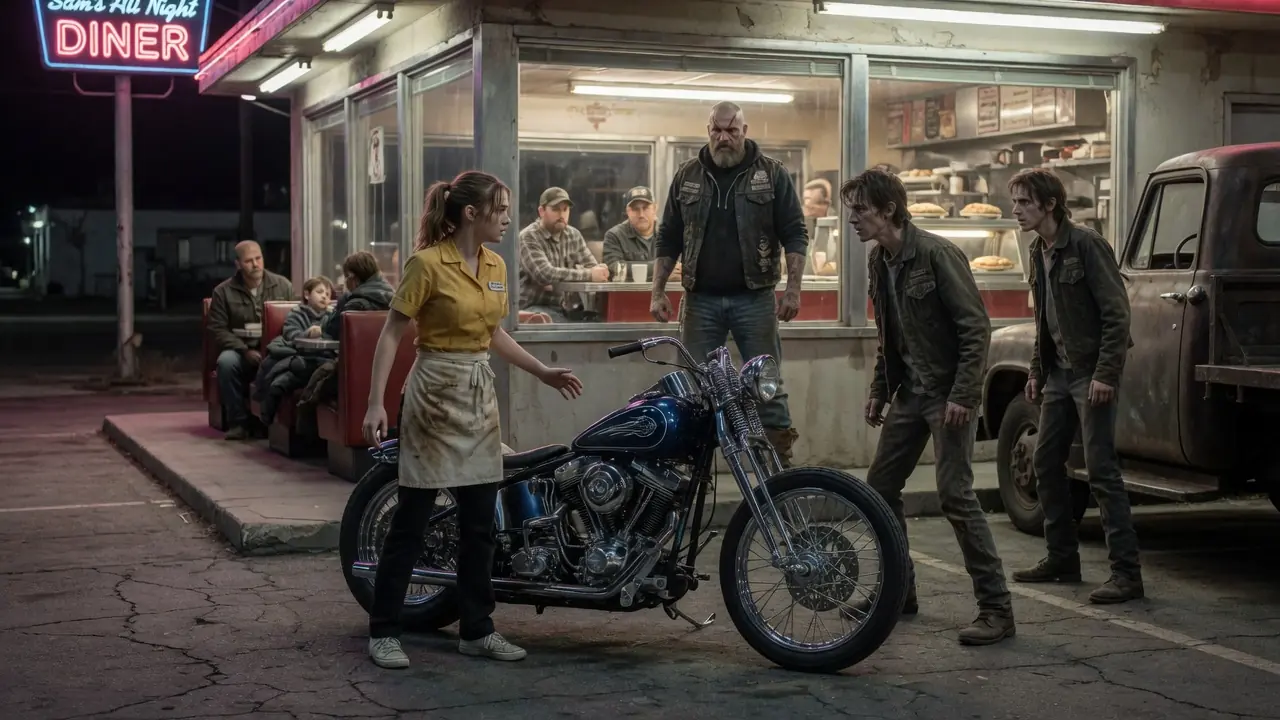
DI ER.
That was what it looked like from Highway 99.
Half a word.
Half a promise.
The kind of place people only noticed when they were too tired to keep driving.
It was 2:15 a.m. on a Tuesday, the dead hour when the world feels abandoned and every sound seems too loud. The highway beyond the lot was mostly empty except for the occasional freight truck roaring past, its headlights sweeping across the diner windows before disappearing into the black stretch of road.
Inside, the air smelled of burnt filter coffee, old grease, bleach, and fried onions that had soaked into the walls long before Rebecca Lawson was born.
For sixteen-year-old Rebecca, that diner was her entire universe.
Her purgatory.
Her hiding place.
Her last lifeline.
She stood behind the counter wearing a faded mustard-yellow uniform that had belonged to three waitresses before her. The hem was too long, the sleeves were too short, and the name tag said Sandy because Sam, the owner, had never bothered ordering one with her name.
Her shoulders ached from carrying trays. Her feet burned inside cheap black sneakers. Her lower back throbbed from hours of standing. Her eyes felt gritty from too little sleep and too much worry.
She was not supposed to be working at two in the morning.
Not legally.
Not at sixteen.
But Sam paid her in cash under the table, and under-the-table money was still money. It bought groceries. It bought bus fare. Sometimes, when stretched carefully enough, it bought medicine.
And medicine was what mattered.
In the back booth, hidden away from the few weary truckers nursing their coffees, her six-year-old little brother Leo slept on a makeshift bed of winter coats. Rebecca had arranged them carefully, folding one beneath his head and tucking another around his small shoulders.
Leo’s face was turned toward the vinyl seat. His lashes rested on his cheeks. His mouth was slightly open, and every few breaths, a faint wheeze slipped from his chest.
That sound terrified Rebecca more than anything else in the world.
Leo had severe chronic asthma. The doctors had used phrases Rebecca hated because they sounded calm while describing danger.
Persistent inflammation.
Respiratory vulnerability.
Medication compliance.
Acute attack risk.
To Rebecca, it meant this: if Leo did not have the right inhalers, his chest could close like a fist.
His rescue inhaler was in her apron pocket. His maintenance inhaler was almost empty. The refill cost nearly three hundred dollars a month, depending on which pharmacy had it and which discount card worked that day.
Their mother had disappeared six months earlier.
No warning.
No goodbye.
No explanation.
She took the last of the emergency cash from the cookie tin in the kitchen, left a note that said I can’t do this anymore, and vanished into whatever life was easier than motherhood. Their father had been gone so long Leo barely remembered his face. Rebecca remembered enough for both of them and wished she did not.
So it was just her and Leo.
A sixteen-year-old girl and a six-year-old boy in a one-bedroom apartment with a leaking ceiling, a half-empty inhaler, and an eviction notice taped to the door.
The notice gave them five days to come up with eight hundred dollars.
Rebecca had forty-two dollars in her checking account.
Forty-two dollars, one tired body, and a brother who needed her to keep the whole world from falling apart.
Every time she wiped down a sticky laminate table, her mind spiraled.
Rent.
Inhaler.
Electric bill.
Groceries.
School.
Leo’s cough.
Rent.
Inhaler.
Rent.
Rent.
Rent.
She should have been asleep at that hour. She should have had homework spread across her bedroom floor, cheap headphones in, worrying about algebra or a boy in science class. She should have been complaining about cafeteria food, arguing about curfews, deciding what to wear to school.
Instead, she was working an illegal graveyard shift in a diner where the manager told her not to mention her age to anyone who looked official.
Sam was not a monster.
That almost made it worse.
He was tired, cheap, and practical in the way people become when their own life has been hard enough to blunt the edges of their conscience. He paid Rebecca less than minimum wage, but he let Leo sleep in the booth during her shifts. He gave them leftover pancakes wrapped in foil. He looked away when she filled a cup with soup from the kitchen and called it dinner.
In her life, exploitation and kindness often wore the same face.
The two truckers at the counter had stopped talking twenty minutes earlier. One stared into his coffee as if waiting for it to become stronger through intimidation. The other scrolled through his phone, thumb moving slowly, eyes half closed.
Rebecca refilled their mugs.
“Thanks, kid,” one of them muttered.
Kid.
She hated being called that almost as much as she hated needing the tip jar.
The bell above the door had not chimed in nearly an hour. Outside, the parking lot sat empty except for two rigs, Sam’s old Buick, and Rebecca’s imagination showing her every possible future that ended badly.
Then the sound came.
Low at first.
A rumble beneath the floor.
Rebecca paused with a coffee pot in her hand.
The trucker nearest the window lifted his head.
The rumble grew deeper, louder, heavier, until the diner’s front windows began to tremble in their frames.
It was not a car.
It was not a truck.
It was a motorcycle.
A big one.
The vibration rolled through the parking lot before the machine itself appeared beneath the flickering neon sign.
Rebecca looked up.
The motorcycle glided into the lot like something out of another time.
It was a custom 1947 Harley-Davidson Knucklehead, painted deep midnight blue, so dark it almost looked black until the neon caught it. Silver ghost flames curled along the tank, subtle and precise, visible only when the light struck just right. Chrome shone everywhere, polished so clean it reflected the broken sign, the wet pavement, and the pale diner windows like liquid mirrors.
It was not just a motorcycle.
It was art with an engine.
The rider rolled to a stop near the front door and killed the engine.
The sudden silence was startling.
Inside the diner, even the coffee machine seemed to quiet.
The two truckers stopped mid-conversation.
Rebecca stood very still behind the counter.
The man who dismounted was enormous.
At least six foot four, maybe taller, with shoulders broad enough to block the streetlight behind him. He wore heavy scuffed engineer boots, faded denim, and a thick leather cut over a black hoodie. His movements were slow, deliberate, and completely unhurried, as if he had never once in his life needed to rush because the world usually moved out of his way.
As he turned toward the diner entrance, the overhead light caught the massive patch on his back.
The winged death head.
Above it, the top rocker read Hells Angels.
Below it, the bottom rocker read California.
The small MC patch sat off to the side.
Rebecca’s stomach tightened.
She knew enough to know what that meant.
Not from experience exactly, but from news stories, warnings, nervous whispers, and the kind of reputation that reaches even people who never want to be near it.
The bell above the door chimed.
It was a cheerful, innocent little sound.
Completely wrong for the man stepping inside.
His face was weathered, deeply lined from decades of sun, wind, and hard roads. A thick graying beard covered most of his jaw. A long jagged scar hooked across his left cheekbone. His dark eyes scanned the diner in a fraction of a second, taking in the truckers, the exits, the kitchen door, the counter, the sleeping child in the back booth, and Rebecca.
Everyone looked down.
Suddenly, the truckers found their hash browns fascinating.
Rebecca swallowed and wiped her hands on her apron.
She had worked nights long enough to know the first rule of surviving a diner after midnight.
Treat everyone the same.
Cops.
Drifters.
Truckers.
Addicts.
Lonely men.
Angry women.
People with wedding rings.
People with blood on their sleeves.
People with club patches that made the whole room forget how to breathe.
“Booth or counter, sir?” she asked.
Her voice stayed steady despite the flutter in her chest.
The biker looked down at her.
“Booth,” he rumbled. “Corner.”
His voice sounded like gravel dragged across concrete.
Rebecca nodded.
“Anywhere you like.”
He walked past her, heavy boots thudding against the linoleum, and slid into the corner booth directly opposite the one where Leo slept. He placed a leather-gloved hand on the table, then removed his helmet and set it carefully beside him.
“Black coffee,” he said. “Plate of whatever meat you’ve got back there. Burnt.”
“Yes, sir. Coming right up.”
Rebecca grabbed a clean mug.
As she poured his coffee, she glanced at the front of his leather vest.
A name patch was stitched over his chest.
Rooster.
David “Rooster” Henderson was a name that meant something in certain places. To men who rode the highways of California. To cops who monitored biker activity. To criminals who knew better than to steal from the wrong people. To club members who respected silence more than speeches.
But to Rebecca, at 2:19 a.m. in Sam’s All Night Diner, he was another customer with a coffee order.
And a tip, hopefully.
When she set the mug in front of him, his eyes flicked to her name tag.
“Sandy?”
Rebecca glanced down.
“No. Rebecca. Sam never changed the tag.”
Rooster grunted.
“Bad owner.”
She almost smiled.
“Not the worst.”
He looked at her for a second, as if weighing that answer.
Then he turned toward the back booth.
“Kid yours?”
“My brother.”
“He sick?”
Rebecca stiffened slightly.
“Asleep.”
Rooster looked at Leo’s small chest rising and falling beneath the coats.
“That ain’t what I asked.”
Rebecca did not answer.
There were customers who asked personal questions because they cared. There were customers who asked because they were bored. And there were customers who asked because weakness interested them.
She did not yet know which kind he was.
“Your food will be ready soon,” she said.
Rooster gave a faint nod and looked down at his coffee.
In the kitchen, Rebecca cracked eggs into a pan and reheated a steak that had been sitting wrapped in foil since the dinner rush. Sam would have yelled if he knew she was giving the biker the better cut instead of the cheaper scraps, but Sam was snoring in his office with the television on low.
She cooked the steak hard, just like he asked. Burnt at the edges. Eggs over hard. Toast. Hash browns from the corner of the grill.
When she carried the plate back to his booth, she noticed something unexpected on the table.
A photograph.
Small.
Dog-eared.
Faded nearly white at the corners.
It showed a much younger Rooster holding a tiny baby wrapped in a pink blanket. In the photo, his beard was darker and his face had fewer lines, but the eyes were unmistakable. He was not smiling exactly. He looked overwhelmed and terrified and proud.
His thumb rubbed the edge of the picture absently.
For one brief second, the hardened outlaw looked impossibly fragile.
Rebecca placed the plate down carefully.
“Your total is fourteen fifty.”
Rooster blinked as if returning from somewhere far away.
He slipped the photo back into his wallet, pulled out a crisp fifty-dollar bill, and dropped it on the table.
“Keep it.”
Rebecca froze.
“Sir, I can’t keep a thirty-five-dollar tip.”
Her pride and desperation collided so hard she nearly felt dizzy.
Thirty-five dollars meant food.
Thirty-five dollars meant the bus pass.
Thirty-five dollars meant part of Leo’s medicine.
Rooster did not look up from his plate.
“I said keep it, kid.”
She hesitated.
He nodded toward the back booth.
“Go buy the little boy a proper blanket.”
Rebecca felt a lump rise in her throat.
“Thank you,” she whispered. “Truly.”
Rooster cut into the steak.
“Don’t make a sermon out of it.”
She went back behind the counter, fingers trembling as she slipped the bill into her apron pocket.
It was not enough to save them from eviction.
Not even close.
But it was enough to buy Leo’s medication tomorrow.
For the first time all week, a thin sliver of relief pierced the panic inside her.
She looked toward Leo.
His breathing still wheezed, but he was asleep.
Safe for the moment.
That was all Rebecca ever got.
Moments.
Small pieces of safe.
The quiet of the graveyard shift is fragile.
It makes promises it cannot keep.
Rebecca was in the back loading the dishwasher when she heard the screech of failing brakes outside.
It was ugly and metallic, the kind of sound that made every mechanic in the world wince.
She straightened.
The truckers at the counter did not react. Rooster was not visible from where she stood. She walked to the greasy drive-thru window and peered out into the lot.
A rusted Ford F-150 flatbed had pulled in.
It parked too close to the entrance, directly parallel to Rooster’s gleaming Harley. The truck’s headlights cut off immediately, throwing that section of the parking lot into shadow.
Two men jumped out.
Even from a distance, Rebecca could read the frantic energy in their bodies. They were rail thin, twitchy, wearing baggy clothes. Their heads moved too fast, darting left and right. One had a shaved head and a dark tattoo crawling up his neck. The other had greasy hair tucked under a beanie and cheeks hollow enough to make his eyes look too large.
The shaved-head man went straight to the back of the flatbed and pulled out a heavy wooden plank.
The other man pulled a pair of bright yellow bolt cutters from inside his jacket.
Rebecca’s heart slammed against her ribs.
They were going for the bike.
She knew what kind of men stole motorcycles.
Desperate men.
Dangerous men.
Men who did not care what stood between them and money.
But stealing a custom Harley from a fully patched Hells Angel was not just theft.
It was a catastrophic lack of survival instinct.
If Rooster walked outside and caught them, the violence that would erupt in that parking lot would destroy the night completely. The diner would become a crime scene. Police would come. Sam would panic. Rebecca would lose her job.
And if she lost the job, she lost the inhalers.
The apartment.
Leo.
Her whole life balanced on that ugly thought.
She turned to rush into the dining area to warn Rooster.
The corner booth was empty.
His helmet remained on the table.
The restroom door down the hall was shut.
Rebecca looked back out the window.
The thieves were already moving.
The shaved-head man had wedged the plank against the flatbed. The greasy-haired man crouched near the front wheel of the Knucklehead, examining the heavy chain lock. The bolt cutters opened with a slow yellow flash under the neon light.
They had less than a minute.
Rational thought left Rebecca.
It was not bravery, not at first.
It was fury.
A lifetime of watching things get taken from people who could not afford to lose them.
Her mother taking the last emergency cash.
Landlords taking security and calling it policy.
Pharmacies taking three hundred dollars for a plastic inhaler that let her brother breathe.
Life taking sleep, school, safety, childhood, and still asking her to smile at customers.
She was so tired of people taking.
Sam kept a heavy iron tire bar propped beside the back door for breaking ice during winter and chasing raccoons away from the dumpster. Rebecca grabbed it with both hands. The cold metal bit into her palm.
She pushed through the kitchen, past the coffee machine, past the counter, and through the front doors into the cold night air.
“Hey!”
Her voice cracked like a whip across the empty lot.
Both men jumped.
The bolt cutters hit the pavement with a loud metallic clatter.
Rebecca planted herself between them and the motorcycle.
“Get the hell away from that bike.”
For one second, they stared at her.
They had expected the biker.
Instead, they saw a sixteen-year-old girl in a mustard-yellow waitress uniform holding a rusty tire bar.
The shock on their faces turned quickly into amusement.
The shaved-head man laughed first.
It was an ugly sound.
“Back inside, sweetheart,” he said, stepping away from the motorcycle. “This ain’t your business. Go pour coffee before you get hurt.”
“I said back away.”
The greasy-haired man rubbed his jaw and looked her up and down.
“You serious?”
Rebecca’s whole body shook with adrenaline, but she did not move.
“Do you have any idea whose bike this is?” she said. “You touch this, you’re done.”
The shaved-head man smiled.
“Sounds like you care more about it than he does.”
“He’s inside.”
“Then go get him.”
That was the smart thing to do.
The obvious thing.
The thing she should have done.
But the man with the bolt cutters moved toward the handlebars, and something inside Rebecca snapped.
She raised the tire bar.
“Don’t touch it.”
The greasy-haired man lunged toward her, not with a weapon, just a shove meant to throw her aside.
Instinct took over.
Rebecca swung the tire bar in a short, brutal arc.
The iron connected with his forearm.
He screamed and stumbled backward, clutching his arm.
“She hit me! The crazy little girl hit me!”
The shaved-head man’s smile vanished.
His eyes changed.
The ugly playfulness became something sharper.
More dangerous.
He reached into his jacket and pulled out a folding knife.
The blade snapped open with a small metallic click.
Rebecca’s breath caught.
Suddenly, she was exactly what she was.
Sixteen years old.
Too thin.
Too tired.
Standing in a dirty parking lot at 2:30 in the morning with a tire bar in her shaking hands and a knife pointed at her.
She thought of Leo asleep in the booth.
If she died here, who would wake him?
Who would know where his inhaler was?
Who would stop child services from splitting him into a system that treated sick children like paperwork?
The shaved-head man stepped closer.
“You’re going to regret that.”
Rebecca raised the tire bar defensively.
“Stay back.”
He lunged.
She swung blindly.
He ducked under the bar and slashed once.
Fire opened across her left forearm.
Rebecca gasped and stumbled backward against the leather seat of the Knucklehead. Pain shot up into her shoulder. Blood began spreading through the mustard fabric of her sleeve, dripping from her fingertips onto the polished chrome.
The man stepped in close, knife raised again.
“Drop it.”
Rebecca’s fingers tightened around the tire bar.
Her vision blurred at the edges.
She did not close her eyes because she did not want the last thing she saw to be nothing.
Then the front door of the diner burst open so hard it slammed into the brick wall and cracked the glass.
“What do you think you’re doing?”
The roar shook the parking lot.
It did not sound human at first.
It sounded like an engine.
A storm.
Something old and violent waking up hungry.
The thief froze.
His knife hand trembled.
Rebecca turned her head.
Rooster stood in the doorway.
He had taken off his hoodie. His massive tattooed arms were bare, corded with muscle. The diner light behind him made him look even larger, a dark shape cut from anger. His eyes moved once over the scene.
The flatbed.
The plank.
The bolt cutters.
The knife.
The blood on Rebecca’s arm.
The blood on his chrome.
For half a second, the world held still.
Then Rooster stepped off the curb.
Broken glass crunched under his boots.
He did not run.
He did not need to.
He stalked forward with the terrifying, deliberate momentum of a freight train.
The shaved-head man backed up, panic breaking through his face.
“Stay back,” he snapped, thrusting the knife toward him. “I’ll cut you.”
Rooster did not blink.
When the knife came forward, his hand shot out with frightening speed. He caught the man’s wrist, twisted hard, and the knife dropped onto the asphalt.
The thief screamed.
Rooster shoved him down against the side of the flatbed with enough force to make the truck rock. Then he pinned him there by the collar.
No wild beating.
No chaos.
Just total control.
The greasy-haired man, still clutching his injured arm, took one look at Rooster and scrambled into the truck cab. The engine coughed, caught, and the flatbed lurched backward so fast the wooden plank fell into the lot.
He abandoned his friend without hesitation.
The truck screeched out of the parking lot and vanished into the Bakersfield dark.
Rooster did not chase it.
He leaned close to the man he held.
His voice dropped so low Rebecca almost did not hear it.
“You picked the wrong bike and the wrong kid.”
The man whimpered.
Rooster shoved him down onto the pavement and kicked the knife away.
Then he turned.
Rebecca was leaning against the Knucklehead, pale and shaking, the tire bar still clutched in her good hand. Her blood had splattered across the chrome pipes and dripped onto the toe of her sneaker.
Rooster stared at the blood.
Then at her.
“You’re bleeding on my chrome.”
His tone was rough, but the fury in his eyes had shifted into something else.
Focus.
Concern disguised as irritation.
Rebecca blinked.
“I’m sorry.”
Her knees buckled.
Rooster caught her before she hit the ground.
His hands, which had just overpowered a grown man, were startlingly gentle beneath her shoulders.
“Stupid kid,” he muttered. “Brave, but stupid.”
“I had to,” Rebecca whispered.
“No, you didn’t.”
“Yes,” she said, teeth chattering. “Sam would fire me if the diner became a crime scene. If I lose this job, Leo loses his medicine.”
Rooster looked toward the diner.
The back booth.
The sleeping boy.
His jaw tightened.
He pulled out a phone and dialed.
“Yeah. It’s Rooster. Sam’s diner off 99. Send a prospect with a truck. Watch my bike. Call it urgent.”
He hung up and tore a strip from the bottom of his hoodie. He wrapped it around Rebecca’s arm with practiced pressure, tight enough that she winced.
“Keep pressure here.”
“I can’t afford an ambulance.”
“You ain’t paying.”
“You don’t understand.”
His dark eyes locked onto hers.
“I understand plenty.”
He lifted her as if she weighed nothing and carried her into the diner.
The truckers stared.
Alyssa would have screamed if she had been there.
But there was no Alyssa in this story, only two men too stunned to move and one outlaw biker carrying a bleeding teenage waitress past the counter like she was something breakable.
He set her down in a booth.
Then he walked to the back corner.
Leo was still asleep, though the noise had made his breathing rougher. His small chest rose and fell in shallow pulls beneath the coats.
Rooster stood over him.
For a moment, he did not move.
Then he took the pink blanket from the booth, shook it out, and wrapped it around Leo properly.
The boy stirred.
“Becca?” he mumbled.
“She’s right there,” Rooster said, voice softer than Rebecca thought possible.
Leo opened his eyes halfway and saw the huge biker leaning over him.
He should have been afraid.
Instead, perhaps because children understand tone before faces, he only whispered, “Are you a giant?”
Rooster grunted.
“Sometimes.”
Leo closed his eyes again.
The ambulance arrived ten minutes later.
Police came too.
Sam stumbled out of his office half awake and then fully panicked when he saw the broken door, blood, cops, paramedics, and Rooster sitting in the booth with Leo tucked against his side.
The scene was so strange that even the officers paused.
A teenage waitress with a bandaged arm.
A shattered front door.
A thief in handcuffs outside.
A Hells Angel calmly holding a sleeping six-year-old boy wrapped in a pink blanket.
As the EMTs lifted Rebecca onto the gurney, she panicked.
“No. Wait. Leo. I can’t leave Leo.”
“I’m riding with him,” Rooster said.
The female EMT looked at him.
“Sir, only family can—”
Rooster looked down at her.
The EMT reconsidered whatever sentence had been coming next.
“He can ride if he stays out of the way,” she said.
Rebecca tried to sit up.
“The bill,” she said. “Please, I can’t pay for this.”
Rooster walked beside the gurney.
“Don’t worry about the bill, kid.”
“You don’t know how much—”
“I said don’t worry.”
His voice left no room for debate.
At the hospital, Rebecca received twelve stitches.
Leo received a breathing treatment because stress and cold air had tightened his lungs.
Rooster stayed in the waiting room the whole time.
He did not pace.
He sat with his elbows on his knees, staring at the floor, his wallet in one hand.
Every few minutes, his thumb rubbed the edge of the faded photograph inside.
When a nurse brought Leo a juice box, Rooster thanked her like the words had rust on them.
When a social worker asked Rebecca where their guardian was, Rebecca lied badly.
“Our mom is working nights.”
The social worker looked like she did not believe her.
Rooster looked like he noticed.
By dawn, Rebecca was released with antibiotics, pain medication she could not afford, and instructions to keep the wound clean. Rooster paid for the prescriptions before she reached the pharmacy counter.
She tried to argue.
He ignored her.
Outside the hospital, the sky was turning pale over Bakersfield. A prospect from the club had brought Rooster’s bike and waited near the entrance, silent and respectful.
Rebecca stood with Leo leaning against her side.
“Thank you,” she said.
Rooster looked at her bandaged arm.
“You got a bad habit of standing in front of trouble.”
She tried to smile.
“Trouble was standing in front of rent.”
He studied her.
“How old are you?”
Rebecca hesitated.
“Eighteen.”
Rooster’s eyes narrowed.
She looked away.
“Sixteen,” she admitted.
His face hardened, but not at her.
“Sam know that?”
“Sam knows enough.”
“And your mother?”
“Gone.”
“Father?”
“Gone longer.”
Rooster was quiet.
Leo coughed into his elbow.
Rebecca rubbed his back automatically.
“He needs his medicine,” she said. “That’s why I work.”
Rooster looked at Leo for a long moment.
Then at Rebecca.
“You got somewhere safe to go?”
“Yes.”
The lie came quickly.
Too quickly.
Rooster heard it.
But he only nodded once.
“For now,” he said.
Five days later, Rebecca’s life collapsed with absolute precision.
Her left arm was stitched and wrapped in thick white gauze. The pain came in waves. She could barely button Leo’s jacket or carry groceries. The antibiotics made her nauseous. Her shift money from the diner was gone because Sam fired her over the phone.
“I’m sorry, kid,” he said, not sounding sorry enough. “After what happened, I can’t have trouble like that around here. Insurance is already crawling up my backside. Nothing personal.”
Nothing personal.
Rebecca had nearly bled on his parking lot trying to stop a theft from turning into a nightmare, and he called it nothing personal.
The eviction notice expired at 8:00 a.m.
By noon, their apartment looked stripped of life.
Their cheap couch was gone, taken by the landlord’s men because Rebecca could not move it herself. Two cardboard boxes sat by the door. One suitcase held her clothes and Leo’s folded shirts. The other held medicine, school papers, a cracked tablet, and the only framed photograph she still had of them with their mother before everything went wrong.
Leo sat on a deflated air mattress, playing quietly with a broken plastic fire truck.
The apartment smelled of dust and old carpet.
The ceiling stain above the kitchen had spread again.
Rebecca sat on an overturned box in the middle of the living room, her bandaged arm resting in her lap.
She had thirty-eight dollars.
No job.
No apartment.
No adult coming.
The homeless shelter downtown had a waiting list.
Her school counselor had left three messages, but Rebecca had not answered because school belonged to a life where someone else paid rent.
Leo looked up from his truck.
“Becca, where are we sleeping tonight?”
The question cracked the last part of her that had been holding.
She covered her face with her good hand.
The cry that came was silent at first.
Then not.
It was the kind of cry that makes the body fold around itself. Not dramatic. Not pretty. Not the kind people post about surviving. It was animal and exhausted and full of all the things she had been too busy to feel.
She had tried so hard.
She had worked nights.
Skipped meals.
Lied to social workers.
Smiled at customers.
Protected a stranger’s motorcycle.
Gotten cut open for it.
And still, everything was being taken.
The floorboards began to vibrate.
At first, Rebecca thought it was thunder.
But the sky outside was gray and still.
The rumble grew.
Low.
Deep.
Mechanical.
Leo stopped playing.
“Becca?”
The sound multiplied until the cheap windows rattled in their frames.
Rebecca wiped her face and stood, wincing as her arm throbbed. She walked to the window and looked down into the cracked, weed-choked parking lot.
Her mouth fell open.
There was not one motorcycle.
There were thirty.
Thirty custom Harley-Davidsons had taken over the lot, parked in a precise diagonal line. Riders dismounted in black leather, heavy boots, denim, and patches. The winged death head appeared again and again across their backs. To the residents of the run-down complex, it looked like an invasion.
Blinds snapped shut.
Doors locked.
Someone shouted from below, then went silent.
Leading the pack toward the stairs was Rooster.
Beside him walked an older man with silver hair, a hard face, and a sergeant-at-arms patch on his chest. Behind them, two younger riders carried cardboard boxes. Another held what looked like a stuffed dinosaur under one arm, which somehow made the scene even more unreal.
A heavy knock sounded at Rebecca’s door.
Leo ran behind her and clutched her shirt.
Rebecca opened the door slowly.
Rooster stood in the hallway, removing his sunglasses.
He looked completely wrong in the peeling apartment corridor, too large and too solid for a place built from cheap drywall and broken promises.
“Heard you were moving,” he said.
Rebecca swallowed.
“I don’t have a choice.”
Rooster looked past her at the boxes, the air mattress, the empty room.
His face did not change, but something in his eyes did.
“The landlord is locking the doors in an hour,” she said, trying to sound brave and failing. “I lost my job.”
“Yeah,” he said. “I heard.”
“How?”
Rooster lifted one eyebrow.
“Kid, you work in a diner off Highway 99. Everybody hears everything.”
She almost laughed.
It came out broken.
“I don’t know what to do.”
Rooster reached into his leather cut and pulled out a thick manila envelope.
He held it out.
“No,” he said. “That part’s done.”
Rebecca stared at the envelope.
“What is that?”
“Open it.”
She took it carefully with her good hand.
Inside was a stack of documents.
The first was a receipt from the hospital.
Paid in full.
The second was a pharmacy invoice.
Paid in full.
The third was a lease agreement for a two-bedroom townhouse on the east side of Bakersfield, near a school, a bus stop, and a pediatric clinic.
Paid for two years.
Rebecca’s breath stopped.
Then she saw the next document.
An appointment confirmation at a pediatric pulmonary clinic in Los Angeles.
Leo Lawson.
Comprehensive evaluation.
Medication plan.
Specialist consultation.
Paid in full.
Private beneficiary.
She read it once.
Then again.
The words blurred.
“I can’t take this,” she whispered.
Rooster said nothing.
“This is too much. This is tens of thousands of dollars. I can’t—”
“You can.”
“No, I can’t. I don’t even know you.”
“You stood in front of a knife for my bike.”
“That doesn’t mean—”
“It means plenty.”
Rebecca shook her head, tears already spilling over.
“I only did it because I needed my job.”
Rooster stepped into the room.
The older biker behind him stayed in the hall, arms crossed, blocking the curious eyes of neighbors.
Rooster pulled out his wallet.
The chain clinked against his jeans.
He removed the faded photograph she had seen in the diner and held it out.
Rebecca looked at it.
The younger Rooster.
The baby in the pink blanket.
“Her name was Sophie,” he said.
His voice changed when he said the name.
It became quieter.
Rougher.
As if the word had edges that still cut him.
“Thirty years ago, I was a dumb kid pushing brooms at a body shop. Didn’t have two dimes to rub together. Sophie had lungs like your little brother.”
Rebecca looked at Leo.
He stood behind her, thumb near his mouth, eyes wide.
Rooster continued.
“She had a bad attack one night. We didn’t have insurance. I couldn’t afford the right inhalers. I kept telling myself I could handle it. Steam from the shower. Sitting upright. Waiting. Praying.”
His jaw tightened.
“I waited too long because I was scared of the hospital bill.”
The room went completely still.
“She died in my arms in the waiting room.”
Rebecca covered her mouth.
Rooster looked down at the photograph.
“I spent a long time being angry at everybody but the man in the mirror. Then the club gave me somewhere to put the rage. Didn’t make me good. Didn’t make me healed. Just gave me brothers who understood broken things.”
He slipped the photograph back into his wallet.
Then he looked at Rebecca.
“I sat in that diner and watched you work with fear in your shoulders. I saw the boy breathing wrong. I saw you count every dollar in your head before you even brought the check. I knew that kind of scared.”
Rebecca could not speak.
“You stepped in front of men twice your size because you thought losing that job meant losing him.”
Rooster pointed gently toward Leo.
“I don’t let that happen twice in one lifetime.”
The older biker in the hallway cleared his throat.
Rooster glanced back.
“Club voted,” the older man said. “Unanimous.”
Rebecca looked from one man to the other.
“Voted?”
Rooster nodded.
“You’re under our protection now. You and the little man.”
Leo whispered, “Does that mean we get the dinosaur?”
The younger biker in the hall immediately stepped forward and held out the stuffed dinosaur.
Leo took it with both hands.
It was green, soft, and new.
His eyes filled with wonder.
Rebecca broke down completely.
She tried to cover her face, but her bandaged arm stopped her. A sob tore out of her. Rooster stood there awkwardly for half a second, clearly more comfortable facing knives than crying teenagers.
Then Rebecca stepped forward and wrapped her good arm around him.
Rooster froze.
The entire hallway seemed to freeze with him.
Then, slowly, he placed one massive hand on her back and patted once.
Then again.
“There,” he muttered. “Don’t leak on the leather.”
She cried harder.
Down in the parking lot, the riders began loading her boxes.
Two bikers carried the air mattress. Another carefully wrapped Leo’s broken fire truck in a towel as if it were valuable. Someone brought up grocery bags. Someone else spoke quietly with the landlord, who had arrived angry and left pale after one conversation with the silver-haired sergeant-at-arms and a cashier’s check covering every legal fee and overdue rent balance.
No threats were needed.
Not explicit ones.
The presence of thirty motorcycles had a way of making people rediscover professionalism.
Rebecca and Leo left the apartment that afternoon.
They rode not on a motorcycle, but in a black SUV driven by a woman named Maria who wore a leather vest over a denim jacket and introduced herself as “club family.” Rooster rode ahead. The other bikes surrounded the vehicle in formation.
Leo pressed his face to the window.
“Are we in a parade?”
Rebecca wiped her eyes.
“Something like that.”
The townhouse was small, clean, and beautiful.
To Rebecca, it looked like a palace.
Two bedrooms.
A working heater.
A kitchen with white cabinets.
A bathroom with no mold around the tub.
A bedroom for Leo with a blue comforter and a new nebulizer already waiting on the nightstand.
Rebecca’s room had a bed with actual pillows, a dresser, and a desk.
On the desk sat a plain envelope.
Inside was a note written in blocky handwriting.
Finish school.
No arguments.
— R
Rebecca laughed through tears.
Rooster stood in the doorway, pretending not to watch her reaction.
“I can work,” she said quickly. “Once my arm heals. I’ll pay back—”
“No.”
“I have to do something.”
“You will.”
“What?”
“School first.”
“I can’t just not work.”
Rooster looked at her.
“You’ve been working like a grown adult because every adult around you failed. That stops now.”
Rebecca looked down.
“I don’t know how.”
“Then learn.”
His voice softened slightly.
“You’re sixteen, kid. Be sixteen for a minute.”
She almost told him she did not remember how.
Instead, she nodded.
Life did not become easy after that.
Stories like this often pretend rescue fixes everything at once.
It does not.
Leo still had asthma. Rebecca still woke up panicked whenever he coughed. She still flinched at bills in the mail. She still hid food without meaning to, storing extra cans under the sink because hunger had taught her not to trust full cabinets.
She had nightmares about the knife.
She felt guilty for accepting help.
She felt guilty for needing it.
She felt guilty when Leo laughed in his new room because joy felt expensive and unfamiliar.
But slowly, the new life held.
Rooster did what he said.
The pediatric clinic in Los Angeles created a treatment plan for Leo. New inhalers. A nebulizer. Emergency instructions. Follow-up appointments. A doctor who looked Rebecca in the eye and spoke to her like she was family, not a child pretending to be an adult.
The club did not smother them, but it surrounded them.
A prospect drove Leo to appointments when Rebecca had school.
Maria brought groceries every Sunday and taught Rebecca how to cook food that did not come from a diner grill or a box.
The silver-haired sergeant-at-arms, whose name was Hank, fixed the townhouse’s loose back gate without being asked.
A biker called Preacher helped Leo build model cars.
Another called Tiny, who was ironically the largest man Rebecca had ever seen, showed up with school supplies and pretended he had “found them lying around.”
Rooster came by rarely at first.
When he did, he checked practical things.
Locks.
Smoke detectors.
Medicine refills.
School attendance.
“Eat,” he would say, dropping a bag on the counter.
“I did.”
“Eat again.”
“You’re bossy.”
“Correct.”
Leo adored him.
He called him Mr. Rooster, which made several bikers laugh so hard they had to leave the room.
Rooster tolerated it.
Barely.
One night, three months after they moved in, Rebecca found Leo sitting on the living room floor with the pink blanket from the diner folded beside him. Rooster had brought it back cleaned and folded, though Rebecca had never asked where he got it from.
Leo was tracing the edge.
“Was Sophie sick like me?” he asked.
Rebecca sat beside him.
“Yes.”
“Did Mr. Rooster love her?”
“Very much.”
Leo nodded.
“Is that why he helps me breathe?”
Rebecca’s throat tightened.
“Yes.”
Leo leaned against her.
“I think Sophie would like me.”
Rebecca put an arm around him.
“I think she would.”
The next week, Rooster arrived with a small wooden box.
He handed it to Leo.
Inside was a tiny silver guardian bell, the kind bikers hang on motorcycles.
“This was Sophie’s,” Rooster said. “Used to hang on my first bike. Don’t know if it does anything. But bikers are superstitious idiots.”
Rebecca frowned.
“Rooster.”
“What? We are.”
Leo held the bell carefully.
“What do I do with it?”
“Keep it near your bed. Scares off bad road spirits.”
Leo’s eyes widened.
“Does it scare asthma?”
Rooster paused.
Then said, “It helps remind it you’ve got backup.”
Leo hung it on his bedpost.
That night, when his breathing got tight around midnight, Rebecca used the nebulizer while he held the bell in one hand.
He got through the attack without a hospital visit.
Rebecca sat on the floor afterward and cried quietly from relief.
Six months passed.
Rebecca returned to school full-time.
At first, she hated it.
Not because she disliked learning, but because it felt humiliating to sit in a classroom after spending months living like an adult. Other students complained about homework and cafeteria pizza. Rebecca wanted to shake them and tell them homework was not a problem, eviction was a problem, medicine was a problem, watching your brother breathe wrong was a problem.
But slowly, school became something else.
A place where she could be Rebecca, not just Leo’s guardian.
Her English teacher, Ms. Nolan, noticed the bandage scar on her arm and the way she always sat near exits. She did not pry. She gave Rebecca books. Then extra credit. Then a recommendation for a youth leadership program.
Rebecca resisted every good thing at first.
Rooster called it “biting the hand that’s trying to hand you a sandwich.”
She told him that was not a real saying.
He said it was now.
The case against the motorcycle thieves moved quietly through the court system. The man Rooster had pinned in the parking lot took a plea. The second thief was arrested two weeks later after trying to sell parts from another stolen bike. Rebecca had to give a statement, but the prosecutor made sure she did not face them in open court longer than necessary.
Sam’s Diner closed three months after the incident.
Insurance problems, unpaid taxes, and a health inspection that should have happened years earlier finally caught up with it. The neon sign went dark. The broken N never got fixed.
Rebecca thought she would feel sad.
She did not.
Some places save you for a while but still do not deserve nostalgia.
The club bought the old building at auction the following year.
Rebecca found out from Maria, who arrived at the townhouse with a grin and a folder.
“They’re turning it into something useful.”
“What?”
“A roadside kitchen.”
“For who?”
“People who need food at night. Truckers. Runaways. Families broke down on the highway. Kids with nowhere to go. People who don’t need questions first.”
Rebecca stared at her.
“Whose idea was that?”
Maria’s grin widened.
“Who do you think?”
The new sign went up six months later.
Not Sam’s All Night Diner.
Sophie’s Roadside Kitchen.
The letters glowed clean and whole above the parking lot.
No broken N.
No harsh pink bleeding light.
The building was repainted. The booths were repaired. The back corner became a small rest area with blankets, phone chargers, basic first-aid supplies, and a locked cabinet stocked with emergency inhalers, epinephrine pens, glucose tablets, and other life-saving supplies through a partnership with a local clinic.
Rebecca stood in the doorway on opening night, overwhelmed.
Rooster stood beside her, arms crossed.
“She would have liked this,” he said.
“Sophie?”
He nodded.
Rebecca looked at the sign.
“So would the girl who worked here.”
Rooster glanced at her.
“That girl made it out.”
“Barely.”
“Barely counts.”
She smiled.
Leo, now healthier and stronger, ran up wearing a volunteer apron that was far too large for him.
“Mr. Rooster, can I hand out menus?”
Rooster looked horrified.
“You ask your sister.”
Rebecca looked down at Leo.
“One hour. Then homework.”
Leo groaned.
Rooster leaned down.
“Homework first, road warrior.”
Leo gasped.
“You betrayed me.”
“Life is betrayal.”
“Rooster.”
Rebecca tried not to laugh.
Years moved.
Not perfectly.
Not magically.
But steadily.
Rebecca graduated high school with honors.
Rooster attended the ceremony in full leather despite the principal’s nervous expression. Thirty bikers sat in the back row, quiet as church, and stood when Rebecca’s name was called. Their applause shook the gymnasium.
Rebecca walked across the stage, saw them standing, and nearly cried before receiving her diploma.
Leo whooped loudest.
Rooster did not cry.
He claimed allergies.
No one believed him.
Rebecca went on to study nursing.
Pediatric respiratory care.
There had never been a question, not really.
She wanted to work with children like Leo. Children whose families were scared, broke, exhausted, and trying not to collapse under medical words they barely understood.
On her first day of clinical rotation, she pinned her ID badge to her scrubs and saw her own reflection in the hospital window.
Rebecca Lawson.
Student Nurse.
For a moment, she saw the girl in the mustard-yellow uniform standing in the diner parking lot with a tire bar and blood on her sleeve.
She whispered to that girl, “We made it.”
Leo grew too.
His asthma did not disappear, but it became managed. He learned his triggers. He learned his medications. He learned that asking for help was not weakness, though Rebecca suspected Rooster’s version of that lesson involved too many motorcycle metaphors.
When Leo turned ten, Rooster took him to a motorcycle show and let him sit on the restored Knucklehead.
Rebecca nearly fainted.
“He’s not starting it,” Rooster said.
“He better not breathe near it too hard.”
Leo put both hands on the handlebars and grinned like he had inherited the moon.
“Someday I’m going to ride.”
Rebecca crossed her arms.
“Someday you’re going to college.”
“Can I ride to college?”
Rooster said, “Yes.”
Rebecca said, “No.”
Leo looked between them.
“Maria says I should always listen to Becca.”
“Maria’s right,” Rooster muttered.
When Rebecca graduated from nursing school, the ceremony was smaller but the feeling was bigger.
Rooster wore a suit jacket over a black shirt, refusing a tie on moral grounds. Maria brought flowers. Hank brought a card signed by half the club. Tiny brought a cake so large it needed its own table.
Afterward, outside the auditorium, Rebecca found Rooster standing alone near the parking lot.
She walked over in her white graduation dress, cap in hand.
“You okay?”
He looked uncomfortable.
“Yeah.”
“You’re doing the face.”
“What face?”
“The one where you pretend you’re angry so nobody notices you’re sad.”
He grunted.
“You got too smart.”
“You paid for part of that.”
He looked away.
Rebecca reached into her bag.
“I have something for you.”
Rooster frowned as she handed him a small framed photograph.
It showed Rebecca in her nursing scrubs, Leo beside her, both smiling. Between them was the restored Knucklehead parked outside Sophie’s Roadside Kitchen. On the back, she had written:
You helped us breathe.
Rooster stared at the photograph for a long time.
Then he swallowed hard.
“Sophie would’ve been about your age now,” he said.
Rebecca’s eyes softened.
“I know.”
“She might’ve hated motorcycles.”
Rebecca smiled.
“Or she might have run the whole club.”
That made him laugh once.
A rough, broken sound.
Then he pulled her into a hug.
This time, he did not freeze.
Years later, people still told the story of the girl who saved a Hells Angel’s motorcycle.
Some made it sound bigger than it was.
They said she fought off five men.
They said Rooster destroyed half the parking lot.
They said thirty bikers arrived that same night and carried her away like a legend.
The truth was smaller and better.
A sixteen-year-old girl was scared.
A man with a painful past noticed.
Two thieves made a terrible choice.
A child needed medicine.
And somewhere between chrome, blood, grief, and thunder, a broken family found protection in the least expected place.
Rebecca never romanticized that world.
She knew the club had shadows.
She knew every leather vest carried stories she did not ask to hear.
She knew Rooster was not a saint.
He never claimed to be.
But people are rarely only one thing.
The man others feared had paid hospital bills.
The outlaw had kept a child breathing.
The biker with the scar and the death’s head patch had built a kitchen named after the daughter he could not save, so other people might be saved in her memory.
And Rebecca, who had once believed help was something other people received, learned that family could arrive with roaring engines, rough voices, and hands gentle enough to wrap a pink blanket around a sleeping boy.
On the tenth anniversary of Sophie’s Roadside Kitchen, the parking lot filled before sunset.
Truckers.
Families.
Nurses from Rebecca’s hospital.
Former runaways who had eaten there on bad nights.
Club members.
Neighbors.
People who had once been stranded, hungry, frightened, broke, or simply alone at the wrong hour.
Rebecca stood near the front door, now thirty-six years old, wearing a navy dress beneath her nurse’s coat. Leo stood beside her, taller than her now, healthy, smiling, studying respiratory therapy because life has a strange way of turning old terror into purpose.
Rooster was older.
His beard was nearly white.
His shoulders had narrowed slightly, but when he stood beside the Knucklehead, he still looked carved from road, grief, and loyalty.
The motorcycle remained midnight blue, silver ghost flames curling across the tank.
There was one difference now.
A small pink ribbon was tied near the handlebars.
For Sophie.
For Rebecca.
For every child who needed one more night, one more breath, one more person willing to stop.
Rebecca stepped up to the microphone.
She hated speeches.
Rooster hated them more.
That made giving one worth it.
“Ten years ago,” she began, “I worked in this building when it was still Sam’s All Night Diner. I was sixteen. I was exhausted. I was scared. My little brother was asleep in the back booth because I had nowhere else to put him while I worked.”
The crowd quieted.
“Then a man rode in on a motorcycle that looked more expensive than my whole life. I thought he was terrifying.”
A laugh moved through the crowd.
Rooster looked deeply offended.
Rebecca smiled at him.
“He was terrifying. But he was also the first adult in a long time who saw that my brother and I were in trouble without making us beg for help.”
Her voice trembled slightly.
“That night, I tried to protect his bike because I thought losing my job would mean losing everything. What I did not understand was that I was the one who needed protecting.”
Leo took her hand.
Rebecca continued.
“Sophie’s Roadside Kitchen exists because a man who lost his daughter decided another child would not be lost to fear, poverty, or silence. It exists because help should not depend on whether someone can pay first. It exists because sometimes the people who look the most frightening understand pain better than anyone.”
Rooster looked down.
Maria wiped her eyes.
Rebecca lifted her glass of lemonade.
“To Sophie. To Leo. To every person who has ever walked through these doors needing warmth before questions. And to Rooster, who taught me that family is not always the people who are supposed to show up. Sometimes it is the people who actually do.”
The applause rose slowly, then thundered across the parking lot.
Rooster muttered something rude and turned away, but Rebecca saw him wipe his face.
Later that night, after the crowd thinned and the highway grew quiet, Rebecca found him sitting alone in the corner booth.
The same booth.
The one across from where Leo had once slept under winter coats.
The diner was brighter now. Cleaner. Safer. The coffee was better. The pie case full. The old smell of stale grease replaced by cinnamon, soup, and fresh bread.
Rebecca slid into the seat across from him.
“Thinking about her?”
Rooster nodded.
“Always.”
“She’d be proud of you.”
He looked at the table.
“Don’t know about that.”
“I do.”
He looked up.
Rebecca held his gaze.
“You didn’t save Sophie,” she said softly. “But you saved Leo. And you saved me. And then you built this place, and it saved more people than either of us can count.”
Rooster was silent.
Then he pulled out the old photograph.
The same one.
Young Rooster.
Baby Sophie.
Pink blanket.
He set it on the table between them.
“I used to think this picture was punishment,” he said. “Proof of what I lost.”
Rebecca touched the edge of the frame.
“What is it now?”
He looked around Sophie’s Roadside Kitchen.
At the blankets folded near the rest area.
At the emergency medicine cabinet.
At the menu board with free soup listed every night after midnight.
At Leo laughing with Maria near the counter.
“At first,” Rooster said, “it was the only thing I had left of her.”
His voice roughened.
“Now it feels like the first brick.”
Rebecca’s eyes filled.
Outside, a motorcycle rolled into the lot.
Then another car.
Then a tired mother with two children stepped through the door and asked if the kitchen was still open.
Rebecca stood.
Rooster put the photograph back in his wallet.
The night was not done.
Someone needed food.
Someone needed warmth.
Someone needed not to be asked too many questions before being treated like they mattered.
Rebecca went behind the counter.
Rooster stayed in the booth for one more second, then stood and carried menus to the family by the door.
The neon sign outside glowed steady and whole.
SOPHIE’S ROADSIDE KITCHEN.
No missing letters.
No broken promise.
Just light in the dark, visible from the highway.
People still ask Rebecca why she stepped outside that night with a tire bar in her hand.
She gives different answers depending on who asks.
Sometimes she says she was young and reckless.
Sometimes she says she was scared of losing her job.
Sometimes she says she was angry.
All of those are true.
But the deepest truth is simpler.
She had spent her whole life watching people take from the vulnerable and call it survival.
That night, for once, she refused to move aside.
And because she refused, someone else finally saw her.
Not as a problem.
Not as a poor girl.
Not as a waitress with the wrong name tag.
But as a child carrying far too much, standing between danger and the last thing she thought she could protect.
Rooster once told her she had bled for his colors.
Rebecca understood the sentiment, but years later, she came to see it differently.
She had not bled for a motorcycle club.
She had bled because she thought nobody was coming.
And what changed her life was not the patch on Rooster’s back.
It was the fact that he came.
He came through the shattered door.
He came to the hospital.
He came to the apartment.
He came with thirty roaring engines when she had no money, no job, and nowhere to sleep.
He came because the past had left him with a wound shaped like a little girl named Sophie, and helping Rebecca and Leo was the first time that wound became something other than pain.
That is how some people heal.
Not by forgetting.
Not by pretending the loss did not happen.
But by building a shelter where the loss can become protection for someone else.
On the wall of Sophie’s Roadside Kitchen, beside the register, there is a framed photograph.
Not the old one of Rooster and Sophie.
That one stays in his wallet.
The framed photo shows Rebecca at sixteen, her arm in a sling, Leo beside her holding the green stuffed dinosaur, and thirty bikers standing behind them in the parking lot of their new townhouse. Rooster stands in the middle, arms crossed, looking like he would rather fight ten men than smile for a camera.
On the frame, a small brass plaque reads:
No One Stands Alone After Midnight.
Most customers think it is just a slogan.
Rebecca knows better.
It is a promise.
It is the sound of engines arriving when hope is gone.
It is a pink blanket around a sleeping child.
It is a hospital bill paid before fear can ask the price.
It is a townhouse key pressed into a trembling hand.
It is a life rebuilt from the exact place where everything should have ended.
And sometimes, it starts in the strangest way.
A broken neon sign.
A midnight-blue Harley.
A tired waitress.
A knife in the dark.
And a girl who should have run, but instead stood her ground.