$19,000. The auctioneer leaned into the microphone and laughed. "Folks, this man wants to pay 19 grand for a storage unit full of filing cabinets." The room exploded. Not polite laughter. Real laughter. The kind that echoed off metal doors and concrete floors. But the farmer never reacted. Didn't lower his paddle. Didn't even look at the crowd. Paddle 19 stayed raised in his hand. And outside the storage facility, a man sitting in a dark blue rental car suddenly stopped typing on his phone. He looked toward the auction room. Then he made a call. Because apparently, the people laughing inside had no idea what was actually sitting in that locker.
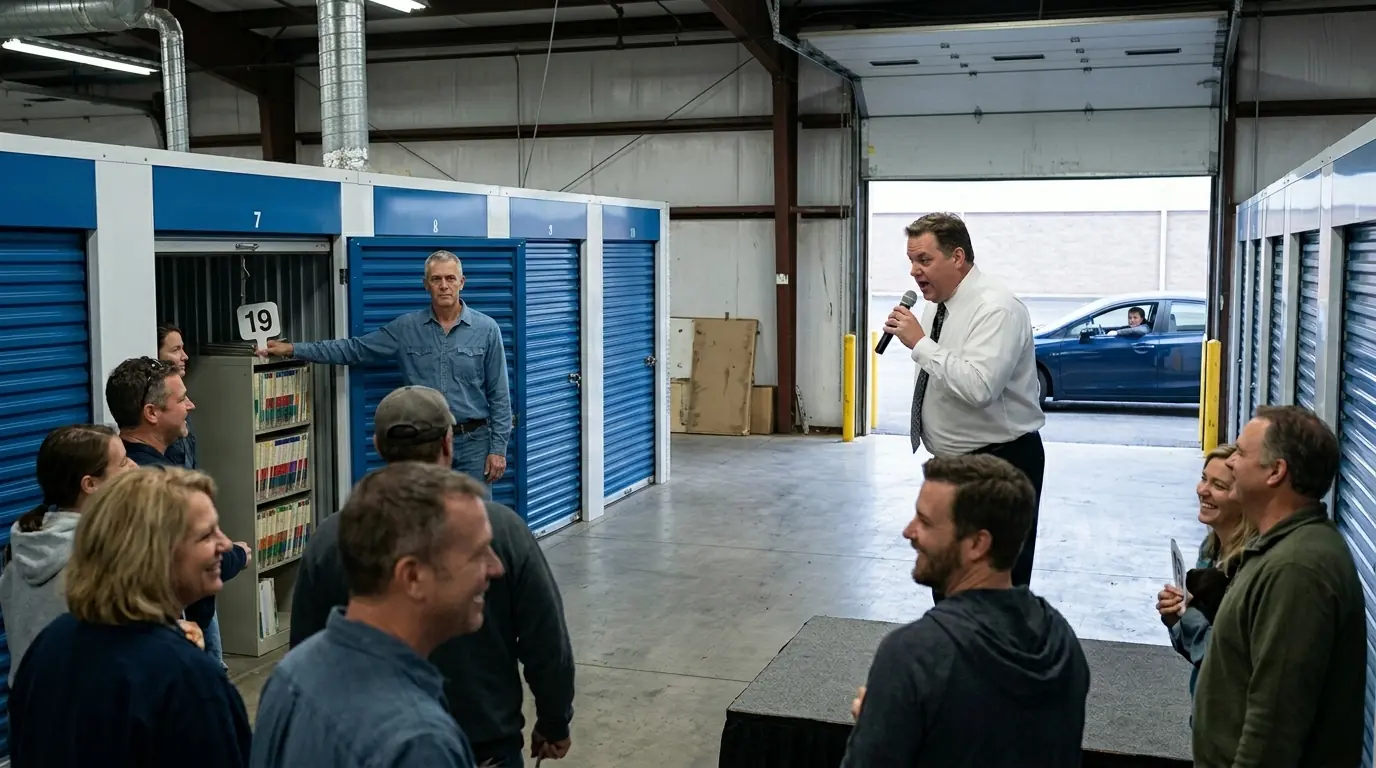 Earl got there before most of the bidders. Not to browse. Not to chat. He walked past every other unit without slowing down. Past the furniture. Past the power tools. Past the motorcycles that had drawn most of the bidders to the front row. He stopped at one place only: Locker seven. During the preview period, Earl stood at the doorway and read the label on every file cabinet drawer he could see from the entrance. Then he pulled a small spiral notebook from his shirt pocket and wrote three things down. Three things. Nobody else looked twice at locker seven.
Before the auction started, Earl walked to the front desk and asked the facility manager one quiet question. What Earl asked him wouldn't matter until much later. But the manager's expression changed the second he heard it. Outside, the man in the rental car was still watching the building. The engine was still running. His phone was in his hand. But he never once stepped out of the car. Not during the preview. Not during the first six units. Not even when the bidding started.
Then the auctioneer called locker seven. Earl raised his paddle before the opening bid was even finished. A few bidders turned around immediately, like they thought they had misheard him. $19,000. Even the auctioneer blinked once before looking back at Earl. First bid. No hesitation. The auctioneer leaned into the microphone. "$19,000, ladies and gentlemen. $19,000 for filing cabinets." A few people laughed immediately. A dealer near the back actually started clapping. The auctioneer smiled wider. "Sir, you sure about that? You want to maybe look inside first?" Earl never answered. Never smiled. Never lowered the paddle. The auctioneer tried again, quieter this time, almost friendly. "Son, there's no furniture in there. No tools. Just paperwork and an old safe nobody's opened in years." Earl finally spoke. Two words: "I know."
For the first time since the bidding started, nobody laughed. A few of the experienced buyers stopped smiling completely. Someone near the front quietly said, "What does he know that we don't?" Nobody countered the bid. The auctioneer looked around the room waiting for another paddle to go up. Nothing. Thirty seconds passed, then forty-five. "Do I hear 19 five? Anyone? 19 one?" Silence. The auctioneer glanced back at Earl again. Still calm. Still holding paddle 19. Then a dealer near the side door quietly picked up his catalog and walked out. "Going once at 19,000." Outside, the engine of the rental car finally shut off. "Going twice." The driver's door opened. "Sold."
And just as the auctioneer lowered the microphone, the man from the rental car walked through the front door. He didn't rush. That was the first thing people noticed. The man in the dark suit walked through the front door of the storage facility and headed straight toward the auctioneer's podium without looking at a single locker. He didn't have a bid paddle. He'd never planned to bid on anything. The auctioneer saw him coming and immediately lost the smile. The man leaned in and whispered something quietly. The auctioneer straightened up fast. "Ladies and gentlemen, we're going to take a short administrative pause before we transfer locker seven. The bid's already closed." Earl said it from the back of the room. Not loud, not angry, just flat and accurate. Now, even the people who had been laughing were paying attention. Two of the remaining bidders pulled out their phones. One of them started searching something.
The auctioneer looked back at the suited man. The suited man looked at Earl for the first time. Earl was already holding the receipt from the cashier's table. Signed, time-stamped. The suited man said nothing. He stepped away from the podium, raised his phone to his ear, and turned toward the wall. The auctioneer cleared his throat. "Locker seven transfers to the buyer of record." Someone near the side door quietly whispered, "Who the hell is that guy?" Nobody answered. Earl folded the receipt, slid it into his shirt pocket, and walked outside to get his truck. Behind him, the man in the suit was already back on the phone. And for the first time all morning, he sounded worried.
Earl backed his truck up to locker seven alone. No crowd, no auctioneer, no suited man. He pulled the door open and stood there quietly for a second. The vault was real, bolted to the back wall. Old cast iron, heavy combination dial, no key slot. Earl looked at it once, then went straight to the file cabinets instead. There were seven of them. Four drawers each. Every drawer had a label: County names, zip codes, years. Nothing random about any of it. Earl opened the first drawer. Loan files. Each file marked with a colored sticker, green, yellow, or red. He pulled a red one. Denied. Handwritten notation in the margin. Zip flag. Earl pulled another file. Denied. Same notation. Third file. Same notation. He opened the second cabinet. Different county. Same system. Same colored stickers. Same notation. Earl slowly stepped back and looked across all seven cabinets. Every file had been organized by geography, not by name, not by income, by location. He moved to the third cabinet and opened the drawer labeled with his own county. It took him several minutes to find the file. Then Earl saw a last name he recognized immediately: Briggs, D. His son's file. Earl held the folder in both hands for a second before opening it. Denied. 2019. Farm operating loan. $340,000. Reason listed: insufficient collateral. And written in the margin, same handwriting, zip flag. Earl read the denial date twice. Then he carefully set the file down on top of the cabinet. A few seconds later, he pulled out his phone and started photographing every page he could find.
Outside, headlights swept slowly across the storage facility parking lot. Someone had come back. Three days after the auction, an envelope arrived at the farm. No personal letter. No phone call first. Just a printed legal notice on bank letterhead. Two full pages citing federal privacy statutes and demanding the immediate return of confidential customer records. Earl read it twice, folded it, put it in his breast pocket. Then he drove forty minutes to see Roy Denton. Roy was 73, retired. He had practiced banking and property law in the same county for more than thirty years. Earl had known him since the late 1980s. Roy read the letter once and set it face down on his desk. "They're citing the wrong statute," Earl said nothing. Roy tapped the paper once with his finger. "This rule stopped applying to third-party auction buyers years ago. Whoever wrote this either didn't check or hoped you wouldn't." Then Earl placed the zip code files on the desk. Roy opened one, then another, then a third. He flipped through several more files before finally looking back up at Earl. "How many are there?" Forty-seven files. Same notation. Same denial reason. Different families. Roy leaned back in his chair and looked at Earl for a long second. "Earl, this isn't one loan officer making bad decisions." He placed the files back on the desk carefully.
This is a system. The bank called Earl's cell phone twice that week. He didn't answer either call. By Friday afternoon, Roy had filed a formal complaint with the Consumer Financial Protection Bureau. Certified mail, documented exhibits, Earl's auction receipt attached as proof of legal acquisition. The bank had three business days to respond. By Monday morning, the complaint had become part of the public record, and someone at the county newspaper had already seen it. The county paper ran it on a Tuesday: "Regional bank faces federal fair lending inquiry following storage auction discovery." By Wednesday, it was the most read story the paper had published in years. By Thursday, Roy Denton's phone hadn't stopped ringing. Farming families, small business owners, a retired school teacher who'd been denied a home equity loan years earlier and never understood why. All of them asking the same question: "Is my name in those files?" The bank released a two-sentence statement. No admission. No apology. Just legal language that said nothing and confirmed everything.
The auctioneer read the story at the diner the next morning. Nobody at his table said anything about it. Nobody had to. Earl's son drove up from Nashville that weekend. They didn't have a long conversation about the loan. They didn't talk much about the loan. They didn't need to. Earl just slid the file folder across the kitchen table. His son opened it and saw the handwritten notation in the margin: zip flag. He looked back up at Earl. Earl only said three words: "Wasn't your fault." That was enough. Earl paid $19,000 for a locker full of paperwork that nobody else wanted. The auctioneer laughed at him in front of a room full of people. The bank sent a man to watch the auction. Then they sent a legal letter trying to get the files back. Then they stopped talking altogether because Earl Briggs had read one line on a public lien notice three weeks before the auction and understood exactly what it meant. The auctioneer thought he was buying junk. The bank thought he was buying paperwork, but Earl Briggs knew he was buying evidence. Another story drops in two days.