By ten o’clock on a gray March morning, the third pickup truck had already slowed along County Road 18.
The driver never stopped.
He simply lowered his window, leaned toward the passenger side, and stared through the fence toward the southern edge of Bennett Farm.
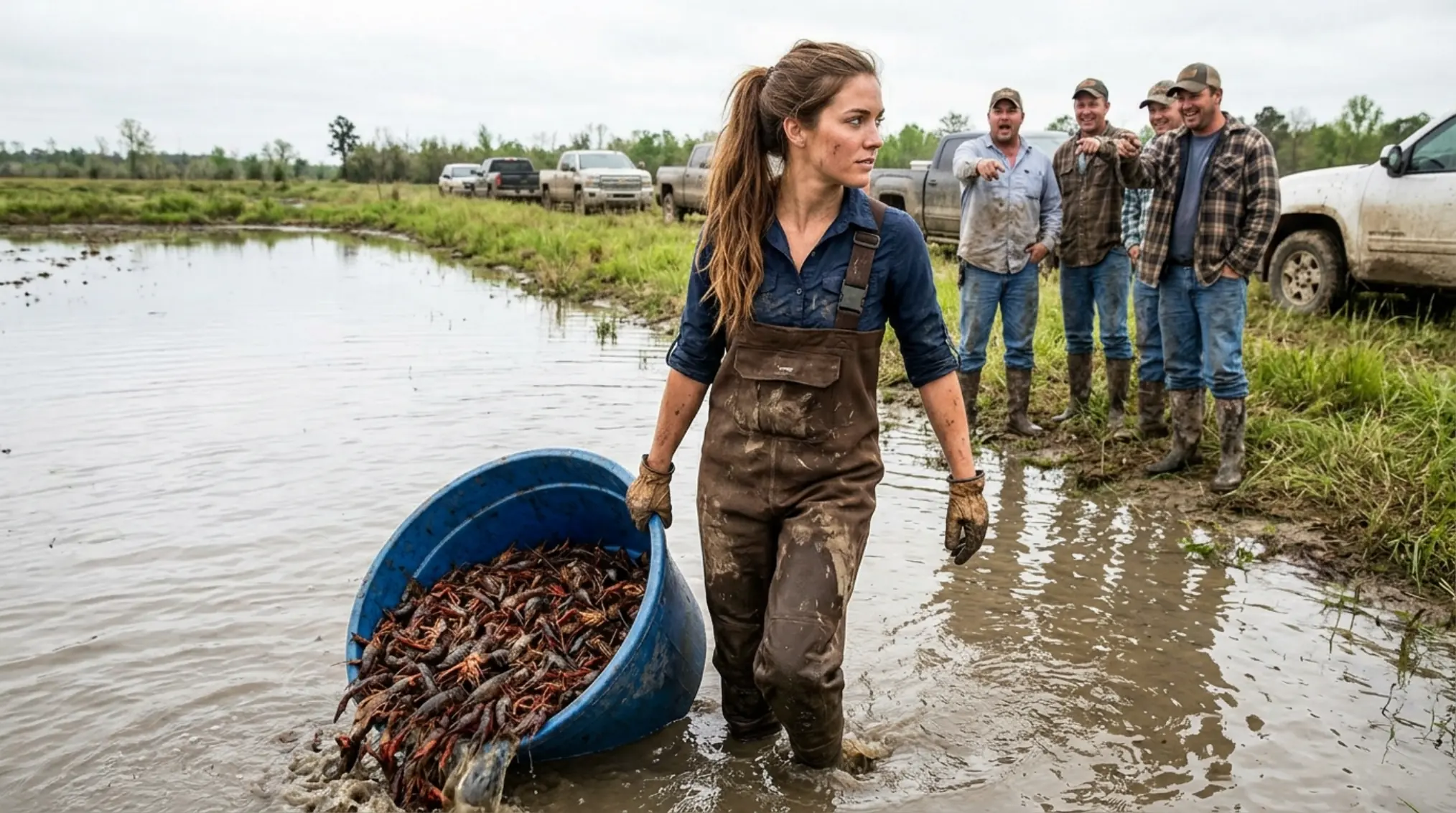
A refrigerated truck stood crooked beside the field. Blue plastic tubs were stacked in the mud near its open rear doors. Water shifted inside them, and beneath the surface thousands of small dark bodies moved against one another.
Twenty-four-year-old Mara Bennett carried one tub at a time down the slick bank.
Mud covered the legs of her chest waders.
Her brown hair had been tied into a messy ponytail before sunrise, but strands now clung to her damp forehead and cheeks. She wore a dark-blue work shirt with the sleeves rolled above her elbows, and one leather glove had already split along the thumb.
A truck door slammed somewhere behind the fence.
Mara ignored it.
She bent her knees, braced the heavy container against one hip, stepped into the shallow brown water, and slowly tipped it.
Hundreds of juvenile crawfish rushed out.
For half a second the surface erupted.
Tiny bodies flicked through muddy water, vanished beneath grass roots, and disappeared into the shallow channels Mara had cut through the field.
Then everything became quiet again.
A laugh came from the road.
Mara reached for another tub.
Four local farmers had gathered beside two pickups by then.
All of them knew Bennett Farm.
More importantly, all of them had known Mara’s father.
Earl Mercer folded his arms across a faded work jacket while another farmer, Wade Hollis, pointed toward the flooded field.
“Daniel spent thirty years trying to get water off this ground.”
Nobody answered.
Wade laughed.
“And his daughter is paying to put things into it.”
Another man shook his head.
“The bank’s going to own that place before summer.”
Mara continued working.
She had learned something during the three months since her father died.
People asked fewer questions when they had already decided the answer.
Bennett Farm had belonged to her family for nearly seventy years.
From the county road, it looked tired.
The machinery shed roof sagged at one corner. The old red barn leaned slightly east. A John Deere tractor left drops of hydraulic fluid wherever it sat. Several fence posts along the west pasture were held upright by wire that had already been repaired twice.
And along the southern boundary sat nineteen acres of ground everyone in the county considered a problem.
During wet springs, it flooded.
During dry summers, the same soil became hard enough to crack.
Corn drowned there.
Soybeans emerged yellow and weak.
Tractors sank there.
Mara’s grandfather had dug drainage channels.
Her father installed tile.
Both rented pumps.
Both planted around wet pockets.
Both spent money trying to force the field to behave like the better ground north of it.
It never did.
The bank’s latest appraisal described those nineteen acres with language so clean it almost sounded polite.
Poor drainage. Unreliable agricultural production. Significant improvement cost. Limited contributory value.
Mara called it what everyone else called it.
Worthless.
At least she had until her father died.
Daniel Bennett collapsed four days before Christmas.
He had been carrying feed sacks toward the mudroom when his hand reached suddenly for the door frame.
Mara heard one bag hit the floor.
When she entered, her father was sitting against the wall, looking almost embarrassed.
“You okay?”
Daniel tried to answer.
He could not.
His heart had been failing quietly for years.
Mara had known he was tired.
She had noticed the pauses halfway across the yard, the hand resting against the truck bed, the increasingly frequent excuses to let her climb into machinery while he handled paperwork.
She had not understood what those signs meant until there was almost nothing left to do.
The ambulance arrived quickly.
It still was not enough.
Three days later, Mara sat in the farmhouse kitchen surrounded by neighbors bringing casseroles, pies, coffee, and condolences.
Four days later, Bennett Farm legally became hers.
The grief did not delay the bills.
Feed still had to be bought.
Cattle still needed water.
A tractor battery failed two weeks after the funeral.
Then the bank called.
Daniel had borrowed heavily through two terrible growing seasons.
One year, rain drowned part of the corn crop before the roots established.
The next year brought heat and drought.
Soybean yields fell.
Machinery repairs increased.
Insurance covered less than everyone hoped.
Daniel borrowed again to keep operating.
When he died, the total debt attached to Bennett Farm stood at roughly $186,000.
Mara sat across from a loan officer in January while he arranged papers into neat stacks.
He was not rude.
She almost wished he had been.
Anger would have been easier than arithmetic.
The loan officer showed her the payment schedule.
Then estimated machinery value.
Then land value.
Finally, his finger stopped beside the nineteen-acre southern parcel.
“This is where I would start.”
“With what?”
“Reducing exposure.”
Mara stared.
He continued carefully.
“Selling marginal property could improve the farm’s position.”
“You mean sell the south field.”
“It does not contribute reliably to crop income.”
“That’s still my land.”
“I understand.”
“No, you understand the appraisal.”
The banker remained quiet.
Mara regretted the sharpness immediately.
But she did not apologize.
He waited a moment before continuing.
“If selling is not acceptable, leasing other acreage may help. The point is to stabilize what remains before the debt removes your options.”
That sentence stayed with her.
Before the debt removes your options.
She drove home slowly.
Instead of turning toward the farmhouse, she continued south until her truck reached the edge of the bad ground.
Rainwater from an earlier storm still reflected the January sky between broken corn stalks.
A white egret stood in water where the planter had bogged down the previous spring.
Mara switched off the engine.
For almost thirty minutes she remained behind the wheel.
The field had cost her family seed.
Fuel.
Repairs.
Time.
Arguments.
Her father fought it for thirty years.
His father fought it before him.
As cropland, the bank was right.
It was almost worthless.
That evening, Mara started cleaning Daniel’s farm office.
The room sat behind the kitchen.
It was narrow, badly lit, and smelled faintly of dust, coffee, and tractor manuals.
Daniel saved everything.
Tax records.
Parts receipts.
Seed catalogs.
Rainfall reports.
Insurance notices.
Old aerial photographs.
Handwritten notes about cattle breeding dates.
Sometimes he wrote important numbers on the backs of envelopes and then forgot why they mattered.
Mara spent three nights sorting.
On the fourth evening, she found a black field notebook beneath old insurance paperwork.
The cover had bent at both corners.
Several pages were swollen from moisture.
She opened it.
Daniel’s handwriting filled nearly every page.
March 17. Water across South Lane by 6:10 a.m.
April 2. Lower ditch full. East corner still holding after four days.
May 11. Tractor sank near old cottonwood line.
June 6. Upper ground drying. South pocket still green.
Mara smiled despite herself.
Her father recorded everything.
She turned another page.
Then another.
Twelve years.
Storm dates.
Water depths.
Small maps.
Arrows.
X marks.
Notes about which part dried first.
Which part held water longest.
Where runoff entered.
Where it escaped.
At first, Mara saw nothing except a history of failure.
Then she noticed something strange.
The same arrows appeared repeatedly.
Water entered from three points on the upper side.
The same shallow ridge stayed above water.
Two depressions held moisture for days after the rest drained.
Overflow always escaped through a narrow low section toward the county ditch.
Mara pulled an aerial photograph from a drawer.
Then another.
She placed the notebook beside them.
Next came a soil map.
She spread everything across the kitchen floor.
By two in the morning, she stopped reading individual notes.
She stood and looked down.
For twelve years, Daniel Bennett had accidentally drawn the same shape.
Not a failed crop field.
A basin.
Water entered.
Slowed.
Collected.
Then escaped through one narrow outlet.
Her family had spent generations asking one question.
How do we get the water out?
Mara sat back down.
She stared at the map.
Then she asked another.
“What if we don’t?”
That question took her south.
Not metaphorically.
Literally.
Over the following two weeks, Mara drove several hours to study commercial crawfish operations.
She walked pond edges.
Watched traps being emptied.
Asked about stocking rates.
Water levels.
Predators.
Vegetation.
Harvest windows.
Costs.
Every operator told her something different about at least one part of the process.
But one message repeated.
Do not build a system that fights your land.
Use what it already wants to do.
Bennett Farm could not imitate a large Louisiana crawfish operation.
Mara had neither the capital nor infrastructure.
She could not excavate nineteen acres into perfect ponds.
She could not afford endless pumping.
She could not survive a season of expensive experimentation.
So she came home and looked at Daniel’s map again.
The natural basin already existed.
She rented a compact excavator for as few days as possible.
Instead of reshaping everything, Mara followed the paths water had been using for decades.
She deepened one narrow channel.
Created a refuge near one natural depression.
Built a low berm where water escaped too quickly.
Opened an overflow route toward the county ditch.
Strengthened the area near the old cottonwood line.
From the road, it looked ridiculous.
Fresh earth crossed the field.
Water intentionally covered land everyone had spent decades trying to dry.
At the diner, people talked.
At the feed store, they talked more.