At 8:47 on a clear Chicago morning, Richard Whitmore struck the marble reception counter so hard that the glass of water beside the visitor register jumped. Across from him stood a woman in an extraordinary black-and-ivory dress, holding a small leopard-print handbag by its gold handles. She did not step back when his palm hit the stone. She did not look toward the entrance when he pointed at it. She simply watched him with the careful stillness of someone deciding whether a conversation could still be rescued.
"Security! Get her out of my bank!" Richard shouted. His voice carried between the tall gray columns and the windows overlooking downtown streets. A guard straightened at the door. The receptionist, Claire Bennett, froze with one hand above her keyboard, her eyes moving from Richard to the thin black portfolio tucked beneath the visitor's left arm. She had noticed that portfolio when the woman arrived. Richard had not.
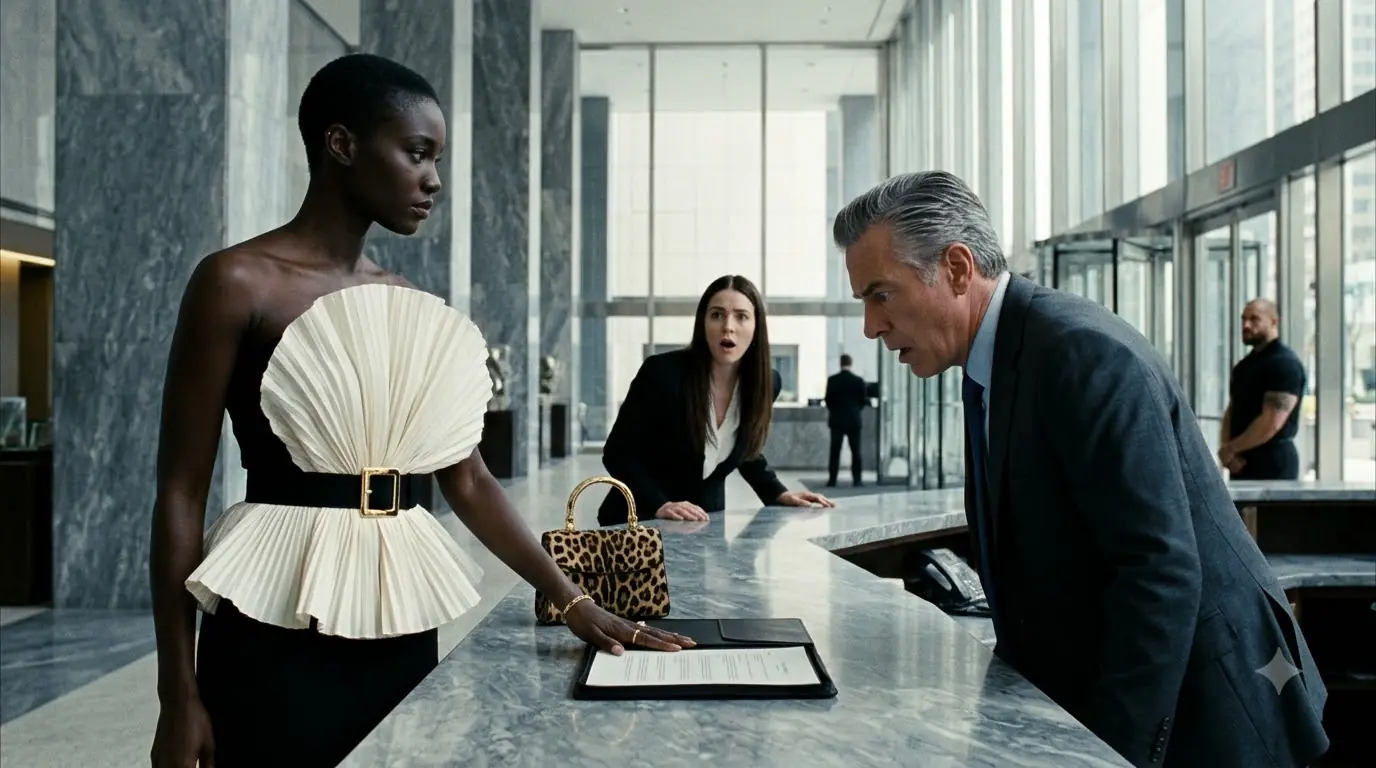
"You have no idea who you're talking to," the woman said. Her voice was level, almost quiet. That steadiness seemed to offend him more than anger would have. Richard stepped close enough that the distance between them felt deliberately unpleasant, then waited for the apology he believed he had earned. Instead, Dr. Amelia Washington set her handbag on the counter, brought the slim portfolio forward, and opened its cover toward him.
For the first time that morning, Richard looked at something other than her face, her dress, or the security guard. He looked down. The color left his cheeks. Claire leaned forward, catching only the sudden change in his expression, not the contents of the pages. Whatever Richard recognized was hidden by the angle of the folder and his own body. He had spent the last several minutes insisting that this woman did not belong in the building. Now his mouth opened without a sound.
The morning had begun much earlier, in a quiet apartment across the city, when Amelia woke before her alarm and listened to rainwater dripping from a neighboring roof. The rain had stopped overnight. A strip of pale blue sky showed between the buildings, promising a brighter day. She had an appointment that required her to be downtown before nine, and she wanted to arrive early enough to observe the place before anyone knew they were being observed.
Amelia was thirty-two. She had spent years being described by strangers in ways that told her more about their expectations than about herself. At conferences she was sometimes mistaken for an assistant. At reception desks, people occasionally asked whether she had come to interview for a position. Even after she introduced herself, some listened for proof that a woman with her closely cropped natural hair, dark skin, and slender frame could possibly be the person named on the invitation. The pattern was familiar, but familiarity had not made it harmless.
She was also someone who had learned to separate discomfort from evidence. An unfriendly glance was not a full explanation of another person's intentions. A rude comment required context. A decision, however, could be recorded and evaluated. She had built her working habits around that difference, because taking every insult personally would have exhausted her before she could examine the systems that allowed insults to become policy.