Margaret Whitfield had spent seventy-four years learning that power rarely announced itself truthfully. Sometimes it arrived in a limousine, surrounded by lawyers and assistants, but sometimes it entered through a revolving door with a wooden cane and an old gray coat. The people who understood dignity treated both versions the same. The people who did not usually revealed themselves before introductions became necessary.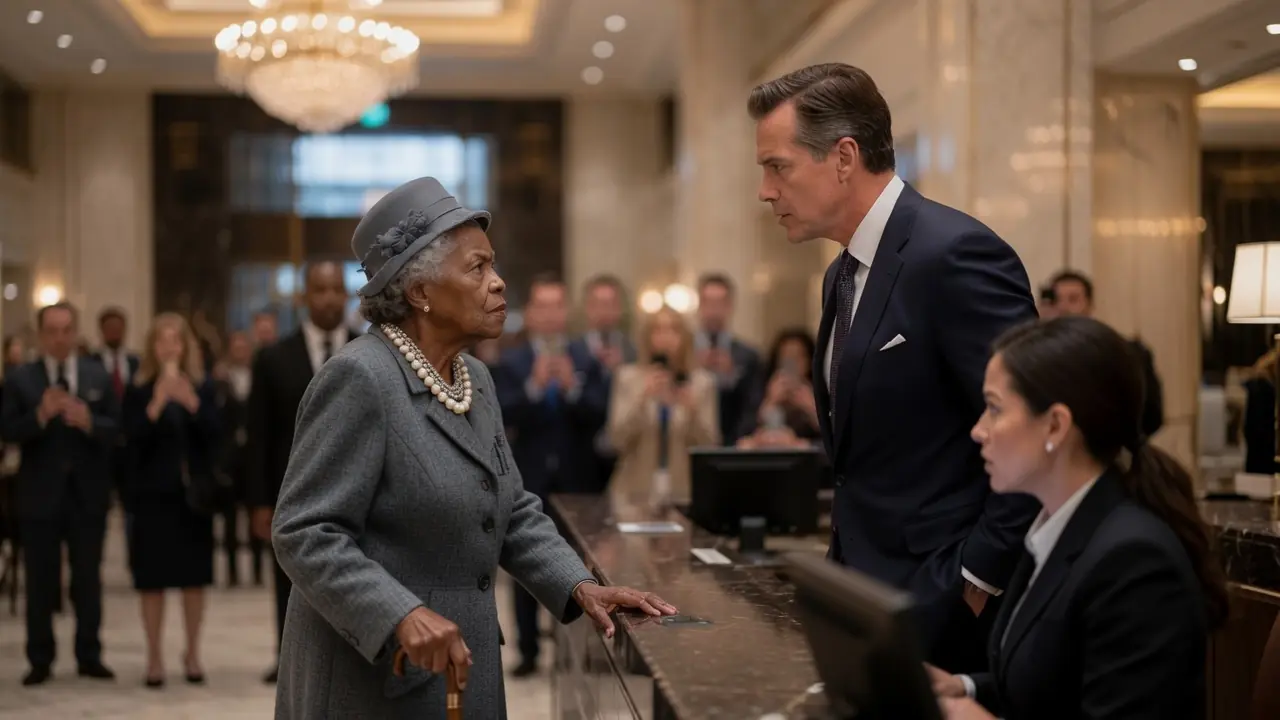
At ten minutes past eleven on a Thursday morning, Margaret stepped into the marble lobby of Hayes Continental Bank in downtown Philadelphia. She wore a charcoal wool coat, a matching hat decorated with three small fabric flowers, and sensible black shoes polished carefully that morning. A slim leather handbag hung from her left arm, while her right hand rested on the cane her doctor had insisted she use after knee surgery. Nothing about her appearance suggested the private jet waiting at Northeast Philadelphia Airport or the board meeting scheduled for three that afternoon.
The lobby was designed to make ordinary customers feel small. Crystal chandeliers hung above marble columns, and polished brass signs directed wealthy clients toward private banking suites hidden behind frosted glass. A black grand piano stood near the waiting area, though Margaret had never heard anyone play it. Even the silence seemed expensive.
Hayes Continental Bank had once been a respected regional institution serving manufacturers, farmers, and neighborhood businesses. Over four decades, it grew into a national financial group with more than two hundred branches and billions of dollars under management. The public still associated the name with the Hayes family, though the family had not controlled the bank in twenty-three years. Whitfield Holdings owned sixty-two percent of the voting shares and appointed most of the board.
Margaret controlled Whitfield Holdings.
Very few employees knew her face.
She preferred it that way.
For nearly twelve years, Margaret had allowed professional executives to manage the bank while she focused on long-term investment, community lending, and the charitable foundation established by her late husband, Arthur Whitfield. She attended board meetings, reviewed reports, and approved leadership appointments, but she avoided photographs and public ceremonies. Her name appeared in corporate filings, yet most people imagined Whitfield Holdings as an office filled with anonymous lawyers rather than one quiet widow who read every customer complaint delivered to her desk.
During the previous eight months, those complaints had begun changing.
Older customers described being ignored while younger, wealthier clients were offered immediate assistance. Small-business owners claimed appointments disappeared when they arrived wearing work clothes. Two Black customers said security followed them across the lobby before anyone asked why they had come. Each complaint was marked resolved by the office of bank president Charles Hayes.
Margaret disliked the word resolved when the same problem kept returning.
Charles Hayes was forty-eight, polished, ambitious, and skilled at presenting cruelty as efficiency. His last name created the useful illusion that he descended from the bank’s founders, though he shared no relation with them. He had risen through commercial lending, impressed the board with aggressive growth figures, and became president of the flagship Philadelphia branch eighteen months earlier. Since then, premium account openings had increased, but employee turnover and customer complaints had nearly doubled.
When Margaret requested explanations, Charles blamed staffing problems and “changing customer expectations.” He insisted the flagship branch remained welcoming, professional, and fully compliant with bank policy. The reports were polished enough to satisfy anyone who preferred charts to people. Margaret had never preferred charts to people.
She decided to visit without warning.
A young receptionist looked up as Margaret crossed the lobby. Her nameplate read Elena Ruiz, and she could not have been older than twenty-five. Elena offered a cautious smile before glancing toward the private banking desk.
“Good morning, ma’am. How may I help you?”
“I need to access my primary account and speak with the senior person available.”
“Do you have an appointment?”
“No.”
Elena’s smile weakened. “Private banking generally requires one.”
“I am aware.”
“May I ask the account type?”
Margaret opened her handbag and removed a sleek black card without a visible number on the front. A small silver emblem rested in one corner. It was issued only to clients with institutional-level accounts or direct ownership connections.
Elena recognized the card immediately.
Her posture changed. “One moment, please.”
Before she could take the card, a man’s voice came from behind the counter. “What seems to be the problem?”
Charles Hayes approached wearing a navy suit, white shirt, and a dark silk tie. His hair was carefully combed, and a white pocket square sat perfectly against his jacket. Two senior managers followed several steps behind him, both carrying tablets and expressions trained to agree.
Elena gestured toward Margaret. “She would like access to a private account.”
Charles looked at the black card in Margaret’s hand.
Then he looked at her coat, cane, worn handbag, and face.
His expression did not show curiosity. It showed suspicion.
“Where did you get that?” he asked.
Margaret held his gaze. “From this bank.”
“That is not what I asked.”
Several customers turned toward them.
A wealthy couple waiting near the piano stopped speaking, and three private bankers behind the counter looked up from their screens. Charles seemed to notice the audience and straighten, as if public attention had transformed the exchange into a stage he intended to control.
Margaret extended the card. “I need the balance and the ownership file attached to this account.”
Charles did not take it immediately. “This card is not used for ordinary personal banking.”
“I know.”
“It is connected to our highest private tier.”
“I know that too.”
Charles finally accepted it, holding it between two fingers as though it might be counterfeit. He examined the silver emblem, turned the card over, and looked again at Margaret’s simple clothing. A faint smile appeared on his face.
“Whose card is this?”
“Mine.”
His smile widened.
Elena shifted uncomfortably. “Mr. Hayes, perhaps we should verify it privately.”
Charles ignored her. “Ma’am, these cards are assigned to clients with extremely substantial assets.”
Margaret rested both hands on her cane. “Then checking it should answer your concern.”
“There are fraud procedures.”
“Follow them.”
“That may involve security.”
“Then involve whoever you need.”
Charles looked toward the security officer near the main entrance. The officer was a tall Black man named Marcus Reed, who had served at the bank for six years. Marcus did not move, but his attention sharpened.
Charles turned back toward Margaret. “Before we create unnecessary embarrassment, I am giving you one opportunity to explain how you obtained this card.”
The wealthy couple near the piano watched openly now.
Margaret felt the familiar exhaustion of being treated like a problem before being treated like a person. It was not the first time someone had mistaken age for weakness or simple clothing for poverty. Yet inside this bank, beneath a corporate name she controlled, the insult felt heavier.
She spoke clearly enough for the room to hear.
“I said check my balance, not my age.”
The silence that followed was immediate.
Charles’s face tightened. “Your tone is inappropriate.”
“My request is straightforward.”
“A woman like you could never own an account like this.”
Elena looked down.
One of the managers behind Charles shifted his weight, while Marcus Reed stepped slightly away from the entrance. No one had yet challenged the president, but the discomfort in the lobby had become visible.
Margaret extended one hand. “Enter the number and read the name.”
Charles gave a short laugh. “Fine.”
He turned toward the central terminal beside the marble counter. “Then security can escort you out with proof.”
Margaret followed him slowly.
The walk required only fifteen steps, yet Charles moved far ahead, making no attempt to match her pace. By the time she reached the counter, two employees had gathered near the terminal. Several customers raised their phones discreetly, sensing that the encounter had become unusual.
Charles inserted the black card.
The terminal requested executive authorization.
His confidence flickered.
He entered his president-level identification code and waited. The first screen displayed no ordinary checking balance, no savings account, and no credit limit. Instead, a red-bordered message appeared.
RESTRICTED INSTITUTIONAL OWNERSHIP PROFILE
Charles frowned.
“What does that mean?” one of the managers asked quietly.
“It means the card was issued incorrectly,” Charles replied.
Margaret remained calm. “Continue.”
The system requested a second verification code sent directly to the registered account holder. Margaret removed a small phone from her handbag. A six-digit number appeared on the screen.
She read it aloud.
Charles entered the code.
The terminal loaded for several seconds.
Then the account profile appeared.
PRIMARY HOLDER: MARGARET ELEANOR WHITFIELD
ENTITY: WHITFIELD HOLDINGS, LLC
VOTING CONTROL: 62.4% — HAYES CONTINENTAL FINANCIAL GROUP
BOARD AUTHORITY: CONTROLLING SHAREHOLDER
Beneath those lines appeared a consolidated asset figure so large that Charles initially seemed unable to understand it. It included investment accounts, trust holdings, corporate reserves, and ownership positions across the entire banking group. The number contained more digits than most people would see in a lifetime.
Charles stopped breathing.
Margaret looked at the screen. “Read the owner’s name carefully, Charles.”
His lips moved, but no sound came.
The wealthy couple near the piano stepped closer. Elena stared from Margaret to the terminal, while the employees behind the counter exchanged frightened looks.
Marcus Reed approached the desk. “Mr. Hayes?”
Charles finally spoke. “Whitfield Holdings.”
“And what does Whitfield Holdings own?” Margaret asked.
He swallowed. “The bank.”
“Again.”
Charles’s face had become pale. “Whitfield Holdings controls Hayes Continental Bank.”
Margaret extended her hand for the card.
He returned it immediately.
For several seconds, no one moved. The same lobby that had felt designed to diminish her now seemed to shrink around Charles. He looked toward the employees, searching for some explanation that might restore the authority he had displayed moments earlier.
“Mrs. Whitfield,” he began, “there has clearly been a misunderstanding.”
Margaret placed the card inside her handbag. “Which part?”
“I was following fraud prevention protocol.”
“You accused me before verifying anything.”
“The card is highly restricted.”
“That is why you should have verified it discreetly.”
Charles lowered his voice. “Perhaps we should continue this conversation in my office.”
Margaret looked toward the customers who had watched him humiliate her. “You did not question me privately.”
“I was protecting the institution.”
“You were protecting an image of who you believed belonged here.”
His jaw tightened. “That is unfair.”
“Is it?”
Margaret turned toward Marcus. “Officer Reed, did I behave suspiciously?”
Marcus hesitated only briefly. “No, ma’am.”
Charles glared at him. “That is not your determination to make.”
“It is part of my job,” Marcus replied. “She requested service and presented valid identification.”
“You were not asked.”
Margaret looked at Charles. “He is answering the question you tried not to ask.”
Charles adjusted his jacket. “I apologize if my wording was too direct.”
“Too direct?”
“I should not have suggested the card was stolen.”
“You did more than suggest it.”
“I was under pressure.”
Margaret looked around the immaculate lobby. “From whom?”
He had no answer.
The revolving doors opened.
A woman in a dark blue suit entered with two attorneys and a silver-haired board member. Her name was Evelyn Shaw, chief legal officer of Whitfield Holdings. Beside her walked board chairman Samuel Price and human resources director Naomi Brooks.
Charles recognized them immediately.
His face changed again.
Evelyn approached Margaret first. “Are you all right?”
“I am.”
“We came as soon as you sent the code.”
Charles looked confused. “What code?”
Margaret tapped the black card inside her handbag. “The verification request automatically alerted my legal office.”
Evelyn turned toward the terminal. “The system records all access attempts on restricted ownership profiles, including the employee credentials used.”
Charles stepped away from the screen. “There is no need to make this larger than it is.”
Samuel Price looked around the lobby. “That decision is no longer yours.”
The bank president glanced toward the phones held by customers. He understood that recordings already existed and that his conduct could no longer be rewritten inside a private report. The authority he had used so casually now offered no protection.
Naomi Brooks asked Elena to escort waiting customers toward another service area. Margaret stopped her.
“Anyone who witnessed this may remain,” she said. “No customer or employee will be punished for speaking honestly.”
Elena looked relieved.
Evelyn opened a leather folder and placed several documents on the counter. “We have been reviewing complaints from this location for three weeks.”
Charles stared at Margaret. “This visit was planned?”
“The visit was,” Margaret answered. “Your behavior was your choice.”
He looked toward Samuel. “You were investigating me without notice?”
“We were investigating repeated reports that your office marked resolved,” Samuel said.
Charles’s confidence returned slightly. “Every complaint followed internal procedure.”
Naomi opened her tablet. “Seven former employees claim you retaliated against them after they questioned customer treatment.”
“They were dismissed for performance.”
“Three had excellent evaluations until the week they complained.”
“That proves nothing.”
Margaret looked toward Elena. “Have you ever been instructed to delay service based on how a customer looked?”
Elena’s hands tightened together.
Charles turned toward her. “Think carefully before answering.”
Margaret’s voice became cold. “Do not threaten her again.”
The receptionist took a breath. “Yes.”
The admission moved through the lobby like a crack beneath glass.
Elena explained that Charles used the phrase “verify the profile” when he wanted staff to delay customers he considered unsuitable for private banking. Employees were expected to ask for extra identification, discourage appointments, or request security presence. The procedure appeared nowhere in official bank policy.
“Who did he consider unsuitable?” Naomi asked.
Elena looked toward Margaret. “Older customers who seemed confused. People wearing work clothes. Black and Latino customers without appointments. Anyone he thought might embarrass the branch.”
Charles laughed sharply. “That is an outrageous interpretation.”
Marcus spoke from beside the counter. “It is accurate.”
Charles faced him. “You are finished here.”
“No,” Margaret said. “He is not.”
Marcus continued. “I was instructed to follow customers who had done nothing suspicious. When I refused twice, my weekend schedule was changed.”
Naomi recorded the statement.
A private banker named Daniel Cho raised his hand slightly, as though he were still in school. “It happened to me too.”
Charles looked toward him in disbelief.
Daniel explained that he had been removed from a profitable client portfolio after helping an elderly Korean couple complete complicated transfer paperwork. Charles accused him of wasting premium service time on clients whose clothing suggested they were not wealthy enough to matter.
“They held four million dollars here,” Daniel said. “They moved everything to another bank the following month.”
Samuel Price closed his eyes briefly.
Another employee spoke.
Then another.
Within twenty minutes, the story of the flagship branch changed completely. Charles had not merely insulted one hidden owner. He had built a system that rewarded employees for judging customers before serving them, then punished anyone who resisted.
Margaret listened without interrupting.
She heard about a disabled veteran forced to stand while a private meeting room remained empty. She heard about a housekeeper asked to prove that a large cashier’s check belonged to her. She heard about an elderly widow whose account had been frozen because Charles assumed a woman her age could not understand an investment transfer she had personally authorized.
Each story carried the same pattern.
Appearance first.
Dignity last.
Charles remained beside the counter, gradually losing the posture that had made him seem untouchable. He attempted to answer every accusation with financial performance, operational pressure, or fraud prevention. The more he spoke, the clearer it became that he understood customers only as risks, assets, or obstacles.
Finally, Margaret raised one hand.
The lobby became quiet.
“Charles Hayes,” she said, “you are suspended effective immediately pending a full investigation.”
His eyes widened. “You cannot remove me without a board vote.”
Samuel stepped forward. “The controlling shareholder may request emergency suspension under Article Nine of your employment agreement. I have approved the request.”
Charles looked from Samuel to Evelyn. “This is because I failed to recognize her.”
Margaret shook her head. “This is because you believed respect depended on recognition.”
“One mistake should not erase eighteen years of work.”
“One mistake did not.”
She gestured toward the employees who had spoken. “You made the same choice repeatedly because you believed no one powerful would ever stand on the receiving end.”
Charles lowered his voice. “What do you want me to do?”
“For now, surrender your access badge, office keys, and company devices.”
His expression hardened. “You intend to humiliate me.”
Margaret looked at him for a long moment. “Accountability feels like humiliation only to people who expected permanent permission.”
Marcus escorted Charles toward the executive elevators.
The president passed the customers he had once treated as an audience for Margaret’s embarrassment. No one mocked him. No one applauded. The silence was more powerful because it denied him the comfort of becoming a victim.
Before entering the elevator, Charles turned back. “Mrs. Whitfield, I apologize.”
Margaret remained beside the marble counter.
“You apologize because you know my balance,” she said. “Return when you understand why I deserved respect before you saw it.”
The elevator doors closed.
The flagship branch remained open, but private banking appointments were paused for the afternoon. Margaret moved into the conference room with Evelyn, Samuel, Naomi, and representatives from compliance. One employee after another entered to give statements.
The investigation lasted six weeks.
It found that Charles had manipulated complaint records, pressured staff to alter security notes, and redirected elderly customers toward lower-service accounts without properly assessing their needs. He had also encouraged employees to concentrate on people whose appearance suggested immediate profit. The practice produced impressive short-term numbers while quietly driving away loyal customers.
Charles was terminated.
Two senior managers who knowingly supported his system were also dismissed. Others received discipline and retraining based on the extent of their involvement. Margaret insisted that employees who had acted under pressure still acknowledge the harm they caused, but she refused to treat every frightened worker as equally responsible as the man who designed the culture.
Elena Ruiz was promoted to client advocacy coordinator.
Marcus Reed became head of customer safety, with authority to reject discriminatory monitoring requests. Daniel Cho was asked to lead a new senior-customer service team focused on accessibility, patient assistance, and fraud prevention without humiliation.
Margaret also ordered the creation of an independent complaint channel that bypassed branch leadership.
No complaint could be marked resolved without confirmation from the person who submitted it. Employees reporting retaliation would receive immediate review from an outside compliance office. The board initially worried the changes would be expensive.
Margaret answered with a question.
“How much has contempt already cost us?”
The final estimate was more than twenty-six million dollars in lost deposits, closed accounts, employee turnover, and legal exposure. Cruelty had not protected profit. It had merely hidden its cost.
Three months later, Margaret returned to the Philadelphia branch.
This time, no one had been told she was coming.
She wore the same gray coat and carried the same cane. The chandeliers still glittered above the marble floor, but several things had changed. The piano had been moved to create a wider accessible waiting area, and a small service desk stood near the entrance for customers who needed additional time or assistance.
Elena greeted her without hesitation.
“Good morning, Mrs. Whitfield.”
Margaret smiled. “You recognize me now.”
“I do.”
“And if you did not?”
“I would still ask how I could help.”
“Good answer.”
Near the counter, Marcus was speaking calmly with a construction worker whose bank card had stopped working. The man wore dusty boots and carried a dented lunchbox. No one followed him, questioned why he belonged there, or asked him to lower his voice.
Daniel sat beside an elderly couple, explaining a transfer one step at a time.
The husband apologized repeatedly for taking too long. Daniel told him that understanding the transaction mattered more than finishing quickly. Margaret heard the words from across the lobby and continued walking without announcing herself.
She entered the private banking suite and placed her black card on the desk.
A newly hired advisor named Claire Lawson greeted her. Claire verified the identification, checked the account privately, and never commented on the balance. She simply asked what service Margaret needed.
“I wanted to see whether the bank had learned anything,” Margaret said.
Claire looked confused. “From your account?”
“From its mistakes.”
Later that afternoon, Margaret stood beneath the framed portraits of the bank’s former presidents. Charles Hayes’s photograph had been removed, leaving a pale rectangle on the wall. Samuel Price asked whether she wanted her own portrait placed there.
“No,” Margaret said.
“You own the institution.”
“That is not what customers need to remember.”
“What should they remember?”
Margaret looked toward the lobby.
A small brass plaque had been installed beside the entrance. It contained no reference to her wealth, ownership, or authority. Instead, it carried a sentence approved by the employees after the investigation.
Every person entering this bank deserves service before judgment and dignity before profit.
Margaret touched the edge of the plaque.
“That,” she said. “They should remember that.”
Outside, the afternoon traffic moved along the wet Philadelphia streets. Margaret descended the marble steps slowly, using her cane while a driver waited near the curb. A young employee hurried forward to help, then stopped before touching her arm.
“Would you like assistance, Mrs. Whitfield?”
Margaret looked at him and smiled.
“Yes,” she said. “Thank you for asking.”
He offered his hand.
She accepted it because help freely offered was not weakness, just as authority quietly carried was not absence. Behind her, Hayes Continental Bank continued serving customers who might never know that the elderly woman in the gray coat controlled the company.
That was exactly how Margaret preferred it.
A bank’s character should not depend on whether its owner was watching.
And a person’s dignity should never depend on the number hidden behind a card.