“I said check my balance—not my clothes, my age, or my skin.”
Margaret Ellison’s voice carried across the marble lobby of Hayes National Trust without becoming loud. The bank president standing opposite her had expected embarrassment, confusion, perhaps even fear. Instead, the elderly woman held his gaze with the controlled patience of someone who had spent a lifetime watching powerful men underestimate her.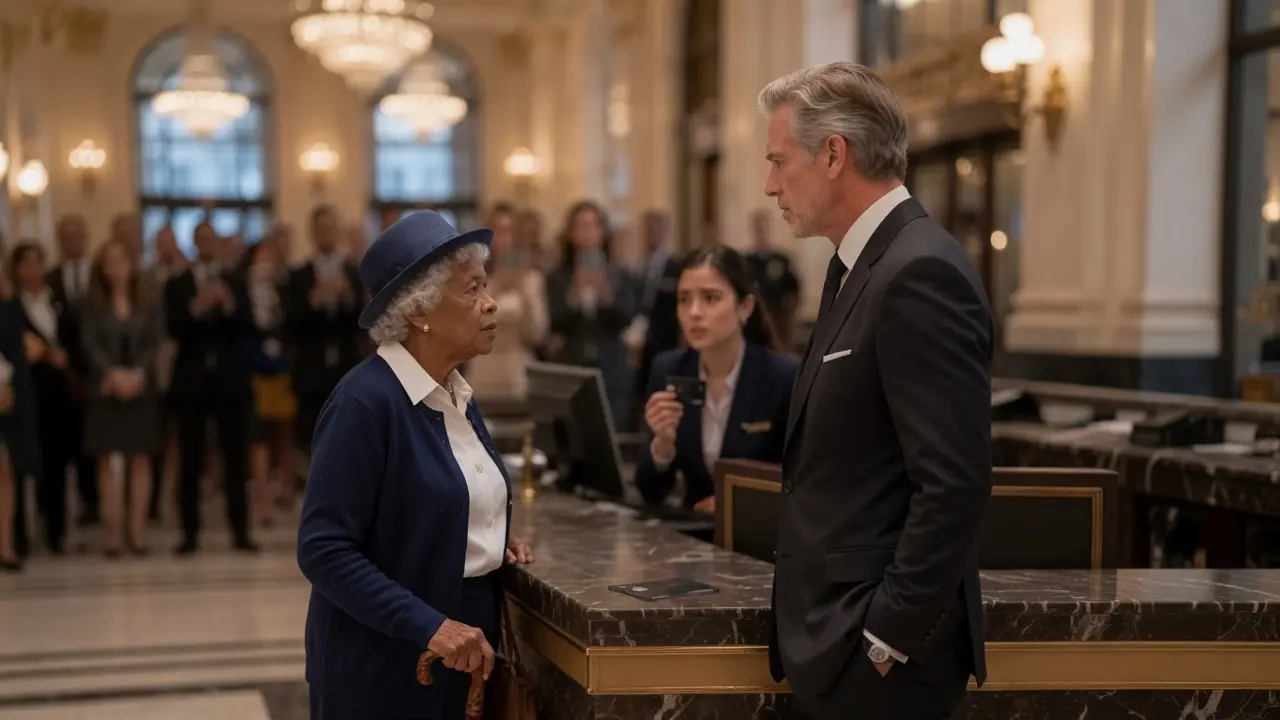
Charles Hayes glanced at the customers gathered near the teller counters.
“That card clearly does not belong to someone like you,” he said.
Margaret rested both hands over the polished handle of her cane.
“Insert it, Charles. Let the entire lobby see.”
The confrontation had begun twenty minutes earlier, when Margaret entered the bank alone through the revolving glass doors. She wore a navy dress beneath a cream cardigan, a small blue hat, and sensible black shoes softened by years of use. Her leather handbag was old enough to have been repaired twice, and the wooden cane supporting her right side carried several scratches near its base.
Nothing about her appearance announced extreme wealth.
That was intentional.
Hayes National Trust occupied the first five floors of a historic building in downtown Chicago. Crystal chandeliers hung above cream-colored marble, brass clocks marked the time in London and New York, and private banking clients were welcomed by employees trained to remember names before asking for identification. The institution presented itself as a place where money became legacy.
Margaret wanted to know whether dignity received the same protection.
She had received four complaints during the previous six months. Two came from elderly clients who said employees ignored them until younger relatives arrived. Another came from a Black physician who claimed a manager questioned the legitimacy of a large cashier’s check despite complete documentation.
The fourth complaint concerned a retired school principal named Dorothy Lewis.
Dorothy had visited the flagship branch to transfer money into education accounts for her grandchildren. A senior employee delayed the transaction for nearly three hours, repeatedly asking how she had obtained the funds. When Dorothy became upset, security escorted her outside.
The internal report called the incident a misunderstanding.
Margaret had known Dorothy for forty-seven years.
She knew there had been no misunderstanding.
That morning, Margaret told her driver to leave her two blocks from the building. She entered carrying the black card issued only to principal owners of Ellison Family Trust, the private investment structure controlling Hayes National Holdings. Fewer than ten such cards existed.
The young receptionist near the entrance barely looked at her.
“Retail services are on the lower level,” she said.
“I need the private accounts desk.”
“Do you have an appointment?”
“No.”
“Then you may have to wait.”
“That is acceptable.”
Margaret took a number and sat beneath a portrait of Augustus Hayes, the banker whose family name still appeared above the doors. The painting showed a stern white man with silver hair, one hand resting on a leather ledger. Beneath it, a gold plaque described him as the institution’s founder.
The plaque told only half the truth.
Augustus opened a failing neighborhood bank in 1958. Margaret’s late husband, Samuel Ellison, supplied the capital that prevented its closure twelve years later. After Samuel died, Margaret expanded the institution into regional commercial lending, mortgage services, and private wealth management.
The Hayes family kept its name on the building.
The Ellison family kept control.
Most customers never knew the difference, and Margaret had always preferred it that way. She believed institutions should not depend on one person’s public image. What mattered was whether the system worked when nobody important appeared to be watching.
After twenty-three minutes, teller assistant Elena Cruz called Margaret’s number.
Elena was twenty-six and had worked at the bank for only four months. She greeted Margaret warmly and invited her to sit. That small kindness did not escape Margaret’s notice.
“How may I help you today?”
“I would like to review the balance connected to this card.”
Margaret placed the black card on the counter.
Elena’s expression changed.
The card carried no visible number, only a small silver emblem shaped like an elm tree. Training materials identified it as an executive trust credential requiring immediate privacy confirmation and senior authorization.
Elena had seen only a photograph of one.
“One moment, please.”
She examined the card without touching it at first.
“May I ask for identification?”
Margaret handed her a driver’s license.
Elena compared the name, then looked toward the private banking floor. She began typing carefully into her terminal.
Before she could continue, branch manager Martin Lowe approached.
“What is taking so long?”
Elena lowered her voice.
“She presented an executive trust card.”
Martin looked at Margaret.
Then he looked at the card.
“That cannot be right.”
Margaret heard him clearly.
“Why not?”
Martin gave her a formal smile.
“These credentials are extremely rare.”
“That does not answer my question.”
He picked up the card and turned it between his fingers.
“Where did you obtain this?”
“It was issued to me.”
“By whom?”
“The institution represented by the emblem.”
Martin looked toward Elena.
“Did you verify the account?”
“I was about to request authorization.”
“Do not enter it yet.”
Margaret’s fingers tightened slightly around her cane.
“Why?”
“Because we have procedures for suspicious instruments.”
“What makes this suspicious?”
Martin avoided her eyes.
“The card type does not match the circumstances.”
“What circumstances?”
He looked at her coat, handbag, and shoes.
Margaret understood.
Elena understood too.
“Mr. Lowe,” she said quietly, “the identification matches the name.”
“That does not verify ownership.”
“Then verify it,” Margaret replied.
Martin motioned toward a security officer standing near the main entrance. The officer did not approach but became attentive.
“Please lower your voice,” Martin said.
“I have not raised it.”
“You are becoming confrontational.”
“I asked for my balance.”
Martin placed the card farther from her reach.
“Until we determine whether this card was lost, stolen, or transferred improperly, it must remain with the bank.”
Margaret looked at his hand covering it.
“You are confiscating my property?”
“We are securing a potentially fraudulent credential.”
Elena appeared increasingly uncomfortable.
“Mr. Lowe, perhaps we should contact executive verification.”
Martin turned sharply.
“I will decide what is necessary.”
That was when Charles Hayes entered the lobby.
He had just finished breakfast with two commercial real estate investors in the private dining room upstairs. At fifty-seven, Charles carried the polished confidence of a man whose surname had opened every door before he reached it. His gray suit was tailored in London, and his silver hair was arranged with deliberate care.
Although he served as bank president, Charles owned less than two percent of the holding company.
He rarely mentioned that detail.
The lobby staff straightened when he appeared. Martin immediately carried the black card toward him and explained that an elderly woman had presented a suspicious executive credential. Charles listened while looking directly at Margaret.
“Did she attempt a withdrawal?”
“No,” Martin said. “She asked to see the balance.”
Charles approached the counter.
“Madam, these cards are not available to the public.”
“I am aware.”
“They are issued only through our holding company.”
“I am aware of that too.”
Charles held up the card.
“Then perhaps you can explain why you have one.”
Margaret looked at his name badge.
CHARLES HAYES
PRESIDENT
She remembered him as a boy running between tables during shareholder dinners. His father, Richard Hayes, had served on Margaret’s board for three decades. Charles received his first internship at the bank after Margaret approved it.
He had changed since then.
Or perhaps success had merely revealed what childhood concealed.
“My name is Margaret Ellison,” she said.
Charles showed no recognition.
“That does not explain the card.”
“It should.”
Charles turned toward Martin.
“Run a basic identity search.”
Elena began to type, but Charles stopped her.
“Not through the executive system.”
Margaret watched him carefully.
“Why not?”
“Because a false credential could trigger protected records.”
“It could also reveal that you are making a mistake.”
Charles gave her a restrained smile.
“People carrying authentic cards do not usually arrive without appointments.”
“People owning banks do not always ask permission to enter them.”
A few customers had begun watching.
Charles noticed and lowered his voice.
“I suggest you cooperate before this becomes more embarrassing.”
“For whom?”
His smile faded.
He asked where Margaret lived, whether anyone helped manage her finances, and if a relative knew she had come to the bank. Each question sounded courteous alone. Together, they formed an accusation.
He believed she was confused.
Or fraudulent.
Or both.
Margaret answered none of them.
“I asked for my balance.”
Charles looked at the card again.
“And I am trying to protect this institution from abuse.”
“By refusing to check an account?”
“By recognizing when something is inconsistent.”
Margaret glanced toward a younger white customer standing at the adjoining counter. He wore an expensive jacket and had just requested access to a commercial account without an appointment. Nobody asked how he had obtained his card.
She looked back at Charles.
“What exactly is inconsistent?”
Charles hesitated.
Her age?
Her clothes?
Her race?
He was intelligent enough not to say the words directly.
Instead, he said, “The complete picture.”
Margaret’s expression hardened.
“I said check my balance—not my clothes, my age, or my skin.”
The lobby fell silent.
Charles glanced at the customers.
“That card clearly does not belong to someone like you.”
“Insert it, Charles. Let the entire lobby see.”
He stared at her.
“You know my name?”
“It is printed on your chest.”
Several people raised their phones.
Charles became aware that retreat would now look like fear. He believed checking the card would expose Margaret and restore his authority before the entire lobby. He motioned for Elena to open the executive account terminal.
“Bring the secure reader.”
Elena placed a small black device beside the keyboard. Charles inserted Margaret’s card himself and requested identification verification.
The terminal asked for a biometric confirmation.
Margaret placed her thumb on the reader.
A green light appeared.
Charles’s confidence weakened.
The screen requested a six-digit security code. Margaret entered it without hesitation.
Another green light appeared.
The terminal paused for several seconds.
Then the account profile opened.
Elena gasped.
Charles leaned closer.
The screen did not display a conventional checking balance. It opened a protected ownership dashboard containing corporate holdings, voting shares, institutional reserves, and trust-controlled assets.
At the top appeared the name:
MARGARET ELLISON
PRIMARY TRUSTEE
ELLISON FAMILY TRUST
Below it, another line read:
CONTROLLING INTEREST: HAYES NATIONAL HOLDINGS — 62.4%
Charles stopped breathing for a moment.
The dashboard showed that the trust controlled the parent company owning Hayes National Trust, the building, its regional subsidiaries, and the executive compensation authority governing Charles’s position.
His voice became almost inaudible.
“You own the bank?”
Margaret removed her thumb from the reader.
“No, Charles.”
He looked at her hopefully.
“The trust owns the holding company. I control the trust.”
The distinction offered him no comfort.
Every phone belonging to senior employees vibrated simultaneously. The system had detected an executive-owner card used under fraud protocols and automatically notified the board secretary, general counsel, and chief compliance officer.
Martin stepped backward.
Elena looked from Margaret to the screen.
Charles removed the card with trembling fingers.
“Mrs. Ellison, I had no idea.”
“That is the problem.”
“We should continue this conversation privately.”
“Why?”
“There are confidential matters displayed.”
Margaret took the card from his hand.
“The only confidential matter I wish to discuss is why your first instinct was to humiliate me.”
Charles glanced toward the customers recording.
“This situation has been misunderstood.”
“No. You understood exactly what you were doing.”
“I was protecting the institution.”
“From its owner?”
“From potential fraud.”
“You had my identification.”
“Identification can be falsified.”
“You refused the executive system that would have verified me immediately.”
Charles looked toward Elena, as if hoping she might support him.
She lowered her eyes.
Margaret continued.
“You asked whether a relative controlled my finances. You implied I was confused. You saw an elderly Black woman carrying authority, and instead of checking the facts, you decided the authority must have been stolen.”
Charles’s face reddened.
“That is not fair.”
“Neither was what you did.”
The elevator doors opened behind them.
General counsel Rebecca Sloan entered with chief compliance officer Daniel Price and two members of the bank’s board. They crossed the lobby quickly, each carrying the tense expression of people who had received an impossible notification and hoped the system had malfunctioned.
Rebecca recognized Margaret immediately.
“Mrs. Ellison.”
“Good morning, Rebecca.”
“What happened?”
Margaret looked toward Elena.
“Let the youngest employee explain.”
Elena went pale.
Charles interrupted.
“There is no need to place her in that position.”
“There is every need.”
Margaret turned toward the teller assistant.
“Tell the truth. Your job is protected.”
Elena described the entire encounter. She explained that the card matched Margaret’s identification, that she wanted to contact executive verification, and that Martin stopped her. She repeated Charles’s questions and his statement that the card did not belong to someone like Margaret.
Charles objected.
“That phrase has been stripped of context.”
Margaret looked at him.
“Give it context.”
He remained silent.
Rebecca requested immediate preservation of the security recordings. Daniel instructed information technology staff to save terminal activity, internal messages, and fraud-reporting actions. Martin was relieved of managerial authority pending review.
Charles stared at the board members.
“You cannot suspend the president in the middle of the lobby.”
Margaret tilted her head.
“Why not? You were prepared to accuse the owner of fraud in the same place.”
Board member Harold Greene stepped forward.
“Charles, please surrender your security badge until the emergency meeting.”
“This is absurd.”
“No,” Margaret said. “It is accountability arriving before you can move it into a private room.”
Charles removed the badge.
His hand shook as he placed it on the counter.
Margaret did not smile.
Public humiliation had never been her purpose. She wanted the truth, and the truth was uglier than one insulting sentence. Charles had not acted alone. Martin followed a culture that rewarded suspicion toward certain customers and deference toward others.
The investigation began that afternoon.
Auditors reviewed three years of complaints from the flagship branch and six regional offices. They found patterns hidden beneath neutral language. Older clients were frequently classified as confused when they questioned fees. Black customers faced higher rates of identity escalation for transactions of similar value.
Employees who challenged those decisions received fewer private-banking referrals.
Charles had approved the performance system.
He had also rejected a compliance proposal that would have required bias reviews for account restrictions. In an email, he called the proposal unnecessary and harmful to executive discretion.
Dorothy Lewis’s complaint reappeared.
Security footage showed her seated patiently for more than two hours while employees repeatedly questioned money she had legally inherited from her sister. When she asked for a manager, Martin described her as agitated.
She had never raised her voice.
Charles personally approved the internal conclusion that security acted appropriately.
Margaret watched the recording twice.
Then she called Dorothy.
“I should have believed you sooner,” Margaret said.
“You did believe me.”
“I believed you as a friend. I did not act quickly enough as an owner.”
Dorothy was quiet.
“What will you do?”
“Make sure the next person does not need to know me to be treated properly.”
Charles appeared before the board one week later.
He arrived with attorneys, character references, and twenty-seven years of employment history. His defense argued that the black card was unusual, executive credentials required caution, and Margaret’s unannounced visit created legitimate confusion.
Margaret listened without interruption.
When he finished, she placed two photographs on the table.
One showed Margaret entering the bank.
The other showed a white male consultant using the same class of executive card three months earlier. He wore jeans, no appointment was recorded, and employees verified him in less than four minutes.
Nobody called security.
Nobody asked whether a relative managed his money.
Charles looked at the photographs.
“That was a different situation.”
“How?”
“He was known to some staff.”
“Not to the teller who assisted him.”
“He appeared familiar with executive procedures.”
“So did I.”
Charles removed his glasses.
“Margaret, my family’s name is on this bank.”
“Your family’s name is on the building because my husband believed continuity inspired confidence.”
“My grandfather founded it.”
“And nearly lost it.”
The room became still.
Margaret rarely discussed the financial rescue that had transferred control to the Ellison family. She had allowed the Hayes name to remain out of respect for history.
Charles had mistaken respect for dependency.
“This bank does not belong to your surname,” she said. “It belongs to every depositor who trusted us not to confuse wealth with worth.”
The board terminated Charles for discriminatory conduct, failed compliance oversight, and loss of fiduciary trust. Martin was dismissed after investigators found he had altered several complaint summaries.
Other employees received retraining or formal discipline depending on their actions.
Elena was offered a role in the new client fairness office.
She hesitated before accepting.
“I only tried to follow the correct procedure,” she told Margaret.
“You tried after someone above you ordered silence.”
“I still became quiet.”
“Fear explains silence,” Margaret said. “It does not make silence harmless. Use the new position to become louder.”
Hayes National Trust introduced major changes.
High-risk identity reviews required documented reasons rather than vague concerns about appearance or behavior. Complaints involving age or racial bias went directly to an independent team instead of branch management.
Employees could challenge suspicious instructions without losing commissions or assignments.
The bank also reviewed customers previously removed or restricted. Several received formal apologies and compensation for documented harm.
Dorothy returned to complete the education transfers for her grandchildren.
This time, Margaret accompanied her only as a friend.
Elena handled the transaction.
No champagne appeared, no executives gathered, and nobody performed respect because the owner was watching. The process took twenty-three minutes.
“That is all I wanted the first time,” Dorothy said.
Margaret looked around the lobby.
“It should never have required a second visit.”
Three months later, the portrait of Augustus Hayes remained above the waiting area. Margaret did not remove it. History became dangerous when institutions erased uncomfortable parts instead of adding the truth.
A second portrait appeared beside it.
It showed Samuel and Margaret Ellison standing inside the original branch after the 1970 rescue investment. Beneath the photograph, a new plaque explained how the Ellison family stabilized the bank, expanded community lending, and later gained controlling ownership.
Margaret insisted on one final sentence:
AN INSTITUTION’S NAME MAY COME FROM HISTORY, BUT ITS CHARACTER COMES FROM HOW IT TREATS PEOPLE TODAY.
The black card confrontation spread online after customers posted videos. Headlines celebrated the reversal: arrogant banker mocks elderly woman, then learns she owns everything.
Margaret disliked the phrase.
She did not own everything.
She controlled shares, buildings, voting rights, and money. Those things gave her power but not moral superiority. Charles’s mistake was not insulting someone secretly wealthy.
His mistake was believing dignity required wealth.
During an employee meeting, Margaret addressed the story directly.
“Do not look for hidden owners,” she said. “Do not imagine every plainly dressed customer may secretly control the bank. That still makes respect dependent on fear.”
The employees listened.
“Treat the person with ten dollars as carefully as the person with ten million. The balance changes what services they need. It does not change what they deserve.”
One year later, Margaret returned to the flagship branch wearing the same cream cardigan and blue hat. Her cane carried another scratch, and the leather handbag remained old.
A new receptionist greeted her.
“Good morning. How may I help you?”
“I would like to check a balance.”
“Certainly. Do you have identification?”
Margaret provided it.
The employee verified the card, invited her to a private desk, and completed the request without surprise or special performance. She did not recognize Margaret until the profile opened.
Her eyes widened.
Then she recovered.
“Your account is verified, Mrs. Ellison.”
“Thank you.”
That was all.
No security officer moved.
No president appeared.
No customer was forced to witness another person defend her humanity.
Margaret left the building and found Dorothy waiting beside the entrance. They walked slowly toward a nearby café, their canes striking the sidewalk in different rhythms.
“Did they behave?” Dorothy asked.
“They followed the procedure.”
“That sounds less interesting than last time.”
“It is exactly as interesting as banking should be.”
Dorothy laughed.
Margaret looked back at the marble building bearing the Hayes family name. Charles had believed the name guaranteed his authority. The black card proved otherwise, but the card itself had never been the most powerful thing in Margaret’s possession.
The most powerful thing was evidence.
The video.
The complaints.
The employees finally willing to speak.
The account balance revealed who controlled the institution, but it did not create the truth. It merely forced people who had ignored the truth to confront it.
Margaret kept the black card inside her old handbag.
She never replaced the bag, despite receiving several expensive ones as gifts. Its repaired handle reminded her of years when banks refused to lend to her and Samuel because they did not believe a Black couple could manage commercial property.
They had built their future anyway.
Decades later, she entered one of the institutions they saved and encountered the same assumption wearing a more polished suit.
This time, she possessed the power to change it.
The bank president had laughed because he believed Margaret’s appearance revealed her balance.
He was wrong.
The screen revealed her wealth.
Her response revealed something more important.
Power meant little unless it was used to protect people who would never possess the card that made an entire lobby finally listen.