“I said check my balance, not my appearance.”
Eleanor Hayes’s voice carried farther than she intended through the marble lobby of Caldwell Metropolitan Bank. Conversations faded beneath the crystal chandeliers, expensive shoes stopped against the polished floor, and several customers turned toward the private banking counter. At seventy-six, Eleanor had endured enough condescension to recognize it before the first insult was spoken.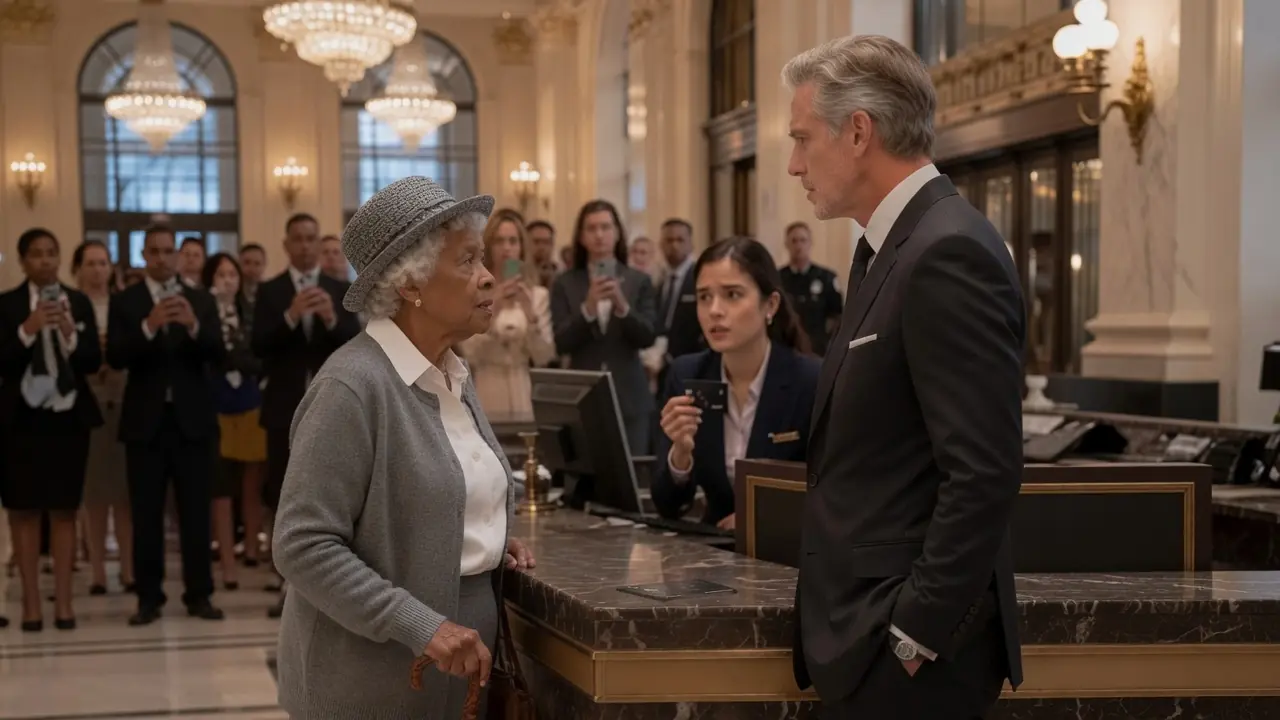
She stood upright despite the pain in her left hip, one hand resting on a polished wooden cane. Short silver curls framed her deeply lined brown face beneath a navy felt hat, and a modest cardigan covered her crisp white blouse. Nothing about her clothing announced wealth, but the rare black card between her fingers should have told any trained banker that she was not an ordinary customer.
Richard Caldwell looked at the card without touching it.
The fifty-eight-year-old bank president stood nearly a foot taller than Eleanor, dressed in a tailored black suit that probably cost more than many employees earned in a month. His gray hair was swept neatly away from his forehead, and a silver watch gleamed beneath his cuff. He wore the expression of a man accustomed to being obeyed before anyone questioned whether he deserved the authority.
“Women dressed like you do not own accounts at this bank,” Richard said. “Tell me where you stole that card.”
A shocked whisper moved through the lobby.
The young teller behind the counter, Sofia Martinez, lowered her eyes. She had already attempted to scan Eleanor’s card, but Richard had interrupted before the account loaded. Instead of allowing Sofia to complete the simple request, he had stepped forward and turned the private transaction into a public accusation.
Eleanor’s fingers tightened slightly around her cane.
She had entered the bank fifteen minutes earlier asking only to verify a transfer from one investment account to another. The teller had greeted her politely, but Richard noticed the black card and immediately assumed something was wrong. He asked for identification twice, demanded to know how she obtained the card, and finally suggested security should be called.
Eleanor had answered every question calmly.
Her driver’s license matched the name embossed on the card. Her signature matched the bank’s records. She even supplied the private verification phrase associated with the account, though Richard dismissed it as information someone could have stolen.
The humiliation was not accidental.
Richard wanted the lobby to watch him expose what he believed was fraud. He positioned himself where wealthy customers could see, raised his voice, and spoke to Eleanor as though she were too confused to understand her own deception. Every word revealed that he had judged the conclusion first and searched for evidence afterward.
“Enter the number,” Eleanor said, tapping her cane once against the marble. “Do it before your employees witness you make the worst mistake of your career.”
Richard laughed quietly.
“Threatening the president of this institution will not improve your situation.”
“I am not threatening you.”
“What would you call it?”
“A professional courtesy.”
Sofia glanced at Eleanor.
There was no panic in the elderly woman’s face. No embarrassment, no frantic explanation, and no desperate attempt to escape. Her calm made the teller wonder whether Richard was the only person in the room who had misunderstood what was happening.
Richard turned toward security.
“Mr. Wallace, remain nearby.”
A broad-shouldered guard approached but stopped several feet away. He had worked at the bank for twelve years and knew the difference between a dangerous customer and an elderly woman requesting account service. His discomfort was visible, though Richard mistook obedience for agreement.
“Scan the card,” Eleanor repeated.
Richard looked at Sofia. “Fine. Let us settle this.”
The teller inserted the black card into the secure terminal.
For a moment, the screen remained blank. Then the verification system requested a fingerprint, and Eleanor pressed her thumb against the reader. A green light appeared, followed by several account alerts Sofia had never seen before.
Her eyes widened.
Richard noticed. “What is it?”
Sofia did not answer immediately.
The screen displayed not one account, but an interconnected portfolio containing private holdings, trusts, institutional shares, and restricted ownership records. A red banner appeared at the top of the system:
EXECUTIVE AUTHORIZATION REQUIRED — MAJORITY OWNERSHIP PROFILE
Sofia looked at Eleanor, then at Richard.
“Sir,” she whispered, “this account belongs to Eleanor Hayes.”
“I can read the name.”
“No, sir. I mean the ownership profile.”
Richard leaned closer.
The color slowly drained from his face.
Displayed beneath Eleanor’s name was a controlling interest in Hayes-Caldwell Financial Holdings, the parent corporation that owned Caldwell Metropolitan Bank and seventeen regional institutions. Her late husband’s family trust held additional voting shares, all legally transferred to Eleanor following his death.
Richard read the numbers twice.
“That cannot be right.”
Sofia swallowed. “The system identifies Mrs. Hayes as the majority shareholder.”
Someone in the lobby gasped.
Richard’s eyes moved rapidly across the screen. He saw the value of Eleanor’s holdings, the authorization level attached to her name, and a note requiring immediate notification of the board whenever her account was accessed at a branch.
Then every private elevator behind the lobby desk began descending.
Richard turned toward the illuminated numbers.
“Why is the entire board coming downstairs?”
Eleanor stepped closer.
“Because they know who owns the bank,” she said. “And now they are coming to learn why its president accused her of theft.”
The elevator doors opened.
Seven board members emerged with the bank’s general counsel and chief compliance officer. At the front stood Margaret Sloan, chairwoman of the board and one of the few people who had worked directly with Eleanor’s late husband.
Margaret took one look at Eleanor and hurried across the lobby.
“Mrs. Hayes, we were not informed you were visiting today.”
“That was intentional.”
Margaret’s expression changed.
She looked from Eleanor to Richard, then toward the security guard and the silent customers surrounding them. “What happened?”
Richard spoke first.
“There was a misunderstanding involving an unusual card presentation.”
Eleanor turned her head slowly.
“A misunderstanding?”
“The verification process had not been completed.”
“You accused me of stealing my own card.”
“I was protecting the institution.”
“From its owner?”
Richard’s jaw tightened. “From possible fraud.”
Margaret faced Sofia. “Tell me exactly what occurred.”
The young teller hesitated.
Richard stared at her with a warning in his eyes, but Eleanor noticed. She had spent decades in boardrooms where powerful men communicated threats without raising their voices. She knew fear when she saw it.
“Speak freely,” Eleanor said. “Your position will not be threatened for telling the truth.”
Sofia took a breath.
She explained that Eleanor had presented valid identification and answered the security questions correctly. Before Sofia could complete verification, Richard interrupted, questioned the authenticity of the card, and accused Eleanor of stealing it.
“Did Mrs. Hayes behave aggressively?” Margaret asked.
“No.”
“Did she refuse identification?”
“No.”
“Did the system show any fraud warning?”
“No.”
Richard stepped forward. “Her appearance was inconsistent with the account level.”
Silence settled across the lobby again.
Margaret stared at him.
“Say that once more.”
Richard realized too late what he had admitted.
“I meant that the circumstances were unusual.”
“No,” Eleanor said. “You meant I did not look wealthy enough to deserve respect.”
Richard adjusted his jacket. “This is being interpreted unfairly.”
Eleanor looked toward the crowd.
Among the customers stood an elderly Latino man holding a deposit slip, a Black nurse in hospital scrubs, a delivery driver clutching a paycheck, and several wealthy clients wearing designer coats. Some looked shocked by the cruelty. Others looked uncomfortably familiar with it.
“How many people have you treated this way when no board members were watching?” Eleanor asked.
Richard’s face hardened. “I have served this institution for twenty-three years.”
“That was not my question.”
“I have protected this bank’s reputation.”
“By deciding who belongs here based on clothing and skin?”
“That accusation is offensive.”
“So was yours.”
Margaret asked the security team to preserve all footage from the lobby. She also ordered the compliance department to review previous complaints against Richard and senior branch managers. Richard attempted to object, but the general counsel informed him that an immediate investigation was required.
Eleanor listened without satisfaction.
She had not come to the bank planning to expose anyone. She had spent most of the morning visiting a community housing project funded through her family foundation. On the way home, she decided to stop at the branch personally rather than asking an assistant to check the transfer.
Her simple clothing came from that visit.
She had spent the morning speaking with residents, inspecting apartments, and sitting with mothers worried about rent. Dressing like a board chairwoman had seemed unnecessary.
That decision revealed more about her bank than any scheduled inspection could have.
Richard looked around the lobby and understood that his authority was disappearing. He had built his career on appearing decisive, controlled, and indispensable. Yet in less than ten minutes, the elderly woman he tried to humiliate had reduced him to a frightened employee waiting for judgment.
“This spectacle is unnecessary,” he said.
Eleanor raised an eyebrow. “You created the spectacle.”
“I was doing my job.”
“No. Sofia was doing her job. You stopped her because you preferred your prejudice to the bank’s verification system.”
Richard pointed toward the black card.
“Cards like that are almost never presented in person.”
“Then perhaps you should have been more careful before accusing the person carrying one.”
“You arrived without an appointment.”
“A customer should not need an appointment to be treated like a human being.”
Applause began near the back of the lobby.
It started with one person, then spread through the room. Richard turned toward the crowd, visibly furious, while employees stood frozen behind their desks.
Eleanor lifted one hand.
The applause stopped.
“This is not a performance,” she said. “It is an examination.”
She asked Sofia how long she had worked at the branch.
“Fourteen months.”
“Have you seen customers treated this way before?”
Sofia looked toward Richard.
Eleanor waited.
“Yes,” the teller finally admitted.
Richard’s face darkened.
Sofia described several incidents. An immigrant business owner had been asked to provide additional documents not required from other clients. A young Black entrepreneur seeking information about a commercial loan had been escorted away from the private banking floor before anyone reviewed his credentials. An elderly woman wearing a housekeeper’s uniform was made to wait nearly two hours to access an account belonging to her employer.
“Did you report these incidents?” Margaret asked.
“Twice.”
“To whom?”
“Mr. Caldwell’s office.”
“And what happened?”
“Nothing.”
The chief compliance officer began taking notes.
Other employees slowly found their courage.
A customer-service representative admitted that staff members were encouraged to prioritize clients who looked profitable. A junior banker said Richard regularly referred to certain customers as “lobby traffic” and instructed employees not to waste time on them. A security officer revealed that he had been ordered to watch people based on appearance rather than behavior.
Each statement stripped away another layer of Richard’s polished image.
He tried to interrupt, accuse employees of resentment, and insist his policies protected efficiency. But the people who had remained silent for years no longer depended on his approval.
Eleanor watched carefully.
She understood that removing one arrogant executive would accomplish little if the institution rewarded the same behavior elsewhere. Richard had not invented the culture alone. He had merely become confident enough to reveal it publicly.
“Mrs. Hayes,” Margaret said, “we should continue this discussion upstairs.”
“No.”
Margaret appeared surprised.
Eleanor looked around the lobby. “The harm happened here. The first response should happen here.”
She asked every customer who had been delayed during the confrontation to receive immediate assistance. She instructed staff to provide written contact information for anyone who wished to report discriminatory treatment. Then she ordered the private conference room opened for employees who wanted to speak to compliance without supervisors present.
Richard shook his head.
“You cannot reorganize branch operations in the middle of the day.”
Eleanor faced him. “I can reorganize anything I own.”
“This is not a family shop. It is a regulated financial institution.”
“Which is precisely why your behavior is dangerous.”
He looked toward the board. “Are you going to allow this?”
Margaret answered calmly. “Mrs. Hayes controls fifty-four percent of voting shares. More importantly, every order she has given is consistent with our legal obligations.”
Richard’s confidence finally broke.
“You cannot remove me because of one difficult interaction.”
Eleanor studied him.
“This was not one interaction. It was the moment your habits finally reached someone you could not intimidate.”
She turned toward the chief compliance officer.
“Place Mr. Caldwell on immediate administrative leave.”
Richard stepped backward.
“Eleanor, be reasonable.”
The use of her first name sounded almost desperate.
“You did not know my name ten minutes ago.”
“I was mistaken.”
“You were comfortable being mistaken because you believed the consequences would belong to me.”
“I apologize.”
“Do you?”
“Yes.”
“For what?”
Richard opened his mouth.
No answer came.
He was sorry the card was real. Sorry the account was enormous. Sorry the woman in modest clothing controlled the institution. But Eleanor saw no evidence that he regretted humiliating someone he believed powerless.
“You are not sorry for how you treated me,” she said. “You are sorry I turned out to be important.”
Richard looked toward the security guards.
For the first time, they were waiting for instructions from someone else.
“Please escort Mr. Caldwell to his office,” Margaret said. “He may collect personal belongings under supervision.”
Richard’s face flushed.
“You are making a terrible mistake.”
Eleanor tapped her cane once.
“No, Richard. My mistake was believing this bank still reflected the values my husband and I built into it.”
He stopped.
“Your husband is dead.”
The words shocked everyone.
Eleanor’s expression did not change, but sorrow moved through her eyes. Her husband, Samuel Hayes, had died three years earlier after fifty-one years of marriage. Together, they had transformed a struggling neighborhood savings institution into a regional financial network.
Richard seemed to regret the sentence immediately.
Eleanor stepped closer.
“Yes, Samuel is dead. But the standards he demanded are not. He believed banks existed because ordinary people trusted us with the results of their labor.”
She gestured toward the customers.
“Teachers, nurses, drivers, shop owners, retirees, and families built this institution one deposit at a time. We did not build it so men like you could decide who deserved dignity at the door.”
Richard said nothing.
“Clear out your office,” Eleanor told him. “Your final transaction as president is the loss of your authority.”
He was escorted toward the elevators.
No one applauded this time.
Eleanor did not want celebration. She wanted accountability.
After Richard left the lobby, Margaret invited Eleanor upstairs again. This time, Eleanor agreed, but she asked Sofia and two frontline employees to join the board.
The meeting lasted four hours.
They reviewed customer complaints, employee turnover records, lending disparities, and internal policies. The evidence showed that applicants from several minority neighborhoods faced longer processing times and higher rejection rates even when income and credit profiles were comparable.
Richard had not acted alone.
Senior managers learned to imitate him because his methods produced short-term profits and attracted wealthy clients. Employees who objected were denied promotion or transferred.
Eleanor felt ashamed.
She owned the institution, yet distance had protected her from seeing what happened inside it. After Samuel’s death, she allowed professional managers to handle daily operations while she focused on philanthropy.
The black card incident taught her that ownership without attention could become another form of neglect.
“We are not fixing this with a press release,” she said.
The board approved an independent review of lending and customer-service practices. They created direct reporting channels for employees, tied executive compensation to fair-service measures, and established a community advisory council.
Eleanor demanded something else.
“Sofia should lead the customer dignity task force.”
The teller nearly dropped her pen.
“Mrs. Hayes, I am not an executive.”
“Neither was I when Samuel and I opened our first branch above a laundromat.”
Sofia shook her head. “I do not have the experience.”
“You recognized what was wrong and tried to follow procedure despite pressure from the president. Experience can be taught. Character is more difficult.”
Margaret agreed.
Sofia received a temporary promotion, training, and authority to interview branch employees. Over the next several months, she helped identify policies that encouraged discrimination.
Richard’s investigation revealed more than arrogance.
He had manipulated performance records, ignored complaints, and approved questionable loans for associates while rejecting qualified small-business applicants. The board terminated him for cause and referred several matters to regulators.
The news reached newspapers within days.
Headlines focused on the elderly Black woman who entered her own bank wearing a cardigan and exposed its president. Reporters waited outside Eleanor’s home, hoping for a dramatic statement.
She refused most interviews.
When she finally spoke, she stood outside the original Hayes Community Savings branch where she and Samuel had begun.
“This story is not important because I was wealthy,” she said. “It is important because I should not have needed wealth to be treated respectfully.”
The sentence spread across the country.
Customers shared stories of being judged by banks, stores, hospitals, and workplaces. Some described being ignored because of clothing. Others spoke of assumptions based on race, age, disability, or accent.
Eleanor read every letter sent to her office.
One came from a twelve-year-old girl named Tiana, whose grandmother had been denied service at another bank because an employee believed she could not understand a financial document. Tiana wrote that seeing Eleanor stand up for herself made her grandmother feel less ashamed.
Eleanor framed the letter.
Months later, she invited Tiana and her grandmother to the bank’s reopening ceremony.
The grand marble lobby looked almost unchanged, but the institution operating inside it was different. Employees had undergone new training, complaint procedures were visible, and community representatives attended quarterly board meetings.
Sofia stood near the counter as the newly appointed vice president of customer experience.
She still remembered the moment Richard warned her not to speak.
Now her job included making sure no employee faced that fear again.
Eleanor arrived wearing the same modest gray cardigan she had worn during several community visits and carrying the same cane. She also brought the black card.
The lobby became quiet when she approached Sofia’s counter.
Sofia smiled. “Good morning, Mrs. Hayes. How may I help you?”
Eleanor placed the card down.
“I would like to check my balance.”
Sofia took the card without looking at Eleanor’s clothing.
“May I see your identification?”
“Of course.”
She verified the documents, completed the security process, and returned the card.
“Everything appears correct.”
Eleanor smiled. “Exactly as it should be.”
The customers nearby applauded, but this time Eleanor allowed it.
Not because she had defeated Richard.
Because an institution had finally begun learning that dignity could not be reserved for people whose wealth was visible.
After the ceremony, Tiana approached Eleanor.
“Were you scared when he accused you?” the girl asked.
Eleanor considered the question.
“I was angry.”
“But were you scared?”
“A little.”
Tiana looked surprised. “You didn’t look scared.”
“Courage is not the absence of fear. It is deciding fear will not speak for you.”
The girl nodded seriously.
Eleanor removed no jewelry, offered no large gift, and made no promise of wealth. She simply handed Tiana a business card.
“If you ever decide to study finance, call my office.”
Years later, Tiana would become one of the youngest analysts hired by Hayes-Caldwell Financial Holdings.
Richard Caldwell disappeared from public banking.
He attempted to sue the institution, but the evidence against him made settlement impossible. Eventually, he moved to another state and worked as a private consultant with far less power than before.
Eleanor did not follow his life.
Revenge had never interested her.
She was more concerned with the people he had harmed and the system that allowed him to do it.
Under the new leadership, the bank launched a small-business lending program focused on overlooked neighborhoods. It funded restaurants, childcare centers, construction companies, medical practices, and grocery stores that traditional lenders had dismissed.
Profits did not collapse as critics predicted.
They increased.
Customers trusted the institution because it treated them as partners rather than appearances to be evaluated. Deposits grew, employee turnover fell, and the bank developed a reputation for listening before judging.
Eleanor remained active on the board until she was eighty-two.
At her final annual meeting, she placed the black card on the table in front of the directors.
“This card once proved how much money I controlled,” she said. “But that afternoon in the lobby, it revealed something more important.”
The directors listened.
“It revealed which people respected me only after learning what I owned.”
She looked toward Sofia, now president of the institution.
“Never confuse a customer’s balance with a measure of human worth.”
Sofia nodded.
Eleanor retired from daily business but continued visiting branches without announcement. Sometimes she wore elegant suits. Other times, she arrived in comfortable shoes and an old coat.
She was never testing whether employees recognized her.
She was testing whether recognition mattered.
Years after the confrontation, the wooden cane and black card were displayed inside the bank’s small history gallery. Beneath them was a plaque containing Eleanor’s sentence:
I said check my balance, not my appearance.
Visitors often smiled at the sharpness of the words.
But beneath that line was another:
Respect offered only after wealth is revealed is not respect. It is fear wearing good manners.
That was the lesson Eleanor wanted remembered.
Richard believed he was humiliating an elderly woman who had wandered into a place above her station. He saw modest clothes, dark skin, gray hair, and a cane, then created a story about theft without checking a single fact.
The balance exposed his mistake.
But Eleanor’s ownership was not what made his treatment wrong.
It only made the consequences impossible for him to escape.
Had she possessed ten dollars instead of billions, she still would have deserved patience. Had she held an ordinary debit card instead of a rare black one, she still would have deserved service. Had she owned nothing inside the institution, she still would have been a human being standing at a counter.
Richard lost his office because he failed to understand that simple truth.
Eleanor changed the institution because she refused to let his failure remain private.
And from that day forward, every employee entering the marble lobby passed beneath a framed message chosen personally by Eleanor Hayes:
Before you ask what someone owns, remember who owns the right to dignity. Everyone.