The banker did not laugh when the old man laid the will on his desk. He did something quieter than that. He leaned back in his leather chair, looked at the yellowed paper for maybe three seconds, then turned his head slightly and spat into the brass waste basket beside his desk. A small sound, casual, disrespectful in a way that felt practiced. The old man watched it happen without moving. The office was on the second floor of Redstone Valley Bank in western Tennessee. Walnut shelves, framed photographs of ribbon cuttings and chamber breakfasts. A view over the town square where the old cotton warehouse used to stand before the bank bought the block and turned it into parking.
The banker wiped the corner of his mouth with a folded handkerchief and said, "Mr. Tally, your grandfather died in 1978. Whatever this paper says, it does not override fifty years of probate, estate closure, and banking law." The old man kept one hand on the document. "My grandfather's estate was never closed," he said.
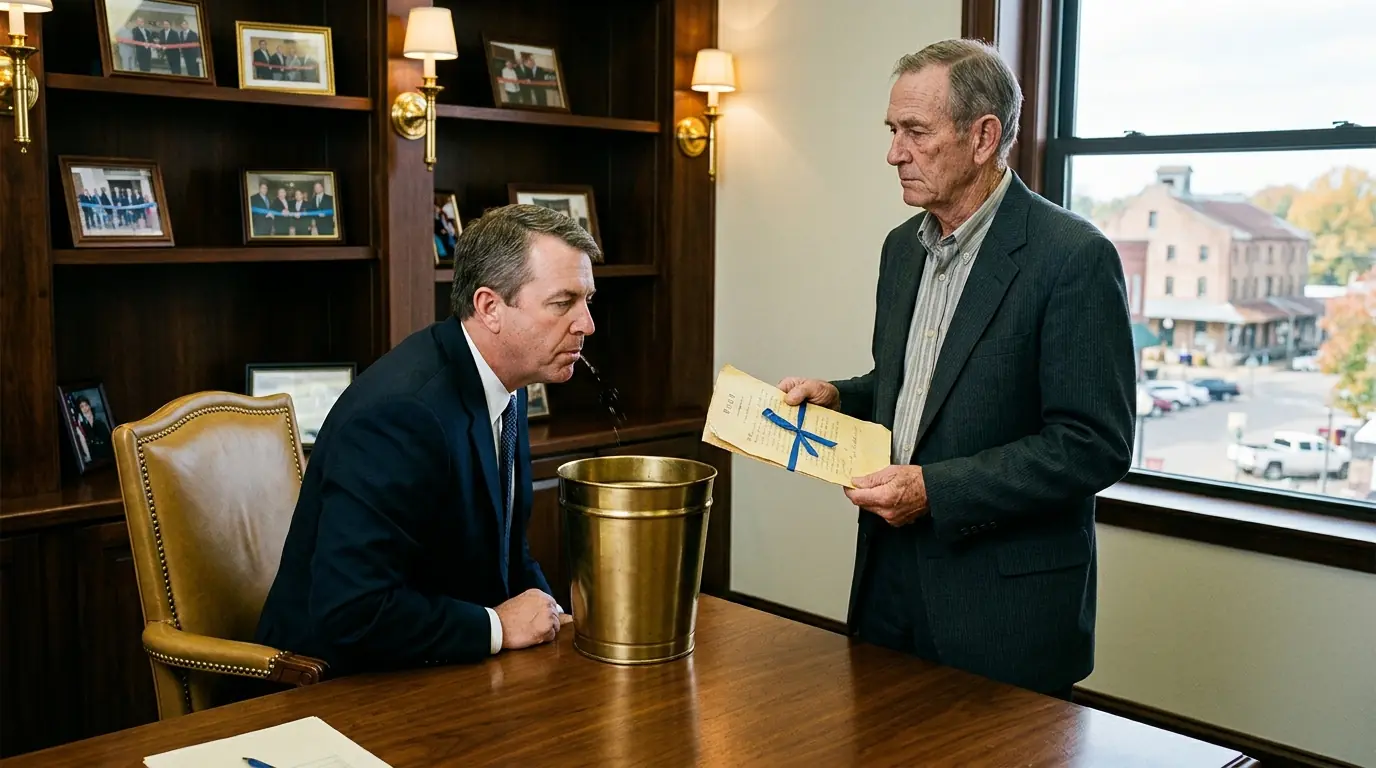 The banker smiled. The kind of smile people use when they think they are already speaking to the losing side. "Our records say otherwise."
"Your records are the reason I'm here." The banker glanced down again. The will was typed on old bond paper, thin and brittle at the folds. A blue ribbon still held three pages together at the top left corner. The signature at the bottom of the final page was written in dark fountain pen ink: Enoch Tally, September 14th, 1959. The banker touched the page with one finger, then pulled his hand back as if the paper itself annoyed him.
"You're asking for access to a sealed lower vault compartment based on this?"
"Yes."
"That compartment was decommissioned in 1984. It was not emptied." The banker's smile faded a little.
"And how would you know that?"
The old man reached into his coat pocket and placed a small iron key on the desk. The key was black with age, its teeth worn smooth at the corners, a red thread still tied through the ring.
"My grandfather told me not to use it until the bank lied." For the first time that morning, the banker stopped speaking.
The old man's name was Jonah Tally. He was seventy-six years old, and his family had lived in Hardaman County, Tennessee since 1912. His grandfather, Enoch Tally, had not been rich. He had run a cotton gin for twenty-seven years, owned eighty-three acres south of Boloulevard, and kept every important paper in flower sacks under the kitchen floorboards because he had come through the Depression with a permanent suspicion of institutions that wore ties.
In 1959, when his health began to fail, Enoch wrote a will, not with a city lawyer, but with a circuit writing attorney named Orson Pike, who drafted wills for farmers, storekeepers, and widows across three counties. The will left the farmland to Jonah's father, the gin equipment to Jonah's uncle, and one final instruction regarding vault compartment C18 of Redstone Agricultural Trust, the predecessor bank to Redstone Valley Bank.
The instruction was brief. The compartment was not to be opened on Enoch's death. It was not to be inventoried by the bank. It was not to be disturbed unless two conditions were met. First, the Tally family's lower river tract was challenged, sold, or encumbered by a third party. Second, the challenge came through a bank, lender, or court claiming superior title. If those conditions were met, Enoch's eldest living male descendant was to open the compartment in the presence of a judge or county officer.
Jonah heard those words exactly once. He was fourteen years old, sitting at his grandfather's bedside in July of 1962, two days before Enoch died. The old man's breathing was bad, his voice thin, but he made Jonah repeat the instruction back to him twice. Jonah did. Then life moved on the way life does. His father took over the farm. The cotton gin closed in 1971. The lower river tract flooded twice in the 1980s and sat mostly unused after that. Jonah married, buried a wife, raised a daughter, and spent forty years driving seed trucks and repairing irrigation pumps for other men. He never used the key.
Then, eleven months ago, Redstone Valley Bank filed a petition claiming ownership of the Tally Lower River tract through a chain of collateral transfers dating back to a 1976 farm operating loan that Jonah's father had allegedly defaulted on. The claim made no sense to Jonah. His father had paid that loan off in 1978. Jonah remembered because he drove him to the bank the day the final note was signed. But memory is not paper. The bank's file said the river tract had been pledged separately as contingent collateral and never properly released. The tract was now valuable because a Memphis logistics company wanted it for a 22 million river-loading project. Redstone had already negotiated terms.
Jonah went to the courthouse, then to the county archive, then to an old lawyer in Jackson named Miriam Voss. Miriam read the bank's petition, read Enoch Tally's will, looked at the iron key, and asked only one question.
"Has the bank denied the compartment exists?"
Jonah nodded. Miriam closed the file. "Then it's time."
Miriam Voss was sixty-eight years old and had practiced chancery and probate law for forty-two years. She knew old families, older documents, and the kind of mistakes modern banks made when they assumed age meant irrelevance. She filed an emergency petition in chancery court that same afternoon.
The petition did not ask the court to award Jonah the river tract immediately. It asked for something narrower and far more dangerous to the bank. It asked the court to preserve evidence. Specifically, it asked Chancellor Ruth Ellery to order Redstone Valley Bank to identify, secure, and produce any vault, ledger, index, transfer card, decommission file, or internal inventory related to compartment C18 of the former Redstone Agricultural Trust. Attached to the petition was the clause from Enoch Tally's will. Miriam had highlighted one line in yellow: "In the event of dispute by any lending institution concerning the river tract, the compartment shall be opened only under seal of the chancery court, and the contents shall be deemed evidence of first title."
Redstone's counsel responded within hours. The bank argued the will had no power to bind a successor bank. It argued the compartment was long gone. It argued any contents, if ever present, would have been abandoned under dormancy law decades earlier. Miriam read the response once and smiled because tucked inside it was an affidavit from the bank's senior operations officer stating that the lower vault had been decommissioned, cataloged, and consolidated in 1984—not emptied, not destroyed, consolidated.
She drove to Jonah's farmhouse before sunset. "They made a mistake," she said as she stepped into his kitchen. Jonah looked up from the table. "What kind?"
"The kind people make when they think old paper can't still bite."
The hearing took place the next morning in a small chancery courtroom with green walls and two slow ceiling fans. Redstone Valley sent three lawyers. Jonah wore his cleanest work shirt and the same denim coat he had worn to his wife's funeral. He sat beside Miriam at the plaintiff's table with Enoch Tally's will in front of him and the iron key in his pocket.
Chancellor Ruth Ellery was not a dramatic judge. She did not like raised voices or theatrical filings. She liked documents, chronology, and people who answered the question they were asked.
Redstone's lead attorney stood first. "Your honor, this is an attempt to weaponize a sentimental family paper against settled commercial reality. Whatever existed in 1959 cannot govern a bank vault sixty-five years later."
Judge Ellery looked down at the will, then at the bank's affidavit. "Council, your own filing states the lower vault was cataloged and consolidated in 1984."
"Yes, your honor, as part of a merger transition. And where was compartment C18 transferred?"
"We are still determining that you decommissioned an entire vault and do not know where a numbered compartment was transferred," the attorney shifted his weight. "We know the system changed, your honor. Physical numbering may not correspond."
Miriam stood. "Your honor, the petitioner asks only that the bank stop touching whatever remains of that compartment until the court can verify chain of custody. If the bank is correct, the compartment is empty and this ends quickly. If the bank is not correct, then the contents may directly affect title to the disputed tract."
Judge Ellery leaned back slightly. "Mr. Tally, stand please."
Jonah stood. "Did your grandfather personally instruct you regarding this key and this will?"
"Yes, ma'am."
"Did he tell you what was inside?"
"No, ma'am."
"Have you ever used the key?"
"No, ma'am."
She studied him for a moment. Then she looked at the bank's table. "I am issuing an immediate preservation order. The lower vault, all related storage areas, and any transferred archival containers associated with former Redstone Agricultural Trust compartments are to be sealed by the sheriff pending supervised inspection. No records are to be altered, moved, destroyed, or accessed without further order."
The bank's lead attorney stood too quickly. "Your honor, the vault will be sealed by noon."
The courtroom went quiet. Jonah did not smile. He just sat back down.
The sheriff arrived at Redstone Valley Bank at 11:38 that morning with two deputies, the county clerk, Judge Ellery-signed order, and a strip of red evidence tape. Customers standing in line at the teller counter stepped aside as the deputies walked through the lobby and down the stairs to the old sub-vault. The bank had not shown on any public floor plan for twenty years.
Jonah and Miriam stood with the clerk at the bottom of the stairwell while the bank's operations officer unlocked the steel door. Inside was a narrow room lined with old metal compartments, most of them tagged with replacement barcodes from the 1984 consolidation. Dust sat thick on the top shelves. The air smelled like paper, cold metal, and something sealed too long. Compartment C18 was still there—not transferred, not merged into another system, still there. The number plate was tarnished but legible. The lock was older than the rest of the room, and tied through the handle, faded almost white with age, was the remains of a red thread.
Jonah looked at it for a long moment. "That's my grandfather's knot," he said quietly. The bank's operations officer did not answer.
Judge Ellery's order prohibited opening the compartment until a full chain of custody log was assembled. So, the clerk photographed it in place, listed it on the record, and watched the deputies place red evidence tape across the vault door. Sealed by order of the chancery court. The tape went on at 12:07 p.m.
By 2:30 that afternoon, Redstone Valley's chief legal officer was driving in from Nashville. By 5:00, the Memphis Logistics Company had called the bank asking why its site inspection had been canceled. By 7:00, the bank's board had scheduled an emergency meeting. Because whatever was in C18 had survived sixty-five years, three mergers, two vault reorganizations, and one banker who had spit on a dead man's will. And now a judge had put the whole institution on notice.
The compartment was opened two days later in Judge Ellery's presence. Also present: the county clerk, Miriam Voss, Jonah Tally, Redstone's general counsel, and a forensic records examiner from Jackson. Jonah inserted the iron key himself. It turned on the second try. Inside the compartment was a narrow cedar box, a linen packet tied with twine, and a sealed envelope addressed in Enoch Tally's hand for the court if the bank forgets who owned the river. No one spoke.
The envelope was opened first. Inside was a handwritten affidavit by Enoch Tally, witnessed and notarized in 1959, explaining that the Tally Lower River tract had never been pledged as collateral for any family debt because it was not owned outright by the family in the ordinary way. It was held under a 1913 river easement trust agreement between Enoch Tally, the old Yazu and Delta Shipping Company, and Hardeman County. The agreement gave the Tally family perpetual supervisory rights over the landing approach, flood berm, and access road on the tract in exchange for maintaining the riverbank and allowing seasonal barge use. Those rights ran with the land and could not be mortgaged, severed, or transferred without all three parties' written consent. The shipping company no longer existed, but its rights had passed through merger into a modern inland freight corporation headquartered in St. Louis, and that corporation had already signed a tentative agreement with Redstone's Memphis buyer for the exact same river loading project.
The linen packet contained the original 1913 trust agreement. The cedar box contained twelve years of receipts proving Jonah's father had fully repaid the 1976 operating loan in 1978, including the release card the bank claimed never existed.
The room stayed silent for almost a full minute. Finally, Judge Ellery looked at Redstone's general counsel. "Council, do you understand that your bank attempted to convey a tract it did not have clear authority to encumber using a collateral theory contradicted by your own predecessor's release card and a trust instrument still binding on the land?"
The general counsel answered quietly, "Yes, your honor."
Jonah reached out and touched the edge of the cedar box with one finger. His grandfather had not hidden money. He had hidden memory backed by paper in Hardeman County. That was more dangerous.
Redstone Valley asked for forty-eight hours. Judge Ellery gave them twenty-four. The next afternoon, the bank returned with a proposed consent order. It withdrew its title claim to the river tract, voided every filing associated with the disputed collateral theory, and acknowledged the 1978 loan release as valid.
That alone would have been enough for Jonah. Miriam Voss asked for more. She asked for the bank to pay all court costs, archival preservation of the C18 contents, and a cash settlement to Jonah for slander of title, wrongful interference with inheritance rights, and damages related to the delayed use of the tract. Redstone agreed faster than Jonah expected.
Because behind the quiet consent order sat a larger problem. The St. Louis Freight Corporation had already informed the bank that if the bank's false title representations had endangered the logistics project, it would pursue its own claims. The Memphis buyer had done the same. Redstone did the math.
Three weeks later, Jonah Tally signed a settlement package worth $2.3 million, recorded clear title to the river tract, and a bank-funded preservation trust for the Tally archival materials. He did not celebrate. He drove home, parked beside the machine shed, and sat in his truck for a while with the cedar box on the seat next to him. Then he carried it inside.
That night, Jonah went into the old back bedroom where his grandfather had died in 1962. The room had changed less than the rest of the house. Same narrow window, same pine walls, same uneven floorboards near the corner stove. He knelt slowly, set the cedar box on the floor, and lifted the loose board his grandfather used to hide papers under when banks were young and trust was not. He did not put the 1913 agreement back there. He did not put the will back there either. Those were going to the county archive in fireproof cases paid for by the bank. But he placed the iron key under the board for one more night. Then he sat on the edge of the bed and looked at the dark window glass. His grandfather had known something Jonah only understood now. Institutions forget on purpose when forgetting is profitable. Families forget by accident. The paper exists to help one side survive the other.