Yvonne Sinclair entered the executive ballroom of Whittaker Aerospace carrying a black leather portfolio and an agreement worth eight billion dollars. The ballroom occupied the top floor of the company’s Manhattan headquarters, with floor-to-ceiling windows overlooking the city and polished marble reflecting the people gathered beneath the crystal lights. Forty board members, senior executives, lenders, and government advisers had assembled to witness the rescue deal that was supposed to save Whittaker Aerospace from collapse. Not one of them understood that the woman walking toward the center of the room held their future inside twelve signed pages.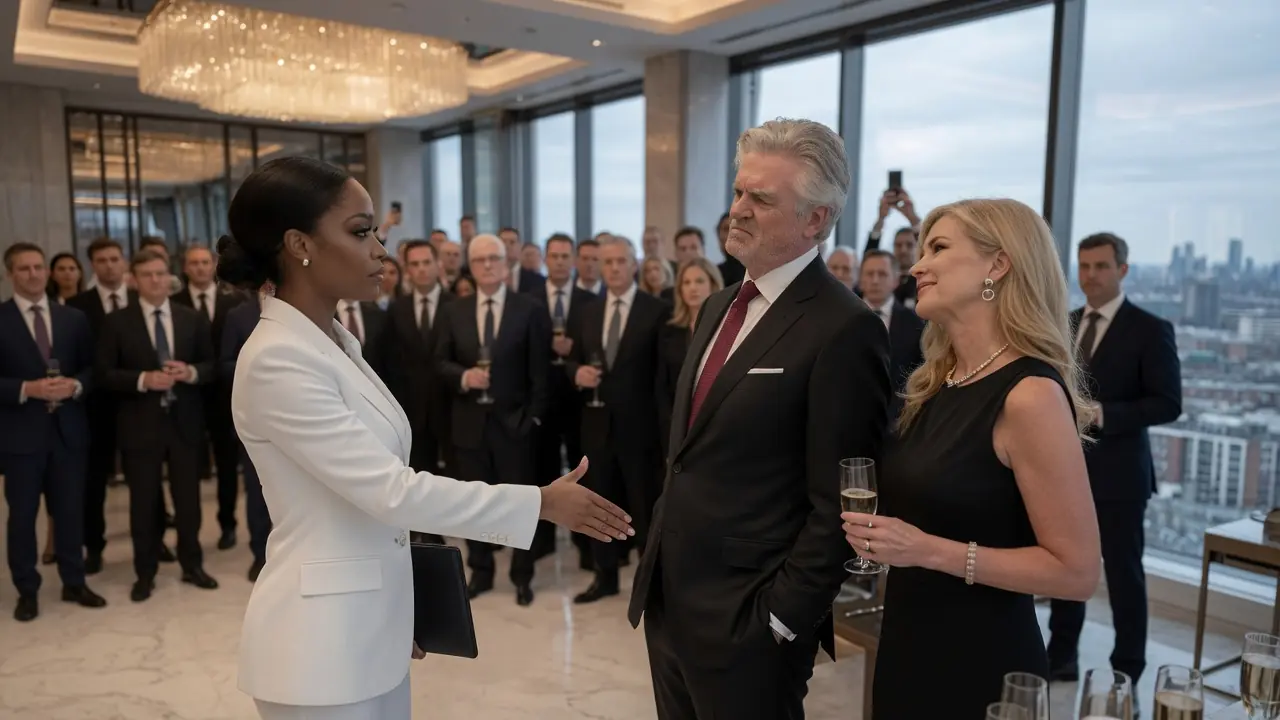
Yvonne was thirty-eight, composed, and dressed in a tailored navy pantsuit over a crisp white blouse. Her dark hair was arranged in a sleek low bun, and a simple pair of pearl earrings provided the only visible luxury she wore. She had founded Sinclair Holdings at twenty-six with a borrowed office, one assistant, and a reputation for seeing value where wealthier investors saw only risk. Twelve years later, her company controlled energy infrastructure, defense manufacturing, aviation finance, and a private investment fund large enough to rescue corporations that once refused to return her calls.
Whittaker Aerospace had spent the previous year moving toward disaster. Its flagship military transport program was eighteen months behind schedule, suppliers had stopped extending credit, and two aircraft prototypes had failed critical inspections. The company still possessed valuable patents, skilled engineers, and government contracts, but it also carried twelve billion dollars in debt. Without Sinclair Holdings’ investment, Whittaker would miss payroll within weeks and default on several major loans before the end of the quarter.
Hayden Whittaker refused to call it a rescue.
He called it a strategic partnership because the word rescue made him feel dependent. At sixty-two, Hayden was accustomed to walking into rooms where people stood before he reached the table. His silver hair remained carefully swept back, his black suit was custom-made, and the red tie against his white shirt appeared in nearly every business photograph published about him. He had inherited Whittaker Aerospace from his father, expanded it through aggressive acquisitions, and gradually convinced himself that being born into power was the same as building it.
His wife, Caroline, stood beside him in a fitted black evening dress with diamonds at her throat. She had organized the reception before the agreement was finalized, ordering champagne, photographers, and engraved crystal gifts bearing both company names. Caroline wanted the evening to appear less like a desperate negotiation and more like a celebration of Hayden’s leadership. She had never met Yvonne in person, but she assumed Sinclair Holdings would send an elderly male chairman surrounded by assistants.
When Yvonne approached them, Hayden glanced past her toward the ballroom entrance.
“Mr. Sinclair is running late?” he asked.
“There is no Mr. Sinclair,” Yvonne replied.
Hayden barely listened. He noticed the portfolio in her hand and decided she belonged to the legal staff. Yvonne extended her right hand with the professional courtesy she offered every business leader, regardless of status.
Hayden recoiled as though she had touched his jacket.
“Get your filthy hand off me,” he said loudly. “I don’t shake hands with staff.”
The room fell silent.
Yvonne slowly lowered her hand. She looked at Hayden, then at Caroline, who covered a laugh behind her champagne glass. Several executives exchanged nervous glances, but none stepped forward to correct him. They knew the identity of Sinclair Holdings’ founder had been included in every negotiation file, yet Hayden had delegated most of the work and attended only the final briefing.
“That hand,” Yvonne said calmly, “was about to approve the eight billion dollars saving your company.”
Hayden stared at her for a moment, then laughed. He looked around the room as though inviting everyone to join him.
“A woman like you couldn’t finance my parking garage.”
Caroline smiled. “Perhaps someone should check her credentials before she continues embarrassing herself.”
Yvonne opened the black portfolio.
The first document displayed Sinclair Holdings’ seal. Beneath it appeared Yvonne’s full name and title: Founder, Chairwoman, and Chief Executive Officer. The final approval page carried her signature beside an empty line reserved for Hayden Whittaker.
A board member named Charles Davenport stepped forward. “Hayden, this is Yvonne Sinclair.”
Hayden’s laughter stopped.
Yvonne removed the signed approval page and held it between two fingers. “I was prepared to invest eight billion dollars, restructure your debt, secure supplier credit, and protect twenty-six thousand jobs.”
Hayden glanced toward the board. Every expression had changed.
“Ms. Sinclair,” he said, forcing a smile, “there has clearly been a misunderstanding.”
“No,” Yvonne replied. “You understood exactly what you believed I was.”
She tore the approval page in half.
The sound was quiet, yet it seemed to move through the entire ballroom. She tore it again, placed the pieces inside her portfolio, and closed the metal clasp.
“Then explain to them,” she said, “why your empire dies ninety seconds after I leave.”
Yvonne turned toward the elevators.
For several seconds, no one moved. Hayden appeared unable to accept that a transaction developed over six months could disappear because of one insult. He had spent his life believing money tolerated arrogance when the arrogant person controlled something valuable. He had not yet understood that he was no longer the most powerful person in the room.
His chief financial officer, Martin Cole, looked down at his phone.
An alert from Sinclair Holdings had arrived.
CAPITAL COMMITMENT WITHDRAWN. ALL CLOSING ACTIVITY TERMINATED IMMEDIATELY.
Other phones began vibrating around the ballroom. The lead bank suspended Whittaker’s emergency credit extension because it had depended on Sinclair’s investment. Two suppliers sent automatic notices announcing that shipments would remain frozen. A government liaison received word that an internal review of Whittaker’s contracts would begin the following morning.
Martin’s face turned pale.
“Hayden,” he whispered, “the bridge financing is gone.”
Hayden rushed toward Yvonne.
“You can’t pull eight billion over one insult,” he shouted. “Give me that agreement.”
He reached for her portfolio.
Yvonne jerked it away before his fingers touched the leather. Two members of her private security team stepped from the crowd, positioning themselves between them.
“You rejected my hand before learning whose signature kept you alive,” she said.
Hayden lowered his voice. “Name your price.”
“My price was a leadership team capable of respecting people before reading their net worth.”
“I will apologize.”
“You are apologizing to the money.”
Caroline hurried forward. “This is absurd. Everyone says regrettable things during stressful negotiations.”
Yvonne looked at her. “You laughed.”
“I was surprised.”
“You were comfortable.”
The elevator doors opened.
Hayden looked toward the board members, investors, and lenders watching his panic. His entire identity depended on appearing untouchable, yet he was now standing before them begging the woman he had humiliated to remain.
“Ms. Sinclair,” he said, “I will apologize in front of everyone.”
Yvonne pressed the elevator button to hold the doors.
“You have sixty seconds,” she said. “Remove him, or watch me fund his competitor instead.”
The ballroom erupted.
Hayden turned toward Charles Davenport, chairman of the independent board committee. “She cannot demand my removal.”
Charles took the voting folder from the table. “She is not demanding it. She is explaining the condition under which her capital might still be available.”
“This is my company.”
“You own eighteen percent.”
“My name is on the building.”
“So was your father’s.”
Hayden looked toward the other directors. Several had supported him for years because challenging a Whittaker inside Whittaker Aerospace seemed impossible. Now the company’s bank accounts were shrinking, its rescue agreement had been destroyed, and the only investor capable of preventing bankruptcy stood beside an open elevator.
Charles requested an emergency vote.
Hayden laughed bitterly. “You cannot remove a chief executive during a reception.”
“We can remove one during an emergency.”
The directors moved toward the long conference table beside the ballroom windows. Lawyers opened laptops, verified voting rights, and contacted two absent directors by secure video. The guests remained in place, unwilling to leave while a corporate dynasty collapsed in real time.
Yvonne released the elevator button.
The doors began closing.
“Wait,” Charles called.
She stopped them again.
The emergency committee had authority to suspend Hayden pending a full governance review. Eleven votes were required. The first six came immediately. Three directors hesitated, looking toward Hayden as though fearing he might still regain control.
Hayden stepped toward them. “Think carefully. My family built this company.”
Martin Cole spoke from the end of the table. “Your father built it. You borrowed against it.”
Hayden’s face tightened. “You work for me.”
“I work for Whittaker Aerospace.”
The seventh vote appeared on the screen.
Then the eighth.
Caroline grabbed Hayden’s arm. “Stop this. Tell them about the government contract.”
The government liaison lowered his phone. “The contract is under review because the company may no longer meet its financial stability requirements.”
The ninth vote arrived.
Hayden looked toward Yvonne. “You planned this.”
“I planned to save your company.”
“You entered here looking for an excuse to take control.”
“I entered with eight billion dollars and an extended hand.”
The tenth director voted for suspension.
Only one more was needed.
The final deciding vote belonged to Richard Sloan, Hayden’s oldest ally. Richard had served with Hayden’s father, attended family holidays, and supported nearly every acquisition Hayden proposed. He stared at the voting screen for several seconds before looking directly at him.
“Your father would have shaken her hand,” Richard said.
He voted yes.
Hayden Whittaker was suspended as chief executive officer ninety-seven seconds after insulting Yvonne Sinclair.
Charles turned toward the elevator. “Ms. Sinclair, the board has removed him from operational authority. We ask that you remain and reconsider the investment.”
Yvonne stepped out of the elevator but did not return to the table.
“I will reconsider nothing tonight.”
Hayden’s expression briefly brightened, believing the board had removed him for no reason. Then Yvonne continued.
“My team will conduct a complete leadership, financial, and cultural review beginning tomorrow. If Sinclair Holdings finds that his behavior reflects this organization rather than one man, the capital remains withdrawn.”
Charles nodded. “You will have full access.”
Caroline stepped between them. “You cannot inspect private executive communications.”
Yvonne looked toward the general counsel. “Can I?”
The lawyer answered without hesitation. “Under the proposed financing terms, yes. The board may authorize immediate due diligence access.”
Caroline’s confidence faltered.
Yvonne noticed.
“What are you afraid we will find?” she asked.
“Nothing.”
Hayden turned toward his wife. “Caroline.”
She looked away.
Corporate security approached Hayden and requested his executive badge. He refused, insisting the vote was temporary and unlawful. Charles reminded him that the company’s bylaws allowed suspension whenever a chief executive endangered a material transaction.
“You endangered eight billion dollars in less than two minutes,” Charles said. “That may be a company record.”
A few people laughed nervously.
Hayden tore the badge from his jacket and threw it onto the marble floor. “You are all cowards. This company will collapse without me.”
Yvonne glanced toward the bank alerts arriving on the directors’ phones. “It nearly collapsed with you.”
Security escorted Hayden and Caroline from the ballroom while cameras captured every step. The event had been intended to announce the rescue of Whittaker Aerospace. Instead, it became the public removal of the billionaire who believed his surname protected him from consequences.
Yvonne remained for twelve minutes.
She instructed her legal team to preserve every agreement but authorize no money. She asked the board to prepare payroll records, government correspondence, supplier contracts, executive compensation, and internal discrimination complaints by eight the next morning. Then she left without drinking the champagne purchased to celebrate her investment.
The story spread before she reached the street.
One guest had recorded Hayden refusing her handshake. Another captured the torn agreement and emergency vote. By midnight, financial networks were replaying the footage beneath headlines announcing that Sinclair Holdings had withdrawn an eight-billion-dollar rescue package after its founder was mistaken for staff.
Whittaker Aerospace shares fell thirty-one percent in overseas trading.
Banks demanded emergency calls.
Suppliers refused to move parts until payment guarantees were restored. Employees arriving for night shifts found reporters outside the gates asking whether the company would survive the week.
Hayden returned to his penthouse and called every director who had voted against him. Only Richard answered.
“You betrayed my family,” Hayden said.
“I protected the company your family left us.”
“She humiliated me.”
“You humiliated yourself.”
“It was one sentence.”
“It was the sentence you chose when you believed she had no power.”
Hayden ended the call.
Caroline paced near the windows, repeatedly checking social media. Her image appeared beside Yvonne’s in hundreds of posts, often frozen at the moment she laughed. The comments were merciless.
“This will destroy us,” Caroline said.
“No. The board’s cowardice will destroy us.”
“She saw me laugh.”
“You should not have.”
Caroline stopped. “You insulted her first.”
“You encouraged me.”
“I did not know who she was.”
The words settled between them.
Neither had known who Yvonne was, yet both understood that ignorance did not excuse the contempt. They had behaved cruelly because they believed the woman before them lacked importance. Her wealth had revealed the mistake, but it had not created it.
At eight the next morning, Yvonne entered Whittaker Aerospace headquarters through the employee entrance rather than the executive lobby. She wore a gray suit, carried no visible portfolio, and arrived with twenty-three auditors, attorneys, engineers, and human-resources specialists. Every department received instructions to preserve documents and cooperate fully.
The review uncovered problems far larger than the insult.
Hayden had diverted hundreds of millions into luxury offices, executive aircraft, and private consulting contracts while engineering teams warned that prototype safety testing lacked funding. He had approved inflated supplier agreements involving companies owned by personal friends. Senior managers who questioned him were reassigned, while employees who praised his decisions received rapid promotions.
Caroline had no formal company role, yet she maintained an office on the executive floor and approved event budgets, charitable donations, and public-relations contracts. Her lifestyle brand had billed Whittaker Aerospace more than forty million dollars over five years for “executive image consulting.”
The cultural review was equally damaging.
Employees submitted statements describing discrimination based on race, gender, accent, and educational background. Security guards were instructed to redirect anyone who “did not look executive” away from the top floors. Receptionists maintained informal lists of guests Hayden considered socially valuable. Several qualified engineers had been excluded from leadership meetings because executives assumed they were administrative staff.
Yvonne read every statement.
The insult inside the ballroom had not been an isolated mistake. It was a perfect expression of the organization Hayden built.
By the third day, Sinclair Holdings had enough evidence to walk away permanently. Yvonne scheduled a final meeting with the board inside the same ballroom where the deal collapsed. The crystal decorations had been removed, and no champagne waited near the windows.
Hayden attended with three attorneys.
His suspension allowed him to appear but not vote. Caroline remained outside after the board refused her request to join. Hayden looked exhausted, though he still wore an expensive suit and the expression of a man expecting negotiation to restore what consequences had taken.
Yvonne placed two folders on the table.
“The first contains our withdrawal notice,” she said. “The second contains revised terms under which Sinclair Holdings may still invest.”
Hayden leaned forward. “What terms?”
“You resign permanently from every executive and board position.”
“I am the largest individual shareholder.”
“You may retain your nonvoting economic interest under existing agreements.”
“You want to steal my company.”
“I want to prevent your leadership from destroying it.”
She continued. Caroline’s consulting contracts would be terminated, all improper payments reviewed, and any recoverable funds returned. A professional chief executive chosen jointly by the independent board and Sinclair Holdings would replace Hayden. Employee safety, ethics, and discrimination systems would be rebuilt under external supervision.
The investment would also change.
Sinclair Holdings would provide six billion dollars immediately rather than eight. The remaining two billion would enter a protected workforce and innovation fund, released only for payroll, engineering, supplier stabilization, and safety testing. No executive could use it for bonuses, private aircraft, or image consulting.
Charles examined the documents. “What ownership would Sinclair receive?”
“Thirty-eight percent, with temporary voting control until the company meets recovery targets.”
Hayden stood. “Absolutely not.”
Yvonne turned toward him. “Then choose the withdrawal folder.”
“You created this crisis to buy us cheaply.”
“The crisis existed before I entered the room. I merely stopped financing it.”
“Our patents are worth more than your offer.”
“Your patents do not make payroll.”
Hayden looked toward the board. “Reject this.”
No one spoke.
Martin Cole opened the latest cash report. Without investment, the company had nine business days before payroll failure. Bankruptcy financing might keep certain divisions operating, but lenders would probably force asset sales, eliminate thousands of jobs, and remove the Whittaker family entirely.
Hayden saw the decision in their faces.
“You would hand my father’s company to her?”
Richard Sloan answered. “Your father wanted it to survive.”
The board approved the revised deal fourteen votes to one.
Hayden cast the only opposing vote despite lacking formal authority. His lawyer reminded him that suspended directors could attend but not participate. Hayden continued speaking until Charles ordered security to remove him.
Before leaving, he stopped beside Yvonne.
“You think you won because you have money.”
“No,” she said. “I won because you mistook decency for weakness.”
He looked at the table where the revised agreement waited.
“You will regret destroying my name.”
“I am saving the company attached to it.”
Hayden left the building without employees lining the hallway or executives following behind him. Caroline met him near the elevators, but reporters waiting downstairs captured their argument before the doors closed. Within weeks, she filed for divorce and claimed Hayden had concealed the seriousness of the company’s finances.
Investigators later found that Caroline knew far more than she admitted.
Several of her consulting payments were tied to shell companies used to hide personal expenses. She returned millions through a civil settlement and disappeared from corporate society almost as quickly as she had entered it.
Hayden faced shareholder lawsuits, regulatory investigations, and possible criminal charges involving false financial statements. He sold two homes, a yacht, and much of his art collection to fund legal costs. The man who once laughed that Yvonne could not finance his parking garage eventually lost access to the private parking level beneath Whittaker headquarters.
Yvonne did not become chief executive.
She appointed Dr. Lena Park, an aerospace engineer who had previously led one of Whittaker’s most successful divisions before Hayden excluded her from leadership meetings. Lena had warned the board about safety and debt problems years earlier. Her reports had been ignored because Hayden called her “too cautious” and complained that she lacked executive presence.
Under Lena’s leadership, Whittaker canceled vanity projects, renegotiated supplier contracts, and redirected money toward engineering. Sinclair’s protected workforce fund prevented layoffs during the first six months. Prototype testing resumed under independent oversight, and employees were allowed to report safety concerns directly to the board.
Yvonne required another change.
Every executive, including herself, spent one day each quarter working beside employees outside their usual department. Some joined assembly teams, others shadowed receptionists, warehouse workers, cleaning staff, or security officers. The purpose was not publicity. No cameras were allowed.
“Titles create distance,” Yvonne explained. “Distance becomes blindness if no one closes it.”
One year after the ballroom incident, Whittaker Aerospace returned to profitability. Its delayed transport aircraft passed independent testing, supplier debt fell sharply, and the government renewed two major contracts. The company’s share price recovered, though it remained below the artificial levels Hayden had protected through misleading reports.
Twenty-six thousand jobs survived.
At the annual meeting, employees filled the manufacturing hangar rather than a luxury ballroom. No chandeliers hung above them, and no engraved crystal gifts waited on tables. A finished transport aircraft stood behind the stage.
Lena spoke first, thanking the engineering teams, assembly workers, suppliers, and families who endured the difficult year. Then she invited Yvonne forward.
The crowd applauded before Yvonne reached the microphone.
She waited until the hangar became quiet.
“Many people describe the night Sinclair Holdings withdrew eight billion dollars as the moment this company nearly died,” she said. “They are wrong. Whittaker Aerospace had been dying slowly for years beneath arrogance, fear, and silence.”
Employees listened without moving.
“The withdrawal did not create the danger. It exposed it.”
Yvonne looked toward the aircraft behind her.
“This company survived because the people who built its machines were stronger than the people who mismanaged its power.”
The applause returned, louder than before.
After the meeting, a young Black engineering intern approached Yvonne near the hangar doors. She held a folder against her chest and appeared too nervous to speak.
Yvonne extended her hand.
The intern took it.
“I wanted to thank you,” the young woman said. “Before the changes, security stopped me twice and asked which executive I was assisting. I’m an aerodynamics engineer.”
“I know,” Yvonne replied. “I read your research proposal.”
The intern’s eyes widened. “You did?”
“It was excellent.”
For a moment, Yvonne remembered the ballroom, Hayden’s disgusted expression, and the hand he refused because he believed it belonged to someone beneath him. That single gesture had cost him authority, reputation, wealth, and the empire he assumed his surname would protect forever.
Yet the story was never truly about a handshake.
It was about what the refusal revealed.
Hayden Whittaker did not lose eight billion dollars because he failed to recognize a wealthy investor. He lost it because he believed people without visible power deserved humiliation. Had Yvonne been an assistant, receptionist, caterer, or cleaner, his behavior would have been equally wrong.
Her identity merely ensured that, this time, the cruelty carried an immediate price.
Yvonne had entered Whittaker Aerospace prepared to save Hayden’s company.
Ninety seconds after he rejected her hand, she forced the board to decide whether saving the company required removing the man whose name remained above the door.
They chose survival.
And the empire Hayden believed no one could take from him continued without him.