The cardboard box struck the boardroom floor with a crack sharp enough to silence the room.
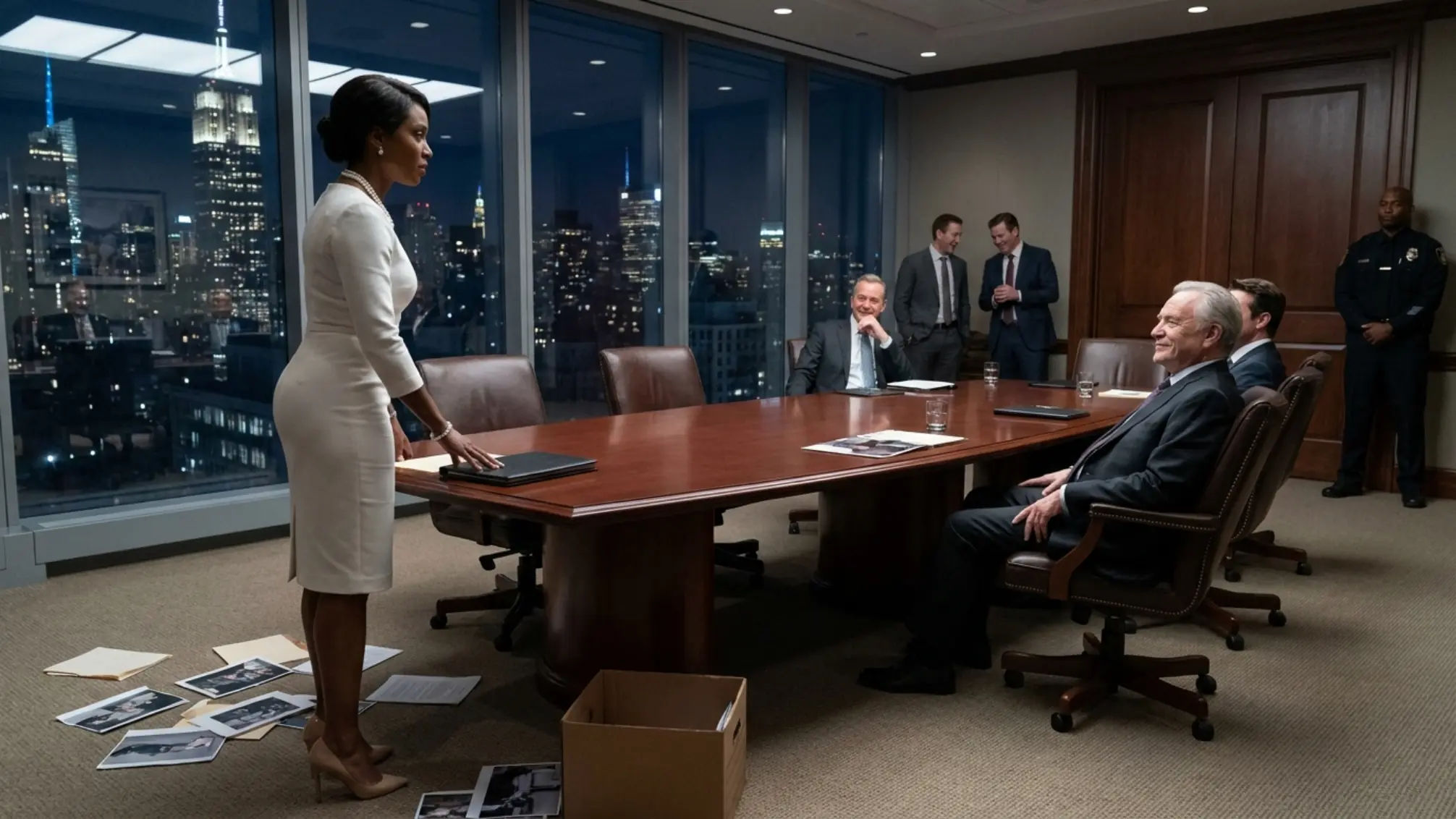
Reports, photographs, and personal notes burst across the polished hardwood beneath the long mahogany table. A framed picture spun twice before landing face-down beneath a leather chair. Several directors watched the pieces of Victoria Hail’s twenty-year career scatter around her shoes as if they were witnessing garbage being emptied.
Then Arthur Crane smiled.
“Pick that up,” he ordered.
At seventy, Arthur occupied the chairman’s seat like a king presiding over an execution. His silver hair was perfectly combed, his black suit was tailored within an inch of perfection, and one polished shoe remained extended from where he had kicked the box.
“That’s all you’re worth now.”
A few board members laughed.
The sound was low and cowardly, but it was enough. They wanted Arthur to know they stood with him. They wanted Victoria to understand that the vote had not merely removed her title; it had stripped away the respect they had pretended to give her.
Victoria did not bend down.
She stood beside the table in an elegant white dress, her dark hair pulled into a sleek low bun. Her face remained calm, but her stillness carried more pressure than shouting ever could. In one hand, she held a slim black folder that had never touched the floor.
The board had voted eleven to two to remove her as chief executive of Hail Meridian Group.
The official reason was a loss of confidence in her leadership.
The unofficial reason had been repeated in private messages for months.
She was too controlling.
Too difficult.
Too visible.
Too unwilling to approve deals that benefited directors and their friends.
Arthur leaned back in his chair and looked around the room. “Finally,” he said.
Director Wallace Kemp raised his glass of water. “Should’ve happened years ago.”
Another man adjusted his tie. “The company needs a different image.”
A younger director smirked. “Someone less divisive.”
Victoria looked at him.
He immediately glanced down at his papers.
At the corner of the room, a young executive assistant named Emily Park clutched her tablet with both hands. She had worked for Victoria for eighteen months and had never seen her lose control, not during market collapses, shareholder revolts, or emergency negotiations.
The security officer near the door appeared equally unsettled.
He had escorted angry employees from buildings before. He knew how people looked when they were defeated.
Victoria did not look defeated.
Arthur gestured toward the scattered papers. “You can take your little memories with you.”
Victoria slowly lifted the dented box and placed it on the table.
She did not pick up the reports.
She did not rescue the photograph beneath Arthur’s chair.
Instead, she set the black folder beside the box and folded her hands.
The silence began changing the room.
Arthur noticed first.
“What’s wrong?” he asked. “Not going to give us one of your speeches?”
Victoria said nothing.
Wallace chuckled. “Maybe she finally understands that nobody wants to hear her.”
“She never looked right for the position anyway,” another director said.
“Image matters,” Wallace replied.
Arthur nodded. “Exactly.”
Victoria raised her eyes.
She studied each person seated at the table, one face at a time. She did not hurry. Every director felt as though she were fixing their name, their vote, and their final insult into permanent memory.
Arthur cleared his throat.
“Security will escort Ms. Hail from the building.”
The officer took one cautious step forward.
Victoria rested two fingers on the black folder.
Arthur’s attention shifted toward it.
“What’s that?”
“Nothing you need to worry about,” Victoria said.
His smile tightened. “Still trying to sound important?”
Wallace tapped his pen against the table. “She still thinks she matters.”
“Old habits,” another man muttered.
Victoria heard every word.
She had learned long ago that arrogant people revealed the most when they believed consequences had left the room.
Twenty years earlier, she had entered her first acquisition meeting carrying a portfolio and been mistaken for an assistant. The chairman asked whose coffee she was delivering. Ten minutes later, she took the head seat and informed him that her company had purchased his debt.
Different decade.
Different table.
Same blindness.
Arthur leaned back. “We have already begun discussing your replacement.”
“I assumed you would.”
“We require stability.”
“Of course.”
“We require the proper image.”
Victoria smiled.
It was a small, cold smile that made Arthur’s expression change.
“What’s funny?” he demanded.
Victoria tapped the folder once.
The sound was soft, yet every conversation stopped.
Even Emily lowered her tablet.
Arthur leaned forward. “What exactly is in that folder?”
Victoria allowed the question to hang above the table.
The security officer stopped moving.
Wallace’s pen became still.
Arthur’s fingers tightened around the arm of his chair.
“Before you escort me out,” Victoria said, “there is something every person in this room should know.”
Nobody spoke.
She opened the folder just far enough for the title page to become visible.
Arthur saw it first.
The color left his face.
His pen slipped from his hand and rolled across the table.
Victoria looked directly at him.
“You didn’t vote me out, Arthur,” she said. “You just triggered the clause that gives me control of the company.”
For several seconds, the directors appeared unable to understand the sentence.
Then Wallace laughed.
It was too loud and too sudden.
“That is absurd.”
Victoria turned the first page. “Is it?”
Arthur reached for the document, but Victoria closed the folder before his fingers touched it.
“Don’t,” she warned.
Something in her voice stopped him.
Chairman Arthur Crane had spent decades ignoring warnings, but this one froze him in his seat.
“What clause?” asked Director Malcolm Pierce.
Victoria looked around the room. “Section Nine of the Founder Continuity and Fiduciary Protection Agreement.”
Wallace shook his head. “That agreement expired years ago.”
“No,” Victoria said. “The employment provisions expired. The voting provisions remain active until the founder trust is dissolved.”
Arthur’s jaw tightened. “There is no founder trust.”
Victoria opened the folder again.
This time she removed a certified copy of the agreement, followed by a sealed letter from the company’s outside counsel.
“There is,” she said. “You signed an acknowledgment of it when you became chairman.”
Arthur stared at the signature page.
His own name appeared near the bottom.
The date was twelve years old.
He glanced toward the company’s general counsel, Leonard Price, who sat near the far end of the table. Leonard had voted to retain Victoria. Since the decision, he had remained silent.
Now he removed his glasses.
“I warned the board,” Leonard said.
Arthur turned sharply. “You said the agreement was unlikely to apply.”
“I said it would apply if you removed her without cause while a fiduciary investigation was active.”
Wallace looked between them. “What investigation?”
Victoria removed another document.
A red label marked it confidential.
“The independent audit into undisclosed related-party transactions,” she said.
The room became still.
Arthur’s face hardened. “That audit was suspended.”
“No. You attempted to suspend it.”
“I am chairman.”
“You were chairman.”
The words landed harder than the box had.
Arthur stood abruptly. “This meeting is over.”
“No,” Leonard said. “It isn’t.”
Arthur turned toward him.
Leonard placed both hands on the table. “The removal vote triggered the agreement exactly as Ms. Hail described. Until the provisions are reviewed, nobody leaves with company records, and no board action can proceed without authorization from the controlling voting proxy.”
Wallace looked at Victoria. “Who holds the proxy?”
She did not answer immediately.
She removed one final certificate and placed it in the center of the table.
Her name appeared beneath the title:
Temporary Controlling Voting Trustee.
Emily inhaled sharply.
The security officer stepped away from the door and returned to his original position.
Arthur stared at the certificate as though it were written in another language.
“That cannot be legal.”
“It was legal when you signed it,” Victoria replied.
“You manipulated the documents.”
“The documents were drafted before I became CEO.”
Arthur’s eyes moved toward Leonard. “Who created this?”
“Eleanor Hail,” Leonard said.
At the mention of Victoria’s mother, several older directors lowered their eyes.
Eleanor Hail had founded the company thirty-eight years earlier with one warehouse, four employees, and a distribution contract no established competitor wanted. She had built Hail Meridian into a national logistics and manufacturing group before dying from cancer.
She distrusted boards that valued short-term profit over the company’s survival.
Before her death, Eleanor created a voting trust holding the family’s super-voting shares. Under ordinary circumstances, the trust remained inactive. But if a chief executive from the founder’s line was removed without documented cause during an unresolved investigation into board misconduct, the shares automatically transferred voting authority to the removed executive for ninety days.
Those ninety days existed for one purpose.
To protect the company from a board attempting to bury evidence.
Arthur had signed the acknowledgment years earlier because he believed the clause would never be triggered.
He had also believed no one would remember it.
Victoria remembered everything.
Wallace stood. “Even if this is real, ninety days changes nothing.”
Victoria looked at him. “Ninety days is enough to remove directors.”
His face stiffened.
“It is enough to freeze executive compensation,” she continued. “Enough to suspend pending contracts. Enough to appoint independent investigators and refer evidence to regulators.”
Arthur’s voice dropped. “You have no evidence.”
Victoria turned to another section in the folder.
“Three consulting agreements awarded to companies controlled by your brother-in-law.”
Arthur’s mouth opened.
“Two property purchases routed through a shell company connected to Wallace.”
Wallace stopped smiling.
“Executive recruitment fees paid to Malcolm’s private investment partnership.”
Malcolm looked toward the door.
“And confidential acquisition information shared with a hedge fund forty-eight hours before a public announcement.”
No one moved.
Arthur slowly sat back down.
Victoria continued. “The audit was not examining poor judgment. It was examining coordinated self-dealing.”
Wallace pointed at her. “This is retaliation.”
“No,” she said. “Retaliation was removing the chief executive supervising the investigation.”
“You were removed for performance failures.”
“Name one.”
“The share price declined.”
“So did the entire sector.”
“You lost two contracts.”
“I rejected two contracts because they required illegal labor practices.”
“You delayed the Atlas acquisition.”
“Because Atlas hid eighty million dollars in liabilities.”
Arthur struck the table with his palm. “Enough.”
Victoria did not flinch.
“You wanted me gone because I would not sign the transaction waivers,” she said. “You believed replacing me would end the audit and release the deals.”
Arthur’s face grew red.
“You think you can walk in here with an old agreement and take this company hostage?”
Victoria looked around at the directors who had laughed while her belongings lay on the floor.
“I did not walk in with it,” she said. “I carried it through the entire meeting.”
The truth settled over them.
She had known.
Before the vote.
Before the insults.
Before Arthur kicked the box.
Victoria had allowed every director to speak freely because their words had become evidence of intent.
Wallace stared at Emily. “Were you recording this?”
Emily’s hands tightened around her tablet.
Victoria answered for her. “Every board meeting is recorded under the governance policy you approved last year.”
Wallace sat down.
Arthur looked toward the security officer. “Remove her.”
The officer did not move.
“I gave you an order.”
The man looked at Victoria, then at Leonard.
Leonard spoke calmly. “Under the triggered continuity agreement, Ms. Hail currently exercises controlling shareholder authority. Removing her without legal review could constitute interference with protected governance activity.”
Arthur’s voice became dangerous. “Do your job.”
The officer straightened. “My job is to protect company personnel and property, sir. I will not touch her.”
For the first time, Arthur appeared small.
Victoria opened the black folder completely and removed a prepared resolution.
“As controlling trustee, I am calling an emergency shareholder action.”
“You cannot hold a shareholder meeting without notice,” Malcolm said.
“This is written consent by the holder of seventy-two percent of voting power.”
She signed the first page.
Leonard signed as witness.
Arthur watched the pen move across the paper.
Victoria placed the signed resolution in front of him.
“Effective immediately, Arthur Crane is removed as chairman pending investigation.”
A director near the window stood so quickly that his chair rolled backward.
“Victoria, perhaps we should slow down.”
She looked at him. “You voted to remove me twelve minutes ago.”
“We did not understand the circumstances.”
“You did not ask.”
“Arthur told us the audit was routine.”
“You received the audit notice.”
“I may have overlooked it.”
“You voted without reading it.”
The director lowered himself back into his chair.
Victoria signed a second resolution.
“Wallace Kemp is suspended from all board committees.”
Wallace rose. “You cannot do this to me.”
“You did it to yourself.”
A third resolution froze compensation, severance packages, stock grants, and expense reimbursements for every director named in the investigation.
Malcolm’s voice shook. “My annual grant vests tomorrow.”
“Not anymore.”
“This is theft.”
Victoria finally allowed anger to enter her eyes.
“Theft is paying your own partnership with shareholder money and hiding it under recruitment expenses.”
Malcolm fell silent.
Arthur stared at the folder.
“How long have you been preparing this?”
“Since you ordered the general counsel to destroy the preliminary audit report.”
“I never ordered that.”
Leonard opened his laptop.
An email appeared on the boardroom screen.
It came from Arthur’s private account.
The message instructed Leonard to eliminate all draft reports and classify the matter as closed before the upcoming leadership vote.
Arthur’s signature appeared beneath it.
Several directors moved away from him as though distance could erase their votes.
“You forged that,” Arthur said.
Leonard’s expression hardened. “It was sent to me.”
Arthur looked at Wallace. “Say something.”
Wallace stared at the table.
Arthur turned toward Malcolm.
Malcolm would not meet his eyes.
The coalition that had appeared unbreakable twenty minutes earlier began collapsing in silence.
Victoria walked around the table.
Her heels passed over the scattered reports without touching them. She stopped beside Arthur’s chair and looked down at the photograph lying beneath it.
“Move your foot,” she said.
Arthur remained still.
Victoria held his gaze.
“Move it.”
He slowly pulled his polished shoe back.
Victoria bent for the first time that evening and retrieved the photograph.
The glass had cracked.
Inside the frame, Eleanor Hail stood beside a much younger Victoria on the day the company opened its first international facility. They were smiling in hard hats while workers gathered behind them.
Victoria wiped dust from the broken glass.
Arthur looked at the photograph.
“Your mother trusted me.”
“My mother prepared for men like you.”
His face twisted. “I helped build this company.”
“And then you decided that helping build it entitled you to loot it.”
“I made you.”
Victoria’s eyes became cold.
“You mistook sitting near my success for creating it.”
Nobody laughed now.
She returned to the head of the table.
Arthur remained seated in the chairman’s chair, but the room no longer recognized him as chairman.
Victoria looked toward the security officer.
“Please escort Mr. Crane from the building.”
Arthur stared at her.
“You would humiliate me like this?”
Victoria glanced at the cardboard box and the papers covering the floor.
“No,” she said. “I will allow you to leave with your belongings intact.”
The security officer approached.
Arthur stood slowly.
“This is not finished.”
“You are right.”
He paused.
“The investigation begins at eight tomorrow morning,” Victoria continued. “Your company devices will be collected tonight, your accounts will be preserved, and the board will receive formal legal notices before midnight.”
Arthur’s hands trembled.
“You think you have won?”
Victoria closed the black folder.
“No. I think the company finally stopped losing.”
The officer escorted him toward the door.
Arthur turned once, expecting someone to rise in his defense.
Nobody did.
The glass door closed behind him.
Wallace immediately leaned forward. “Victoria, I was pressured.”
She looked at him.
“Arthur controlled the agenda. He told us your removal had already been approved by the major shareholders.”
“You never contacted them.”
“He said there was no time.”
“There was time to laugh.”
Wallace’s face fell.
“I made a mistake.”
“You made eleven of them,” she said. “One for every vote you influenced.”
Malcolm stood. “I am willing to cooperate fully.”
“You will cooperate because the alternative is worse.”
“What happens now?”
Victoria looked around the room.
“Now every director submits all communications involving Arthur, Wallace, Atlas, the consulting firms, and the hedge fund. No messages are deleted. No devices leave this floor until forensic copies are made.”
One director raised a shaking hand. “And those of us who were not involved?”
“You will have the opportunity to prove it.”
The executive assistant finally spoke.
“Ms. Hail?”
Victoria turned toward Emily.
“Should I cancel tomorrow’s leadership announcement?”
“No.”
Emily looked confused.
“Change it,” Victoria said.
“To what?”
Victoria placed the cracked photograph inside the cardboard box.
“Announce that the board attempted an improper removal during an active fiduciary investigation. State that the founder continuity provisions were triggered and that an independent review is underway.”
Emily nodded quickly.
“And Ms. Hail?”
“Yes?”
“Who should we list as CEO?”
Victoria looked toward Leonard.
The general counsel gave a small nod.
She turned back to Emily.
“List me as interim executive chair.”
Several directors shifted uneasily.
Victoria continued, “The company will appoint a new chief executive after the investigation. No one person should hold power permanently simply because they survived an attack.”
That answer unsettled them more than vengeance would have.
She did not intend to become Arthur.
She intended to repair what he had corrupted.
By midnight, access to seven executive accounts had been suspended. Three pending transactions were frozen. Outside investigators received copies of the audit files Leonard had preserved despite Arthur’s instructions.
Before sunrise, the company’s largest institutional shareholders had been briefed.
Two demanded Arthur’s immediate permanent removal.
A third requested a criminal referral if the self-dealing evidence proved accurate.
At eight the next morning, Victoria entered the same boardroom wearing a charcoal suit.
The papers were gone.
The floor had been cleaned.
Arthur’s chair stood empty.
Wallace and Malcolm sat at the far end beneath the supervision of outside counsel. Neither man spoke when Victoria entered.
She placed the black folder at the head of the table.
No one laughed.
The investigation lasted six weeks.
It uncovered more than forty million dollars in hidden conflicts, inflated consulting contracts, property transactions, and unauthorized disclosures. Arthur had used his position to reward allies, enrich relatives, and pressure directors into approving deals they had not properly reviewed.
Wallace resigned before the final report.
Malcolm returned his stock grant and entered a settlement requiring repayment of improperly directed fees.
Three other directors were removed.
Arthur denied wrongdoing until investigators produced bank records, internal messages, and recordings showing exactly how the removal vote had been planned to stop Victoria’s audit.
He lost his chairmanship, pension privileges, office, and legal protection from the company.
Prosecutors later opened their own inquiry.
Victoria never celebrated publicly.
She appointed two independent directors, strengthened conflict-disclosure rules, and gave the internal audit team authority to report directly to shareholders. She also ordered that no employee’s belongings could ever again be thrown into a box during termination.
Six months later, Emily entered Victoria’s office carrying the repaired photograph.
The cracked glass had been replaced, though a faint line remained across one corner of the frame.
“I thought you might want this back,” Emily said.
Victoria accepted it.
“Thank you.”
Emily looked toward the black folder resting on a shelf.
“Did you know they would vote against you?”
“Yes.”
“And you let them?”
“I needed the vote to trigger the agreement.”
“You could have warned them.”
Victoria studied the photograph of her mother.
“They were warned by the documents they signed, the audit notices they received, and the questions they chose not to ask.”
Emily nodded.
“Arthur said you planned the whole thing.”
“No,” Victoria replied. “Arthur planned it. I simply allowed him to finish.”
That afternoon, Victoria attended the first meeting of the reconstructed board.
The new directors stood when she entered—not because she demanded it, but because respect had returned to the room.
She placed no cardboard box on the table.
There were no security officers at the door.
Only a black folder rested beside her chair.
Everyone noticed it.
Nobody dared ask what was inside.
Victoria looked around the table and opened the meeting.
“Let us begin,” she said.
Months earlier, Arthur Crane had kicked her career across the floor and told her that the scattered pieces represented all she was worth.
He believed the room belonged to the loudest man in it.
He believed laughter made his victory permanent.
He believed a calm Black woman holding a folder was already defeated.
But Victoria had learned something Arthur never understood.
Power did not always announce itself.
Sometimes it stood silently amid humiliation, listened while arrogant people exposed themselves, and waited for them to trigger the consequence with their own hands.
The board had thrown her out like she was nothing.
The black folder proved she was the only person in the room who had understood what their vote truly meant.