The truck’s diesel engine growled behind Linnea Gustafson as another wooden pallet scraped across the metal loading ramp. Hundreds of chipped Mason jars rattled inside the crates, filling the cold Iowa morning with the sharp sound of glass striking glass. Linnea stood between the truck and her family’s weathered red barn, holding a jar of amber apple butter against her leather apron while the plant manager thrust a liability waiver toward her. Forty-three pallets of rejected glass surrounded them, but the heavyset man facing her looked at the delivery as though he were dumping stones into a grave.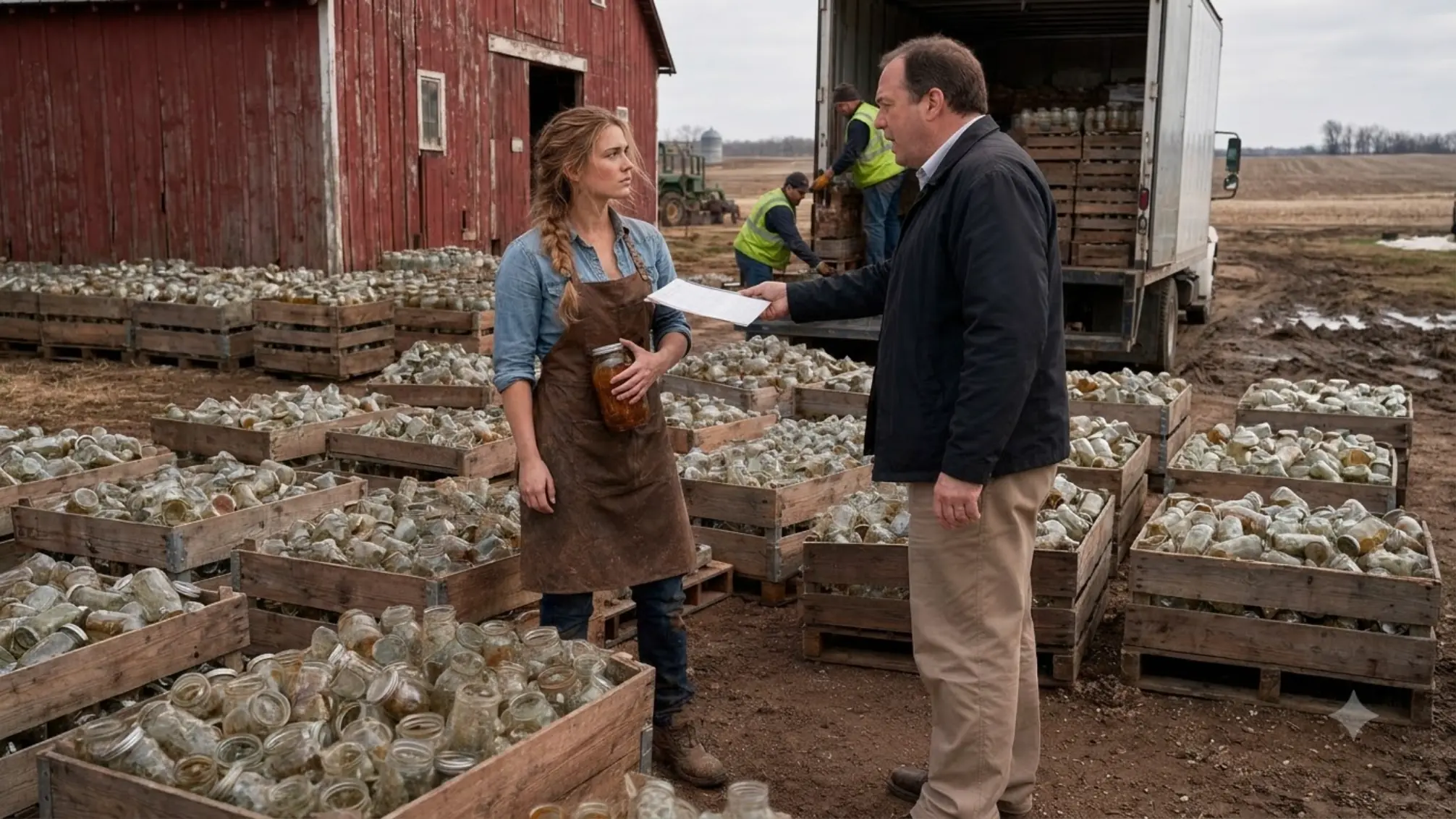
Doug Prescott lowered the paperwork and stared at the beautiful twenty-four-year-old farm woman as if she had failed to understand her position. His polished brown shoes were already coated with dust, and irritation darkened his narrow gray eyes. He managed Hartwell Glass outside Marshalltown, where strict commercial standards required the plant to reject any jar with a small rim chip, an air bubble, or a cosmetic flaw. For years, the company had paid to haul those imperfect jars to a landfill, but Doug had found a cheaper destination.
Linnea’s barn was half empty after her father sold the family’s hog operation. She had responded to Doug’s quiet offer before knowing precisely what she would do with twelve thousand unwanted jars. Eleven other farms had refused because of liability concerns, storage limitations, or the simple belief that damaged glass belonged in the ground. Linnea had looked at the free delivery, calculated the potential value, and said yes.
Now Doug seemed offended that she might do more than store it.
“You signed an agreement to accept industrial waste,” he said.
“I signed an agreement accepting rejected containers.”
“The difference won’t matter when somebody gets injured.”
“The jars will be inspected before use.”
Doug glanced at the amber jar in her hands. “You already filled one?”
“Test batch.”
“With food?”
“Apple butter.”
He laughed loudly enough for the two delivery workers to hear. Both men paused beside the loading ramp, exchanging amused looks as though the farm woman had announced plans to build an airplane from broken fence posts. Linnea did not react. She had spent four years learning that some people laughed whenever a woman spoke confidently about a plan they could not imagine.
Doug tapped the liability waiver against his palm. “Let me make this simple. Hartwell is giving you garbage because landfill fees cost us money. You are not authorized to resell our defective products, advertise our name, or embarrass the plant by pretending these rejects have commercial value.”
“They have whatever value I create.”
“You’re standing in mud beside a collapsing barn.”
“And you drove forty miles because your company needed me.”
His face tightened.
Linnea placed the apple butter jar on top of a crate. The sunlight passing through the glass turned its contents deep gold, making the supposedly worthless container look like something displayed in a country store. Doug followed her gaze and seemed to understand for the first time that she was not merely offering storage. She intended to build a product.
He stepped closer. “Sell food in those jars, and I’ll have our attorneys shut you down.”
“Then they can bring copies of the safety regulations.”
“You think a college degree makes you untouchable?”
“No. It makes me capable of reading the standards you hoped I would never check.”
Doug took the waiver from her hand and walked back toward the truck.
“Enjoy your hobby,” he said. “When the barn is full and nobody buys what you make, don’t call us to remove it.”
Linnea looked around at the towering pallets.
“I won’t.”
The truck disappeared down the gravel road twenty minutes later, leaving the young woman alone with more glass than anyone in Tama County believed she could possibly use. Cold wind moved loose strands of honey-blonde hair across her face while she counted crates, sizes, and potential production batches. Some jars would be unsuitable for sealing, but many carried flaws so minor that only an industrial sensor could detect them. Hartwell saw disposal costs. Linnea saw inventory.
She had returned to the farm after graduating from Iowa State with a degree in food science. Her father, Arvid, respected education but could not understand why his daughter wanted to transform produce instead of planting more corn. The Gustafson family had survived for decades by raising soybeans, grain, and livestock, selling whatever they produced at prices controlled by distant markets. Their margins had narrowed every year, yet Arvid trusted familiar hardship more than unfamiliar opportunity.
Linnea’s mother, Sigrid, understood her more easily.
When Linnea carried the first jar into the farmhouse kitchen, Sigrid spread a spoonful of apple butter across warm toast and tasted it without speaking. She finished the slice, prepared another, and placed the jar beside the stove. Her silence contained more approval than most people’s praise.
Arvid entered later with mud on his boots and looked at the empty glass stacked beyond the kitchen window.
“You accepted all of it?”
“Every pallet.”
“Some of those crates are six feet tall.”
“They were free.”
“So are rocks. We don’t fill the barn with them.”
Linnea slid the apple butter toward him.
Arvid ate one spoonful, then another.
“It tastes like my mother’s.”
“That orchard was hers.”
He studied the jar. “What are you planning?”
“To sell it.”
“At the county market?”
“To start.”
Arvid placed the spoon down. “People buy preserves from grocery stores.”
“People buy stories, Dad.”
“They eat food.”
“They do both.”
He looked unconvinced but did not tell her to remove the glass. On the Gustafson farm, that qualified as permission.
Linnea spent the next two months testing recipes and inspecting jars. She rejected anything with a crack, a dangerous rim defect, or structural weakness. Safe jars were washed, sterilized, and sorted by size. She studied cottage-food rules, prepared ingredient labels, filed the necessary permits, and recorded every cost in a notebook.
Her grandmother’s orchard contained twelve aging trees that produced more apples than the family could consume. For years, fallen fruit had rotted beneath the branches. Linnea gathered the usable harvest, refined an old family recipe, and developed an apple butter with cinnamon, clove, and enough acidity for safe preservation.
Her first farmers-market table held forty-eight half-pint jars.
She priced them at six dollars each.
The handwritten sign read:
GUSTAFSON FARM PANTRY
TAMA COUNTY APPLE BUTTER
MADE FROM OUR FAMILY ORCHARD
People stopped because the amber jars caught the morning light. They listened when Linnea explained that the apples came from trees planted by her grandmother and that each batch was prepared inside the farmhouse kitchen. Several customers asked about the tiny cosmetic flaws in the glass, and Linnea told them the truth.
“These jars were rejected by a bottling plant,” she said. “They were headed for a landfill, but they are inspected individually and given another purpose here.”
The story made the product more valuable, not less.
She sold every jar before noon.
The next week, she brought ninety-six.
Those sold too.
By midsummer, Linnea had added strawberry jam, dill pickles, tomato preserves, and peach butter. Customers began returning with empty jars because they liked the idea of reuse. Some drove from neighboring counties after hearing about the young farm woman selling food in rescued glass.
The barn stopped looking like a dumping ground.
It became a workshop.
Linnea bought secondhand stainless-steel tables, commercial burners, storage racks, and an old label printer. She painted one wall white, repaired the roof, and converted a former livestock room into a clean processing area. Her mother helped during large batches, while Arvid quietly repaired a leaking water line without admitting that he supported the project.
Doug called in October.
“We have another rejection run,” he said. “Sixty-one pallets.”
“I’ll take them.”
There was a pause.
“You used the first delivery?”
“Most of it.”
“That’s impossible.”
“Send the truck Thursday.”
“What are you doing with twelve thousand jars?”
“Creating demand for the next twelve thousand.”
Doug’s voice hardened. “You’re selling them.”
“I’m selling what I put inside them.”
“Our agreement was never meant to supply a commercial operation.”
“Your agreement transferred ownership after delivery.”
“You think that technicality protects you?”
“I think the signature protects me.”
Doug hung up.
The Thursday truck arrived anyway because Hartwell still needed somewhere to send the rejects. Linnea watched sixty-one additional pallets enter the barn while calculating future production. She had standing orders from three specialty stores, a waiting list at the farmers market, and inquiries from restaurants interested in local preserves.
Free jars had reduced one of her largest packaging costs to nearly zero.
Doug’s waste had become her advantage.
That winter, Linnea wrote letters to eleven specialty grocery stores and food cooperatives across Iowa. Each envelope included her farm’s history, production standards, wholesale prices, and the story behind the reclaimed jars. She mailed a sample of apple butter with every proposal.
Eight stores declined or failed to respond.
A small food cooperative in Iowa City accepted six jars of each flavor on consignment. The entire shipment sold in nine days. The manager ordered twenty-four jars of every variety, then requested monthly deliveries.
Linnea drove home through freezing wind with the truck windows open because she could not stop smiling.
She showed Arvid the purchase order at the kitchen table.
He read it twice.
“How many stores can you supply?”
“Four comfortably. Seven if we expand the orchard and contract with neighboring farms.”
“You want to stop planting corn?”
“Only on the south forty.”
“That ground has produced corn since before you were born.”
“It also loses money every bad year.”
Arvid’s expression became rigid. “Corn built this farm.”
“And something else may save it.”
The sentence wounded him because it suggested tradition was no longer enough. Linnea saw the anger in his face but refused to retreat. She opened her notebook and showed him sales figures, raw-material estimates, projected wholesale growth, and the cost of converting acreage into fruit production.
Arvid read everything.
Sigrid washed dishes at the counter, listening.
Finally, he said, “You’re asking me to give up dependable income for trees that won’t produce properly for years.”
“I’m asking you to trade shrinking margins for ownership of the final product.”
“We already own the corn.”
“We don’t own the price.”
Silence filled the kitchen.
Sigrid turned from the sink. “She’s right.”
Arvid looked at his wife, then at his daughter.
“You get ten acres,” he said. “Not forty.”
Linnea smiled. “I can prove it with ten.”
During the following two years, Gustafson Farm Pantry grew without fanfare. Linnea woke before sunrise, processed food until late evening, delivered orders personally, and reinvested nearly every dollar. She hired two local women for seasonal work and purchased fruit from neighboring farms whose harvests would otherwise have been sold at thin wholesale prices.
Her products spread through stores in Cedar Rapids, Des Moines, and Iowa City.
The company developed a reputation for unusual flavors: heirloom tomato jam, honey-pear butter, smoked peach preserves, and hot dill pickles. Every label named the county, the farm, and often the specific grower who supplied the ingredients.
Customers were not merely buying food.
They were buying proof that the person who grew it still mattered.
Doug visited the farm again after hearing that Linnea’s products had entered six retail stores. He arrived in a clean company truck and walked into the barn without waiting for an invitation.
The place shocked him.
Stainless-steel equipment filled the former livestock area. Workers packed labeled jars into cardboard cases while invoices hung from organized clipboards. The pallets he had once called garbage stood sorted neatly along the far wall.
Linnea approached wearing her work apron.
“You should have called.”
Doug stared at the operation. “You built all this from our jars?”
“I built it from food. Your jars helped.”
“You’re using Hartwell rejects as part of your marketing.”
“I’m describing where the packaging came from.”
“You make the plant look wasteful.”
“The plant was sending usable glass to a landfill.”
“That was our decision.”
“Now it’s mine.”
Doug’s face reddened. “Our attorneys can terminate the supply arrangement.”
“Then terminate it.”
He had expected fear.
Instead, Linnea opened a cabinet and showed him purchase agreements from two alternative glass suppliers. Her business could now afford new packaging if necessary, although the cost would reduce margins.
Doug looked at the contracts.
“You replaced us?”
“I prepared for you.”
“You owe this company.”
“I removed your disposal problem for three years. We helped each other.”
He stepped closer. “Without Hartwell, you would still be selling corn beside your father.”
“Without me, your rejects would still be costing you landfill fees.”
Doug stared at her for a long moment.
Then he left.
Hartwell did not cancel the arrangement.
The plant’s finance department had calculated how much Linnea saved them each year, and the number mattered more than Doug’s pride.
In the summer of 2012, drought struck Tama County. Corn leaves curled beneath relentless heat, ponds dropped, and families watched entire fields weaken before harvest. Arvid’s grain yield fell by nearly a third. Neighbors who had borrowed heavily for seed and fertilizer began discussing equipment sales and refinancing.
The Gustafson orchard survived because Linnea had installed drip irrigation from the farm pond.
Demand for her products continued.
While grain income collapsed, pantry revenue increased. The processing operation bought damaged or undersized fruit from local farmers, giving several families money for crops that conventional distributors refused.
At the end of the year, Arvid sat with the farm’s financial statements.
The pantry operation had earned more net income than the grain acreage.
He removed his glasses and looked at Linnea.
“How many acres do you need?”
“The south forty.”
“You said ten would prove it.”
“It did.”
He nodded slowly. “Plant the forty.”
Linnea wanted to celebrate, but she understood what the decision cost him. Corn was not simply a crop to Arvid. It was continuity, identity, and the method by which his father had taught him to survive.
“Thank you,” she said.
“Don’t thank me yet. Make the numbers work.”
“I will.”
The breakthrough came the following year when a regional food writer received a jar of Gustafson apple butter from a friend. She called Linnea, toured the farm, and published a feature about the young woman turning rejected glass and surplus harvests into a growing company.
The article appeared online on a Thursday.
By Friday afternoon, thousands of people had visited the company’s modest website.
By Monday, Linnea had more than two thousand orders.
For several minutes, she sat alone in the barn staring at the screen. The number was larger than her inventory, larger than her staff could reasonably process, and large enough to destroy the company if handled badly.
Then she opened her notebook.
She called every supplier, hired temporary workers, extended production shifts, and organized orders by promised delivery date. Sigrid prepared food for the crew. Arvid handled incoming produce and deliveries. Linnea worked eighteen-hour days for six weeks.
Hartwell sent an emergency shipment of rejected jars.
Doug arrived with the final truck.
This time, he did not shove paperwork at her.
He watched employees loading finished products into delivery vans while phones rang continuously inside the office. The barn he had threatened to seize now supported full-time jobs and purchased crops from farms across the county.
“You filled all those orders?” he asked.
“We’re finishing the last four hundred.”
Doug looked at a shipping label. “California?”
“We ship nationwide now.”
He rubbed his jaw. “Hartwell’s board saw the article.”
“I assumed they would.”
“They’re concerned about our name being connected to defective glass.”
“Then stop calling it defective.”
“It failed quality control.”
“For automated commercial sealing. Not for every possible use.”
“You understand how difficult you’ve made this for me?”
Linnea looked across the barn.
Workers carried boxes past them. Machines hummed. Sunlight shone through thousands of jars stacked along the wall.
“No,” she said. “I understand how valuable I made your waste.”
Doug remained silent.
Linnea took an apple-butter jar from a packing table and held it out.
“Try it.”
He accepted reluctantly.
After one spoonful, his expression changed.
“My grandmother made something like this.”
“A lot of grandmothers did.”
He ate another spoonful.
“What do you want from Hartwell?”
“A written long-term supply agreement.”
Doug laughed. “You think we’ll contractually guarantee free glass?”
“Yes.”
“Why would we?”
“Because your board doesn’t want headlines saying Hartwell ended a recycling partnership after the story went national.”
His smile disappeared.
Linnea continued. “You save disposal fees. I receive packaging. We publish the amount of glass diverted from landfills each year. Everybody wins.”
“You planned this.”
“I prepared for the conversation you promised me ten years ago.”
“It has been four.”
“It felt longer.”
Doug looked toward the pallets.
“What terms?”
Linnea handed him a folder.
She had already written the proposed agreement.
Three days later, Hartwell signed it.
The contract guaranteed Gustafson Farm Pantry first access to safe, cosmetically imperfect jars for ten years. Hartwell gained public recognition for reducing landfill waste, while Linnea secured the packaging supply needed to expand.
The plant manager who once threatened to bury her farm had returned asking how quickly she could make the partnership official.
By 2018, Gustafson Farm Pantry sold more than fifty products through stores across several states. Its annual revenue exceeded four hundred thousand dollars, and the operation employed nine full-time workers. Nineteen farms eventually supplied fruit, vegetables, herbs, honey, and other ingredients.
The south forty became an orchard.
Arvid walked the rows each morning with the same care he once gave his corn machinery. He rarely praised the business aloud, but visitors often found him explaining which apple varieties produced the best butter.
Doug remained at Hartwell for several more years. His relationship with Linnea never became warm, but it became respectful. When new executives questioned the free-jar arrangement, he defended it using the same argument she had once given him.
“They are not worthless,” he said. “We simply did not know their best use.”
Linnea kept the first liability waiver framed in her office.
Beside it stood the first jar of apple butter, still sealed beneath a handwritten label. The glass contained a small cosmetic bubble near its base, the flaw that had caused Hartwell to reject it.
Visitors often asked why she displayed something imperfect at the center of a successful company.
Linnea always gave the same answer.
“Because everybody who looked at that jar saw a defect. I saw empty space waiting to be filled.”
Years later, young farmers began visiting the operation for advice. Some arrived with inherited land, shrinking margins, and families urging them not to risk new ideas. Others had products nobody believed could become businesses.
Linnea never promised success.
She showed them her ledgers, production costs, mistakes, rejected recipes, and the years of labor hidden behind the photographs. Then she led them into the original barn, where rescued jars still stood stacked near the red wall.
“People will tell you what your idea is worth before you have evidence,” she said. “Write down exactly what they say.”
One woman asked why.
Linnea smiled.
“Because someday they may return asking for a contract.”
The Gustafson farm had not been rescued by a miracle, a wealthy investor, or a perfect business plan. It survived because a young woman understood that value did not end at the field’s edge. She transformed unwanted fruit into preserved food, dismissed knowledge into strategy, and industrial waste into packaging that carried her family’s name across the country.
Doug had predicted the rejected jars would bury her little farm.
Instead, they lined the shelves of the business that saved it.
The glass had always been useful.
The orchard had always been productive.
Linnea had always been capable.
The only thing missing was someone willing to look at what everyone else had discarded and say, with absolute certainty:
“I can work with this.”