“Sign it. Those rotten seeds are garbage, and a pretty girl with a shovel won’t turn them into a farm.”
Victor Hale dropped the disposal agreement onto the hood of Mary Ann Tovey’s pickup while the third cannery truck reversed toward the abandoned equipment shed. Behind him, workers pulled back a black tarp, releasing another wet avalanche of tomato pulp, skins, and seeds onto the edge of her property. The sour-smelling mixture spread through the dirt like something already beginning to rot. Victor watched it with the confidence of a man certain he was delivering failure.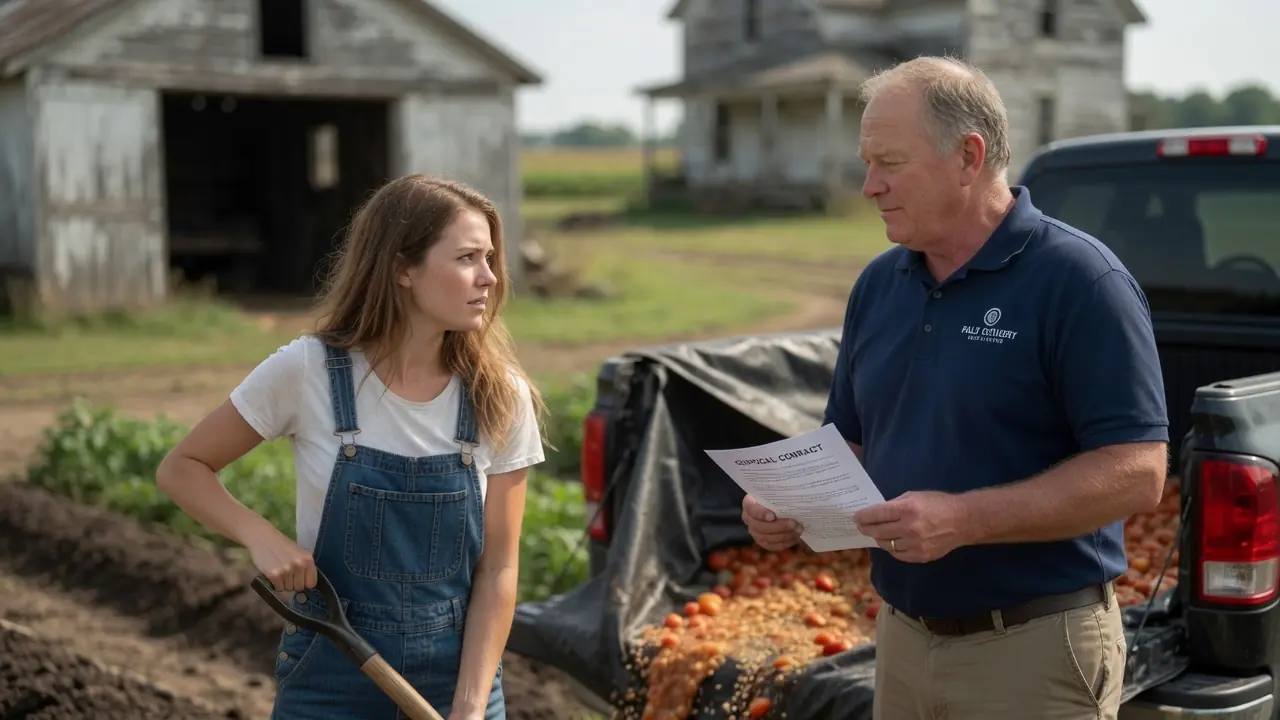
Mary Ann rested both hands on the wooden handle of her shovel. At twenty-seven, she had fair skin darkened by months outdoors, focused hazel eyes, and long light-brown hair falling loosely around the straps of her fitted denim overalls. Her tall rubber boots were already coated with mud from preparing the growing beds behind the shed. She looked too calm for someone being handed several tons of industrial waste.
“Then you won’t mind putting in writing that every seed you dump belongs to me,” she said.
Victor laughed. “Keep them. By harvest, this place will stink like the failure you are.”
Mary Ann drove the shovel into the soil between them. “Come back in August. Your cannery will beg to buy what you paid me to bury.”
The truck driver glanced at Victor, waiting for him to react. Victor only shook his head and signed the agreement with a theatrical flourish. The cannery would pay Mary Ann a small disposal fee, assume no responsibility for what happened to the waste, and surrender every future claim to the seeds, pulp, or plants produced from it.
To Victor, the final clause meant nothing.
To Mary Ann, it meant everything.
The Tovey farm sat on sixty neglected acres in eastern Iowa, where old cattle pastures had grown thick with thistle after Mary Ann’s husband died three years earlier. Benjamin Tovey had been thirty-two when a grain truck crossed the center line during a winter storm. Mary Ann survived the call, the funeral, and the months that followed, but she sold the herd because managing cattle alone required strength she no longer possessed.
Afterward, the barn went silent.
She worked three days a week at the feed store and spent the remaining time keeping the farmhouse from collapsing. Neighbors watched the pastures grow wild and assumed the land would eventually be sold to a developer. Most of them considered Mary Ann too young to understand the farm and too alone to save it.
Victor’s cannery stood four miles north, processing thousands of tons of commercial tomatoes every season. The plant separated usable pulp from skins, stems, and seeds, then paid contractors to haul the waste away. Benjamin’s cousin drove one of those trucks and asked whether Mary Ann would allow temporary dumping behind her shed.
She agreed before hearing the disposal fee.
The first loads arrived in March.
Neighbors complained about the smell, though the pile sat far from their homes. One farmer advised Mary Ann to demand more money. Another told her the wet seeds would attract pests, spread disease, and leave the ground useless for years.
Mary Ann listened politely.
Then every evening after the trucks left, she spread the slurry thin across prepared strips of soil.
She did not begin with a business plan. At first, the work simply gave her a reason to step outside. Her grandfather had saved tomato seeds in glass jars when she was a child, and the smell of fermenting pulp brought back memories of summers spent on his porch.
“Anybody can buy seed,” he used to say. “Knowing which ones deserve another year—that’s farming.”
Mary Ann had not understood him then.
Now she had millions of unwanted seeds and sixty acres of silence.
Her first planting failed almost completely.
She raked the raw slurry into a shallow bed, watered it heavily, and watched hundreds of pale seedlings emerge in dense clusters. Within two weeks, fungus spread through them. Their stems darkened at soil level, bent, and collapsed.
Victor visited while delivering another contract copy.
He looked at the dead seedlings and smiled. “August came early.”
Mary Ann knelt beside the ruined bed. “This is March.”
“It’ll still be dead in August.”
She did not answer.
The second planting performed little better. Mary Ann used less water and thinned the seedlings, but germination remained inconsistent. Some areas produced nothing while others became overcrowded within days.
She began reading every book she could find about tomato propagation.
The gel surrounding fresh tomato seeds contained natural compounds that delayed germination. Traditional seed savers removed it through fermentation, allowing healthy seeds to separate from weak material. Mary Ann remembered her grandfather’s cloudy jars and finally understood what he had been doing.
Her first fermentation batch stayed in water too long.
When she opened the container, the smell forced her out of the shed. The seeds had begun decomposing with the pulp. She dumped them, scrubbed the jar, and started again.
The second batch worked.
Good seeds settled to the bottom while empty ones floated. Mary Ann rinsed them, dried them on screens, and planted them with greater spacing. Germination nearly doubled.
Then the plants created another problem.
They were wildly inconsistent.
Some grew six feet tall but produced only a few tomatoes. Others carried heavy fruit that split before ripening. One plant produced tiny yellow tomatoes, while the next grew large purple fruit with uneven shoulders.
Victor’s cannery relied on commercial hybrids selected for uniform size, thick skins, mechanical harvest, and processing efficiency. The seeds Mary Ann received were the unstable children of those hybrids. Their genetics scattered unpredictably instead of reproducing the original crop.
A county extension agent explained that replanting hybrid seed rarely produced consistent results.
“You may get something interesting,” he said, “but you won’t get a dependable commercial variety.”
“How many generations before it becomes dependable?”
He raised an eyebrow. “That depends on how carefully you select.”
“Five years?”
“Maybe more.”
Mary Ann looked toward the greenhouse she had built from salvaged windows. “Then I should start now.”
By summer, the experimental rows resembled a botanical argument. Plants of different heights leaned across one another, and the fruit varied so dramatically that visitors assumed Mary Ann had planted dozens of varieties. She tasted every ripe tomato and recorded flavor, texture, disease resistance, cracking, size, color, and yield in a notebook.
Most were disappointing.
A few were unforgettable.
One plant produced large tomatoes streaked red and gold, with thin skin and a sweet, rich flavor unlike anything sold at the grocery store. Another developed deep purple fruit that remained firm long enough for transport. A third carried smaller orange tomatoes with remarkable resistance to summer heat.
Mary Ann tied colored cloth around those plants.
She collected only their healthiest fruit for seed.
Her neighbor, Hollis Pruitt, watched from the fence one afternoon. Hollis was a retired produce buyer with a bent back, sharp eyes, and forty years of experience deciding which crops supermarkets would accept. He had stopped to ask whether Mary Ann needed help repairing a wagon, but his attention remained on the marked tomato plants.
“You saving those?” he asked.
“Yes.”
“Why those?”
“They survived. The fruit tastes better. Fewer cracks.”
Hollis nodded. “You’re not growing tomatoes.”
Mary Ann frowned.
“You’re growing decisions,” he said. “Every season, you decide which plants deserve another one. That’s the whole job.”
He left before she could ask anything else.
The sentence stayed with her.
Mary Ann replanted the selected seeds the following spring. Many plants still separated into different shapes and colors, but a few resembled their parents. She marked those and discarded the others.
The process repeated.
Each generation became slightly more stable.
Victor continued using the back section of her property as a disposal site. He found her selection beds amusing and occasionally brought cannery supervisors to look at what he called the widow’s garbage garden. He never noticed the notebooks, drying screens, labeled jars, or careful maps tracking every plant across multiple seasons.
During the third year, four lines began reproducing consistently.
The first produced red-and-gold fruit weighing nearly a pound each. The second grew dark purple tomatoes with a smoky flavor and firm flesh. The third carried golden pear-shaped fruit in heavy clusters. The fourth produced a bright red tomato with unusual heat tolerance and resistance to cracking.
Mary Ann named them after places and people connected to the farm.
The striped tomato became Benjamin’s Gold.
The purple line became Tovey Midnight.
The pear-shaped fruit became Grandfather’s Lantern.
The heat-tolerant red variety became Back Forty Red, named after the land where the waste had been dumped.
That summer, Mary Ann filled four wooden crates with the first harvest she considered worth selling. The tomatoes were irregular, colorful, and too delicate for standard supermarket shipping. She loaded them into her pickup and drove to the Saturday farmers market with a borrowed folding table.
At eight in the morning, customers walked past without stopping.
The fruit looked strange beside rows of perfect red tomatoes sold by established growers. Mary Ann arranged sample slices on a plate, hoping flavor could accomplish what appearance had not.
A woman tasted Benjamin’s Gold.
She called her husband over.
Within fifteen minutes, three more people were sampling the tomatoes. By nine, a line formed. Before ten, every crate was empty.
Mary Ann returned home with more cash than she expected and a list of customers asking when she would bring more.
The following year, she planted a quarter acre.
That expansion nearly destroyed everything.
A June hailstorm tore through the farm, shredding leaves and breaking stems. Mary Ann walked the rows afterward, staring at fruit scattered across mud. Nearly half the planting was gone.
Victor drove past slowly and lowered his window.
“Still waiting for my cannery to beg?”
Mary Ann looked at the damaged plants. “You should.”
He laughed and drove away.
She spent the next week staking injured stems, pruning broken growth, and applying protective treatments to prevent disease. The surviving plants recovered, though the harvest arrived late.
Then blight appeared.
Dark spots formed on lower leaves and moved upward after days of humid weather. Mary Ann lost another section before learning how airflow, ground contact, and crowded foliage encouraged fungal spread. She changed row spacing, removed lower leaves, and stopped overhead watering.
The remaining crop survived.
Her customers returned.
One of them was Gabriel Lowe, chef and owner of a restaurant two towns away. He purchased one crate of Tovey Midnight tomatoes, then called the following morning.
“I need thirty pounds every week.”
Mary Ann laughed. “I don’t grow thirty pounds every week.”
“Then tell me how much you can grow next season.”
Gabriel used the tomatoes in salads, sauces, and seasonal dishes. Customers began asking where they came from, and his menus displayed the Tovey Farm name. Another restaurant contacted Mary Ann after hearing about them.
Demand grew faster than production.
Mary Ann built a small hoop house from used greenhouse frames and transparent covering. It extended her season in spring and autumn, protecting early plants from frost and late fruit from cold nights. She staggered planting dates so tomatoes ripened gradually instead of overwhelming her in one month.
She also began selling seeds.
The first packets were plain envelopes labeled by hand. Gardeners bought them partly because they loved the story of varieties rescued from cannery waste. They returned because the plants produced exceptional tomatoes.
Orders arrived from neighboring counties, then from other states.
The farm began making money again.
Victor finally noticed when a local newspaper published a feature titled WIDOW TURNS CANNERY WASTE INTO RARE TOMATO BUSINESS. He appeared at Mary Ann’s door the next morning carrying the old disposal contract.
“These varieties came from our seed,” he said.
Mary Ann leaned against the porch post. “The agreement says the seed became mine when it touched my property.”
“That clause covered waste disposal, not commercial development.”
“It covers every seed, plant, and product produced from the material.”
Victor’s face reddened. “You manipulated unstable hybrid genetics belonging to our suppliers.”
“I selected discarded plants for four years.”
“You had no breeding license.”
“These are open-pollinated lines developed on my land from material your company abandoned.”
Victor opened the contract. “The cannery deserves compensation.”
Mary Ann smiled. “You paid me to take it.”
He stepped closer. “Do not make this difficult.”
“You told me a pretty girl with a shovel couldn’t build a farm.”
“That was a joke.”
“You told me the seeds were garbage.”
“They were.”
“Then your company owns nothing valuable.”
Victor left with the contract clenched in one hand.
Two weeks later, a lawyer representing the cannery sent Mary Ann a demand letter. It ordered her to stop selling seed, disclose all profits, and surrender the four varieties pending an ownership investigation. The letter frightened her more than she admitted.
She could afford tomato stakes, irrigation repairs, and packaging.
She could not afford a long legal battle against a regional corporation.
Hollis visited after hearing about the threat. He read the disposal agreement slowly, then examined Mary Ann’s notebooks.
“You documented every generation?”
“Every planting.”
“Selections, failures, dates?”
“All of them.”
“And the cannery signed away future claims?”
“Yes.”
Hollis placed the paperwork on the table. “Then they aren’t suing because they own your business. They’re threatening you because they finally understand it.”
Mary Ann contacted an agricultural attorney recommended by the extension office. The lawyer reviewed the contract, breeding records, and seed history.
“The cannery may attempt to create pressure,” she said, “but the agreement is unusually clear. They surrendered ownership, paid for disposal, and exercised no control over your selection process.”
“What if they keep coming?”
“Then we make the history public.”
Mary Ann’s attorney responded firmly.
The cannery withdrew its demand.
Victor did not apologize.
Instead, he terminated the disposal agreement and sent the waste elsewhere, believing he could starve Mary Ann of future material. She no longer needed it. By then, the four varieties had become stable, and she maintained thousands of carefully selected seeds.
Her business continued growing.
Success brought larger failures.
A regional grocery distributor ordered six hundred pounds of tomatoes for a seasonal promotion. Mary Ann harvested, sorted, and packed the fruit according to the buyer’s instructions. During transport, the delicate heirlooms bruised against one another.
The distributor rejected nearly the entire shipment.
Mary Ann returned home with boxes of damaged tomatoes and sat alone at the kitchen table. The loss represented weeks of labor and most of that month’s expected income. She had accepted an order she was not equipped to handle.
For several hours, she considered stopping expansion.
Then she began cutting bruised tomatoes.
She roasted them slowly, dried portions into powder, and experimented with preserving the strongest flavors. Gabriel helped her refine two recipes and connected her with a licensed commercial kitchen. The rejected shipment became jars of roasted tomato spread and packets of concentrated tomato powder.
Both products sold out.
Mary Ann learned that fragile tomatoes required different packaging, shorter distribution routes, and buyers who understood their value. She stopped chasing supermarkets and built direct relationships with restaurants, specialty stores, gardeners, and customers.
By her seventh growing season, Tovey Farm employed two part-time harvest workers and one assistant during seed-packing months. Four restaurants held standing contracts. Seed packets shipped to eleven states, and customers ordered preserved products through a small website managed from Mary Ann’s kitchen.
That winter, her accountant reviewed the books twice.
“You cleared six figures.”
Mary Ann stared at him. “Revenue?”
“Profit after operating expenses.”
She looked through the window toward the abandoned cattle pasture where cannery trucks once dumped waste. Neat rows, hoop houses, seed-drying sheds, and winter cover crops now occupied the land.
Nothing about the transformation felt sudden.
Six figures had grown from thousands of small decisions: which plant to save, which seed to discard, which failure to study, which customer to trust, and when to refuse an offer that looked larger than it truly was.
Hollis died before the following season.
At his memorial, his daughter found Mary Ann near the back of the room.
“He talked about you constantly,” she said. “He told everyone you turned garbage into a business, but he never called it luck.”
Mary Ann’s eyes filled.
“He gave me one sentence.”
“I know. He said you eventually understood it.”
Mary Ann returned home and stood among the seedling trays. Every plant existed because she had chosen its parents years earlier. Hollis had been right.
She had never merely grown tomatoes.
She had grown decisions.
Victor returned in August.
He arrived in a polished company vehicle and wore a suit instead of his cannery polo. The plant had lost several supplier contracts, and changing consumer tastes had created demand for premium tomato products. Management wanted distinctive varieties with a marketable story.
Mary Ann met him beside the original dumping ground, now covered in rows of Back Forty Red.
Victor looked across the healthy plants. “The cannery is prepared to discuss a licensing agreement.”
She said nothing.
“We could process your varieties at scale.”
“You said they were garbage.”
“Business conditions change.”
“You said this farm would stink like failure.”
He looked uncomfortable. “I underestimated the potential.”
“You underestimated me.”
Victor opened a leather folder. “We’re offering a significant advance for exclusive processing rights.”
Mary Ann read the proposed number.
Years earlier, it would have seemed impossible to refuse. Now she understood what exclusivity meant. The cannery wanted control over her varieties, brand, and production decisions. It planned to turn her work into another standardized product while using her story to sell it.
She closed the folder.
“No.”
Victor stared at her. “You haven’t reviewed the full offer.”
“I reviewed the word exclusive.”
“We can increase the advance.”
“My customers buy these tomatoes because they remained what your cannery threw away—different, unpredictable in appearance, and selected for flavor instead of machines.”
“You cannot scale without industrial support.”
“I don’t want your version of scale.”
His expression hardened. “You’re letting emotion interfere with business.”
Mary Ann smiled.
“No. I’m protecting the business from the people who confused waste with worth.”
Victor left without a contract.
Tovey Farm continued expanding carefully. Mary Ann added no acreage unless demand had already proven itself. She trained workers to select fruit and preserve seed according to the standards in her notebooks. Every packet included the story of the variety’s development, but none described the outcome as a miracle.
Miracles ignored the years of failure.
The truth was harder and more valuable.
She had received discarded material, curiosity, and an empty field. Everything else came from patience.
A decade after the first trucks arrived, Mary Ann stood behind the old equipment shed during a farm tour. Gardeners, chefs, students, and agricultural researchers walked through rows of tomatoes in red, gold, orange, and purple.
One visitor asked where the original cannery pile had been.
Mary Ann pointed toward the center of the most productive field.
“Right there.”
The woman looked surprised. “What made you think anything valuable could grow from it?”
Mary Ann considered the question.
“I didn’t know it would,” she said. “I only knew throwing something away didn’t prove it was worthless.”
Nearby, a young farm intern examined a plant marked with blue cloth. Mary Ann asked why she had selected it.
“Strong fruit set, no cracking, and the leaves stayed healthy after the wet week.”
“Flavor?”
“Not tested yet.”
“Then you haven’t made the decision.”
The intern nodded and wrote in her notebook.
Mary Ann watched her move to the next row.
Years earlier, Victor Hale had believed the power belonged to the person deciding what counted as garbage. He controlled the cannery, the trucks, and the contracts. Mary Ann had only a shovel, an abandoned field, and seeds no one wanted.
But waste was never a permanent identity.
It was a judgment made by someone unwilling to look longer.
The cannery dumped millions of seeds on her farm and paid her to make them disappear. Mary Ann did something far more dangerous than complaining.
She paid attention.
She saved the strongest plants, survived the failed batches, outlasted the ridicule, and turned unstable leftovers into four valuable heirloom lines. By the time Victor returned with an offer, the young farmer he mocked no longer needed his approval, his company, or his money.
She had built a six-figure business from what he called garbage.
And when the cannery finally begged to buy it back, Mary Ann made the most important decision of all.
She said no.