For three months, nobody at Carter Dynamics knew the quiet man pushing the cleaning cart through the marble lobby was anything more than what his uniform said he was.
They ordered him around. They mocked him under their breath. Some of them looked straight through him as if he were made of glass.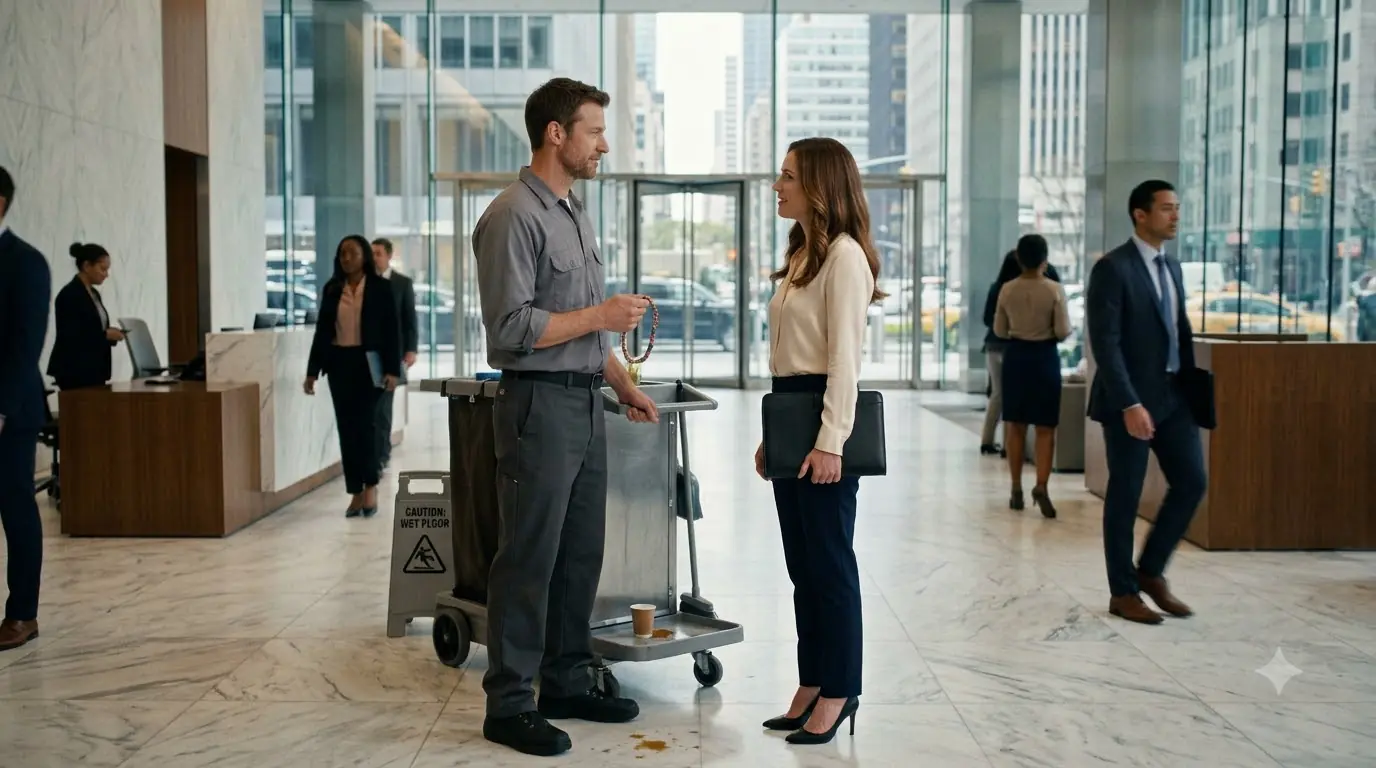
Only one person in that entire building ever paused to say thank you, and that person was the chief executive herself, a woman named Amelia Carter, who smiled at him the way she smiled at everyone, as if kindness cost her nothing at all.
What she did not know, what nobody in that tower of steel and ambition knew, was that the man mopping her floors held the fate of her company in the palm of his hand.
And on the morning the board of directors gathered to vote away everything her family had built, the truth would walk into that room wearing a different face. The silence that followed would last for a very long time.
Autumn had settled over New York with a kind of quiet insistence. Gray skies pressed low over the avenues, and a light rain fell just often enough to keep the sidewalks slick and the umbrellas open.
Inside the glass tower on Lexington Avenue, Carter Dynamics moved through its days with the practiced calm of a company that did not yet know it was drowning.
Nathan Cole arrived on a Monday in early September, badge clipped to a gray uniform shirt, his name stitched crookedly above the pocket, a cart of cleaning supplies rattling behind him down the hallway.
Nobody in the building had any reason to look at him twice. Nobody knew that the same man, in a different suit and a different life, sat at the head of Cole Capital, a private investment fund so quiet and precise that most of Wall Street only whispered about it, never quite able to say who ran it or how it always seemed to know which companies were about to fall and which ones were worth saving.
He had come to Carter Dynamics the way he came to every company he was considering.
Without warning, without his real name attached to anything, using a background contractor's badge his people had arranged through channels designed to keep his identity confidential.
He mopped the hallways in the early morning before the executives arrived. He pushed the cart from floor to floor, wiping down glass partitions, emptying wastebaskets, replacing burned-out bulbs in ceiling fixtures above the boardroom table.
He fixed a door that had been sticking on the fourteenth floor for eleven months, the kind of small broken thing nobody with real authority ever seemed to notice. He did it without being asked simply because it needed doing.
In the break rooms and along the elevator banks, the low-level managers treated him the way certain people always treated someone they believed had no power over them.
A department head named Trevor Boyle, a man who ran the marketing division with more volume than sense, once handed Nathan a stack of bankers' boxes and told him to carry them down to storage himself. Then Trevor ordered him to move an entire archive of old contracts to a different room because the current arrangement, in Trevor's words, offended his sense of order.
Nathan carried the boxes. He moved the archive. He said nothing. More importantly, he noticed everything, because a man who had spent twenty years buying and rebuilding broken companies had learned that character revealed itself most honestly in the moments when a person believed no one worth impressing was watching.
There were smaller cruelties, too, the kind that rarely made it into any formal complaint but accumulated quietly over the course of a week. An assistant on the eleventh floor once let a door swing shut in his face rather than hold it for a man carrying a full trash bin in each hand.
A junior analyst joked loudly to a colleague that the building must be paying its cleaning contractor too well, given how slowly the new man seemed to move. The analyst never realized that the slowness was simply care, the same unhurried attention Nathan brought to everything he did, whether reviewing a company's tax filings or wiping down a conference table before a meeting nobody would remember by the following week.
Nathan absorbed each slight the way he absorbed every piece of information that came his way. Without comment, he filed it into the same quiet ledger where he kept everything else he learned about the people who worked inside that building.
That first night, alone in the small rented apartment three blocks from the office, Nathan opened a leather notebook he had carried into a hundred companies before this one. Beneath the date, he wrote a single line.
"People show you exactly who they are the moment they believe you have no power over them."
He closed the notebook, turned off the light, and thought before he fell asleep about the one person in that entire glass tower who had looked him in the eye that day and had not needed a reason to be decent about it. Her name, of course, was Amelia Carter.
She had walked past him near the automatic doors at the ground-floor entrance that same afternoon, only to have those doors stutter and freeze halfway open, the sensor malfunctioning in the damp autumn air. Nathan had been kneeling beside the frame within seconds, tools already out, murmuring something about a loose wire and a corroded contact point. Amelia stopped instead of simply walking around him the way most people would have. When the doors finally slid smoothly shut and open again, she said thank you simply and warmly, the way a person spoke when gratitude was a habit rather than a performance.
Nathan looked up at her, and for one unguarded second, he was surprised. Not because a CEO had spoken to him, but because nothing in her voice suggested she expected anything in return for the kindness. She lingered a moment longer than she needed to. She asked what shift he worked, whether the building was treating him all right, and whether he had eaten lunch yet that day.
She thanked him again for keeping the building running, as if the small, invisible labor of maintenance mattered to her as much as the multimillion-dollar decisions she made upstairs. A junior manager nearby leaned toward a colleague and murmured, not quite quietly enough, that it was strange to see the chief executive being so polite to the cleaning staff. It was as though decency were a rare currency that only certain people were permitted to spend. Nathan filed that comment away along with everything else.
Over the following days, he watched Amelia more closely than she ever realized, not out of suspicion, but out of the same instinct that had made him wealthy in the first place. It was an instinct for reading people the way other men read balance sheets. He noticed that she never distinguished between the executives who filled the top floor and the security guards who worked the night shift at the front desk. He noticed she remembered names: the barista in the ground-floor coffee shop, the mailroom clerk, the woman who watered the plants on the ninth floor twice a week.
He also noticed that when Amelia made mistakes, and she made several that autumn under the crushing weight of the board's demands, she owned them out loud instead of letting blame drift downward onto someone with less power to argue back. Slowly, without meaning to, Nathan Cole began reevaluating everything he thought he understood about Carter Dynamics. The woman running it was nothing like the profile his analysts had built. That difference mattered.
One evening, long after most of the staff had gone home, he found her still at her desk on the top floor, staring at a spreadsheet with the particular exhaustion of someone trying to solve a problem that refused to be solved. Nathan was there to empty the bins and vacuum the carpet. In the process, almost without thinking, he mentioned that the delay she was staring at, a bottleneck in the supply chain division, might be solved by restructuring two departments that had nothing to do with each other on paper but everything to do with each other in practice. He explained it simply, without jargon and without showing off, the way a person explained something they had simply always known.
Amelia looked up from the screen with an expression somewhere between confusion and disbelief.
"How do you know that?" she asked.
Nathan only smiled, the same quiet, unreadable smile he had been wearing for three months.
"Sometimes the people cleaning the floors hear more than anyone realizes."
She laughed a little, assuming he meant gossip from other cleaning staff, assuming there was nothing more to the moment than a lucky guess from an observant man. Then she went back to her spreadsheet. Still, something about the exchange stayed with her longer than she expected.
Beneath the surface of polite hallways and quiet mornings, Carter Dynamics was rotting from the inside, and Nathan had known it before he ever set foot in the building. That was precisely why he had come. His analysts back at Cole Capital had flagged the company eight months earlier, a business with strong fundamentals and a wounded balance sheet. It was the kind of situation that could mean either a brilliant turnaround or a slow, engineered collapse, depending entirely on who was steering the ship and who was quietly working against them.
Within his first few weeks pushing a cart through those hallways, Nathan began finding exactly what he had suspected he might find. Evidence was scattered carelessly across a company that had never imagined anyone beneath executive rank would ever look closely enough to notice. He found invoices for consulting services that had never actually been rendered. Six-figure sums had been paid to firms that existed only as post-office boxes in states nobody bothered to check.
He found vendor contracts inflated far beyond market rate. Service fees appeared to conceal money routed through multiple entities and eventually back toward people already sitting inside the building. The scheme involved three executives in particular. The chief financial officer, Richard Voss, was a sharp-suited man who smiled too easily and asked too few questions about his own numbers.
The chief operating officer was Diane Marsh, whose calm exterior concealed a talent for making bad decisions look inevitable. The head of procurement was Gregory Hale, who signed off on contracts that would never have survived honest scrutiny. Together, the three of them had spent nearly two years quietly bleeding the company dry while publicly blaming market conditions for the resulting decline. At the same time, they were negotiating in private to sell Carter Dynamics to a rival conglomerate at a price that would look reasonable to outside eyes and criminally low to anyone who understood what the company was actually worth.
Nathan documented everything with the patience of a man who had done this many times before. He photographed paperwork left carelessly in unlocked drawers during his evening rounds. He preserved conversations that drifted into hallways where nobody expected a maintenance worker to be listening. He archived copies of documents that a careless assistant had once printed and forgotten in a recycling bin destined for his cart.
He noticed, too, how carefully the scheme had been built to survive casual inspection. Each fraudulent invoice carried just enough documentation to pass a first review. Each inflated contract had been split into pieces small enough to avoid triggering the board's usual threshold for additional scrutiny. It was the kind of fraud that could only have been designed by people who understood exactly where a company's internal controls stopped looking.
Nathan recognized the pattern immediately because he had seen it before in other companies, in other cities. It was always dressed in slightly different clothing, but it was always built from the same quiet arrogance. The assumption was simple. Nobody beneath a certain pay grade would ever bother to check.
Amelia, meanwhile, saw only the surface of the wound. She saw declining cash flow, missed projections, and a board growing more restless with every quarterly report. She blamed herself in the quiet hours of the night for not finding the solution fast enough. She never once suspected that the people she trusted most in that building were the ones tightening the noose around her company's neck.
Late one evening, wheeling his cart past a half-closed conference-room door, Nathan heard Richard Voss's voice drop low and certain. Voss was speaking to Gregory Hale about timing, about how the following week would be the moment to finally remove Amelia from her position. He described her as too soft, too sentimental, and too unwilling to make the hard choices a crisis required. Nathan stood very still in the hallway, listening until the voices faded.
Then he continued on with his cart as though he had heard nothing at all. Had anyone been paying attention, however, something in his expression might have looked very much like resolve.
Amelia had a habit of staying at the office long after the rest of the building had gone dark. It was the kind of habit that came from carrying a weight nobody else seemed willing to share. Nathan's evening rounds inevitably brought him past her office more often than pure coincidence would explain. Over the following weeks, what began as brief, polite exchanges slowly deepened into something neither of them had quite expected.
She would look up from her desk and see him in the doorway. Instead of waving him away, she would gesture toward the chair across from her and ask him to sit for a moment. She treated the difference in their positions as though it mattered less to her than the simple relief of talking to someone who did not want anything from her.
They spoke about leadership, about the loneliness of making decisions nobody else in the room was willing to make. They talked about the particular exhaustion of being responsible for thousands of livelihoods while feeling, more nights than not, entirely alone in the effort. Nathan spoke carefully, in short, simple sentences that carried more weight than their brevity suggested. One evening, while watching city lights blur through the rain-streaked window behind her desk, he said something Amelia would remember for a long time.
"A company doesn't die because it runs out of money," he told her. "It dies because people stop trusting each other."
Amelia turned that sentence over in her mind long after he left. It was the way a person turned over an idea that felt somehow larger than the moment in which it had arrived. She found herself thinking about him during board meetings. Not romantically, not yet, but with a kind of quiet curiosity she could not quite explain to herself.
There was something in the way he spoke, some deep and settled confidence that had nothing to do with the uniform he wore, that made her wonder what kind of life had shaped a man who cleaned floors for a living into someone who understood the architecture of trust better than half the executives on her leadership team. She began to look forward to those late evenings. His presence had become, without either of them naming it, one of the only steady things in a season of her life defined by uncertainty. It was not his face she found herself drawn to, not at first. It was his mind.
One evening, she asked him, half joking, whether he had always wanted to work in maintenance. Nathan answered carefully, the way he answered most personal questions, with a version of the truth that was honest without being complete. He told her he had spent years learning how businesses actually worked from the ground up. That was true in a way she could not have guessed.
Amelia laughed and told him that most people who talked about business that way had never actually swept a floor in their lives. Nathan smiled at that and said nothing more. She let the moment pass without pressing because there was something about him that made her feel it was better to let a person reveal himself on his own schedule rather than pull at threads he was not yet ready to give.
Another night, she admitted that she sometimes wondered whether her father would recognize the company he had built if he could see it now, buried under spreadsheets and cost-cutting measures that felt further and further removed from the values he had always talked about at the dinner table when she was young. Nathan listened without interrupting, the way he always listened. Then he told her that a company was never really the buildings or the balance sheets. It was the accumulated decisions of the people who ran it.
"As long as you're still making decisions your father would recognize as honest," Nathan told her, "the company is still his in every way that matters."
Amelia carried that thought with her for days afterward. She turned it over the way she had turned over so many of his simple, unhurried observations.
One night, staying even later than usual, Nathan discovered the final piece of the puzzle he had been assembling for weeks. A set of internal wire-transfer records had been left unsecured on a shared drive that Gregory Hale had failed to lock down properly after a rushed afternoon meeting. The documents traced a clear line from Carter Dynamics operating accounts through three shell companies and finally into personal accounts belonging to Voss, Marsh, and Hale. The scheme was far larger than Nathan had initially estimated.
Tens of millions of dollars had been siphoned away over two years, disguised behind consulting fees and inflated procurement contracts. Nathan copied the records that night, sitting alone in a stairwell with a laptop balanced on his knees. For the first time since arriving at Carter Dynamics, he allowed himself to feel something close to anger on Amelia's behalf. The woman he had come to respect over those quiet months was about to be made the scapegoat for a crime she had no part in committing.
The pieces fell together with brutal clarity once Nathan traced the full financial trail back to its source. Voss, Marsh, and Hale had not simply been skimming money quietly for their own enrichment, though that alone would have been damning enough. They had been actively courting a rival conglomerate for months. The competitor was Halbrook Industries.
They were offering to deliver Carter Dynamics into Halbrook's hands at a price far below its actual value. In exchange, they were promised executive positions within the acquiring company once the deal closed. The plan required convincing the board and shareholders that Carter Dynamics was beyond saving, that its declining numbers reflected fundamental weakness rather than deliberate sabotage, and that selling quickly, quietly, and cheaply was the only responsible path forward.
Nathan transferred every document, every recording, and every financial trail he had gathered to the legal team at Cole Capital, a group of attorneys accustomed to building airtight cases against exactly this kind of corporate betrayal. He instructed them to prepare everything quietly. He told them to file nothing yet. They were to wait for his signal.
Nathan understood something about timing that most people rushing toward justice tended to forget. Evidence revealed too early only gave guilty people time to construct better lies.
Meanwhile, inside the boardroom, the whispers against Amelia grew louder. One older board member, a stern, silver-haired man named Walter Grimes, had sat on the board since Amelia's father ran the company. During a private lunch, he remarked that the chief executive was simply too soft for the moment the company found itself in, too sentimental to make the difficult decisions survival now demanded.
Voss cultivated that sentiment carefully over several weeks. He dropped quiet remarks in hallway conversations and board committee calls, always phrased as concern rather than criticism. He framed every suggestion as though he were reluctantly forced to acknowledge a truth he wished were not true. By the time the emergency vote was scheduled, a majority of the board had gradually convinced themselves that removing Amelia would be an act of mercy rather than betrayal, sparing her the burden of a decision she was, in their minds, no longer equipped to make.
Nathan watched the campaign unfold with the detached clarity of a man who had seen the same maneuver executed in a dozen other boardrooms. It was the slow, deliberate erosion of confidence, dressed up as concern, and the quiet reframing of integrity as weakness. He said nothing to Amelia about any of it. Not yet.
He held to his conviction that the truth would land with far greater force if it arrived all at once, undeniable, rather than in scattered warnings she might have dismissed as the anxious imagination of a man who cleaned her floors. The date for the emergency shareholder vote was set for a Thursday in late October. As the day approached, Nathan understood that Amelia had no idea what was truly at stake. She did not know the executives she trusted most had already decided her fate weeks earlier and were only waiting for the paperwork to catch up with their intentions.
Nathan made a deliberate choice in those final days before the vote, one that cost him something, though he never let it show. He did not warn her. He did not walk into her office and lay the evidence on her desk the way every instinct in him wanted to. He told himself it was strategy, that revealing the fraud too early would only give Voss and his allies time to destroy evidence or twist the narrative before the board could see it clearly.
That was true as far as it went, but there was something else beneath the strategy, something Nathan admitted to himself only in the quiet of his rented apartment at night. He wanted to see what Amelia would do when she truly believed the only way to save her company was to abandon everything she claimed to stand for.
The offer came to her three days before the vote. Richard Voss delivered it himself with the practiced solemnity of a man performing grief he did not feel. Halbrook Industries was prepared to acquire Carter Dynamics immediately, he explained, at a price that would keep the lights on, keep the company solvent, and keep the Carter name alive in some diminished form. All Amelia had to do was sign the recommendation to the board, endorse the sale publicly, and accept that a portion of the workforce, perhaps a third or more, would be let go during the restructuring that followed.
If she refused, Voss warned, the company's cash position would not survive the next two quarters. Everyone would lose their jobs anyway, along with whatever remained of the Carter legacy.
Amelia barely slept that week. She sat alone in her office long after the building emptied, staring at projections and termination estimates, running the math again and again as if a different answer might appear if she simply looked hard enough. She thought about the thousands of families whose incomes depended on decisions she alone would have to make.
She thought about her father, who had built the company on the principle that a business existed to serve the people inside it, not merely the shareholders above it. She thought, more than once, about the quiet man who emptied her wastebasket each evening and spoke to her about trust as though he understood something about it that she had forgotten.
On the night before the vote, Nathan found her still at her desk past midnight. The office was empty around her. He did not say anything about what he knew. He simply asked, gently, what she had decided.
Amelia looked up at him with the particular exhaustion of a person who had finally stopped running from a decision.
"I will not save this company by betraying it," she said quietly.
Nathan felt something settle in his chest that he had not expected to feel. It was a kind of quiet, certain relief. The woman across from him had just answered a question he had been asking, in one way or another, for three months.
The morning of the vote arrived cold and bright. The autumn rain finally gave way to hard, clear sunlight that seemed almost cruel in its indifference to what was about to unfold inside the Carter Dynamics boardroom. Every shareholder of consequence had gathered, along with the full board of directors, Voss, Marsh, and Hale. Each of the three executives wore the calm, satisfied expression of people who believed the outcome had already been decided in their favor.
Nathan arrived as he always did, in his gray uniform. He pushed nothing this time. He simply walked toward the boardroom with the same unhurried steadiness that had carried him through three months of quiet observation.
A security guard at the door, a broad-shouldered man named Frank who had worked in the building for more than a decade and had never once had reason to question Nathan's presence, stepped in front of him with an apologetic shrug. Frank explained that cleaning staff were not permitted inside during shareholder meetings. Nathan did not argue. He did not raise his voice.
"I'm here to attend the meeting," he said simply.
The words landed strangely enough in the hallway that several nearby employees turned to look. Some laughed outright at what seemed like an absurd misunderstanding. A janitor was claiming a seat at a meeting reserved for the most powerful people in the company.
The laughter had not yet faded when the boardroom door opened from the inside. A tall man in a dark, precisely tailored suit stepped into the hallway. He was a senior attorney from Cole Capital named Mr. Sanders, and he had flown in that morning specifically for this moment.
He looked past the security guard, past the gathered staff, and directly at the man in the gray uniform.
"The room is ready for Mr. Nathan Cole."
The hallway went utterly silent.
It was the kind of silence that seemed to swallow sound rather than simply lack it, as every person present tried and failed to reconcile the name they had just heard with the man standing in front of them holding nothing more than his own quiet composure.
Nathan walked into the boardroom without theater. He removed the gray uniform jacket and folded it once over his arm. Beneath it was a plain white shirt. Mr. Sanders handed him a dark suit jacket from a garment bag near the door.
The transformation took less than a minute. Yet it seemed to take an eternity for the room to absorb what it was witnessing. The man they had ignored, ordered around, and dismissed for three months now stood before them with the unmistakable bearing of someone who had never once needed their permission to belong in that room.
A screen at the front of the boardroom flickered to life. The Cole Capital logo appeared in clean, understated lettering. Nathan addressed the room for the first time, not as an anonymous worker, but as exactly who he was.
"I am the largest shareholder in this company," he said, his voice as calm and unhurried as it had been every day he had pushed a cart down those hallways. "And I believe there are several matters this board needs to review before any vote takes place."
What followed unfolded with the precision of a man who had spent three months building a case brick by brick, knowing exactly which piece of evidence to lay down first and which to hold until the room could no longer look away from what it was seeing.
Emails appeared on the screen. They showed correspondence between Richard Voss and executives at Halbrook Industries discussing terms of the acquisition weeks before any formal proposal had reached the board. The messages also contained promises of executive positions once the deal closed.
Financial records followed. Wire transfers had been routed through shell companies with names created specifically to obscure their true destination. Each trail ended in personal accounts belonging to Voss, Marsh, or Hale.
Then a recorded conversation played through the boardroom speakers. Richard Voss's own voice discussed the timing of Amelia's removal with chilling casualness. He described her as too soft, too sentimental, and an obstacle to the transaction they intended to complete.
Voss's face drained of color as the recording played. His carefully maintained composure cracked in real time in front of the same board members he had spent months courting. Diane Marsh rose from her chair as though she intended to leave the room entirely. She stopped when she saw Mr. Sanders and two colleagues from Cole Capital's legal team standing near the exit, along with representatives from the District Attorney's Financial Crimes Division who had been quietly waiting in an adjoining room since early that morning.
Gregory Hale said nothing. He simply sank lower into his chair, as though he might disappear into the leather upholstery if he stayed still enough.
Within minutes, all three were escorted from the building. Their careers, and quite possibly their freedom, were ending in the same boardroom where they had planned to seize control only hours earlier.
Amelia sat perfectly still through all of it. She watched the man she had known for three months as a quiet, thoughtful presence in her late evenings transform in minutes into someone she was only beginning to understand. She was not angry, not yet. The shock had not yet given way to any single clear emotion.
There was only a stunned recalibration as she tried to reconcile the man who had fixed her office door with the billionaire who had apparently been evaluating her company, and perhaps her, the entire time.
Once the room had settled, once security had escorted the three conspirators out, and once the shareholders sat in a silence heavier than any that had come before, Nathan turned to look directly at Amelia. Something in his expression softened. The calculated composure of the previous several minutes gave way to something far more sincere.
"I was not looking for the most brilliant executive in this industry," he said, his voice carrying easily through the quiet room. "I was looking for someone who would not sell her conscience, no matter what it cost her."
Then Nathan told the room, and told Amelia, the story of the last three months. It was not framed as a confession but as testimony. He described what he had witnessed in the ordinary, unwatched moments of her leadership.
He spoke about the way she greeted the night security staff by name every evening without exception. He spoke about the fact that she had never once raised her voice at an employee, even under the crushing weight of a collapsing balance sheet. He spoke about the way she protected the core values her father had built the company on, even when protecting them seemed likely to cost her everything.
"This was the real audit," Nathan explained. "Not only of Carter Dynamics' finances, though that mattered. It was an audit of the character of the woman running it."
Companies could always be rebuilt with enough capital and enough time, he said. Integrity, once lost, rarely returned.
Nathan told them about the evening Amelia had stayed until nearly midnight helping a junior accountant find a rounding error that had nothing to do with her own responsibilities, simply because the young woman had looked too frightened to ask anyone else for help. He told them about the morning Amelia had personally called a supplier's small family business to apologize for a late payment that had technically been someone else's mistake. Amelia believed the responsibility ultimately climbed all the way to her desk, regardless of whose hand had caused the delay.
None of it was dramatic. None of it belonged in any quarterly report. Nathan told them that was exactly the point.
"The truest measure of someone's character is found in what they do when they have every reason to believe no ledger is keeping score."
Then he made his announcement, and the room, still reeling from everything it had already absorbed that morning, found one more reason to sit in astonished silence.
Cole Capital would invest its full resources into restructuring Carter Dynamics. It would not acquire the company. There would be no forced change in leadership. Cole Capital would come in as a direct partner supporting the same chief executive the board had been preparing to remove only days earlier.
The shareholders who had arrived expecting to vote the company into a hostile sale instead rose to their feet in spontaneous applause. It was not the polite applause of boardroom ritual. It was the reaction of people who had spent months bracing for collapse and suddenly realized there might still be a future.
Amelia did not join the applause immediately.
She sat with her hands folded in her lap, processing not only the collapse of a conspiracy she had never known existed but the disorienting realization that the man she had allowed herself to trust, to lean on, and perhaps even care for in ways she had not fully admitted to herself was not who she had believed him to be for three months.
It would take time, she understood even in that moment, to untangle the difference between the deception and the man beneath it. But for the first time since the crisis began, she understood exactly who had been standing beside her all along, quietly making sure she never had to face it entirely alone.
Six months passed, and Carter Dynamics looked, by nearly every measure, like a different company from the one that had nearly collapsed under the weight of betrayal that October. Revenue climbed steadily as the restructuring took hold. Contracts were renegotiated at fair market value. Departments were reorganized along the lines Nathan had quietly suggested during those late evenings when Amelia had assumed she was simply talking through problems with an unusually perceptive member of the cleaning staff.
Employees who had spent years navigating a culture of quiet fear under the old leadership found themselves working inside something markedly more transparent. Performance reviews made sense. Promotions reflected merit rather than favoritism. Speaking up no longer felt like a risk.
Nathan no longer hid who he was, though very little about his daily habits actually changed. He still arrived early most mornings and made his own coffee in the small kitchen near the executive offices rather than waiting for someone to bring it to him. He still greeted the security staff by name. He still asked Frank at the front desk how his daughter's college applications were coming along.
He still stopped to speak with the two-person cleaning crew that had replaced the role he had once quietly occupied. Nathan treated them with the same unhurried respect he had once hoped for, and rarely received, from the people who had walked past him without a second glance. Power, it turned out, had never been the thing that changed him, because he had never let it define him in the first place.
The relationship between Nathan and Amelia grew slowly in the months following the boardroom revelation. Neither of them rushed toward something neither fully trusted yet. In the weeks immediately after the truth came out, Amelia kept a careful distance.
She needed time to separate the deception, however well-intentioned, from the man who had carried it out. She needed to understand for herself whether what she had felt during those late evenings had been real or simply the product of circumstances neither of them had entered honestly. Nathan gave her that space without complaint. He understood better than most that trust rebuilt too quickly rarely held.
It was on a clear evening in early spring, with the two of them standing on the rooftop terrace of the Carter Dynamics building and the city spread out beneath them, that Amelia finally asked the question she had been carrying since October.
"Was I ever anything more to you than a test?"
Her voice was steady but quiet, the kind of question a person asked only after deciding they could bear whatever answer came back.
Nathan turned to look at her. For a long moment, he said nothing. He chose his words the way he chose everything, with care.
"In the beginning, no," he admitted. "I came to evaluate the company. Nothing more."
It had been a calculation as cold and precise as every acquisition he had ever considered. But somewhere in those quiet evenings, somewhere between the late-night conversations about leadership, trust, and the particular loneliness of responsibility, the test had stopped being about Carter Dynamics at all.
Nathan found himself wanting more than any successful turnaround or return on investment. He wanted simply to see her again the next evening. He wanted to hear what she thought. He wanted to watch the way she carried a burden that would have broken most people and somehow never let it break her.
Amelia reached out and took his hand there on the rooftop, the city lights reflecting faintly in the damp evening air. Something between them settled into place the way things do when two people finally stop asking whether something is real and simply allow themselves to believe it.
They did not rush toward any grand declaration that night. They chose something steadier, an understanding that whatever came next between them would be built the way everything worth having was built: slowly, honestly, on a foundation neither of them would ever need to hide from the other.
They became partners in every sense that mattered. First in the boardroom, where Cole Capital's continued investment in Carter Dynamics gave Nathan a permanent, if quiet, role in the company's direction. Gradually, that partnership extended into life, in the unhurried way two people build something together when neither is trying to prove anything to the world watching them.
Nathan never asked Amelia to be anything other than exactly who she already was. Amelia never had to wonder whether his interest in her had anything to do with the fortune attached to his name, because she had known him first, for three long months, as a man in a gray uniform who fixed broken doors and listened more than he spoke.
On a Monday morning, not long after that conversation on the rooftop, the two of them walked together through the main lobby of Carter Dynamics. It was the same lobby where Nathan had once pushed a cleaning cart past employees who had never bothered to learn his name.
Now, some of those same employees straightened as he passed, offering quiet nods of genuine respect rather than the careless indifference of the previous autumn. Nathan accepted the gesture with the same understated ease he had carried through every version of himself the building had known. He offered a small, easy smile in return, the kind of smile that asked for nothing.
Then he walked beside Amelia toward the elevator.
The doors closed behind them the way doors always do, quietly and without ceremony, carrying the two of them upward together. They closed the chapter on a test that had reshaped not only the future of a company, but the lives of everyone inside it. And they opened onto something new.
A partnership built not on power or fortune, but on the rare and steady foundation of integrity recognized, and trust finally, fully earned.