Everyone in the showroom laughed the moment he walked through the door.
It was the kind of laughter that spreads quickly through a crowd of well-dressed people who have never once considered that they, too, might look out of place somewhere. Instinctive, careless, and sharp as broken glass.
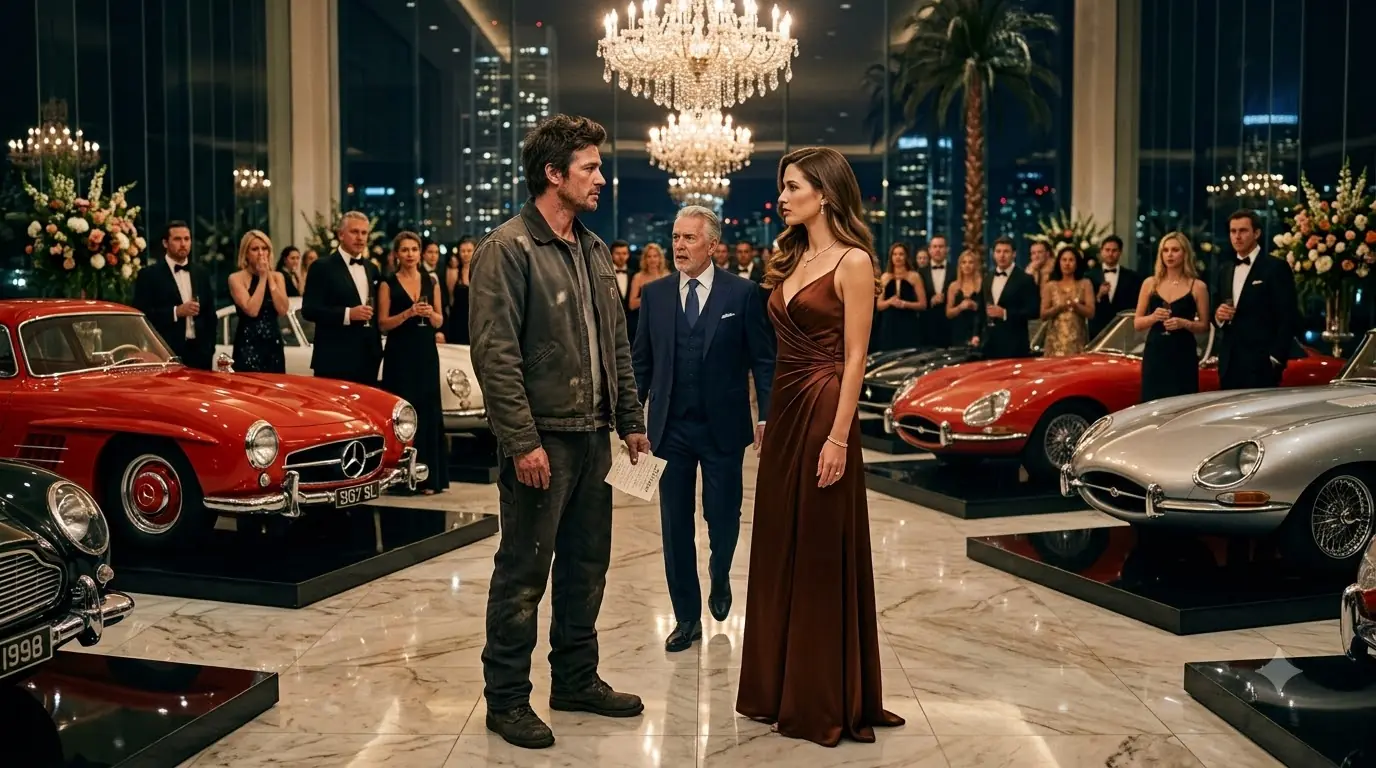
The man standing just inside the entrance was wearing a pair of dark work pants stained with grease along the left knee, a faded canvas jacket that had been washed so many times the original color was impossible to determine, and boots that had clearly seen a decade of hard use.
He carried no briefcase, no invitation visibly in hand, and his dark hair was slightly disheveled in the way of someone who had driven with the windows down.
He looked, in the most precise terms, like someone who belonged beneath a car rather than beside one worth half a million dollars. The laughter was loudest, most cutting, and most deliberate from a woman standing near the far end of the showroom floor.
Olivia Carter, 29 years old, CEO of Carter Holdings, held a glass of champagne in one hand and a conversation in the other as she paused mid-sentence to let the full weight of her amusement land. She looked at the man the way a person looks at something that does not belong to them and never could. She said something quietly to the security officer standing nearby.
The man in the work clothes simply looked at her for a moment, not with anger, not with hurt, but with a kind of calm that is rarer and more unsettling than either, and then turned and walked back toward the exit.
What no one in that room knew, including Olivia herself, was that within the next 30 minutes the entire evening would change, and it would change because of him. Jack Turner was 38 years old and had been running his garage on the east side of Millbrook for 11 years. The garage was called Turner Restoration.
If you drove past it without knowing what you were looking for, you might not slow down at all. The sign above the bay doors was modest, hand-painted in dark green letters that had faded slightly over the years.
The building itself was a converted warehouse with good bones, high ceilings that allowed room for a lift and a pair of halogen work lights, and a side room with a desk where Jack kept his records in a filing system that made sense only to him. He had one full-time employee, a young man named Danny, who had come to him at 17 asking for a summer job and never quite left.
He also had two part-time helpers who came on weekends during busy restoration seasons. The garage did not have a website, did not run advertisements, and did not need to. Every piece of work Jack took in came by word of mouth, and the waiting list for his restorations ran, on average, between 14 and 18 months.
He worked on vehicles that most mechanics would not touch, cars from the 1940s and 1950s, machines whose original parts were no longer manufactured, and whose repair required a combination of engineering precision and something that could only be called instinct, a feel for the materials and the era and the specific character of each machine.
Jack had both. He had always had both. He was also a single father. His daughter, Maya, was 9 years old.
She came to the garage after school on days when the sitter was unavailable and did her homework at a small desk Jack had set up near the side window, eating crackers from a bag and drawing horses in the margins of her notebook.
She called his employees by their first names and had a habit of asking technical questions that made Danny laugh and then scramble to answer correctly because she always knew when he was guessing.
Jack had raised her alone since she was three, after her mother left in the way some people leave without ceremony and without much explanation. He had done so with the same steady, unhurried attention he brought to everything else in his life.
He did not talk about it often. He did not talk about most things often. He was a man who communicated through what he did rather than what he said. And what he did, consistently and without fanfare, was exceptional.
The invitation to the Millbrook Classic and Collector Automotive Exhibition had arrived 6 weeks earlier in a plain envelope, the kind with a gold foil crest on the back flap. Jack had read it at his desk, set it down, and then gone back to the differential he had been rebuilding. He read it again the following morning over coffee and decided he would go.
Not because he particularly enjoyed large events with champagne and people in tailored suits, but because the car he had been restoring for the past 2 years, a 1953 Hudson Hornet, originally dark blue, now brought back to a color so precise it matched the paint code in the original factory documentation, had been selected as a finalist in the collector vehicle category. He thought it deserved to be seen.