The afternoon sun pressed down on the outskirts of Phoenix, Arizona, with the kind of dry, unforgiving heat that made the asphalt shimmer in slow waves.
A convoy of glossy black sedans tore down the long stretch of road leading toward the high-end auto exposition center, escorted by motorcycles and flanked by camera vans.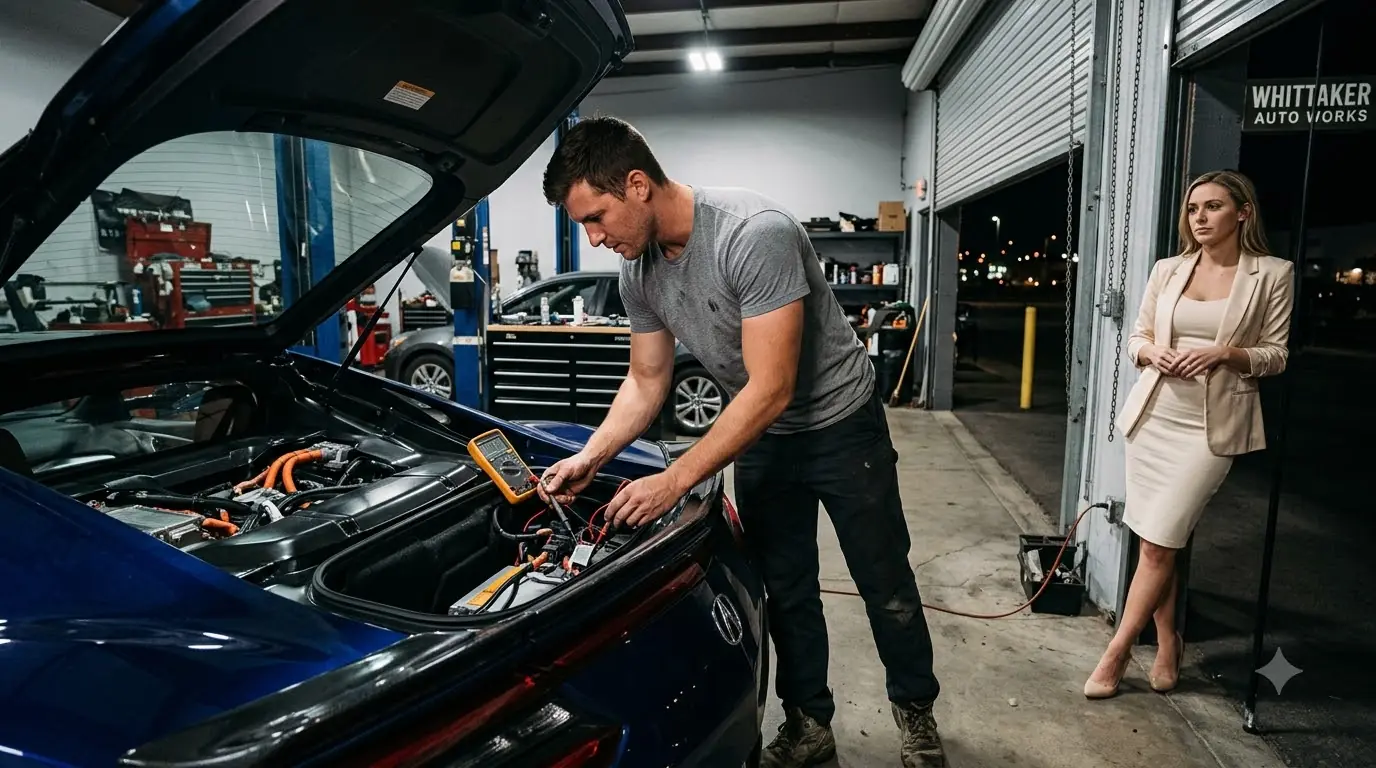
Tucked between the dark vehicles like a jewel in iron, a midnight-blue supercar caught every angle of light and threw it back doubled.
The car was the PVX-1 Aurora, a hybrid prototype valued at more than $1 million and scheduled to roll onto a stage in less than fifty-five minutes before investors flown in from New York and Dubai.
Inside the cabin, Audrey Prescott reviewed her opening remarks one final time on a slim tablet balanced on her knees. She wore a cream bodycon dress with a deep V-neckline beneath a pale champagne blazer, and her blonde-brown hair fell long over one shoulder in a precise, expensive wave.
At twenty-eight years old, she was the chief executive of Prescott Velocity Motors, having inherited the title two years earlier when her father passed away. Tonight was supposed to be the night the world stopped calling her the founder's daughter.
The supercar shuddered. The movement was barely perceptible at first, more felt than heard, but then the dashboard flashed red.
The cabin lights dimmed for half a second, the hybrid drive cut out, and the climate system stalled. The car rolled to a slow, helpless stop along the shoulder of the highway.
The convoy braked in a chaotic ripple. Doors opened and voices rose as Audrey stepped into the heat with her tablet still in her hand.
She could feel her heart begin a hard, methodical pounding in her chest. A young technician named Finn Mercer hurried forward with a diagnostic laptop, sweat already beading along his hairline.
Finn plugged a heavy cable into the vehicle's data port and watched lines of red error codes scroll across the screen. Lithium pack lockout.
Drivetrain isolation fault. Thermal protection error.
Module communication breakdown. The codes kept multiplying, and although he tried to offer Audrey a reassuring half smile, the expression failed before it formed.
A nearby assistant returned with the news Audrey did not want to hear. The factory recovery vehicle was at least eighty minutes away, while the launch would begin in fifty-five.
The math was cruel and immediate. The closest place that could hold the car safely was a small independent garage just down the road, a place none of them had ever heard of called Whittaker Auto Works.
Within minutes, the supercar was being eased onto a flatbed and unloaded onto a slab of cracked concrete in front of a building that looked, at first glance, as though it had been forgotten by time. The sign was sun-bleached and peeling.
The roll-up door bore long scratches along the lower panels, a pair of empty oil drums stood near one wall, and an old pickup was parked off to the side beneath a thin layer of desert dust. The contrast was almost theatrical.
The shining hybrid prototype sat before the modest workshop like a diamond placed on a dish of clay.
Zane Whittaker stepped out from beneath the half-raised door, wiping his hands on a clean rag. He was twenty-nine years old, tall and broad-shouldered, with dark brown hair cropped close, a strong jaw, and the quiet, slightly tired eyes of a man who had spent years taking care of someone other than himself.
He wore a gray T-shirt with one small smear of grease across the chest, dark work pants, and worn but spotless boots.
His daughter Bonnie sat behind the small office counter inside. She was seven years old, with light brown hair that fell in loose, soft tangles past her shoulders.
She held a worn brown teddy bear in her arms. The bear was named Milo, a gift from her mother before her mother passed away.
Audrey took two steps into the lot and surveyed the ceiling fan turning lazily inside the garage, the homemade wooden tool shelves, the cracked concrete, and the dust on the windowsills. Her lips tightened.
"You call this a garage?" she said, her voice cutting through the heat like cold metal.
"It looks more like a place where people abandon broken cars than a place where anyone should touch a million-dollar supercar."
Bonnie ducked her head behind the counter. Her small fingers tightened around Milo until her knuckles turned white.
Zane glanced at his daughter for one short, careful second, then looked back at Audrey. His expression did not change.
He did not raise his voice or flinch.
"Do you want me to take a look?" he asked, nodding toward the silent supercar.
Audrey looked him up and down. She saw the grease on his shirt, the worn boots, and the small daughter peeking from behind the counter.
She lifted her chin.
"I am not letting a run-down garage put its hands on a million-dollar car," she said.
Zane did not argue. He only watched her as the dashboard inside the supercar blinked red again, almost as though it disagreed with her.
"It is not dead," he said softly, almost to himself but loudly enough for her to hear.
"It is just calling for help in the wrong direction."
The clock on the dashboard read fifty-three minutes to launch.
Zane Whittaker had not always lived at the edge of Phoenix. Six years earlier, he had worked inside one of the cleanest experimental performance-hybrid garages in the country, where only the most carefully chosen technicians were trusted to lay hands on prototype electrical systems.
He had specialized in low-voltage signal integrity, thermal sensor calibration, safety relay logic, and the strange, half-musical art of listening to machines that should not have been making a sound. He had been quiet about his ability, but he had been very good.
Then his wife, Rachel, became ill. The disease moved faster than either of them had been ready for, and Bonnie was only three years old when her mother died.
Zane had stood in the hospital hallway that night holding his daughter against his chest, and he had understood with terrible clarity that the choice ahead was not really a choice at all.
He could keep the high salary, long travel, and constant pressure while Bonnie grew up loved by strangers in daycare, or he could walk away and raise his daughter himself. He walked away.
He bought a small failing garage on the edge of Phoenix from an old man who could no longer keep up with the work. He patched the roof himself and repainted the office walls one slow weekend at a time while Bonnie napped in a folding chair in the corner.
There had never been enough money left over to replace the sign or repour the cracked concrete out front. Every spare dollar went to Bonnie.
Inside, however, the shop was a different story. The floor was swept, and the tools were arranged by size and function on labeled shelves Zane had built by hand.
He fixed pickup trucks for laborers and sedans for retired teachers. Once, he refused payment from an elderly woman who had brought in her late husband's old car and asked if there was any way he could make it run again.
Bonnie grew up at a small painted desk near the office window, drawing pictures of her father at work. Milo sat on the desk where he could watch over the pencils.
When customers asked Bonnie why she liked the garage so much, she always answered with the same words.
"Because Daddy is here."
Zane had taught her, gently and without making it sound like a lecture, that a person's worth was not measured by the building behind them or the clothes they wore. He told her that some people could have a beautiful house, a beautiful car, and beautiful clothes while still being poor inside if they did not know how to treat others.
Bonnie remembered every word.
So when Audrey Prescott called the garage a place where people abandoned broken cars, Bonnie did not understand all the mechanical terms being thrown around, but she understood the tone. She understood the way Audrey's eyes had moved over her father.
She understood that something inside her chest hurt badly, and she did not yet know whether she wanted to cry or fight.
Outside, the heat continued to climb, and Audrey had larger problems than she was willing to admit. The phone calls had not stopped since the supercar died.
She stood with her back to the garage door, one hand pressed to her temple, her tablet against her thigh, while her assistant Carter Blake hovered at her elbow with another phone already ringing.
She listened to her chief of communications, then her head of investor relations, and finally a board member named George Whitmore, who did not bother to soften his voice.
"Audrey," George said, "if that car is not on that stage on time, you are not just losing a launch.
You are losing the confidence of the board. Do you understand what I am saying?"
She understood. She had understood since the day she took her father's chair.
The PVX-1 Aurora was not just a car. It was proof.
It was the answer to every whispered comment she had ever pretended not to hear.
It was the answer to the cousin who had told her at a holiday dinner that she was very lucky to be the sort of girl people loved. It was the answer to the analyst who had described her the previous month as presenting beautifully without using the word competent even once.
The car had to roll onto that stage on time. Audrey had to stand in front of it in her cream blazer and tell a hall full of investors what the future of high-performance hybrid mobility looked like.
Carter Blake, thirty-five years old and immaculate in a gray suit and tie, leaned close and lowered his voice in the way some men did when they wanted to sound important.
"We should not let a backyard mechanic touch this car," he murmured.
"The warranty implications alone could end us."
Finn Mercer stood at the open hood with his diagnostic laptop balanced on a portable stand. He had run three full scans.
The error codes had not disappeared. They had multiplied.
He swallowed and turned to Audrey.
"Ma'am, I am not going to lie to you.
Without the factory team, we should not be opening this car up. If the high-voltage system is actually locked, we are looking at a tow back to the plant.
That is at least a day, maybe two."
A day. The word struck Audrey like a physical blow.
A day meant the launch was over. A day meant the board would have everything it needed.
A few feet away, Zane stood with his hands in the pockets of his work pants, listening. He could hear the relays clicking inside the rear compartment of the supercar, soft little metallic taps, and to him those taps were a language.
He could hear the order of them and the pauses between them. The car was not dead.
The car was confused. There was a difference, and almost no one in the lot besides him seemed to know it.
When Audrey finally lowered her phone, she found him watching her. Her jaw tightened in pure reflex.
"What?" she asked.
"That car is showing you ten errors at once," he said.
"When a car shouts ten things, usually only one of them is actually wrong.
The other nine are scared."
Audrey almost laughed, but it was a thin, brittle sound born more of stress than amusement. Somewhere underneath it, his words made a small, troubling kind of sense.
She turned away because she was not ready to admit anything yet.
Inside the garage, Bonnie decided she had been quiet long enough. She slipped out from behind the counter clutching Milo against her chest, crossed the cracked concrete, and stopped a few feet from the woman in the cream dress.
From a small basket on the office shelf, she had taken a cold bottle of water. She held it out with both hands.
"You look hot," Bonnie said.
Audrey blinked down at her. The little girl stood in pink sneakers, offering water with the simple, undefended kindness small children sometimes possessed before the world taught them otherwise.
"My daddy fixes cars really well," Bonnie said softly.
"He just does not have a fancy garage."
For one heartbeat, Audrey did not know what to say. She had been called many things in her career, but she had not been spoken to like this in a very long time.
Carter decided to be helpful. He looked down at Bonnie with a small, polite, condescending smile.
"That is sweet, sweetheart," he said, "but this is a million-dollar car, not a toy your daddy can practice on."
Something in Bonnie's face went very still. Her small hand tightened around Milo, and the bottle of water trembled in the other.
Audrey heard the comment and felt it land, but she did not stop it.
Zane crossed the lot before anyone realized he had moved. He did not raise his voice and did not look at Carter.
He knelt in front of his daughter so his eyes were level with hers, then gently straightened the strap of her small backpack.
"You do not have to prove anything to me, sweetheart," he said.
"I know you believe in me.
That is all I need."
Bonnie's voice was very small.
"But they think you are not good."
Zane considered this. He did not lie to her and did not promise revenge.
He simply smiled a little.
"Then, in a little while," he said, "they are going to learn something new."
He took the bottle from her hand, opened it, and pressed it gently back into her palm. He told her to drink it slowly, then stood and walked toward the supercar without looking at Carter once.
Audrey watched the entire exchange and felt a slow, uncomfortable heat rising behind her ribs that had nothing to do with the desert sun.
Finn made one more attempt with the laptop. He cycled the diagnostic protocols, tried a soft system reset, and attempted a forced communication refresh.
The car answered each attempt with the same sequence of red lights and the same dry, hollow click from the start button. Nothing he did made the supercar willing to speak to him.
At last he stepped back and looked at Audrey, his face finally stripped of professional composure.
"I cannot get her to listen," he said.
"We need the factory."
"Twenty-four minutes to launch," Zane said into the silence.
He stood near the rear of the supercar with one hand resting lightly on the painted body, his head tilted as though he were listening to a distant radio station. Then he turned and looked directly at Audrey.
"That car is not dying," he said.
"If the battery were truly dead, the relays would not be cycling like that.
If the central module were truly dead, the screen would not be showing the errors in this order. What I am hearing is a false safety lockout.
The car thinks it is in danger, and it is wrong."
Finn frowned.
"How can you tell?"
Zane pointed through the open driver's door toward the dashboard.
"Because the thermal alarm appeared less than half a second before the drivetrain alarm.
That order matters. The drivetrain did not actually fail."
"It was disabled because the car suddenly believed something was hot that was not hot," he continued.
"Something is feeding the system a false reading.
That is why she keeps clicking. She is not refusing.
She is afraid."
Audrey stared at him.
"And if you are wrong?"
"If I am wrong, you lose ten minutes," Zane answered calmly.
"If you keep chasing module replacement, you lose the entire launch."
Audrey's pulse pounded behind her temples. Pride pulled her in one direction while math pulled her in the other.
Math was winning.
Finally, she lifted her chin and gave him the smallest nod she had ever given anyone.
"You have ten minutes.
And if you damage anything, anything at all, I will buy this property and have this garage erased from the map by morning."
The threat hit the air like a slap. Bonnie, standing in the office doorway, flinched.
The garage was not merely a workplace to her. It was her second home, the place where her mother's photograph hung on a small shelf above the calendar and where her drawings covered the office wall.
The thought of someone wiping it from the earth turned her stomach in a way she did not have words for.
Zane heard the threat and walked toward Audrey slowly. For the first time that afternoon, his voice carried a small, controlled edge.
"You can be richer than me," he said quietly, "but do not threaten the place my daughter calls home."
The lot went silent. Audrey opened her mouth, then closed it.
She did not apologize because she was not ready to, but something had shifted inside her and she knew it.
"Begin," she said.
Zane went to work. He did not bring out high-tech factory equipment.
Instead, he brought an older multimeter, a thin inspection light, a mechanical stethoscope, a clean microfiber cloth, a small set of moisture-resistant connector tools, a low-temperature heat source, and a bound notebook filled with his handwriting.
Carter made a small sound in his throat that was probably meant to be a laugh but came out closer to a cough. Zane ignored him.
He worked through a clear, deliberate sequence, checking the auxiliary low-voltage system, listening to the rhythm of the safety relay chain, and reading the order of fault codes again and again.
He inspected the thermal sensors near the high-voltage pack, tested the safety contacts at the rear hatch, and examined the small accessory connectors near the cooling channels. Then he stopped and asked one simple question.
"Was this car cleaned this morning with hot pressurized steam or high-pressure spray detailing?"
Carter started to answer too quickly. Audrey raised a hand to silence him and turned to her event coordinator on the phone.
The answer came back within twenty seconds. Yes, the car had been steam-cleaned that morning at the staging facility, with particular attention paid to a small smudge near the rear panel.
The detailers had wanted the car flawless beneath the stage lights.
Zane closed his eyes for one second, opened them, and nodded.
"So the car did not break on its own.
Someone made it too clean in the wrong place."
He carefully removed an outer cover near the rear auxiliary bay, taking photographs of every connector before touching it and placing each screw into a small magnetic tray. Finn, watching from several feet away, found himself involuntarily straightening.
The man in the worn shirt worked with the patient, exact rhythm of someone trained on machines worth far more than the one before him.
Beneath the cover, in a small recess near the thermal sensor cluster and auxiliary safety latch, Zane found what he was looking for. It was almost invisible.
A thin, pale film of moisture had settled across a small accessory connector. Hot steam under pressure had crept past a worn rubber seal and condensed against the fittings inside.
The moisture was not enough to create a full short. It was enough to make the signal flicker.
The car had interpreted the flicker as a sudden temperature anomaly near the battery pack and a possible incomplete latch on the rear compartment. To protect the driver, it had shut everything down.
Zane explained the problem without arrogance, using language simple enough for a child to understand.
"Right now your dashboard is shouting ten errors at you," he said.
"But only one of them is actually telling the truth, and that one is lying about all the others.
The car is not seriously hurt. It just believes a bad signal."
The phrase landed in Audrey like a small stone dropped into a still well. She said nothing.
Zane did not bypass the safety system or invent a shortcut. He dried the connector with the careful low-temperature heat source, cleaned the contacts, sealed the connector with an appropriate temporary moisture barrier so the car could safely complete the launch, and reseated everything in exact reverse order.
He explained each action as he performed it. He did not mock Carter and did not glance at Audrey for approval.
At last, he stood, wiped his hands, and gestured toward the open driver's door.
"She is ready to listen now," he said.
"Whether she chooses to start is up to her."
Twenty-two minutes remained before launch. Zane slid into the leather driver's seat, the contrast of his work clothes against the polished interior almost surreal.
Audrey stood in the open doorway with her arms folded, her tablet forgotten on the office counter. Bonnie stood near the office door with Milo pressed to her cheek, her eyes huge and her breath held.
Zane keyed the auxiliary power. The dashboard came alive, but the error codes remained, glowing red.
Carter exhaled a small triumphant sound he immediately tried to hide.
"I told you," he muttered.
"There is nothing this man can do."
Audrey did not answer. She watched Zane.
"She is not ready to run yet," he said quietly.
"She is only willing to listen."
He performed a careful resynchronization. He waited for the auxiliary power to steady and waited out the relays.
He cleared the thermal phantom code first, confirmed the temperature signal was holding within a safe range, reactivated the safety-latch logic in the correct sequence, and allowed the hybrid system to perform its self-check.
One red light winked out. Then another.
Then another.
The garage went still in a way that air conditioners, oil drums, and even insects seemed to respect. No one moved.
Then a single red light returned. Thermal protection unavailable.
Audrey's throat tightened. Carter took half a step forward.
"Stop," he said sharply.
"Stop before you make it worse."
Zane did not stop. He listened to the relays one more time and understood that the system had not yet reaccepted the auxiliary sensor because the start cycle had been interrupted too early.
He cut auxiliary power, counted exactly to four, and restarted the cycle in a slightly different order.
In the office doorway, Bonnie pressed her forehead lightly against Milo's soft head.
"You can do it, Daddy," she whispered.
Zane did not turn, but the smallest, gentlest smile touched the corner of his mouth.
The red light went out. The dashboard cleared completely.
For two perfect seconds, the cabin remained silent. Then the high-performance hybrid drive came alive in a low, full, controlled growl that filled the garage, rolled across the cracked concrete, and spread into the desert air.
The headlights flared on. The system stabilized.
The million-dollar prototype, silent and dead twenty minutes earlier, breathed.
No one in the lot moved for a full breath. Finn Mercer slowly closed his laptop the way a man closes a book by which he has just been quietly outsmarted.
Carter Blake's face had gone the color of wet paper. Audrey did not blink.
She stared at the man in the worn gray T-shirt sitting calmly behind the wheel of her future.
Zane stepped out of the car. He did not strut or gloat.
He crouched as Bonnie ran across the concrete and threw both arms around his neck with Milo crushed between them. Zane held her and kissed the top of her head.
Then he stood, looked at Audrey, and spoke as though he were giving any other customer ordinary instructions.
"She will run," he said.
"But do not push her hard until that connector is replaced with a factory-spec part.
Tonight she only needs to do her job for ten minutes on a stage."
Audrey opened her mouth, closed it, and finally asked, "How much do I owe you?"
Zane named a fair, ordinary repair fee. It was not adjusted for the value of the car or her panic.
It was the amount he would have charged anyone on any normal afternoon for that much careful work.
Audrey almost wished he had overcharged her. It would have been easier to deal with.
She arrived at the exposition center with eleven minutes to spare. The PVX-1 Aurora rolled onto the stage exactly on cue.
Its gull-wing doors lifted on command, and the spotlights caught the midnight-blue paint and turned it electric. The audience applauded, cameras flashed, and George Whitmore smiled at Audrey from the front row as though he had never doubted her for a second.
Carter, recovered from his shock, was already telling reporters at the back of the room that the company's internal technical team had elegantly resolved a small in-transit issue. Audrey heard him.
She walked to the microphone, placed her notes down, and looked across the room.
She had a choice. She could let the world believe what it wanted to believe.
She could allow Carter's lie to become the press release. She could be photographed beautifully beside the car and let the successful launch become the proof her board needed to keep her in her chair.
Then she thought of a little girl with a teddy bear. She set her notes aside.
"Before I tell you about the technology behind this car," Audrey said, "I need to tell you about the person who saved it tonight."
George Whitmore's smile froze. Carter went pale at the back of the room.
The audience became still.
Audrey did not look at either man. She looked into the front camera.
"This car is not on this stage because I am perfect," she said.
"It is on this stage because a single father in a small repair shop on the edge of this city heard something the rest of us missed.
And I was wrong this afternoon to judge him by the building behind him."
She did not name Zane because she did not need to. She simply told the truth in front of the people who paid her salary.
The room stayed quiet for a long second. Then someone in the second row began to clap.
Another person joined, and the sound spread through the hall, slow, uneven, and real. Several investors leaned toward one another and began to murmur.
It was not the kind of applause Audrey had been trained to want. It was better.
Late that night, after the lights came down and the questions ended, Audrey did not return to her penthouse. She turned her own car onto the long, quiet road leading toward the edge of the city and drove herself, alone, back to Whittaker Auto Works.
The garage was nearly closed when she arrived. The roll-up door was halfway down, and a warm yellow lamp lit the interior.
Zane was wiping a wrench clean and returning it to its hook. Bonnie slept in the office chair with Milo tucked beneath her chin and a small cotton blanket pulled to her shoulders.
Audrey stepped quietly beneath the door. This time she did not see a run-down garage.
She saw the swept floor and the tools arranged precisely by size. She saw a child's drawing of a smiling man holding a wrench taped to the wall, a small coat hanging carefully near the office door, and a child's lunchbox at the corner of a desk.
She saw a life.
Zane noticed her and did not look surprised.
"Car acting up again?" he asked.
Audrey shook her head. Her voice, when it came, was lower than it had been all day.
"This time, it is me."
She did not approach Zane first. Instead, she crossed the small office floor and lowered herself so that when Bonnie stirred and opened her sleepy eyes, she was looking at Audrey at her own height rather than up at her.
"I owe you an apology before I owe your father one," Audrey said softly.
"I am sorry I made you feel as though the place where your father works was not something to be proud of.
I was wrong. And I am sorry I let someone speak to you the way they did this afternoon."
Bonnie blinked and considered the apology with the seriousness of a seven-year-old.
"Do you still think Daddy's garage is run-down?" she asked.
Audrey looked around slowly. She let her eyes pass over the swept floor, the labeled shelves, the careful drawings, the child's blanket, the smell of clean machine oil, and the warm light.
"I think," she said gently, "that this is the place that saved the most important day of my life."
Bonnie considered that, nodded once in satisfaction, and tucked Milo more firmly beneath her chin.
Audrey straightened and turned to Zane. She offered no excuses.
She did not blame the pressure of the launch or blame Carter. She told him clearly that she had been wrong to insult him, wrong to stand silently while her assistant insulted his daughter, and wrong to threaten the building behind him.
Zane listened. When she finished, he did not rush to forgive her.
He only nodded once, slowly.
"I am used to people underestimating me," he said.
"But she is not the one who should ever have to hear it."
Audrey nodded. She had not driven to the edge of the city only to apologize.
She told him Prescott Velocity Motors wanted to enter into a formal independent maintenance and inspection contract with Whittaker Auto Works for its showcase fleet. She also wanted to retain him personally as an outside technical consultant for difficult hybrid-system faults.
She made it clear, without forcing him to ask, that this was not charity. It was a contract based on what she had watched him do that afternoon.
Zane took the document she offered but did not sign it. He folded it carefully and set it on the corner of the workbench.
"I will read it," he said.
"But if we work together, the first line of any agreement will be that no one in your company looks down on a working person because they are not wearing a suit."
Audrey smiled. It was not a media smile.
It was small, unguarded, and a little uncertain, the first time she had smiled that way in two years.
"That will not be a problem," she said.
Bonnie, who had been pretending to sleep for several seconds, sat up suddenly with Milo clutched to her chest. She looked seriously at Audrey, then at Zane, then back at Audrey.
"Do you know how to fix cars?" she asked.
Audrey laughed before she could stop herself.
"Not at all," she admitted.
Bonnie nodded gravely.
"Well, you can learn from my daddy.
But you have to listen to him."
Zane's quiet laugh was warm enough to fill the small office. Audrey found herself laughing too, in a way she had not laughed in a long time.
Somewhere beneath the cream blazer and practiced posture, she felt a small, surprising piece of herself begin to soften.
In the weeks that followed, Whittaker Auto Works changed, but not in the ways one might have expected. The old peeling sign was carefully repainted by hand, but it was kept.
The cracked concrete out front was patched, not torn out. A new diagnostic station was added in one corner, a better light was installed above Bonnie's desk, and a small bookshelf appeared near her chair.
The shelf was filled with picture books about engines, animals, and planets. At the very top, framed, was Bonnie's own crayon drawing of the PVX-1 Aurora.
The work changed too. Sports cars came, and vintage cars came, but Zane still fixed the same old pickup for the elderly man down the road.
He still adjusted the brakes on the same retired teacher's sedan once each season for the same modest fee.
One afternoon, a wealthy customer in tailored clothes walked through the door, looked around uncertainly, and asked whether the place truly serviced supercars. Before Zane could answer, Bonnie looked up from the book she was reading at her painted desk, hugged Milo a little closer, and answered for him.
"My daddy does not need a fancy garage to do what no one else can do," she said.
Audrey had stopped by that afternoon under the polite pretext of checking on a fleet vehicle. She leaned quietly against the doorframe with a small bag of cookies for Bonnie hanging from her fingers.
She had heard every word.
Zane looked at his daughter, and his eyes grew bright in a way that had nothing to do with the desert sun.
In the months that followed, Bonnie referred to Audrey in one specific and important way. One evening, after Audrey brought her a small wooden model car, Bonnie decided that the woman in the cream blazer had earned a name.
"The CEO who knows how to apologize," Bonnie called her.
Audrey was both embarrassed and unspeakably grateful.
Zane Whittaker did not become a millionaire. He did not become famous or get carried into a different life.
He was simply seen, finally, for what he had always been. He was allowed, in front of his daughter, to be respected.
That was the only victory he had ever wanted.
The lesson of that afternoon, like the best lessons, did not announce itself. It settled quietly in the minds of everyone who had been present.
Do not measure a person by the building behind them, the sign above their door, the clothes on their shoulders, or the size of their bank account.
Some of the finest hands in the world are not standing beneath bright stage lights. Some of them are quietly working in modest places, raising children, caring for neighbors, and waiting for the one moment when the world finally has no choice but to look up and see them.