Avery Lawson woke with her cheek pressed against a stranger’s shoulder at thirty thousand feet. For one frozen second, she did not move. The cabin lights were low, the engines hummed through the aircraft walls, and the world beyond the window was nothing but black sky and scattered moonlight. She slowly realized that her face was resting against the worn brown jacket of the man beside her.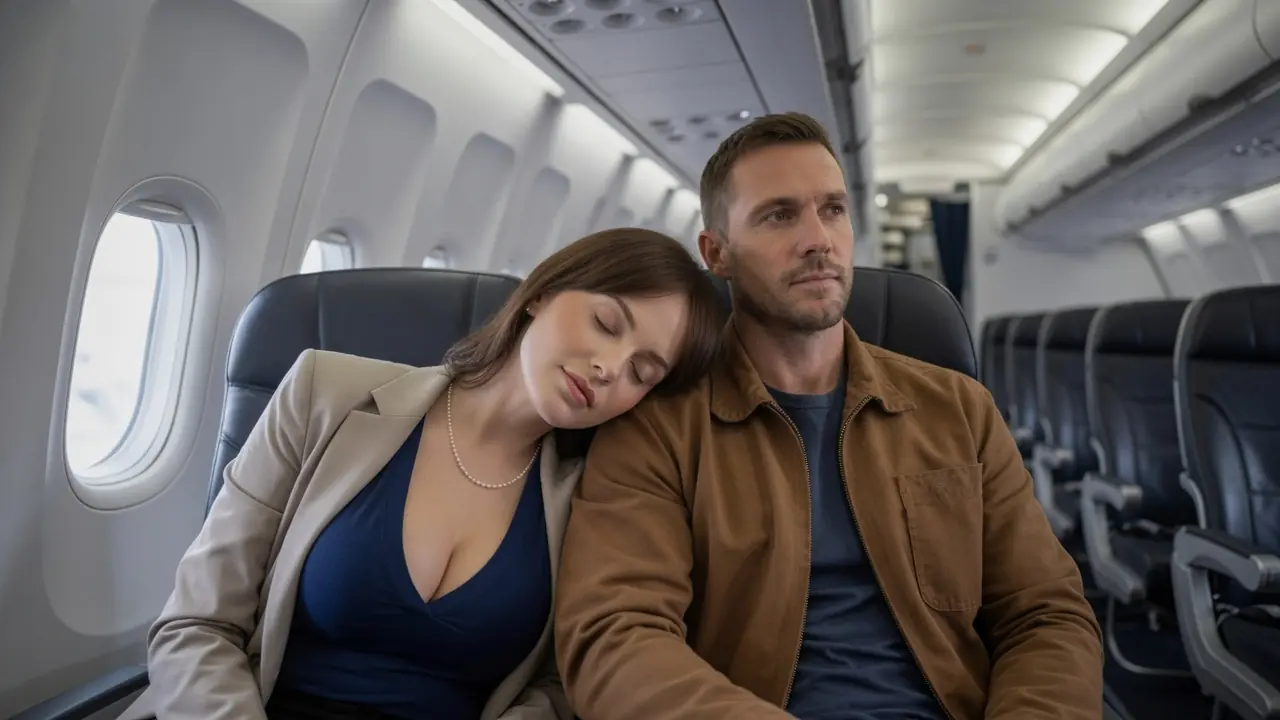
Mortification hit her before she fully understood where she was. Avery Lawson, forty-two years old, CEO of Meridian Aviation, a woman who had faced hostile boardrooms without blinking, had fallen asleep on a complete stranger in economy class. Her assistant had booked her usual first-class seat, but a last-minute aircraft swap had crushed every passenger into a smaller plane with no premium cabin. Now she was in 12B, wearing a fitted navy blouse under a light beige blazer, trying to lift her head without losing the last pieces of her dignity.
The man beside her did not flinch. He sat upright, eyes open, staring forward with a stillness that felt almost military. He was in his mid-thirties, broad-shouldered, tired, and unshaven, with calloused hands resting near the armrest. On his other side, a little boy slept against him, clutching a worn stuffed elephant beneath one small arm.
“I’m sorry,” Avery whispered, smoothing her hair and straightening her blazer. “I didn’t mean to fall asleep on you.”
The man’s expression barely changed. “It’s fine.”
His voice was low and rough, but not unkind. Avery searched his face for irritation and found none. That somehow made her more embarrassed.
“That was unprofessional of me,” she said.
He glanced at her then, one corner of his mouth moving slightly. “We’re in a metal tube over the Midwest at midnight. I think professional got left behind somewhere after takeoff.”
Despite herself, Avery smiled. She looked again at the sleeping boy. “Your son?”
“Ethan,” he said, and the hardness in his face softened instantly. “Six years old.”
“He looks exhausted.”
“We both are.”
Avery heard something behind the words. Grief, maybe. Or a kind of tiredness that did not come from missed sleep alone. She knew that kind of tiredness because she carried her own version through board meetings, legal calls, and empty hotel rooms where the lights stayed on too late.
“I’m Avery,” she said, offering her hand.
He looked at her hand for a moment before taking it. “Owen Parker.”
His grip was firm, rough, warm. Not the hand of a man who spent his life behind a desk. Avery had met enough mechanics, engineers, and pilots to recognize hands shaped by practical work.
“What do you do, Owen Parker?” she asked.
“Mechanic. Small aircraft mostly. Contract work around Boeing Field.”
Avery’s attention sharpened. “Aviation?”
“Some.”
“What kind of some?”
His jaw tightened almost imperceptibly. “Enough to pay rent.”
Avery knew deflection when she heard it. She used it herself when reporters asked about her private life or board members asked why she never took vacations. She did not press him. Instead, she looked down and noticed his fingers moving lightly against his thigh.
Small motions. Precise. A slight pull, a correction, a subtle rotation.
Control inputs.
“You’re not just a mechanic,” she said quietly.
Owen’s hand went still.
Avery lowered her voice so she would not wake Ethan. “Those are pilot movements.”
Owen stared forward. “Was a pilot.”
“Military?”
“Air Force.”
There it was. Avery felt pieces align in her mind: the posture, the alertness, the way he watched the cabin without appearing to watch it. He was not merely sitting beside her. He was aware of exits, crew movement, passenger behavior, engine sound, all of it.
“Why did you stop?” she asked.
His face closed. “Some questions don’t need answering at thirty thousand feet.”
The sharpness in his voice surprised her. It was not rude exactly, but it was a warning. Avery nodded once and leaned back. “Fair enough.”
For several minutes, neither of them spoke. Ethan breathed softly against his father’s arm. The cabin around them settled into the restless silence of an overnight flight, full of sleeping passengers, flickering screens, and the faint rustle of blankets.
Then the plane shook.
At first it was ordinary turbulence. A few bumps. A soft dip. The seatbelt sign chimed overhead, and a flight attendant’s voice came across the cabin speakers, asking everyone to remain seated. Avery had flown thousands of times. She understood turbulence the way some people understood weather through a kitchen window.
But Owen changed.
His shoulders tightened. His eyes lifted toward the overhead panels, then toward the aisle, then toward the emergency exits. His fingers no longer moved like memory. They held still like restraint.
“It’s just turbulence,” Avery said.
“Maybe.”
The answer chilled her more than it should have.
The plane dipped again, harder this time. Ethan stirred and made a frightened little sound. Owen immediately turned toward him, wrapping one arm around the boy.
“Dad’s here, buddy,” he murmured. “Just a bumpy road.”
Ethan blinked sleepily. “Are we okay?”
“We’re okay.”
Avery watched the way Owen’s voice changed for his son. Calm, steady, absolute. Whatever fear lived inside him, he kept it away from Ethan like a father holding back wind with his own body.
The turbulence grew worse over the next ten minutes. A baby began crying somewhere behind them. A woman across the aisle gripped her armrests. Overhead bins creaked, and the cabin lights flickered once, briefly enough that some passengers pretended not to notice.
Owen noticed.
Avery saw his eyes track toward the wing outside the window. The aircraft gave a sharp sideways lurch, and a service cart crashed somewhere toward the back with a metallic bang. People gasped. Ethan jerked awake fully, clutching his stuffed elephant.
“Dad?”
“I’ve got you,” Owen said, pulling him close.
The captain’s voice came over the speaker, professional but strained. “Ladies and gentlemen, we’ve encountered unexpected severe weather. Please remain seated with your seatbelts securely fastened. Flight attendants, take your seats immediately.”
Avery’s stomach tightened. Flight attendants take your seats immediately was not routine.
The aircraft dropped. Not a gentle dip, but a sudden fall that stole the breath from the cabin. Screams broke out. Oxygen masks dropped from the ceiling in a chaotic cascade of yellow cups and clear tubes.
Owen moved before anyone else in their row. He grabbed three masks, pulled sharply to test the flow, secured Ethan’s first, then passed one to Avery. His hands were fast, exact, trained.
“Put it on,” he ordered.
Avery obeyed.
Ethan was crying now, muffled beneath the mask. Owen held the boy’s face between both hands. “Eyes on me. Breathe with me. In. Out. That’s it. You’re doing great.”
Avery found herself breathing with them.
The intercom crackled again. This time it was not the captain. It was a flight attendant, and the panic beneath her voice was impossible to hide.
“Is there anyone on board with flight experience? We have an emergency in the cockpit. Anyone with pilot training, please press your call button immediately.”
The entire cabin went silent.
Avery turned slowly toward Owen.
His face had lost all color. His eyes were fixed forward, but he was no longer seeing the seatback. He was somewhere else, somewhere terrible. His breathing grew ragged beneath the oxygen mask.
“You have to help,” Avery whispered.
“No.”
The word came out flat and dead.
“Owen.”
“I said no.”
Avery leaned closer. “They asked for a pilot.”
“I’m not a pilot anymore.”
“You were Air Force.”
His eyes snapped to hers, sharp with panic and anger. “Was. Past tense.”
The flight attendant staggered down the aisle, gripping seatbacks as the plane bucked beneath her. She was young, pale, and bleeding from a small cut near her eyebrow. Her eyes swept the passengers desperately and landed on Owen.
“Sir,” she said, voice shaking. “Do you have flight experience?”
Owen did not answer.
Avery spoke for him. “He does. Air Force transport.”
Owen turned on her, furious. “Don’t.”
The flight attendant grabbed the seat beside them to steady herself. “Please. The captain is unconscious. The first officer is trying to fly alone, but the autopilot is malfunctioning, and we’re losing systems. We need help now.”
Ethan’s small voice broke through everything. “Dad, are we going to die?”
Owen froze.
Avery watched the question strike him deeper than any alarm, any turbulence, any command ever could. His son stared up at him with terrified eyes, mask pressed to his small face, stuffed elephant crushed against his chest. Owen’s hands shook once, then stopped.
“No,” Owen said.
The word was different this time. Not denial. Decision.
He unbuckled his seatbelt, then Ethan’s, and pulled the boy into a fierce embrace. “Listen to me. I have to go help the pilots for a little while.”
“No, Daddy, don’t go.”
“I’ll come back.”
“Promise?”
Owen closed his eyes for half a second. When he opened them, they were wet, but steady. “I promise.”
He turned to Avery. “His name is Ethan Parker. He’s six. Birthday is March fifteenth. He’s allergic to shellfish. He likes dinosaurs, space books, and that elephant is Mr. Trunks.”
Avery’s throat tightened. “Owen, stop.”
“If I don’t come back,” he said, voice low and brutal, “you make sure someone knows who he is. You make sure he matters.”
“You are coming back.”
His stare hardened. “Promise me.”
Avery nodded, tears burning in her eyes. “I promise. But you are coming back to him.”
Owen kissed the top of Ethan’s head, released him, and stood. The aircraft lurched violently, but he caught himself on the seatback. For one second, he looked at his son. Then he turned toward the front of the plane.
Avery pulled Ethan into her arms as Owen disappeared down the aisle.
The next minutes stretched into something unreal. The plane dipped and shuddered, rain battering the windows though they were still above the clouds. The cabin lights dimmed into emergency glow. Passengers prayed, sobbed, clutched strangers’ hands. Avery held Ethan tightly and tried to sound calm.
“He’s going to save us, isn’t he?” Ethan whispered.
Avery looked toward the cockpit door where Owen had vanished. “Yes,” she said. “He is.”
Inside the cockpit, Owen Parker faced the thing he had spent five years trying to escape.
The smell of instruments, metal, recycled air, and fear hit him like a memory. The first officer, Sarah Chen, sat in the right seat, pale and shaking but still fighting the aircraft. The captain was unconscious behind her, being attended by a flight attendant who looked nearly as terrified as everyone else.
“You’re the pilot?” Sarah gasped.
“Former Air Force,” Owen said, sliding into the captain’s seat. “Not current commercial. Give me a sitrep.”
“I can’t keep it stable,” Sarah said. “Autopilot is gone. Main computer is down. Backup is cycling errors. Hydraulics are degraded. Number two engine is overheating. Seattle is fogged in, and we’re losing altitude too fast.”
“Breathe,” Owen snapped.
Sarah blinked.
“I need you useful, not panicked. Breathe and give me numbers.”
The command steadied her. Training rose through fear. “Altitude eleven thousand. Descending eight hundred feet per minute. Airspeed two-twenty. Both engines running, but number two temperature rising. Weather below minimums. Seattle recommends Portland, but I don’t think we have time.”
Owen looked at the instruments. His hands found the controls, and the old terror screamed through him. He saw another cockpit, another storm, another man named Jake sitting beside him in a military aircraft that never made it home.
He forced the memory down.
Ethan was behind him.
Three hundred passengers were behind him.
“Seattle Approach, this is Northwest 447,” Owen said into the radio. “We have a cockpit medical emergency and multiple systems failures. Former Air Force pilot assisting. Request vectors for immediate landing.”
Static, then a voice. “Northwest 447, we read you. Confirm qualified pilot at controls?”
“Qualified enough to be your best option.”
A pause. “Copy that, 447. We’ll get you down.”
The number two engine failed seven minutes later.
Alarms screamed. Sarah shouted the temperature warning, but Owen was already moving. Fuel cutoff. Fire suppression. Engine secured. The aircraft yawed hard, the remaining engine fighting alone through storm and crosswind.
Sarah’s voice shook. “We lost thrust.”
“We still have one engine,” Owen said. “That’s enough if we stop wasting fear on what we don’t have.”
He did not know if he was speaking to Sarah or himself.
Seattle cleared them for Runway 16 Left. The weather was terrible: heavy rain, low ceiling, bad visibility, crosswinds near the edge of safe limits. The aircraft was damaged, heavy, and sluggish. Hydraulics lagged behind every input. Owen had to feel each movement before it fully happened, correcting seconds ahead like a man steering through mud.
Sarah called the checklist. Owen answered. Together, they became a crew.
“Gear?”
“Down.”
“Flaps?”
“Twenty-five. No more. We’ll lose what’s left of the hydraulics.”
“Airspeed?”
“One-sixty-five.”
“Too fast.”
“I know.”
The runway was invisible until the last moments. At five hundred feet, they saw nothing. At four hundred, the wind threw them off course. At three hundred, Avery’s voice flashed through Owen’s mind: You are coming back to him.
Then the approach lights appeared, faint and white through the rain.
“I’ve got the runway,” Sarah shouted.
Owen saw it too. The most beautiful strip of lights he had ever seen. They were high, fast, and fighting a crosswind that wanted to shove them sideways. There was no chance to go around. No second try.
At fifty feet, the aircraft drifted.
“Off centerline,” Sarah warned.
“I know.”
At twenty feet, Owen cut power and pulled back into the flare. The plane hung for a heartbeat between sky and ground.
Then it hit.
The landing was hard, ugly, and violent, but it was a landing. The right main gear collapsed under the side load, and the aircraft scraped along the runway in a shower of sparks. Sarah cried out, but Owen kept the nose from swinging too far. He held what control remained until the aircraft finally stopped.
For three seconds, there was only rain, alarms, and breathing.
Then Owen said, “We’re down. We’re alive.”
Evacuation followed in chaos. Owen rushed back into the cabin, shouting Ethan’s name. Avery had already unbuckled the boy and was helping an elderly passenger into the aisle. Ethan broke free and threw himself at his father.
“You came back,” Ethan sobbed.
Owen held him so tightly the boy squeaked. “I promised.”
Avery looked at Owen over Ethan’s shoulder. Her navy blouse was wrinkled, her beige blazer stained, and there was a small cut at her temple, but her eyes were steady. “We need to move. Fuel.”
Owen nodded.
They helped passengers toward the exits. Flight attendants shouted commands. Slides deployed into the rain. Owen sent Avery down first, then Ethan, then kept helping until the cabin was clear. Only when the last passenger was out did he slide down himself.
On the runway, firefighters pulled him away from the aircraft. Ethan ran to him through foam and rain, ignoring everyone trying to stop him. Owen dropped to his knees and caught his son, and this time he cried without trying to hide it.
“You saved everyone,” Ethan said, patting his father’s face. “You’re a hero.”
Owen could not answer.
Avery stood beside them, watching the man she had dismissed as just a tired stranger. Only now she understood the terrible truth. Her company had rejected him before he ever entered an interview room.
She learned the details before dawn.
Owen had applied to Meridian Aviation three times. Each application had been rejected automatically by hiring filters because of employment gaps, PTSD-related medical notes, and an incomplete commercial recertification path. No human being had reviewed his file. No one had seen the Air Force record beneath the trauma. No one had seen the man who could land a failing aircraft in a storm when every system around him broke.
Avery invited Owen and Ethan to her home that night because reporters had already found his apartment. In her kitchen, after Ethan fell asleep upstairs, Owen sat across from her in borrowed clothes, hands wrapped around a mug of tea.
“You looked me up,” he said.
“Yes.”
“And?”
Avery’s face was pale with exhaustion and guilt. “Meridian rejected you three times.”
Owen gave a bitter laugh. “So did everyone else.”
“My company rejected you without a person ever reading your file.”
“That’s efficient.”
“It’s shameful.”
He looked at her. “You didn’t know me.”
“No,” Avery said. “But the system should have known enough to look closer.”
Owen stared into the tea. “Systems don’t care who they miss.”
“Mine will.”
He looked up, skeptical. “Because you feel guilty?”
“Because I should feel responsible.”
There was a difference, and both of them knew it.
Avery leaned forward. “Tomorrow I’m changing the hiring review process. Veteran applicants, pilots with trauma history, people with gaps after service, none of them get thrown away by an algorithm again. A human panel reviews every case.”
“That won’t fix me.”
“I’m not trying to fix you.”
“Then what are you trying to do?”
She held his gaze. “Hire you.”
Owen stared at her.
“Not as a pilot,” Avery said quickly. “Not unless you decide that path is right someday. I want you as Director of Pilot Integration and Support. Help us find the people the system rejects. Help us build a real path back for skilled pilots who need support, not silence.”
Owen stood abruptly. “You watched me barely hold myself together and thought, corporate title?”
“I watched you save three hundred lives while terrified.”
“That doesn’t make me qualified.”
Avery’s voice sharpened. “No, Owen. It makes you exactly the man I should have found before the crash.”
His jaw tightened. “You don’t get to turn my worst night into your redemption project.”
The words struck her, and for a moment she said nothing.
Then she nodded. “You’re right.”
That disarmed him more than an argument would have.
Avery stood too, but kept her distance. “I don’t want to use you. I don’t want your story polished into a press release. But I run the company whose aircraft you landed, and I approved the system that rejected you. If I walk away from that after tonight, then I deserve every bit of blame coming to me.”
Owen looked toward the stairs where Ethan slept. “I just want my son safe.”
“Then take the job because it gives him health insurance, stability, and a room with an actual door,” Avery said. “Or refuse it because you don’t trust me. But don’t refuse because some broken system taught you that you’re worth less than what you did tonight.”
The kitchen went silent.
Owen lowered his eyes. “I don’t know how to be that man anymore.”
Avery’s voice softened. “Maybe you don’t have to be the man you were. Maybe you get to be someone who survived him.”
He closed his eyes.
For five years, Owen had measured himself by the cockpit he could not enter, the friend he could not save, the applications that never became interviews, and the panic that lived under his ribs. That night had not erased the fear. It had not healed everything. But it had proven something he had stopped believing.
He could still answer when it mattered.
“I’ll think about it,” he said.
Avery nodded. “That’s enough.”
In the weeks that followed, the crash investigation confirmed what the passengers already knew: Flight 447 survived because Sarah Chen kept the aircraft flying long enough for Owen Parker to reach the cockpit, and because Owen and Sarah worked together through system failures that should have ended far worse. The media called Owen a hero. He hated the word. Ethan loved it and told everyone at school his dad had landed a plane with one engine.
Avery kept her promise. Meridian Aviation dismantled the automatic rejection filters that had erased people like Owen. A new review board was created for veterans and pilots with medical or trauma-related gaps. Sarah Chen became part of the training review process after completing counseling and returning to flight duty.
Owen accepted the job after three weeks.
On his first day at Meridian, he wore a navy suit Avery’s assistant helped him choose, though he kept his old mechanic’s watch on his wrist. Avery met him outside the glass conference room where executives waited to hear from the man who had exposed their failure simply by surviving it.
“You ready?” she asked.
“No.”
“Good,” Avery said. “That means you’ll tell the truth.”
Owen looked through the glass at the polished table, the laptops, the people who made decisions about pilots they had never met. Then he thought of Ethan sleeping against him on the plane, of Avery waking on his shoulder, of Sarah’s shaking voice in the cockpit, of three hundred lives depending on a man the system had labeled too risky to consider.
He opened the door.
Inside, the room fell silent.
Owen did not begin with heroism. He did not begin with the landing. He began with a sentence that made every executive look up.
“Your system decided I was safer outside the cockpit than inside it. Flight 447 proved your system was wrong.”
Avery stood at the back of the room, arms folded, eyes fixed on him.
Owen continued. “I am not here because I’m perfect. I am here because imperfection is not the same as useless. Trauma is not the same as incompetence. A gap in employment is not the same as a lack of skill. If your process cannot tell the difference, then your process is not protecting passengers. It is hiding from complexity.”
No one interrupted.
For the first time in years, Owen Parker stood in an aviation room and did not feel like a rejected man begging for permission to matter. He felt like a father, a pilot, a survivor, and a witness to what systems miss when they stop seeing people.
Months later, Ethan had his own room in a small house near a good school. Owen still went to therapy. He still had bad nights. He still sometimes woke with his heart racing and the echo of alarms in his ears. But he also began flying again in simulators, slowly, carefully, with support instead of shame.
Avery remained part of his life in a way neither of them rushed to define. Sometimes she came to dinner. Sometimes Ethan fell asleep on the couch while they talked late into the night about work, fear, responsibility, and the strange mercy of chance seating assignments. Owen teased her once that she had terrible airplane etiquette.
She smiled and said, “Falling asleep on your shoulder was the best mistake I ever made.”
He looked at her, remembering the first moment she woke embarrassed in 12B, wearing that navy blouse and trying to rebuild her CEO armor before anyone noticed she was human.
“It wasn’t a mistake,” he said.
“No?”
“No,” Owen said, glancing toward Ethan’s room. “It was where the story started.”
And somewhere in Meridian Aviation’s new pilot support office, framed beside the first revised hiring policy, was a photograph of Flight 447 on the runway after every passenger had survived. Beneath it were words Owen had written himself.
A person is more than the worst thing that happened to them.
Avery read those words often.
So did Owen.
And every time he did, he remembered that the sky had not been returned to him all at once. It had come back through terror, through love, through one frightened child asking if they were going to die, and one broken father deciding the answer was no.