Clare Donovan had spent most of her adult life proving she did not need anyone to rescue her.
At thirty-four years old, she was the founder and CEO of Donovan Enterprises, a company that had begun in a cramped rented office above a failing travel agency with two borrowed laptops, one broken printer, and a bank account that looked more like a warning than a business plan.
Back then, the carpet in the office had smelled faintly of dust and old cigarette smoke. The heat barely worked in winter. The windows rattled every time a truck passed on the street below.
Clare had eaten instant noodles over financial spreadsheets, answered client emails at two in the morning, and taken meetings with men who smiled kindly while making it clear they did not believe she would last six months. Some called her ambitious in the same tone they might have used to describe a child reaching for something too high on a shelf. Others advised her to find a “more experienced partner,” which always meant a man they could feel more comfortable trusting. Clare listened, smiled politely, and went back to work.
Twelve years later, those same men requested meetings with her assistant.
Donovan Enterprises now had offices in six cities, nearly nine hundred employees, and contracts with clients who once would not have returned Clare’s emails. The company handled strategic logistics, infrastructure consulting, and corporate restructuring for clients large enough to reshape entire regions with one signed agreement. Her decisions affected ports, rail networks, manufacturing plants, disaster recovery contracts, and corporate supply chains stretching across the country. When Clare spoke in a boardroom, people took notes.
Her name appeared in business magazines, on conference banners, in investor reports, and on annual lists celebrating women who had built their own empires from nothing but stubbornness, discipline, and skill. People called her brilliant. Relentless. Disciplined. Impossible to intimidate. They said it with admiration when she was in the room and with resentment when she was not.
Clare had learned to accept both.
She lived in a glass penthouse overlooking the city, thirty-four floors above sidewalks crowded with people who had no idea that the woman behind those windows often stood barefoot in the dark, holding a cup of tea she forgot to drink, wondering how a life so full of achievement could still feel so empty. Her home was beautiful in a way that impressed visitors but comforted no one. White marble counters gleamed under recessed lights. Floor-to-ceiling windows reflected the skyline at night. Sculptural furniture sat exactly where a designer had placed it, as if the rooms were meant to be photographed rather than lived in.
A dining table that could seat ten stood near the windows, though no one had eaten dinner at it in months. Fresh flowers arrived twice a week from a florist her assistant paid automatically. The flowers were always perfect. Clare rarely noticed them. Sometimes they wilted before she remembered they had been there at all.
Her closet was arranged by color. Her shoes stood in quiet rows. Her calendar was planned in fifteen-minute blocks. Her life functioned with the kind of precision people envied from a distance, because they could not see what that precision had cost. Clare had learned to make every moment useful because useless moments gave loneliness room to speak.
Control had become Clare’s religion.
She knew how to read contracts at a glance, how to predict market shifts before competitors noticed the first signs, and how to turn silence into pressure during negotiations. She sat at the head of boardroom tables where powerful men twice her age lowered their voices when she spoke. She had built a reputation for never blinking first. It was useful, that reputation. It also made it difficult to admit that sometimes she was simply tired.
That Thursday morning, Clare had closed a deal worth millions at Ashford Ridge Resort. The luncheon had been arranged by a regional development council eager to attract private infrastructure investment, and Clare had been invited as both keynote speaker and proof that ambition could be polished into something donors liked applauding. She had stood behind a podium in a cream suit and spoken about opportunity, leadership, and women building independent futures. People had risen to their feet when she finished.
Afterward, a line formed around her. Executives wanted introductions. Donors wanted photographs. Younger women wanted advice, and Clare gave it gently because she remembered what it felt like to search powerful rooms for someone who looked even remotely like herself. She smiled until her cheeks ached. She shook hands until the skin between her fingers felt tender. She answered questions about expansion, risk, leadership, and resilience, all while wanting only one thing.
Quiet.
Her assistant, Maya, waited near the exit with a tablet hugged to her chest.
“The car is ready,” Maya said. “Your driver can take the interstate back. You’ll be home by six if traffic behaves.”
“I’ll drive myself.”
Maya blinked.
“You hate driving outside the city.”
“I need air.”
“You need sleep.”
“I’ll settle for air.”
Maya looked at Clare carefully. She was six years younger than Clare, sharp, loyal, and far too observant for Clare’s comfort. “You have three calls tonight.”
“Move them.”
“All three?”
“Yes.”
“Clare.”
“Maya.”
Her assistant sighed, already knowing she had lost. “Take the main road, at least. There’s a mountain route that looks shorter on maps, but cell service is terrible.”
“Noted.”
“Which means you’re going to take it.”
“I said noted. I did not say obeyed.”
Maya closed her eyes briefly. “Please don’t die in the woods. It would ruin my week.”
Clare almost smiled. “I’ll do my best.”
That was how she ended up alone on a deserted mountain road at 4:17 in the afternoon, two hours from the city and twenty miles from the nearest major highway, with the sky hanging low over the ridges and her sleek black car half-angled on the gravel shoulder, expensive and useless.
The road curved through the high ridges outside Ashford Ridge, a quiet mountain town tucked between pine-covered slopes and narrow valleys where fog lingered in the mornings. Tall trees lined the shoulders, their branches combing the gray sky. The air was cool, clean, and sharp enough to remind Clare that she had spent too many years breathing climate-controlled office air. Above her, late autumn clouds gathered like a decision not yet made.
Clare tried the ignition again.
Nothing.
No sputter.
No reluctant engine cough.
Just silence.
She stared at the dashboard as if frustration alone might force the machine to obey.
“Come on,” she whispered.
She turned the key again.
Still nothing.
Her fingers tightened around the steering wheel. That morning, she had stood in front of forty executives and closed a deal worth millions. She had answered every question with calm authority. She had watched three men underestimate her and then sign exactly where she told them to sign. She had walked out of that meeting with investors calling her office before she reached the elevator.
And now, on a mountain road with no signal and no traffic in either direction, she could not make her car start.
The irony was almost insulting.
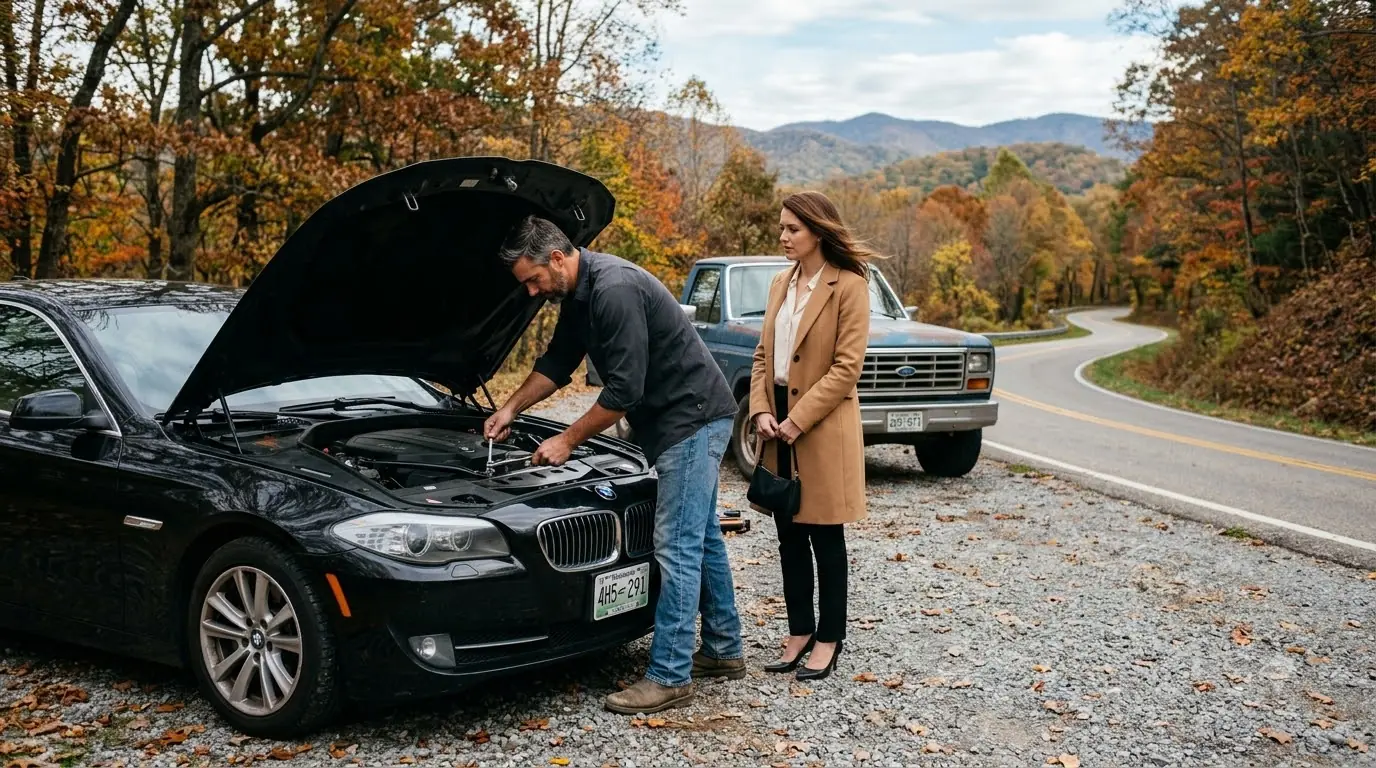
Clare stepped out, her black heels crunching against loose gravel. The wind moved through the trees with a restless, whispering sound. She pulled her tailored camel coat tighter around herself and held up her phone, watching the signal flicker from one bar to none, then back to one, then vanish again. The screen seemed to mock her.
“Of course,” she muttered. “Of all the days.”
She had taken the mountain road because she wanted quiet. That was the explanation she had given herself after leaving the resort. The real truth was that Clare needed distance. From her office. From her board. From investors calling nonstop. From executives who depended on her certainty. From Maya’s carefully worded reminders. From the life she had built so successfully that it sometimes felt like a beautiful prison with better furniture.
She had wanted one afternoon where no one addressed her as Ms. Donovan. One road where she did not have to be strategic. One hour where the phone might lose signal and the world might stop demanding things from her.
Now the world had stopped completely.
And she hated it.
She walked around the car once, as if the act of inspection might magically give her mechanical knowledge she did not possess. She found the hood latch after two embarrassing minutes, lifted the hood, and stared down at an engine that looked less like machinery than accusation. Wires. Tubes. Metal. Silent judgment. She had negotiated infrastructure contracts involving port automation systems and cross-state freight optimization, but she could not tell which component was the battery without reading the tiny diagram on the inside of the hood.
The road behind her remained empty.
The road ahead curved out of sight.
The sky darkened.
A cold uneasiness moved through her. Clare had been in hostile boardrooms, legal disputes, investor attacks, and public criticism sharp enough to leave bruises no one could see. She had handled all of it with discipline. But standing alone beside a dead car in the mountains awakened a different kind of fear, something older and more physical. She was a woman alone on a quiet road. No signal. No passing cars. No certainty that the person who eventually stopped would be safe.
She hated needing help.
She hated needing anyone.
Then, far behind her, an engine sounded.
Not the smooth hum of a new luxury car.
Something older.
Rougher.
Steady.
Clare turned.
An old blue pickup truck appeared around the curve, its paint faded by years of sun, salt, and weather. It slowed as it approached, then pulled onto the shoulder behind her car. The driver did not crowd her bumper. He stopped several yards back, leaving space, as if he understood the first rule of helping a stranger was not making her feel trapped.
The truck door opened with a creak.
A man stepped out.
He was tall, broad-shouldered, and dressed in a dark work shirt rolled at the sleeves, jeans worn pale at the knees, and dusty brown boots. His hands were rough, the hands of a man who fixed things for a living. His dark hair was touched with silver at the temples, and his trimmed beard carried the same faint gray. His face was weathered, not from neglect, but from years of responsibility and sunlight.
He looked at the car first.
Then at Clare.
“Engine trouble?”
His voice was deep, calm, and familiar in a way Clare could not immediately place.
She felt relief first.
Then caution.
“It won’t start,” she said. “I don’t know what’s wrong with it.”
He nodded once, keeping a respectful distance.
“Mind if I take a look?”
She hesitated only a second.
“Please.”
He walked to the front of the car with the easy confidence of someone who had spent his life around engines. Clare returned to the driver’s side, found the hood release again, and stood aside as he lifted the hood fully. He leaned in, studying the battery, cables, and connections with quiet focus. He did not whistle. He did not make a show of expertise. He simply looked.
Clare stood near the driver’s door, watching him work.
There was something about the way he moved.
Not rushed.
Not careless.
He had a stillness that did not feel lazy. It felt grounded. Every motion had a purpose. Every pause meant he was thinking. A strange feeling tugged at her memory. Not recognition exactly. More like the shadow of a song she had once known by heart.
“When’s the last time you had the battery checked?” he asked.