Officer Derek Mason drew his pistol before Marcus Williams had even finished folding the newspaper.
One second, Marcus was sitting beneath the Sunday morning sun with a cup of coffee cooling beside him.
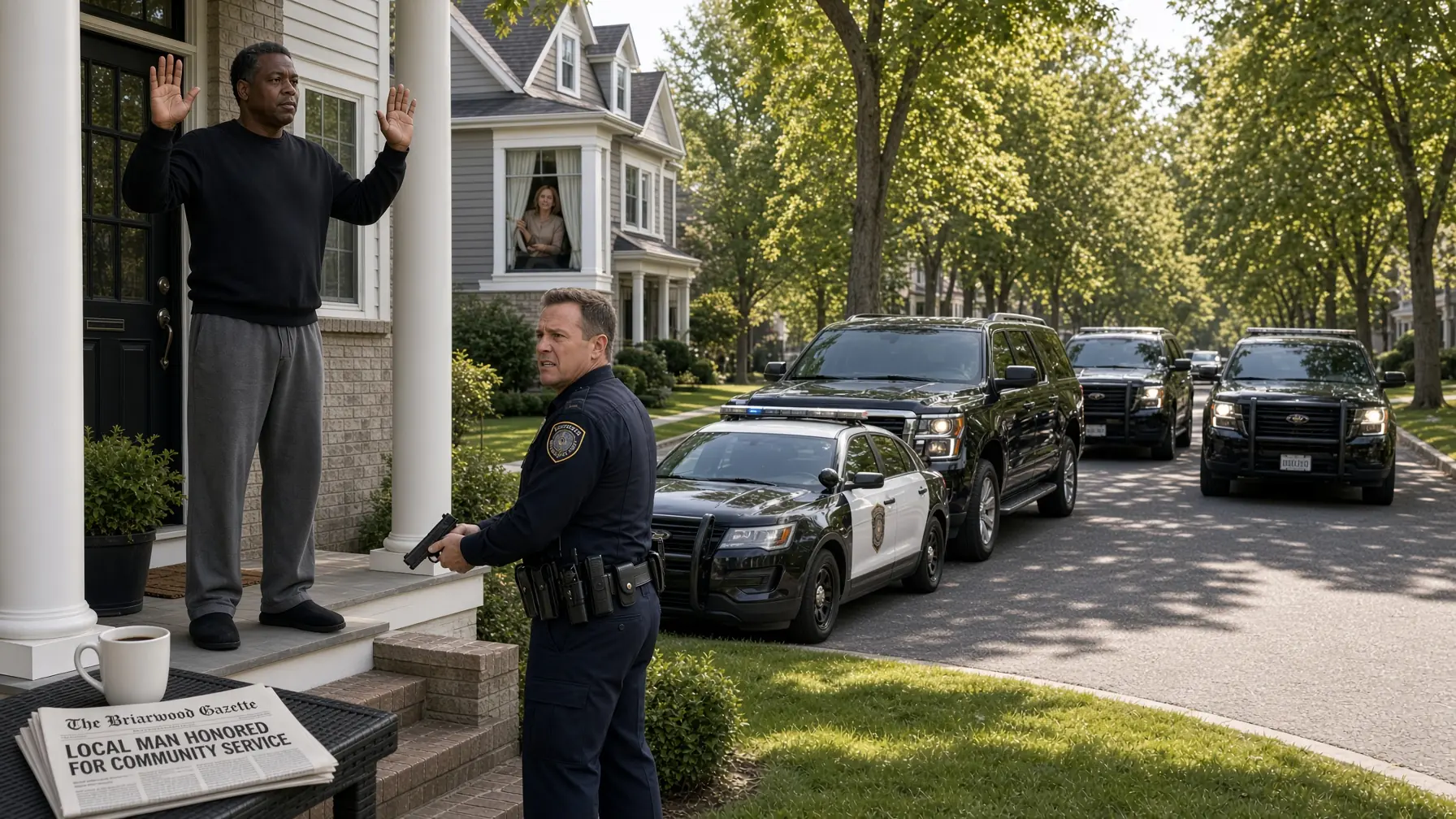
The next, a patrol officer stood at the bottom of his porch steps with both hands wrapped around a service pistol pointed directly at Marcus’s chest.
Birds moved through the maple trees along Briarwood Lane.
A sprinkler clicked three houses away.
Someone was mowing a lawn beyond a wooden fence.
Everything in the neighborhood continued as if a gun had not just been aimed at a man drinking coffee in house slippers.
Marcus did not move.
He folded the newspaper once.
Slowly.
Placed it beside the cup.
“Hands where I can see them.”
Marcus lifted both hands.
“They’re visible.”
“Don't reach for anything.”
“I won't.”
Mason came one step closer.
“What are you doing here?”
Marcus glanced behind him.
White columns.
Blue front door.
A pair of his wife’s gardening gloves near the steps.
Then back at Mason.
“Reading the newspaper.”
“I asked what you're doing at this residence.”
Marcus’s expression changed slightly.
“I live here.”
The gun remained pointed at his chest.
That answer should have changed the encounter.
Not ended it.
Not automatically proven anything.
But changed it.
An officer could verify ownership.
Call dispatch.
Check vehicle registration.
Ask for identification.
Test the house key lying beside Marcus’s coffee.
Any of those things would have taken less time than the gun had already been out.
Mason did none of them.
His eyes moved across Marcus instead.
Black sweatshirt.
Gray sweatpants.
Bare feet inside slippers.
Then the houses around him.
Large lots.
Stone mailboxes.
Expensive cars.
Perfect lawns.
Something in Mason’s stare suggested those details did not fit together.
“You have ID?”
“Inside.”
“Where?”
“Kitchen counter.”
“Don't go for it.”
“I wasn't planning to.”
Mason kept the weapon level.
Marcus studied him.
Not challengingly.
Carefully.
That was the kind of attention Marcus had spent years learning to give people when their decisions mattered.
Mason mistook it for something else.
“Someone else inside?”
“My wife is at church.”
“My daughter went with her.”
“So you're alone.”
“Yes.”
“Whose house?”
“Mine.”
“Name?”
“Marcus Williams.”
Something flickered across Mason’s face.
Recognition without memory.
The name bothered him.
Marcus noticed.
“What was the call?”
“You don't need to worry about that.”
“If someone reported a crime at my house, I’d like to know what crime.”
“I’m asking the questions.”
Marcus nodded once.
That small movement irritated Mason.
There was no panic in Marcus’s voice.
No pleading.
No frantic attempt to prove he belonged.
But calm was not the absence of fear.
Marcus was a Black man standing twenty feet from an armed officer who had already skipped several obvious opportunities to lower his weapon.
One wrong movement could make everything that came afterward irrelevant.
So Marcus kept his palms open.
His feet still.
His voice ordinary.
“Then ask.”
Thirty-eight minutes earlier, Elaine Porter had been standing behind the curtains of number 1187.
She had moved into Briarwood Estates three weeks earlier.
She knew almost nobody.
She knew even less about the Williams house across from hers.
Her real-estate agent had once mentioned an older white couple who had lived there.
Elaine had seen a white-haired man retrieving mail during a showing months earlier.
She did not know that man had been the previous owner.
She did not know Marcus and Renee Williams had bought the house fourteen months earlier.
What Elaine knew was that a Black man in a dark sweatshirt was sitting on the porch of one of the nicest houses on the street.
She watched him drink coffee.
Open a newspaper.
Stand once to retrieve another section from the front step.
Then sit down again.
Nothing criminal happened.
That did not stop the discomfort growing inside her.
At 8:22 a.m., she called the police non-emergency line.
The dispatcher asked:
“What exactly is he doing?”
“Sitting on the porch.”
“Trying to enter?”
“No.”