“Three years dead, Henry. Cut the damn thing down.”
The county extension agent tapped the black walnut’s trunk with his knuckles, then gestured toward the bare gray branches above the fence. His clipboard rested against his charcoal field jacket, and the look on his face suggested he had already spent more time on this tree than it deserved.
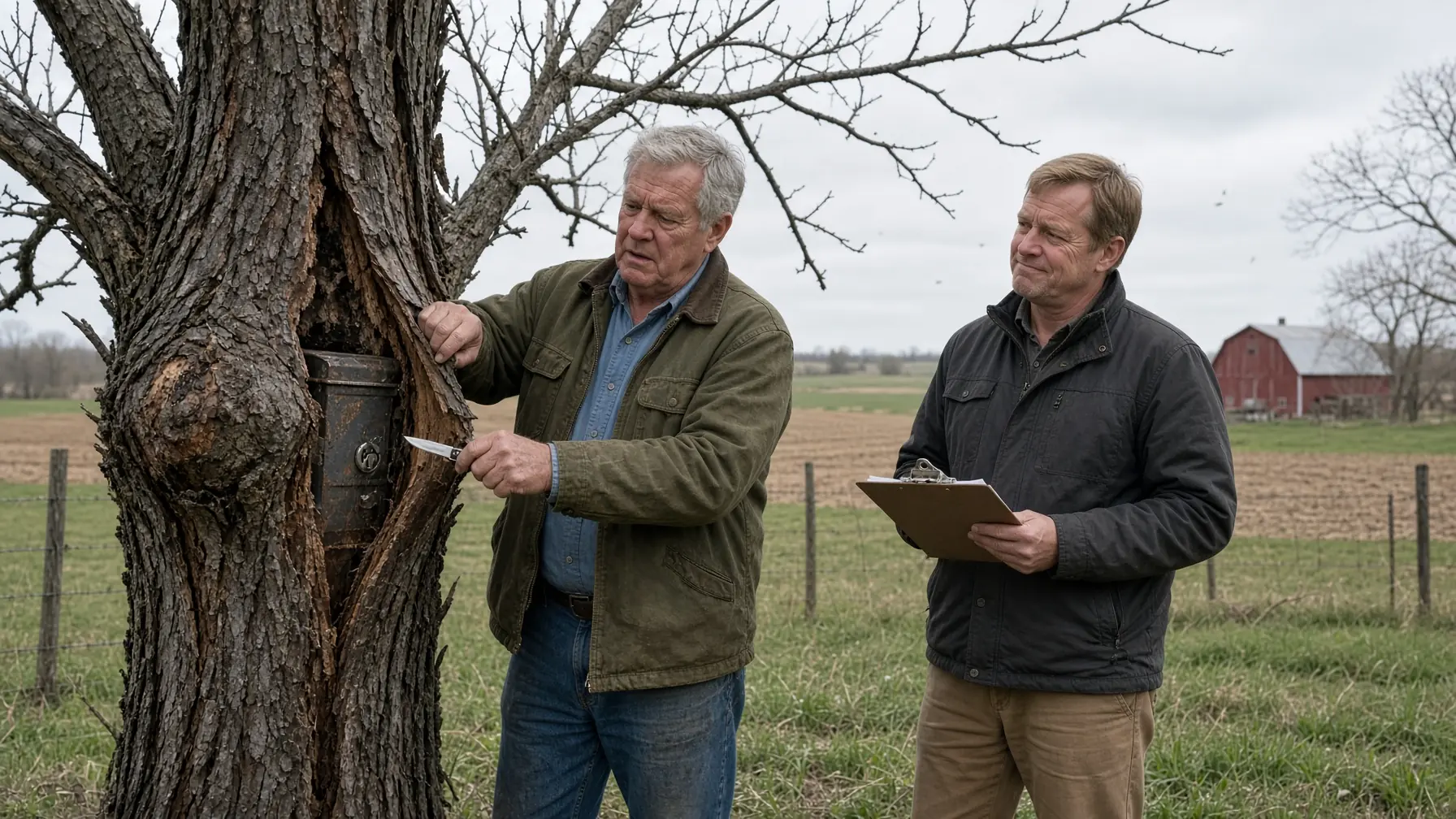
Henry Walker did not answer immediately.
He stood beside the trunk with one muddy boot on the grass and the other near a shallow root, looking at a swollen place beneath a sheet of loose bark. At sixty-eight, he knew what dying wood looked like.
This did not look quite right.
The agent glanced toward the weathered pickup parked nearby, then back at Henry. Beyond them, the north pasture stretched toward cultivated fields and a faded red barn under the low clouds of a late April morning.
Henry placed his palm against the lump.
The surface beneath the bark felt cold and hard.
“My granddad planted this,” he said.
The agent gave a short laugh.
“That won’t stop it falling.”
Henry knew that.
Knowing it had not made bringing a saw to the pasture any easier.
The evening before, he had put one in the bed of the pickup. He checked the chain, topped up the oil, and set a fuel can beside it, then stood looking at the equipment as though somebody else had arranged it there.
He was not a man who usually delayed necessary work.
If a gate sagged, he repaired it before an animal found the opening. If the tractor developed a new sound, he stopped long enough to decide whether it could safely finish the job.
His farm had survived partly because he did not confuse hoping with checking.
But the walnut was different.
He had spent three years finding reasons to leave it until the next quiet week, the next stretch of dry weather, the next time somebody could help him handle the branches.
There was always another job.
That was the truth.
It was also an excuse.
The tree stood near the wire fence in the north pasture, far enough from the house that it could remain out of sight for days if Henry stayed busy elsewhere. He could drive toward the barn, work the fields, and come home without having to look directly at the empty branches.
When he did look, the shape was still familiar.
That was what made it difficult.
The leaves were gone, but the tree itself held the outline it had carried through most of his life. Its broad trunk leaned slightly away from the fence, and one long limb extended toward the pasture like an arm held out for balance.
Henry could remember sitting beneath it with his grandfather.
He could remember his father parking a tractor in its shade while they worked along the fence.
He could remember standing there as a young man, feeling that the farm was enormous and that he had time to learn every inch of it.
Now the tree was dead.
The farm was still large enough to keep him tired.
Time felt much smaller.
That afternoon, he had found a broken piece of branch on the grass.
It was not a large limb, but it had fallen close to the fence. The pale wood inside was dry, and the bark came away when he lifted it.
Henry carried it to the pickup.
For several seconds, he held it over the bed without letting go.
A small fallen branch did not mean the entire tree would come down tomorrow. He knew that, too.
But it was another sign he could not reasonably ignore.
He set the branch beside the saw.
Then he walked back toward the trunk.
The pasture had been wet from recent rain, with darker patches where the ground still held moisture. He placed his boots carefully, following the firmer line beside the fence.
The walnut’s bark looked different close up.
It had always been deeply ridged, broken into dark, rough plates. As a boy, Henry used to run his fingers along those ridges and imagine he could follow them all the way to the top.
Now some plates had loosened.
One section near chest height stood away from the trunk at its lower edge.
Behind it, something pushed outward.
Henry stopped.
He had seen the unevenness before without paying much attention. Old trees developed odd shapes, and a trunk that size had endured enough weather and damage to carry plenty of irregular places.
But the loose bark had changed the outline.
There was a corner where he expected a curve.
He stepped closer.
The light was beginning to fade, and his eyes were tired from the day. He pressed lightly against the projecting bark, then withdrew his hand.
It felt unusually firm.
Henry looked upward.
He did not want to stand there worrying at the trunk while dead limbs hung above him. Nor did he want to start dismantling a tree alone at the end of a long afternoon.
He walked back to the pickup.
The saw remained in the bed.
He drove home without using it.
Inside the farmhouse, he washed his hands and put a kettle on.