The morning everyone in Caldwell County began calling Marin Holt reckless, she stood at the edge of her family’s wheat field with mud drying beneath her fingernails. At twenty years old, she had a softly freckled face, tense hazel eyes, and chestnut-brown hair twisted into a loose low bun with stray strands brushing her cheeks. Her faded blue-gray work dress reached her ankles beneath a heavily stained beige canvas apron, and her worn brown boots were planted firmly in the dust. Forty acres of ripe golden wheat moved behind her while every other combine in the valley roared toward the approaching storm.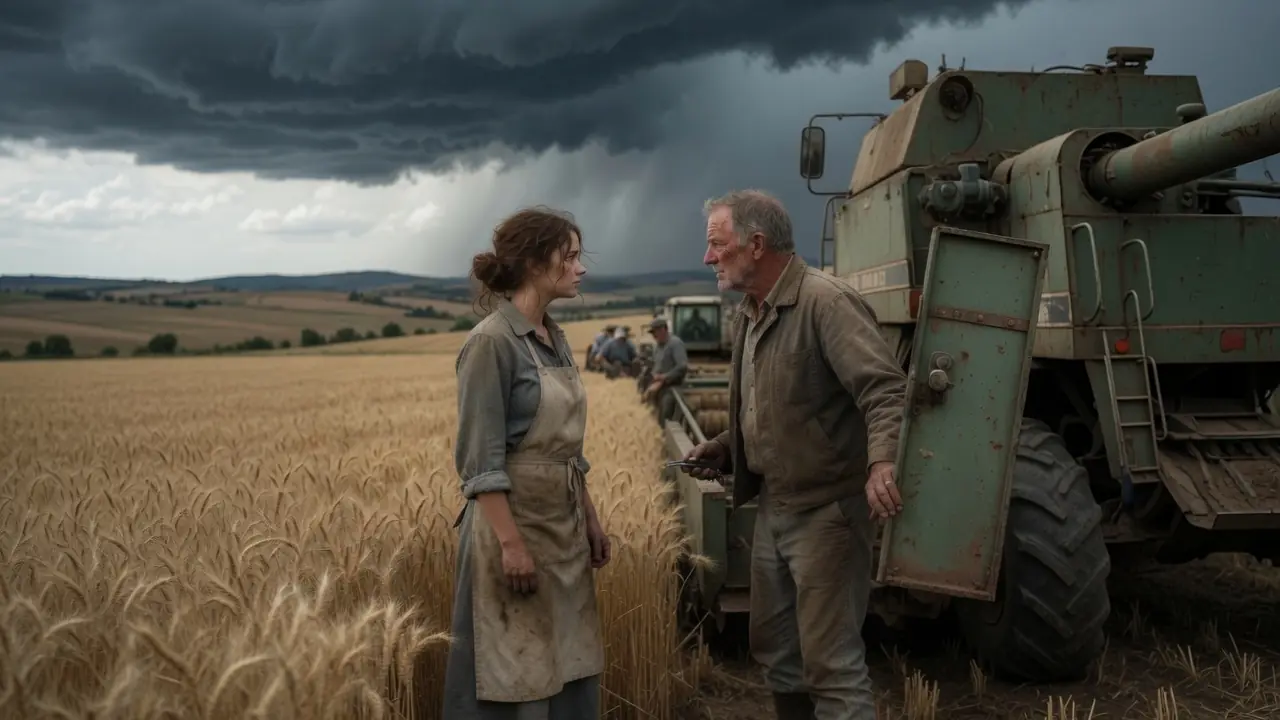
Walt Hendricks drove his pickup through the Holt gate shortly before noon. He was sixty-one, broad through the shoulders, with short gray hair and a deeply lined face shaped by decades of sun, cold, and hard opinions. He stopped beside the family combine and stared at the untouched field as if Marin had deliberately insulted every farmer who had ever planted wheat. “Your father’s farm will die because a stubborn girl thinks she understands weather,” he said.
Marin did not turn toward him. “I understand this field better than you understand your fear.”
Walt climbed down from the truck and reached for the combine door. “Move, or I’ll harvest every acre before you ruin it.”
Marin stepped directly between him and the machine. “Touch that machine—and tomorrow your grain will prove why I waited.”
The statement traveled through the valley faster than any official forecast. By lunchtime, men at the feed store were repeating it with amused disbelief, changing the wording slightly each time. At the diner, people said grief and exhaustion had finally made Marin irrational. By evening, everyone seemed to agree that the Holt girl was about to destroy the last good crop her injured father had left.
Four months earlier, Marin’s father, Thomas Holt, had collapsed inside the machine shed during spring planting. A stroke weakened the left side of his body and stole the certainty from his movements, leaving him unable to climb machinery or walk the fields without assistance. He returned from the hospital alive, but the farm returned with him as a question no one knew how to answer. Marin’s older brother had moved to St. Louis years before and made it clear that he would not abandon his career to manage three hundred acres of wheat and hay.
The work fell to Marin.
At first, the neighbors praised her. They admired the young woman rising before dawn, repairing fences, checking cattle, calculating diesel costs, and driving machinery men twice her age treated with caution. Their respect lasted as long as Marin remained the hardworking daughter doing her best under tragic circumstances. It began fading when she stopped accepting every piece of advice they offered.
Three weeks before harvest, Marin began walking the wheat field every evening. She carried a notebook, a moisture tester, and a narrow wooden stake marked with measurements. She examined the heads of grain, pressed kernels between her fingers, studied the low ground near the creek, and watched the direction birds flew before dusk. None of her actions appeared important enough to explain why she delayed the harvest.
The regional forecast showed a slow-moving storm system developing over the plains. Meteorologists warned of heavy rain, powerful wind, and possible flash flooding near low creeks. Agricultural advisers urged farmers to cut immediately because mature wheat left standing could lodge beneath wind, sprout after rain, or rot before machinery could enter the field again. Caldwell County responded with engines, lights, and panic.
Combines ran past midnight. Grain trucks crowded the elevator, where drivers waited hours to unload before returning to their fields. Families who normally guarded equipment from one another began sharing machinery because no one wanted a neighbor’s wheat destroyed. In the middle of that frantic movement, the Holt field remained golden and untouched.
Thomas watched from the farmhouse porch as Marin returned from another inspection. His cane rested against the chair, and a wool blanket covered his weakened legs despite the summer heat. He had trusted her with planting decisions, livestock care, and machinery repairs, but leaving ripe wheat beneath a dangerous sky required a different kind of trust. “Are you sure?” he asked.
“As sure as I can be.”
“That is not the same as certain.”
“No farmer is certain.”
Thomas looked across the field. “Your grandfather used to say certainty was something people invented after the harvest.”
“That sounds like him.”
“Is this about his journals?”
Marin stopped.
Her grandfather, Silas Holt, had kept detailed field journals for more than forty years. The notebooks remained inside a dented metal box in the attic, filled with dates, rainfall totals, crop diseases, wind directions, seed varieties, machinery failures, and observations no modern report preserved. Marin found them while searching for an old property map after her father’s stroke. One entry from forty-one years earlier changed how she understood the approaching storm.
Silas described a nearly identical weather pattern. The barometric pressure declined slowly rather than collapsing, wind arrived from the southwest, swallows flew in tight circles near the tree line, and moisture moved steadily north from the Gulf. Forecasts predicted destructive rainfall, yet the storm delivered strong wind and prolonged moderate rain rather than the violent downpour farmers feared.
Most farmers harvested early that year. They cut grain with moisture levels at the upper safe limit, rushed it into storage, and sealed it inside bins while humid air remained trapped around it. Two weeks later, storage mold spread across three counties. Grain quality fell, contaminated loads were rejected, and prices rose sharply because clean wheat became scarce.
One farmer missed the early harvest after his combine broke. His crop remained standing through the storm, suffered limited lodging, and matured several extra days before dry weather returned. His later wheat entered the elevator clean, heavy, and valuable precisely when everyone else’s stored grain began failing.
Silas had underlined one sentence twice:
The storm did not reward waiting. Careful preparation did.
Marin read the entry dozens of times. She compared weather maps, pressure changes, wind direction, field drainage, and the behavior of birds that nested near the creek. The storm approaching Caldwell County was not guaranteed to repeat history, but its structure closely matched the one her grandfather recorded. More importantly, Marin discovered that her wheat still had several days of grain filling left.
Cutting immediately would protect the crop from the storm but lock in a lower test weight. It would also place warm grain into storage during extremely humid conditions. Waiting risked field damage, yet harvesting in panic created dangers the other farmers barely discussed.
Marin did not simply stand and hope. She cleared three years of weeds from the drainage ditch along the northern edge. She repaired the spillway leading toward the creek, marked weak sections likely to lodge, and removed fallen branches that could trap runoff. Twice daily, she recorded moisture from separate parts of the field rather than trusting one average reading.
Most people noticed only the silent combine.
Walt Hendricks returned the following afternoon with two neighboring farmers. His own wheat was nearly harvested, and dust covered his brown jacket and faded trousers. “We brought a second machine,” he announced. “If we begin now, we can finish before midnight.”
“I did not ask for help.”
“Your father would have.”
“My father knows my decision.”
Thomas appeared slowly on the porch behind her. “She speaks for this farm.”
Walt stared at him. “Tom, you cannot let sentiment destroy your family’s future.”
Thomas tightened his hand around the cane. “You think trusting my daughter is sentiment?”
“I think she is twenty years old.”
“So was I when my father let me choose seed for the west field.”
“And you nearly lost it.”
Thomas smiled faintly. “Then I learned.”
Walt looked back at Marin. “Your wheat is ready.”
“Almost.”
“The storm will not wait for almost.”
“Neither will mold inside a humid grain bin.”
Walt shook his head. “You are gambling on an old notebook.”
“I am using a field journal, current readings, drainage preparation, pressure data, and the crop in front of me.”
“You think birds know more than the weather service?”
“No. I think observation tells me which forecast risk matters most.”
The other farmers exchanged doubtful glances. Walt told her the elevator might refuse sprouted wheat and warned that no insurance company would reward deliberate delay. Marin thanked him for coming and returned to the field. By sunset, the story around town had changed from concern to judgment.
At the hardware store, farmers said Thomas’s stroke had forced a child to make decisions beyond her ability. At church, women quietly discussed whether someone should contact Marin’s brother. The county extension agent, Henry Lawson, arrived carrying a clipboard and the patient expression of a man trying not to embarrass a struggling family.
Henry walked the wheat with Marin. He checked moisture, examined the grain heads, and acknowledged that the crop remained firm and healthy. Still, he pointed toward the darkening western horizon and recommended immediate harvest. “Standing wheat is vulnerable,” he said.
“So is damp grain in storage.”
“We can aerate the bins.”
“Our west bin’s fan is unreliable.”
“Then use commercial storage.”
“The elevator line is nearly twelve hours long, and their receiving pit is already backed up.”
Henry wrote something on his clipboard. “What exactly are you waiting for?”
“Two more points of moisture reduction, fuller kernels, and the storm to confirm its structure.”
“You cannot confirm a storm until it happens.”
“I know.”
“If you are wrong, this field could flatten.”
“Yes.”
“And if you are right?”
“We harvest cleaner, heavier grain after the air dries.”
Henry studied her face. “You understand how narrow that margin is?”
“I have measured it every day.”
He left without approving of the decision, but he no longer described her as careless.
The weather service upgraded the warning that evening. Flash flooding was possible along creeks, wind gusts might exceed sixty miles an hour, and residents were advised to secure equipment. The announcement spread through Caldwell County, strengthening everyone’s certainty that Marin had made a disastrous choice.
Thomas sat at the kitchen table while she reviewed pressure readings beneath a hanging lamp. His speech had improved since the stroke, though fatigue still blurred some words. “You can change your mind,” he said.
“I know.”
“No one worth respecting will call it weakness.”
“I know that too.”
“Then why are you still waiting?”
Marin placed Silas’s journal beside her notebook. “Because the pressure is still falling slowly. The storm is wide, not concentrated. The rain will last, but the heaviest core is moving north of us. The ditch is clear, and the wheat still bends without breaking.”
Thomas traced the edge of his father’s journal. “What are you afraid of?”
“Being right for the wrong reasons.”
“That is a farmer’s fear.”
She looked toward him.
“People think we fear failure,” Thomas continued. “Mostly, we fear confusing luck with wisdom and repeating the mistake.”
“What would you do?”
He took a long time to answer. “Before the stroke, I would have harvested with everyone else.”
“And now?”
“Now I have spent four months watching you notice things I ignored.”
The storm arrived shortly before sunset the next day. The western sky turned purple-gray, and wind rushed across the stripped fields surrounding the Holt property. Without neighboring wheat to slow it, each gust struck Marin’s standing crop with greater force. Stalks leaned in long waves, rising again before the next blast.
Rain followed sideways, hammering the farmhouse windows and washing dust from the yard. The temperature dropped sharply. A metal roofing panel tore loose from an abandoned shed across the road and disappeared into the darkness.
Marin stood behind the kitchen window, unable to see beyond the nearest fence. She had trusted measurements, history, preparation, and experience, but none of those things could make the field visible through the storm. For three hours, she listened as wind tested the house and water rushed through the drainage channel she had cleared.
Thomas sat behind her with a battery lantern after the power failed. Neither spoke about the wheat. Every violent gust sounded like forty acres being flattened beyond the glass.
Around midnight, emergency alerts warned of flooding along the north creek. Marin pulled on her boots, intending to check the ditch, but Thomas blocked the door with his cane. “No crop is worth walking into that.”
“The culvert could clog.”
“You cleared it.”
“A branch could block it.”
“And the current could take you.”
She remained inside.
The rain weakened near dawn. Marin waited until the first gray light appeared before stepping into the yard. Mud pulled at her boots, branches covered the lane, and water rushed brown and fast through the ditch. She walked toward the wheat with her heart beating harder than it had during the storm.
From a distance, the field looked damaged.
The western rows leaned heavily. Patches near the tree line lay uneven, and several acres appeared almost flat beneath the wet morning light. Marin stopped at the gate, afraid to move closer and discover that hope had changed what she saw.
Then a gust crossed the field.
Much of the leaning wheat lifted.
The stalks were bent but not broken. The heads remained attached, heavy with grain. Water filled the lowest corner near the creek, but the cleared ditch carried most of it around the field rather than allowing it to spread through the crop.
Marin walked every boundary before returning to the center. Some loss had occurred, especially where wind struck the exposed western edge. Yet the disaster everyone predicted had not arrived. The field was standing.
Thomas reached the gate nearly an hour later, driving the small utility vehicle because walking through mud was impossible. Marin stood among the wheat, wet to her knees, holding several heads in her hands.
“Well?” he called.
She walked toward him and opened her palm. The kernels were full, firm, and intact.
Thomas looked at the field for a long moment. “Your grandfather would have complained about the western corner.”
Marin laughed through sudden tears. “He would have found something.”
Across the valley, other farmers faced different problems. Grain trucks were trapped in mud, and several storage bins had taken water through roof vents or damaged seams. Walt Hendricks discovered a thin line of rainwater running down the interior wall of his largest bin. The leak was small, but warm grain had been loaded quickly and unevenly, creating pockets where moisture could gather.
Within five days, the weather cleared. Temperatures rose, wind dried the field, and Marin continued testing the grain. She did not harvest immediately after surviving the storm, despite new pressure from people eager to see whether the crop had been saved. She waited until the kernels reached the proper moisture level.
On the sixth morning, the Holt combine entered the field.
Marin drove the first pass herself. The machine moved slowly through the western rows where lodging was worst, lifting bent stalks and separating grain from straw. Thomas watched from the edge while Henry Lawson recorded samples.
The yield monitor climbed.
The wheat was not merely intact. Because the kernels had continued filling before and immediately after the storm, their average weight exceeded early projections. The driest central acres produced the best results the Holt farm had seen in almost eight years.
At the elevator, the load graded at the top level. Protein was strong, moisture was safe, and test weight surpassed the county average. The manager congratulated Marin but warned that prices remained ordinary.
That changed nine days later.
Storage mold appeared in early-harvested grain across the region. Farmers had cut during humid weather, loaded warm wheat into bins, and struggled to aerate it properly while storms interrupted electricity. Not every farm suffered, but enough grain degraded to create a shortage of high-quality wheat.
Elevators reduced bids for affected loads. Clean grain prices rose.
The Holt wheat had entered storage after the storm, during dry weather, with lower moisture and better kernel development. Buyers competing for premium grain offered nearly twenty percent more than Thomas had budgeted. The difference covered medical debt from his stroke, repaired the west bin’s ventilation system, and preserved the farm through winter.
Walt came to the Holt house one evening carrying his cap in both hands. The confidence usually filling his face had disappeared. Mold damaged nearly a third of the grain inside his leaking bin, and the elevator downgraded two additional loads.
Marin met him near the porch.
“I came to apologize,” he said.
“For what part?”
“Trying to take your combine.”
“That is one part.”
“For telling everyone you were ruining the farm.”
“That is another.”
Walt looked toward the harvested field. “I thought speed was the only safe answer.”
“So did most people.”
“You didn’t.”
“I almost did.”
He seemed surprised. “You looked certain.”
“I was terrified.”
“Then how did you stand there?”
“Being afraid of a decision does not make the opposite decision correct.”
Walt nodded slowly. “May I see the journal?”
Marin invited him inside.
They sat at the kitchen table with Thomas while Walt read Silas Holt’s entry from forty-one years earlier. He examined Marin’s pressure charts, moisture records, drainage map, and notes from the weeks before the storm. The evidence did not prove she could predict weather perfectly. It showed that she had identified multiple risks while everyone else focused on only one.
“That actually makes sense,” Walt said.
Marin raised one eyebrow. “It made sense before the storm too.”
He lowered his eyes. “I know.”
Other farmers began visiting. Some asked about the field journal, while others wanted to understand storage moisture and drainage preparation. Marin shared everything without reminding them how loudly they had doubted her. Respect gained through evidence felt more useful than revenge gained through embarrassment.
The following spring, Caldwell County’s extension office created a field-observation program. Farmers recorded local wind behavior, drainage changes, crop moisture, bird migration, and historical weather patterns alongside official forecasts. No one abandoned modern meteorology, but they stopped treating broad regional warnings as substitutes for understanding individual fields.
Walt repaired his bins and installed moisture sensors. He also began keeping his own journal, though he complained that writing after dark made his hands ache. Henry Lawson invited Marin to speak at a regional farming conference about risk analysis and delayed harvest decisions.
She refused to present the story as a miracle.
“The storm could have shifted,” she told the audience. “The wheat could have lodged, and the creek might have flooded beyond the ditch’s capacity. I did not defeat weather. I compared several risks, prepared the field, and accepted that no choice was safe.”
A farmer in the front row asked whether she would make the same decision again.
“Not automatically,” Marin replied. “Next year’s crop, soil, storage, and storm will be different. Repeating a successful decision without repeating the analysis would be another kind of recklessness.”
Thomas smiled from his wheelchair near the aisle.
His recovery continued slowly. He regained enough strength to walk short distances with a cane and operate smaller machinery, but he never fully returned to his old workload. Rather than mourning the authority he had lost, he began teaching Marin the financial and legal parts of the farm he once handled alone.
By the following harvest, no one questioned who managed Holt Farm.
Marin still wore the faded blue-gray work dress on cooler mornings, though her mother replaced the torn apron with a stronger canvas one. Her hair remained loosely tied, her hands remained stained by soil and grease, and her face still carried the serious expression some people mistook for uncertainty. The difference was that neighbors now paused before assuming silence meant ignorance.
One year after the storm, Marin stood beside the same field while combines started across the valley. The forecast was clear, the wheat was fully mature, and storage conditions were dry. She climbed into the machine before sunrise and began harvesting without delay.
Walt stopped beside the road and called toward her window. “You’re not waiting for another famous storm?”
Marin smiled. “There isn’t one.”
“What does the journal say?”
“That the crop is ready.”
He laughed and drove on.
That evening, Thomas joined Marin at the edge of the cut field. Golden stubble stretched beneath the fading sky, and the grain bins hummed with steady ventilation. He rested both hands on his cane and looked toward the drainage ditch she had cleared the year before.
“People still tell the story wrong,” he said.
“How?”
“They say you saved the wheat because you refused to harvest.”
“I did refuse.”
“That is not what saved it.”
Marin waited.
“You watched. You measured. You prepared the ditch, studied the grain, questioned the forecast, and left yourself room to change your mind. Refusing was only the part they could see.”
She looked across the field.
For months, the valley remembered her as the stubborn young woman standing in front of a combine while a storm approached. That image made a good story because it turned a complicated decision into one dramatic moment. But the truth lived in quieter places: the attic journal, the moisture readings, the cleared ditch, the behavior of swallows, and the fear she carried without allowing it to make the decision for her.
Marin did not save Holt Farm because she was fearless.
She saved it because she understood that fear could make an entire valley move in the same direction without asking whether that direction was right.
Everyone had rushed to harvest before the storm.
The young farmer they mocked was the only one patient enough to ask what might happen after it.