The first farmer laughed when eleven-year-old Della Pruitt asked for his broken irrigation pipe. The second told her to take the entire rusted pile because it was cheaper than hauling the scrap to town. By the end of June, six neighboring farmers had watched the small girl drag discarded metal and cracked plastic through the Arkansas dust while making jokes about children building useless contraptions. Della remembered every laugh, but she never answered one of them.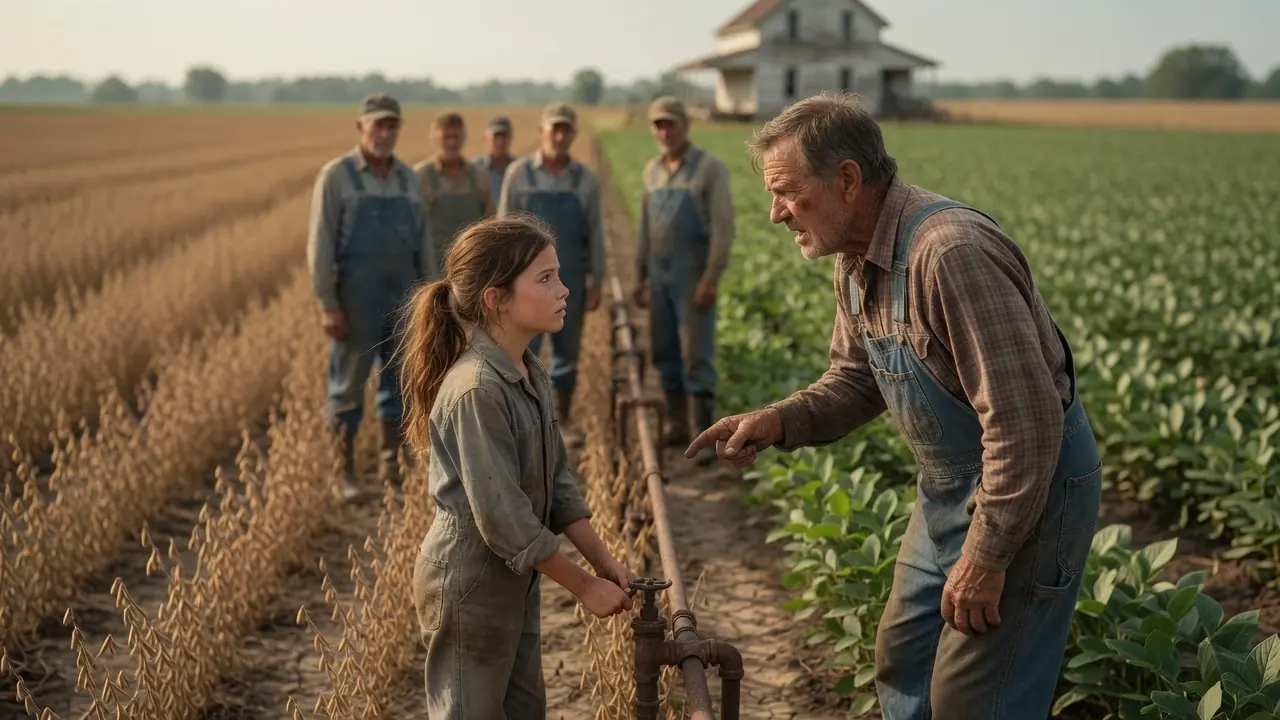
She wore a faded gray cotton dress with the sleeves rolled above her elbows, brown work boots several sizes too large, and a loose ponytail that came apart whenever the wind crossed the fields. Her hands were small, but they were already rough from opening stubborn valves, carrying feed buckets, and helping her father repair fences. Each morning, before the heat became dangerous, she loaded a wooden wagon and followed the farm road from one property to the next. By noon, the wagon usually held another piece of what everyone else considered trash.
The Pruitt farm covered ninety-two acres outside the small town of Briar Glen. Della’s grandfather had grown cotton there, her father had switched most of the land to soybeans, and the family had survived more difficult seasons than anyone cared to count. Yet the summer drought of 1954 felt different from every hardship before it. The sky remained painfully blue while the earth cracked beneath the crops.
Della’s father, Samuel Pruitt, woke before dawn to move irrigation lines across the fields. Their old pump pulled water from a shallow well near the barn, but the well level dropped each week. The metal sprinklers threw wide silver arcs over the soybeans, and much of the water disappeared into the hot air before reaching the plants. Whatever struck the hard ground often ran downhill instead of sinking toward the roots.
Samuel knew the system was wasteful, but replacing it would cost more money than the farm possessed. The bank had already extended one loan for seed and another for fuel. A third request had been refused after the manager examined the damaged crop and called the Pruitts a dangerous investment. If the soybeans failed, Samuel would have no way to make the autumn payment.
Della heard the conversation from the kitchen doorway. Her mother, Lillian, sat beside the account book while Samuel stared through the window at the dry fields. Neither noticed the girl listening until Samuel said they might have to sell the eastern pasture before winter. That pasture contained the pear tree where Della’s grandfather had taught her to read weather from clouds.
She went outside without asking questions.
Near the edge of the southern field, one sprinkler pipe had developed a hairline crack. Samuel had wrapped it with cloth and wire, but a thin stream continued escaping close to the ground. Around that leak, the soil remained dark several hours after the rest of the field dried. Three soybean plants beside it stood greener and taller than everything surrounding them.
Della knelt and pressed two fingers into the earth.
The surface appeared nearly dry, but moisture remained beneath it. Water from the crack did not fly into the wind or strike the soil hard enough to run away. It escaped slowly, gathering around the roots one drop at a time. Della stayed there until the answer began taking shape in her mind.
That evening, she asked her father why farmers sprayed water above the plants instead of placing it beneath them. Samuel said irrigation had always worked that way because moving lines across the field was faster than watering individual rows. He explained pressure, pipe length, elevation, and how difficult it was to control flow across uneven ground. Della listened until he assumed her curiosity had ended.
It had only begun.
The Briar Glen library occupied two rooms behind the post office. Its shelves contained schoolbooks, newspapers, agricultural magazines, and several government pamphlets no one had opened in years. Della found articles about gravity-fed irrigation, orchard pipes, buried clay channels, and experiments that delivered water near plant roots. Most diagrams described expensive equipment designed for wealthy farms.
She copied them anyway.
Her notebook filled with sketches of pipes running parallel to crop rows. She calculated how many openings would be required and marked where water might move too quickly downhill. She did not fully understand pressure, but she understood that water followed gravity and escaped wherever it found weakness. The discarded pipes already possessed plenty of weaknesses.
The first pile belonged to Wade Mercer.
Wade was sixty-four and owned the largest soybean operation in the county. He had a broad body, short gray hair, and the habit of speaking as though years of experience made disagreement disrespectful. When Della asked whether she could take the cracked pipes behind his equipment shed, he looked at her mud-stained dress and laughed.
“What are you building, little girl?”
“An irrigation system.”
“With those?”
“Yes, sir.”
Wade called two farmhands over so they could enjoy the answer. One said she might be constructing the world’s ugliest flute, while the other suggested the pipes would make excellent homes for snakes. Wade finally waved toward the pile and told her to take everything she could carry. Della thanked him politely.
Her wagon returned home so heavily loaded that one wheel cracked near the gate.
Samuel found her repairing it with a piece of wire. Behind her lay twelve metal pipe sections, seven cracked connectors, and a coil of damaged rubber hose. He rubbed both hands over his tired face and asked where she had obtained them. Della explained the idea quickly.
“No,” he said.
She stared at him. “You haven’t seen the plan.”
“I’ve seen broken pipe.”
“It can carry water.”
“It leaks.”
“That’s why I need it.”
Samuel looked toward the field. “Della, I don’t have time to help with a child’s experiment.”
The words hurt because he did not say them cruelly. He sounded exhausted, which made his refusal feel more final. Della lowered her eyes and promised she would not interfere with the working equipment. Samuel told her to keep the scrap behind the barn and remain away from the pump.
She obeyed half the instruction.
Behind the barn, Della sorted the pipe by length and diameter. Some metal sections were rusted through, while others had only small holes. The plastic pieces bent easily but cracked near the connectors. She filled each section using buckets and watched where water emerged.
Large breaks emptied too quickly. Tiny punctures produced steady drops. Della marked usable sections with white chalk and placed the others in a separate pile. She then arranged them beside three rows of beans she had planted herself near the chicken coop.
Her first system failed immediately.
The sections did not fit together securely, so water burst from every joint and flooded the nearest plants. One pipe rolled downhill, struck the fence, and sprayed muddy water across Della’s dress. Her younger brother, Ben, laughed until he saw her expression.
Della spent the afternoon taking the system apart.
The failure taught her that the holes were not the greatest problem. Connections determined whether water reached the end of the line. She cut narrow strips from an old tire tube, wrapped them around the joints, and tightened wire over the rubber. The second attempt held longer but still lost most of its water before reaching the final row.
Ben stopped laughing and began watching.
He was eight, skinny, sunburned, and incapable of remaining silent for more than two minutes. He held connectors while Della wrapped them and crawled beneath the pipes to locate hidden leaks. In exchange, she allowed him to turn the main valve during tests. He treated the responsibility like command of a battleship.
The third attempt carried water through four connected sections.
Drops emerged beside most of the test plants, but the downhill section received far more than the upper row. Della adjusted the openings by wrapping cloth around some and widening others with a nail. She tested again, waited, and measured how far moisture traveled beneath the surface. By sunset, every plant had damp soil near its roots.
The system was ugly.
It was also working.
For two weeks, Della watered the test rows using one bucket each morning. She placed mulch over the pipes to reduce heat and marked water depth with narrow wooden sticks. The nearby control row received the same amount through ordinary surface watering. After ten days, the difference became visible.
Plants beside the pipe system stood taller and darker. Their leaves remained open through the hottest part of the afternoon, while the control plants curled inward. When Della dug carefully beside one stem, she found moisture several inches below ground. The surface-watered row had already dried.
She showed Samuel after supper.
He walked behind the barn reluctantly, expecting another collection of broken farm equipment. Instead, he found six healthy soybean plants beside six struggling ones. Della explained the amount of water each row had received and showed him the notebook containing every measurement.
Samuel crouched beside the green plants. “Both rows received one bucket?”
“Yes.”
“Every day?”
“Yes.”
“How much water escaped the joints?”
“Less after I used the tire strips.”
He removed his hat. “Show me the whole system.”
The following morning, father and daughter tested a longer line. Samuel taught Della how to calculate the drop in elevation and how pressure changed with pipe diameter. He found short sleeves that could fit inside mismatched sections, while Della showed him where the smallest leaks should remain. Together, they constructed a line extending across twenty soybean plants.
Samuel still refused to risk the entire field.
He allowed her one experimental row near the south fence.
That was enough.
News traveled quickly through Briar Glen. Farmers heard that Samuel Pruitt had handed part of his dying crop to an eleven-year-old girl with a pile of rusty pipe. Wade Mercer arrived first, followed by several men who had donated scrap. They stood near the fence watching Della position the final connector.
Wade shook his head. “You stole our scrap because you think a little girl can outsmart every farmer in this county?”
Della gripped the valve. “You threw away the answer because none of you bothered to look twice.”
Several men laughed.
Wade stepped over the pipe and pointed toward the pump. “Your father’s well is nearly dry. Turn this on, and that useless toy will drain what little he has left.”
“The row uses less water than one sprinkler section.”
“You don’t know that.”
“I measured it.”
Wade reached down to disconnect the pipe. “I’ll rip it out before you ruin his field.”
Della slapped his hand away.
The sound silenced every farmer.
“Touch it,” she said, “and watch my green rows prove your whole county wrong.”
Samuel stepped beside his daughter. Wade looked toward him, expecting an apology or correction. Samuel folded his arms and nodded toward the valve.
“Let her show you.”
Della opened it slowly.
No dramatic spray appeared. Water traveled through the pipe quietly, almost invisibly. Wade laughed again and declared nothing was happening. Della waited five minutes, then moved the mulch beside the final plant and pressed her fingers into the soil.
The earth beneath it was dark and cool.
She repeated the demonstration at the middle and upper sections. Moisture had reached every root zone while the ground between rows remained dry. Samuel checked the pump meter and announced that the line used less than half the water required by their sprinkler.
Wade’s smile disappeared.
“One row proves nothing,” he said.
Della closed the valve. “Then come back in two weeks.”
The drought worsened.
Temperatures rose above one hundred degrees for six consecutive days, and hot wind crossed the county without mercy. Ponds shrank into mud, wells deepened, and several farmers stopped watering weaker fields to protect their cattle. Soybean leaves turned pale across Briar Glen.
Della’s experimental row remained green.
Samuel extended the system to five rows, then ten. Every section required individual adjustment because the discarded pipes differed in size and condition. Della walked the lines each morning, sealing large leaks and clearing blocked openings with a thin wire.
Lillian joined the work after her hospital shifts. Ben carried tools and treated every successful connection like a personal victory. Even Della’s grandmother, who lived in town, arrived with strips cut from old rubber boots. The Pruitts transformed a pile of broken material into a family project.
By mid-July, twenty rows were connected.
The family’s water use dropped enough to keep the well stable. Plants watered near their roots developed stronger stems and fuller pods. Fields beyond the system continued failing, but the protected section looked like a green river flowing through brown land.
Farmers began stopping along the road.
At first, they remained in their trucks. Later, they walked the rows, lifted mulch, and asked Samuel technical questions. He answered most of them by pointing toward Della.
“She designed it.”
Some men still struggled to accept that.
They asked whether Samuel had secretly built the system and allowed his daughter to receive attention. Others claimed the healthy beans came from better seed or richer soil. Della responded by showing records, water measurements, and side-by-side rows planted on the same day.
Evidence was harder to mock than a child.
Wade Mercer returned during the final week of July. His western well had dropped below pumping level, and nearly forty acres of his soybeans were dying. He walked the Pruitt field without speaking, examining every connector and opening.
“How many pipes would I need for ten acres?” he finally asked.
Della looked at him. “Are you asking the little girl who built a useless toy?”
Wade removed his hat.
“I was wrong,” he said.
It was not an easy apology, and perhaps not a complete one, but Della accepted it. She calculated the approximate pipe length and warned that his steeper land would require separate pressure zones. Wade asked whether she would visit his farm.
“My work isn’t free,” Della replied.
Samuel turned away to hide a smile.
Wade offered ten dollars, more money than Della had ever earned at once. She agreed on the condition that he provide transportation and allow Ben to come as her assistant. Wade accepted both terms.
At Mercer Farm, Della discovered a different problem. The field sloped sharply toward a creek, causing lower pipes to receive too much water. She divided the system into three sections and used small raised barrels to control gravity flow. Several connections failed before the pattern worked.
Wade did not laugh during the failures.
He held the pipe while Della rebuilt each joint.
Within twelve days, his test rows began recovering. They would not produce a full harvest, but they remained alive while neighboring plants collapsed. Wade paid Della the promised ten dollars and added five more without mentioning it.
After that, requests arrived daily.
Mrs. Carver needed help with tomatoes. The Jenkins brothers wanted a system for their vegetable plot. Louis Benton offered fifty discarded pipe sections if Della would show him how to repair connectors. The same farmers who had mocked her now waited beside the Pruitt barn holding notebooks.
Della did not pretend one design fit every farm.
She studied slope, crop spacing, well strength, and soil type before making recommendations. Some properties required plastic hose instead of metal. Others needed shorter sections or filters to prevent mud from blocking the openings. Every new field taught her something.
Dr. Alice Monroe from the state agricultural extension office visited Briar Glen after hearing about the strange green rows. She arrived expecting a simple child’s project exaggerated by desperate farmers. After reviewing Della’s notebook, she spent two full days measuring flow and soil moisture.
“This is a form of low-pressure root irrigation,” Alice explained. “Similar ideas are being tested elsewhere, but Della adapted it using materials available here.”
“Did I invent it?” Della asked.
“You discovered it for yourself and made it work under local conditions. That matters.”
Alice helped improve the system without taking it away from her. She suggested simple filters made from cloth and gravel, taught Della to calculate flow more accurately, and showed farmers how to avoid overwatering. She also warned that rusty metal might not remain safe indefinitely for every crop, so newer systems should use suitable tubing when money became available.
Della listened carefully.
She had never wanted to prove broken pipe was perfect. She wanted to prove discarded materials could reveal a better way.
Harvest arrived under a cloudless September sky.
The Pruitt farm did not produce its usual yield, but the irrigated rows created enough soybeans to cover the bank payment and purchase seed for the following year. Fields outside the system produced little. Without Della’s work, Samuel would have lost the eastern pasture and possibly the entire farm.
Wade Mercer’s test rows also survived.
So did vegetables on eleven smaller properties.
At the county agricultural meeting, the same men who once laughed at Della stood while Alice Monroe presented the water-use records. Root-level irrigation had saved between forty and sixty percent of the water used by their old sprinklers. The results varied, but no one could deny the pattern.
The county created a cooperative fund to purchase proper tubing, connectors, and filters. Farmers donated labor, while the extension office supplied guidance. Della was invited to help design the first coordinated system covering more than one hundred acres.
She remained eleven years old.
That meant she still disliked washing dishes, argued with Ben, forgot her schoolbooks, and sometimes climbed the pear tree when she wanted to avoid conversation. Yet each morning, grown farmers arrived at the Pruitt gate asking what she thought. Her father never answered for her.
A newspaper reporter from Little Rock came to write about the irrigation project. He asked Della how it felt to prove the county wrong.
“I wasn’t trying to prove them wrong,” she said.
“What were you trying to do?”
“Save the beans.”
The reporter laughed, but Della did not.
She understood that revenge might satisfy a wounded person for one afternoon. A working system could keep farms alive for years. The men’s embarrassment mattered far less than the water remaining inside the county’s wells.
The following spring brought better rain.
Some farmers abandoned the root-irrigation project because the emergency had passed. Others remembered what drought revealed and continued building. Wade became one of its strongest supporters, donating part of his equipment shed as a workshop for repairing and storing pipe.
He placed a wooden sign above the door:
DELLA PRUITT WATER PROJECT
When Della saw it, she told him the letters were crooked.
“They’re handmade,” Wade replied.
“So is my irrigation, but mine is straighter.”
He laughed, this time with her rather than at her.
Over the next several years, Briar Glen farms adopted improved versions of the system. Proper hoses replaced rusted pipe, pressure regulators replaced raised barrels, and filters became more reliable. Yet every new installation could trace its beginning to the pile behind the Pruitt barn.
Della eventually studied agricultural engineering.
She returned home during school breaks and worked with farmers to improve water conservation across the region. Samuel expanded the soybean operation without selling the eastern pasture, and Ben became unusually skilled at repairing pumps after years as his sister’s assistant.
People later described the drought as the year an eleven-year-old girl changed the county.
Della always corrected them.
“The drought changed the county,” she said. “I just noticed where the water was going.”
Years after the original system had been removed, one rusty section remained beside the Pruitt farmhouse. Samuel wanted to throw it away, but Della refused. She mounted it above the barn door where visitors could see the tiny openings punched along its length.
The pipe was cracked, stained, and useless by every standard the county once trusted.
That was precisely why she kept it.
Everyone had looked at the broken irrigation pipes and seen the end of their usefulness. Della saw openings through which water might still reach something living.
The veteran farmers laughed when a little girl collected their scraps.
By the time the drought ended, they were building the future of their farms from the lesson she found inside them.